
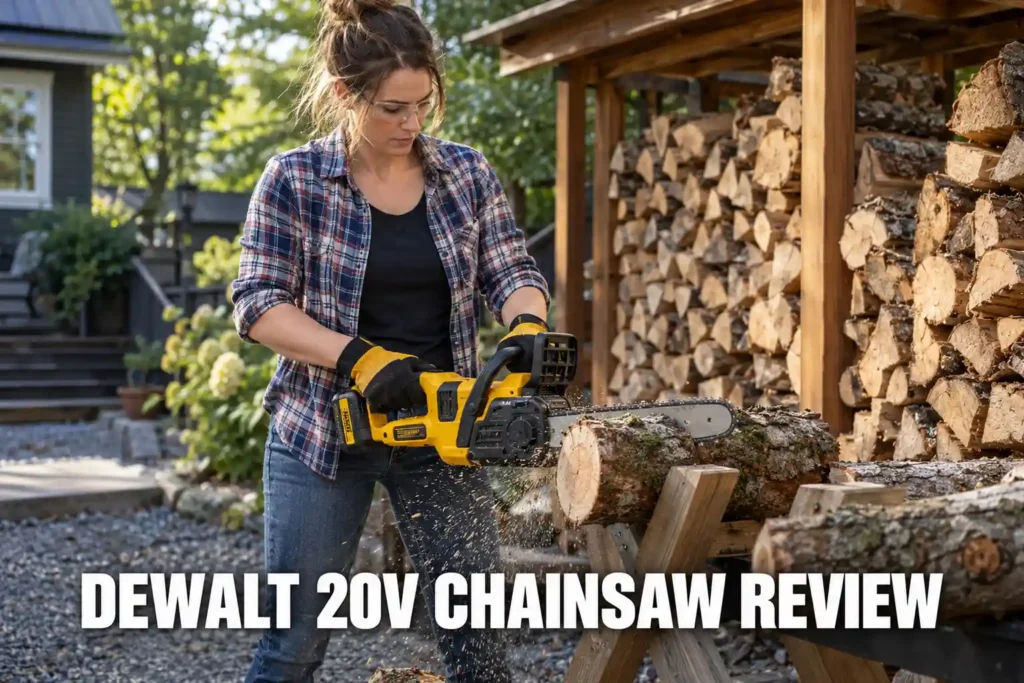

In my DeWalt 20V chainsaw review, the DCCS621P1 earns a clear buy for limbs and logs up to 10 inches, and a firm skip for anything bigger. It is a compact 12-inch battery saw, and I used it on the cut wood and fallen branches around the orchard and the yard. Buy it if you already own DeWalt 20V MAX batteries and want one saw for small jobs. Below I cover the specs, the brake check, the oil and chain routine, and who should pick a different saw.
DeWalt 20V Chainsaw Review: The Quick Verdict
The DCCS621P1 is a brushless 12-inch saw made for pruning and small logs. According to DeWalt’s manual, it is “ideal for pruning applications and cutting logs up to 10″ (254 mm) in diameter,” so the bar is longer than the wood the maker wants it to cut. Inside that limit it is quick to ready and easy to carry between cuts. Past it, you need a bigger saw. My ranking of lightweight chainsaws covers seven compact saws for limbs and small logs.
- Who it is for: owners of DeWalt 20V MAX tools who cut limbs, storm-broken branches and small logs, and who get training first.
- What it does best: limb and small-log work, with a hand-guard chain brake, an automatic oiler and a brushless motor.
- Main trade-off: a 10-inch log limit and no published runtime, so it is not a firewood or felling saw. For firewood cutting, I compare seven saws for bucking logs in my chainsaw for firewood picks.

DeWalt DCCS621P1 Specs at a Glance
Two rows decide this purchase: the bar length set against the 10-inch log limit, and the battery in the box. The DeWalt 20V chainsaw kit comes with one DCB205 5Ah battery, and the 20V MAX platform runs the saw.
| Spec | DCCS621P1 |
|---|---|
| Saw Type | Rear-handle battery chainsaw, compact |
| Power Source | 20V MAX (18V nominal), brushless motor, one DCB205 5Ah battery in the kit |
| Bar Length | 12 in called length; DeWalt’s log limit is 10 in |
| Chain Speed, manual figure | Under 20 m/s |
| Chain Brake | Front hand guard |
| Chain Tensioning | Supplied wrench, not tool-free |
| Oiler | Automatic, with an oil level indicator |
| Warranty, DeWalt | 3-year limited, 1-year free service, 90-day satisfaction guarantee |
This is a DeWalt 20V chainsaw with battery and charger included, plus the tensioning wrench and a bar sheath. My comparison of DeWalt and CRAFTSMAN chainsaws sets the DCCS621P1 and CMCCS620M1 kits side by side.
How It Performs on Limbs and Small Logs
The DCCS621P1’s 12-inch bar is built for short cuts in thin wood, and that is where I used it. My jobs were bucking wood already on the ground and limbing a downed branch at waist height, never felling.
The 10-Inch Log Limit in Real Cuts
The 12 inches is the bar’s called length, not a promise about the wood. DeWalt states the log limit as 10 inches. On the thick pruning limbs where my hand saw turns into a long job, the DCCS621P1 is the better tool, and it stays inside that limit. I set the bumper spike into the wood first, then let the chain do the cutting.

Force Cut-Out and the Brake Test
DeWalt’s manual says that if too much force is applied in a cut the saw turns off, and you must release the trigger before it restarts. I met that when I leaned on the saw in dense stone-fruit wood; easing off and letting the chain pull itself in fixed it. Lean on the saw and it stops.
Before the first cut I test the chain brake on firm ground with the chain clear of the ground. I push the front hand guard forward with the back of my left hand, and the chain stops immediately, as the manual says it should. The brake caught earlier than I expected when my wrist rolled. DeWalt tells you to test it before every use, and the manual’s method is the one to follow.
Kickback, Grip and Height
Laboratory kickback tests on gas saws found that proper chain tension, anti-kickback chain links, sliding-end guide bars and a quick chain brake influence kickback (1). DeWalt’s manual says its low-kickback bar and chain do not totally eliminate kickback.
Kickback, Grip and Height
If the upper part of the bar tip touches wood or another object, the bar can kick back up and toward you (rotational kickback). Wood pinching the chain on the top of the bar pushes the saw straight back at you (pushback), and wood pinching the bottom pulls it forward, away from you (pull-in). A low-kickback chain, a chain brake and a correct grip reduce these risks; none removes them. Hold the saw with both hands, right hand on the rear handle and left hand on the front handle, thumbs and fingers wrapped around the handles, with your body to the left of the chain line and firm footing. Never cut at or above shoulder height, and never cut from a ladder or a roof. DeWalt’s manual sets a stricter limit for this saw: do not cut above chest height.
Before each use, inspect the saw as its manual describes: test the chain brake by the manual’s method, and check the throttle trigger lockout, the stop switch, the chain catcher, the guards and the chain’s sharpness, tension and condition. If any check fails, do not use the saw until it is repaired, and never disable a safety device.
Protective Gear
Wear impact-rated safety glasses with side protection marked Z87+ (a mesh face screen adds to them but never replaces them), hearing protection, chainsaw chaps or chainsaw trousers used within their maker’s stated limits (some are not designed to stop a battery or corded saw’s chain, and no clothing guarantees protection), work gloves and sturdy boots with ankle support, plus a hard hat when you fell a tree or anything can fall from above.
In a hospital series of chainsaw leg injuries, the left foot was hurt most often, usually because it sat in the path of the saw (2). In an Irish survey of 62 domestic chainsaw accidents, only 3% of the injured users wore any protective gear (3). I stand with my feet well clear of the bar line, and I wear the gear every time.
Living With It: Oil, Chain and Battery
In this kit the DeWalt 20V chainsaw battery is the same 20V MAX family as DeWalt’s other 20V MAX tools, so one pack can serve several tools. The rest of the routine is oil, chain tension and a battery that comes out before any adjustment.
Oil and the Orchard
The manual’s rule for DeWalt 20V chainsaw oil is a high-quality biodegradable bar and chain oil, and a vegetable-based oil when you prune trees, because mineral oils may harm living trees. I cut on a hard pad, not over the drip lines, so the oil stays off the soil near the roots. The oiler is automatic with an oil level indicator. To refill, release the trigger, set the chain brake, wait until the chain has stopped and take the battery out first. Refill when the tank is less than a quarter full, and never run the saw without oil.
When I finish cutting I empty the oil tank, as the manual says, and I store the saw on its side on a stable surface so it is not a tripping hazard. Battery out, brake set, sheath on.
Chain Tension and Parts
A new chain stretches during the first few hours, so DeWalt says to check the tension often in the first two. Before you check or adjust the tension, release the trigger, set the chain brake, wait until the chain has stopped, take the battery out and put on gloves. The chain is right when it snaps back after you pull it 1/8 inch (3 mm) from the bar with light finger force. After my first cuts I took the battery out and found the chain needed a small turn of the tension screw. Loosen the bar lock nut one full turn, turn the screw with the supplied wrench, and tighten the nut to 6 ft. lbs.
Order a replacement chain or bar by the part numbers in the manual: DWO1DT612 for the chain and DWZCSB12 for the bar. Replacement chains and bars must be of the pitch, gauge and drive link count the manual approves, and a low-kickback chain stays on a homeowner saw.
Maintenance, Carrying and Storage
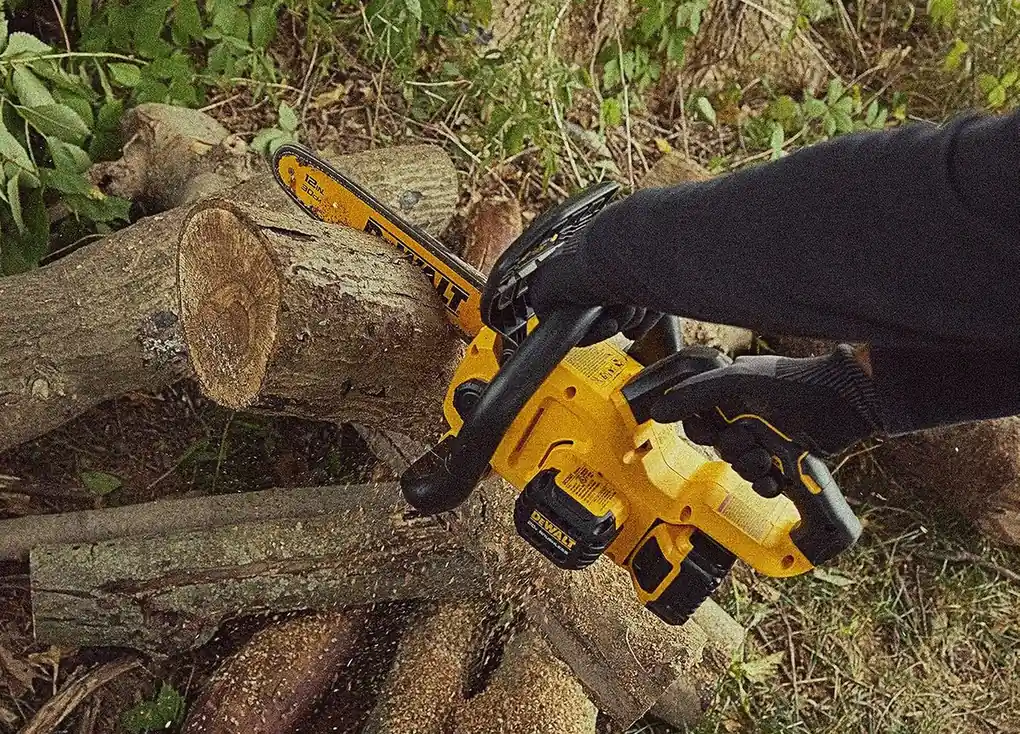
To touch the chain, adjust the tension, clear a jam, sharpen or change the bar or chain, release the trigger, set the chain brake and wait until the chain has stopped, then take the battery out. Put on gloves before touching the chain. Release the chain brake only when the exact manual’s procedure requires it, and never force a locked chain or cover.
To carry the saw, stop it as above, take the battery out, keep the chain brake engaged, point the bar behind you and put the bar cover on. Carrying it down the orchard strip like this, I never wanted to stop and set it down. DeWalt says to charge the battery between 40 F and 104 F, and not to store the tool or battery where it can reach 104 F or more.
Noise and Exhaust
A battery saw has no exhaust, and NIOSH sampling of landscaping workers found significantly more noise and carbon monoxide exposure with fuel-powered chainsaws, leaf blowers and string trimmers than with battery versions (4). It is still loud, and DeWalt’s manual warns that its noise may contribute to hearing loss. In a 12-month field test, one model of helmet-mounted earmuff kept chainsaw noise at the ear around 79 dB(A), below the 85 dB(A) criterion (5). I wear my earmuffs from the first cut.
Who Should Buy the DCCS621P1 and Who Should Skip It
Match the saw to the job before you buy. Power-saw injuries in US emergency department data from 2006 to 2016 about half involved the fingers and hand, and most happened at home (6). The first buyer rule is training, not the saw. For a first saw, my chainsaw picks for beginners all carry a chain brake.
Buy It If
- You already own DeWalt 20V MAX batteries and want a saw for pruning limbs and cutting small logs.
- You cut wood already on the ground, at or below chest height, in short jobs.
- You will get hands-on training and read the manual first. The manual calls it “a professional power tool” and requires supervision when inexperienced operators use it.
- You want a battery saw with a front hand guard brake and an automatic oiler. My chainsaw picks for homeowners all carry a chain brake as well.
Skip It If
- Your logs are thicker than 10 inches. DeWalt’s limit stops there.
- You want a published runtime. DeWalt gives no cuts-per-charge figure for this saw.
- You want tool-free chain adjustment. This saw needs its wrench.
- You plan to fell trees. The manual says felling should be done only by a trained person.
The tool-only DCCS621B is the same saw without the battery, so it suits someone who already has a 20V MAX battery and charger. Felling is the most dangerous chainsaw job. Never work alone, keep everyone at least two tree lengths away, and plan and clear two escape routes angled back from the direction of fall before any felling cut. A large, leaning, dead or hung-up tree, or a trunk or limb under tension after a storm, is a job for a certified arborist.
Drawbacks
The trade-offs are plain, and each one has a workaround.
- 10-inch log limit: the 12-inch bar tempts you to bigger wood. Keep to DeWalt’s limit, and buy a longer saw for thicker logs.
- No published runtime: DeWalt gives no minutes or cuts per charge. A second 20V MAX battery is a sensible buy if you cut in longer sessions.
- Wrench tensioning: the wrench is small and stores in a slot on the underside, so keep it with the saw.
- Not for wet work: the manual says do not use the saw under wet conditions. Cut in dry weather, and keep the battery dry.
In a rural series of 185 chainsaw patients, arm injuries cost more lost work time than leg injuries, 75 days against 60 (7). The manual asks for both hands on the saw and for full protective gear.
How It Compares With Other Battery Saws
Three roundup saws are the closest alternatives, and each answers a different need.
| Saw | Bar | Battery in kit | Tensioning | Chain brake |
|---|---|---|---|---|
| DeWalt DCCS621P1 | 12 in | 20V MAX, 5Ah | Wrench | Front hand guard |
| DeWalt DCCS623L1 | 8 in | 20V MAX, 3Ah | Wrench | None described |
| Greenworks CS40B210 | 12 in | 40V, 2.0Ah | Tool-free knob | Front handle guard |
| EGO CS1613 | 16 in | 56V, 4.0Ah | Tool-free knob | Hand-operated brake handle |
DeWalt DCCS623L1 8-Inch Pruning Saw
The DeWalt 20V MAX 8-Inch Brushless Pruning Chainsaw Kit DCCS623L1 is the smaller saw on the same 20V MAX platform, a pruner with an 8-inch bar. The manual rates it for pruning up to 6 inches in diameter and describes no chain brake. Pick it if your work is thin branches, and follow its own manual. Choose the DCCS621P1 if you cut logs up to 10 inches. Anyone shopping for a DeWalt 20V pruning chainsaw should compare both manuals, and my review of DeWalt’s pruning chainsaw goes through the smaller saw.
Greenworks CS40B210 12-Inch Saw
The Greenworks CS40B210 40V 12-Inch Cordless Chainsaw Kit has the same 12-inch bar on a different 40V battery platform, with tool-free tensioning by a knob. Pick it if you have no DeWalt batteries and want to adjust the chain without a wrench. Choose the DCCS621P1 if you already own the 20V MAX packs. I go through that saw in my Greenworks 12-inch chainsaw review.
EGO CS1613 16-Inch Saw
The EGO Power+ CS1613 16-Inch 56V Chainsaw Kit has a 16-inch bar, a 56V battery and tool-free tensioning, and EGO lists its intended use as basic felling, limbing, pruning and woodcutting. Pick it if your logs run past 10 inches. Choose the DCCS621P1 if limbs and small logs are your whole list. My review of the EGO CS1613 covers the 16-inch kit for limbing and cutting logs.
Common Problems and How to Prevent Them
Two symptoms need a clear response, and both come straight from the manual.
- Dull chain: if you must push the saw to cut, or the chips come out fine and dust-like, it is time to sharpen, according to UGA Extension. If you are unsure how, Clemson says to have the chain sharpened professionally.
- Overload stop: the manual says the saw turns off when too much force is applied in a cut. Ease the pressure, release the trigger and squeeze it again. If it stops for any other reason, or the chain jams, stop the saw, set the brake, wait for the chain to stop and take the battery out before you inspect it.
My Final Verdict on the DeWalt DCCS621P1
I recommend the DCCS621P1 to anyone who needs a compact battery saw for pruning limbs and cutting logs within DeWalt’s 10-inch limit, especially an owner of 20V MAX batteries. Skip it for thicker wood, for felling, and for a buyer who wants a published runtime. Get training, test the brake before every cut and keep the oil topped up. That is where my DeWalt 20V chainsaw review lands: a clear yes for small cutting jobs and a no for the big ones. My ranking of battery chainsaws puts nine cordless saws side by side.
Frequently Asked Questions
What is the blade size for a 20V DeWalt saw?
The DCCS621P1 20V DeWalt saw has a 12 inch bar, which is the part many people call the blade. According to DeWalt’s manual, the saw is ideal for pruning and for cutting logs up to 10 inches in diameter, and the replacement bar for it is the DeWalt part DWZCSB12.
Is the DeWalt 12 inch chainsaw any good?
The DeWalt 12 inch chainsaw is a good saw for pruning and small logs when you match it to that job. DeWalt rates it for logs up to 10 inches, and its manual calls it a professional power tool that needs supervision for inexperienced operators, so get training first and keep it off big wood.
Does DeWalt make a mini chainsaw?
DeWalt makes a mini chainsaw in the DCCS623, an 8 inch brushless pruning saw on the same 20V MAX platform as the DCCS621P1. According to DeWalt’s manual, it is rated for pruning applications up to 6 inches in diameter, and the L1 kit comes with a 3.0Ah battery and a charger.
What size chainsaw should a homeowner buy?
A homeowner should buy a bar sized to the biggest wood they cut, and NC State Extension says most household jobs rarely need more than 16 inches. A 12 inch saw like the DCCS621P1 suits limbs and small logs, while frequent thick logs call for a 16 to 20 inch saw, per Alabama Extension.
Is DeWalt power tools any good?
DeWalt power tools are a sound choice when the tool matches the job, and the DCCS621P1 is a good example for limb and small-log work. DeWalt backs the saw with a 3-year limited warranty, 1 year of free service and a 90-day satisfaction guarantee, and it runs on the 20V MAX battery family.
References
- Dąbrowski A. Reducing kickback of portable combustion chain saws and related injury risks: laboratory tests and deductions. Int J Occup Saf Ergon. 2012;18(3):399-417.
- Gemci Ç, Imerci A, Aydogan NH. Lower extremity injuries due to chainsaw during four-year periods. Cureus. 2023;15(8):e44058.
- Doyle YG, Conroy RM. Prevention of timber felling and chainsaw-related accidents in the Republic of Ireland. Accid Anal Prev. 1989;21(6):529-534.
- Alexander BM, Graydon PS, Pena M, Feng HA, Beamer BR. Hazardous exposures and engineering controls in the landscaping services industry. Journal of Occupational and Environmental Hygiene. 2025;22(3):189-202.
- Kirk P. Earmuff effectiveness against chainsaw noise over a 12-month period. Appl Ergon. 1993;24(4):279-283.
- Sritharen Y, Hernandez MC, Zielinski MD, Aho JM. Weekend woodsmen: overview and comparison of injury patterns associated with power saw and axe utilization in the United States. Am J Emerg Med. 2018;36(5):846-850.
- Özdeş HU, Ergen E, Köroğlu M, et al. Chainsaw-related extremity injuries. Medicina (Kaunas). 2025;61(4):759.
Safety Note: Read your saw’s manual first and get hands-on training before your first cut. A chainsaw can react faster than you can: if the upper part of the bar tip touches wood or another object, the bar can kick back up and toward you; wood pinching the top of the chain can push the saw straight back at you, and wood pinching the bottom can pull it forward. Keep the bar tip out of contact and watch for wood closing on the bar. A low-kickback chain and a chain brake reduce these risks but never remove them. Before each use, inspect the saw as your manual describes: test the chain brake, and check the throttle lockout, the stop switch, the chain catcher, the guards and the chain. On a gas saw the chain must not move at idle. If any check fails or a part is missing or damaged, do not use the saw until it is repaired, and never disable a safety device. Wear impact-rated safety glasses with side protection marked Z87+ (a mesh face screen adds to them but does not replace them), hearing protection, chainsaw chaps or chainsaw trousers, work gloves and sturdy boots with ankle support, and a hard hat when you fell a tree or when anything can fall from above. Use leg protection within its maker’s stated limits: some chaps are not designed to stop the chain of a battery or corded saw, and no clothing guarantees protection. Hold the saw with both hands, right hand on the rear handle and left hand on the front handle, thumbs and fingers wrapped around the handles, and keep your body to the left of the chain line with firm footing. Never cut one-handed with a rear-handle saw, never cut at or above shoulder height, and never cut from a ladder or a roof. Top-handle saws are made for trained tree workers: follow that saw’s manual. Keep children, bystanders and pets well away while you cut. Never work alone. Start a gas saw with the chain brake engaged, on the ground or held firmly as the manual shows, never by drop-starting it, and at least 10 feet from where you fuelled it. Refuel outdoors with the engine off and cool, with no smoking, flames or sparks nearby, wipe up spills, and use only the fuel mix and ethanol content your manual allows. Exhaust contains carbon monoxide, which can kill: never run a gas saw indoors or in a garage, shed or other enclosed space. Before you touch the chain, clear a jam, adjust the tension or sharpen: release the trigger, engage the chain brake, stop the engine or motor and wait until the chain has stopped. Then, on a gas saw, let the engine and muffler cool and pull the spark plug cap off; on a battery saw, take the battery out; on a corded saw, unplug it by the plug. Put on gloves before you touch the chain, and release the chain brake only when your manual’s procedure calls for it. To carry the saw, stop it, take out the battery or unplug it, keep the chain brake engaged and the bar pointing behind you, and fit the bar cover for transport. Use a corded saw only with an outdoor-rated extension cord of the gauge your manual gives, plugged into GFCI-protected power. Never use it in rain or wet conditions: GFCI protection does not make that safe. Keep the cord away from the chain. Use only the chains and bars your manual approves. Felling trees is the most dangerous chainsaw job. Before any felling cut, keep everyone at least two tree lengths away, and plan and clear two escape routes angled back from the direction of fall; when the tree starts to fall, follow your manual’s retreat steps (release the trigger, stop the saw and set it down as it describes) and move away along that route; never delay escape to cool, unplug or cover the saw. A large, leaning, dead or hung-up tree, a trunk or limb under tension after a storm, and any tree near a house or a road are jobs for a certified arborist. Power lines are a separate danger: treat every downed line, and anything touching it, as live, stay well away and call the utility; before any work near a power line, contact the utility and leave that work to its qualified line-clearance crews. Stop when you are tired, and take breaks if your hands tingle or go numb.