

This DeWalt 60V edger review comes down to one call: buy the DCED472X1 kit if you want an edger that shares its powerhead and battery with other DeWalt tools, and skip it if you need the weight and run time on paper before you pay a premium. I edge the concrete work pad, the path to the house door and the borders of the tilled strips under my plum trees, and a vertical blade makes a clean line on all three. Below I cover depth, the guide, the battery, the blade and who should pass.
DeWalt 60V Edger Review and Short Verdict
I recommend the DeWalt DCED472X1 60V MAX Cordless Edger Kit for owners who edge along paved borders and want one battery system for more than edging. According to DeWalt, it has a 7-1/2 in hardened steel blade, a depth of up to 2-1/2 in and a brushless motor, and the kit includes a FLEXVOLT battery and charger. The manual sets 1 in as the depth for edging, so the deep setting is for trench work. For other options along paved borders, I compare seven lawn edgers for sidewalk edges.
- Who it is for: homeowners and small-farm owners with paved edges, garden beds and other DeWalt 60V MAX or 20V MAX tools.
- What it does best: it holds a straight line along a slab edge with its edge guide and large front guide wheel.
- Main trade-off: DeWalt publishes no weight, run time or noise figure, and the kit sits in the premium price tier.
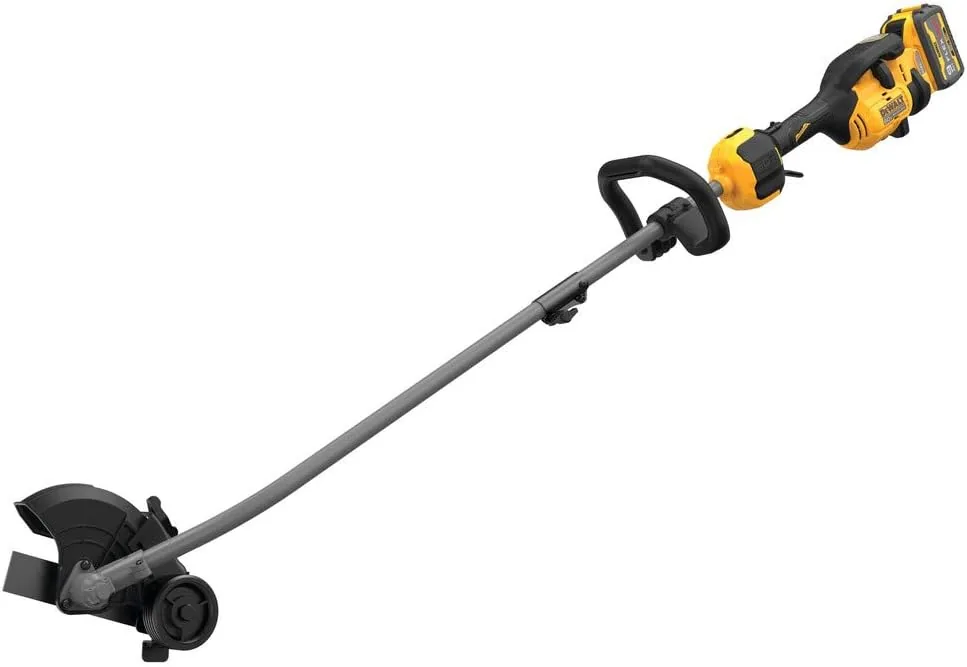
DeWalt DCED472X1 Specs That Matter
Two rows decide the fit: the cut depth, because the maker’s edging depth is far below the maximum, and the rows DeWalt leaves blank.
| Spec | Figure |
|---|---|
| Edger type | Stick edger on an attachment capable powerhead |
| Power | Battery, 60V MAX (nominal 54V, per DeWalt’s footnote) |
| Blade, maker’s figure | 7-1/2 in hardened steel |
| Cut depth, maker’s figure | Up to 2-1/2 in; the manual recommends 1 in for edging |
| Guides | Large front guide wheel and an edge guide |
| Speed control | Variable trigger and HI/LO switch |
| In the kit | FLEXVOLT DCB609 battery (listed as 3.0Ah in 60V MAX mode), charger, one edger blade, auxiliary handle |
| Weight, run time, noise | Not published by the maker |
| Warranty | 3 years limited |
DeWalt says 60V is the maximum initial voltage without a load, and the nominal voltage is 54. The same pack also runs DeWalt’s 20V MAX tools, so the DeWalt FLEXVOLT edger kit doubles as a battery for tools you own. If you are considering other battery systems, my roundup of cordless battery powered lawn edgers compares seven options.
How the DeWalt Edger Performs in Real Edging Work
Performance comes down to four things: depth, the guide, speed and where the debris goes.
Cut Depth and the 1 Inch Rule
The front wheel slides on a depth knob: lowering the wheel gives a shallower cut and raising it gives a deeper one. I switch off, wait for the blade to stop and take the battery out before I loosen the knob. The manual recommends 1 in for edging, so I set 1 in for the slab edge and the path to the house door.
The 2-1/2 in maximum belongs to landscaping and trenching, where the manual says to set depth only as deep as the job needs. I use the deeper setting only to renew a strip border under the trees, and only after I have marked the drip lines. Call 811 before any cut into soil, and mark private lines yourself, because 811 may not locate them. For shallow trench work, I compare options in my roundup of lawn edger and trencher models.
Guide Wheel and Edge Guide Along Paved Edges
Rest the edge guide against the edge of the paved surface with the wheel on the pavement, tilt the handle down so the blade is above the ground, switch on and let the blade spin without moving the tool, then lift the handle slowly to lower the blade. On my work pad the wheel rides the slab and the guide holds the line without me steering.
The tilt-then-lower start avoids kickback, and I never skip it. Where grass has crept over the slab, the manual warns that thick growth may drag on the guard, so I make a first pass on the grass side at reduced depth. Thick grass over a slab is a case I cover in my picks for lawn edgers for overgrown edges.
Speed Control, Sparks and Debris
The powerhead has a variable trigger and a HI/LO switch. The manual says LO extends runtime and HI trades runtime for speed, so I run LO on the long, easy lawn edge and HI on the thick strip border. DeWalt gives no minutes for either setting, so I plan the work in edges per charge and never by a number on the box.
Sparks from stones are normal, according to the manual, and a spark means the blade hit a stone, which can then be thrown. The guard stays on, bystanders and pets stay at least 100 ft away, and I keep the blade off the gravel yard edge. In a US study of lawnmower eye injuries, about three quarters came from thrown grass, dirt and rocks, and only 2 percent of those cases were documented with eye protection (1). Wear ANSI Z87.1 eye protection with side coverage every time, and NIOSH or OSHA approved respiratory protection where the work raises dust.
The DeWalt Edger Attachment on the Powerhead
The edger is an attachment on a 60V MAX powerhead, and its manual says to use it only with DeWalt powerheads. The manual asks you to fit it fully, tighten the knob and check the fit during use, and I check the knob after the first few feet of each edge. Hold the tool with one hand on the powerhead handle and one on the auxiliary handle, and never grip the pole.
Setup, Battery and Blade Care for the DeWalt Edger
DeWalt links two manuals for this edger, one for the powerhead and one for the attachment. Read both: the start and speed controls sit in the first and the edging rules in the second.
To start, push the lock-off tab forward, squeeze the lock-off lever, then squeeze the variable speed trigger, and never lock the trigger on. The blade turns for a moment after you release, so wait for it to stop before you set the tool down. Charge only in air between 40 F and 105 F, and expect a cold pack to charge slowly while the charger waits for it to warm.
I charge in the tool shed when the room sits between 40 F and 105 F, and I do not judge a pack on a frosty morning, since a lab test of lithium-ion cells found less capacity and power below freezing (2). After the job I remove the battery, clean the guard and hang the edger by its handle on a hook, never by the trigger. Keep it away from fertilizers and garden chemicals, and never hose it or dip it in water.
DeWalt Edger Blade Change
The blade has two wear indicators that show when it needs replacing. The manual says to start at the minimum depth and raise it as the blade wears, which extends its life. Follow this order every time.
- Switch off, wait for the blade to stop, then remove the battery.
- Wearing gloves and eye protection, take the edger attachment off the powerhead and lay it on its side.
- Insert the locking rod through the shaft bushing hole and hold it in place.
- Turn the flange nut clockwise with a 13 mm or 17 mm wrench, then lift off the spacer and the blade.
- Fit the new blade, set the spacer with its wide flat side facing the blade, and tighten the nut counterclockwise to 27 to 28 ft lb, or snug plus a quarter to half turn without a torque wrench.
- Remove the locking rod.
Plan a DeWalt edger blade replacement around the wrench, which the kit does not include; I keep a 13 mm wrench in the pouch with the batteries. DeWalt lists no part number for the blade, so confirm the exact one with a DeWalt service center before you order.
Who the DeWalt Edger Suits and Who Should Skip It
The choice comes down to the batteries you own and the numbers you need.
Buy It If
- You edge paved borders and garden beds and want a guide wheel plus an edge guide.
- You already own a DeWalt FLEXVOLT battery, or DeWalt 20V MAX tools that can reuse the included pack. An ordinary 20V MAX battery will not run this edger.
- You want a powerhead that can take other DeWalt attachments later.
Skip It If
- You need a published weight or run time before you buy.
- You edge when the grass or soil is wet or moist, which the manual rules out.
Drawbacks of the DeWalt DCED472X1
The drawbacks are missing numbers, price and wet ground.
- No weight, run time or noise figure: DeWalt prints none of the three, so I plan in edges per charge and hold the tool with both hands to manage the load.
- Premium price tier: the kit sits well above 8 in battery kits from other makers.
- Dry ground only: the manual says not to edge when the grass or soil is wet or moist, so a damp morning waits.
How the DeWalt Edger Compares With EGO and Greenworks
Two battery kits sit closest to this DeWalt edger, and the table compares them as sold, with the weight basis stated. If weight is a deciding factor, I cover seven options in my roundup of lightweight lawn edgers.
| Item | DeWalt DCED472X1 | EGO ME0801 | Greenworks 40V |
|---|---|---|---|
| Kit as sold | Powerhead, edger attachment, FLEXVOLT battery, charger | Power head, edger attachment, 56V 2.5Ah battery, charger | Dedicated edger, 4.0Ah battery, 2A charger |
| Blade | 7-1/2 in | 8 in | 8 in |
| Maximum depth, maker’s figure | Up to 2-1/2 in (1 in recommended) | Up to 3 in | Up to 2.25 in |
| Weight, maker’s figure | Not published by the maker | Edger attachment 5.09 lb and power head 5.82 lb, battery extra | 9.59 lb without battery |
| Other attachments | Powerhead takes other DeWalt attachments | Edger runs on EGO’s own power head only | None, dedicated edger |
EGO ME0801 Edger Kit
According to EGO, the EGO Power+ ME0801 8-Inch Edger Multi Combo Kit pairs an 8 in edger attachment with a 56V power head and cuts up to 3 in deep. EGO prints the weight of the attachment and the power head, which DeWalt does not. Pick the EGO for the larger blade and a published weight, and pick the DeWalt if a FLEXVOLT pack already sits on your shelf. My full comparison of DeWalt versus EGO edger goes through both kits in more detail.

Greenworks 40V Edger Kit
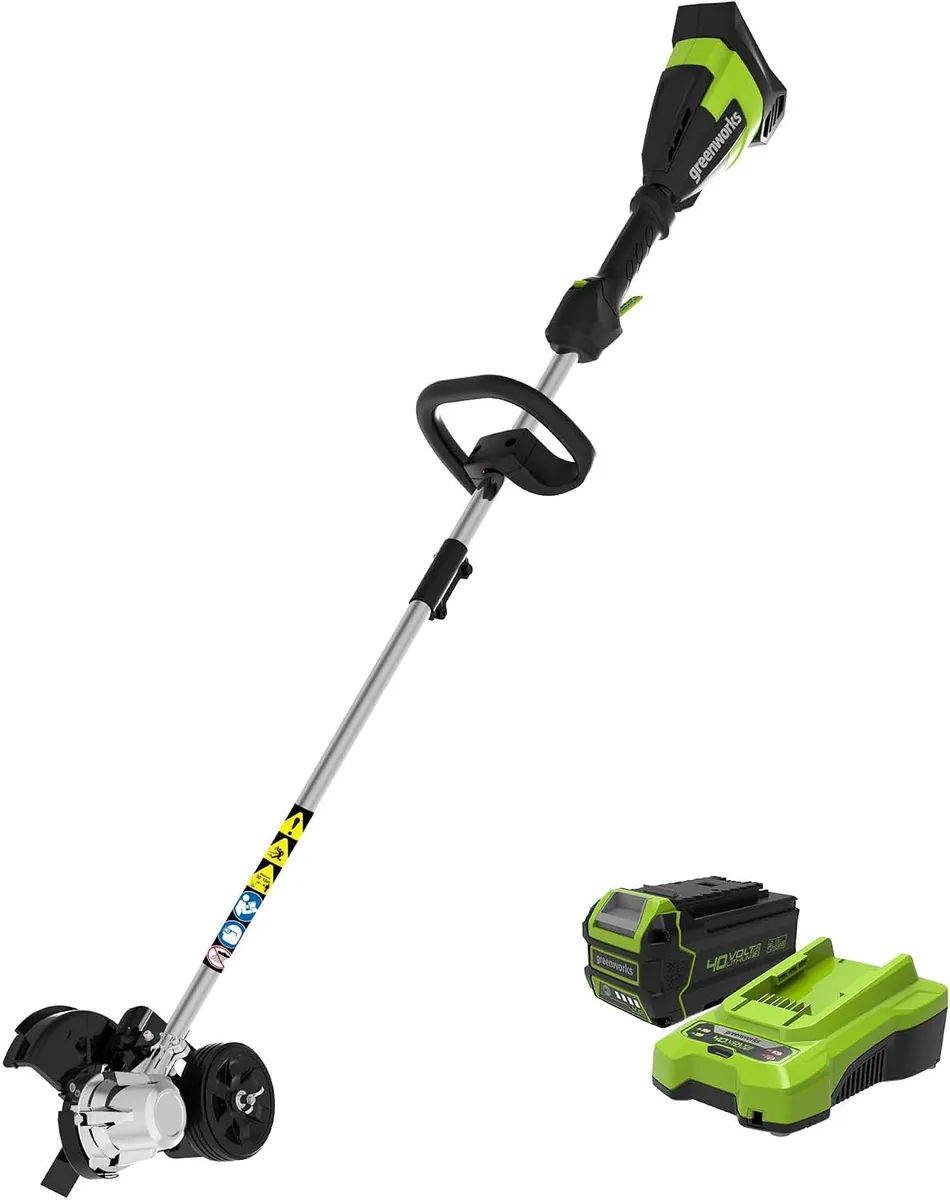
According to Greenworks, the Greenworks 40V 8-Inch Brushless Edger Kit is a dedicated 8 in edger that weighs 9.59 lb without the battery and cuts up to 2.25 in deep. It lists up to 60 minutes on the 4.0Ah battery. Pick it for an edger that only edges and lists its weight and run time, and pick the DeWalt if you want the powerhead to do more later.
Common Problems and How to Avoid Them
The manuals give the fix for each common problem.
- Clogged blade chamber: release the trigger, wait for the blade to stop, remove the battery and clear the material with a stick. Never tap the tool on the ground, and keep hands clear of the edge guide and blade, which wear to a very sharp point.
- Eye injuries: in a case series of brush-cutter operators, small objects entered from the side or through visor mesh, so the authors added eye protection glasses (3).
- Noise: DeWalt gives no figure, and the manual says noise may contribute to hearing loss, so wear ANSI S12.6 hearing protection. NIOSH recommends 85 dBA over an eight-hour day and halving the time for every 3 dBA more (4).
- Hand vibration: DeWalt gives no figure either. In one laboratory test, gloves lowered hand vibration on grounds equipment (5).
Safety Order
Before you adjust the depth, change the blade, clear a clog or carry the tool: switch off, wait for the blade to stop, remove the battery, then touch the blade. Wear eye and hearing protection, long pants, sturdy boots and gloves every time, and keep bystanders and pets at least 100 ft away.
My Final Verdict on the DeWalt 60V Edger
The DeWalt DCED472X1 earns a place in the shed of an owner who edges paved borders and garden beds and wants one battery system for more than edging. I like the edge guide and front wheel on a slab edge, the 1 in edging depth the manual sets and the HI/LO switch for long, easy runs. I do not like that DeWalt prints no weight, run time or noise figure, so hold the tool in a shop before you pay a premium. That is where my DeWalt 60V edger review lands: a clear yes for owners of DeWalt FLEXVOLT batteries with paved edges, and a pass for anyone who needs the numbers first.
Frequently Asked Questions
How to use a DeWalt edger?
To use this DeWalt edger kit, set the depth to 1 in with the battery out, then fit it and rest the edge guide on the paved edge. Tilt the handle so the blade is above the ground, push the lock-off tab forward, squeeze the lever and trigger, let the blade spin, then lift the handle slowly and walk forward.
Does the DeWalt edger come with a battery?
The DeWalt edger with battery and charger is the DCED472X1 kit, while the tool-only version comes without either. According to DeWalt, the kit holds one FLEXVOLT DCB609 battery listed as 3.0Ah in 60V MAX mode, a charger, one edger blade and an auxiliary handle, which gives you the second grip the manual requires.
How do I change a DeWalt edger blade?
To change a DeWalt edger blade, switch off, wait for the blade to stop, remove the battery, then take the attachment off the powerhead and hold the locking rod in the shaft hole. Turn the flange nut clockwise with a 13 mm or 17 mm wrench, fit the new blade and spacer, and tighten to 27 to 28 ft lb.
Does DeWalt make a 60V edger?
DeWalt makes a 60V MAX edger: the DCED472X1 kit, a 7-1/2 in attachment capable edger with a brushless motor and a cut depth of up to 2-1/2 in, which the manual sets at 1 in for edging. According to DeWalt, the kit includes a FLEXVOLT battery and charger, and the same pack also runs DeWalt’s 20V MAX tools.
Can you use a DeWalt edger attachment on a string trimmer?
You can use the DeWalt edger attachment only on a DeWalt powerhead, according to its manual, so a trimmer from another brand is out. The kit’s own 60V MAX powerhead is attachment capable, and DeWalt refers owners to its customer service to confirm whether a DeWalt trimmer powerhead accepts the edger.
References
- Stange NR, Jennissen CA. Lawnmower-Related Eye Injuries in the U.S., 2004 to 2023. Am J Ophthalmol. 2025;277:7-16.
- Hossain Ahmed S, Kang X, Bade Shrestha SO. Effects of Temperature on Internal Resistances of Lithium-Ion Batteries. J Energy Resour Technol. 2015;137(3):031901.
- Gau M, Meier P, Wiedemann P. Penetrating and perforating eye injuries with foreign bodies during motorized brush-cutting while wearing head protection gear [in German]. Klin Monbl Augenheilkd. 1999;215(5):311-314. doi:10.1055/s-2008-1034720
- National Institute for Occupational Safety and Health. Noise-Induced Hearing Loss. Noise and Hearing Loss. Centers for Disease Control and Prevention; 2024.
- Oh J, Chen N, Boyd C. Laboratory evaluation of occupational exposure to hand-arm vibration (HAV) during grounds maintenance equipment operations. Ann Agric Environ Med. 2023;30(2):384-389.
Safety Note: Read your manual first. An edger can throw stones, soil and other debris with force, so remove loose stones, glass, wire and other objects before you start, keep the blade guard in place, and never edge in or near gravel or let the blade strike pavement or rocks on purpose. Wear impact-rated eye protection with side coverage that meets ANSI Z87.1, hearing protection, gloves, long pants, close-fitting long sleeves and sturdy slip-resistant boots. Keep people and pets at least as far away as your manual says (50 feet in some manuals, 100 feet in others), and stop if anyone comes closer. Use only the blade your manual lists for your exact edger or attachment, and fit an attachment only to a power head its maker approves, with the coupling fully locked. Before each use, with the tool switched off, all movement stopped and the battery removed, the cord unplugged or the spark plug wire disconnected (a gas engine cooled), check the blade, its bolts and the guard, and replace a cracked, bent or badly worn blade as your manual says; never sharpen a blade unless that manual allows it. Start the tool in the position your manual shows, with the blade clear of the ground, and let it reach full speed before you ease it into the cut. The blade can push the tool sideways when it hits concrete, a stone or a root, so hold both handles, keep firm footing and never force the cut. After the blade strikes something or the tool starts to vibrate, switch it off, wait for all movement to stop, disconnect the power the same way and inspect it before you go on. Before you clear a jam, change depth, clean the tool, fit or remove an attachment, or inspect or replace the blade, stop the motor or shut off the engine, wait for all movement to stop, then remove the battery, unplug the cord or disconnect the spark plug wire. On a gas edger, releasing the blade control can leave the engine running, and a blade that turns at idle means the edger must not be used until it is repaired. An edger cuts into the soil: in the US, contact 811 before you edge or trench into soil, and mark sprinkler lines, drip lines, landscape lighting wire and other private lines, which 811 may not locate. Refuel a gas model outdoors with the engine off and cool, away from flames or sparks, and move as far from the fueling spot as your manual says before starting; start and run it outdoors only, never in a garage, shed or other closed space, even with the door open. For a battery model, use only the battery and charger approved for your tool, charge and store them within the temperature range in your manual, and never use a damaged or swollen pack. For a corded model, use an undamaged outdoor extension cord of the gauge and length your manual gives, plugged into a GFCI outlet, keep the cord clear of the blade, the wheels and your feet, and avoid wet conditions.