
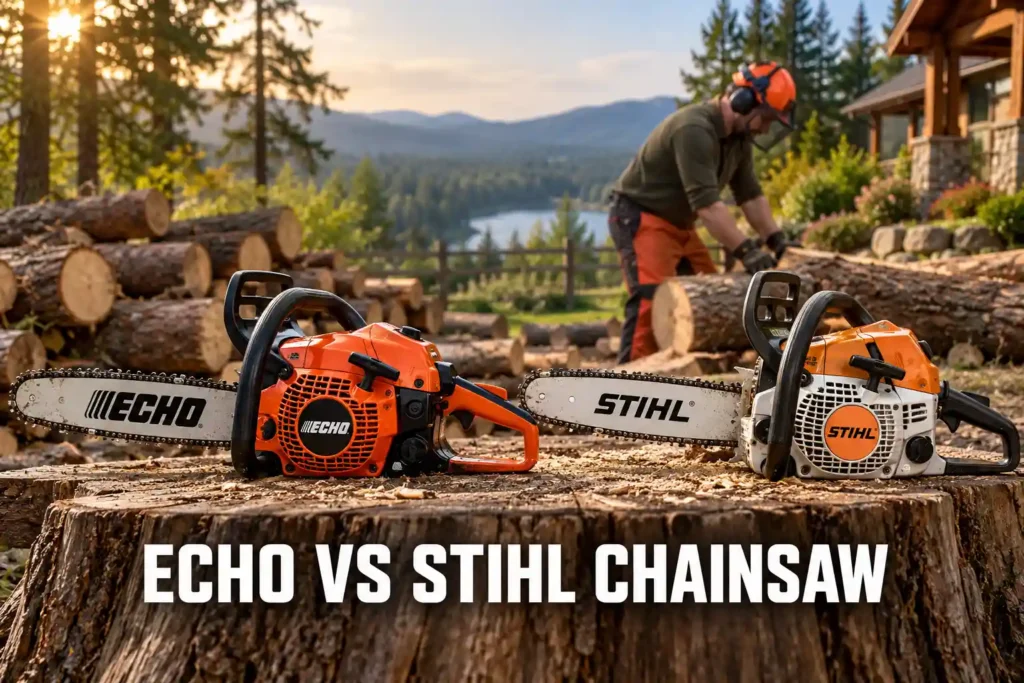
The ECHO vs Stihl chainsaw choice rests on service and paperwork more than on a quality ranking: Stihl sells through authorized dealers only and gives owners of its gas saws one year of consumer cover, while ECHO gives homeowners five years on chainsaws bought from an authorized dealer. I pick a saw the way I pick any machine for the orchard: by the job first, then by who can repair it close to home. This guide compares dealers, warranty terms, battery systems and the safety rules that stay the same on both brands.
ECHO vs Stihl Chainsaw at a Glance
The two brands differ in how they sell, service and warrant a saw. Stihl says its saws are sold only through authorized local dealers and lists more than 10,000 of them. ECHO writes its warranty for saws sold by authorized dealers and gives homeowners the longer term on gas saws. For a few cuts a year, the nearest servicing dealer and the warranty text count for more than the badge on the cover.
| Item | ECHO | Stihl |
|---|---|---|
| Company base | ECHO Incorporated, Lake Zurich, Illinois, part of Japan’s Yamabiko group | Stihl Incorporated, Virginia Beach, Virginia, the US arm of the German Stihl Group, founded in 1926 |
| Where you buy | Authorized dealers; the warranty applies to saws they sold | Authorized local dealers only, according to Stihl |
| Homeowner gas chainsaw warranty, maker’s term | 5 years | 1 year on MS saws |
| Commercial or income-use gas chainsaw warranty, maker’s term | 1 year | 3 months |
| Battery chainsaw warranty for consumers, maker’s term | DCS-5000 tool: 5 years | AK and AP products: 5 years |
| Battery systems | One: 56V | Three: AS, AK and AP |
| Top-handle saws | Gas and battery models | Offered; Stihl calls them in-tree professional use only |
Who Each Brand Suits
- Choose ECHO if the longer homeowner warranty on gas saws matters to you and an authorized ECHO servicing dealer is within an easy drive.
- Choose Stihl if you have a Stihl dealer you trust nearby and want a battery system with a homeowner tier and a professional tier.
Who Sells and Services Each Brand
Both makers tie their warranty to the dealer you buy from. That makes the sales channel part of the product, and it is the first thing I check in an ECHO vs Stihl chainsaw comparison of any size.
Stihl Sells Through Dealers Only
According to Stihl, “genuine STIHL products, parts and accessories are only sold through authorized local STIHL Dealers,” and the local dealer is “the only way to obtain parts.” Stihl also tells buyers to be wary of its products on unauthorized, discount or auction websites, and says imitation products are not covered by its warranty policies. Many dealers sell online, and Stihl points buyers to its dealer locator to find them.
ECHO and Unauthorized Sellers
ECHO Incorporated has been based in Lake Zurich, Illinois, since 1985. Its warranty statement says the limited warranty is “only applicable” to products sold by authorized dealers and is extended to the original purchaser only. A unit rebuilt or sold through an unauthorized dealer or an unauthorized outlet store is sold without ECHO’s limited warranty, and proof of purchase rests with the customer.
ECHO has also posted a notice about unauthorized sellers on online marketplaces. It advises buyers to verify that a retailer is listed as an authorized ECHO seller before purchasing, and to use its official dealer locator.
Check the Seller Before You Rely on the Warranty
For either brand, confirm on the maker’s dealer locator that the seller is authorized before you pay. The same saw bought from an unauthorized seller can arrive without the warranty the maker advertises.
Dealer distance is the practical part. A farm is not a town, so I look up the nearest servicing dealer of a brand on its locator before I look at a single spec, and I phone it to ask whether it services the saw class I want. A saw that cannot be serviced nearby spends the season in the shed.
Warranty Terms Side by Side
On gas chainsaws, ECHO gives homeowners five years and Stihl gives one year, while for income use ECHO gives one year against Stihl’s three months. Those are the makers’ own periods, from ECHO’s limited warranty statement and Stihl’s 2026 policies.
ECHO vs Stihl Chainsaw Warranty Periods
| Item | ECHO | Stihl |
|---|---|---|
| Homeowner gas chainsaw | 5 years, all units for homeowner or non-income use | 1 year on MS gas chainsaws, for personal non-income household use |
| Commercial or income use, gas chainsaw | 1 year on chain saws | 3 months on MS gas chainsaws |
| Top-handle gas saws | Same terms as other chain saws | No consumer warranty; 3 months for professional use |
| Battery saws and packs | DCS-5000 page: tool 5 years consumer and 2 years commercial; pack 2 years and 2 years | AK, AP and AS packs and chargers: 5 years consumer, 3 years professional; top-handled battery saws get no consumer warranty |
| Who is covered | Original purchaser; not transferable | Original retail purchaser, units from US authorized dealers |
ECHO limits bars, chains and sprockets to 60 days for homeowner use and 30 days for commercial use, for defects only. Stihl’s gas-saw periods can change with the oil you buy. Its program doubles the standard warranty on gas machines used for personal household purposes when the buyer purchases a 6-pack of Stihl HP Ultra 2-cycle oil or a gallon of MotoMix pre-mixed fuel at the time of purchase. The program excludes top-handle saws.
Fuel is part of both contracts. Stihl’s policy excludes repairs made necessary by gasoline with more than 10 percent ethanol (E10), and ECHO’s CS-590 manual allows up to 10 percent ethanol and does not approve E15 or E85. Mix and octane come from the manual of the saw you own.
What the Periods Mean for a Small Orchard
Take two owners with the same stone-fruit plot, both on gas saws. The first cuts a few dead limbs a year, so a longer homeowner term and a nearby servicing dealer carry the most weight. The second sells cut firewood, so the commercial term applies, which is one year with ECHO and three months with Stihl as the makers write them. The periods tell you what the maker promises, nothing more. Rear-handle gas saws for yard and orchard work are in my top gas chainsaw roundup.
I read a warranty statement to its last line before I buy, because the exclusions decide whether the headline number means anything.
Line-Up of Gas, Battery and Top-Handle Saws
Both brands cover the same ground, gas rear-handle saws, gas and battery top-handle saws, and battery rear-handle saws, but they sort their line-ups differently. This section compares the structure, not single models, because a 40 cc saw from one maker and a 60 cc saw from the other do different jobs. My guide to what does cc mean on a chainsaw explains engine displacement in plain terms.
How Stihl Sorts Its Saws
Stihl’s buying guide splits chainsaws into three categories built for different users and tasks. Homeowner saws are “designed for lighter-duty work,” such as pruning, storm cleanup and small firewood. Farm and Ranch saws are “built for regular, demanding work on larger properties.” Professional saws offer power and reliability that “stand up to all-day use” in logging, land clearing and tree service.
Stihl’s policy names its gas lines MS (rear-handle) and MS-T (top-handled), with separate warranty rows for each. My comparison of top-handle and rear-handle chainsaws explains which layout is safer for a homeowner.
How ECHO Sorts Its Saws
ECHO’s warranty statement separates homeowner and commercial use rather than naming saw tiers. Its gas line includes rear-handle saws such as the CS-590 Timber Wolf, a 59.8 mL (3.65 cu in) saw that weighs 13.2 pounds dry without bar and chain, with bars from 16 to 27 inches listed in its manual. The same maker lists top-handle gas saws and a 56V battery line that includes an 18 inch rear-handle saw and a 12 inch top-handle saw. I cover ECHO’s long-shaft gas pole saw in a separate ECHO PPT-2620 pole saw review.
The CS-590 is an example of class, not a rival to any one Stihl saw. A saw’s displacement, bar and weight should fit your job, and the badge comes after that. When I cut up wood from a fallen plum limb in the orchard, the size of the wood sets the saw class, not the name on the housing. I set the CS-590 against a Husqvarna in my Husqvarna 455 and ECHO CS-590 comparison.
Top-Handle Saws Are for Trained Tree Workers
Stihl states in its warranty legend that top-handled chainsaws are for in-tree professional use only. For work on the ground, I want a rear-handle saw and leave top-handle saws to people who are trained and secured in the tree.
Three Stihl Battery Systems and One ECHO System
Stihl runs three battery systems, AS, AK and AP, and ECHO runs one, the 56V system. A system decides which packs and chargers you share, so it matters more as your shed fills up. My guide on what voltage chainsaw do I need walks through the battery platforms.
Stihl AS, AK and AP
Stihl’s warranty legend sorts its cordless products into the AS, AK and AP systems. Its battery chainsaws sit on the AK and AP systems, and the buying guide says AK suits homeowners while AP is made for extended professional use. Stihl lists them as separate systems, so ask the dealer which pack fits which tool before you buy a second battery. The battery policy gives AK, AP and AS products and chargers five years for consumers and three for professionals.
ECHO and Stihl Battery Systems Compared
ECHO’s DCS-5000, an 18 inch rear-handle saw, runs on the ECHO 56V Battery System with 2.5Ah and 5.0Ah packs. ECHO lists the saw with 2.5Ah and 5.0Ah packs and gives 12.7 pounds with the 2.5Ah battery. Compare saws on the same battery size. If you are weighing ECHO against EGO, my EGO and Echo pole saw comparison puts one saw from each brand head to head.
Voltage names do not tell you which saw cuts better, and I do not compare a number from one maker with a number from another. What I check is where the pack charges and how it behaves in cold weather. On a frost morning I bring the pack into the house the night before. If you are weighing a gas saw against a battery one, my battery versus gas chainsaw comparison covers power, upkeep, noise and safety.
Safety Rules That Do Not Change With the Badge
The risk comes from the tool and the technique, so the same rules apply to both brands. US emergency-room data for 2006 to 2016 list 18,250 power saw and axe injuries, with power saws behind 89 percent of them, about half to the fingers and hand, and 65 percent at home (1). A series of 185 rural chainsaw injuries found 109 patients hurt in the legs and 76 in the arms, with arm injuries costing more work time (2).
Check the Saw Before Every Cut
ECHO’s CS-590 manual says to confirm that the brake works properly before each use, and the test differs between saws. Before each use, inspect the saw as its manual describes: test the chain brake by the manual’s method, and check the throttle trigger lockout, the stop switch, the chain catcher, the guards and the chain’s sharpness, tension and condition; on a gas saw the chain must not move at idle. If any check fails, do not use the saw until it is repaired, and never disable a safety device.
Kickback and Grip
If the upper part of the bar tip touches wood or another object, the bar can kick back up and toward you (rotational kickback). Wood pinching the chain on the top of the bar pushes the saw straight back at you (pushback), and wood pinching the bottom pulls it forward, away from you (pull-in). A low-kickback chain, a chain brake and a correct grip reduce these risks; none removes them.
Lab kickback tests link proper chain tension, anti-kickback chain links and a quickly activated brake to lower kickback (3). The wood matters as well, because species, moisture and where the bar tip touches change the risk (4). Use only the bar and chain the manual approves. ECHO’s manual warns that a replacement chain or bar other than the one specified may cause severe kickback.
Hold the saw with both hands, right hand on the rear handle and left hand on the front handle, thumbs and fingers wrapped around the handles, with your body to the left of the chain line and firm footing. Never cut at or above shoulder height, and never cut from a ladder or a roof.
Protective Gear
Wear impact-rated safety glasses with side protection marked Z87+ (a mesh face screen adds to them but never replaces them), hearing protection, chainsaw chaps or chainsaw trousers used within their maker’s stated limits (some are not designed to stop a battery or corded saw’s chain, and no clothing guarantees protection), work gloves and sturdy boots with ankle support, plus a hard hat when you fell a tree or anything can fall from above.
In a year-long field test, Peltor H7P3 helmet-mounted earmuffs held the average chainsaw noise at the ear to about 79 dB(A) at 12 months, below the 85 dB(A) criterion, although protection slipped by about 3 dB(A) in the last three months as the cushions wore (5). I wear ear and eye protection from the first second, even for a quick cut off a plum limb. Chainsaw handles also carry vibration: a groundskeeper study measured 8.0 m/s2 at the right hand of chainsaws, the highest of the tools it tested (6), so I take breaks and stop when my hands tingle, and I see a doctor if it persists.
Stopping, Maintenance and Refuelling
The orders below are the same for both brands, and a manual that is stricter wins.
- Stopping a saw: release the trigger, engage the chain brake (on a battery or corded saw, if it has a brake lever), switch the engine or motor off and wait until the chain has stopped.
- Maintenance (touching the chain, clearing a jam, adjusting tension, sharpening, changing the bar or chain): stop as above, then on a gas saw let the engine and muffler cool and pull the spark plug cap off; on a battery saw take the battery out; on a corded saw pull the plug from the outlet by the plug, not the cord. Put on gloves before touching the chain. Release the chain brake only when the exact manual’s procedure requires it (for example to remove the clutch cover or check that the chain moves freely), and never force a locked chain or cover.
- Refuelling a gas saw: stop as above, let the engine cool, refuel outdoors with no smoking, open flame or sparks nearby, wipe spills, and move at least 10 feet away before starting.
Exhaust contains carbon monoxide, so a gas saw never runs indoors or in a garage or shed. In the tool shed I keep two-stroke mix in a measured bottle, away from the charger shelf, and I mix only what the day needs.
Know Where Your Limit Is
Felling is the most dangerous chainsaw job. Never work alone, keep everyone at least two tree lengths away, and plan and clear two escape routes angled back from the direction of fall before any felling cut. A large, leaning, dead or hung-up tree, or a trunk or limb under tension after a storm, is a job for a certified arborist. Get hands-on training before your first use.
Power Lines
Treat every downed power line, and anything touching it, as live: stay well away and call the utility. Before any work near a power line, contact the utility and leave that work to its qualified line-clearance crews; a general arborist is not automatically qualified for it.
How to Choose Between ECHO and Stihl
In an Echo chainsaw vs Stihl decision, choose dealer distance first, saw class second and battery system third. The table turns that order into a decision for the usual homeowner and farm situations. If Husqvarna is also on your list, my guide to Husqvarna and Stihl chainsaws runs the same dealer and warranty checks.
| Your situation | Weigh this first | What to do |
|---|---|---|
| A few cuts a year, a servicing dealer nearby | Warranty term | Compare the homeowner periods as the makers state them |
| No servicing dealer within an easy drive | Service access | Pick the brand with the closer authorized dealer |
| Cutting for income, such as selling firewood | Commercial term | Read the income-use periods and exclusions |
| Small jobs near the house, no mix to handle | Battery system | Pick a battery saw and check the pack family |
| Work on the ground | Handle layout | Choose a rear-handle saw |
| Large, leaning or hung-up trees, storm tangles | Not a homeowner job | Call a certified arborist |
| Any power line near the work | Utility first | Contact the utility; its qualified line-clearance crews do that work |
When I read a weight, I check what it includes. ECHO’s CS-590 weight is dry, without bar and chain, and a carried saw with bar, chain and full tanks weighs more. Weight at arm’s length by the end of an afternoon matters more to me than the number on the box. I go through the CS-590 on its own in my Echo CS-590 review.
Cut stone-fruit wood leaves gum and fine dust around the chain brake. I clean that area before the next job, with the saw stopped and made safe in the order above, whichever saw is in my hands.
Pick the Dealer Before the Badge
Three things to remember: the makers’ warranties depend on buying from an authorized dealer, the periods differ by use, and the battery system is a commitment to a family of packs. One tip from my own routine: I write the dealer’s phone number on the inside of the tool shed door next to the fuel mix ratio, so a question never waits. Next, read the warranty statement of the saw you are considering, then look up the nearest servicing dealer on the maker’s locator. That check settles an ECHO vs Stihl chainsaw decision for most yards better than any spec sheet. My comparison of Husqvarna and ECHO chainsaws covers the same line-up, service and warranty ground.
Frequently Asked Questions
Is Echo or Stihl better chain saw?
Which chain saw is better, Echo or Stihl, depends on the saw class you need, the servicing dealer near you and the warranty text. Echo gives homeowners the longer warranty on gas saws, and Stihl sells only through authorized dealers.
Is Echo just as good as Stihl?
Echo and Stihl both build rear-handle gas saws, top-handle saws and battery saws, and each ties its warranty to an authorized dealer. Judge a saw by its class, service access and warranty terms.
What brand is comparable to Stihl?
ECHO and Husqvarna sell gas and battery chainsaws in the same homeowner and professional classes that Stihl lists. Compare them by displacement, bar length, weight with its basis, battery system and the nearest servicing dealer, not by name.
What are the common problems with Echo chainsaws?
The common problems with Echo chainsaws that ECHO’s own manuals point to are chain tension, fuel and chain choice. The CS-590 tensions its chain with a wrench, ECHO limits ethanol to 10 percent and does not approve E15 or E85, and its manual warns that a replacement chain or bar other than the one specified may cause severe kickback.
Are ECHO and STIHL the same company?
ECHO and Stihl are separate companies with separate dealer networks and warranties. ECHO Incorporated is based in Lake Zurich, Illinois, and belongs to Japan’s Yamabiko group, while Stihl Incorporated in Virginia Beach, Virginia, is the US arm of the German Stihl Group.
References
- Sritharen Y, Hernandez MC, Zielinski MD, Aho JM. Weekend woodsmen: overview and comparison of injury patterns associated with power saw and axe utilization in the United States. Am J Emerg Med. 2018;36(5):846-850.
- Özdeş HU, Ergen E, Köroğlu M, et al. Chainsaw-related extremity injuries. Medicina (Kaunas). 2025;61(4):759.
- Dąbrowski A. Reducing kickback of portable combustion chain saws and related injury risks: laboratory tests and deductions. Int J Occup Saf Ergon. 2012;18(3):399-417.
- Dąbrowski A. Kickback risk of portable chainsaws while cutting wood of different properties: laboratory tests and deductions. Int J Occup Saf Ergon. 2015;21(4):512-523.
- Kirk P. Earmuff effectiveness against chainsaw noise over a 12-month period. Appl Ergon. 1993;24(4):279-283.
- Chen N, Yang S, Oh J. Evaluation of hand-arm vibration (HAV) exposure among groundskeepers in the southeastern United States. Annals of Work Exposures and Health. 2025;69(1):81-95.
Safety Note: Read your saw’s manual first and get hands-on training before your first cut. A chainsaw can react faster than you can: if the upper part of the bar tip touches wood or another object, the bar can kick back up and toward you; wood pinching the top of the chain can push the saw straight back at you, and wood pinching the bottom can pull it forward. Keep the bar tip out of contact and watch for wood closing on the bar. A low-kickback chain and a chain brake reduce these risks but never remove them. Before each use, inspect the saw as your manual describes: test the chain brake, and check the throttle lockout, the stop switch, the chain catcher, the guards and the chain. On a gas saw the chain must not move at idle. If any check fails or a part is missing or damaged, do not use the saw until it is repaired, and never disable a safety device. Wear impact-rated safety glasses with side protection marked Z87+ (a mesh face screen adds to them but does not replace them), hearing protection, chainsaw chaps or chainsaw trousers, work gloves and sturdy boots with ankle support, and a hard hat when you fell a tree or when anything can fall from above. Use leg protection within its maker’s stated limits: some chaps are not designed to stop the chain of a battery or corded saw, and no clothing guarantees protection. Hold the saw with both hands, right hand on the rear handle and left hand on the front handle, thumbs and fingers wrapped around the handles, and keep your body to the left of the chain line with firm footing. Never cut one-handed with a rear-handle saw, never cut at or above shoulder height, and never cut from a ladder or a roof. Top-handle saws are made for trained tree workers: follow that saw’s manual. Keep children, bystanders and pets well away while you cut. Never work alone. Start a gas saw with the chain brake engaged, on the ground or held firmly as the manual shows, never by drop-starting it, and at least 10 feet from where you fuelled it. Refuel outdoors with the engine off and cool, with no smoking, flames or sparks nearby, wipe up spills, and use only the fuel mix and ethanol content your manual allows. Exhaust contains carbon monoxide, which can kill: never run a gas saw indoors or in a garage, shed or other enclosed space. Before you touch the chain, clear a jam, adjust the tension or sharpen: release the trigger, engage the chain brake, stop the engine or motor and wait until the chain has stopped. Then, on a gas saw, let the engine and muffler cool and pull the spark plug cap off; on a battery saw, take the battery out; on a corded saw, unplug it by the plug. Put on gloves before you touch the chain, and release the chain brake only when your manual’s procedure calls for it. To carry the saw, stop it, take out the battery or unplug it, keep the chain brake engaged and the bar pointing behind you, and fit the bar cover for transport. Use a corded saw only with an outdoor-rated extension cord of the gauge your manual gives, plugged into GFCI-protected power. Never use it in rain or wet conditions: GFCI protection does not make that safe. Keep the cord away from the chain. Use only the chains and bars your manual approves. Felling trees is the most dangerous chainsaw job. Before any felling cut, keep everyone at least two tree lengths away, and plan and clear two escape routes angled back from the direction of fall; when the tree starts to fall, follow your manual’s retreat steps (release the trigger, stop the saw and set it down as it describes) and move away along that route; never delay escape to cool, unplug or cover the saw. A large, leaning, dead or hung-up tree, a trunk or limb under tension after a storm, and any tree near a house or a road are jobs for a certified arborist. Power lines are a separate danger: treat every downed line, and anything touching it, as live, stay well away and call the utility; before any work near a power line, contact the utility and leave that work to its qualified line-clearance crews. Stop when you are tired, and take breaks if your hands tingle or go numb.