


My EGO backpack sprayer review of the BSP3500 comes down to a clear verdict: buy it if you already own EGO 56V batteries and want a 4 gal tank with a printed ceiling of up to 350 PSI, and skip it if you have no EGO batteries or want a printed runtime. My plant protection training taught me to read the label before I look at the sprayer, so this page starts with the label. EGO sells the sprayer without a battery or charger, and both are sold separately.
Affiliate Disclosure: Garden Power Scout is a proud participant in the Amazon Services LLC Associates Program. As an Amazon Associate, we earn from qualifying purchases, at no extra cost to you.
EGO Backpack Sprayer Review: My Verdict on the BSP3500
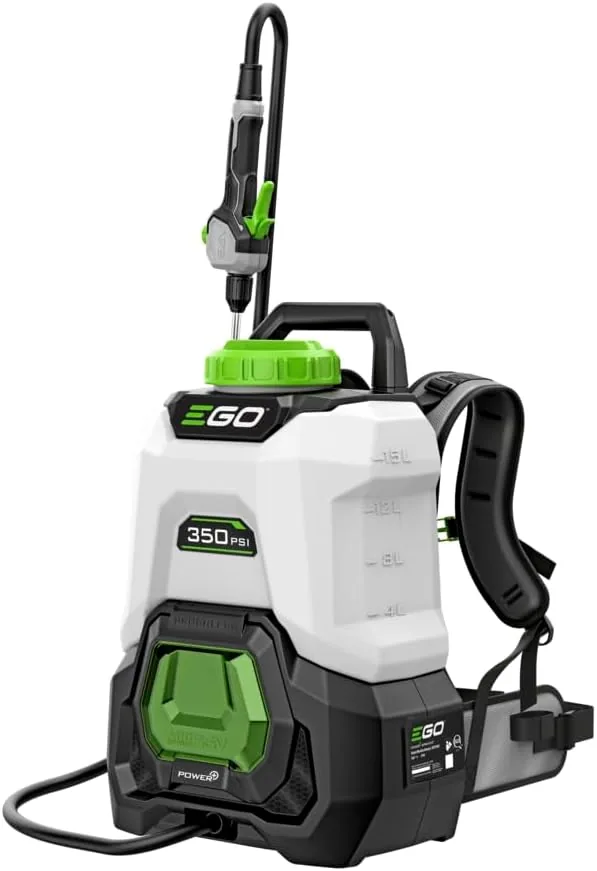
The EGO Power+ BSP3500 is a 56-volt cordless backpack sprayer with a 4 gal tank, and it suits a homeowner or small-orchard owner who already runs the EGO battery platform. According to EGO’s manual it carries a speed dial that sets the flow rate, a lock-on lever on the trigger and four nozzles in the box. The sprayer alone does not run, because the battery pack and the charger are not in the box. I recommend it to EGO owners and tell everyone else to price the battery first. For a small orchard, my list of battery sprayers for fruit trees shows how seven backpack models compare.
- Who it is for: an EGO 56V battery owner with a lawn, a garden or a few fruit trees to treat.
- What it does best: four nozzles in the box and a speed dial on the body that sets the flow rate.
- Main trade-off: battery and charger are sold separately, and the manual prints no runtime.
EGO BSP3500 Specs and What Comes in the Box
Two rows decide the buying question in this table: the battery and charger row, which is empty, and the weight row, which has a basis. Every figure below is EGO’s own, and the weight is dry and without a battery pack. This is a 4 gallon battery powered backpack sprayer, and the 4 gal figure is the tank EGO supplies, not a safe fill level.
| Spec | Value |
|---|---|
| Sprayer type, EGO’s term | 56-volt lithium-ion cordless backpack sprayer |
| Power source, maker’s figure | 56 V, EGO ARC Lithium battery packs listed in the manual |
| Tank capacity, maker’s figure | 4 gal (15 L) |
| Pump and pressure | Pump type: Not listed. Maker’s ceiling: up to 350 PSI, as EGO prints it. Flow: up to 0.6 gal/min with the adjustable nozzle in spray mode. Speed dial sets the flow rate. |
| Battery and charger | Not included, sold separately |
| Runtime | Not listed |
| Nozzle and wand | Adjustable nozzle on the wand, fan nozzle, shower nozzle and foaming nozzle; wand length: Not listed |
| Weight, dry and without battery pack | 16.8 lb (7.6 kg) |
| Warranty, EGO warranty page | 5 years consumer use and 1 year professional use for EGO outdoor power equipment; the chart does not name the BSP3500 |
| In the box | Sprayer, wand with adjustable nozzle installed, fan nozzle, shower nozzle, foaming nozzle, operator’s manual; assembly required |
The manual says the product needs assembly, and the assembly step follows the shutdown box below. EGO’s manual calls the sprayer horticultural and agricultural equipment and lists spraying herbicides, pesticides and fungicides, applying fertilizers and watering plants as its uses. The warranty chart puts agricultural use in the 1 year professional column, so ask EGO which term covers your use before you buy. This sprayer is the EGO BSP3500, sold on Amazon as the BSP3500 tool-only kit. If spraying pesticides is your main job, my list of battery sprayers for pesticides compares nine models by tank and battery.
Before You Fill the Tank: Label, Protection and Shutdown
The label comes before the sprayer, and the shutdown comes before every hand on the tank, the nozzle or the battery. I put both here so the later sections can point back to them.
The product label is the law. It tells you what protective equipment to wear, how and where you may use the product, what weather it allows, how long to stay out of the treated area, how long to wait before you harvest, how to protect bees and other pollinators, and how to dispose of leftover product and the empty container.
Using a registered pesticide in a way its label does not allow is against federal law. Your sprayer’s manual does not replace the label, and the label does not replace the manual: read the label before you open the container, and follow both.
Wear the protective clothing and equipment the product label requires, and put it on before you open the container. Wear the eye protection and gloves the label names every time you mix, load, spray, clean the tank or clear a nozzle.
Cornell’s pesticide safety program also advises chemical-resistant gloves, goggles and a respirator when you handle moderately toxic products, even when the label does not call for them. Wear every respirator the label requires, of the type the label names, and follow the respirator maker’s instructions for fit, use and care.
If you follow Cornell’s advice and wear one the label does not require, or if it is unclear which respirator or filter is right, get qualified guidance on the respirator and filter before you handle the product. Protective equipment lowers your exposure; it does not make spraying safe.
EGO’s manual adds its own line: always wear eye, breathing and skin protection, eye protection with side shields or goggles marked to comply with ANSI Z87.1, and heavy long pants, boots and gloves. EGO says not to wear short pants or sandals, and not to go barefoot. All of that stands alongside the protection the product label requires. A critical review of protective equipment for agricultural pesticide users found that its real-world protection may be over-estimated (1). In a systematic review of agricultural pesticide handlers, goggles and gloves were worn less often than long sleeves and trousers (2).
Full Shutdown Box
Emergency first: if a battery becomes unusually hot, swells, hisses, gives off an unusual odor or smokes, stop using the sprayer without handling or removing the battery, keep people away and follow the battery manual’s emergency instructions; if it smokes, burns or presents immediate danger, move away and call 911 or the fire department without finishing the routine shutdown. Shutdown before you open the tank, fill or refill it, change or clean a nozzle, clear a clogged nozzle, clean or rinse the sprayer, adjust or repair anything, charge or change the battery, move, store or leave the sprayer. Never point the wand at yourself, another person or a pet. During normal spraying, move only as the equipment manuals and the product label permit; walking while spraying with a backpack unit, or driving a mounted boom at the spraying speed its manual describes, is operation, not transport. Never ride while operating a hand-held wand or lance. Battery sprayer (handheld or backpack): release the trigger or close the wand valve, then switch the pump off. Relieve all trapped pressure using only your exact manual’s procedure and a discharge destination consistent with the product label, without opening the tank or loosening any part beforehand unless that procedure expressly requires it, and never toward yourself, another person or an animal. Then remove the battery and keep it away from the sprayer. Wear the protective equipment the product label requires while you clean the tank, the strainer or a nozzle. Clear a clogged nozzle only with the method in your exact manual; never clear a nozzle with your mouth and never by blowing into it. Add every step your manual gives, in its order. Refit every part, close the lid and check for leaks with clean water before product goes back in.
Assembly comes next. Before you do this, complete the full shutdown for your sprayer in the shutdown box above. EGO’s manual then has you thread the wand’s end cap onto the control handle, clockwise. The emergency exception in the box above applies at every step.
EGO’s manual adds steps to that order. Remove the battery pack before filling the tank, before draining, cleaning, changing attachments or storing, because a battery sprayer with the pack inserted is always on and can start by accident. Turn the speed dial to OFF when the sprayer is not in use. EGO’s manual prints no method for relieving trapped pressure, so ask EGO for its guidance before you open or loosen anything.
Harness, Tank and Carrying Comfort
Before you do this, complete the full shutdown for your sprayer in the shutdown box above. Then adjust the shoulder straps, snap the chest buckle and snap the waist buckle, as EGO’s manual describes, so the hips carry the weight.
The back panel sat closer to my hips than my shoulders once I followed the manual’s advice that the pack should not ride high on the back. EGO prints 16.8 lb dry without the battery pack, and the full-tank and with-battery weights are not printed, so I judged the carry by how the waist belt took the load, not by a scale reading. The padded straps and the waist belt are visible in the listing photo, and the tank keeps close against the back when the straps are set as the manual says.
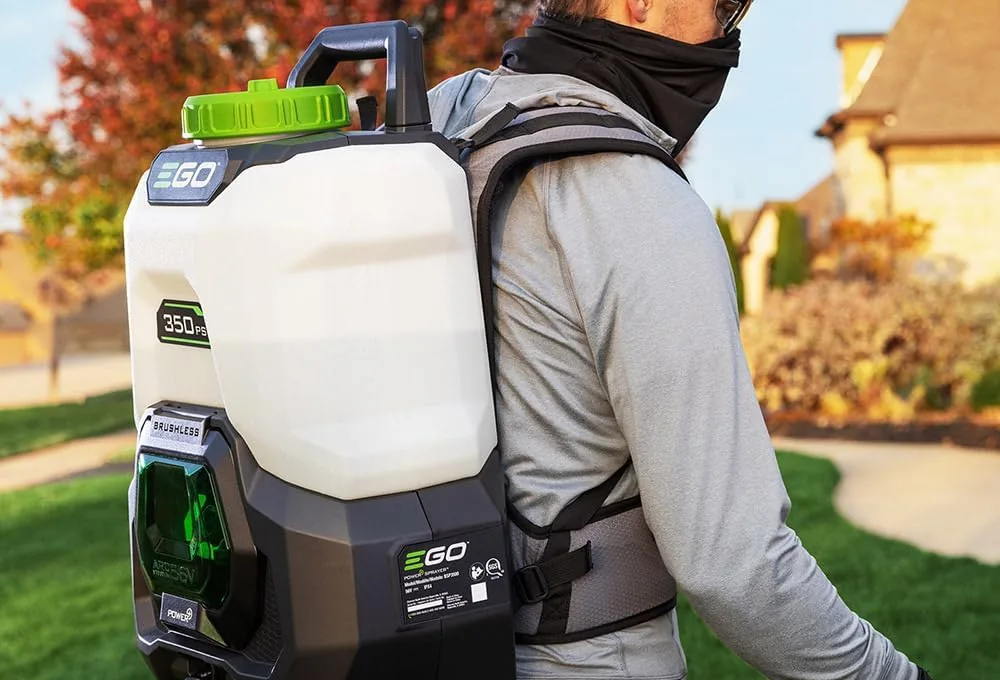
Before you open or fill the tank, complete the full shutdown in the shutdown box. Then fill only to the level your manual allows and, for a carried sprayer, only to a weight you can handle with the straps and hip belt adjusted as the manual describes.
Before you lift, put on or take off a backpack unit, or load, unload, transport or leave the sprayer, complete the full shutdown again. During normal spraying, move only as your manual and the product label permit, and never ride while operating a hand-held wand or lance.
Carrying a full tank is tiring work: rest when you are tired, and stop before you lose your footing.
Speed Dial, Trigger and Nozzles in Use
Before you do this, complete the full shutdown for your sprayer in the shutdown box above. Then I start with the controls, because the speed dial is the part of this sprayer that differs most from a plain battery sprayer.
The Speed Dial and the Lock-On Lever
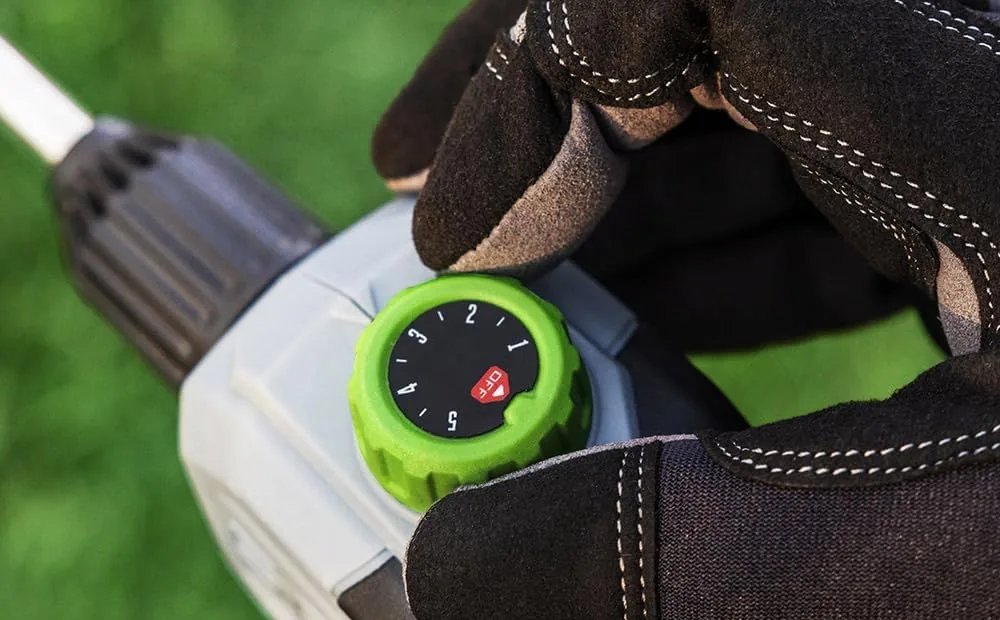
The speed dial sits on the sprayer body: clockwise raises the flow rate, counterclockwise lowers it, and OFF stops the sprayer. I found the dial with a gloved hand without taking my eyes off the wand, which matters when the wand is the part you are watching. The listing mentions a pressure knob on the wand, but EGO’s manual describes the dial on the body and the adjustable nozzle at the end of the wand, so I follow the manual.
The trigger has a lock-on lever that EGO says is convenient for extended spraying. My thumb found the lever under a glove, and the manual’s warning stuck with me: make sure the trigger is not locked on before you put the battery pack into the sprayer. The manual prints no PSI for any dial position and the sprayer has no gauge, so the 350 PSI figure stays a ceiling, not a setting.
The Four Nozzles
EGO puts four nozzles in the box. The adjustable nozzle on the wand goes from stream to spray, the fan nozzle is for broad areas, the shower nozzle is for watering and treating plants, and, according to EGO’s manual, the foaming nozzle visibly marks treated weeds. You unscrew the whole nozzle counterclockwise to change it, so complete the full shutdown in the shutdown box above first.
With clean water on a wall, the adjustable nozzle turned from a narrow jet to a wide spray as I turned it, and the fan nozzle laid a flat band. I read nothing into droplet size or coverage from that, because I did not measure either. In a bench test of a knapsack sprayer at 15 and 25 psi, a hollow cone nozzle gave the highest coverage and an air-induction flat fan the largest droplets (3). That bench used nozzles the EGO does not ship, so I take it as a reminder that nozzle shape changes the spray.
Pressure, Wind and Drift
EGO prints a ceiling of up to 350 PSI, which is the limit of the machine and not a number to aim for. The product label and the nozzle’s maker decide the pressure and the nozzle for a job. Nozzle type, nozzle size and pressure each change the droplet size spectrum on a test rig (4). K-State Extension says higher pressures make many more droplets under 100 microns and advises staying under 40 to 45 psi, but it wrote that for field sprayers and it is not a setting for this tool (5).
Drift is spray carried off target by the air, and wind speed is the factor extension sources stress most. Their figures differ and none fits every situation, and your product label may be stricter than all of them. K-State Extension suggests spraying when the wind is under 10.1 miles per hour and says there is no maximum wind speed that fits every situation.
LSU AgCenter says to avoid applying when the wind is above about 10 miles per hour. NC State says under 5 miles per hour when you calibrate with the product in the tank. Cornell gives no number and says not to take a chance by spraying in the wind.
Do not spray during a temperature inversion, when cool air near the ground holds small droplets in the air, and do not assume that calm air, early morning or evening is suitable: check the actual conditions and follow every weather restriction on the product label. High temperature and low humidity make spray evaporate faster. Do not spray just before rain.
Droplets smaller than about 150 micrometers drift most easily, and higher pressure makes more of them.
EGO’s manual says to avoid spraying on windy days and to spray in the early morning or late afternoon, because excessive heat can evaporate the spray before it settles. It also says to spray downwind, never toward people or animals, and never toward electrical outlets.
Mixing, Loading and the Liquids the Manual Forbids
Before you do this, complete the full shutdown for your sprayer in the shutdown box above. Then read your product’s label before you open the container.
The product label, not this page, gives the amount of product, the dilution and the mixing order, so read it before you mix.
EGO’s manual is stricter for this sprayer: it says not to combine chemicals, and no label, manufacturer or specialist advice overrides that line for the BSP3500.
Before you load the sprayer, complete the applicable full shutdown in the shutdown box, including its emergency exception, and wear the protective equipment the product label and your manual require for the task. Mix and load outdoors, away from other people (including children), pets and livestock, and where a spill or overflow cannot reach a well, a drain or other water. Read the label before you open the container, stand upwind, and do not eat, drink or smoke while you handle pesticides.
Never use your mouth to siphon a pesticide from its container. Keep the fill hose above the level of the liquid in the tank so the product cannot siphon back into your water supply, and never leave the sprayer unattended while you fill it. Use measuring tools kept only for pesticides, never kitchen utensils or food containers.
Mix only as much as the job needs so the tank ends empty; do not store leftover mix in the sprayer for later, because it can damage the sprayer’s parts.
EGO’s manual says the liquid you spray must be as thin as water and that you must not overfill the tank. It also names what stays out of the tank: bleach, hydrogen peroxide, alcohol-based chemicals, powders, abrasive chemicals, caustic or self-heating liquids, and flammable liquids such as gasoline. EGO requires a liquid with a flash point higher than the figure printed in its manual, and it says not to combine chemicals. The manual never states that any given product is compatible with the sprayer, so the label and the manual decide.
Illinois Extension advises a dedicated sprayer for the home orchard, one that has never been used for weed control products. Penn State and Iowa State warn that even small amounts of herbicide left in tanks, hoses, screens and fittings can harm crops, and that water alone is generally not enough to remove pesticide residue. Treat a sprayer that has held weed killer as a weed-killer sprayer, and keep a separate one for fruit trees, vegetables, ornamentals and liquid fertilizer. My list of battery sprayers for weed killer is where I start when a sprayer is meant for herbicide only.
Battery, Charger and the Real Cost of Tool Only
The BSP3500 runs on EGO’s ARC Lithium platform, and the manual lists the battery packs and chargers that fit it. A fair EGO sprayer review has to count the battery and the charger, because they are not in the box. Check the pack and charger against the manual’s list before you buy, since EGO says to use only the listed ones.
EGO Backpack Sprayer Tool Only Kit: What You Still Buy
The listing title says battery and charger are not included, and the manual agrees. If you own an EGO pack and charger from another EGO tool, the sprayer slots into what you have. If you do not, you must also buy a listed battery and charger, and EGO lists no runtime to help you size the pack.
The battery bay has a green cover at the bottom of the tank, and EGO’s manual says the compartment cover must be fully closed before you begin, so liquid cannot reach the battery or enter the battery port. The latch must snap in place, and the release button detaches the pack. Complete the full shutdown in the shutdown box above before you change the pack.
Use only the battery and charger the maker supplies or lists for your exact sprayer, and charge, store and handle the battery only as your manual describes. To change or charge a battery, first complete the full shutdown in the shutdown box, including its emergency exception, which ends with removing the battery; begin the change or the charging only after that.
Lithium-ion batteries can overheat and catch fire (thermal runaway), so do not use a damaged battery or charger, and follow the manual’s directions if a battery or charger gets wet. If a battery becomes unusually hot, swells, hisses, gives off an unusual odor or smokes, stop using it without handling or removing it, keep people away and follow the battery manual’s emergency instructions; if it smokes or burns, move away and call 911 or the fire department.
EGO’s manual prints a charging and operating temperature window, and you stay inside it. It also warns that exposure to fire or high heat may cause an explosion, and that a damaged or modified battery pack or sprayer stays out of use. OSHA’s lithium-ion fact sheet says these batteries can undergo thermal runaway, which can cause fire and explosion, and lists the maker’s instructions for storage, use, charging and maintenance as a control (6). A modelling review calls thermal runaway a recognised safety concern for lithium-ion batteries (7). Neither source concerns garden tools, so the EGO manual and battery manual are the rules for this sprayer.
Cleaning, Clogs and Storage
Before you do this, complete the full shutdown for your sprayer in the shutdown box above. Then clean the sprayer as soon as you can after use.
Before you clean the sprayer, complete the applicable full shutdown in the shutdown box, including its emergency exception, and wear the protective equipment the label and your manual require. Clean the sprayer as soon as you can after use, because dried product is harder to remove than product still in solution. Empty the tank, rinse the tank, hose, wand and nozzle, and clean the strainers and screens, following the product label and your manual; extension guidance warns that water alone may not remove every product.
Clean it away from desirable plants, wells and other water, and wash the outside. Do not pour leftover product or rinse water down a sink, a toilet or a storm drain, or onto bare ground.
EGO’s manual asks for cleaning after each use. Drain the tank and wipe the outside with a soft, dry cloth, never detergent or alcohol, then rinse the tank with clean water as the product label and EGO’s manual direct, and expect to rinse more than once. EGO says to handle contaminated rinse water under local ordinances, and the label’s directions for rinse water come first. Let every piece dry fully before reassembly and storage, because liquid left in an idle sprayer may make its moving pieces and connectors seize up.
The filter sits inside the tank, and EGO says it filters out foreign matter from the liquid. Before you do this, complete the full shutdown for your sprayer in the shutdown box above. Wear the protective equipment the label requires, and clear a clogged nozzle only with EGO’s methods. On the adjustable nozzle, EGO says to unscrew the knurled part, push a thin wire, which is not included, through the cross holes to clear debris, and rinse with clean water. On the fan nozzle and the foaming nozzle, EGO says to unscrew the nozzle from the wand and push a thin wire through the hole. EGO gives no clearing method for the shower nozzle, and you never clear a nozzle with your mouth or by blowing into it.
I keep the thin wire in mind as a missing part, because the box does not carry one and the manual’s only clearing method needs it. After any hands-on work, refit every part and check for leaks with clean water before product goes back in.
Follow the product label’s instructions for rinsing the empty container, handling the rinse water and disposing of the container, and rinse only a container the label directs you to rinse. Add rinse water to a spray mixture only when the label permits it and the mixture can take it without exceeding the permitted fill level or changing the label-directed mixture.
Never reuse an empty pesticide container for any purpose. For leftover product, follow the label’s disposal steps, or call your state pesticide agency or a household hazardous waste program.
Before you store the sprayer, complete the applicable full shutdown in the shutdown box, including its emergency exception. Store pesticides in their original containers, with the label on, locked up or under the control of a person who can keep others away, and out of the reach of children. Never put a pesticide in a container used for food, drink or household products.
Keep pesticides away from food, animal feed and protective equipment, and store pesticides and fertilizers apart, because they can react with each other and start a fire. Store the sprayer drained, cleaned and dry, as your manual describes, with the battery stored as the battery manual describes.
EGO’s manual says to store the sprayer indoors in a well-ventilated place, with the tank empty, the battery removed, the speed dial off and the wand secured in the storage clip, away from corrosive agents such as garden chemicals and de-icing salts. It also says close supervision is necessary when the sprayer is used near children.
Keep children, pets and other people out of the area while you mix, load and spray, and keep them off the treated area for as long as the label says. Before you spray, remove toys and take away or cover pet food and water dishes.
If someone is exposed to a pesticide, follow the first-aid section of the product label and call Poison Control at 1-800-222-1222, and keep the product label with you. Call 911 in an emergency.
If product spills, keep people and animals away and follow the emergency directions on the product label and its safety data sheet. Try to contain a small spill only if the label says that is safe and you have the protective equipment it requires; when it is safe to do so, complete the shutdown before hands-on work on the sprayer.
For a spill you can safely manage, use only absorbents and waste containers that are compatible with the spilled product, as its label, its safety data sheet or qualified emergency guidance specifies, and dispose of the collected waste as directed. If the spill is more than you can manage safely, call the emergency number on the label; call Poison Control at 1-800-222-1222 if anyone is exposed, and call 911 for a fire, immediate danger or a large spill.
Who Should Buy It and Who Should Skip It
The BSP3500 fits a narrow, clear buyer. It is a good battery backpack sprayer for someone already holding EGO packs, and a poor one for anyone starting from nothing.
- Buy it if: you own EGO 56V packs and a charger and want a 4 gal tank with four nozzles in the box.
- Buy it if: you want a speed dial on the body and a lock-on lever for longer jobs.
- Buy it if: you will read the label and the manual before the first fill.
- Skip it if: you have no EGO batteries and do not want to buy a pack and a charger.
- Skip it if: you need a printed runtime, because EGO lists none.
- Skip it if: you want a sprayer you can unclog from the box, since the thin wire is not included.
Drawbacks You Should Know About
The drawbacks are plain. Battery and charger cost extra. The sprayer has no printed runtime, and EGO gives neither a wand length nor a pump type. Many liquids are forbidden in the tank, and EGO prints no pressure-relief method. The 16.8 lb dry weight leaves out the pack and the liquid, and EGO prints no weight with either.
IPX4 is EGO’s ingress rating for protection from splashing water, and it applies to the sprayer and the battery together as a system. EGO’s manual still says not to expose the sprayer to rain.
How It Compares With Other Battery Backpack Sprayers
Three other 4 gal battery backpack sprayers sit in the Powered Sprayers roundups, and the table lines up what each box holds. The printed pressure and runtime figures of different makers are not comparable, so I leave them out and compare kit contents. My list of 4-gallon battery backpack sprayers puts seven of them side by side.
| Model | Tank, maker’s figure | Battery and charger |
|---|---|---|
| EGO Power+ BSP3500 | 4 gal (15 L) | Not included, sold separately |
| DEWALT DXSP190681 | 4 gal | In the box, according to DEWALT’s page |
| Craftsman CMXCAFG190682 V20 | 4 gal | In the box, according to the manual’s package contents |
| Field King 190515 | 4 gal, according to the listing | 18V 2.1 Ah battery, charger included according to the listing |
Pick the DEWALT or the Craftsman if you want a kit that arrives with its battery and charger and you do not own EGO packs. Pick the Field King if you want an 18V battery included in the box. Pick the EGO if you already hold EGO packs and want a speed dial and four nozzles in the box. I set the two kits side by side in my comparison of EGO and DEWALT backpack sprayers.
Common Problems and How to Handle Them
EGO’s troubleshooting table covers three cases. Treat each as a stop and complete the full shutdown in the shutdown box above before any hands-on inspection, except when a battery is unusually hot, swollen, hissing, smelling odd or smoking, which follows the emergency exception in that box instead.
- The sprayer does not start: EGO lists the battery not fully inserted, no contact, a depleted battery, or a battery or sprayer that is too hot, which needs to cool into the operating range.
- The motor runs but no spray comes out: EGO lists low liquid in the tank or a clogged nozzle.
- The sprayer leaks: EGO lists a loose wand end cap, to tighten, or a nozzle that is loose or wrongly installed, to reinstall.
A leak, a pump that runs without delivering, or a sprayer that cuts out means stop, full shutdown, inspect, and resume only on the manual’s conditions. Before the first water test, complete the full shutdown in the shutdown box, then fill the tank with clean water and close the lid as your manual directs. Connect the power (install the battery or connect the 12V supply) only when you are ready to test. Run the sprayer and watch the wand, hose, fittings and tank seams for leaks without touching pressurized parts. Before you open the tank, correct a leak or add product, complete the full shutdown again. Before every use, check the tank, strainer, hose and nozzle, and fix any leak before product goes in. Follow your manual’s first-use steps.
My Final Verdict on the BSP3500
The EGO BSP3500 earns my recommendation for an owner of EGO 56V batteries who wants a 4 gal backpack sprayer with a speed dial, a lock-on lever and four nozzles. It is the wrong choice for a buyer who has to start the battery platform from nothing, because the pack and the charger are separate. Read the label and the manual first, keep the tank clean, and treat 350 PSI as EGO’s ceiling. That is where my EGO backpack sprayer review lands: a clear yes for the EGO battery owner, and a no for everyone else. I compare seven models by fit and battery in my list of battery powered backpack sprayers.
Frequently Asked Questions
Is the EGO backpack sprayer tool only?
The EGO BSP3500 backpack sprayer is sold tool only, which means the battery pack and the charger are not in the box and are sold separately. EGO’s manual lists the battery packs and chargers that fit it, so check that list against any EGO pack and charger you already own before you order.
Can you use the EGO backpack sprayer without a battery?
The EGO backpack sprayer does not run without a battery, because an EGO ARC Lithium pack in the bay at the tank base powers the pump. EGO’s manual lists a battery that is not fully inserted or is depleted among the reasons the sprayer does not start, and it lists the packs made for this sprayer by model number.
Which EGO batteries fit the BSP3500 backpack sprayer?
EGO’s manual lists the battery packs that fit the BSP3500, including the BA1400, BA2800 and BA4200 families and their T variants, along with the chargers made for them. Use only the packs and chargers the manual lists for this exact sprayer, because the sprayer is built for EGO’s 56 V ARC Lithium platform.
How many nozzles come with the EGO BSP3500 backpack sprayer?
Four nozzles come with the EGO BSP3500 backpack sprayer: the adjustable nozzle installed on the wand, a fan nozzle, a shower nozzle and a foaming nozzle. EGO’s manual packing list names all four, and you unscrew the whole nozzle counterclockwise to change one, after you complete the full shutdown first.
Does the EGO backpack sprayer have a lock-on trigger?
The EGO backpack sprayer has a lock-on lever on its trigger, which locks the trigger in the ON position for longer spraying. EGO’s manual says the lever is convenient for extended spraying, and it says to make sure the trigger is not locked on before you put the battery pack into the sprayer.
References
- Garrigou A, Laurent C, Berthet A, et al. Critical review of the role of PPE in the prevention of risks related to agricultural pesticide use. Saf Sci. 2020;123:104527.
- Sapbamrer R, Thammachai A. Factors affecting use of personal protective equipment and pesticide safety practices: a systematic review. Environ Res. 2020;185:109444.
- Alheidary MHR. Influence of nozzle type, working pressure, and their interaction on droplets quality using knapsack sprayer. Iraqi J Agric Sci. 2019;50(3).
- Nuyttens D, Baetens K, De Schampheleire M, Sonck B. Effect of nozzle type, size and pressure on spray droplet characteristics. Biosyst Eng. 2007;97(3):333-345.
- Wolf RE. Strategies to Reduce Spray Drift. MF-2444. Kansas State University Agricultural Experiment Station and Cooperative Extension Service; March 2000.
- Occupational Safety and Health Administration. Lithium-ion Battery Safety. Fact Sheet DTSEM FS-4480. US Department of Labor; January 2025.
- Wang G, Ping P, Kong D, et al. Advances and challenges in thermal runaway modeling of lithium-ion batteries. Innovation (Camb). 2024;5(4):100624.
Safety Note: Read your sprayer’s manual and the product label before you open any container. The label is the law: it tells you what protective equipment to wear, how and where you may use the product, what weather it allows, how long to stay out of the treated area, how long to wait before you harvest, how to protect bees and other pollinators, and how to dispose of leftovers and the empty container. Using a registered pesticide in a way its label does not allow is against federal law. This page never gives an amount of product, a dilution or a mixing order: the label does. Wear the protective clothing and equipment the label requires, put it on before you open the container, and wear the eye protection and gloves it names whenever you mix, load, spray, clean the tank or clear a nozzle. Protective equipment lowers your exposure; it does not make spraying safe. Wear every respirator the label requires, of the type it names, and follow the respirator maker’s fit, use and care instructions. Before you clean or store the sprayer, or wire a 12V pump, complete the shutdown below first. Before you mix or load, complete the shutdown below, including its emergency exception. Mix and load outdoors, away from other people (including children), pets and livestock, and where a spill cannot reach a well, a drain or other water. Stand upwind, never use your mouth to siphon a product, keep the fill hose above the liquid so it cannot siphon back into your water supply, and never leave the sprayer unattended while you fill it. Mix only what the job needs, and do not store leftover mix in the sprayer. Never point the wand at yourself, another person or a pet, and never test a spray against your hand. Emergency first: if a battery becomes unusually hot, swells, hisses, gives off an unusual odor or smokes, stop using the sprayer without handling or removing the battery, keep people away and follow the battery manual’s emergency instructions; if it smokes, burns or presents immediate danger, move away and call 911 or the fire department without finishing the routine shutdown. Otherwise, before you open the tank, fill it, change or clean a nozzle, clear a clogged nozzle, clean or rinse the sprayer, adjust or repair anything, charge or change the battery, load, unload, transport, store or leave the sprayer, or lift, put on or take off a backpack unit, complete the shutdown. During normal spraying, move only as your manual and the product label permit, and never ride while operating a hand-held wand or lance. Battery sprayer: release the trigger or close the wand valve, then switch the pump off. Relieve all trapped pressure using only your exact manual’s procedure and a discharge destination consistent with the product label, without opening the tank or loosening any part beforehand unless that procedure expressly requires it, and never toward yourself, another person or an animal. Then remove the battery. 12V vehicle sprayer: first stop and secure the vehicle as its manual directs, then release the trigger, close the wand or boom valve and switch the pump off. Relieve all trapped pressure using only your exact manual’s procedure and a discharge destination consistent with the product label, without opening the tank or loosening any part beforehand unless that procedure expressly requires it, and never toward yourself, another person or an animal. Then disconnect the pump’s 12V supply at the connection your manual specifies, and reconnect it only after the work is complete, every part is secured and the pump switch is off. Wear the label’s protective equipment while you clean the tank, the strainer or a nozzle. Clear a clogged nozzle only with the method in your exact manual, never with your mouth and never by blowing into it. Refit every part and check for leaks with clean water before product goes back in. For the first water test, complete the shutdown first, fill the tank with clean water and close it as your manual directs, connect the power only when you are ready, and watch the wand, hose, fittings and tank seams for leaks without touching pressurized parts; complete the shutdown again before you open the tank, fix a leak or add product. Wind, heat and fine droplets carry spray off target: the label may be stricter than any extension guideline, and extension sources give different wind figures, so no single number fits every situation. Do not spray during a temperature inversion, and do not assume that calm air, early morning or evening is suitable. Do not spray just before rain. Keep children, pets and other people out of the area while you spray and off the treated area for as long as the label says, and remove toys and cover pet food and water dishes first. The label’s pollinator wording decides when you may spray around flowering plants, and early morning or evening is not automatically suitable. A sprayer that has held weed killer should stay a weed-killer sprayer: extension services advise a dedicated sprayer, and rinsing may not remove every residue. Follow the product label’s instructions for rinsing empty containers, handling rinse water and disposing of them, and never reuse an empty pesticide container; for leftover product, call your state pesticide agency or a household hazardous waste program, and never pour it down a sink, a toilet or a storm drain. Store pesticides in their original containers, locked up and out of the reach of children, away from food and animal feed, and keep pesticides and fertilizers apart. If someone is exposed, follow the first-aid section of the label, call Poison Control at 1-800-222-1222 and keep the label with you; call 911 in an emergency. If product spills, keep people and animals away and follow the label’s emergency directions; try to contain a small spill only if the label says that is safe and you have the protective equipment it requires, and otherwise get help (the emergency number on the label, Poison Control if anyone is exposed, 911 for a fire, immediate danger or a large spill). Use only the battery and charger the maker supplies or lists for your exact sprayer, charge and store the battery as your manual describes, and do not use a damaged battery or charger: lithium-ion batteries can overheat and catch fire. Wire a 12V pump the way your manual says and use the fuse it lists. On an ATV or UTV, wear the helmet and protective gear the Consumer Product Safety Commission recommends, get hands-on training, sit only in the positions the manufacturer designed, never ride with more passengers than there are seats, and in a UTV fasten the seat belts and keep every part of your body inside the vehicle; stay within the rack and tow capacity in your vehicle’s owner’s manual, and remember that sloshing liquid shifts weight and changes how the vehicle handles; Montana State University Extension advises against riding and spraying if you have to hold a wand or lance. Stop at once, complete the full shutdown and inspect if the sprayer leaks, loses pressure or runs without spraying, and restart only as the manual allows. If a battery becomes unusually hot, swells, hisses, gives off an unusual odor or smokes, do not handle or remove it: keep people away, follow the battery manual’s emergency instructions, and if it smokes or burns, move away and call 911 or the fire department. Before you fill the tank, complete the shutdown, and fill it only to the level your manual allows. Carrying a full tank is tiring: rest when you are tired.