

EGO HPW3204 vs HPW2100 is a choice between a kit and a tool: the HPW3204-2 comes with two batteries and a charger, and the HPW2100 comes with neither. I recommend the HPW3204-2 kit if you own no EGO 56V packs yet, and the HPW2100 if you already own packs and want the lighter washer. I built the drip irrigation on my orchard, so I read hose connections, filters and fittings before anything else on a washer. Below I set the printed figures side by side and say what each box holds.
Affiliate Disclosure: Garden Power Scout is a proud participant in the Amazon Services LLC Associates Program. As an Amazon Associate, we earn from qualifying purchases, at no extra cost to you.
EGO HPW3204 vs HPW2100: The Short Answer
Pick by what is in the box and what you want to carry. The HPW3204-2 is the 56V EGO washer with two battery slots, a telescopic handle and wheels, sold as a kit with two 6.0 Ah packs and a charger. The HPW2100 is the compact one-slot washer with a built-in carry handle, sold as a bare tool. Each is an EGO cordless pressure washer for cold water, so I can set EGO’s printed figures side by side on the same basis. For a view beside a corded washer, my EGO against Greenworks pressure washer comparison sets the HPW3204-2 kit next to the GPW3002A.
| Row | EGO HPW3204-2 kit | EGO HPW2100 tool only |
|---|---|---|
| Washer type, EGO’s words | 56V lithium-ion battery (cordless) pressure washer, cold water | 56V lithium-ion battery (cordless) pressure washer, cold water |
| Pressure rating, EGO’s maximum rated | Maximum rated pressure 3200 PSI (HPW3200 manual) | Maximum rated pressure 2100 PSI |
| Water flow, EGO’s maximum rated | 1.2 GPM with quick-connect lance and stainless steel wand; 2.0 GPM with only the short pressure gun | 1.2 GPM with stainless steel wand; 1.3 GPM with only the short pressure gun |
| Battery slots | Two packs | One pack |
| Battery and charger in the box | Two 6.0 Ah ARC Lithium batteries and a charger (listing) | Not included |
| Hose, per the listing | 25 ft high-pressure hose, siphon hose included | 25 ft high-pressure hose, siphon hose included |
| Nozzles and detergent | 15, 25 and 40 degree, Turbo and Rinse nozzles; quick-connect lance; foam cannon with a detergent knob | 15, 25 and 40 degree and Turbo nozzles (rinse nozzle sold separately); no lance; foam cannon with a detergent knob |
| Weight, EGO’s basis: without battery pack | 36.2 lb | 20.4 lb |
| Handle | Telescopic handle and two wheels | Built-in carry handle, no wheels |
| Warranty, household use | 5-year tool warranty per EGO’s listing; EGO’s chart gives outdoor power equipment 5 years for consumer use | Not listed by model; EGO’s chart gives outdoor power equipment 5 years for consumer use |
In EGO HPW3204 vs HPW2100, two rows decide it: the battery slots and the weight. The HPW3204-2 has two slots and weighs 36.2 lb without battery packs, and the HPW2100 has one slot and weighs 20.4 lb without a battery pack, so both weights share EGO’s no-battery basis. Every HPW3204-2 figure in the table comes from EGO’s manual for the HPW3200, the same washer sold as a tool, with the kit’s batteries and charger taken from the listing.
What Kit and Tool Only Mean for These Two Models
A kit is the washer sold together with its power. EGO’s listing for the HPW3204-2 puts two 6.0 Ah ARC Lithium batteries and a charger in the box, while EGO’s operator’s manual for the EGO HPW3200 pressure washer lists the pressure washer unit, a high-pressure hose, a siphon hose, a short pressure gun, a quick-connect lance, a stainless steel wand, a foam cannon, a filter, a nozzle cleaning needle and five nozzles. That manual names the HPW3200 and never the kit’s number, and it is the manual I follow for the HPW3204-2 here.
The HPW2100 is the EGO 2100 PSI pressure washer sold as a tool only. Its manual lists the washer, a high-pressure hose, a siphon hose, a short pressure gun, a stainless steel wand, a foam cannon, a filter, a nozzle cleaning needle and four nozzles, and EGO’s listing says the battery and charger are not included. You bring a pack and a charger from the lists in the manual, or you buy them with the washer. My list of compact pressure washers compares small corded and cordless models.


Cost over a few seasons follows from that split. If you already own EGO 56V packs for a mower or a blower, the HPW2100 tool uses them and adds a washer to the shelf. With none on the shelf, the HPW3204-2 kit is the EGO pressure washer and its power together, and the HPW2100 needs a pack and a charger bought on top. My list of pressure washers for home use includes both corded and battery models.
EGO Power Washer 2100 vs 3200 PSI: What EGO Prints
EGO prints a maximum rated pressure of 3200 PSI for the HPW3200 and 2100 PSI for the HPW2100. Both are ceilings EGO sets for its own machine. Neither tells you what reaches a surface, and neither is a recommendation for any job.
Flow depends on the set-up. EGO’s HPW3200 manual gives a maximum rated flow of 1.2 GPM with the quick-connect lance and stainless steel wand connected, and 2.0 GPM with only the short pressure gun connected. EGO’s HPW2100 manual gives 1.2 GPM with the stainless steel wand and 1.3 GPM with only the short gun. Compare the wand figures with each other, 1.2 GPM against 1.2 GPM, and never a wand figure with a short-gun figure.
This page gives no pressure, nozzle, distance or detergent setting for any surface. Your manual’s nozzle table and the label of whatever you apply give those, and a surface maker’s care instructions come first if they restrict pressure washing.
Hoses, Nozzles, Detergent and Batteries on Both Washers
Every hands-on step on these washers starts from the same safe state, so I put the full steps here once, before any hose, nozzle, detergent or battery work.
Safe-State Steps for Every Pressure Washer
Emergency first, for a washer with a battery: if you notice an unusual odor, a change in color, too much heat, a change in shape, leaking or odd noises from a lithium-ion battery, stop using the washer and follow your battery manual’s emergency instructions. Stop and make safe before you connect or disconnect a hose, change a nozzle, wand or accessory, clear a clogged nozzle, clean a filter, add detergent, refuel, check the oil, charge or change a battery, drain the washer, move it, store it or leave it. Release the trigger and engage the trigger lock on the spray gun. Battery washer: turn the washer off and wait until all moving parts have stopped. Every washer, after the steps above for your type: follow your manual’s water-supply shutdown and pressure-relief procedure. Point the gun away from people, pets and electrical equipment at a discharge location your manual and the detergent label permit. Disengage the trigger lock, squeeze the trigger to relieve the trapped pressure as the manual directs, then engage the lock again. Then unplug a corded washer by the plug, not by the cord, with dry hands, or remove the battery from a battery washer as your manual directs and keep it away from the washer while you work. Do not disconnect hoses or change nozzles before the pressure is relieved. If the manual’s procedure does not release the pressure, stop and get service; do not loosen a fitting to release it. Only then disconnect hoses or change nozzles. Where your manual gives a different order for these steps, follow your manual’s order. Follow every applicable step in your manual, in the order it specifies, and check that every hose, fitting and nozzle is attached and undamaged before water or power goes back on.
Water Supply and Start-Up
Before you inspect parts or connect hoses, complete the applicable stop and make-safe steps in the safe-state box. Inspect the high-pressure hose, the spray gun and every fitting before each use, as your manual describes, and do not use a damaged part. Replace a damaged high-pressure hose; never repair or patch it. Connect the hoses and turn on the water before you start the machine, and purge and start it in the order your manual specifies.
EGO’s manuals say never to connect either washer to the potable water mains and never to use hot water or water from pools or lakes. They also say to run the garden hose for 30 seconds first, check the metal mesh in the inlet port and uncoil the hose. On the HPW3204-2 the quick-coupler sets arrive already fitted to the outlet port, the hose and the gun, so the hose clicked on without a tool. EGO says to tighten every collar connection before each use, because a loose one can burst under high pressure and cause personal injury.
Nozzles
Use only the nozzles and accessories your manual permits, following its instructions for the job. Never direct any nozzle at skin, people or animals. Before you change a nozzle, complete the stop and make-safe steps in the safe-state box.
On the HPW3204-2 you pull back the collar at the quick-connect end of the wand and push the nozzle in until it clicks. EGO’s HPW3200 manual says to tug on the nozzle to make sure it is attached, and to hold the gun in one hand and the nozzle in the other when you disconnect it, because personal injury may result if the nozzle jumps out. The HPW2100 uses the same pull-back collar, and its box holds the 15, 25 and 40 degree nozzles and the Turbo nozzle, with the rinse nozzle sold apart.
I tugged each nozzle after it clicked in, on both washers, before the water went back on.
Detergent
Before you add detergent or connect or adjust a detergent accessory, complete the applicable stop and make-safe steps in the safe-state box. Use only the detergents your manual allows, through the detergent system the manual describes, and read the detergent label before you open it. Wear the protective equipment the detergent label requires, and avoid contact of detergent with your eyes and skin. Do not run a detergent that your manual does not name through the pump.
Both washers come with a foam cannon and a siphon hose. EGO’s manuals say to use only detergents made for pressure washers, to keep the detergent no warmer than 140 F (60 C) and to follow the detergent maker’s application, disposal and safety instructions. The knob that sets the amount sits on the foam cannon itself, so the amount is set at the cannon and not at the washer.
Wash Water and Runoff
Before you wash, plan how to keep wash water, detergent and debris out of streets, storm drains, ditches and streams, because a storm drain carries what enters it to local waters without treatment. Check with your city or county stormwater office about collecting and disposing of the wash water for the job. Send wash water to landscaping only where local rules and the detergent label permit it and the soil can absorb it without runoff or contamination. Otherwise contain and collect it for an approved disposal route. Do not assume that water carrying oil, paint debris, pesticide residue or material from an old treated deck is suitable for a lawn.
Battery
Use only the battery and the charger the maker specifies for your exact pressure washer, and charge, store and handle them only as your manual describes. Before you change or charge the battery, follow the emergency exception and the applicable stop and make-safe steps in the safe-state box. Lithium-ion batteries can overheat and catch fire (thermal runaway), so do not use a damaged battery or charger. If you notice an unusual odor, a change in color, too much heat, a change in shape, leaking or odd noises from a battery, stop using it and follow your battery manual’s emergency instructions.
The HPW3204-2 has a hinged cover over two battery slots, and I seated each pack and listened for the click before I checked the latch. EGO says to align the grooves, push until the pack clicks and make sure the latch snaps into place before you start, and it recommends two packs of 5.0 Ah or greater for best performance. With one pack in, EGO’s manual gives no TURBO speed. The HPW2100 takes one pack under its translucent green cover, with the same click and the same latch check.
EGO rates both washers IPX5, valid only when the battery compartment is properly closed. EGO also says to remove the battery pack whenever the washer is not in use, and a model study of lithium-ion cell storage found that long storage at high temperature and a high state of charge degraded cells most (1). Store and charge packs only as the battery manual describes.
EGO HPW3204 vs HPW2100 on Weight, Handle and Wheels
Before you move, lift or carry either washer, complete the stop and make-safe steps for your pressure washer in the safe-state box above. EGO prints the HPW3200 at 36.2 lb without battery pack and the HPW2100 at 20.4 lb without battery pack, so both figures share one basis. EGO does not say whether hoses and accessories are in either number, and with packs fitted each washer weighs more than its printed figure, so take the packs out before you move it.
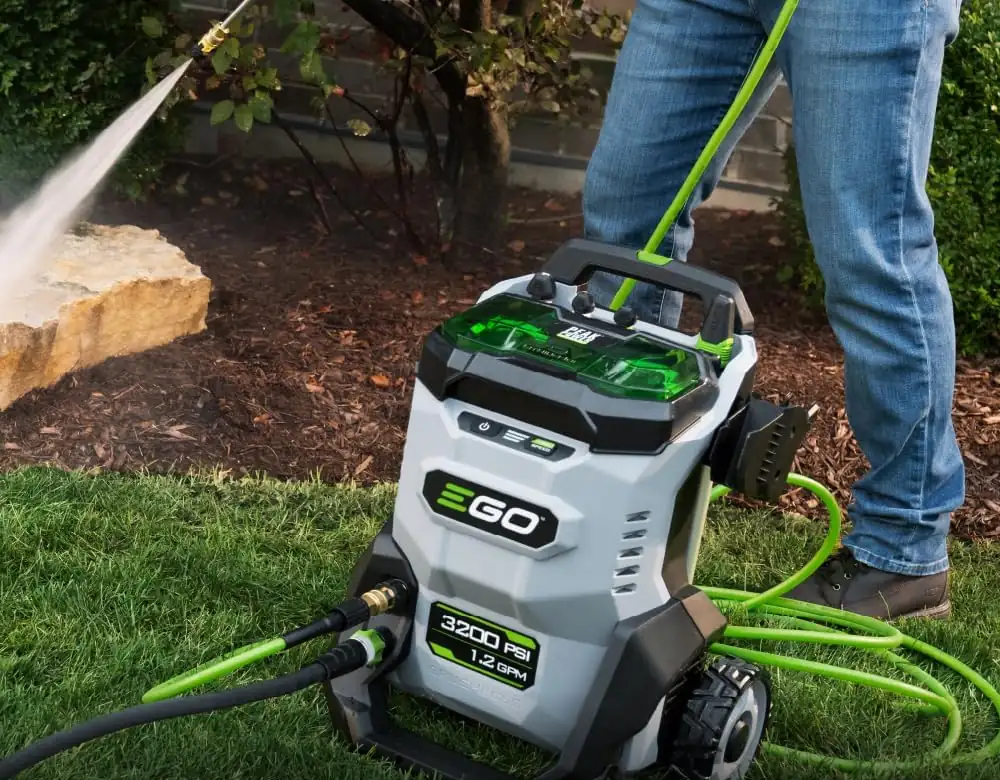
The HPW3204-2 stands on two wheels with a telescopic handle that locks in three positions. With the packs out, I tilted it back on the handle and rolled it on its two wheels instead of lifting it, which the 36.2 lb printed figure makes the sensible way to move it. The HPW2100 has no wheels, so I lifted it by its built-in carry handle with the battery out, and at 20.4 lb without a pack it is the one I prefer to carry up a flight of steps. My list of portable pressure washers weighs carry and storage across cordless and corded picks.
Starting, Stopping and Storing Either Washer
EGO’s start order for both washers runs in this sequence: connect the hoses and the gun; connect the wand and a nozzle, or the foam cannon, which snaps onto the gun directly, and connect the filter if you draw water through the siphon hose; connect the water supply EGO’s manual allows and turn it on; install the battery; press the power button; then hold the gun with both hands, press the unlock side of the lock-off button and squeeze the trigger until the water flow is steady. The HPW3204-2 adds a lance between the gun and the wand, and the washer always runs at high speed after each start.
The Manual
Read the pressure washer’s manual before you connect water or power, and follow it. Its warnings, its operator rules and its steps for your exact model come before anything in this article.
Spray at People
Never point the spray at yourself, another person, a pet or any part of the body. Keep your hands and feet away from the nozzle and the stream. Get medical care without delay for a spray wound, even if it looks minor at first. Tell the clinician that a pressure washer caused the injury.
A case report of a pressure washer injection injury says such injuries can lead to infection, compartment syndrome and in some cases amputation (2), and one case needed surgery to decompress a finger (3). Pressure washer eye injuries in one case series ended in poor final vision (4). The CDC’s pressure washer safety page says to get medical care without delay after a spray wound.
Protective Equipment
Wear safety glasses or goggles and closed footwear when you operate the washer, and put them on before you start; where your manual requires goggles, side shields or a face shield, that requirement replaces the minimum here. Follow the manual’s additional protective-equipment requirements, including hearing protection where the manual requires it, and the detergent label’s requirements when you handle detergent. Keep your hands and feet away from the spray. Protective equipment does not make contact with the stream safe.
EGO calls the trigger lock the lock-off button: it helps to prevent accidental activation of the trigger, and you press its unlock side before the trigger works. EGO’s stop order engages it first, before anything else. I pressed the unlock side with my thumb on both washers and kept the gun in two hands, as EGO says.
EGO says to hold the gun with both hands, to keep good footing and balance at all times, and not to overreach or stand on unstable support.
Ladders and Heights
Do not use a pressure washer for a task at height, such as from a ladder, unless your manual expressly permits the equipment and the method.
Children and Pets
Keep children, pets and other people away from the work area while the machine runs, and never let a child use the machine. Store the washer and its battery or fuel where children cannot reach them.
Complete the stop and make-safe steps for your pressure washer in the safe-state box above, and where your manual gives a different order, follow your manual’s order. EGO’s stop order for both washers keeps the battery in until the pump is drained, and I add the box’s gun direction and relocking.
- Release the trigger and press the lock-off button to the lock position.
- Turn the power off.
- Close the faucet, or lift the siphon hose out of the bucket.
- Point the gun away from people, pets and electrical equipment, unlock the lock-off button, squeeze the trigger to empty the water from the hoses, then engage the lock again.
- Only then disconnect the gun, hoses, wand, nozzles and foam cannon.
- Switch the power on briefly until water stops flowing from the ports, then switch it off.
- Remove the battery pack or packs. If the pressure does not release, stop and get service, and never loosen a fitting.
Storage and Freezing
Before you store the pressure washer, complete the stop and make-safe steps in the safe-state box. Drain and store it as your manual directs, in a place the manual allows and away from children. Store a battery as the battery manual describes, and fuel as the manual and the fuel container’s label describe.
I rolled the hoses and strapped them with the hose holder on both washers. EGO says to store the washer in a dry, well-ventilated area, locked up or up high, out of the reach of children, and never on or beside fertilizers, gasoline or other chemicals. Both manuals have a winterizing section that uses a pump protector, which EGO sells separately. Complete the stop and make-safe steps in the safe-state box above, then follow that section of your manual in full, step by step, because the protector fluid ejects from the outlet port. Both manuals describe rolling the hoses and strapping them with the hose holder, with the gun and wand set in their holder brackets.
Exposure and Emergency
If someone is hit by the stream, get medical care without delay, even if the wound looks small. If someone swallows a cleaning product or gets it in the eyes, follow the label’s first-aid section and call Poison Control at 1-800-222-1222. Call 911 for a fire or immediate danger.
Warranty and Care Between Jobs
EGO’s warranty chart gives outdoor power equipment and portable power products 5 years for consumer use (personal, household) and 1 year for professional use, which EGO defines as any commercial, agricultural or institutional use. EGO’s listing states a 5-year tool warranty on the HPW3204-2, and the chart does not name the HPW2100 by model, so confirm its term with EGO. EGO gives ARC Lithium batteries and chargers 3 years of consumer use and 1 year of professional use, so check your own pack’s terms.
EGO’s HPW3200 manual says the washer should not be used with hard water, and it asks for a flush of at least 120 seconds before storing and a periodic descaling. The HPW2100 manual describes the same descaling and the same hard-water warning.
Cleaning and Maintenance
Before you clean the machine, check or clean the inlet filter, or do any other maintenance, complete the stop and make-safe steps in the safe-state box. Do the maintenance your manual describes, in the order it describes it, and do not use a part or an accessory the maker does not name.
Choose the EGO HPW3204-2 If
EGO Power+ HPW3204-2 3200 PSI Cordless Pressure Washer Kit is the one I recommend when the battery shelf is empty.
- You own no EGO 56V packs. The kit includes two 6.0 Ah batteries and a charger, per EGO’s listing.
- You want wheels. The telescopic handle and two wheels move the 36.2 lb printed weight, without battery packs, without lifting it.
- You want the higher printed ceiling. EGO prints 3200 PSI and a lance set-up for it, and that is a maker figure for the machine, never a promise for any surface.
- Skip it if you already own packs and want the lighter washer to carry, or if the 36.2 lb unit without packs is more than you want to move.
The short gun on the HPW3204-2 doubles as a remote control for the speed, and I went through its buttons and its 5-LED fuel gauge before the first start. EGO’s manual warns that the gun’s coin cell is an ingestion hazard, so keep the gun away from children.
Choose the EGO HPW2100 If
EGO Power+ HPW2100 2100 PSI Compact Cordless Pressure Washer is the one I recommend when EGO packs and a charger are already in the shed.
- You already own 56V packs. EGO’s manual lists the batteries and chargers the HPW2100 accepts, and the box holds neither.
- You carry the washer by hand. The built-in handle and 20.4 lb printed weight, without a pack, suit a lift, with no wheels to roll.
- You want a siphon hose and a foam cannon at the lower printed ceiling. EGO prints 2100 PSI and 1.2 GPM with the wand, and the rinse nozzle is sold separately.
- Skip it if you own no packs and want the washer, batteries and charger in one box, or if you want wheels.
I coiled the HPW2100’s hoses on the body with the hose holder straps and set the gun and wand in the holder brackets, after the safe-state steps, the way EGO’s storage section describes it. My EGO HPW2100 washer review looks at the tool-only washer on its own.
Which EGO Battery Washer I Recommend
Check three things before you order. First, count the EGO 56V packs and chargers you already own, because the HPW2100 box holds neither and the HPW3204-2 box holds two packs and a charger. Second, decide how you will move the washer: the HPW3204-2 rolls on two wheels at 36.2 lb without packs, and the HPW2100 is lifted by its handle at 20.4 lb without a pack. Third, read your manual for the water source, the stop order and the battery rules, and complete the stop and make-safe steps for your pressure washer in the safe-state box above before every hands-on step. Those three checks settle EGO HPW3204 vs HPW2100 for most yards.
Frequently Asked Questions
What is the difference between the EGO 2100 PSI and 3200 PSI pressure washers?
The difference between the EGO 2100 PSI and 3200 PSI pressure washers starts with what EGO prints: the HPW3204-2 lists a maximum rated pressure of 3200 PSI and takes two battery packs, while the HPW2100 lists 2100 PSI and takes one. The HPW3204-2 kit includes batteries and a charger, and the HPW2100 does not.
What size battery does the EGO HPW3204-2 take?
The EGO HPW3204-2 takes EGO 56V ARC Lithium battery packs, two at a time, and the kit includes two 6.0 Ah packs and a charger according to the listing. EGO’s manual says to use only the batteries and chargers it lists, and it recommends two packs of 5.0 Ah or greater for best performance.
What are the speed modes on the EGO HPW3204-2?
The EGO HPW3204-2 has three speed modes that EGO’s manual calls low, high and TURBO, shown by one, two or three green lights. The washer always runs at high speed after each start, and with only one battery pack installed it gives no TURBO speed, as EGO’s manual describes the modes.
Can the EGO HPW3204-2 run on one battery?
According to EGO’s manual, the HPW3204-2 accommodates two battery packs, and with only one pack installed it gives no TURBO speed. Before you install or remove a battery, complete the stop and make-safe steps for your pressure washer in the safe-state box above, and use only the packs and chargers that EGO’s manual lists for the washer.
Is the EGO HPW3204-2 the same washer as the HPW3200?
The EGO HPW3204-2 is the HPW3200 washer sold as a kit with two 6.0 Ah batteries and a charger, while the HPW3200 itself is sold as a tool. EGO’s manual covers the HPW3200 and never names the kit’s number, so match the model on your washer to the manual before you rely on a figure in it.
References
- Asiri M, Kedhim M, Jain V, et al. Impact of temperature and state-of-charge on long-term storage degradation in lithium-ion batteries: an integrated P2D-based degradation analysis. RSC Adv. 2025;15(28):22576-22586.
- Funato N, Sugizaki Y, Ri Y, Ichibayashi R. High-pressure injection damage caused by a high-pressure washer. Cureus. 2024;16(1):e52498. doi:10.7759/cureus.52498
- Choi JH, Choi SY, Hwang JH, Kim KS, Lee SY. Finger compartment syndrome due to a high-pressure washer injury: a case report. World J Clin Cases. 2023;11(13):3017-3021. doi:10.12998/wjcc.v11.i13.3017
- Placide J, Yang MY, Gross AW, Crowell EL. Case series: traumatic ocular lacerations secondary to pressure washers. Am J Ophthalmol Case Rep. 2022;27:101612. doi:10.1016/j.ajoc.2022.101612
Safety Note: Read your pressure washer’s manual before you connect water or power, and follow it. Never point the spray at yourself, another person, a pet or any part of the body. Keep hands and feet away from the nozzle and stream. Get medical care without delay for a spray wound, even if it looks minor at first. Tell the clinician that a pressure washer caused the injury. Wear safety glasses or goggles and closed footwear before operating the washer, plus any additional protection required by the manual and the detergent label. Follow the manual’s instructions for the trigger lock, grip, footing and recoil, and engage the trigger lock whenever you stop spraying. Use only the nozzles, accessories and detergents the manual permits, and never point any nozzle at skin, people or animals. Do not perform a task at height without instructions expressly permitting the equipment and method in the exact manual. Gas models: operate outdoors, never inside a building or a partly enclosed space. Keep the engine at least 20 feet from any window, door or vent, following CDC’s pressure washer guidance and any stricter manual requirement. Exhaust contains carbon monoxide, which cannot be seen or smelled and can kill. Opening doors or windows does not make indoor operation safe. Refuel only with the engine off and cool, following the manual. Corded models: use the manual’s specified electrical supply and GFCI protection, and test the GFCI before use according to its instructions. After an operating GFCI or breaker trip, do not reuse the washer until a qualified repair person has examined it. Where the washer has a grounding prong, connect it to a properly grounded receptacle and never remove the prong. Wear closed, rubber-soled footwear that provides some electrical insulation, plus any additional footwear required by the manual; footwear does not replace GFCI protection or the other electrical precautions. Never cut or splice cords. Use an extension cord only as the manual permits. Keep connections dry and away from runoff, standing water and the washing area, and keep spray away from electrical equipment. Battery models: use only the battery and charger the maker specifies for your exact model. Emergency first: if you notice an unusual odor, a change in color, too much heat, a change in shape, leaking or odd noises from a lithium-ion battery, stop using the washer and follow your battery manual’s emergency instructions. Otherwise, complete the applicable stop and make-safe procedure before hose, nozzle, wand or accessory work, clearing a blockage, cleaning, maintenance, refueling, checking oil, adding detergent, battery changes or charging, draining, moving, transporting, storing or leaving the washer. Follow your exact manual’s procedure and order. Release the trigger and engage its lock. Gas: switch the engine off and wait for it to stop; disconnect the spark plug wire before service as the manual directs, and let hot parts cool before refueling, storage or contact. Corded: switch off and unplug by the plug with dry hands. Battery: switch off, remove a removable battery as the manual directs and keep it away while working; for a built-in battery, follow the manual’s isolation procedure and do not open the battery compartment. Complete the manual’s water-supply shutdown and pressure-relief steps: point the gun in a safe direction at a permitted discharge location, disengage the trigger lock, squeeze the trigger as directed to relieve pressure, then reengage the lock. Do not disconnect hoses or change nozzles until pressure is relieved. If pressure cannot be relieved by the prescribed procedure, obtain service without loosening fittings. Refit and inspect parts before restoring water or power. Replace a damaged high-pressure hose; never repair or patch it. Before you wash, plan how to keep wash water, detergent and debris out of streets, storm drains, ditches and streams, and check with your city or county stormwater office about collection and disposal. Send wash water to landscaping only where local rules and the detergent label permit it and the soil can absorb it without runoff or contamination. Keep children and pets away, and never let a child use the machine. Drain and store the washer as its manual directs. For exposure to a cleaning product, follow the label’s first-aid instructions and call Poison Control at 1-800-222-1222. Call 911 for a fire or immediate danger.