

EGO MHC1603 vs ECHO PAS-225VP is an easy call for most lawns: buy the EGO, the only kit of the two that arrives with its own battery and charger, and the one whose manual states a cutting depth of up to 3 in. The ECHO wins for a buyer who already mixes 2-stroke fuel, would rather refuel than recharge and wants ECHO attachments on the same power head. I judged both on the lawn line beside my concrete work pad and the tilled strips under my plum and apricot trees. Below I compare what each box holds, weight, depth, run time, upkeep and safety.
EGO MHC1603 vs ECHO PAS-225VP: The Short Answer
Both kits put a string trimmer and a vertical-blade edger on one power head, and they differ in what drives it. The EGO is my pick for most owners because it is the complete box and has the simpler routine. The ECHO is the stronger choice for a reader who wants a gas engine and ECHO’s own attachments.
| Row | EGO MHC1603 | ECHO PAS-225VP |
|---|---|---|
| Kit type | 56V battery multi-head kit | Gas 2-stroke Pro Attachment Series kit |
| In the box | Power head, 8 in edger attachment, 16 in string trimmer attachment, 4.0Ah battery, 320W charger, shoulder strap | Power head, curved-shaft edger attachment, Speed-Feed 400 trimmer attachment, support handle; no fuel, no oil, harness optional |
| Edger blade | 8 in | 7.75 in |
| Cutting depth | Up to 3 in, set continuously with a knob | 0.5 in is optimal; maximum not published |
| Weight, edger fitted, no battery and no fuel (sum of the manual figures) | About 11.3 lb | About 14.5 lb |
| Weight with the battery (estimate, assuming a 4.0Ah pack such as the BA2240) | About 16.2 lb | Fuel adds to the 14.5 lb |
| Run time, maker’s figure | Up to 75 minutes of edging on low with the included battery | Not published by the maker; depends on load and the 12.8 fl oz tank |
| Warranty, maker’s figure | 5 years on the tool, 3 years on the battery, 1 year commercial | 5 years consumer, 2 years commercial |
The box row decides it for most buyers, because the ECHO needs fuel and oil before it cuts anything. For most edges, the complete box wins.
What Each Box Contains and What You Add
According to EGO, the MHC1603 holds the PH1420 power head, the EA0820 carbon fiber edger attachment, the STA1600 16 in string trimmer attachment, a 56V 4.0Ah battery, a 320W charger and a shoulder strap. That makes it a ready-to-run trimmer edger combo as soon as the pack is charged. My review of the EGO MHC1603 covers how the full kit handles in use.
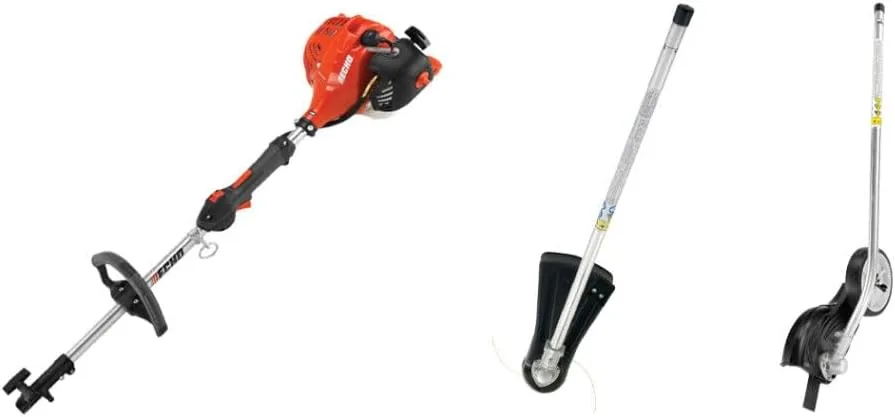
According to ECHO and its manual, the PAS-225VP holds the PAS-225 power head, a Speed-Feed 400 trimmer attachment, a curved-shaft edger attachment, a support handle with its bracket and the quick start guide. The box has no fuel and no oil, and the manual lists a harness as optional equipment that it recommends for trimmer use. You add gasoline, 2-stroke oil and a marked mixing can.
Count the extras before you compare the boxes. The EGO needs a second battery to keep going past one charge, and the ECHO needs the fuel routine.
Weight and Balance Along a Long Edge
Weight depends on what you count, so I add the manuals’ own figures. According to EGO’s manual, the edger attachment weighs 5.09 lb and the PH1420 power head 6.2 lb, which adds up to about 11.3 lb with no battery. EGO’s battery manual lists a 4.0Ah pack such as the BA2240 at 4.87 lb, which brings the working kit to about 16.2 lb as an estimate. ECHO’s manual gives the PAS-225 power head at about 9.3 lb dry and the edger attachment at 5.17 lb with its blade, so the ECHO comes to about 14.5 lb before any fuel goes in.
With the EGO on the edge beside my work pad, the shaft end felt light because the 6.2 lb motor and the battery ride up by my hands. Over the whole lawn border my shoulders still felt the battery weight at the top, so I cut the border into sections and rest between them. I plan the same sections with the ECHO, because fuel adds to the 14.5 lb and the engine sits at the top of the long shaft. Winner: ECHO PAS-225VP, narrowly, because about 14.5 lb dry is lighter than about 16.2 lb with the battery, while the two edger attachments themselves are within a tenth of a pound. For less weight to carry, I compare alternatives in my roundup of the lightest lawn edgers.
Blade Size and Cutting Depth
Depth is where the two manuals differ most. The EGO EA0820 carries an 8 in blade, and EGO’s manual gives a cutting depth of up to 3 in.
You loosen a knob, slide the guide wheel along the depth-adjusting guide bar until the blade just breaks the surface, tighten the knob and check the setting again in your working stance, with the battery out. The ECHO edger blade is 7.75 in long, and its manual calls a depth of 0.5 in optimal without giving a maximum. One guide wheel with a knob sets it.
On the border between a tilled strip and the grass alley I set the EGO wheel with the battery out until the blade only broke the surface, then checked it again standing in my working stance. With the ECHO I set the wheel for about half an inch on the path to the house door. Before I change either setting I switch the tool off, wait until the blade stands still, and only then take out the battery or pull the spark plug wire. My roundup of the top lawn edgers for sidewalks covers path and pavement work in more detail.
Neither kit belongs on gravel. EGO’s manual says not to use the edger on or near graveled surfaces, and an edger throws stones, so I stop the cut where the turf gives way to stone. Winner: none on depth, because the EGO states a maximum and sets depth continuously while the ECHO states a recommended working depth.
Power, Run Time and Refuelling
On the EGO you plan around a charge, and on the ECHO around a tank. According to EGO, the MHC1603 edges for up to 75 minutes on the low setting with the included 4.0Ah battery, and the trimmer runs up to 45 minutes. EGO gives no minutes for high speed. The power head’s two-speed switch is the lever, and the manual says low speed gives better control and a longer run per charge.
ECHO publishes no run time for the PAS-225, because it depends on load and on the 12.8 fl oz tank (14.2 fl oz on older serial ranges). The engine runs on a 50:1 mix of gasoline and 2-stroke oil, and the manual calls for fresh 89 octane gasoline bought within the last 30 days.
I treat EGO’s 75 minute figure as a ceiling when I plan the pad, the path and the house-side border, and I keep the power head on low for the long straight runs. The ECHO takes the manual’s whole starting sequence: stop switch, choke to cold start, purge bulb until fuel flows, then the pulls with the throttle depressed, and the blade turns the moment the engine fires. So I lay the ECHO on level ground with the blade clear of everything, keep everyone 50 ft back and fill the tank outdoors on a cool engine.
The EGO starts with the lock-off lever and a squeeze of the variable-speed trigger, and the blade runs only while I hold it. Winner: EGO MHC1603, because it gives a stated run time and a start with no mixing, choke or pulls.
Swapping Heads and Adding Attachments
Both kits ride on one power head, so the swap between line and blade is a routine you repeat. On the EGO the attachment couples to the power head through an arrow-aligned shaft and a wing knob, and the manual says the knob must be fully tightened and checked from time to time in use. EGO’s PH1420 manual approves further attachments for the power head: a hedge trimmer, pole saw, cultivator, brush cutter, bristle brush, rubber broom and snow shovel.
The ECHO uses a lead-in coupler. You pull the locater pin and turn it a quarter turn, fit the shaft, turn the pin back until it snaps flush and tighten the clamping knob. ECHO says the power head pairs with up to twelve PAS attachments, only ECHO’s own.
Changing from line to blade at the edge of the lawn, I switch the EGO off, wait for the motor to stop and then take out the battery, and on the ECHO I stop the engine, wait for everything to stop and then pull the spark plug wire. On the EGO I tighten the wing knob fully and check that the arrows line up, and on the ECHO I wait for the pin to snap flush before I tighten the clamping knob. Pick by the attachment you need, because each power head takes only its own maker’s tools.
Upkeep, Storage and Warranty
Upkeep is where the energy source shows its cost over the seasons.
The EGO has no fuel and no spark plug. EGO’s manual asks for a gear grease check about every 50 hours of operation, filled to three quarters and never completely, and for a new anti-wear guard on the gear case as soon as the gear case shows. Charge the pack only between 41 and 104 F. My roundup of the top battery powered lawn edgers compares seven cordless options.
A gas trimmer edger combo like the ECHO asks for more between seasons. Mix no more fuel than you expect to use in 30 days, or 90 days with a stabilizer,. For a break longer than 30 days the manual has you drain the tank and run the engine dry, and the wrong oil voids the 2-stroke warranty.
I date the mixed-fuel can the day I make it and keep the EGO battery indoors and dry, apart from the fuel and the fertilizer. According to EGO, the tool carries a 5-year limited warranty, the battery 3 years and industrial or commercial use 1 year. ECHO gives 5 years for consumer use and 2 for commercial use. Winner: EGO MHC1603, because it has no fuel to age and no spark plug to replace.
Noise, Debris and Safety Gear
Neither maker publishes a sound level or a vibration value for the edger, so I cannot rank the two on noise.
In a study of groundskeepers at North Carolina public universities, 82 percent of the maximum equipment sound levels recorded were above 85 dBA (1). NIOSH sampling of landscaping workers found significantly more noise and carbon monoxide exposure with fuel-powered leaf blowers, string trimmers and chainsaws than with battery versions (2). That study did not measure these two kits, so I wear ear plugs and ear muffs together with both.
An edger throws soil and stones. In US emergency department data on lawn trimmers, the eye accounted for 42.5 percent of injuries (3). In a study of lawnmower eye injuries, most came from projectiles such as grass, dirt and rocks, and only 2 percent of the projectile injuries were documented with eye protection (4).
Both manuals ask for eye protection with side shields that meets ANSI Z87.1, hearing protection, gloves, long pants and slip-resistant boots. ECHO’s manual keeps children and animals 15 m (50 ft) back, and I keep 50 ft for both.
Along the tilled strip border I mark the drip lines before the first cut. Before the blade goes into soil, call 811, the free national before-you-dig service, and mark your own sprinkler, drip and lighting lines, which 811 may not locate. Dig-in strikes on underground utilities have caused outages, injuries and deaths (5), and I never treat a cutting depth as safe for buried lines. My roundup of the top edgers for flower beds covers bed lines and tilled borders.
Before You Touch the Blade
Stop the motor or engine, wait until every moving part has stopped, then remove the battery or pull the spark plug wire. A gas engine never runs indoors, in a shed or in a garage, even with the door open, because the exhaust contains carbon monoxide.
Choose the EGO MHC1603 If
The EGO suits the reader who wants to open the box, charge the pack and edge.
- You want the battery and the charger in the box and a kit that runs on the day it arrives.
- You want a stated maximum depth of 3 in and a depth you can set and return to.
- You prefer a lock-off lever and a trigger to a fuel mix and a pull cord.
I come back to the EGO for the controlled pass along the concrete pad edge, because the low setting gives me control, and EGO’s up to 75 minutes on low is the ceiling I plan under. Skip it if you want a gas engine.

Choose the ECHO PAS-225VP If
The ECHO suits a narrower buyer, one who already owns a mixing can. I compare stick and walk-behind options in my roundup of the top gas lawn edgers.
- You already mix 2-stroke fuel and are happy to follow the 50:1 mix and the 30 day fuel limit.
- You want to refuel and keep working instead of waiting on a charger.
- You may add other ECHO attachments to the same power head later.
I reach for the ECHO on a long day with a long border, because the tank sets how long I work, not a battery. Skip it if you want a box with no fuel routine.
Which Kit I Take to the Orchard Edge
For most edges I take the EGO. It arrives with its energy source, states its depth and run time, and asks for no mixing can. I take the ECHO when I want a gas engine and the option of other attachments on the same power head. Eye and ear protection, bystanders kept back and a call to 811 before a new line stay the same with either kit. In the EGO MHC1603 vs ECHO PAS-225VP choice, the EGO is the trimmer and edger kit I put on the work pad. For more options, my roundup of the top lawn edgers compares corded, battery and gas models.
Frequently Asked Questions
Does the Ego trimmer have an edger attachment?
The EGO multi-head system has an edger attachment, and the MHC1603 kit includes it: the 8 in EA0820 sits in the box beside the 16 in string trimmer attachment and the 56V power head. The edger works only with EGO’s own power heads that the manual lists, so it is not an add-on for another brand’s trimmer.
What is the difference between a string trimmer and a stick edger?
A string trimmer cuts with a spinning nylon line, while a stick edger cuts with a vertical metal blade that slices a straight line between turf and a hard edge. Each kit here carries both heads on one power head, the STA1600 trimmer and EA0820 edger on the EGO and the Speed-Feed 400 and curved-shaft edger on the ECHO.
Is a cordless trimmer edger combo as good as a gas one?
A cordless combo is the better fit for most edges, and a gas combo is the better fit when you want to refuel instead of recharge. The EGO MHC1603 brings a battery, a charger and up to 75 minutes of edging on low, while the ECHO PAS-225VP brings a 12.8 fl oz tank and a 50:1 fuel mix.
Which is easier to look after, the EGO MHC1603 or the ECHO PAS-225VP?
The EGO MHC1603 is easier to look after, because it has no fuel to age, no spark plug to replace and only a gear grease check about every 50 hours of operation. The ECHO PAS-225VP asks for a 50:1 fuel mix used within 30 days, a spark plug check and a storage routine for any break longer than 30 days.
Can I add other attachments to the EGO MHC1603 or the ECHO PAS-225VP later?
You can add attachments to both kits, but only the maker’s own. EGO’s manual lists a hedge trimmer, pole saw, cultivator, brush cutter, bristle brush, rubber broom and snow shovel for its power head, and ECHO says its power head pairs with up to twelve PAS attachments, so check the maker’s list before you buy any add-on.
References
- Balanay JAG, Kearney GD, Mannarino AJ. Assessment of Occupational Noise Exposure among Groundskeepers in North Carolina Public Universities. Environ Health Insights. 2016;10:83-92.
- Alexander BM, Graydon PS, Pena M, Feng HA, Beamer BR. Hazardous exposures and engineering controls in the landscaping services industry. Journal of Occupational and Environmental Hygiene. 2025;22(3):189-202.
- Leinert J, Griffin R, Blackburn J, McGwin G. The epidemiology of lawn trimmer injuries in the United States: 2000-2009. J Safety Res. 2012;43(2):137-139. doi:10.1016/j.jsr.2012.03.001
- Stange NR, Jennissen CA. Lawnmower-Related Eye Injuries in the U.S., 2004 to 2023. Am J Ophthalmol. 2025;277:7-16.
- Al-Bayati AJ, Sturgill RE, Panzer L, Victorio SM, Omer T. Locating underground utilities in the United States: A comparative analysis of services provided by private locators. Transportation Research Interdisciplinary Perspectives. 2022;16:100707.
Safety Note: Read your manual first. An edger can throw stones, soil and other debris with force, so remove loose stones, glass, wire and other objects before you start, keep the blade guard in place, and never edge in or near gravel or let the blade strike pavement or rocks on purpose. Wear impact-rated eye protection with side coverage that meets ANSI Z87.1, hearing protection, gloves, long pants, close-fitting long sleeves and sturdy slip-resistant boots. Keep people and pets at least as far away as your manual says (50 feet in some manuals, 100 feet in others), and stop if anyone comes closer. Use only the blade your manual lists for your exact edger or attachment, and fit an attachment only to a power head its maker approves, with the coupling fully locked. Before each use, with the tool switched off, all movement stopped and the battery removed, the cord unplugged or the spark plug wire disconnected (a gas engine cooled), check the blade, its bolts and the guard, and replace a cracked, bent or badly worn blade as your manual says; never sharpen a blade unless that manual allows it. Start the tool in the position your manual shows, with the blade clear of the ground, and let it reach full speed before you ease it into the cut. The blade can push the tool sideways when it hits concrete, a stone or a root, so hold both handles, keep firm footing and never force the cut. After the blade strikes something or the tool starts to vibrate, switch it off, wait for all movement to stop, disconnect the power the same way and inspect it before you go on. Before you clear a jam, change depth, clean the tool, fit or remove an attachment, or inspect or replace the blade, stop the motor or shut off the engine, wait for all movement to stop, then remove the battery, unplug the cord or disconnect the spark plug wire. On a gas edger, releasing the blade control can leave the engine running, and a blade that turns at idle means the edger must not be used until it is repaired. An edger cuts into the soil: in the US, contact 811 before you edge or trench into soil, and mark sprinkler lines, drip lines, landscape lighting wire and other private lines, which 811 may not locate. Refuel a gas model outdoors with the engine off and cool, away from flames or sparks, and move as far from the fueling spot as your manual says before starting; start and run it outdoors only, never in a garage, shed or other closed space, even with the door open. For a battery model, use only the battery and charger approved for your tool, charge and store them within the temperature range in your manual, and never use a damaged or swollen pack. For a corded model, use an undamaged outdoor extension cord of the gauge and length your manual gives, plugged into a GFCI outlet, keep the cord clear of the blade, the wheels and your feet, and avoid wet conditions.