
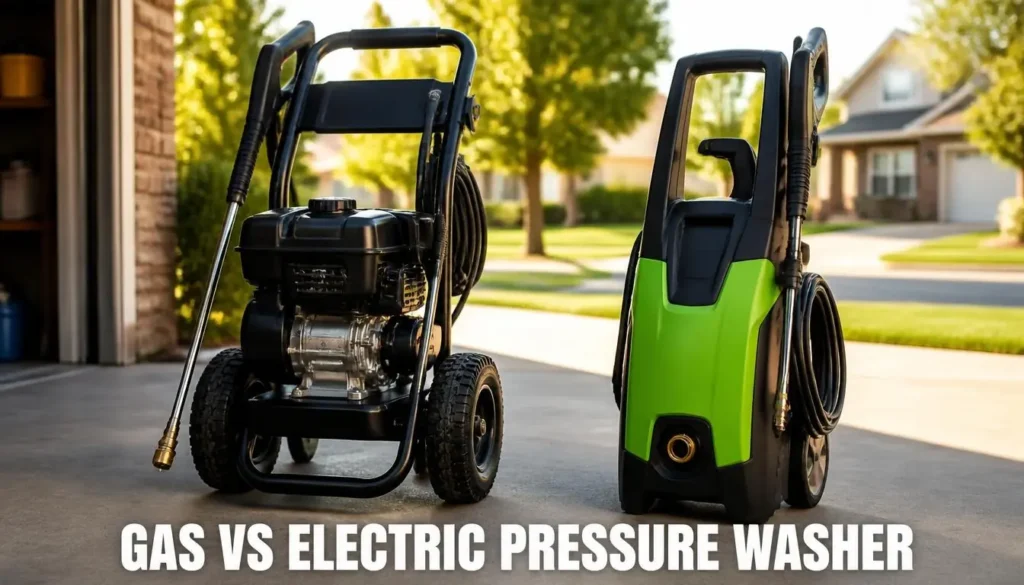
The gas vs electric pressure washer choice starts with what turns the pump: a gasoline engine or a motor on a power cord. That one difference decides what you carry to the job, where the machine may run and what you maintain each season. I read a washer manual the way I read a plant protection label, start to finish, and the manuals below disagree in places. Here are the two types side by side, what each asks of you, and how to choose for a yard like mine.
Gas vs Electric Pressure Washer: The Short Answer
A gas pressure washer uses a gasoline engine to drive its pump, so it needs fuel, engine oil and open air for its exhaust. An electric pressure washer uses a motor on a power cord, so it needs an outlet, GFCI protection and a cord that reaches the work. The printed ratings of the two types sit on each maker’s own basis, so a gas figure and an electric figure are not a ranking. My advice is to choose by what you can store, fuel and plug in, and to leave any claim that one type is simply more powerful out of the decision.
| Row | Westinghouse WPX3400 (gas) | Westinghouse ePX3500 (corded electric) | Sun Joe SPX3000 (corded electric) |
|---|---|---|---|
| Power | 212 cc engine, recoil start | 120 V AC, 13 amps | 120 V, 14.5 amp motor |
| Pressure, as the maker prints it | 3400 PSI, no basis word printed | Peak 2500 PSI; rated max 2000 PSI | Up to 2030 PSI at initial discharge per CSA internal testing; rated 1450 PSI under typical load |
| Water flow, as the maker prints it | 2.6 GPM, no basis word printed | Maximum 1.76 GPM; rated 1.24 GPM | 1.76 GPM at minimum pressure; 1.24 GPM under typical load |
| Fuel and oil | Unleaded gasoline, 87 to 93 octane, ethanol 10% or less; SAE 10W-30 engine oil | None | None |
| Starting | Choke when cold, then the recoil pull | Start button once; the motor then starts when the trigger is squeezed | Motor switch, which must be off before you plug in; reset the GFCI when first plugged in |
| Extension cord | None needed | Never use an extension cord | Not recommended; stated limits if you use one |
| Water temperature | Cold water only | Cold water only | Cold or lukewarm water |
A peak rating, a rated rating and an initial-discharge rating are three different statements, so a printed gas figure cannot be set above or below a printed electric figure. The manual’s technical data page tells you which kind of figure you are reading. My guide to pressure washer PSI and GPM shows how each maker prints those two ratings.
What a Gas Pressure Washer Asks of You
A gas washer is a small engine bolted to a pump, and it asks for what any small engine asks for: fuel, oil, air and attention. The Westinghouse WPX3400 manual is a good example of the routine, and I use it here because it prints the steps plainly.
Stop and Make Safe First
Stop and make safe before you connect or disconnect a hose, change a nozzle, wand or accessory, clear a clogged nozzle, clean a filter, add detergent, refuel, check the oil, charge or change a battery, drain the washer, move it, store it or leave it. Release the trigger and engage the trigger lock on the spray gun. Gas washer: turn the engine off with its switch as the manual says and wait until all moving parts have stopped. Let the engine and the muffler cool for the time your manual gives before you refuel, store the washer or touch hot parts, and disconnect the spark plug wire before maintenance where your manual directs it. Corded electric washer: turn the washer off with its power switch and wait until all moving parts have stopped. Every washer, after the steps above for your type: follow your manual’s water-supply shutdown and pressure-relief procedure. Point the gun away from people, pets and electrical equipment at a discharge location your manual and the detergent label permit. Disengage the trigger lock, squeeze the trigger to relieve the trapped pressure as the manual directs, then engage the lock again. Then unplug a corded washer by the plug, not by the cord, with dry hands. Do not disconnect hoses or change nozzles before the pressure is relieved. If the manual’s procedure does not release the pressure, stop and get service; do not loosen a fitting to release it. Only then disconnect hoses or change nozzles. Where your manual gives a different order for these steps, follow your manual’s order. Follow every applicable step in your manual, in the order it specifies, and check that every hose, fitting and nozzle is attached and undamaged before water or power goes back on. A battery washer has its own steps in its own manual.
The three manuals add orders of their own, and they differ, so each one stands alone here.
- Westinghouse WPX3400 (gas): lock the trigger, turn the engine switch off, close the fuel valve and turn the water off. Then disengage the trigger lock and depress the trigger for 15 seconds to depressurize the system, and only then disconnect the garden hose. For maintenance, disconnect the spark plug boot.
- Westinghouse ePX3500 (corded): stop the washer with its start/stop button, then point the gun in a safe direction and pull the trigger to release the pressure. For a nozzle change, stop the washer, turn the water off, release the pressure and lock the trigger. For maintenance, turn the washer off, release the pressure and unplug it.
- Sun Joe SPX3000 (corded): switch the washer off and unplug it, turn the water off, then hold the trigger to release the water pressure before you disconnect the hoses. Never change a nozzle without locking the safety lock on the trigger handle.
Fuel, Oil and the First Start
Before you do this, complete the stop and make-safe steps for your pressure washer in the safe-state box above. The WPX3400 manual asks for safety goggles or safety glasses with side shields, a full face shield as necessary and full ear protection whenever you operate the washer, and it says to wear eye protection while refueling and to avoid skin contact with engine oil or gasoline. It adds that goggles cover the sides, top and bottom of the eyes, and that safety glasses are not the same thing.
Before the WPX3400 starts for the first time, oil goes in first: the manual says not to crank or start the engine before it has been serviced with the recommended oil, which it names as SAE 10W-30 at 20 ounces. Fuel is unleaded gasoline of 87 to 93 octane with ethanol at 10% or less, and the manual says not to use E15 or E85 and not to mix oil into the fuel. I keep the same order for every engine on the farm: oil and fuel are checked outdoors, with the engine stopped and cool. My guide on how to start a gas pressure washer walks through the order two maker manuals print.
Before you refuel, complete the applicable stop and make-safe steps in the safe-state box, including letting the engine cool as the manual directs. Add only the fuel and oil the manual names, keep fuel away from flame and sparks, and wipe up spilled fuel before you start the engine. The engine and the muffler stay hot after the engine stops, so keep your hands, skin and clothing away from them. The WPX3400 manual puts a number on the cooling: wait at least two minutes before refueling. It adds that you refuel outdoors in a ventilated area, never overfill the tank, let the area of any spilled fuel dry before you operate the washer, inspect for fuel leaks after refueling and never run the engine if a leak turns up.
Before you do this, complete the stop and make-safe steps for your pressure washer in the safe-state box above. Starting follows the manual’s order. Connect the garden hose and turn the water on, squeeze the gun trigger to purge air until a steady stream flows, and only then start the engine: engine switch on, fuel valve on, choke to CHOKE when the engine is cold, a slow pull until you feel resistance and then a fast pull, and the choke to RUN once it runs. The manual also warns that running the machine for more than a minute without spraying lets heat build in the pump.
Exhaust and Where You May Run It
Operate a gas pressure washer outdoors, never inside a building or a partly enclosed space. CDC says to keep it at least 20 feet from any window, door or vent, and your manual may set a stricter placement, which you follow (1). Engine exhaust contains carbon monoxide, which you cannot see or smell and which can kill. Opening a door or a window does not make it safe to run an engine inside. If anyone develops symptoms such as headache, dizziness, weakness, nausea or confusion, move to fresh air and get emergency medical care.
The research agrees with the plain rule. A study of small gasoline engines concluded that they should not be run inside buildings or in semi-enclosed spaces, and ordinary ventilation did not change that (2). My machinery shed has a dirt and concrete floor and doors that close, and I treat it as the first place a gas washer must never run.
Care That Comes With an Engine
Before you do this, complete the stop and make-safe steps for your pressure washer in the safe-state box above. The WPX3400 manual lists a routine: check the oil and the inlet screen with its gasket before every use, clean the air filter every 50 hours or six months, clean the spark plug at 100 hours or six months and replace it at 300 hours or once a year. Valve clearance is a dealer job. None of it is hard, and all of it is a schedule you keep, which is the real cost of an engine.
What an Electric Pressure Washer Asks of You
An electric washer swaps the engine for a motor, so fuel, engine oil and exhaust leave the job and a power cord enters it. The cord sets how far you can work from an outlet, and the water beside it is why the electrical rules matter. Two corded manuals, the Westinghouse ePX3500 and the Sun Joe SPX3000, show how a corded washer behaves. For the start order of a corded model, I wrote out the steps in my piece on starting an electric pressure washer.
The Plug, the GFCI and the Cord’s Reach
Both manuals describe a GFCI built into the power cord’s plug. The ePX3500 manual says to test it monthly by pressing TEST, listening for a click and pressing RESET, and it adds that GFCI plugs do not protect against shocks, short circuits and overloads. The SPX3000 manual says the GFCI may need a reset when the washer is first plugged in. Federal safety guidance says to plug a corded washer into a grounded receptacle with GFCI protection and to keep extension cord connections out of standing water.
Electricity Beside Water
Use the electrical supply and the GFCI protection your manual specifies, and test the GFCI before use according to its instructions. If the washer trips a GFCI or a circuit breaker while you use it, stop using it and have a qualified repair person examine it before you use it again; do not keep resetting it and carry on. Where the washer has a grounding prong, connect it to a properly grounded receptacle and never remove the prong. Never cut or splice a power cord or an extension cord. Wear closed, rubber-soled footwear that gives some electrical insulation, plus any additional footwear the manual requires; footwear does not replace GFCI protection or the other electrical precautions. Use an extension cord only if your manual permits it, and then only the type and length it names. Keep every plug and cord connection dry, out of standing water and away from runoff and the area you are washing, and keep the spray away from outlets, wiring and electrical equipment. Do not use a damaged cord or plug.
Extension Cords and Two Different Manuals
The two manuals do not agree. Westinghouse says never to use an extension power cord on the ePX3500, because it causes voltage drop and can burn the motor. Sun Joe says an extension cord is not recommended on the SPX3000, and then gives limits if you use one: not over 25 feet, the combined length not over 60 feet, and 14-gauge or heavier. The same manual adds that an extension cord’s plug and socket must be of watertight construction and that a cord on a drum must be completely unwound so it does not overheat. I name no winner. When your manual forbids a cord, the washer’s own cord is your reach, so I measure from the outlet to the work before I buy.
Before you do this, complete the stop and make-safe steps for your pressure washer in the safe-state box above. The ePX3500 manual asks for eye protection and says never to operate the washer in bare feet, sandals or open-toed shoes. The SPX3000 manual asks for safety glasses, safety footwear, snug-fitting clothing, protective gloves, and hearing and head protection.
The ePX3500 also has an auto-start feature. The motor runs for several seconds and stops, and the manual warns that the unit could be pressurized even when you cannot hear the motor and pump running. It asks for slow, deliberate trigger pulls, because squeezing fast makes it miss a cycle. A battery washer is a third type with its own manual and its own steps, so I leave it out of this comparison and cover it in my article on battery vs corded electric pressure washer.
Before you inspect parts or connect hoses, complete the applicable stop and make-safe steps in the safe-state box. Inspect the high-pressure hose, the spray gun and every fitting before each use, as your manual describes, and do not use a damaged part. Replace a damaged high-pressure hose; never repair or patch it. Connect the hoses and turn on the water before you start the machine, and purge and start it in the order your manual specifies. The inlet screen is the part I look at first, the same way I clean the 150-mesh disc filter at the pump head of my drip system.
Reading the Printed Ratings Without Ranking Them
Every figure in the table is a maker’s statement for one model. The ePX3500 manual prints a peak pressure and a lower rated pressure, and a maximum flow and a lower rated flow. The SPX3000 manual prints a pressure at initial discharge under CSA internal testing and a rated pressure under typical load. The WPX3400 manual prints one figure for each and no basis word.
That is why a printed gas figure and a printed electric figure are not a ranking. I treat a printed PSI the way I treated a sprayer nozzle chart: it is a rated figure, and I want the conditions before I compare it with a second one. A number is not the job either. What a surface can take is set by the manual and by the surface maker’s care instructions, so I leave settings to them. My piece on what PSI a washer needs shows how to read a printed rating.
Gas vs Electric Pressure Washer Pros and Cons
A fair list for each type says what the machine asks of you, in the manual’s own terms. I recommend reading the maintenance page of a manual before the buying page, because that page tells you what the next five years look like.
What the Gas Type Asks For
- Fuel and oil: unleaded gasoline with ethanol at 10% or less, engine oil before the first start, and no fuel left in the tank for storage in a closed space.
- Outdoor space: open air, 20 feet from any window, door or vent, and more if the manual says so.
- Engine care: the oil and screen checks before each use and the filter and plug intervals above.
- A reach without a cord: the engine needs no outlet, so the hose and the work area set the distance.
- Lifting help: the manual says to have assistance when lifting the washer, and the maker’s page gives a dry weight of 63 pounds without fuel or oil.
What the Electric Type Asks For
- An outlet in reach: the cord is the reach, and one manual forbids an extension cord.
- GFCI protection: a plug GFCI that you test or reset as the manual says, and a stop if it trips.
- No fuel or engine oil: the corded manuals read here list no fuel and no engine to service, and they still ask for hose, inlet screen and O-ring care.
- Weight as printed: the Sun Joe SPX3000 manual prints a net weight of 27.6 pounds.
- Indoor storage: the Westinghouse manual says to store the washer indoors in a heated place.
The electric manuals do not say that a corded washer needs no care. The ePX3500 manual asks for cleaned and greased hose O-rings and says never to clean the machine with a garden hose, and silence about a task is not proof that no task exists.
Moving, Storing and Winter Care
Storage is where the two types part ways most, and it is where manuals are clearest. Before you store the pressure washer, complete the stop and make-safe steps in the safe-state box. Drain and store it as your manual directs, in a place the manual allows and away from children. Store fuel as the manual and the fuel container’s label describe.
Gas Washer Storage
The WPX3400 manual asks for at least 30 minutes of cooling before storage and says fuel left in the tank for more than 30 days can deteriorate. It also says never to store a pressure washer with fuel in the tank indoors or in a poorly ventilated area where fumes can reach an ignition source. For winter it names an RV non-toxic antifreeze or a pump protection made for pressure washers, and it warns not to let water in the pump freeze. The wheels are for hand transport only, and the manual says not to up-end the washer or lay it on its side.
Electric Washer Storage
The ePX3500 manual says that when water freezes and expands, the high-pressure pump will crack, and its label says not to store the machine where the temperature could drop below 40 F. It asks you to tilt the unit to drain the inlet, remove the nozzles, wrap the hose and cord on their retainers and store the washer in a dry, covered place. The SPX3000 manual says freeze damage is not covered by the warranty and never to store the washer outdoors. An unheated tool shed freezes in a cold snap on my place, so for me those lines decide where a washer lives from late fall.
Gas or Electric Pressure Washer for Your Yard
Power is the wrong place to start. Start with four questions about your own ground, and answer them with the manual of the model you are looking at.
- The nearest outlet: if the work area sits within the cord, a corded washer removes fuel, oil and exhaust from the job. If the manual forbids an extension cord, the washer’s own cord is the whole reach.
- Room for an engine: it must sit outdoors and 20 feet from every window, door and vent. If it cannot, a gas washer has no place there.
- A winter home: the freeze and storage lines above decide where either type sleeps.
- Lifting, fuelling and service: an engine adds a schedule and a weight that the manual asks you to lift with help.
On my property the list is short: the distance from the plug to the work area, whether the engine can stand clear of every door and window, and where the washer waits out January. If a plug is within reach of the job, I lean to a corded model from my top electric pressure washers list, because it takes fuel and exhaust off the list. If the job is beyond any cord, I accept the engine and its rules. I also never rely on a washer’s name to tell me its type, because the manual states the power source.
The Spray Rules Are the Same for Both
Whatever drives the pump, the stream is the hazard. The strong spray can cause serious wounds that look minor at first (1). In US emergency department records, pressure washers are the most common source of hand injection injuries (3). A case report describes how such an injury can lead to infection and compartment syndrome and, in some cases, amputation (4). A series of three patients describes open and blunt-sharp eye injuries from pressure washers, and all three needed surgery (5).
Before You Squeeze the Trigger
Read the pressure washer’s manual before you connect water or power, and follow it. Its warnings, its operator rules and its steps for your exact model come before anything in this article. Never point the spray at yourself, another person, a pet or any part of the body. Keep your hands and feet away from the nozzle and the stream. Get medical care without delay for a spray wound, even if it looks minor at first. Tell the clinician that a pressure washer caused the injury. Wear safety glasses or goggles and closed footwear when you operate the washer, and put them on before you start; where your manual requires goggles, side shields or a face shield, that requirement replaces the minimum here. Follow the manual’s additional protective-equipment requirements, including hearing protection where the manual requires it, and the detergent label’s requirements when you handle detergent. Keep your hands and feet away from the spray. Protective equipment does not make contact with the stream safe. Engage the trigger lock on the spray gun whenever you stop spraying, even for a moment, before you set the gun down, and before you walk away or change position. Disengage the lock only for controlled spraying or for the manual’s pressure-relief procedure, with the gun pointed in a safe direction. The WPX3400 manual says to grasp the gun with two hands, to operate only on level surfaces and not to use the washer where the kickback of the gun could cause a serious fall from a raised position, because the forces from the gun can make you lose your footing. The ePX3500 manual says to hold the gun and lance with two hands, one to pull the trigger and one to stabilize the gun, until you get used to the recoil, and to keep good footing and balance. Start the stream away from your feet and from anyone else, and never swing the gun toward people or pets as you turn. Keep children, pets and other people away from the work area while the machine runs, and never let a child use the machine. Store the washer and its battery or fuel where children cannot reach them. If someone swallows a cleaning product or gets it in the eyes, follow the label’s first-aid section and call Poison Control at 1-800-222-1222. Call 911 for a fire or immediate danger.
What to Settle Before You Buy
Two checks settle most of the choice. First, measure from the nearest outlet to the work, and find a spot 20 feet clear of every door, window and vent for an engine. Second, read the storage page of the manual and ask where the washer will sit in January, because a washer you cannot store as the manual directs is the wrong one for the yard. My one tip is to make the second check before the first purchase decision, since the gas vs electric pressure washer lists above matter less than a place to keep the machine. If an engine suits your yard, my top gas pressure washers roundup compares five models on engine, soap system and hose.
Frequently Asked Questions
What is the difference between a gas and an electric pressure washer?
A gas pressure washer runs its pump from a gasoline engine, while an electric pressure washer runs it from a motor on a power cord. The engine needs fuel, oil and outdoor space for its exhaust, and the motor needs an outlet, GFCI protection and a cord that reaches. Each maker prints its ratings on its own basis, so the manual of the exact model decides what it may do.
What are the pros and cons of a gas vs electric pressure washer?
The pros and cons come down to what each type asks of you, because printed ratings cannot be ranked across makers. A gas model asks for fuel, oil, engine upkeep, outdoor placement and storage care, and an electric model asks for an outlet, a GFCI and a cord that reaches. Read the manual of the exact model before you weigh either list.
Can you use an extension cord with an electric pressure washer?
An extension cord is banned on some electric pressure washers and limited on others, so the manual of your model decides. Westinghouse says never to use one on the ePX3500, while Sun Joe says it is not recommended on the SPX3000 and lists limits if you use one. When your manual allows none, the cord that came with the washer sets your reach.
Where can you use a gas pressure washer?
A gas pressure washer belongs outdoors, never inside a building or a partly enclosed space, and at least 20 feet from any window, door or vent according to CDC. Your manual may set a stricter placement, which you follow. Opening a door or a window does not make it safe to run an engine inside.
Which is easier to store, a gas or an electric pressure washer?
The easier washer to store is the one whose manual steps your space can meet, because the two types ask for different things. The Westinghouse gas manual asks for 30 minutes of cooling and no fuel in the tank indoors in a poorly ventilated area, and the Westinghouse electric manual says to store the washer indoors in a heated place. Follow your own manual’s draining and winter steps either way.
References
- Centers for Disease Control and Prevention. Pressure washer safety. Natural Disasters. Published May 15, 2024. Reviewed August 26, 2026. Accessed October 31, 2026.
- Earnest GS, Mickelsen RL, McCammon JB, O’Brien DM. Carbon monoxide poisonings from small, gasoline-powered, internal combustion engines: just what is a “well-ventilated area”? Am Ind Hyg Assoc J. 1997;58(11):787-791. doi:10.1080/15428119791012289
- Johnson C, Newton W, LaRochelle L, Allen J, Daly C. High-pressure injection injuries of the hand in community and industrial settings: incidence and trends. Hand (N Y). 2025;20(6):917-922. doi:10.1177/15589447231218404
- Funato N, Sugizaki Y, Ri Y, Ichibayashi R. High-pressure injection damage caused by a high-pressure washer. Cureus. 2024;16(1):e52498. doi:10.7759/cureus.52498
- Placide J, Yang MY, Gross AW, Crowell EL. Case series: traumatic ocular lacerations secondary to pressure washers. Am J Ophthalmol Case Rep. 2022;27:101612. doi:10.1016/j.ajoc.2022.101612
Safety Note: Read your pressure washer’s manual before you connect water or power, and follow it. Never point the spray at yourself, another person, a pet or any part of the body. Keep hands and feet away from the nozzle and stream. Get medical care without delay for a spray wound, even if it looks minor at first. Tell the clinician that a pressure washer caused the injury. Wear safety glasses or goggles and closed footwear before operating the washer, plus any additional protection required by the manual and the detergent label. Follow the manual’s instructions for the trigger lock, grip, footing and recoil, and engage the trigger lock whenever you stop spraying. Use only the nozzles, accessories and detergents the manual permits, and never point any nozzle at skin, people or animals. Do not perform a task at height without instructions expressly permitting the equipment and method in the exact manual. Gas models: operate outdoors, never inside a building or a partly enclosed space. Keep the engine at least 20 feet from any window, door or vent, following CDC’s pressure washer guidance and any stricter manual requirement. Exhaust contains carbon monoxide, which cannot be seen or smelled and can kill. Opening doors or windows does not make indoor operation safe. Refuel only with the engine off and cool, following the manual. Corded models: use the manual’s specified electrical supply and GFCI protection, and test the GFCI before use according to its instructions. After an operating GFCI or breaker trip, do not reuse the washer until a qualified repair person has examined it. Where the washer has a grounding prong, connect it to a properly grounded receptacle and never remove the prong. Wear closed, rubber-soled footwear that provides some electrical insulation, plus any additional footwear required by the manual; footwear does not replace GFCI protection or the other electrical precautions. Never cut or splice cords. Use an extension cord only as the manual permits. Keep connections dry and away from runoff, standing water and the washing area, and keep spray away from electrical equipment. Battery models: use only the battery and charger the maker specifies for your exact model. Emergency first: if you notice an unusual odor, a change in color, too much heat, a change in shape, leaking or odd noises from a lithium-ion battery, stop using the washer and follow your battery manual’s emergency instructions. Otherwise, complete the applicable stop and make-safe procedure before hose, nozzle, wand or accessory work, clearing a blockage, cleaning, maintenance, refueling, checking oil, adding detergent, battery changes or charging, draining, moving, transporting, storing or leaving the washer. Follow your exact manual’s procedure and order. Release the trigger and engage its lock. Gas: switch the engine off and wait for it to stop; disconnect the spark plug wire before service as the manual directs, and let hot parts cool before refueling, storage or contact. Corded: switch off and unplug by the plug with dry hands. Battery: switch off, remove a removable battery as the manual directs and keep it away while working; for a built-in battery, follow the manual’s isolation procedure and do not open the battery compartment. Complete the manual’s water-supply shutdown and pressure-relief steps: point the gun in a safe direction at a permitted discharge location, disengage the trigger lock, squeeze the trigger as directed to relieve pressure, then reengage the lock. Do not disconnect hoses or change nozzles until pressure is relieved. If pressure cannot be relieved by the prescribed procedure, obtain service without loosening fittings. Refit and inspect parts before restoring water or power. Replace a damaged high-pressure hose; never repair or patch it. Before you wash, plan how to keep wash water, detergent and debris out of streets, storm drains, ditches and streams, and check with your city or county stormwater office about collection and disposal. Send wash water to landscaping only where local rules and the detergent label permit it and the soil can absorb it without runoff or contamination. Keep children and pets away, and never let a child use the machine. Drain and store the washer as its manual directs. For exposure to a cleaning product, follow the label’s first-aid instructions and call Poison Control at 1-800-222-1222. Call 911 for a fire or immediate danger.