
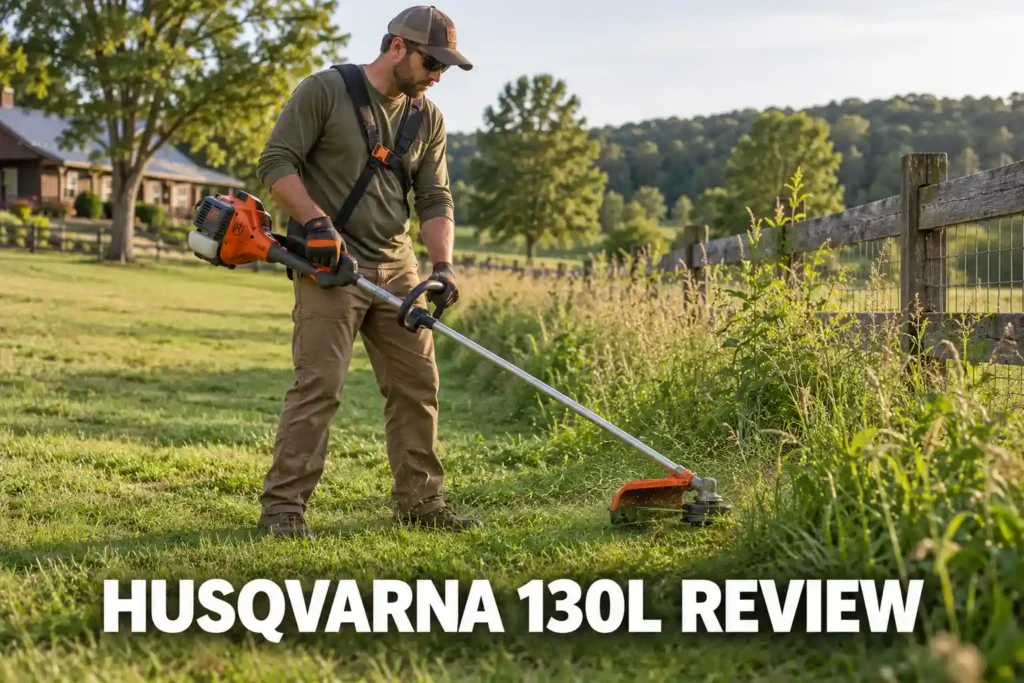
The Husqvarna 130L review verdict is short: buy it for long fence lines, tree-row strips and gravel edges, and skip it if you want light weight, low noise or attachments. I used it on the strips under the plum and apricot rows of our 3.7-acre orchard and along the yard fences. According to Husqvarna, it is a 28 cc straight-shaft gas trimmer with an 18-inch swath and a bump-feed head. Below I cover the specs, fuel and line, how it cuts, weight and vibration, who should buy it and how it compares with two other gas trimmers.
Husqvarna 130L Review: My Verdict in Short
I recommend the Husqvarna 130L for a property with long runs of edge: fence lines, strips under trees and the grass side of a gravel yard. Its 28 cc engine and 18-inch swath cover ground quickly, and the RapidReplace head reloads in three short steps. The price of that reach is a two-stroke routine of mixed fuel, a rope start and hearing protection every minute the engine runs. It cuts grass only, so brambles and woody stems need a different tool, and the manual calls it a tool for occasional operation, not for daily hours of trimming. I also rank it in my roundup of string trimmers for large yards.
- Who it suits: owners of large lawns, fence lines and orchard strips who want a wide-swath gas trimmer on a straight shaft.
- What it does best: long edges, where the 18-inch swath and the quick line reload save the most time.
- Main trade-off: hand vibration. Husqvarna’s product page gives a rear handle figure of 8.93 m/s2, well above the 3.5 m/s2 in the 122LK manual.
Husqvarna 130L Specs and What Comes in the Box
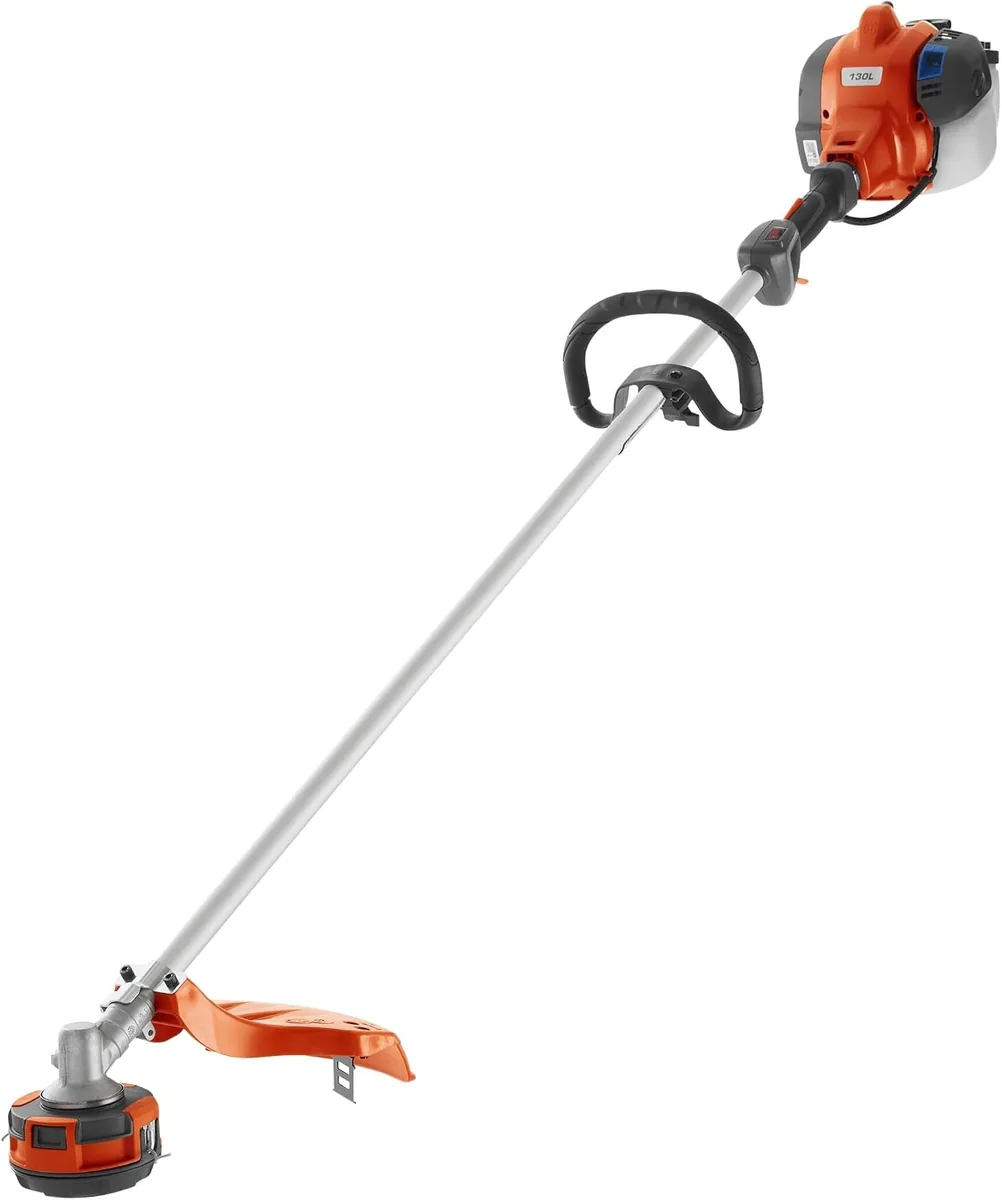
The two rows that matter most are the engine and the swath: a 28 cc two-stroke driving an 18-inch cut. The Husqvarna 130L gas string trimmer ships as the power unit with the RapidReplace head fitted. A harness, fuel, oil and blades are not in the kit.
| Spec | Husqvarna 130L |
|---|---|
| Power Source | Gas, two-stroke |
| Engine | 28 cc (1.7 cu in); fuel tank 0.5 L (1.12 US pint) |
| Fuel Mix | 50:1 (2%) with air-cooled two-stroke oil |
| Cutting Swath, maker’s figure | 18 in (45.7 cm) |
| Line Diameter, manual | Head takes .080 to .105 in line |
| Feed Type | Bump feed (tap advance) |
| Shaft | Straight; 70 in overall product length, maker’s figure |
| Weight, manual | 11.0 lb (5.0 kg) without fuel, head and guard |
| Attachment Capable | No |
| Run Time | Depends on load and tank; not published by the maker |
Husqvarna’s product page gives 12.2 lb excluding the cutting equipment, against the manual’s 11.0 lb. Neither includes fuel, so the tool in your hands weighs more than either number.
Husqvarna 130L Fuel Mixture and Starting Routine
The 130L runs on a 50:1 mix, which is 2 1/2 fluid ounces of two-stroke oil in each US gallon of fresh unleaded gasoline with no more than 10% ethanol. Use oil made for air-cooled engines, never outboard or four-stroke oil, and mix no more than a month of fuel at a time.
I measure the oil into a marked bottle before the gasoline goes in, because 2 1/2 ounces to the gallon leaves no room for guessing.
A cold start follows the manual’s order exactly:
- Move at least 10 feet away from the place where you fuelled.
- Press the air purge bulb 10 times.
- Set the choke lever to full choke.
- Hold the unit on the ground with one hand and pull the starter rope handle 3 times with force, without pulling the rope all the way out and without touching the throttle trigger.
- Move the choke to half choke and pull until the engine runs.
- Let it run for 10 seconds, then switch the choke off.
On a cool morning at the yard edge I notice that the order of bulb, choke and rope matters more than the force. If the engine is hot and will not restart, the manual’s cure is 20 minutes of cooling and 10 to 15 seconds on the purge bulb. Never run the engine in a shed, a garage or any closed space, even with the door open: carbon monoxide.
Fuel and Fire Safety
Stop the engine and let it cool before you refuel, open the cap slowly, keep flames and sparks away, and never start the trimmer if fuel has spilled on it or on you.
How the Husqvarna 130L Cuts on Fence Lines, Tree Rows and Gravel Edges
The 18-inch swath is the reason to buy this trimmer. The Husqvarna 130L string trimmer cuts best with the head just above the ground at a slight angle and the line parallel to it, without pushing the head into the soil.
Fence Lines and Orchard Strips
Along the yard fences I drop to the 80% throttle the manual gives for working near objects, and I keep the head angled just above the soil. On the tilled strips under the plum and apricot rows, I use the wide swath to take the grass at the strip edge in one long pass, then stop well short of the thin-barked trunks. Line can strip the bark of a young tree, so it never touches a trunk; near plants the manual advises a shorter line and the lower throttle.
Gravel Edges and Thrown Stones
Along the gravel yard the line flings small stones sideways, so the guard stays on and I trim the grass side of the edge, never the stone side. Eye protection that meets ANSI Z87.1 is a must here: US emergency departments treated an estimated 81,907 lawn trimmer injuries in ten years, and the eye accounted for 42.5% of them (1). Keep people and pets 50 feet away. Besides eye and hearing protection, the manual calls for protective gloves, heavy long pants, long sleeves and heavy slip-resistant steel-toe boots.
Tall Grass and Long Line
A long line loads the engine more than a short one, and the manual says so. In tall grass at the drainage ditch bank the head will not advance on soft ground, because the manual tells you to tap it on a hard, flat surface. I switch the engine off, wait for the head to stop, let the engine cool, disconnect the spark plug wire and only then pull line out by hand. For overgrown areas, I compare nine picks in my roundup of string trimmers for tall grass.
Husqvarna 130L String Size and How the Head Reloads
The manual’s accessory table lists line from .080 to .105 inch for the RapidReplace head on this model. Husqvarna’s product page recommends .095 inch line, and I use that as my starting point and keep any other size inside the manual’s range. Never fit anything the manual does not list.
The Husqvarna 130L trimmer head reloads without tools. Switch the engine off, wait for the head to stop, let the engine cool, disconnect the spark plug wire, and only then touch the head. Turn the top half of the head until the line holes align, push a 22-foot (6.7 m) piece of line through, and wind the line by turning the head until about 5 inches shows on each side.
Soaking line in water for two days makes it last longer, and cleaning the head cover with each new line prevents unbalance. I keep a coil of line in a bucket of water for that reason.
Weight, Vibration and Noise After a Long Edge
The unit is heavier than the 122LK, and it feels that way at the far end of a long edge. With the head fitted and the tank full the load sits well above the dry 11.0 lb, and the arms feel it first. I stop and shake out my hands before the next fence post.
According to Husqvarna’s product page, vibration at the front handle is 5.66 m/s2 and at the rear handle 8.93 m/s2. In a laboratory comparison, a grass trimmer gave the highest hand vibration of the grounds tools tested, and gloves lowered it (2). Line length also matters: on one trimmer, line length, engine speed and handle material all changed the vibration, so keep the line at the length the manual gives (3).
The manual warns of white finger: if fingers discolor, tingle or go numb, stop and see a doctor.
Noise is the other cost. According to Husqvarna’s page, the sound at the operator’s ear is 95.4 dB(A), and the sound power level is 116 dB(A). Two petrol grass-trimmer engines in one field study measured about 100 and 105 dB(A) at the operator, above recommended limits for a full workday (4). I wear foam plugs under earmuffs from the first minute.
Husqvarna 130L Attachments and What That Means
The manual’s accessory table lists only the RapidReplace head and its guard, and it describes no attachment system. The manual says to use only flexible cutting line. Never fit a metal blade to it, because the maker lists none for this tool.
That limits the job. The brambles and woody regrowth at the hedgerow base are not work for line, so I leave them for a tool built for a blade. A detachable model such as the 122LK below takes attachments.
Who Should Buy the Husqvarna 130L and Who Should Skip It
The 130L suits a buyer with a lot of edge and a fuel routine to match. My top string trimmer picks cover nine options across yard sizes, budgets and power types.
Buy It If
- You trim long fence lines, orchard strips or lawn borders and want an 18-inch swath.
- You want a straight shaft and a head that reloads in three short steps.
- You are comfortable mixing 50:1 fuel and starting by rope.
Skip It If
- You want attachments or a blade for brush.
- Weight and hand vibration already bother you on a long job.
- You want a quiet tool or a tool with no fuel to store.
- You plan regular, extended trimming; the manual describes occasional operation.
Drawbacks of the Husqvarna 130L
Vibration is the first one. The rear handle figure on Husqvarna’s page is 8.93 m/s2, so plan breaks on long edges.
Bump feed is the second: in tall, thick grass the head does not always advance, and you must switch off, wait for the head to stop, let the engine cool and disconnect the spark plug wire before you pull line out by hand. Gas upkeep is the third, with fresh 50:1 fuel every month, a clean air filter and plug, and grease for the bevel gear. For thick growth, I compare battery and gas options in my roundup of string trimmers for thick weeds.
In a bench test of one two-stroke engine, carbon-based material made up most of the fine particle mass (5). I run it outdoors with the wind at my back. Read the warranty statement that comes with the tool.
How the Husqvarna 130L Compares With Two Gas Alternatives
Two gas trimmers make the closest comparison: the ECHO SRM-3020T and the Husqvarna 122LK. The 122LK is the detachable, attachment-capable one. I compare the 130L with the Echo in my Husqvarna 130L and Echo SRM-3020T comparison.
ECHO SRM-3020T
The ECHO SRM-3020T has a larger 30.5 cc engine and a 20-inch swath according to ECHO’s page, and it is a dedicated straight-shaft trimmer with no attachment coupling.
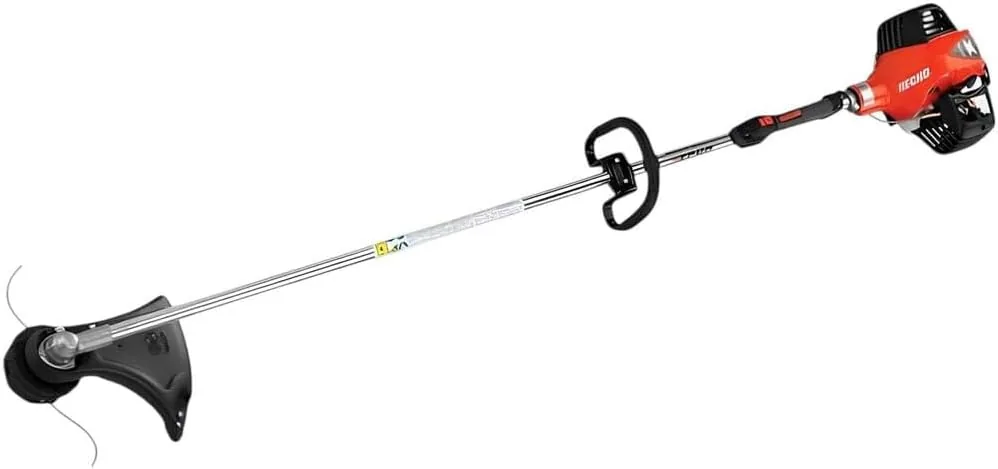
Pick the ECHO if you want the widest swath and a bigger engine and accept a heavier tool.
Husqvarna 122LK
The Husqvarna 122LK is the lighter, detachable sibling. It has a 21.7 cc engine, a 17-inch swath and an attachment list that includes an edger, a hedge trimmer and a pole saw.
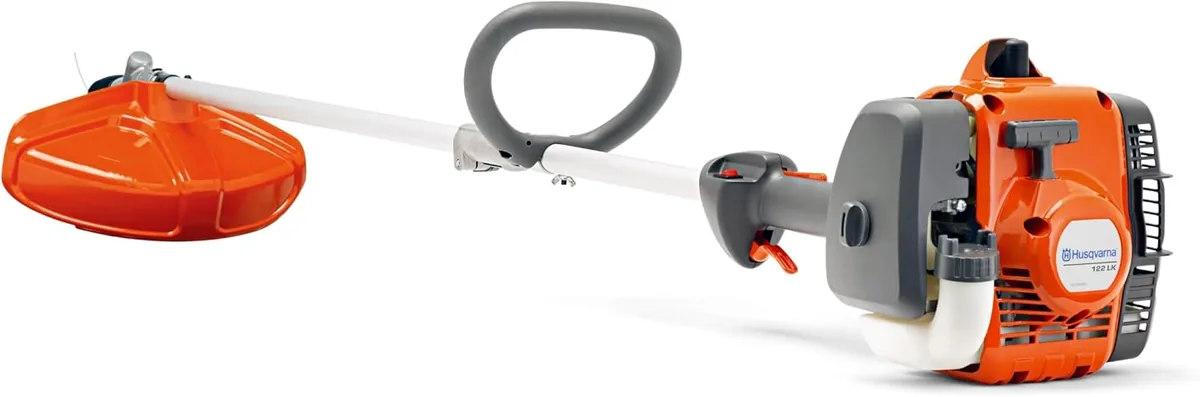
Pick the 122LK if you want one power unit for several jobs and a lower dry weight, and your edges are shorter.
| Spec | Husqvarna 130L | ECHO SRM-3020T | Husqvarna 122LK |
|---|---|---|---|
| Engine | 28 cc two-stroke | 30.5 cc two-stroke | 21.7 cc two-stroke |
| Cutting swath, maker’s figure | 18 in | 20 in | 17 in |
| Weight, manual | 11.0 lb, no fuel, head or guard | 12.3 lb, dry, without head | 10.6 lb, no fuel, attachment or guard |
| Attachments | No | No | Yes |
Common Problems With the Husqvarna 130L and How to Avoid Them
Most trouble traces back to fuel or care.
- Hard starting when hot: cool the unit for 20 minutes and press the purge bulb 10 to 15 seconds.
- Old fuel: mix no more than one month of fuel at a time.
- Shaking handles: clean the head cover each time you fit new line.
- Engine strain: drop to idle after each work step; long spells at full throttle with no load can damage the engine.
- Burns: the bevel gear, the muffler and a grey marked area near the engine get hot and stay hot.
For care, the manual lists the air filter, the plug, the cooling fins and bevel gear grease. The Husqvarna 130L spark plug is a Champion QCJ-8Y with a 0.6 mm (0.024 in) gap. For storage, empty the fuel tank, fit the transportation guard, remove the spark plug cap and keep the tool away from sparks and open flame.
Before any cleaning or line change, switch off, wait for the head to stop, let the engine cool and disconnect the spark plug cap. Before carrying, fit the transportation guard and remove the cap as well.
My Final Verdict on the Husqvarna 130L
I recommend the 130L to anyone who trims long fence lines, orchard strips and gravel edges and does not mind a two-stroke routine. Its 18-inch swath and three-step line reload are the reasons to pick it, and its rear handle vibration and lack of attachments are the reasons to walk past it. Any Husqvarna 130L review comes down to one trade: buy it for long edges, skip it if you need light weight or a blade. I compare five gas string trimmers by power, weight and warranty in my roundup.
Frequently Asked Questions
What size line does a Husqvarna 130L use?
A Husqvarna 130L uses trimmer line from 0.080 to 0.105 inch in diameter, according to the manual’s accessory table for its RapidReplace head. Husqvarna’s product page recommends 0.095 inch line, so I start there for most trimming, and I never fit a size the manual does not list for that head.
How to string up Husqvarna 130L?
To string up a Husqvarna 130L, switch off, wait for the head to stop, let it cool and disconnect the spark plug wire. Then turn the top half of the head to the line holes, push a 22-foot piece through and wind until about 5 inches shows on each side, and no tools are needed.
How to start a Husqvarna 130L weed eater?
To start a Husqvarna 130L weed eater cold, press the purge bulb 10 times, set full choke, hold the unit down and pull the rope 3 times. Then set half choke, pull until it runs, wait 10 seconds and switch the choke off, at least 10 feet from the fuelling spot.
What fuel does a Husqvarna 130L take?
A Husqvarna 130L takes good quality unleaded gasoline with no more than 10% ethanol, mixed with oil for air-cooled two-stroke engines at 50:1. That is 2 1/2 fluid ounces of oil per US gallon, and the manual says never to mix more than one month of fuel at a time.
Does Husqvarna use 40 1 or 50 1?
Husqvarna’s manual for the 130L gives a 2% mix, which is 50:1, so use 50:1 with air-cooled two-stroke oil. That means 6 1/2 fluid ounces of oil for 2 1/2 gallons of fuel, or about 12 7/8 fluid ounces for 5 gallons, with fuel no more than a month old.
References
- Leinert J, Griffin R, Blackburn J, McGwin G. The epidemiology of lawn trimmer injuries in the United States: 2000-2009. J Safety Res. 2012;43(2):137-139. doi:10.1016/j.jsr.2012.03.001
- Oh J, Chen N, Boyd C. Laboratory evaluation of occupational exposure to hand-arm vibration (HAV) during grounds maintenance equipment operations. Ann Agric Environ Med. 2023;30(2):384-389.
- Mallick Z. Optimization of the operating parameters of a grass trimming machine. Appl Ergon. 2010;41(2):260-265. doi:10.1016/j.apergo.2009.07.010
- Mallick Z, Badruddin IA, Khaleed Hussain MT, Salman Ahmed NJ, Kanesan J. Noise characteristics of grass-trimming machine engines and their effect on operators. Noise Health. 2009;11(43):98-102. doi:10.4103/1463-1741.50694
- Tsai JH, Chen YR, Chen SJ, et al. Characteristics of Emissions from a Portable Two-stroke Gasoline Engine. Aerosol Air Qual Res. 2020;20(3):630-642.
Safety Note: Read your manual first. A string trimmer or brush cutter throws debris with force, so clear stones, glass and wire from the area before you cut. Wear impact-rated eye protection with side coverage that meets ANSI Z87.1, hearing protection, gloves, heavy long pants, long sleeves and sturdy slip-resistant boots (steel-toe where your manual says so). Keep people and pets at least as far away as your manual says (50 feet in some manuals, 100 feet in others), and stop if anyone comes closer. Keep the correct guard fitted, use only the cutting attachments, handles and harness the maker approves for your exact tool, and never replace trimmer line with wire. A blade can kick sideways when it hits a stump or a thick stem, so fit the handlebar and harness your manual requires for blade work, hold both handles firmly and keep secure footing. Before you clear a jam, clean the tool or change line, a blade or an attachment, switch it off, wait for all movement to stop, then remove the battery, unplug the cord or disconnect the spark plug wire. Refuel a gas model outdoors with the engine off and cool, away from flames or sparks, and move away from the fueling spot before starting, as far as your manual says (often 10 to 30 feet); never run it in a garage, shed or other closed space. For a battery model, use only the maker’s battery and charger, charge it within the temperature range in your manual and never use a damaged or swollen pack. For a corded model, use a GFCI outlet, keep the cord clear of the cutting line and avoid wet conditions.