
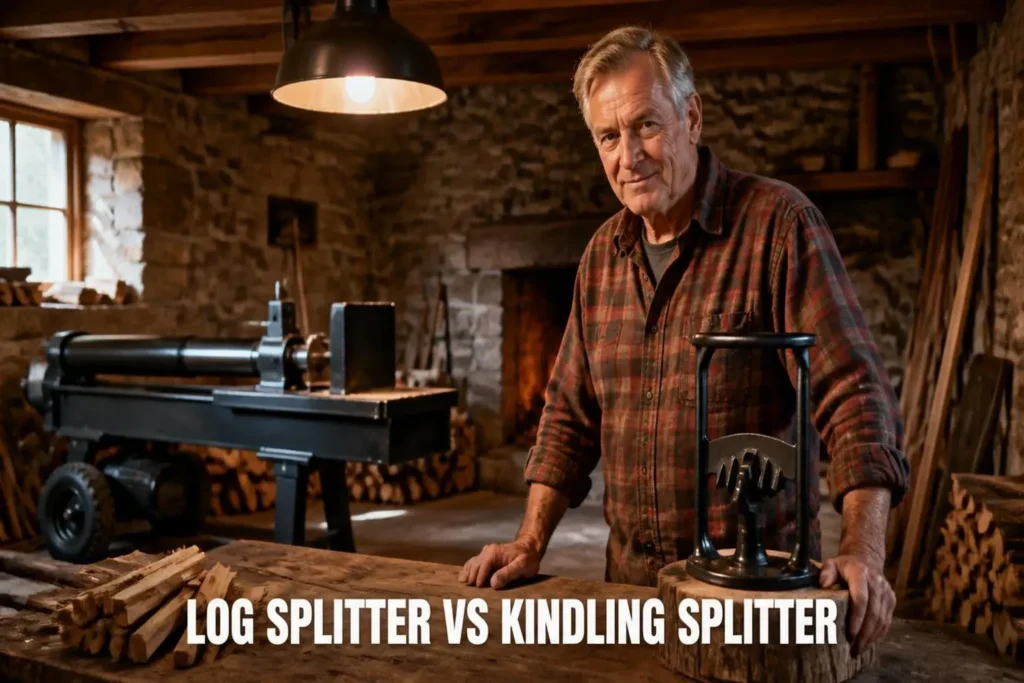
The log splitter vs kindling splitter choice comes down to wood size. A log splitter is a machine, driven by a motor or a hand pump, that pushes whole rounds through a wedge, and a kindling splitter is an unpowered tool, either a frame you strike with a hammer or a hand lever, that turns small pieces into stove kindling. I cut up pruned apricot and plum limbs every winter on our orchard, and the small, forked pieces showed me where each tool stops. Below you will find what each one takes, the limits the makers print, the safety rules, and which one fits your wood pile.
The Short Answer on Log Splitter vs Kindling Splitter
Buy a log splitter when your job is whole rounds for the stack, and buy a kindling splitter when your job is small pieces for a stove, fire pit or pizza oven. The two tools overlap only at the small end of the wood range. A log splitter works inside a printed window of log length and diameter, and a kindling splitter works inside the opening of its frame. Match the tool to the thickest piece you will actually put through it. My kindling splitter picks rank five hand-tool options for the small end of the pile.
| Point | Kindling splitter | Log splitter |
|---|---|---|
| Power | None. Kindling Cracker says to strike it with a hammer, mallet or another piece of wood; lever designs take a hand lever instead | Electric motor or hand pump, as in the examples below |
| Size it takes, as printed | Kindling Cracker Original: 6.5 in ring opening. King XL: 9 in ring opening | BILT HARD 6.5 ton electric: logs up to 20.47 in long and 1.97 to 9.84 in across. Sun Joe LJ10M hand pump: 13.5 to 18 in long without the manual’s block for short logs, up to 8 in across |
| Force | No rating, the force is your swing | Rated in tons by the maker, for example 6.5 tons or 10 tons |
| Cost tier | Budget for the Kindling Cracker | Budget for the Sun Joe LJ10M, mid-range for the Yardmax and VEVOR examples |
| Best at | Small, straight, dry pieces | Whole rounds inside the manual’s limits |
On our place the split follows wood size. The thicker pruning limbs and any rounds from an orchard removal are machine work, the pencil-thick prunings go to a chipper, and a kindling tool only matters for the pieces in between. My guide to a log splitter or wood chipper shows which branches belong to which machine.
What a Kindling Splitter Is and How It Works
A manual kindling splitter, meaning one with no motor or pump, is a fixed wedge held in a frame, and you supply the force with a hammer. It has no motor, no cord and no fluid, so the opening and the base are what you weigh when you choose one. The two common designs differ in how you present the wood, and I cover both below.
Ring-and-Wedge Tools
The Kindling Cracker firewood splitter is a one-piece cast iron frame with a fixed toothed wedge inside a safety ring. According to Kindling Cracker, you strike the wood with a hammer, mallet or even another piece of wood. The Original has a 6.5 in ring opening on a 12 in frame, and the King XL has a 9 in ring opening on a 17 in frame. The maker lists no hammer weight, and none comes in the box. My comparison of the Original against King XL covers ring size, weight and which frame to buy.
According to Kindling Cracker, the ring keeps your hands completely away from the fixed splitting wedge at all times. That is the maker’s claim, and it does not replace eye protection or clear footing. Both frames have bolt holes for mounting to a stump or workbench. For our shed pad I recommend bolting the frame down, since a tool that shifts under a hammer blow is the one that surprises you.
Wall-Mounted Lever Tools
A wall-mounted kindling splitter works differently: a hand lever pushes a blade through the wood, so no hammer is involved, and the tool is fixed to a wall. Check the maker’s log range and the wall you plan to use before you buy one. I cover the hammer tools in the rest of this guide, because they are the common ring-and-wedge design.
What a Log Splitter Does Differently
A log splitter uses a motor or a hand pump to drive a hydraulic cylinder, and the cylinder pushes the log into a wedge or pushes a wedge into the log. Makers rate that force in tons, for example 6.5 tons for the electric units and 10 tons for the Sun Joe LJ10M. A ton rating is the maker’s number, never a measured force, and the same manuals print that tonnage and cycle time vary with conditions. I explain how the pump drives the ram in my answer to “how does a log splitter work”.
The electric examples run from a 120 V, 15 A outlet. The BILT HARD 6.5 ton unit takes logs up to 20.47 in long, and the Yardmax YS0650 prints 20.5 in long and 10 in across. The Sun Joe LJ10M has no motor at all: you pump its handles, and it prints a log window of 13.5 to 18 in long and up to 8 in across. Every one of these figures belongs to its own manual, and none of them is a ranking of one maker’s length against another’s diameter.
Log Size and Wood Limits for Each Tool
Size limits decide this comparison more than anything else. The kindling tool stops at its opening, the powered tool stops at its printed length and diameter, and the wood itself can stop both. I treat every printed limit as a ceiling and never as a target. My answer to “what size log splitter do I need” starts from your longest and widest round.
Opening, Length and Diameter
A ring opening is not a log limit. Kindling Cracker prints the ring size and publishes no maximum log size or length, so I describe the opening as 6.5 in or 9 in and leave it there. On the powered side, BILT HARD prints a diameter range of 1.97 to 9.84 in for its 6.5 ton electric unit, and it adds that a small knotty log can be hard to split while a regular log slightly over the figure may split. That minimum matters for kindling: a piece thinner than about 2 in sits outside the printed range of that unit. I look at the larger frame in my King XL review.
The Sun Joe LJ10M adds a second limit. Its manual gives a 13.5 in minimum log length and says a shorter log needs a flat wood block in front of the ram plate. I do not improvise that block from my own wood pile. If you want to follow that step, read the manual’s instruction first and use the block exactly as it describes. I cover this manual hydraulic model in my Sun Joe LJ10M splitter review.
Knots and Grain
Knots and interlocked grain can resist splitting. The USDA Wood Handbook describes interlocked-grain wood as exceedingly difficult to split radially (1). Sun Joe says small logs with knots or harder wood may be more difficult to split, and its manual tells you not to force a log that fails on the first attempt. In my orchard the forked collars from plum limbs are the pieces I keep out of a ring tool, since a fork sits badly in a 6.5 in opening.
Dry Kindling Burns Better
Dry pieces are what you want in the stove. A University of Tennessee extension publication puts properly seasoned firewood below 20 percent moisture and green wood above 60 percent, and it says wood must be cut to length, split, stacked and given airflow to dry (2). A stove study found that fuel moisture changes burning rate and emissions, and that a probe moisture meter could underestimate the true moisture in some cases (3). I stack split pieces off the ground under cover near the shed, because kindling that is still wet defeats the reason to make it.
Using a Log Splitter for Kindling
A powered splitter can make kindling, but only inside its printed window. The question to ask is whether your pieces are long enough and thick enough for that manual. I read the minimum diameter line first, because pruning pieces are small, and I do not buy a hydraulic splitter to make kindling. I compare five options for firewood, branches and kindling in my list of log splitters for small logs.
Splitting a piece twice on a powered unit is a method only where the manual allows the piece at all. The BILT HARD manual prints 1.97 in as the smallest diameter, and the Sun Joe LJ10M prints 13.5 in as the shortest log. A piece thinner than the BILT HARD minimum is outside that unit’s printed range, and a log shorter than the usual Sun Joe LJ10M window needs the manual’s flat-block method or a different tool. A manual’s silence on small pieces is not permission, so check the exact manual for your model before you load anything short or thin.
Safety Before You Split Anything
A powered splitter drives a ram or wedge with tons of rated force, and a kindling frame is struck with a hammer. The safety section below gives the rules for both, and the shutdown box covers every time you stop the machine to free a log, check fluid, clean or move it.
Safety for Hands, Hammer and Machine
Hand injuries are the documented risk of powered splitters. A clinical case series from Vermont described disabling hand injuries from powered log splitters used to process fuel wood (4). A Swedish registry and interview study linked hand injuries to unsafe machines and to patterns of use such as more than one person at the machine (5). A second Swedish study rated injury severity, which ranged from minor to major (6).
None of this puts a number on your risk. It tells you where the hazard sits.
Before Every Start
Pre-Start Check
Before every start, check that the wedge, ram, beam, hoses and fittings are undamaged and tight, the fluid is at the level your manual gives, and every guard is in place. If the splitter leaks, groans, vibrates or moves the ram on its own, stop, complete the full shutdown and have it fixed before you use it again.
Hands and Controls on a Powered Splitter
Hands and Controls
Never put your hands or feet between the log and the wedge, the ram or any part of the splitter while it moves, and keep your fingers out of cracks that open in the log: they can close suddenly. Load the log by holding its sides, never its ends, and run the control only with your hand. Never tie down, block or bypass a two-hand control. Keep your hands clear during both the splitting stroke and the return stroke. Follow your manual’s unloading sequence; WEN 56207 requires the entire cycle to finish and the ram to retract fully before removing split wood. Never straddle or step over an operating splitter or reach or bend over it to retrieve a log.
The Yardmax YS0650 uses a two-hand control: the left hand holds the hydraulic lever and the right hand holds the push button, and the pusher freezes when either hand lets go. I treat that as the reason the control exists, never as a puzzle to solve.
One Operator
One person operates the control. That person also loads the log unless the exact manual explicitly permits a loading helper. Never let anyone hold the log while you operate the splitter. If a loading helper is permitted, wait until the helper has left the operating area and reached the clearance required by the manual before moving the control.
BILT HARD and Yardmax both say the splitter is operated by one person only and that nobody helps free a jammed log.
Eyes, Ears, Feet and Clothing
Wear the eye protection your manual specifies (Champion calls for ANSI-approved safety glasses, and Boss calls for safety goggles or safety glasses with side shields), and a face shield where your manual asks for one; hearing protection with a gas engine or wherever your manual asks; sturdy boots, steel-toed where your manual asks; gloves exactly as your manual directs; and no loose clothing, jewelry, drawstrings or untied long hair.
The manuals disagree on gloves, so follow the exact one. BILT HARD and Yardmax each print a ban on gloves caught in moving parts next to a glove recommendation in the same manual, and VEVOR asks for tight fitting gloves without loose cuffs or draw strings. Read your own manual’s wording before you decide.
Bystanders, Site and What to Split
Bystanders and Site
Keep children, pets and other people out of the work area, at least the distance your manual prints, and stop the splitter if anyone comes closer. No distance makes a work area safe on its own: keep watching it. Set the splitter on firm, level, dry ground outdoors, never on a slope, ice, mud or slippery ground. Secure it against movement as the manual directs; Yardmax’s gas models require blocking the front and back of both wheels. Work in daylight or good artificial light as the manual permits, and keep split pieces cleared away from your feet. Never run an electric splitter in rain or damp conditions, and observe every additional weather restriction in your manual.
VEVOR prints 10 ft for people and pets on its 6.5 ton electric unit, and that figure belongs to that one manual. BILT HARD and Yardmax print no distance for their electric units, so keep well clear of the work area, as each manual describes. For anchoring, the Yardmax YS0650 manual lists two bolts or stakes, which you supply, and VEVOR asks you to block the wheels.
What to Split
Split one log at a time, with the grain and square-cut ends, within every size and weight limit your manual gives, including any minimum length. Check for nails, wire and other foreign objects. Do not use knotted, curved or uneven logs where your manual forbids them; Boss ES7T20 forbids uneven logs, including knotted or curved logs. Stop at the manual’s splitting time limit and follow its procedure for repositioning or rejecting the log; never force it. Any exception involving a second log is allowed only in the exact manual’s stated procedure.
Full Shutdown Box
Shutdown before you free a stuck log, check or add fluid or oil, touch a hose, fitting or the wedge, clean, sharpen, adjust, move, store or leave the splitter. Never use your hands to free a stuck log, and never check a hydraulic leak with your hand. Electric splitter: release the controls, switch the motor off, wait until every moving part has stopped completely, including the ram and any flywheel, then unplug it from the outlet by the plug. Manual hydraulic splitter: stop pumping and release the pressure exactly as your manual says. On a hydraulic splitter, relieve the hydraulic pressure as your manual describes before servicing it or touching any hose, fitting, cap or the wedge area. Never remove the hydraulic oil cap or vent plug while the machine is running or hot. Use only the stuck-log procedure your manual gives, including its instructions for any powered clearing step, and refit every guard before restarting.
Stuck Log
Never free a stuck log with your hands. Before intervening, complete the full shutdown in the shutdown box. Follow only your exact manual’s stuck-log procedure, including any instructions for a powered clearing step. Complete the full shutdown again before any further hands-on intervention.
Hydraulic Fluid
Pressurised hydraulic fluid can inject through your skin from a hole too small to see. Never check for a leak with your hand: pass a piece of cardboard or wood over the spot and look for discolouration. If fluid hits your skin, see a doctor at once, even if the wound looks small. Before touching any hose, fitting or cap, complete the full shutdown for your splitter in the shutdown box, including hydraulic pressure relief exactly as your manual describes. Never open the hydraulic oil cap or vent plug while the machine is running or hot.
Electric Cord
Use the grounded supply your manual requires and GFCI protection. If the manual permits an extension cord, use a grounded three-wire cord rated for outdoor use, with the manual’s specified gauge and length. Keep connections away from water and the cord away from moving parts and your feet. Never handle the plug with wet hands or unplug by pulling the cord.
Cord rules differ by maker. Yardmax prints no cord longer than 30 ft and at least 12 gauge for the YS0650, and VEVOR prints no more than 25 ft and a minimum gauge of 16 for its ELS106S. At our shed pad I place an electric unit near the shed outlet, so the cord stays within the gauge and length in its manual. If an outlet is within reach, my electric log splitter picks compare five plug-in models for home firewood.
The Hammer Tool
Kindling Cracker publishes no hammer weight and no striking method beyond the sentence quoted above, so follow the maker’s instructions for your exact frame when you swing. For eyes, the University of Minnesota Extension advice for hand splitting is to wear goggles or safety glasses whenever striking a steel wedge, and I treat a hammer on a cast iron frame the same way. Before each strike I clear the ground around the frame and put on safety glasses.
Rest When You Tire
Loading rounds is heavy, repetitive work. Follow your manual’s lifting and handling instructions and every printed log-weight limit. Take breaks and stop when you are tired or your attention slips.
Speed, Cost, Noise and Storage
The makers of the tools named here print no sound level, and a kindling tool has no cycle time, so the useful comparison is setup, power and storage.
| Point | Kindling splitter | Log splitter |
|---|---|---|
| Power | None | 120 V outlet and a cord for the electric units, your own pumping for the Sun Joe LJ10M |
| What you add | A hammer, mallet or another piece of wood, and a block or bench to bolt it to | Hydraulic oil level per the manual, and a cord of the printed gauge and length for electric units |
| Moving it | Carry it, or fix it to a block or bench; a lever design is fixed to a wall | Wheels and handles: 6 in tires on the VEVOR, 7 in wheels on the Yardmax, and wheels marked for minor moving only on the BILT HARD |
| Weight, with basis | Kindling Cracker King XL 21 lb per the maker’s product weight | VEVOR 99.4 lb net; Sun Joe LJ10M 87 lb net; BILT HARD 98 lb, basis not stated |
| Care | Brush it off, according to Kindling Cracker | Fluid checks and changes at the manual’s interval |
| Storage | Dry, off the ground | Dry and out of children’s reach, as the manual directs. Before you store a machine, complete the full shutdown in the shutdown box above; VEVOR also asks you to let its unit cool for 5 minutes after use before storing |
These are small differences for one household and large ones for a shed with one outlet. A tool you have to wheel to the pile and plug in gets used less often for a handful of kindling sticks, and a frame bolted at the pad gets used every time the stove is lit. That habit matters more to me than any spec line. I compare the two power options for a firewood pile in my manual or electric splitter guide.
Which Should You Buy?
The choice follows the wood you actually have and the place you will work.
Choose a Kindling Splitter If
Choose the Kindling Cracker Original if your pieces are modest and your goal is kindling for a stove, fire pit or pizza oven. Pick the King XL if your pieces run thicker and you can accept a taller frame. A frame bolted down at the work pad suits a household that lights a stove often. Skip it if you want to split rounds for the stack, because it is a small-wood tool and not a firewood machine. My Kindling Cracker Original review looks at the cast iron splitter with the 6.5 in opening.
Choose a Log Splitter If
Choose a log splitter if your wood arrives as rounds that fit a manual’s printed window, such as the 20.47 in length and 9.84 in diameter of the BILT HARD unit, and you have an outlet near the pad. Choose the hand-pump Sun Joe LJ10M if there is no outlet and your rounds sit inside its 13.5 to 18 in by 8 in window. Skip it if kindling is the whole job, since kindling pieces are thinner than the BILT HARD minimum and shorter than the usual Sun Joe LJ10M window. My BILT HARD electric splitter review goes through its printed length and diameter limits.
Own Both If
Own both when you burn wood through the winter and your pile includes both rounds and small pieces. The machine handles the rounds, and the frame handles the pieces that fall below the machine’s minimum.
What to Remember Before You Choose
Decide first whether you need to split rounds, make kindling from prepared splits, or do both, then read the printed limits of the exact tool before you buy. One tip from my own habit: sort the pile by thickness before you reach for any tool, so the right wood goes to the right splitter. Read the exact manual for the model you own and stay within every limit it prints. For most stove households the log splitter vs kindling splitter question is settled by whether you split rounds, make kindling, or do both. My best log splitter ranking shows which machines suit which rounds.
Frequently Asked Questions
What’s the easiest way to split kindling?
The easiest way to split kindling is to use a tool that holds the piece in place while you apply the force. According to the maker, you strike the wood in a Kindling Cracker with a hammer, mallet or another piece of wood, and its safety ring is there to keep your hands away from the wedge.
What is a kindling splitter?
A kindling splitter is an unpowered tool that holds a small log against a fixed wedge or blade so you can turn it into kindling. Some designs are struck with a hammer, like the Kindling Cracker, and others use a hand lever fixed to a wall.
Can a log splitter split kindling?
A log splitter can split kindling only if the piece falls inside the printed size range of that exact manual. The BILT HARD 6.5 ton electric unit prints a minimum diameter of 1.97 in, and the Sun Joe LJ10M prints a 13.5 in minimum log length with a flat-block method in its manual for shorter logs.
What is a cast iron kindling splitter?
A cast iron kindling splitter is a one-piece iron frame with a fixed wedge that you strike with a hammer. The Kindling Cracker is one: the maker describes a cast iron splitting head inside a cast iron frame with a safety ring on top.
What is an electric kindling splitter?
An electric kindling splitter is the name some shoppers use for a small electric log splitter used on kindling-size wood. The electric splitters in this guide are sold as electric hydraulic log splitters, and their manuals give log length and diameter ranges rather than a kindling mode.
References
- Ross RJ, ed. Wood Handbook: Wood as an Engineering Material. General Technical Report FPL-GTR-282. USDA Forest Service, Forest Products Laboratory; 2021.
- Taylor A. Moisture Content of “Seasoned” Firewood. W179. University of Tennessee Institute of Agriculture; 2014.
- Price-Allison A, Lea-Langton A, Mitchell EJS, et al. Emissions performance of high moisture wood fuels burned in a residential stove. Fuel. 2019;239:1038-1045.
- Kristiansen TK, Seligson D. Log splitter injuries to the hand. J Occup Med. 1981;23(6):400-402.
- Lindqvist A, Nilsson O. Hand injury from powered wood splitters: machine safety, patterns of use and injury events. Int J Occup Saf Ergon. 2011;17(2):175-186.
- Lindqvist A, Berglund M, von Kieseritzky J, Nilsson O. Assessment of the severity of injuries to hands by powered wood splitters. J Plast Surg Hand Surg. 2010;44(4-5):237-244.
Safety Note: Only an adult who has read the manual and understands the controls should use a log splitter, never a child or anyone tired or impaired. The ram and wedge push with tons of force and can crush or cut off fingers, hands and feet: never put your hands or feet between the log and the wedge, the ram or any part of the splitter while it moves, keep your fingers out of cracks that open in the log, load each log by holding its sides, never its ends, and run the control only with your hand, never tying down, blocking or bypassing a two-hand control. Keep your hands clear during both the splitting stroke and the return stroke. Follow the manual’s unloading sequence; WEN 56207 requires the entire cycle to finish and the ram to retract fully before removing split wood. Never straddle or step over an operating splitter or reach or bend over it to retrieve a log. One person operates the control and also loads the log unless the exact manual explicitly permits a loading helper. Never let anyone hold the log while you operate the splitter. If a loading helper is permitted, wait until that helper has left the operating area and reached the manual’s required clearance before moving the control. Keep children, pets and other people out of the work area, at least the distance your manual prints for that exact model, and stop if anyone comes closer. No single distance is safe for every splitter. Set the splitter on firm, level, dry ground outdoors, never on a slope, ice, mud or slippery ground. Secure it against movement as the manual directs; Yardmax requires blocking the front and back of both wheels. Work in daylight or good artificial light as the manual permits, and keep split pieces cleared away from your feet. Never run an electric splitter in rain or damp conditions. Split one log at a time, with the grain and square-cut ends, within every size and weight limit your manual gives, including any minimum length. Check for nails, wire and other foreign objects. Reject knotted, curved or uneven logs where the manual forbids them; Boss ES7T20 forbids uneven logs, including knotted or curved logs. Stop at the manual’s splitting time limit and follow its procedure rather than forcing the log. Wear the eye protection your manual specifies: Champion calls for ANSI-approved safety glasses, and Boss calls for safety goggles or safety glasses with side shields. Also use a face shield where your manual asks for one, hearing protection with a gas engine or wherever your manual asks, sturdy boots (steel-toed where your manual asks), gloves exactly as your manual directs, and no loose clothing, jewelry, drawstrings or untied long hair. Pressurised hydraulic fluid can inject through your skin from a hole too small to see: never check for a leak with your hand, pass cardboard or wood over the spot instead, and see a doctor at once if fluid hits your skin, even if the wound looks small. Before freeing a stuck log, checking or adding fluid or oil, servicing, cleaning, sharpening, adjusting, moving, towing, storing or leaving the splitter, complete the shutdown for its power type. Electric: release the controls, switch the motor off, wait until every moving part has stopped completely, including the ram and any flywheel, then unplug it from the outlet by the plug. Gas: release the controls or return the hydraulic control lever to neutral as your manual directs, turn the engine off, wait until every moving part has stopped completely, including any flywheel, let the engine and muffler cool, then disconnect the spark plug wire and secure it away from the plug. Manual hydraulic: stop pumping and release the pressure exactly as your manual directs. On every hydraulic splitter, relieve hydraulic pressure as the manual describes before servicing or touching a hose, fitting, cap or the wedge area. Never remove the hydraulic oil cap or vent plug while the machine is running or hot, and never adjust pump or valve pressure settings. Before moving, towing or storing a gas splitter, close its fuel valve where fitted as the manual directs. Free a stuck log only by the manual’s procedure, including its instructions for any powered clearing step, never with your hands. Refit every guard before restarting. Use the grounded supply your manual requires and GFCI protection. If an extension cord is permitted, use a grounded three-wire outdoor-rated cord of the manual’s specified gauge and length. Keep connections away from water, keep the cord clear of moving parts and your feet, and never handle the plug with wet hands or disconnect it by pulling the cord. Refuel a gas splitter outdoors in a well-ventilated area with the engine off and cooled for several minutes, following any longer cooling period in its manual. Keep smoking, flames and sparks away, never overfill the tank, and wipe up spills before starting. Keep the manual’s clearances from surrounding objects and combustible materials. Never run it indoors or in a garage or shed, even with the doors open, because the exhaust contains carbon monoxide. Tow a towable splitter only as its manual describes, with towing chains attached exactly as the manual specifies, and never faster than the speed it prints. Store it dry and out of children’s reach, following the manual’s fuel-storage restrictions; Champion 100236 prohibits storing the unit indoors with fuel in its tank. Follow your manual’s lifting and handling instructions and every printed log-weight limit. Take breaks and stop when you are tired.