
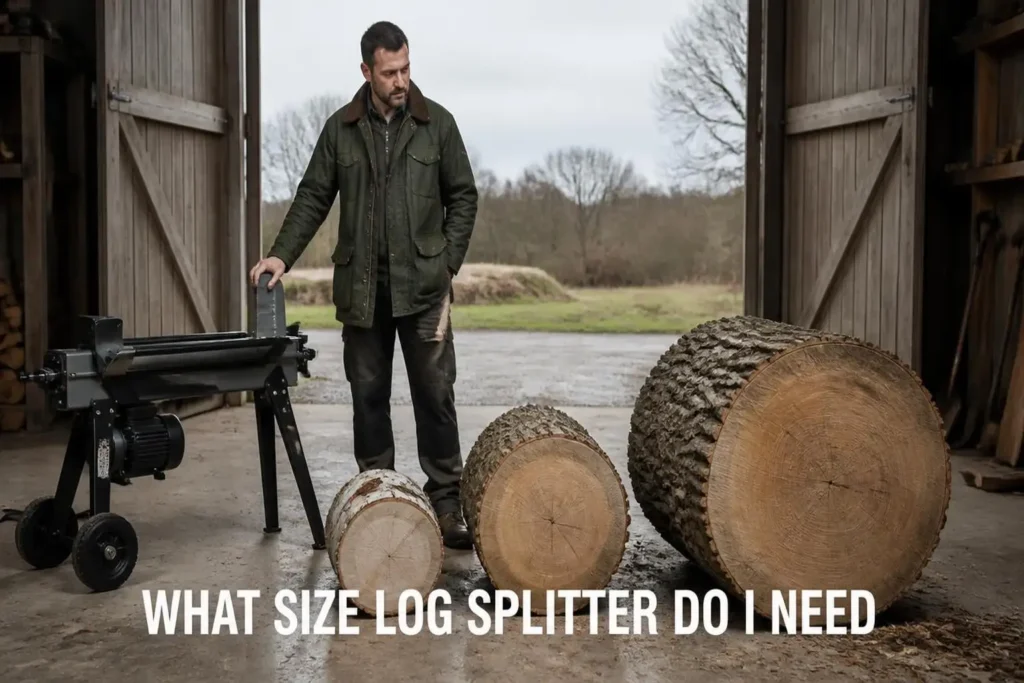
A log splitter is the right size when the longest and widest round you split sits well inside the maximum log length and diameter printed in its manual. The wood you burn and the work you do each season come next, and the power source your site allows comes last. I cut apricot and plum rounds out of the orchard after tree removals, and I read the printed limit on any splitter before I think about its ton rating. Below you get the limits of several models side by side, what the ton number does and does not tell you, and a worked example with a pile of rounds.
What Size Log Splitter Do I Need?
Start with your biggest typical round, and pick a splitter whose printed log length and diameter limits sit above it with room to spare. Log splitter size comes down to those limits, and the ton rating is the maker’s number for the model, so it follows them rather than leading. Wood, workload and power source then narrow the field.
- Measure your biggest normal round: length and diameter across the widest point, before you look at any ton rating.
- Compare it with the maker’s printed limits: choose a model whose maximum log length and maximum log diameter are higher than that round.
- Match the wood: knotty, twisted or interlocked-grain wood asks more of a machine than straight, easy wood.
- Match the work: an occasional pile and a winter’s supply call for different machines.
- Match the power source: a 15 amp outlet near the work, a gas engine outdoors, or a hand pump with no power at all.
The Short Answer
Size by the log limits in the manual first. The rated tons are the maker’s figure and not a measured force, and it says nothing about a species of wood.
Read the Log Length and Diameter Limits First
The two numbers that decide whether a round fits are the maximum log length and the maximum log diameter. Each maker prints them for the exact model, and they differ more than the ton ratings do. The table lists the limits from the manuals of four models as the makers print them.
| Model | Type | Rated by maker | Max log length | Max log diameter |
|---|---|---|---|---|
| Sun Joe LJ10M | Manual hydraulic, hand pump | 10 ton | 18 in (min 13.5 in) | 8 in |
| BILT HARD WS6T | Electric, 120 V, 15 A | 6.5 ton | 20.47 in | 9.84 in |
| VEVOR ELS106S | Electric, 120 V, 15 A | 6.5 ton | 20 in | 10 in |
| SuperHandy GUO084 | Electric, 120 V, 15 A | 14 ton | 20.5 in | 16 in, per the manual |
Gas manuals read differently. BILT HARD’s gas manual for its 20 ton model prints a 21 in log length and no diameter. Champion’s gas manuals list lengths from 19.3 to 24 in and print no diameter, and the Powerhorse 117510 manual prints 25 in by 14 in. Where a maker prints no diameter, ask the maker before you buy. My BILT HARD gas splitter review covers the model rated at 22 tons.
Why a Higher Rating Does Not Mean a Wider Log
The Sun Joe LJ10M is rated 10 ton and takes an 8 in round. The BILT HARD WS6T and the VEVOR ELS106S, both rated 6.5 ton, take about 10 in. So a lower rating can sit beside a wider log limit, and the label on the model name cannot tell you which round fits. My comparison of 6 and 10 ton splitters covers log size, speed and safety.
Read the diameter line, not the ton figure. I never compare one maker’s length with another maker’s diameter, since each pair belongs to its own beam and wedge.
A Limit Is a Ceiling
The BILT HARD WS6T and VEVOR manuals call the printed diameter indicative, and say a small knotty log can be hard to split while a straight-grained log over the figure may split. That note describes the machine’s behavior. It gives no permission to go over. Sun Joe’s LJ10M manual says plainly: “Do not exceed the maximum permitted log length of 18 inch (46 cm) or the maximum permitted log diameter of 8 inch (20.3 cm).” I cover the VEVOR ELS106S in my VEVOR splitter review.
Split one log at a time, with the grain and square-cut ends, within every size and weight limit your manual gives, including any minimum length. Check for nails, wire and other foreign objects. Do not use knotted, curved or uneven logs where your manual forbids them; Boss ES7T20 forbids uneven logs, including knotted or curved logs. Stop at the manual’s splitting time limit and follow its procedure for repositioning or rejecting the log; never force it. Any exception involving a second log is allowed only in the exact manual’s stated procedure.
What the Tonnage Number Tells You
Tonnage is the maker’s rating on the label or the model name. Makers say that real force and cycle time vary: Boss prints that tonnage and cycle time may vary with the electricity supply and with mechanical and environmental conditions, and Yardmax prints a similar footnote. So write “rated 6.5 ton” in your notes and never “6.5 tons of force”. My comparison of 10-ton and 20-ton log splitters shows which rating fits your wood and yard.
A higher rating does not widen the beam: only the manual’s diameter line says whether a round fits. I compare a 25 ton model with a 30 ton log splitter separately, but here I put log size ahead of the tonnage rating.
Match the Wood You Burn
The same round splits very differently depending on grain, knots and moisture. A ton rating says nothing about a species, so I do not use one for wood. Extension services rank how easily species split instead, and those rankings disagree with each other.
What the Extension Tables Say About Species
According to the University of Arkansas Division of Agriculture, white oaks split easily, red oaks and hickories medium, and black locust and elm with difficulty. It adds that splitting elm vertically is almost impossible without a hydraulic splitter, because the fibers run horizontally. The University of Kentucky ranks white oak as good for splitting, black locust as good and American elm as poor, and says those ranked poor should be avoided. Black locust is difficult in one table and good in the other, so I name the university rather than quote one ranking as fact.
The University of Maryland Extension keeps it broad: softwoods, green wood and straight-grained wood such as pine generally split more easily, and denser hardwoods such as oak split harder. I work with apricot and plum, which are modest in diameter, so for me the first question is rarely hardness. It is whether the round fits the limit.
Grain, Knots and Green Wood
Interlocked-grain wood is described in the USDA Forest Products Laboratory’s Wood Handbook as exceedingly difficult to split radially (1). Forks and branch collars on fruit trees are twisted in a similar way, so I treat a knotty round as a stall risk even when it is well under the diameter limit. Sun Joe’s LJ602E manual warns that logs with knots or harder wood may be more difficult to split, and the LJ602E and LJ10M manuals both say not to split hard wood that needs more than 5 seconds.
Moisture matters too. The University of Tennessee describes green wood as normally above 60 percent moisture and seasoned firewood as below 20 percent (2). Maryland Extension says green wood is generally easier to split than seasoned wood.
Match the Work You Do Each Season
A splitter that suits a few rounds a year is a different machine from one that supplies a heating stove all winter. I do not put a cord count or a logs-per-hour figure on it, and the makers print none. The maker’s own duty line says more.
- Occasional work: the Sun Joe LJ602E manual says the splitter is designed for occasional use, and that use over a long period will overheat the motor.
- VEVOR ELS106S: the manual describes a thermal protector with a printed 30 minute wait. A tripped protector is reset only after the full shutdown, in the manual’s own order.
- A hand-pump splitter: the Sun Joe LJ10M has no cord and no engine. You pump the handles for each split, and the manual publishes no cycle time. I cover the Sun Joe LJ10M in my Sun Joe splitter review.
- A gas splitter: it needs no outlet, and it carries an engine, fuel and two separate oils to look after.
My own work is modest rounds from orchard removals and a pile of thicker pruning limbs, so I look for a machine whose limits clear my biggest round with room to spare and whose duty line suits a few sessions at a time. A gas machine is more than that work needs.
Choose the Power Source That Fits Your Site
Power source is a sizing question only after the log limits are met. It decides where the machine can work, what it weighs and what safety rules apply. Manuals disagree on cords and clearances, so read your own. My comparison of electric and gas log splitters shows which power type fits which wood and yard.
Electric Splitters and the Outlet
The electric models in the table run from a standard 120 V, 15 A outlet. The shed outlet on my work pad decides where an electric unit stands, so the manual’s cord gauge and length matter to me as much as the rating does. Net weights run from 87 lb for the Sun Joe LJ10M to 99.4 lb for the VEVOR ELS106S and 126 lb for the SuperHandy GUO084, so the weight to lift is a real part of the choice.
Use the grounded supply your manual requires and GFCI protection. If the manual permits an extension cord, use a grounded three-wire cord rated for outdoor use, with the manual’s specified gauge and length. Keep connections away from water and the cord away from moving parts and your feet. Never handle the plug with wet hands or unplug by pulling the cord. The manuals disagree: WEN 56207 prints 14 gauge up to 25 ft and 12 gauge up to 50 ft, while Sun Joe LJ602E prints 14 AWG up to 25 ft, 12 AWG from 25 to 50 ft, and no extension cord over 50 ft.
Gas Splitters and Fresh Air
Gas hydraulic units run without an outlet and carry an engine, a separate engine oil and a separate hydraulic oil. They also make carbon monoxide.
Refuel outdoors with the engine off and cooled for several minutes, with no smoking, flames or sparks nearby, never overfill the tank, and wipe spills before you start. Never run a gas splitter indoors or in a garage or shed, even with the doors open: the exhaust contains carbon monoxide, which you cannot see or smell. Keep the clearances your manual gives (Champion: 3 feet on all sides and 5 feet from combustible material).
A Worked Example With a Pile of Rounds
Take three piles of rounds, all cut to 16 in long: one about 7 in across, one about 11 in and one about 15 in. I check each pile against the printed limits, using only the maker’s figures from the table.
| Model | 7 in rounds | 11 in rounds | 15 in rounds |
|---|---|---|---|
| Sun Joe LJ10M (8 in) | Fits | Over the limit | Over the limit |
| BILT HARD WS6T (9.84 in) | Fits | Over the limit | Over the limit |
| VEVOR ELS106S (10 in) | Fits | Over the limit | Over the limit |
| SuperHandy GUO084 (16 in, per the manual) | Fits | Fits | Fits, with 1 in to spare |
The 7 in pile clears every model. The 11 in pile needs the SuperHandy GUO084, which I cover in my SuperHandy splitter review, or a gas machine whose manual prints a diameter.
The 15 in pile sits 1 in under the GUO084’s printed ceiling, so I do not make that my everyday round. Those rounds go to a larger machine. A gas manual that prints no diameter cannot settle the question, so you ask the maker.
When the Job Is Bigger Than a Homeowner Splitter
Some work sits above what any homeowner splitter in this guide is built for: rounds above the stated length or diameter, and a whole tree to buck. That work goes to a larger rental machine with its own manual, or to a professional. Storm-damaged or hanging limbs belong to the same group, and I do not work on them or plan a purchase around them.
Safety Limits That Do Not Change With Size
The precautions for hands, hydraulic fluid and fatigue apply at every splitter size. A case series from Vermont documented disabling hand injuries from powered log splitters (3). In a Swedish study of hand injuries from powered wood splitters, patients hurt on wedge splitters often named more than one person at the machine as a cause (4). I wear eye, ear, hand and foot protection and keep my hands off the beam while the ram moves.
Hands, Operators and Protection
Hands and Controls
Never put your hands or feet between the log and the wedge, the ram or any part of the splitter while it moves, and keep your fingers out of cracks that open in the log: they can close suddenly. Load the log by holding its sides, never its ends, and run the control only with your hand. Never tie down, block or bypass a two-hand control. Keep your hands clear during both the splitting stroke and the return stroke. Follow your manual’s unloading sequence; WEN 56207 requires the entire cycle to finish and the ram to retract fully before removing split wood. Never straddle or step over an operating splitter or reach or bend over it to retrieve a log.
One Operator
One person operates the control. That person also loads the log unless the exact manual explicitly permits a loading helper. Never let anyone hold the log while you operate the splitter. If a loading helper is permitted, wait until the helper has left the operating area and reached the clearance required by the manual before moving the control.
Protective Gear
Wear the eye protection your manual specifies (Champion calls for ANSI-approved safety glasses, and Boss calls for safety goggles or safety glasses with side shields), and a face shield where your manual asks for one; hearing protection with a gas engine or wherever your manual asks; sturdy boots, steel-toed where your manual asks; gloves exactly as your manual directs; and no loose clothing, jewelry, drawstrings or untied long hair.
Keep children, pets and other people out of the work area, at least the distance your manual prints, and stop the splitter if anyone comes closer. No distance makes a work area safe on its own: keep watching it. Boss prints 25 ft, WEN 20 ft and Sun Joe LJ602E 16.5 ft.
Set the splitter on firm, level, dry ground outdoors, never on a slope, ice, mud or slippery ground. Secure it against movement as the manual directs; Yardmax requires blocking the front and back of both wheels. Work in daylight or good artificial light as the manual permits, and keep split pieces cleared away from your feet. Never run an electric splitter in rain or damp conditions, and observe every additional weather restriction in your manual.
Hydraulic Fluid, Stuck Logs and Shutdown
Every task that puts a hand near the hoses, the wedge or a stuck round starts with the same full shutdown. A review of high-pressure injection injuries to the hand describes injection by a pressurised jet as a surgical emergency in which early treatment matters (5), which is why a hydraulic leak is never checked by hand.
Full Shutdown Box
Shutdown before you free a stuck log, check or add fluid or oil, touch a hose, fitting or the wedge, clean, sharpen, adjust, move, tow, store or leave the splitter. Never use your hands to free a stuck log, and never check a hydraulic leak with your hand.
- Electric splitter: release the controls, switch the motor off, wait until every moving part has stopped completely, including the ram and any flywheel, then unplug it from the outlet by the plug.
- Gas splitter: release the controls or return the hydraulic control lever to neutral as your manual directs, turn the engine off, wait until every moving part has stopped completely, including any flywheel, let the engine and muffler cool, and pull the spark plug wire off and secure it away from the plug.
- Manual hydraulic splitter: stop pumping and release the pressure exactly as your manual says.
On a hydraulic splitter, relieve the hydraulic pressure as your manual describes before servicing it or touching any hose, fitting, cap or the wedge area. Never remove the hydraulic oil cap or vent plug while the machine is running or hot. Before moving, towing or storing a gas splitter, close the fuel valve where fitted as its manual directs.
Use only the stuck-log procedure your manual gives, including its instructions for any powered clearing step, and refit every guard before restarting.
Pressurised hydraulic fluid can inject through your skin from a hole too small to see. Never check for a leak with your hand: pass a piece of cardboard or wood over the spot and look for discolouration. If fluid hits your skin, see a doctor at once, even if the wound looks small.
Before touching any hose, fitting or cap, complete the full shutdown for your splitter in the shutdown box, including hydraulic pressure relief exactly as your manual describes. Never open the hydraulic oil cap or vent plug while the machine is running or hot.
Never free a stuck log with your hands. Before intervening, complete the full shutdown in the shutdown box. Follow only your exact manual’s stuck-log procedure, including any instructions for a powered clearing step. Complete the full shutdown again before any further hands-on intervention.
Before Every Start
Before every start, check that the wedge, ram, beam, hoses and fittings are undamaged and tight, the fluid is at the level your manual gives, and every guard is in place. If the splitter leaks, groans, vibrates or moves the ram on its own, stop, complete the full shutdown and have it fixed before you use it again.
Loading rounds is heavy, repetitive work. Follow your manual’s lifting and handling instructions and every printed log-weight limit. Take breaks and stop when you are tired or your attention slips.
Pick the Limits First and the Rest Falls Into Place
Three things settle the choice. The printed log length and diameter limits come first, with room above your biggest round. Wood and workload come second, and the power source your site allows comes third. My list of the log splitters for home use covers five models for easier firewood work.
My tip from the orchard is to measure the widest round of the season before you shop, and to carry that number with you when you compare models. Next, read the manual of the model you pick before the machine arrives. The size of log splitter that suits you is the one whose printed limits clear your biggest round.
Frequently Asked Questions
How many tons do I need in a log splitter?
The tons you need depend first on the log length and diameter your splitter takes, because tonnage is the maker’s rating and says nothing about a species of wood. Boss and Yardmax print that real force and cycle time vary with conditions, so match the printed limits to your biggest round and then choose the rating.
What is the ideal size for split firewood?
The ideal size for split firewood depends on how fast it must dry and what it burns in, and the extension guidance covers the splitting side. According to University of Minnesota Extension, pieces 6 to 10 in across should be at least halved, pieces 10 to 14 in at least quartered, and larger rounds sectioned as fits. Check your stove or fireplace manual for the largest piece it takes.
What size motor do I need for my log splitter?
The motor size you need is the one the maker builds into the model, and the electric units compared here run from a standard 120 V outlet. The BILT HARD WS6T manual prints 120 V and 15 A, and the VEVOR ELS106S manual prints 15 A and an output of 1800 W. Choose the model by its log limits and use the cord gauge and length your manual gives.
What size cylinder do I need for a log splitter?
The cylinder size you need is the one your model’s manual and parts list print for its bore and stroke, and no single size fits every splitter. Boss prints a 2.36 in bore for the ES7T20, the Powerhorse 117510 lists a 4 in bore, and the VEVOR ELS106S manual prints a 16.5 in maximum stroke. Before you touch a cylinder, hose or fitting, complete the full shutdown for your splitter in the shutdown box above.
What size hydraulic pump for a log splitter?
The pump size for a log splitter is the one the maker matches to your model’s motor or engine and cylinder, and the manual or parts list names it. The SuperHandy GUO084 manual lists a gear pump rated at 10 gallons per minute, and the Champion 90720 manual calls its pump a 2-stage gear pump. Order parts from the maker for your exact model, and complete the full shutdown for your splitter in the shutdown box above before touching any hose or fitting.
References
- Ross RJ, ed. Wood Handbook: Wood as an Engineering Material. General Technical Report FPL-GTR-282. USDA Forest Service, Forest Products Laboratory; 2021.
- Taylor A. Moisture Content of “Seasoned” Firewood. W179. University of Tennessee Institute of Agriculture; 2014.
- Kristiansen TK, Seligson D. Log splitter injuries to the hand. J Occup Med. 1981;23(6):400-402.
- Lindqvist A, Nilsson O. Hand injury from powered wood splitters: machine safety, patterns of use and injury events. Int J Occup Saf Ergon. 2011;17(2):175-186.
- Hogan CJ, Ruland RT. High-pressure injection injuries to the upper extremity: a review of the literature. J Orthop Trauma. 2006;20(7):503-511.
Safety Note: Only an adult who has read the manual and understands the controls should use a log splitter, never a child or anyone tired or impaired. The ram and wedge push with tons of force and can crush or cut off fingers, hands and feet: never put your hands or feet between the log and the wedge, the ram or any part of the splitter while it moves, keep your fingers out of cracks that open in the log, load each log by holding its sides, never its ends, and run the control only with your hand, never tying down, blocking or bypassing a two-hand control. Keep your hands clear during both the splitting stroke and the return stroke. Follow the manual’s unloading sequence; WEN 56207 requires the entire cycle to finish and the ram to retract fully before removing split wood. Never straddle or step over an operating splitter or reach or bend over it to retrieve a log. One person operates the control and also loads the log unless the exact manual explicitly permits a loading helper. Never let anyone hold the log while you operate the splitter. If a loading helper is permitted, wait until that helper has left the operating area and reached the manual’s required clearance before moving the control. Keep children, pets and other people out of the work area, at least the distance your manual prints for that exact model, and stop if anyone comes closer. No single distance is safe for every splitter. Set the splitter on firm, level, dry ground outdoors, never on a slope, ice, mud or slippery ground. Secure it against movement as the manual directs; Yardmax requires blocking the front and back of both wheels. Work in daylight or good artificial light as the manual permits, and keep split pieces cleared away from your feet. Never run an electric splitter in rain or damp conditions. Split one log at a time, with the grain and square-cut ends, within every size and weight limit your manual gives, including any minimum length. Check for nails, wire and other foreign objects. Reject knotted, curved or uneven logs where the manual forbids them; Boss ES7T20 forbids uneven logs, including knotted or curved logs. Stop at the manual’s splitting time limit and follow its procedure rather than forcing the log. Wear the eye protection your manual specifies: Champion calls for ANSI-approved safety glasses, and Boss calls for safety goggles or safety glasses with side shields. Also use a face shield where your manual asks for one, hearing protection with a gas engine or wherever your manual asks, sturdy boots (steel-toed where your manual asks), gloves exactly as your manual directs, and no loose clothing, jewelry, drawstrings or untied long hair. Pressurised hydraulic fluid can inject through your skin from a hole too small to see: never check for a leak with your hand, pass cardboard or wood over the spot instead, and see a doctor at once if fluid hits your skin, even if the wound looks small. Before freeing a stuck log, checking or adding fluid or oil, servicing, cleaning, sharpening, adjusting, moving, towing, storing or leaving the splitter, complete the shutdown for its power type. Electric: release the controls, switch the motor off, wait until every moving part has stopped completely, including the ram and any flywheel, then unplug it from the outlet by the plug. Gas: release the controls or return the hydraulic control lever to neutral as your manual directs, turn the engine off, wait until every moving part has stopped completely, including any flywheel, let the engine and muffler cool, then disconnect the spark plug wire and secure it away from the plug. Manual hydraulic: stop pumping and release the pressure exactly as your manual directs. On every hydraulic splitter, relieve hydraulic pressure as the manual describes before servicing or touching a hose, fitting, cap or the wedge area. Never remove the hydraulic oil cap or vent plug while the machine is running or hot, and never adjust pump or valve pressure settings. Before moving, towing or storing a gas splitter, close its fuel valve where fitted as the manual directs. Free a stuck log only by the manual’s procedure, including its instructions for any powered clearing step, never with your hands. Refit every guard before restarting. Use the grounded supply your manual requires and GFCI protection. If an extension cord is permitted, use a grounded three-wire outdoor-rated cord of the manual’s specified gauge and length. Keep connections away from water, keep the cord clear of moving parts and your feet, and never handle the plug with wet hands or disconnect it by pulling the cord. Refuel a gas splitter outdoors in a well-ventilated area with the engine off and cooled for several minutes, following any longer cooling period in its manual. Keep smoking, flames and sparks away, never overfill the tank, and wipe up spills before starting. Keep the manual’s clearances from surrounding objects and combustible materials. Never run it indoors or in a garage or shed, even with the doors open, because the exhaust contains carbon monoxide. Tow a towable splitter only as its manual describes, with towing chains attached exactly as the manual specifies, and never faster than the speed it prints. Store it dry and out of children’s reach, following the manual’s fuel-storage restrictions; Champion 100236 prohibits storing the unit indoors with fuel in its tank. Follow your manual’s lifting and handling instructions and every printed log-weight limit. Take breaks and stop when you are tired.