

In the Senix vs Skil snow blower choice, I recommend the 21-inch SENIX for most short paved drives, and the SKIL if cold, splashes and a small shed decide. Both are cordless single-stage push machines with no drive and no clean-out tool in the box. I read the limits in a snow machine’s manual before I read its spec sheet, because the limits show what the maker will not stand behind. Below I compare the SENIX STX2-M1 and the SKIL SB2001C on kit, path, runtime, cold, upkeep and warranty.
Senix vs Skil Snow Blower: Which One Fits a Short Paved Driveway?
For a short paved drive and a path to the door, I recommend the SENIX STX2-M1, because it clears a wider path and sits a tier lower in price. The SKIL SB2001C is the better pick where cold, splashing water or storage space are the real problems, since its manual prints limits that the SENIX manual leaves out. The SENIX is in the budget to mid-range tier and the SKIL in mid-range. My roundup of small driveway snow blowers covers more machines for a short drive like that.
| Row | SENIX STX2-M1 | SKIL SB2001C-10 |
|---|---|---|
| Clearing width | 21 in | 20 in |
| Intake height, maker’s figure | 12 in | 10.5 in |
| Throw distance, maker’s best case | Up to 33 ft | Up to 30 ft |
| Listed weight | 36 lb, tool only | 35.2 lb, battery not stated |
| Batteries in the kit | Two 5.0 Ah packs, used together | One 6.0 Ah pack, one port |
| Charger in the kit | 6.0 A dual-port | 150 W |
| Maximum runtime, maker’s figure | 15 minutes on the two packs | No minutes printed |
| Chute turn | Button, 180 degrees | Crank at the grip, 180 degrees |
| Weather rating | None printed, keep-dry symbol | IPX4, splashing water |
| Operating temperature | None printed | -4 F to 50 F |
| Handle | No fold stated | Quick-fold |
Two rows decide it: path width and price tier favor the SENIX, and the cold and water limits that only the SKIL manual prints favor the SKIL. The rest is close.
What Each Kit Includes
Check the exact kit before you order, because both brands sell more than one version of these machines.
The SENIX STX2-M1 40V 21-Inch Cordless Snow Blower kit holds the blower, two 20V Max 5.0 Ah packs that work together as a 36 V system, a 6.0 A dual-port charger and the bolts and knobs for the handle and chute. It runs on both packs at once, so a single pack is not an option. The 18-inch SENIX is a different machine, so match the model number STX2-M1, which is the one in my SENIX blower review.

The SKIL Power Core 40 snow blower kit, SB2001C-10, holds the blower, one 6.0 Ah battery, a 150 W charger and the manual. The wheels, chute and both handles go on at home with a Phillips screwdriver that is not in the box. The bare tool, SB2001C-00, ships without a battery, so check which one is in your cart. The listing here is the SKIL PWR CORE 40 SB2001C 20-Inch Cordless Snow Blower.

Neither kit includes a clean-out tool, although both manuals tell you to use one. I keep a hardwood stick by the door for that job, a habit that costs nothing and lowers a real risk.
Path, Intake and Throw
The SENIX opens a 21-inch path and the SKIL a 20-inch path, so the SENIX clears about 5 percent more width on every pass.
According to SENIX, the STX2-M1 takes snow up to 12 inches deep, and according to SKIL the intake of the SB2001C is 10.5 inches. Those are housing heights rather than working depths: a battery single-stage blower works comfortably in about 6 inches of snow, some manage 9, and I compare more single-stage snow blowers in my roundup of pavement-clearing models. In anything deeper, take the snow in layers, top first. Throw is each maker’s best case, up to 33 feet for SENIX and up to 30 feet for SKIL, and the two figures are not measured the same way. Wet snow lands closer.
A Senix 21-inch snow blower uses a belt-driven steel auger with rubber paddles, and the scraper bar under the housing is what meets the pavement. On my concrete pad by the machinery shed, a scraper bar like this catches the raised edge where two slabs meet, so I press the handle down a little at that seam to lift the bar over it.

The SKIL also uses a rubber-tipped steel auger, and its manual names the parts that wear: rubber paddles SRP2000 and scraper bar SSS2000. Its intake is the lower of the two, so a plow ridge at the end of a drive needs more layers.

Winner: SENIX STX2-M1 on path width, because the intake and throw figures are not a like-for-like comparison.
Battery System and Runtime
Neither kit includes a spare set: the SENIX needs a spare pair of packs, the SKIL one spare pack.
The SENIX manual gives a maximum runtime of 15 minutes on the two packs, with no snow conditions attached, so treat it as a ceiling, not the time a full charge gives you. Two 5.0 Ah packs at 36 V hold about 180 watt-hours together, and that is all a Senix 40V snow blower has to work with. The packs also fit other tools on the same X2 system. I keep the spare pair indoors and swap it in when the first pair goes cold, and my roundup of battery snow blowers covers pack size, runtime and cold weather for other models.
The SKIL snow blower battery is one 6.0 Ah pack in one port, and the machine cannot run two at once. According to SKIL, one charge clears up to 6 inches of snow from a 6-car driveway, but the manual prints no runtime in minutes and does not define a car length. The SKIL 40V snow blower platform is PWR CORE 40, and the manual lists 2.5, 4.0, 5.0 and 6.0 Ah packs for it.
A longer drive costs more than the machine, and the sum differs by kit:
- SENIX: a second pair of 5.0 Ah packs doubles the pack cost, because the machine uses both together.
- SKIL: a second 6.0 Ah pack, a mid-range cost on its own, swapped in when the first runs down.
- Both: the spare packs are the real price of a drive longer than a few cars.
Cold, Wet Snow and Storage
SKIL prints cold, water and storage limits that SENIX leaves out.
A review of lithium-ion batteries in electric vehicles found that cold lowers the energy a pack can deliver (1), and the same chemistry sits in these packs. SKIL prints a recommended operating range of -4 F to 50 F, and says the machine may not start with a pack at -4 F or colder: bring the pack indoors for 10 minutes, then fit it again. SENIX prints no range, and its manual lists a too-cold pack as a no-start cause, with 10 minutes on the charger as the fix. SKIL also wants its battery kept where the temperature stays above 32 F, so an unheated shed is out.
Wet snow decides the purchase. A study of US snowfalls found that when the low-level air averaged near or above about 27 F, very fluffy snow, more than 25 inches of snow per inch of water, occurred less than 5 percent of the time (2). Snow near freezing is often wet and heavy, and that is the snow that tests a single-stage machine.
The SENIX manual warns that heavy wet snow loads the belt and means replacing it more often. The SKIL slows its motor under overload and then shuts it off, and its manual says to slow down and narrow the swath. On the SENIX, wet snow near freezing packed in the chute before it packed on the ground, so I walk slower on those days.
SKIL prints IPX4, which covers splashing water only. The SENIX manual carries a keep-dry symbol and no rating. On a thaw day, with meltwater standing on my pad, I left the SKIL in the shed despite its IPX4 rating, because splash-proof is not standing-water-proof.
The SKIL manual rules out gravel and ice. The SENIX manual allows gravel only with the handle pushed down to lift the scraper, and stones can still be thrown. On the gravel edge of my yard I stop and shovel that last strip myself, because these machines sit close to the ground.
Winner: SKIL SB2001C, because it prints cold, water and storage limits that the SENIX manual does not.
Chute Control, Handles and Daily Use
The SENIX turns its chute with a button and the SKIL with a crank.
On the SENIX, a button turns the chute through 180 degrees and a squeeze trigger raises or lowers the deflector. You press the power button first and then pull the starter lever. With no drive, you steer by tipping the machine onto one pair of 7-inch wheels. The SKIL uses a crank at the grip for the 180-degree turn, and a trigger handle sets the deflector from 0 to 48 degrees. Release the bail switch before you move the deflector, as the manual says.
Its 8-inch wheels roll over rough pavement a little easier, and the handle folds for storage.
Each has an LED headlight on a handle button.
Against the shovel I used before, my shoulders and lower back feel the SKIL far less, and the path to the house door opens sooner. Their listed weights are 36 pounds for the SENIX, tool only, and 35.2 pounds for the SKIL. In a small test with ten healthy men, shoveling heavy wet snow pushed heart rate to between 86 and 97 percent of the maximum within 10 minutes, and an electric snow thrower lowered the strain (3). Anyone with a heart condition should ask a doctor before any snow work. I compare corded and battery alternatives to hand shoveling in my roundup of electric snow blowers.
Winner: SKIL SB2001C, because the handle folds and the deflector range is printed.
Clogs and Safety
Clearing a clog is the one job on both machines where a shortcut costs a hand.
The orders differ by a step. On the SENIX, turn the motor off, wait 10 seconds, take out both packs, then use a clean-out tool or a stick. For the SKIL, turn it off, take out the battery, wait 10 seconds for the auger to stop, then use the tool. Never use a hand, and never clear a running machine.
The numbers explain the rule. In a US emergency department sample for 2009 to 2017, about 22 percent of hand injuries from reaching into a clogged snow blower were amputations (4). A series of 52 patients at one trauma center found that 83 percent were hurt while unclogging the machine (5). Across 2003 to 2018, a hand in the chute was 44.5 percent of the injury mechanisms in snow blower visits (6).
Clog Rule
Switch off, take out every battery pack, wait 10 seconds until the auger stops, then use a stick. A hand never goes in the chute.
Warranty and Parts
SENIX covers its battery and charger for 3 years and SKIL for 2.
For the SENIX tool itself, read the terms on the order page before you buy. SKIL gives 5 years on the tool if you register it within 30 days, and 3 years otherwise, with 2 years on the battery and charger. SKIL does not cover belts, scraper bars or blower nozzles.
On upkeep, the SENIX manual shows the steps for replacing the scraper bar and the auger belt yourself. The SKIL manual has you hand the drive belt to an authorized station, while the paddles and scraper bar are listed parts.
Choose the SENIX STX2-M1 If
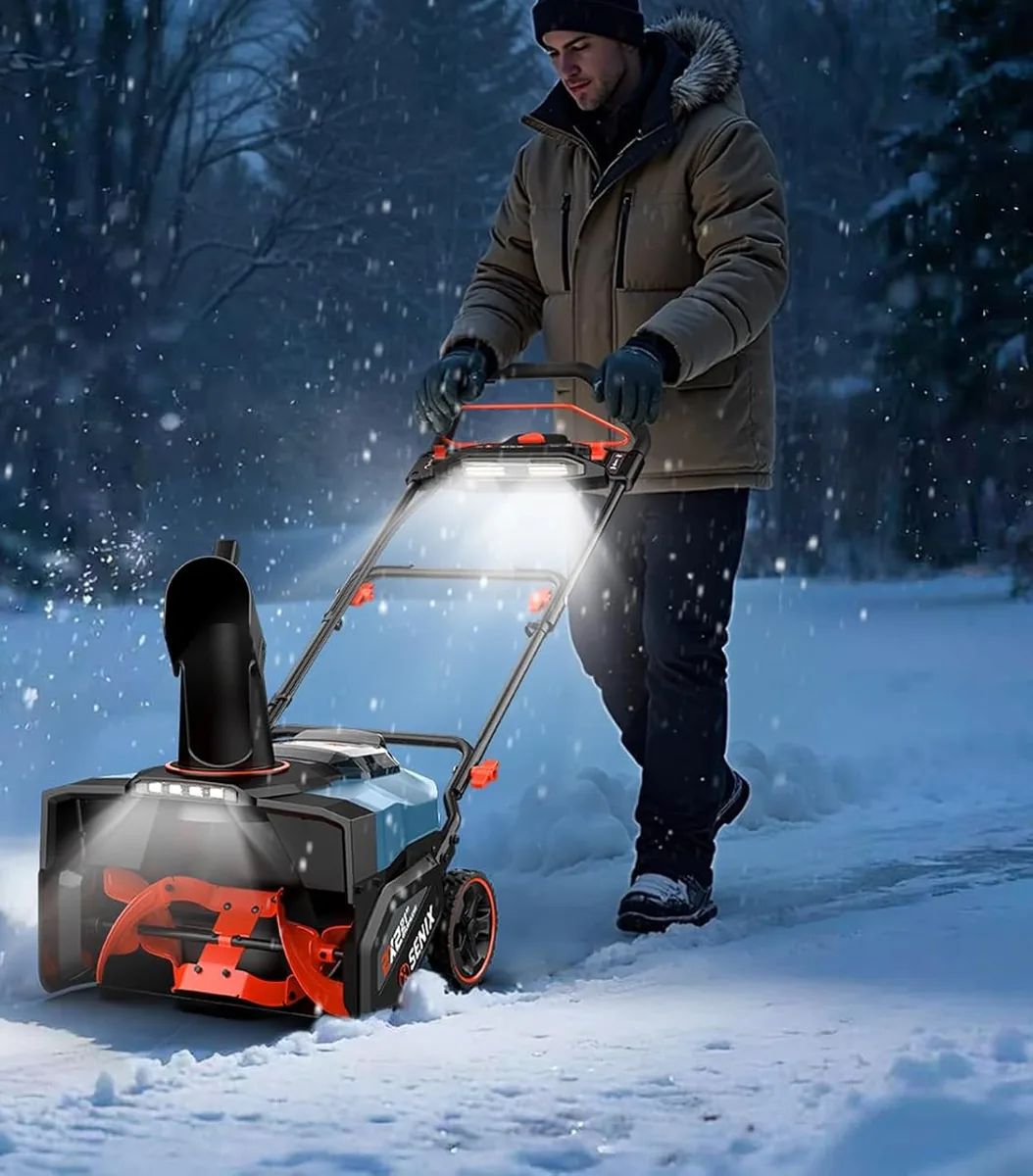
This Senix cordless snow blower fits a buyer who wants the widest path for the least money and does not mind steering a light push machine. If an EGO is also on your list, I set the EGO and SENIX snow blowers side by side in a separate comparison.
- Short paved drive: one to three cars and the walk to the door in a few inches of dry snow, with a shovel or a power shovel kept for the steps.
- Lower price tier: you want the wider path without the mid-range cost.
- Other X2 tools: you already own packs from the same system.
- Skip it if: your drive is long, your shed is unheated in a hard winter, or you need a printed temperature and water rating.
Before a forecast storm I charge both packs the night before, so the 15 minutes is available at full strength when the snow starts.
Choose the SKIL SB2001C If
The SKIL fits a buyer who stores the machine in a tight space, clears in real cold, or wants a known platform and a tool warranty that depends on registering it.
- Cold mornings: the manual prints -4 F to 50 F, and the machine has an electric brake that stops the auger in about 3 seconds.
- Small storage space: the handle folds for storage.
- Splashing water: it carries IPX4, which covers splashes but not standing water and not heavy wet snow.
- Skip it if: you want the widest path at the lower price, or an unheated shed for the battery.
Its single pack is the trade-off: a second 6.0 Ah pack is what turns a short job into a longer one.

My Pick for a Short Paved Drive
For a short paved drive, a path and a few inches of dry snow, I pick the SENIX STX2-M1 for its wider path and lower price tier. Pick the SKIL SB2001C when your winter is colder or your storage is tight.
Neither machine suits gravel, solid ice, long drives or heavy wet snow. A two-stage machine with its skid shoes lowered is the class for gravel, long drives and deeper snow; I compare five options in best snow blower for gravel driveway. Keep a stick by the door, take the battery out before any clog work, and keep both off standing water. For most buyers, the Senix vs Skil snow blower decision ends with the SENIX for a short paved drive.
Frequently Asked Questions
Is Senix snow blower a good brand?
The Senix snow blower brand is a sound choice for a short paved drive, judged by the STX2-M1 alone. That machine gives a 21-inch path and a 15-minute maximum runtime from its manual, but one model does not speak for the whole brand, so check the exact model number before you order.
What is the best snow blower for the money?
The best snow blower for the money depends on your drive, and for a short paved one the SENIX STX2-M1 gives the widest path for its tier, in a kit with its packs and charger. A long, wet or gravel drive needs a two-stage machine, which costs more money up front.
Do electric snowblowers work in heavy snow?
Electric snowblowers work in heavy snow only up to the limit of their class, and battery single-stage machines like these two are comfortable in about 6 inches. Heavy wet snow loads the belt and can slow or stop the motor, so take it in thin layers or use a two-stage machine.
What are the downsides of using an electric snow blower?
The downsides of the two cordless single-stage kits here are a short runtime per charge, the cost of a spare pack and limits in cold, wet snow and on gravel. Corded and two-stage electric machines avoid some of these, and these two have no drive, so you push every pound yourself.
Are battery snowblowers worth it?
Battery snowblowers are worth it for a short paved drive, a path and a few inches of snow, because they start at the push of a button and need no fuel or oil. These two single-stage kits stop being worth it on a long drive or in heavy snow, where a battery two-stage machine or extra packs fit better.
References
- Jaguemont J, Boulon L, Dubé Y. A comprehensive review of lithium-ion batteries used in hybrid and electric vehicles at cold temperatures. Appl Energy. 2016;164:99-114.
- Ware EC, Schultz DM, Brooks HE, Roebber PJ, Bruening SL. Improving Snowfall Forecasting by Accounting for the Climatological Variability of Snow Density. Weather Forecast. 2006;21(1):94-103.
- Franklin BA, Hogan P, Bonzheim K, et al. Cardiac Demands of Heavy Snow Shoveling. JAMA. 1995;273(11):880-882.
- Hammig B, Jones C. Hand injuries associated with reaching into a snow blower to clear clogged snow. Am J Emerg Med. 2020;38(4):785-788.
- Curtin P, Flood MG, DeFazio MW, et al. Snowblower Injuries to the Hand: A Longitudinal Study. J Occup Environ Med. 2026;68(1):63-65.
- Loder RT, Solanki D. Events Due to Snowblower Use Seen in US Emergency Departments From 2003 Through 2018. Cureus. 2020;12(12):e11836.
Safety Note: Snow blowers throw snow, ice and hidden objects with force. Never reach into a clogged chute or auger. Shut the machine off first: stop the engine on a gas model, unplug a corded model, or remove the safety key and every battery pack from a battery model. Wait at least as long as your manual says, often 10 seconds, and until every moving part has stopped, then remove the key and disconnect the spark plug wire where your manual says so, and clear the clog with the clearing tool. Keep people and pets out of the discharge path, run gas models outdoors only, and read the manufacturer’s manual.