
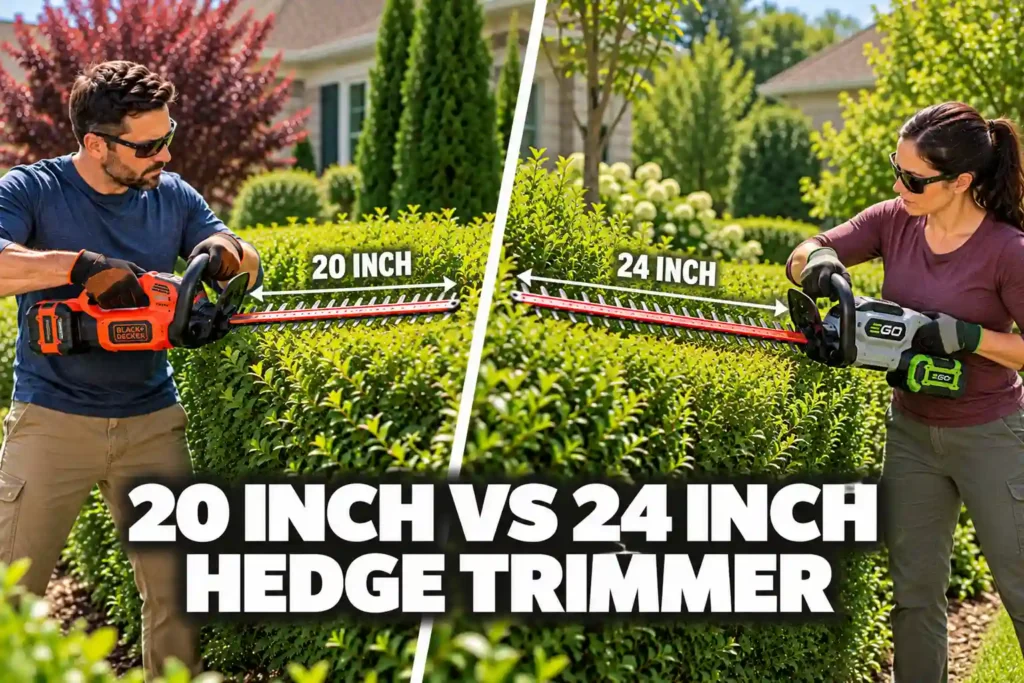
Choosing a 20 inch vs 24 inch hedge trimmer comes down to reach per pass and weight, and the length has no say in how thick a stem the blade can cut. I keep the hedgerow along my orchard perimeter, and the first line I read in any trimmer manual is the stem rule, never the blade length. Pick 20 inches for a small hedge and close shaping, and 24 inches for a long, straight run. Below I show what each length changes, what the manuals print for capacity and weight, and how to match the blade to your hedge.
The Short Answer on 20 Inch vs 24 Inch Hedge Trimmer Length
Blade length is how much hedge the bar covers in one sweep. A 24 inch bar covers 4 inches more than a 20 inch bar, so a long run takes fewer sweeps, and the same 4 inches adds a little weight at the end of your arms. Everything else people expect from a longer blade, including thicker stems, is set by other numbers on the spec sheet.
Key Takeaway
Choose the blade length for the size and shape of the hedge and for how long your arms can hold the tool. Choose the cutting capacity for the stems. They are two different numbers, and the maker prints both.
Here is the quick split I use before I look at any model:
- Go with 20 inches for small hedges, corners, short runs and anyone who wants a lighter, more controllable tool in the arms.
- Go with 24 inches for long, straight sides and wide flat tops, where fewer sweeps matter more than a little extra weight.
- Go with neither length for a hedge you cannot reach from the ground or for stems thicker than the capacity the maker prints.
What Blade Length Changes, and What It Does Not
The hedge trimmer blade length a maker prints, such as 20 in or 24 in, is the called length of the cutting bar. The bar carries a row of teeth, and the gap between the teeth sets the thickest stem that can slide in. Adding length adds more teeth to the row and leaves the gap as it was. My answer to “what is a hedge trimmer” names the parts, the types and the limits.
Blade Length and Cutting Capacity Are Separate Numbers
The manuals show this plainly. I print each capacity in the maker’s own words.
| Model | Blade length | Cutting capacity as the maker words it |
|---|---|---|
| Craftsman V20 CMCHT810 kit | 20 in | Stems up to 5/8 in (16 mm) |
| BLACK+DECKER LHT2220 | 22 in | Stems up to 3/4 in (19 mm) |
| EGO Power+ HT2400 | 24 in | Stems less than 3/4 in (19 mm) |
| Milwaukee M18 FUEL 2726-20 | 24 in | Branches up to 3/4 in diameter |
| Ryobi 40V RY40601 | 24 in | Stems or twigs up to 3/4 in |
| Greenworks 40V 24 in kit | 24 in | 1.1 in (27 mm), kind of number not stated |
| Milwaukee M18 FUEL 3033-20 | 24 in | 1-1/4 in blade gap |
| Milwaukee M18 FUEL 3034-20 | 30 in | 1-1/4 in blade gap |
The two Milwaukee rows are the clearest proof. The 24 inch and the 30 inch models print the same 1-1/4 inch blade gap, because the gap between the teeth is what Milwaukee measures. The Craftsman kit at 20 inches does print a smaller stem figure than the 24 inch models, but that is a choice in that tool’s design. The 22 inch BLACK+DECKER, which I cover in my Black and Decker LHT2220 review, already matches the 24 inch EGO at 3/4 inch.
Wood above the printed number belongs to loppers or a pruning saw. Ryobi, EGO and Milwaukee all tell the user not to force the blade through it, and Milwaukee warns that the tool may stall or kick back. When a stem is near the limit, I put the trimmer down and cut it with loppers first, then trim the green growth around it.
Why Capacity Wording Needs a Second Look
A maker can mean three different things by capacity: the stem, the branch or the blade gap. Echo goes further on its gas HC-2020 and prints 1 inch for soft material but only 1/2 inch for woody material. The Craftsman kit shows how far the words can drift: its manual says stems up to 5/8 inch, while the maker’s product page says branches up to 3/4 inch. When two numbers disagree like that, I follow the manual. My list of hedge trimmers for thick branches explains each maker’s capacity wording in plain terms.
How Much Hedge You Cut per Pass
Reach per pass is the one thing length truly buys, and a short calculation shows how much. The numbers below are plain arithmetic on the called length, not a timed result, because real sweeps overlap and no maker publishes a speed for either length.
| Hedge side | 20 inch blade | 24 inch blade |
|---|---|---|
| 10 ft (120 in) | 6 blade lengths | 5 blade lengths |
| 30 ft (360 in) | 18 blade lengths | 15 blade lengths |
One blade length fewer in every six is a real gain on a long run and a small one on a short run. A 10 ft side measures six 20 inch blade lengths or five 24 inch blade lengths, a difference too small to notice on a single yard shrub. Along the orchard hedgerow the same gap repeats for the whole side, so it adds up.
Makita prints 3 to 4 seconds per meter for its XHU02, and that figure belongs to that model. The habit behind it fits every trimmer: move calmly and never force the blade through heavy growth, as the Ryobi, EGO and Milwaukee manuals tell you.
A long bar also shows every wobble at the tip. When I stretch a string along the top of a hedge to keep it level, a long blade rides the string over a longer stretch, and my hands show it faster if they drift. The manuals from DeWalt, EGO, Ryobi, Makita and Milwaukee all recommend the string for a level top.
Weight, Balance and Arm Fatigue
The extra 4 inches of bar is extra mass at the far end of the tool, so the arms and shoulders feel it. The weight figures below are the makers’ own, with their basis, because a tool weighed without the battery is not comparable to one weighed with it.
| Model | Blade length | Weight |
|---|---|---|
| Greenworks 24V hedge trimmer, without battery pack | 22 in | 5.7 lb (2.6 kg) |
| Greenworks 40V 24 in kit tool, without battery pack | 24 in | 6.0 lb (2.7 kg) |
| EGO Power+ HT2400, without battery pack and blade guard | 24 in | 6.24 lb (2.83 kg) |
| Craftsman V20 CMCHT810 | 20 in | Not published by the maker |
| Milwaukee M18 FUEL 2726-20 | 24 in | Not published by the maker |
Different makers use different motors and batteries, so these rows tell you the order of magnitude, about 6 pounds without a pack, and no more. The cleaner test is one maker with two lengths.
| Model | Blade length | Weight |
|---|---|---|
| Echo DHCS-2800 | 28.1 in | 6.4 lb (2.9 kg) |
| Echo DHCS-3400 | 34.1 in | 6.8 lb (3.1 kg) |
| Husqvarna 522iHD60 | 600 mm (about 24 in) | 7.9 lb (3.6 kg) |
| Husqvarna 522iHD75 | 750 mm (about 30 in) | 8.4 lb (3.8 kg) |
In both families, about 6 more inches of blade added about 0.4 to 0.5 pound. These are professional-line models, so I use them only to show the size of a length step on one platform. For the 4 inches between a 20 inch and a 24 inch trimmer, read the exact model’s printed weight and its basis before you compare.
What the arms feel is the weight at arm’s length over time. A study of 120 Chinese garden workers found that pruning high hedges with the arms above shoulder height gave the highest trapezius and biceps load, while low horizontal hedges loaded the back most (1). A survey of landscape workers in Malaysia found shoulder symptoms in 65.5 percent of them, with awkward posture as the main risk factor (2). Keep the cut below shoulder height where the hedge allows it, and use a pole model for a tall hedge.
A British national survey found gardeners and groundsmen among the occupations that most often had high daily hand vibration doses (3). That is a reason to take breaks, and a reason to share a long job across two days.
On the orchard hedgerow I notice the weight in my arms by the end of a long row. At that point a lighter tool is worth having. My picks among lightweight hedge trimmers show each weight with its basis stated.
Hedge Size, Shape and Tight Spots
Hedge size and shape decide which length gives you control. A short bar turns into corners and around posts. A long bar runs straight.
What a 20 Inch Hedge Trimmer Does Well
A 20 inch hedge trimmer fits small hedges, the shrubs beside a path and the hedge by the front steps. BLACK+DECKER says shorter blades suit smaller shrubs and longer blades suit bigger hedges, and I agree with the direction of that advice. The shorter bar is easier to hold close to the body and easier to steer around the corner of a bed. I compare nine light models in my list of hedge trimmers for small bushes.
What a 24 Inch Hedge Trimmer Does Well
A 24 inch hedge trimmer pays off on long, straight sides and on wide flat tops, where each sweep covers more. Maker lists show many battery models at this length, so a 24-inch hedge trimmer gives you plenty of platforms to pick from. For long sides, my roundup of hedge trimmers for large hedges compares the long-blade models.
The advantage disappears on a hedge full of curves, because a long bar cuts a flat line and a curve needs short, steady cuts.
Shape Matters More Than Length
Whatever the length, hold a taper: narrower at the top than at the base. EGO says to trim the side of a hedge so it is slightly narrower at the top, and Iowa State and Clemson extension pages explain why. A narrow base is shaded by the top, so the lower leaves drop and the hedge goes bare at the bottom. Neither blade length prevents that, only the cut you make does.
Battery Platform and Kit Differences Between the Two Lengths
Length does not choose the battery system. Among the battery models that Amazon sells today, a 20 inch hedge trimmer such as the Craftsman V20 kit runs on a 20V MAX class pack with a battery and charger in the box, while a 24 inch cordless hedge trimmer might be a tool-only EGO 56V or Milwaukee M18 model that needs a battery and charger bought separately. The installed battery adds weight and affects run time, while total weight also includes the tool, and real run time depends on the model and the work. My comparison of the EGO and Milwaukee 2726-20 trimmers weighs the kit against the bare tool.
Run time depends on the model, the pack and the work, so I give no figure. On either length, check the box: confirm whether the battery and charger are included, and whether the pack matches the other tools you own. A bare 24 inch electric hedge trimmer needs a compatible battery and charger if you do not already have them. I compare nine cordless options in my roundup of battery hedge trimmers.
Battery Safety
Use only the maker’s battery and charger for your trimmer, charge and store them within the temperatures your manual gives and never in rain or wet places, never use or charge a damaged, swollen or leaking pack, and keep loose batteries away from metal objects such as keys, coins and nails that could short the terminals.
Safety With a Longer Blade
A longer bar puts more blade in front of your hands and makes it easier to reach too far. The safety rules below apply to both lengths, and I treat them as the floor for every cut.
Two hands come first. Hedge trimmer blades are the reason: a hand that touches the blade is cut in a fraction of a second.
Two Hands and Both-Hand Switches
Hold the trimmer with both hands on the handles, by the insulated gripping surfaces only because the blade can contact hidden wiring (the grips do not make the trimmer insulated or wire contact safe), whenever the blade is moving; one hand can cost you control of the tool. On a trimmer with two switches, both hands must be on the switches to start the blade, and the blade stops when you let go of either one. Keep your body parts clear of the blade and never remove cut material or hold the stem you are cutting while the blade moves.
Blade and Reach
Never hold a branch with your free hand or reach toward the blade, through the hedge or into any opening while the blade moves. On a gas trimmer never reach into any opening while the engine is running: a blade that has stopped in a jam does not stop the engine, so first complete the full maintenance shutdown. Do not overreach: keep your footing and balance, and trim only what you can see.
Clearing a Jam or Cleaning the Blade
To clear a jam, remove cut material, clean, lubricate or touch the blade, release the switch, switch the motor or engine off and wait until the blade has stopped completely. Then on a battery trimmer take the battery pack out, on a corded trimmer pull the plug from the outlet by the plug, not the cord, and on a gas trimmer let the engine and muffler cool and pull the spark plug wire off. Put on gloves before you touch the blade, and check every lock and coupling before power goes back on. A gas engine can keep running after the blade stops in a jam, so never reach into the tool until it is off, cool and the spark plug wire is off.
Hidden Wire in the Hedge
Before you cut, look through the hedge for fence wire, cable and cords. If the blade jams on a wire or a cord, do not touch the blade, the wire or the cord and do not try to free the trimmer: stopping the blade does not remove the electrical danger, so the electrical supply to the damaged line or cord must be disconnected first. Treat anything touching a wire as live, and if it is a utility line, never go back to the trimmer to switch it off or unplug it: call the utility at once, and 911 if anyone is hurt, and keep everyone away.
No Ladders
Do not use a hedge trimmer on a ladder, a roof, a tree or any unstable support; the manuals of EGO, Ryobi, Milwaukee and Echo ban it, and Husqvarna bans work from any raised position that is not fully secured. For a tall hedge, stay on the ground and use a pole or long-reach hedge trimmer, or hire a professional.
Before the blade runs, I look through the hedge for fence wire, posts, cords and drip lines, and for nests. I leave the whole hedge untrimmed where birds are nesting. These checks take a few minutes, and the manuals from DeWalt, Ryobi and EGO ask for the first part of them.
Before Every Use
Before each use, check the trimmer as your manual describes: the blades sharp, undamaged and lubricated, the operating guards fitted, the blade cover removed before you start (it is for carrying and storage only), the switches and the lock-off working, every handle and pole coupling tight, and the battery, cord or fuel system undamaged. If anything fails the check, do not use the trimmer until it is fixed.
Protective Gear and Weather
Wear safety glasses with side shields marked ANSI Z87.1, and a face shield over them where your manual asks for one; hearing protection; sturdy work gloves; long pants and long sleeves with no loose clothing or jewelry (Echo says never wear shorts); and closed, non-slip shoes or boots. Wear head protection when you operate a pole or long-reach trimmer overhead (the Ryobi RY40603, Husqvarna 520iHE3 and Echo DHCS and DHCA manuals require it). The Echo DHCA-2600 manual also prints the symbol ‘Do not cut branches overhead’, and head protection never overrides it. Wear a respirator when dust is present, as the DeWalt manual states. Never trim in rain, dense fog, strong wind, a storm or when lightning is possible, wait until the hedge is dry, and trim only when the light lets you see the stems, any wire in the hedge and your footing clearly.
Hearing protection matters on every power type. A Brazilian field study mapped the noise around an operator running a hedge trimmer and concluded that a work regime and hearing protection were needed (4). Battery trimmers are quieter than gas models, but they are not silent.
Fatigue
Weight at arm’s length builds up over a long hedge: take breaks and stop when you are tired or your grip weakens.
Carrying and Storing
To carry or store the trimmer, release the switch, switch the motor or engine off and wait until the blade has stopped completely. Then take the battery pack out of a battery trimmer, pull the plug of a corded trimmer from the outlet by the plug, or on a gas trimmer let the engine and muffler cool and pull the spark plug wire off. Fit the blade cover, carry the trimmer by the handle with the blade pointing behind you, and store it indoors in a dry place out of children’s reach; keep gas fuel apart in an approved container.
When Neither Length Is the Right Tool
Some jobs are beyond both lengths, and the right answer is a different tool or a professional. I make these calls before I start, not halfway through a cut. In my guide on hedge trimmer vs pole saw, I show what each tool cuts and when to switch.
- A hedge too tall to reach from the ground: use a pole or long-reach hedge trimmer from the ground, or hire a professional. Never a ladder.
- Stems thicker than the maker’s stated capacity: cut them with loppers or a pruning saw, then trim the rest.
- A large overgrown hedge that needs a hard cut back: hire a professional, because the right cut depends on the plant and the trimmer is the wrong tool for old stems.
Anything near a power line goes to the utility and its qualified line-clearance crews. No hedge trimmer, pole or handle makes work near a wire safe, so I leave that work alone.
Choosing Between the Two Lengths
Match the blade to the hedge first, then check that the capacity fits the stems and that the weight suits your arms. The two lists below put it in short form.
Choose a 20 Inch Blade If
- Your hedges are short, curved or close to corners, posts and walls.
- You trim a few times a season and want the lighter tool in your arms.
- Your hedge sits beside a path, wall or bed where a shorter bar is easier to steer.
Choose a 24 Inch Blade If
- Your hedge has long, straight sides or a wide flat top.
- You can hold the weight comfortably at the height you cut, which stays below your shoulders.
- You want a wide choice of battery platforms at that length.
Skip both if the stems are above the stated capacity, the hedge is too tall for the ground, or you plan to work from a ladder.
My Pick for Most Hedges
For most home hedges I pick 24 inches when the sides run straight and 20 inches when they curve or stay short. Remember three things: blade length sets reach per pass, the maker’s capacity wording sets the stem, and weight at arm’s length decides how long you can work. My tip is to stretch a string along the top before the first cut and trim to it, whichever bar you own. Before you buy, measure your longest straight side and read the stem rule in the manual to settle the 20 inch vs 24 inch hedge trimmer choice. Once the length is set, my best hedge trimmer roundup helps you pick a model.
Frequently Asked Questions
What is the best length for a hedge trimmer?
The best length for a hedge trimmer depends on the hedge you trim. A 20 inch blade suits small, curved hedges and tires the arms less, while a 24 inch blade suits long, straight runs and wide tops. Whichever you choose, match the maker’s stated cutting capacity to the stems you cut.
What size hedge trimmer do I need?
The size hedge trimmer you need is set by the length of your longest straight side and by the stems you cut. Choose 20 inches for short runs and 24 inches for long ones, then check the capacity the maker prints, because a longer blade does not cut thicker stems. For a hedge too tall to reach from the ground, choose a pole or long-reach model.
What are the differences between the EGO 24-inch and 26-inch hedge trimmers?
The EGO 24 inch HT2400 and the 26 inch HT2600E differ by 2 inches of blade and in their capacity wording. According to EGO, the HT2400 cuts stems less than 3/4 inch and weighs 6.24 lb without battery pack and blade guard, while the HT2600E manual (the Australia and New Zealand edition) limits branches to less than 30.5 mm (about 1.2 in) in diameter and lists 3.14 kg (about 6.9 lb) on the same basis. Check the manual of the exact model you buy, because EGO sells several versions.
What is the longest blade on a hedge trimmer?
One of the longest blades on a hedge trimmer is the 34.1 inch bar on the Echo DHCS-3400, and the Milwaukee M18 FUEL 3034-20 has a 30 inch bar. Makers sell other lengths too, so check the exact model, and know that long bars are heavier and need both hands at all times. A longer bar does not raise the stem capacity.
Can a 24 inch hedge trimmer cut thicker stems than a 20 inch hedge trimmer?
A 24 inch hedge trimmer does not cut thicker stems than a 20 inch hedge trimmer because of its length. Milwaukee prints the same 1-1/4 inch blade gap on its 24 inch and 30 inch models, and the maker’s capacity wording is what counts. Anything above that number goes to loppers or a pruning saw.
References
- Yang W, Li S, Li B, Liu W, Ning F, Gao S. Analysis of the effects of working position on muscle fatigue during hedge pruning: a cross-sectional study based on Chinese garden workers. J Mech Med Biol. 2023;23(2):2350027.
- Lim MC, Awang Lukman K, Giloi N, et al. Landscaping Work: Work-related Musculoskeletal Problems and Ergonomic Risk Factors. RMHP. 2021;Volume 14:3411-3421.
- Palmer KT, Griffin MJ, Bendall H, Pannett B, Coggon D. Prevalence and pattern of occupational exposure to hand transmitted vibration in Great Britain: findings from a national survey. Occup Environ Med. 2000;57(4):218-228.
- Silva MO, Yanagi Junior T, Schiassi L, Rossoni DF, Barbosa JA, Yanagi SNM. Spatial variability of the noise level of a hedge trimmer and backpack blower. Rev Bras Cienc Agrar. 2014;9(3):454-458.
Safety Note: Only an adult who has read the manual and understands the controls should use a hedge trimmer, never a child or anyone tired or impaired. The blades are sharp, a hand that touches them is cut in a fraction of a second, and they keep moving for a moment after you release the switch. Hold the trimmer with both hands on the handles, by the insulated gripping surfaces only because the blades can contact hidden wiring (the grips do not make the trimmer insulated or wire contact safe), whenever the blades move; on a trimmer with two switches, both hands must be on the switches to start. Never hold a branch or reach toward the blades, through the hedge or into any opening while they move, and never reach into any opening of a gas trimmer while the engine is running, because a blade that stops in a jam does not stop the engine. Never overreach, and trim only what you can see. Before you start, look through the hedge for wire, fence wire, cords, posts, stakes, irrigation lines, nests, people and pets, and keep the cord or hose out of the blade’s path. If a blade jams on a wire or a cord, do not touch the blade, the wire or the cord: stopping the blade does not remove the electrical danger, so the electrical supply to the damaged line or cord must be disconnected first. Cut only stems up to the capacity your manual states, in the maker’s own wording, and leave thicker wood to loppers or a saw. Do not use a hedge trimmer from a ladder, a roof, a tree or any unstable support, so for a tall hedge stay on the ground and use a pole or long-reach hedge trimmer, or hire a professional. Power lines can kill. With a pole or long-reach hedge trimmer, look for every overhead wire, including wires hidden in leaves, and keep yourself, the trimmer, the pole and any branch that could fall or swing at least 50 feet (15 m) from every line, the distance Ryobi and Echo print in their pole hedge trimmer manuals, or farther if your manual asks for more. A pole hedge trimmer is not insulated, and electricity can jump through the air and travel through branches, especially wet ones. Treat every wire as live, and leave a hedge that has grown into or near a wire to the utility and its qualified line-clearance crews. If the trimmer, the pole or a branch touches a wire, treat the trimmer, the branch, the wire and anything touching them as live: do not go back to the trimmer to switch it off or unplug it, do not touch anything in contact with the line, keep everyone away and call the utility, which alone frees the trimmer, and 911 if anyone is hurt, a fire starts or a line comes down. Wear safety glasses with side shields marked Z87.1, a face shield over the glasses where your manual asks for one, hearing protection, sturdy gloves, long pants, long sleeves with no loose clothing or jewelry, and closed, non-slip shoes. Wear head protection when you work a pole or long-reach model overhead, as the Ryobi, Husqvarna and Echo pole manuals require, and a respirator when dust is present, as the DeWalt manual states; where a manual forbids cutting overhead, do not. Keep people and pets away at the distance your manual gives, and stop trimming if anyone comes closer. Never trim in rain, fog, strong wind, a storm or when lightning is possible, trim only in good light, and let the hedge dry first. Before each use, remove the blade cover (it is for carrying and storage only), and check the blades, the operating guards, the switches and every handle and pole coupling as your manual describes, and do not use a trimmer that fails a check. Before you clear a jam, remove cut material, clean, lubricate or touch the blades: release the switch, switch the motor or engine off and wait until the blades have stopped completely, then take the battery pack out, unplug a corded trimmer from the outlet by the plug, or on a gas trimmer let the engine and muffler cool and pull the spark plug wire off; put on gloves and check every lock and coupling before power goes back on. To carry or store the trimmer, release the switch, switch the motor or engine off and wait until the blades have stopped completely, then take the battery out, unplug a corded trimmer by the plug, or on a gas trimmer let the engine and muffler cool and pull the spark plug wire off; fit the blade cover, carry the trimmer by the handle with the blades pointing behind you, and keep it indoors, dry and out of children’s reach. Use only the maker’s battery and charger, charge and store them within the temperatures your manual gives and never in the wet, never use or charge a damaged, swollen or leaking pack, and keep loose batteries away from metal objects that could short the terminals. Use a corded trimmer only with an outdoor-rated extension cord of the gauge your manual gives, plugged into GFCI-protected power, with the cord behind you and away from the blades, and never in rain or wet conditions: GFCI protection does not make that safe; if the cord is cut or damaged, disconnect it at once by pulling the plug from the outlet by the plug, before you touch the cord or the blades. Refuel a gas trimmer outdoors with the engine off and cool, with no smoking, flames or sparks nearby, wipe up spills, move at least 10 feet from where you fuelled before you start it, wear hearing protection, and never run it indoors or in a garage or shed, because the exhaust contains carbon monoxide. Look for nests before you cut and leave a hedge where birds are nesting. Take breaks and stop when you are tired.