

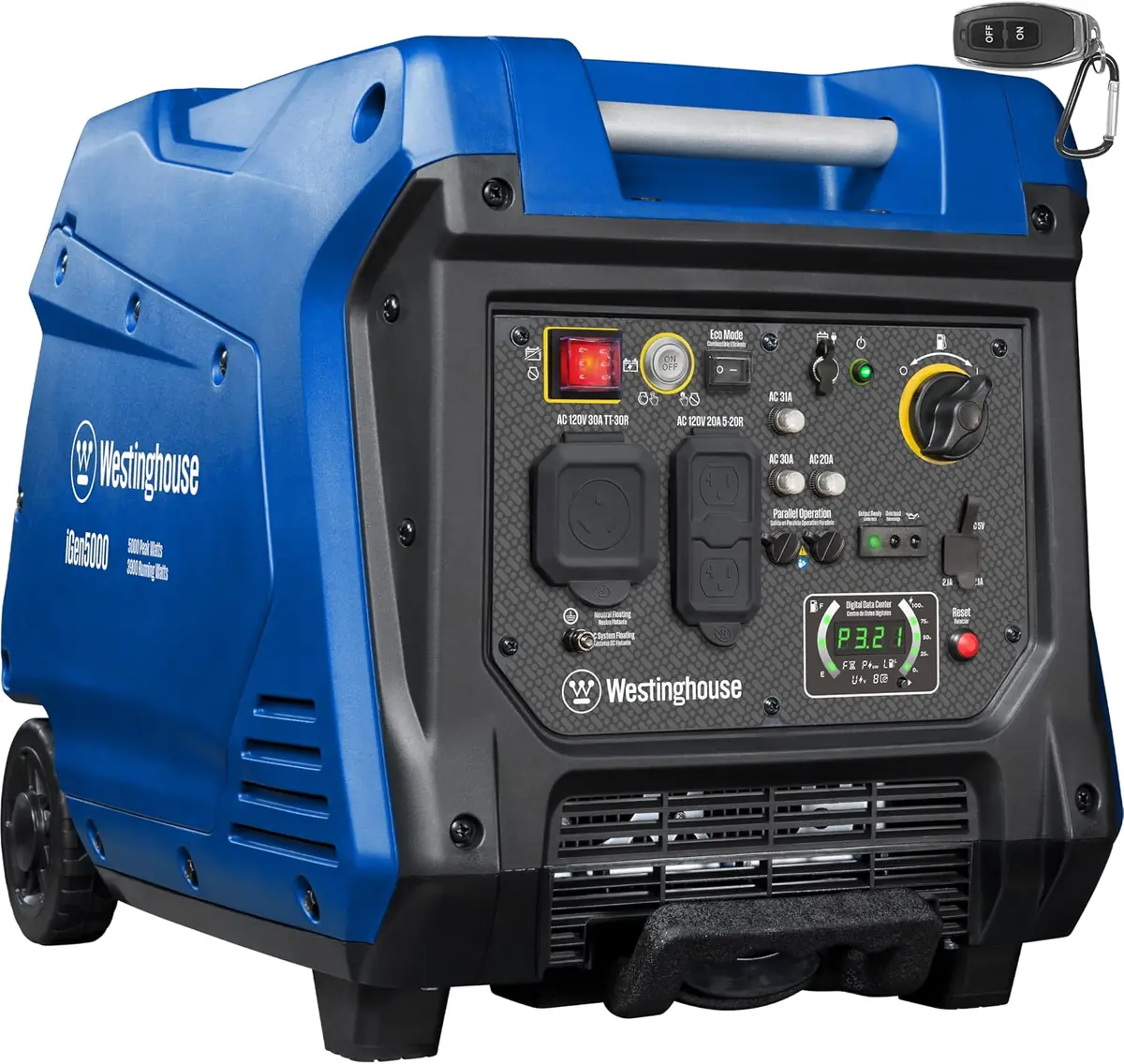
The Westinghouse iGen5000 is the gas inverter generator I recommend for RV trips, camping and a short list of home essentials, and you should skip it if you need a CO shutoff, propane or a light machine. It makes 3,900 W running and 5,000 W at the peak, starts from a key fob and weighs 104.7 lb. I sized it against the loads on my own list: the workshop lights and chargers, the kitchen fridge and a chest freezer in the fruit storage room. Below you get what the numbers mean, how it behaves under load, where it must stand, and who should pick something else.
Westinghouse iGen5000 Review and Verdict
Buy the iGen5000 if you want 3,900 W of running power from a gas inverter and a 30 A outlet for a camper. According to Westinghouse, it delivers 3,900 W running and 5,000 W starting, and its 3.4 gal tank runs up to 18 hours at 25% load. The price you pay is weight and one missing safety feature: it has no CO sensor, so you need both correct outdoor placement and working CO alarms inside the home. It sits in the premium tier and earns that on tank size and clean power.
- Who it is for: RV and camper owners, campers with a tow vehicle, and homeowners who want a few essentials covered through heavy outdoor cords.
- What it does best: a big tank, remote key fob start and clean inverter output with a 30 A outlet built in.
- The main trade-off: 104.7 lb and no CO sensor, so you lift it with help and set it far from the house.
Which Westinghouse iGen5000 You Are Buying
Westinghouse sells several generators with 5000 in the name, and owners mix them up. The unit in this review is the gas-only model at 3,900 W running and 5,000 W starting. The iGen4500 is a smaller, lower-rated machine, and none of its figures apply here.
Anyone shopping for a Westinghouse 5000 watt inverter generator should know that the 5,000 is the starting figure, a short peak for motor start-up. Plan every load on the 3,900 W running number. The DF version adds propane, and the c and cv versions add a CO sensor, so check the style shown on the Amazon page before you order.
Specs and What the Numbers Mean
The iGen5000 runs a 224 cc four-stroke engine, and the two rows that matter most are running watts and weight. Everything below is Westinghouse’s figure for the gasoline model.
| Spec | iGen5000 |
|---|---|
| Running watts | 3,900 (32.5 A at 120 V) |
| Starting watts | 5,000 |
| Run time, maker’s figure | Up to 18 hours at 25% load |
| Noise, maker’s figure | As low as 52 dBA, with no load or distance stated |
| Weight, dry | 104.7 lb |
| Fuel tank | 3.4 gal |
| Outlets | One 120 V 20 A duplex, one 120 V 30 A RV outlet, two USB ports; 120 V only |
| CO shutoff | None |
| Warranty | 3 years limited residential |
The Westinghouse iGen5000 manual puts the oil sump at 0.63 qt of 10W-30 and asks for clean unleaded gasoline with no more than 10 percent ethanol. Westinghouse lists total harmonic distortion at 3 percent or less, which suits laptops, routers and chargers. There is no GFCI outlet on the panel, so a loaded job near damp ground needs a GFCI cord or adapter.
Setup, Start-Up and Eco Mode
The box holds the generator, battery, charger, oil, key fob and manual, and the wheels and telescoping handle are built in. The battery switch has to be on before the electric or remote start works, and the recoil pull stays as the backup.
The start-up order in Westinghouse’s iGen manuals is simple: eco mode off, let the engine settle until the OUTPUT READY light comes on, then switch eco on. Eco mode lowers engine speed to match the load, which saves fuel and noise. Turn it off for a pump or compressor, because a motor’s start-up surge needs the engine at full speed.
With eco on and only the workshop lights plugged in, the engine note dropped to a low murmur, and it climbed the moment I started a pump motor. On my first run I plugged the pump in last, after the lights and the charger, and the overload light came on. The unit kept running and only the AC output cut, as the manual describes. I unplugged everything, pressed reset and added the pump first, then the small loads one at a time.
What the Westinghouse iGen5000 Runs in Real Use
Three jobs fit this generator: a camper, a short list of home essentials and the loads on a working property. Each one comes down to three limits: the 3,900 W total running rating, the limit of the outlet you use and the start-up draw of any motor.
RV and Camper Power
The 30 A RV outlet takes a camper cord directly, which is the reason this model suits RV owners. Count the air conditioner first, because its start-up draw is the hard part. Read that figure on its nameplate before you count on the iGen5000 for it. The 30 A, 120 V outlet tops out at 3,600 W, below the generator’s 3,900 W total, so the camper’s loads must fit under 3,600 W.
Home Essentials With a Transfer Switch
At 3,900 W you can cover a fridge, a chest freezer, lights and a router if you add the nameplates first. A licensed electrician installs a transfer switch or an interlock to connect a generator to a house, and without one you run cords to each appliance. I never plug a generator into a wall outlet.
Farm and Workshop Loads
I ran a long outdoor-rated cord from the generator to the workshop and laid it along the wall so nobody trips on it. The iGen5000 puts out 120 V only, so a 240 V pump or compressor is out. A 120 V pump can run if its nameplate running watts and start-up draw fit within the 3,900 W rating, and I start it first and add the small loads after it. Take cord gauge and length from the manual’s chart.
Fuel, Run Time and Noise
According to Westinghouse, a full 3.4 gal tank runs up to 18 hours at 25% load. A heavier load shortens that, and the maker prints no figure for other loads. The LED data center shows fuel level and remaining run time.
I watched the remaining run time drop when I added the chest freezer, and I refueled at the next break instead of at the last minute. Refuel only with the engine off and cool, outdoors, and keep the fuel can well away from the generator and the house. Use E10 or lower, never E15 or E85.
Westinghouse quotes the noise as low as 52 dBA and prints no distance or load with it. A figure without those two details cannot sit next to another maker’s number, so I treat it as a sign of a quiet inverter, not a measurement for my yard. NIOSH recommends limiting noise to 85 dBA averaged over eight hours and halving the exposure time for every 3 dBA more (1). I wear earplugs when I stand beside it for a long job. For other options, I compare noise ratings and distances in my quiet generator picks.
Weight and Moving It
The Westinghouse iGen 5000 weighs 104.7 lb dry, according to Westinghouse. Loading it onto a trailer took two people. Two people is the rule here. The wheels roll well on the gravel pad but dig into soft ground after rain, so I pick a dry path.
Carbon Monoxide, Placement and Safety
A gas generator runs outdoors only. The manual says never to run one in a home, garage, basement, crawl space, shed or carport, even with doors and windows open. It asks for at least 5 ft of clearance on all sides and overhead, and the CPSC and CDC say to keep the generator at least 20 feet from the house with the exhaust pointed away from doors, windows and vents. I follow the 20 feet.
This model has no CO sensor, so distance and alarms are the only protection. I stand it on open ground well clear of the house and the sheds, away from every door and window, with the exhaust pointing away from all of them. After four hurricanes hit Florida in 2004, misplaced portable gasoline generators caused nearly all the CO exposures in a CDC analysis (2). In NIST tests for the CPSC, the highest CO inside a test house came from a stock generator running in the attached garage with the bay door closed and the house door open about 2 inches (3).
After a major ice storm in Maine, locating a generator in a basement or an attached structure such as a garage was the strongest risk factor for poisoning (4). The manual tells owners to run battery CO alarms inside the home. A county in North Carolina found that 96.2 percent of severe poisonings after a 2002 ice storm happened in homes with no reported working alarm (5). The alarm protects the people inside.
Never Backfeed
Never plug the generator into a wall outlet. Power can flow back into the grid and kill a utility worker, and a house connection belongs to a licensed electrician with a transfer switch or an interlock.
Keep the generator dry. The manual rules out rain, snow and wet conditions, and I never touch it with wet hands or while standing in water.
Care and Storage
I check the oil level on level ground before every run, and I drain the carburetor before the generator sits for the season. Follow the oil-change schedule in the manual. Fuel left in the carburetor goes stale and can keep a stored generator from starting.
Altitude and heat also cut output. It drops about 3.5 percent for every 1,000 ft above sea level and about 1 percent for every 10 F above 60 F, and above 5,000 ft the engine needs a high-altitude carburetor kit.
Who It Suits and Who Should Skip It
The iGen5000 fits people who need more running power than a small inverter gives and will carry the weight for it. I compare nine clean-power options for outages, RV and camping in my inverter generator picks.
- RV and camper owners: the 30 A outlet takes a camper cord without an adapter.
- Campers and tailgaters: key fob start and a quiet inverter engine.
- Home essentials through cords: a fridge, a freezer, lights and a router at 3,900 W.
- Long jobs: the 3.4 gal tank is large for an inverter.
- Skip it if you want a CO shutoff: the c and cv versions have one, this one does not.
- Skip it if you want propane: the DF version burns propane, this one is gasoline only.
- Skip it if you need 240 V: a 240 V pump needs a different generator.
- Skip it if weight is your limit: 104.7 lb is a two-person lift.
- Skip it in California: Westinghouse lists it as not CARB compliant.
Drawbacks
Beyond the weight and the missing CO sensor, the limits are small but real. It puts out 120 V only, the panel has no GFCI outlet, and the noise figure comes with no load or distance.
The 5,000 W peak lasts a few seconds and only covers a motor’s start-up. Plan on 3,900 W and start the biggest motor first.
How It Compares With Alternatives
Three machines cover the same jobs, and the table compares gasoline figures.
| Spec | Westinghouse iGen5000 | Westinghouse iGen5000DF | Honda EU3200i | Champion 201050 |
|---|---|---|---|---|
| Running watts, gasoline | 3,900 | 3,900 | 2,600 | 3,000 |
| Weight, dry | 104.7 lb | 104.7 lb | 59.0 lb | 51.8 lb |
| Fuel tank | 3.4 gal | 3.4 gal | 1.21 gal | 1.54 gal |
| Fuel | Gasoline | Gasoline or propane | Gasoline | Gasoline or propane |
| CO shutoff | None | None | CO-MINDER | CO Shield |
Westinghouse iGen5000DF
The Westinghouse iGen5000DF 5,000-Watt Dual Fuel Inverter Generator uses the same engine and the same 3,900 W on gasoline, and it adds propane at 3,500 W running. It also has no CO sensor. My Westinghouse iGen5000DF review covers the propane side of that model in more detail.

Pick the DF if you want a second fuel that stores well.
Honda EU3200i
The Honda EU3200i 3,200-Watt Inverter Generator gives 2,600 W rated at 59.0 lb, and it carries Honda’s CO-MINDER shutoff.

Pick the Honda if you lift it often and 2,600 W covers your list.
Champion 201050
The Champion 201050 4,000-Watt Dual Fuel RV Ready Inverter Generator gives 3,000 W running on gasoline at 51.8 lb, with dual fuel and Champion’s CO Shield.

Pick the Champion if weight and a CO shutoff matter more to you than the last 900 W.
Common Problems and How to Prevent Them
These are the usual causes of trouble with this generator, each with its remedy.
- Overload light: unplug the loads, press reset and add them back one at a time, biggest motor first.
- Hard starting after storage: stale fuel in the carburetor is a likely cause, so drain it before the generator sits for the season.
- Loud at full load: eco mode only quiets light loads, so wear ear protection beside it.
My Final Verdict on the iGen5000
Buy the iGen5000 for a camper with a 30 A hookup, or for a workshop and a few essentials on a long cord run, and give it a dry pad far from the house. Skip it for a CO shutoff, propane or a unit you can lift alone. That is where my Westinghouse iGen5000 review lands: a 3,900 W inverter with a big tank, for people who can lift it and place it safely. I compare options for home backup, camping and job site power in my best generator picks.
Frequently Asked Questions
Are Westinghouse generators of good quality?
Westinghouse generators vary in quality by model, so judge the gas iGen5000 on its own record: a 3-year limited residential warranty and clean output at 3 percent THD or less. Its documented limits are 104.7 lb, no CO sensor and 120 V only, which decide whether it suits your job.
Can a 5000W generator run a house?
A 5000W generator can run part of a house, because the iGen5000 holds 3,900 W running and its 5,000 W peak lasts only seconds. It carries chosen essentials such as a fridge and lights, and a house connection needs a transfer switch or interlock fitted by a licensed electrician, never a wall outlet.
Are Westinghouse generators as good as Honda?
Westinghouse generators and Honda generators compare best model against model, and the iGen5000 and the Honda EU3200i differ clearly. The iGen5000 offers 3,900 W running at 104.7 lb with no CO sensor, while the EU3200i offers 2,600 W at 59.0 lb with the CO-MINDER shutoff, so pick by the watts, weight and safety feature you need.
Are Westinghouse generators as good as Generac?
Westinghouse generators and Generac generators compare best model against model, and the iGen5000 and the Generac iQ5200 DF share a 3,900 W gasoline running rating. The Generac adds propane and a CO shutoff, so pick by the fuel options and safety features you want, and by the weight you can lift.
How much gas does a 5000 watt generator use?
A 5000 watt generator like the iGen5000 uses about 0.19 gal of gasoline an hour at 25% load, working from Westinghouse’s figure of up to 18 hours on a 3.4 gal tank. Heavier loads burn more fuel, and the maker prints no run time for them, so plan refuels from the data center display.
References
- National Institute for Occupational Safety and Health. Noise-Induced Hearing Loss. Noise and Hearing Loss. Centers for Disease Control and Prevention; 2024.
- Centers for Disease Control and Prevention. Carbon monoxide poisoning from hurricane-associated use of portable generators – Florida, 2004. JAMA. 2005;294(12):1482. doi:10.1001/jama.294.12.1482
- Emmerich SJ, Persily AK, Wang L. Modeling and Measuring the Effects of Portable Gasoline Powered Generator Exhaust on Indoor Carbon Monoxide Level. NIST Technical Note 1781. National Institute of Standards and Technology; 2013. doi:10.6028/NIST.TN.1781
- Daley WR, Smith A, Paz-Argandona E, Malilay J, McGeehin M. An outbreak of carbon monoxide poisoning after a major ice storm in Maine. J Emerg Med. 2000;18(1):87-93. doi:10.1016/S0736-4679(99)00184-5
- Centers for Disease Control and Prevention. Use of carbon monoxide alarms to prevent poisonings during a power outage – North Carolina, December 2002. JAMA. 2004;291(14):1691. doi:10.1001/jama.291.14.1691
Safety Note: Generator exhaust contains carbon monoxide, which can kill in minutes. Run a fuel generator outdoors only, never in a home, garage, basement, shed or other enclosed or partly enclosed space, even with doors or windows open. The CPSC says to place it at least 20 feet from your home and other buildings, with the exhaust pointed away from doors, windows and vents. Install battery-operated or battery-backup carbon monoxide alarms on every level of the home and outside sleeping areas. Never plug a generator into a wall outlet: connect it to a house only through a transfer switch or interlock installed by a licensed electrician. Refuel only with the engine off and cool, and read the manufacturer’s manual, including for a portable power station.