
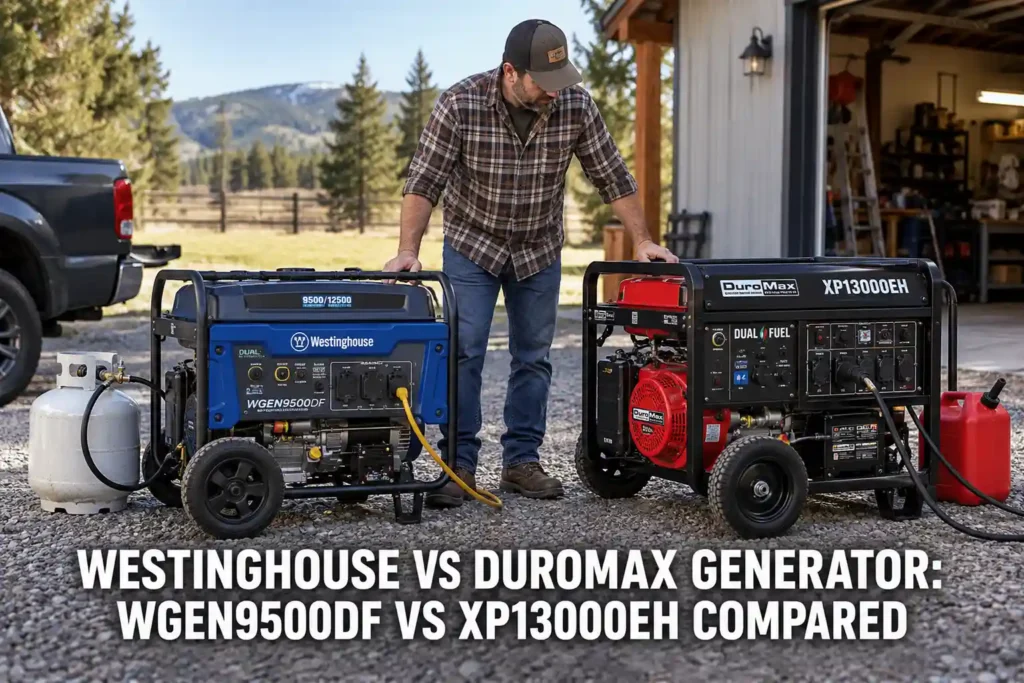
In the Westinghouse vs DuroMax generator matchup, the choice comes down to 1,000 running watts against 23 pounds. The DuroMax runs 10,500 watts on gasoline, while the Westinghouse runs 9,500 and weighs less, so I recommend the Westinghouse to most buyers and the DuroMax to anyone whose loads need the extra watts.
I compare machines the way I did on a large crop operation: same load, same fuel, same distance. Below you get output, run time, noise, weight, starting, safe placement and a clear pick for each buyer.
Westinghouse vs DuroMax Generator Short Answer
Choose the Westinghouse if you move the generator yourself, want a key fob start and want to pay less. Take the DuroMax if you need its 10,500 running watts, its larger tank or its smaller loss on propane. Both are 120/240 volt, open-frame dual fuel units with wheel kits, so the Westinghouse WGen9500DF vs DuroMax XP13000EH table below compares like with like.
| Spec | Westinghouse WGen9500DF | DuroMax XP13000EH |
|---|---|---|
| Running watts, gasoline | 9,500 W | 10,500 W |
| Running watts, propane | 8,500 W | 9,975 W |
| Starting (peak) watts, gasoline | 12,500 W | 13,000 W |
| Run time, gasoline, 25% load | 12 hr | Up to 17 hr |
| Run time, gasoline, 50% load | 8 hr | 8 hr |
| Run time, propane, 50% load | 7 hr on a 20 lb tank | 6 hr on a 40 lb cylinder |
| Fuel tank | 6.6 gal | 8.3 gal |
| Noise, distance not stated by the maker | 74 dBA | 74 dB |
| Dry weight | 211 lb | 234 lb |
| Starting | Push button, key fob up to 99 ft, recoil backup | Push button, recoil backup |
| 240 volt outlets | 30 A twist-lock and 50 A 14-50R | 30 A L14-30R and 50 A 14-50R |
| Warranty | 3 years limited, residential | 3-year limited |
Two rows decide it: the running watts on the fuel you will really burn, and the weight you have to move. Everything else is close enough to settle on your own loads.
Power and Fuel From 9,500 to 10,500 Watts
Compare running watts, not the big number in the title. The Amazon listings say 12,500 and 13,000 watts, but those are the gasoline starting peaks that last a few seconds while a motor spins up. The steady figures are 9,500 watts for the Westinghouse and 10,500 for the DuroMax, a gap of 1,000 watts.
Propane is where the gap changes. In a Westinghouse vs DuroMax dual fuel generator comparison, the Westinghouse gives up 1,000 running watts on propane and falls to 8,500, while the DuroMax gives up only 525 and holds 9,975. The DuroMax therefore leads by 1,475 watts on propane, a bigger margin than on gasoline.
I size a generator from the nameplate of the biggest motor, then add the small loads one at a time. A 240 volt pump needs a 120/240 volt unit, and both of these have the 50 amp outlet for it. The pump’s own start-up draw, not the 12,500 or 13,000 on the box, decides whether either one carries it.
Winner: DuroMax, because it holds more running watts on both fuels and loses far less on propane.
Run Time and Tank Size
Compare run time only at the same load. At 50% load both makers list 8 hours on gasoline. The DuroMax gets there with an 8.3 gallon tank against 6.6 gallons, and 50% of its rating is about 500 watts more than 50% of the Westinghouse rating, so it delivers more power for the same hours.
At 25% load Westinghouse lists 12 hours and DuroMax lists up to 17 hours. On propane, Westinghouse gives 7 hours at 50% load from a 20 lb tank, and DuroMax gives 6 hours at 50% load with a 40 lb cylinder suggested. The cylinders differ, so I do not rank the propane hours directly.
I keep propane with the farm fuel, outdoors and away from the house, so cylinder size decides how often I make the trip. Refuel only with the engine off and cool, and keep fuel in approved containers away from the generator.
Winner: DuroMax, because it matches the Westinghouse at 50% load with more watts behind that load and reaches up to 17 hours at 25%.
Noise, Weight and Moving It
Both makers list 74, Westinghouse as 74 dBA and DuroMax as 74 dB, and neither states the distance. A reading taken close to a generator is always higher than one taken at 23 feet, so I call the noise a tie only on paper. NIOSH recommends keeping exposure to 85 dBA or less averaged over eight hours, and each 3 dBA increase halves the time (1). I wear ear protection whenever I stand beside either one.
Weight is the clear difference: 211 lb dry for the Westinghouse and 234 lb for the DuroMax. Both ship with a wheel kit that needs assembly, and the Westinghouse manual says its wheels are for moving it by hand only, not for towing. Over the gravel pad by my machinery shed a wheel kit is enough, but a step or a truck bed takes two people with either unit.

Winner: Westinghouse, because 23 fewer pounds decides who can place it and who needs help.
Starting, Outlets and Home Hookup
The Westinghouse has a push button, a key fob that starts it from up to 99 feet and a recoil backup. The DuroMax has a keyed switch with a push-button electric start and a recoil backup, but no remote. On a cold morning the fob let me start the Westinghouse from the kitchen door, though the unit has to be fueled and set to the right state first. I cover this 9,500-watt dual-fuel backup model in my review of the Westinghouse WGen9500DF.
Both use a battery that comes in the box, and the DuroMax needs its battery switch turned on before you press start. Before the first start I took the shipping braces off the DuroMax, as its Quick Start says. For the Westinghouse I kept the first five hours at half of the rated running watts or less, which is what its manual asks for break-in.
Both are listed as transfer switch ready, and both the 30 amp and the 50 amp outlets give 120/240 volts, with the circuit picked and sized by the electrician. The DuroMax adds a 120 volt 30 amp locking outlet and a 12 volt DC outlet. Connection to a house goes through a transfer switch or an interlock installed by a licensed electrician. According to OSHA, never attach a generator to a building any other way, because the power can flow back to the grid and kill line workers. I compare more options for household outages in my picks for a generator for home backup.
A 50 amp plug needs a heavy, grounded, outdoor-rated cord. I lay the cord to the workshop in a straight line so nobody trips on it. Pick the cord gauge from the cord maker’s guide for your load and your length.
Winner: Westinghouse, because the key fob start is the one feature the DuroMax does not have.
Where to Run Each One Safely
Both generators run outdoors only. According to the CPSC, that means at least 20 feet from the house with the exhaust pointed away from the house and other buildings. The CDC gives the same 20 feet from doors, windows and vents. Never run either one in a garage, shed, basement, crawl space or carport, even with the doors open.
After four Florida hurricanes in 2004, misplaced portable gasoline generators, indoors, in garages or outdoors near windows, caused nearly all of the carbon monoxide exposures that the CDC analyzed (2). NIST tests with generators run in the attached garage of a research house recorded peak house CO from under 10 ppm to over 10,000 ppm, depending on the generator and the door positions (3).
Put battery-powered CO alarms in the house. After an ice storm in North Carolina, 96.2% of the severe poisonings happened in homes with no functioning CO alarm (4). One Houston hospital treated or telephone-triaged 37 people for generator CO in the first 36 hours after Hurricane Ike, and 54% were under 18. In 5 of the 9 incidents with a known reason, the generator was powering video games or televisions (5).
Distance, exhaust direction and alarms are the protection I rely on, and no feature of a generator makes a closer spot safe. Keep it dry. Rain protection is a canopy or cover that the manual allows, one that keeps the generator dry and leaves it unenclosed with the exhaust open, and I never touch it with wet hands or while standing in water. The Westinghouse manual asks for 5 feet of clearance on all sides and overhead, which I treat as a bare minimum.
Warranty and Price Tier
Both sit in the premium price tier, and the DuroMax is the more expensive of the two. Westinghouse lists 3 years limited for residential use and 1 year for commercial use. DuroMax lists a 3-year limited warranty, so read its terms before you use it commercially. A longer warranty on a tri-fuel DuroMax is covered below.
Winner: Westinghouse, because it costs less and its residential warranty is documented at 3 years. The extra 1,000 watts of the DuroMax have to be worth the higher price to your loads.
Westinghouse vs DuroMax Tri Fuel Generator Models and Other Lines
Anyone comparing a DuroMax vs Westinghouse generator should know that both brands sell more than these two. Each model below is a different machine with its own figures, so I do not carry numbers from one to another. If you want natural gas as a third fuel, I compare five options in my tri-fuel generator picks.
- Westinghouse WGen9500TFc 9,500-Watt Tri-Fuel Generator: the same 9,500 running watts on gasoline as the WGen9500DF, with 8,500 on propane and 7,500 on natural gas, at about 215 lb dry according to Westinghouse. Natural gas needs a licensed plumber for the supply line.
- Westinghouse WGen11500TFc 11,500-Watt Tri-Fuel Generator: 11,500 watts on gasoline, 10,500 on propane and 9,500 on natural gas, with a 9.5 gallon tank and 230 lb dry according to Westinghouse. I compare it with the smaller WGen9500TFc in WGen9500TFc versus WGen11500TFc.
- DuroMax XP13000HXT 13,000-Watt Tri-Fuel Generator: 10,500 watts on gasoline, 10,000 on propane and 9,000 on natural gas. DuroMax lists a 5-year parts warranty for residential use, and its manual gives 246 lb.
- Westinghouse iGen5000DF Dual Fuel Inverter Generator: a 120 volt inverter unit in a much smaller class, with 3,900 watts on gasoline and 104.7 lb. It is no stand-in for a 240 volt pump. My review of the Westinghouse iGen5000DF takes a closer look at this dual fuel inverter and its 30 amp outlet.
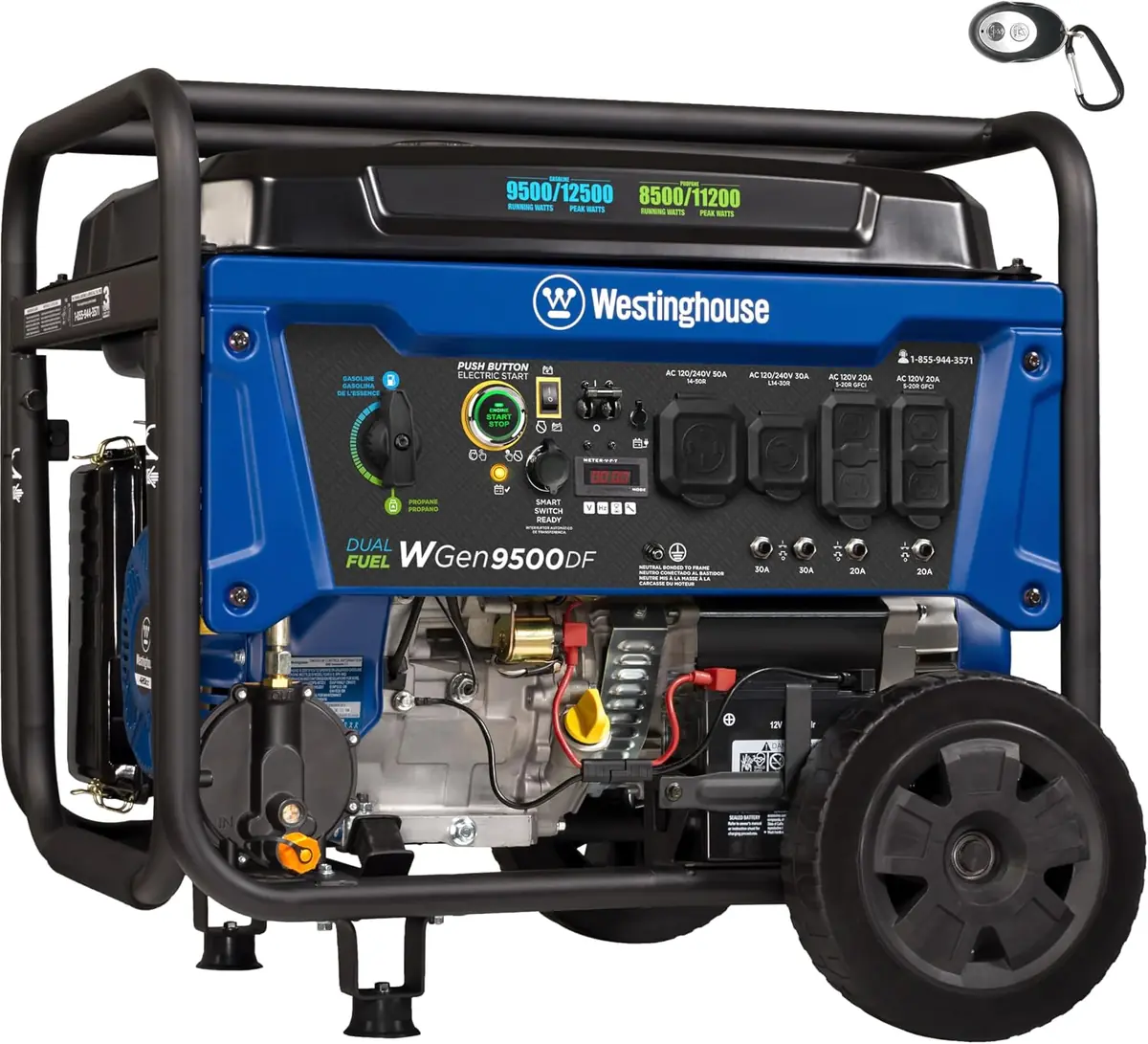
Choose the Westinghouse WGen9500DF If
The Westinghouse suits the buyer who handles the machine and wants the lowest cost of the two.
- You move it yourself: 211 lb dry is 23 lb less to wheel across gravel.
- You want a remote start: the key fob works from up to 99 feet.
- Your running loads stay under 9,500 watts, or 8,500 on propane.
- You want the lower price and a documented 3-year residential warranty.
My habit with this class of machine is to stand it on the gravel pad, exhaust turned away from the house and the sheds, and leave it there for the whole outage.
Choose the DuroMax XP13000EH If
The DuroMax suits the buyer whose loads are heavy and who places the machine once.
- Your running loads fall between 9,500 and 10,500 watts: it holds 10,500 on gasoline.
- You will burn propane: it keeps 9,975 running watts, 525 less than gasoline.
- You want a bigger tank: 8.3 gallons, and up to 17 hours at 25% load according to DuroMax.
- You need the extra outlets: a 120 volt 30 amp locking outlet and a 12 volt DC outlet.
- You can place it once and leave it: it weighs 234 lb dry.
The digital panel shows hours run and hours to the next maintenance, and I read it every time I check the oil on level ground before a run. For a closer look at this dual fuel backup unit, see my review of the DuroMax XP13000EH.

My Pick for a Farm Backup Plan
For my own yard I pick the Westinghouse, because I move equipment by hand and it is 23 pounds lighter. The DuroMax earns its place when the pump, the workshop and the freezers run together and the load is too big for the Westinghouse.
Add up what runs at the same time and compare it with the running watts on your fuel: 9,500 on gasoline or 8,500 on propane for the Westinghouse, 10,500 or 9,975 for the DuroMax. Then add the largest motor’s starting watts to the other running loads and check that against the starting rating. If neither unit covers the total, shed loads or ask an electrician to size a bigger setup. For loads between those two ratings, the extra watts of the DuroMax settle the Westinghouse vs DuroMax generator choice. If neither model fits your load list, my best generator picks cover home backup, camping and job site power.
Frequently Asked Questions
What are the common complaints about the DuroMax generator?
The main complaints to expect about the DuroMax generator are weight and noise, since the XP13000EH weighs 234 lb dry and lists 74 dB with no distance. It also costs more than the Westinghouse and has no remote start, so plan for a walk to the panel in bad weather.
Can a 9500 watt generator run a whole house?
A 9500 watt generator can run a whole house only when the running watts of everything on at once stay under 9,500 on gasoline, and the largest motor’s start-up fits the 12,500 watt peak. The connection must go through a transfer switch or interlock installed by an electrician, and any load that pushes past those limits stays off.
What is the disadvantage of a dual fuel generator?
The main disadvantage of a dual fuel generator is that propane gives less power than gasoline. The Westinghouse loses 1,000 running watts on propane and the DuroMax loses 525, so size the unit for the lower figure if propane is the fuel you will store, and check the propane run time against your real load.
What can a 13,000 watt generator power?
A 13,000 watt generator such as the DuroMax XP13000EH can power loads up to its 10,500 running watts, because 13,000 is only a short starting peak. That can cover a refrigerator, a freezer, lights and a 240 volt pump on the 50 amp outlet when their running watts stay under that total and the pump’s start-up fits the peak.
Is the DuroMax XP13000EH an inverter generator?
The DuroMax XP13000EH is an open-frame portable generator with a 500 cc engine, not an inverter generator. Open-frame output is less clean than inverter output, so ask DuroMax before you connect laptops or other sensitive electronics, and keep them off the generator until you have that answer from DuroMax in writing.
References
- National Institute for Occupational Safety and Health. Noise-Induced Hearing Loss. Noise and Hearing Loss. Centers for Disease Control and Prevention; 2024.
- Centers for Disease Control and Prevention. Carbon monoxide poisoning from hurricane-associated use of portable generators – Florida, 2004. JAMA. 2005;294(12):1482. doi:10.1001/jama.294.12.1482
- Emmerich SJ, Persily AK, Wang L. Modeling and Measuring the Effects of Portable Gasoline Powered Generator Exhaust on Indoor Carbon Monoxide Level. NIST Technical Note 1781. National Institute of Standards and Technology; 2013. doi:10.6028/NIST.TN.1781
- Centers for Disease Control and Prevention. Use of carbon monoxide alarms to prevent poisonings during a power outage – North Carolina, December 2002. JAMA. 2004;291(14):1691. doi:10.1001/jama.291.14.1691
- Fife CE, Smith LA, Maus EA, et al. Dying to play video games: carbon monoxide poisoning from electrical generators used after Hurricane Ike. Pediatrics. 2009;123(6):e1035-e1038. doi:10.1542/peds.2008-3273
Safety Note: Generator exhaust contains carbon monoxide, which can kill in minutes. Run a fuel generator outdoors only, never in a home, garage, basement, shed or other enclosed or partly enclosed space, even with doors or windows open. The CPSC says to place it at least 20 feet from your home and other buildings, with the exhaust pointed away from doors, windows and vents. Install battery-operated or battery-backup carbon monoxide alarms on every level of the home and outside sleeping areas. Never plug a generator into a wall outlet: connect it to a house only through a transfer switch or interlock installed by a licensed electrician. Refuel only with the engine off and cool, and read the manufacturer’s manual, including for a portable power station.