
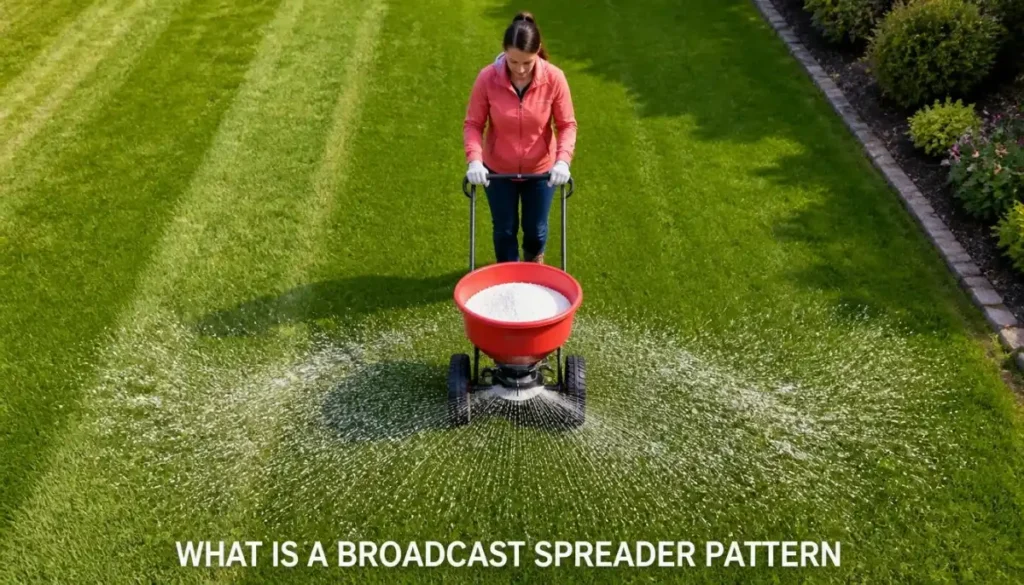
A broadcast spreader pattern is the way granules land across the width a rotary spreader throws: heavy in the middle, lighter toward the sides, and never one clean strip. In large-scale production, I verified seed drill calibration on weighing trays, so I read a pattern as something to check rather than assume. Below you will find its shape, what skews it, how extension specialists check it and where it meets the edge of your lawn.
What a Broadcast Spreader Pattern Is
A broadcast spreader, also called a rotary spreader, lets granules fall from a hopper onto a spinning impeller, which is a disc or a paddle, and throws them out in a fan. The pattern is the way those granules spread over the ground the fan reaches. It describes both how wide the fan lands and how much product sits in each part of it.
Kentucky Extension says rotary spreaders spread a wider swath than drop spreaders, suit large areas and are less precise, though less likely to leave missed strips (1). That trade explains why the pattern matters. A wide fan covers a lawn quickly, and the shape of the fan decides whether the lawn gets product evenly or in bands. My broadcast and drop spreader comparison shows how each one delivers product to the lawn.
I picture a pattern as a low hill: tall in the middle, sloping off on both sides. A single pass lays down one hill. The ground between two passes only gets what the slopes of both hills add together.
Pattern, Swath and Rate Are Three Different Things
The swath is the width the fan lands across. The rate is how much product is applied per unit of ground area, and the label of the product you spread gives it. The broadcast pattern is the distribution inside the swath. A spreader can have a printed swath and a correct rate and still lay down an uneven pattern if tilt, humidity or build-up on the impeller bends it.
| Term | What it describes | Who decides it |
|---|---|---|
| Pattern | How granules are spread across the fan | The spreader, the product and the conditions on the day |
| Swath | How wide the fan lands | The spreader maker prints a ceiling; the real width depends on the product |
| Rate | How much product is applied per unit of ground area | The product label, then the maker’s chart as a starting point |
The Shape Is Heavy in the Middle and Light at the Sides
NC State Extension describes a rotary pattern as heavier in the center and lighter at the sides, and Kentucky Extension describes the same shape (2). Both treat it as the normal outcome of a thrown fan, which is the reason passes have to overlap. I treat that shape as the starting fact about any broadcast spreader I look at, and my answer to “what is a broadcast spreader” covers the parts.
| Part of the fan | What lands there | What it means on the lawn |
|---|---|---|
| Middle | The most product | One pass leaves its heaviest strip along its own path |
| Sides | Less product | A strip beside the pass gets a light dose unless the next pass reaches it |
| Far fringe | A few granules thrown past the lawn | These can reach pavement, beds or water |
None of this gives you a number for your spreader. A different model, a different product and a different day all move the shape. A figure printed on a box is the maker’s ceiling for the maker’s own product, so I read it that way and never as the width that lands on my lawn.
Why Equipment Type Does Not Settle It
A field study of commercial farm spreaders found a wide spread in how uniform the swaths were, and the type of spreader did not appear to decide it (3). Those machines are far larger than a push spreader, and the result does not transfer to a lawn. It does show that a spreader’s label on the front tells you little about the pattern on the ground.
Pattern Width and Why Passes Overlap
Extension specialists talk about an effective swath width, which is not the full distance the granules fly. NC State Extension says the effective width sets the distance between passes (2). The idea is simple: the light sides of one pass and the light sides of the next should add up to a normal dose. My answer to “what is spread width” covers swath, effective width and pass spacing.
Follow the overlap and spacing directions in the product label and the spreader maker’s manual; they set the method for your product and your machine.
What to Take From This
Treat the overlap as part of the pattern. If you skip it, the light sides of the fan show up as pale strips. If you overdo it, the heavy middle of one pass lands on the heavy middle of the next.
What Skews the Pattern
A pattern is a balance between the product, the machine and the day. Laboratory and field work points to a handful of things that bend it. Each one is something you can watch for before you open the gate.
Humidity and Sticky Product
A laboratory study of rotary turf spreaders found that when humidity rises above a fertilizer’s critical relative humidity, the material absorbs moisture, its friction on the impeller changes and the pattern skews (4). Fully water-soluble materials gave stable patterns at one humidity level and different ones at another. The study gives no humidity figure to avoid, so I never quote one.
Tilt and Uneven Ground
A test of single and twin disc rotary spreaders tilted from side to side found that the angle had a significant effect on the pattern (5). Those were tractor-mounted farm machines, so the lesson is the principle, not a number: keep the spreader level. NC State Extension adds that the handle should stay at the same height used when the spreader was calibrated and that the impeller should be level. On a sloped yard, I treat a lean as a pattern problem before it is a comfort problem. My roundup of spreaders for uneven ground compares push, tow and hand models.
Build-Up on the Impeller
The same humidity study found that fertilizers with insoluble parts build up on the impeller and other parts and shift the pattern gradually (4). That is The cleaning section below covers how to deal with it safely.
Pace and Turning
A faster pace lowers the application rate and a slower pace raises it, according to Clemson and NC State Extension. One laboratory study with a single spreader and a single material found that the pattern held up better when speed went up than when it went down, while the rate moved with small speed changes, and the author cautions against stretching the result (6). I do not recommend a walking speed for any yard, since the pace you calibrated at is the pace that counts.
Turning is the other trap. NC State Extension says to close the lever before slowing, turning or stopping, and not to spread while turning, because generally only one wheel drives the impeller and its speed changes in a turn (2). Hence a turn leaves its own mark in the pattern.
Close the gate before you stop, before you slow down to turn, and whenever you pause, and open it again only after you are walking or driving at the steady pace your manual describes. Do not spread while you turn.
Wind and Weather
NC State Extension lists wind speed and direction, surface slope, temperature and relative humidity as conditions that affect distribution, and advises delaying the job when they interfere with a uniform application. The yard side of my property is more exposed to wind than the orchard side, which the hedgerow shelters, so wind is the first thing I look at there.
| What changes it | What happens | What you control |
|---|---|---|
| Humid air and damp product | The material turns sticky and the fan skews | The day you choose and the product’s label |
| Side to side tilt | The pattern shifts toward one side | How level you hold the spreader |
| Product left on the impeller | The pattern drifts over time | How the spreader is cleaned |
| Pace | The rate moves; the pattern follows | Holding the pace you calibrated at |
| Turning with the gate open | The impeller changes speed | Closing the gate before you turn |
| Wind and slope | The fan lands off the intended line | Delaying the job when conditions interfere |
How Extension Checks a Pattern
Extension publications describe a few ways to check a pattern, and every one of them puts product on a tarp, a hard surface or a set of pans. That makes a check a hands-on job with product in the hopper, so the safety steps come first. The numbers belong to the label, the maker’s manual and your own measurements.
Stop and Make Safe First
Stop and make safe before you fill or unload the hopper, reach into the hopper, clear a clog, clean or rinse the spreader, lubricate it, adjust the gate or the pattern, change a part, hitch or unhitch it, charge or change a battery, move it, store it or leave it. Keep your hands, feet, hair and loose clothing away from the impeller, the plate, the agitator, the gears and the wheels while anything can turn. During normal spreading, walk or drive only as your manual and the product label permit; walking behind a push spreader, or pulling a tow-behind unit at the speed its manual describes, is operation, not transport. Walk-behind or hand-crank spreader: close the gate, then stop walking or cranking, and wait until the impeller, plate, agitator and wheels have stopped turning. Keep the gate closed while you fill. Wear all the protective equipment the product label and your manual require while you fill, clean or clear a jam. Clear a clog only with the method in your exact manual. Follow every applicable safety step in your manual, in the order it specifies. Refit every guard and cover, and check that the gate opens and closes before product goes back in.
Read the product label before you open the bag. Follow its directions for the permitted use, the application amount, protective equipment, weather, watering in, access by people and pets, storage and disposal. Using a registered pesticide in a way its label does not allow is against federal law. Follow the spreader’s manual too. If the product’s instructions and the spreader’s instructions cannot both be followed, do not use that combination; ask the manufacturers for guidance.
Wear all the protective equipment the product label and your spreader’s manual require, and put it on before you open the bag. Wear it every time you fill the hopper, clean the spreader or clear a clog. Protective equipment lowers your exposure; it does not make handling a lawn product safe.
If the product contains a pesticide, wash your hands before eating, drinking, smoking or using the restroom. Change your clothes and wash your hands immediately after you apply a product that contains a pesticide, and follow the label’s additional washing and clothing instructions.
The Pan Method
Clemson Extension describes setting pans in a line, walking the spreader across the line and comparing the material in the pans from the center outward to find where the effective edge of the swath falls. NC State Extension adds that the pans should be equal in size and have pads or baffles so material cannot bounce out. The result tells you how far the effective swath reaches on each side of the center, and that is the width that sets the spacing between passes.
Before you fill the hopper for a check, complete the stop and make-safe steps for your spreader in the safe-state box, and keep the gate closed. For fertilizer, fill on a hard surface where spilled granules can be swept up, away from drains and water. Follow the product label’s handling and ventilation directions, and wear all the protective equipment the label and your manual require. Fill only to the level your manual allows, and secure the hopper cover or lid if your spreader has one. Keep children and pets away, and never leave a filled spreader where they can reach it.
The Tarp or Hard Surface Check
Kentucky Extension suggests a faster check for a rotary spreader: spread on a hard surface or a tarp and measure how far the furthest granules landed. It warns that granules bounce on a hard surface and says to sweep the product up afterward (1). The method gives a rough width and no more, so I recommend it as a first look and not as proof of a pattern.
Keep people and pets away from a spill. Follow the product label and its safety data sheet for collecting, reusing and disposing of spilled product, and wear the protective equipment they require. Never hose or wash granules into a street, a gutter, a drain, a ditch or water, and do not pile spilled product onto the lawn or return contaminated material to the bag. If you cannot manage the spill safely, stay away and call the emergency number on the label. Call Poison Control at 1-800-222-1222 if anyone is exposed, and call 911 for a fire, immediate danger or a large spill.
A Hand-Cranked Spinner Is Its Own Case
A 1979 study of a hand-operated spinner spreader found that the way the operator carries it changes the pattern: the widest swath and the most uniform distribution came with the spinner directly in front of the operator and the crank slightly to the right (7). It was one old design, so I use it only for the idea that body position matters on a handheld. Your manual’s picture of how to carry the spreader is the better guide. My answer to “what is a handheld spreader” also helps you pick a kind.
Never push, kick or dig product out of the gate or off the plate while anything can turn. If product clumps or bridges in the hopper or the gate clogs, stop and complete the stop and make-safe steps in the safe-state box first, then clear it only with the method in your manual.
Reading Stripes on a Lawn
Dark and light stripes after a feeding are the visible record of the pattern. NC State Extension and Kentucky Extension tie them to missed strips, doubled strips, a skewed fan and an uneven pace. The dark bands are where more product landed, since the effect comes from the fertilizer itself.
I do not take a stripe as proof that a spreader is faulty. A turn with the gate open, a damp bag and a lean on a slope can each produce one with a perfectly good machine. Look at what changed on the day before you blame the model.
A rotary spreader leaves fewer missed strips than a drop spreader, according to Kentucky Extension, and a wide fan makes the edges of each pass easy to misjudge. A maker’s claim that a broadcast fertilizer spreader prevents stripes is a sales line, not a fact you can lean on.
Pattern and the Lawn Edge
A rotary fan throws granules past the edge of the lawn, so the edge is where a pattern does the most harm. Clemson and Kentucky Extension both note that a rotary spreader throws farther than its own body, and UC IPM recommends drop spreaders over rotary ones to avoid off-target fertilizer application. A few makers print a spreader deflector or other edge feature for this reason.
My concrete work pad, the path to the house door and the gravel yard all run along the lawn. Granules that land there are the standard runoff problem, and I pay more attention to the edge of the fan than to its middle.
Keep fertilizer off pavement and out of drains and surface water. If scattered plain fertilizer lands on a sidewalk, a driveway or a patio, sweep it back onto the lawn before you water, without going over the label rate; collect a concentrated spill instead. For pesticide granules, follow the label’s cleanup instructions. Follow any buffer requirement that applies and keep fertilizer out of those areas. EPA advises against fertilizing before windy or rainy days, and Purdue advises against fertilizing drought-stressed, dormant or frozen turf. Follow the product’s weather and watering directions too.
Purdue Extension names a vegetative buffer strip of about 10 feet around ponds, lakes and streams (8). That is Purdue’s guidance, and other states and local rules differ, so the label and your local rules decide the distance. Drainage ditches border my property, which makes water the thing I check before I think about a fan.
Labels, Settings and Calibration in One Place
The product label gives the application directions, so read it before you set the gate. A setting listed for your exact spreader and product is a starting point, not proof of the amount delivered: follow the spreader’s manual and calibrate for the product, the spreader and the person using it before you apply. Never exceed the label’s application rate.
Clemson Extension says an improperly calibrated spreader can apply too much or too little product, and Kentucky Extension says to calibrate again for each new fertilizer, since particle size and density differ. I read a maker’s chart the way I used to read a seed drill chart: a place to start that I check against what actually lands. NC State Extension says to calibrate for each product and each operator, so a setting that works for a neighbor can miss on your lawn.
- Read the label of the product and the manual of the spreader before the first fill.
- Complete the stop and make-safe steps in the safe-state box, then fill on a hard surface with the gate closed.
- Measure the test area and weigh the product you put in, as your manual or your extension service describes for a known-area check.
- Make the pass the label and the manual permit, then weigh what is left and compare it with the label’s direction.
- Before you unload the hopper or adjust the opening, complete the stop and make-safe steps in the safe-state box again, then adjust only as the manual directs and repeat the check.
- Write down the product and the opening you used, since a new product means a new check.
Cleaning So the Pattern Stays True
Product left on the impeller changes the pattern over time, as the humidity study found, and NC State Extension says to wash a spreader after each day’s use to avoid buildup around the ports and on the impeller. It also says to dry the spreader completely to prevent rusting and to lubricate it as the owner’s manual specifies. My answer to “what is a spreader impeller” shows its parts, types and how it throws granules.
Cleaning Safely
Before you clean the spreader, complete the stop and make-safe steps in the safe-state box, and wear the protective equipment the product label and your manual require. Handle leftover product, cleaning water and residues as the product label directs. Clean the spreader only by a method both the label and the manual permit, and rinse it only where they permit it, keeping product and contaminated wash water out of drains and water supplies. Dry the spreader completely, and lubricate it as its manual directs. If you change products, follow both products’ cleaning requirements: a rinse alone does not show that all residue is gone.
Before you store the spreader, complete the stop and make-safe steps in the safe-state box. Store it empty, clean and dry, as your manual describes, with the gate closed. Keep products in their original labeled containers, securely closed, under the storage conditions their labels give, and away from children and pets. Lock pesticides away, apart from fertilizer, food and animal feed, and never put any product into a food or drink container.
Keep children, pets and other people away from the area while you fill and spread, and keep them off the treated area for as long as the label says. Store the bag and the filled spreader where they cannot reach them. If someone swallows or is exposed to a lawn product, follow the first-aid section of the product label and call Poison Control at 1-800-222-1222, and keep the product label with you. Call 911 in an emergency.
What to Remember About Your Spreader’s Pattern
Three points carry the rest. The fan is heavy in the middle and light at the sides, so overlap is part of the job. Humidity, tilt, build-up, pace and turns each bend the shape, and you control most of them. The label and the maker’s manual set every number that belongs on the ground. If you are choosing one, my broadcast spreader picks compare push, tow-behind and handheld models side by side.
One habit has served me in other work: check against what lands before you trust a setting. Next, learn how the gate, the plate and the throw work in sequence in my answer to “how does a broadcast spreader work”, then keep the broadcast spreader pattern in mind each time you open the gate.
Frequently Asked Questions
What is a broadcast spreader pattern?
A broadcast spreader pattern is the way a rotary spreader’s thrown granules spread across the ground in front of it. It is heavier in the middle of the fan and lighter at the sides, which is why neighboring passes overlap.
What shape is the pattern of a broadcast spreader?
The pattern of a broadcast spreader is a fan that is heavier in the center and lighter at the sides, as NC State Extension and Kentucky Extension both describe it. The exact shape changes with the product, the spreader and the conditions on the day.
Why is a broadcast spreader pattern heavier in the middle?
A broadcast spreader pattern is heavier in the middle because a thrown fan puts more granules near its center line than toward its edges, as NC State Extension and Kentucky Extension describe. One pass therefore leaves its sides light, and the next pass has to overlap them.
What can make a fertilizer spreader pattern uneven?
A fertilizer spreader pattern can turn uneven from humid air and sticky product, a spreader that leans to one side, build-up on the impeller, a changed walking pace or spreading while turning. Wind and slope can add to it. Laboratory and extension work support each of these causes.
Can wind or humidity change a broadcast spreader pattern?
Wind and humidity can both change a broadcast spreader pattern. NC State Extension lists wind and relative humidity among the conditions that affect distribution, and a laboratory study found that damp product skews the fan. Delay the job when conditions interfere, and follow the label’s weather directions.
References
- Munshaw G. Calibrating Fertilizer Spreaders for the Home Lawn. AGR-211. University of Kentucky Cooperative Extension Service; 2014.
- Buhler W, Erickson E, Bruneau A, et al. The Calibration of Turfgrass Boom Sprayers and Spreaders. AG-628. North Carolina Cooperative Extension; 2001, reviewed 2024.
- Crozier CR, Roberson GT. Granular fertilizer spreader swath uniformity achieved at varying target application rates. Crop Manag. 2014;13(1):1-6.
- Parish RL. The effect of relative humidity on rotary turf spreader patterns. Appl Eng Agric. 1991;7(5):541-544.
- Yildirim Y. Effect of side to side spreader angle on pattern uniformity in single- and twin-disc rotary fertilizer spreaders. Appl Eng Agric. 2008;24(2):173-179.
- Parish RL. The effect of speed on performance of a rotary spreader for turf. Appl Eng Agric. 1987;3(1):17-19.
- Wolf DD, Smith ES. Uniformity of seed and fertilizer distribution with a hand-operated spinning spreader. Trans ASAE. 1979;22(4):761-762.
- Bigelow CA, Tudor WT, Nemitz JR. Facts About Phosphorus and Lawns. AY-334. Purdue University Extension.
Safety Note: Read the product label and your spreader’s manual before handling product. Follow both; if their instructions cannot both be met, do not use that combination. Registered pesticide use must comply with its labeling. A listed spreader setting is a starting point; calibrate as the manual directs and never exceed the label rate. Wear all protective equipment required by the label and manual before opening the container and during filling, cleanup and jam clearing. Wash your hands before eating, drinking, smoking or using the restroom when working with pesticides. After application, change your clothes and wash your hands immediately, and follow the label’s additional washing and clothing instructions. Keep children, pets and other people away during handling and application and off treated areas for as long as the label requires. Emergency first: if a battery becomes unusually hot, swells, hisses, smells unusual or smokes, stop using the spreader without handling or removing the battery. Keep people away and follow the battery manual’s emergency instructions. If it smokes, burns or presents immediate danger, move away and call 911 or the fire department. Otherwise, complete the applicable stop and make-safe sequence before filling, unloading, reaching into the hopper, clearing a jam, cleaning, lubricating, adjusting, changing parts or batteries, hitching, unhitching, transporting, storing or leaving the spreader. Walk-behind or hand-crank: close the gate, stop walking or cranking, and wait for all moving parts to stop. Tow-behind: close the gate, stop the vehicle, set the parking brake, switch off the engine and remove the key as the vehicle manual directs, and wait for the wheels, impeller and agitator to stop before reaching into the hopper or touching the impeller. Battery spreader: release the trigger or close the gate, switch off, wait for moving parts to stop, then remove the battery as the manual directs and keep it away while working. Follow any additional isolation steps in the exact manual. Keep hands, feet, hair and loose clothing away from moving parts. Clear jams only by the manual’s method. Refit guards and covers and check the gate before refilling. With the spreader made safe and the gate closed, fill fertilizer on a hard surface where spills can be collected, away from drains and water. Follow the label’s handling and ventilation directions and the manual’s fill limit. Keep people and pets away from spills. Follow the label and safety data sheet for collection, reuse and disposal; do not spread concentrated spills onto the lawn or return contaminated product to its bag. Sweep scattered plain fertilizer from pavement onto the intended lawn before watering only without exceeding the label rate. Follow the label’s cleanup instructions for pesticide granules. Never wash product into streets, gutters, drains, ditches or water. Observe applicable buffers. EPA advises against fertilizing before windy or rainy days; Purdue advises against fertilizing drought-stressed, dormant or frozen turf. Close the gate before stopping or turning, as the manual directs. Follow both towing manuals for hitching, turning, slopes, speed and load limits; never ride on the spreader or carry passengers on it. Use only batteries specified for the model. Recharge rechargeable batteries only with a charger approved for them, as the manual directs; never recharge disposable cells. After completing the applicable shutdown, handle leftover product, cleaning water and residues according to the product label. Clean only by methods permitted by both label and manual, keeping contaminated water out of drains and water supplies. Rinse only if permitted, then dry and lubricate as directed. A rinse does not establish that all pesticide residue is gone. Use salt or ice melt only when the product directions and spreader manual permit it. Salt-based deicers can damage metal; follow the model’s cleaning instructions. Do not use lawn fertilizer to melt ice. Store the spreader empty, clean and dry as its manual directs. Keep products securely closed in their original labeled containers under their labels’ storage conditions, away from children and pets. Lock pesticides away, separate from fertilizer, food and feed; never use food or drink containers. For human exposure, follow the label’s first-aid instructions, call Poison Control at 1-800-222-1222 and keep the label available. Call 911 for immediate danger.