

WORX WG170 vs Milwaukee 2828-21 comes down to yard size, and I pick the Milwaukee for most buyers: its 14 or 16 in. swath and 0.080 or 0.095 in. spiral line suit thick weeds and dense growth along fence lines and hedgerow bases, work the 12 in. WORX with its 0.065 in. line is not built for. Buy the WORX instead for a small lawn with hard edges, because its wheels turn it into an edger. I ran both along the tree-row strips, the fence and the house lawn, and the gap in line and swath showed from the first edge.
WORX WG170 vs Milwaukee 2828-21: The Short Answer
The Milwaukee is the trimmer for a property with a fence, a hedgerow or a ditch bank, where heavier line and a wider circle do real work. The WORX is the cheaper tool for a small yard, and it is the only one of the two that edges.
| Row | WORX WG170 kit | Milwaukee 2828-21 kit |
|---|---|---|
| Kit contents | Two 20V Max 2.0 Ah batteries, charger, wheels, guards, three spools | Trimmer, one M18 6.0 Ah XC6.0 battery, charger |
| Battery system | WORX PowerShare, 20V Max (18V nominal per the manual) | Milwaukee M18, 18V |
| Motor | Type not stated by the maker | Brushless |
| Cutting swath | 12 in. | 14 in. or 16 in. |
| Line | 0.065 in. only | 0.080 in. or 0.095 in. spiral |
| Speed, no load | Single speed, 7,600 rpm | Low 4,600 rpm, High 6,200 rpm |
| Line feed | Command Feed button, about 0.25 in. of line at each start | Bump feed |
| Weight, maker’s figure | 5.5 lb, listed with a battery installed | Not published by the maker |
| Run time, maker’s figure | No minutes given; one 2.0 Ah charge is designed for an average 1/4 acre yard | XC6.0 pack: 14 in. swath 20 min Low, 14 min High; 16 in. swath 18 min Low, 12 min High |
| Edging | Wheel edger, shaft turns 90 degrees | Maker says do not use as an edger |
| Attachments | Not supported | Not supported |
| Warranty | 3 years limited, register within 30 days | 3 years |
| Price tier | Budget | Mid-range |
Two rows decide it for most yards: the swath and line row and the edging row. When swath and line matter more, the Milwaukee wins, and when edging does, the WORX wins.
What Is Actually Different Between These Two Kits
The two names hide kit differences that change what you carry home. The WORX GT Revolution WG170 in this comparison is the plain WG170 kit with two 2.0 Ah packs and a charger. The WG170.2 and WG170.3 ship with one battery, and the WG170.9 is the tool alone. If you are also weighing the WG163, my WG163 and WG170 comparison covers that pairing.
The Milwaukee 2828-21 string trimmer is the M18 brushless model, not an M18 FUEL trimmer, and the maker states its QUIK-LOK attachment system does not fit it. The kit holds the 2828-20 trimmer, one XC6.0 battery and a charger, and the head takes hand-wound spiral line.
Voltage labels also differ in a way that confuses people. WORX calls its platform 20V Max, and its manual lists the nominal voltage as 18 volts. Milwaukee labels its battery system 18V, so the two sit at the same nominal voltage, and neither tool gains power from its label.
Cutting Swath, Line and Power
The WORX WG170 cuts a 12 in. circle with 0.065 in. line, and WORX states that heavier line, metal wire and rope are not allowed. The Milwaukee cuts 14 in., or 16 in. when you turn the line cut-off blade 180 degrees, and it takes only Milwaukee spiral line in 0.080 in. or 0.095 in. That is the biggest gap between them on paper.
Speed is the second gap. The WORX runs at one speed, 7,600 rpm with no load, so the trigger is the only control. The Milwaukee has a speed button for Low, up to 4,600 rpm, or High, up to 6,200 rpm, and Milwaukee says to use Low for larger jobs and High for dense growth. According to Milwaukee, the brushless motor reaches up to 1.39 peak HP.
On the fence line I wanted the Milwaukee. I fed 0.095 in. line into the head for the weeds that stand along the fence, and the High setting cut them without the slow second pass that thin line asks for on thick stems. The line loads in a short winding job, and the manual shows the steps.
On the tree-row edge I turned the cut-off blade from 14 in. to 16 in., a two-screw job after I switched it off, waited for the head to stop and took the battery out, and a wider circle covered the strip edge in fewer passes. The WORX gave me no such choice, so on the same edge I worked a 12 in. circle and walked the strip edge more slowly.
Battery Platform and Run Time
The difference sits in capacity and in what the maker tells you. The WORX kit holds two 2.0 Ah packs, about 72 watt-hours between them, and the Milwaukee kit holds one 6.0 Ah pack, about 108 watt-hours. That is nominal voltage times amp-hours, a measure of what the packs hold and not a run-time prediction.
Run time is where Milwaukee gives you more to plan with. WORX gives no minutes for the WG170, but according to WORX, one charge on a 2.0 Ah pack is designed to trim an average 1/4 acre yard, and results vary. Milwaukee prints a table for the XC6.0: at 14 in. it lists up to 20 minutes on Low and 14 on High, and at 16 in. 18 on Low and 12 on High. Those are the maker’s figures, and real run time shifts with the load.
The 5 hour charge time of the WORX kit, listed in the manual for this charger, shaped how I worked. I started the house lawn edge on one pack and kept the second on the shelf, because a flat pack would not return that afternoon. With the Milwaukee I used the table the other way round: I watched the speed button on the dense growth, since High takes roughly 30 percent off the minutes at 14 in.
Platforms matter after the first season. WORX says its PowerShare packs fit more than 75 of its 20V, 40V and 80V tools, and Milwaukee says M18 packs run over 300 of its tools. Use only the maker’s own charger and packs, and charge and store within the range in your manual. WORX lists 32 to 104 F for charging and 32 to 113 F for use and storage. My battery string trimmers list groups the cordless options by yard size and budget.
Edging, Wheels and Attachments
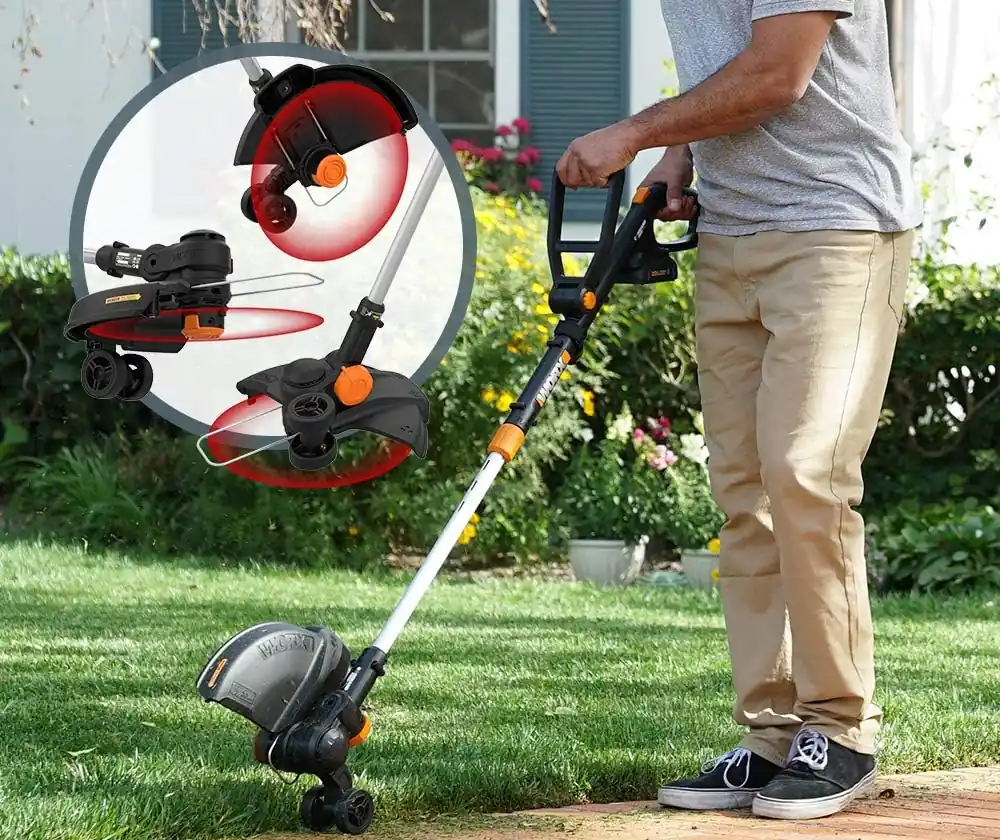
Edging is the clearest win for the WORX. The wheels bolt on in three positions, for edging, trimming or a wheeled mode WORX calls mini mower, and for edging you pull the shaft up and turn it 90 degrees. Switch off, wait for the head to stop and remove the battery before you move the wheels or turn the shaft. The mini mower mode is wheeled trimming with line, not a rotary mower deck, and it has no blade. If edging is a priority, I compare other models with an edge mode or edger kit in my roundup of string trimmers for edging.
At the house lawn I switched off, waited for the head to stop, pulled the battery, turned the shaft 90 degrees and then ran the wheels along the path edge, and that gave me a straighter line than I get swinging a trimmer by hand.
The Milwaukee does the opposite on purpose. The manual says not to use it as an edger, not to tilt it to a right angle to the ground, and to keep the head and line parallel to the ground, because the guard cannot protect against flying debris in that position. On the gravel yard edge I kept it flat, as the manual says, and worked the grass side of the line.
Neither tool is a platform for other tools. WORX states that the head is not removable and attachments are not supported. Milwaukee states the QUIK-LOK attachment system does not fit this trimmer, so there are no Milwaukee 2828-21 attachments to buy. If you want interchangeable attachments such as a pole saw or a hedge trimmer, neither of these is the right tool.
Weight, Balance and Setup
WORX lists the WG170 at 5.5 lb with a battery installed. Milwaukee publishes no weight for the 2828-21, so I cannot rank the two on weight, and you should hold the Milwaukee in a store before you decide if its length and balance suit you. I compare weights across more models, always on the maker’s stated basis, in my lightweight string trimmer picks.
At the far end of the house lawn edge, the 5.5 lb WORX never made me stop to rest it on my hip. The telescoping shaft and the 7-position front handle let me set it for my height, and the pivoting head tilted so I could reach the grass at the base of the fence line.
Setup is simpler on the WORX, where you fit the wheels, guards and spool. The Milwaukee ships folded in half, and with the battery out you unfold the coupler and tighten three bolts with the supplied key. You also fit the guard with four screws and the front handle with the key. Do not run it without the coupler, guard or front handle, and I check the bolts again before each session because the manual says the coupler stays secured at all times.
Hands take the load over a long edge. A small laboratory test with two participants found vibration at gloved hands of 3.5 to 5.8 m/s2 on one grass trimmer, higher than on a backpack blower, and gloves lowered hand vibration on the equipment tested (1). The tools tested were other models, so I take it as a reason to wear gloves and to keep both hands on the grips, as both manuals require.
Line Feed, Loading and Upkeep
The WORX uses Command Feed: you press a button and the motor pauses while the line comes out, and the head also advances about 0.25 in. of line at each start. The Milwaukee has bump feed, where you tap the head gently on the ground while running at normal speed. The manual says to bump only on the ground and never on rocks or a driveway.
The short clatter at each WORX restart was the line advancing, which the manual calls normal, so I stopped treating it as a fault. On the Milwaukee I bumped the head on bare ground beside the strip edge, never on the gravel, since dense growth wears the line faster and asks for more bumps.
Pro Tip
Store spare Milwaukee line in a sealed plastic bag with a tablespoon of water, as the manual advises, so it does not dry out or crack. Keep the line cutter sharp so the line never runs longer than the head allows, because a long line can overload the motor.
Keep the heads clean. Switch off, wait for the head to stop, remove the battery, then clear grass from the head. Wipe the WORX dry, keep its vents clear and never clean it with water. Milwaukee asks for mild soap and a damp cloth, and a return of the tool, battery and charger for inspection after six months to one year, depending on use.
Safety and Trimming Near Trees
A line trimmer throws what it hits. In a US emergency room estimate, lawn trimmers caused 81,907 injuries from 2000 to 2009, and the eye accounted for 42.5 percent of them (2). Bystanders get hurt too, as published eye trauma cases show (3). Wear eye protection that meets ANSI Z87.1, hearing protection, long pants, sturdy boots and gloves every time.
The Milwaukee manual keeps bystanders 50 ft away, and the WORX manual names no distance, so I hold the same 50 ft for both and stop the tool when someone walks closer. NIOSH sampling of landscaping workers found significantly more noise and carbon monoxide with fuel-powered string trimmers than with battery versions, and most of the eight-hour noise results were at or above 85 dBA (4). A battery trimmer still gets ear protection from me.
Near young trees the line strips bark. The Milwaukee manual tells you to avoid ornamental trees, shrubs and plantings, and I keep the head well off the trunks along the tree row and use the strip edge instead. The same manual says to avoid fence posts and siding, since the line damages them.
Before Touching the Head
Switch the trimmer off, wait for the head to stop, then remove the battery before you clear the head, change line, adjust, carry or store it. Use neither tool in rain or wet locations. Never use line heavier than the maker allows, and never fit wire, rope or a metal blade to either tool.
Choose the WORX WG170 If
The WORX suits a small yard where the trimmer also has to edge. Pick it when the following describes your lawn.
- Your yard is small: WORX designs one 2.0 Ah charge for an average 1/4 acre yard.
- You edge along paths and beds: the wheels and the 90 degree shaft turn give you a straight line.
- You want a budget kit: two batteries and a charger sit in the box.
- You own WORX PowerShare tools: the packs fit more than 75 tools across the 20V, 40V and 80V range, according to WORX.
Skip it if you trim thick weeds along a fence, because the 0.065 in. line is the only line the head takes. It is the trimmer I recommend for a small lawn with a stone path. I rank more easy-to-handle options in my roundup of trimmers for small yards.

Choose the Milwaukee 2828-21 If
The Milwaukee earns its higher tier on swath, line choice and speed control. Pick it when these describe your property.
- You trim fence lines, hedgerow bases or a ditch bank: 0.095 in. line and the High setting suit dense growth.
- You want a wider circle: 14 in. or 16 in., set by turning the cut-off blade.
- You want the maker’s run times before you buy: the table covers the XC6.0 at both swaths and speeds.
- You own M18 tools: the maker says the trimmer runs on any M18 battery.
Skip it if you need a trimmer that edges, because the maker says it is not an edger, and skip it if one 6.0 Ah pack will not cover your yard, since the maker’s longest figure is 20 minutes. Setting the key and bolts was the only slow part of the first session.

Which Trimmer Fits a Mixed Property
On a place with a lawn, a path, a fence and a tree row, I keep the Milwaukee for the rough work and use the WORX where the line needs to run straight. Most buyers own one trimmer and face a mix of jobs, and dense growth wears line out fastest. For those, a wider swath, heavier line and a High setting count for more than a wheeled edging mode.
The WORX earns its place on the small lawn, where two packs, a wheeled edge and a lower tier cover what the yard asks. Check the kit contents before you order, since the WORX comes in one-battery and tool-only versions under similar names. I go through the plain kit, the charger and the wheeled modes in my review of the WORX WG170.
Whichever way the WORX WG170 vs Milwaukee 2828-21 decision goes for your yard, charge the pack within the range in your manual before the first session.
Frequently Asked Questions
Can you use any string in a Milwaukee trimmer?
You cannot use any string in a Milwaukee trimmer, because the 2828-21 manual allows only Milwaukee spiral line in 0.080 inch or 0.095 inch diameter. Any other line can degrade performance or damage the trimmer, so buy the maker’s own line in one of those two sizes, never a substitute from another brand.
What is the best battery for a Milwaukee string trimmer?
The best battery for a Milwaukee string trimmer to start with is the M18 XC6.0 in the 2828-21 kit, the pack behind the maker’s run-time table. The maker says the trimmer runs on any M18 battery, so a spare pack you already own works, and you charge any pack only with the charger specified for that battery.
How to replace the string in a Milwaukee string trimmer?
To replace the string in a Milwaukee string trimmer, switch off, wait for the head to stop, remove the battery, then push up to 25 ft of 0.080 inch or 20 ft of 0.095 inch spiral line through to equal lengths. Wind the cap in the arrow direction until 4 to 6 inches show, never longer than the line blade.
What brand of trimmer is the best?
The best brand of trimmer is the one whose battery platform you already own or will buy into, because each maker tells you to use its own packs and charger. For these two, that means WORX PowerShare for a small lawn on a budget and Milwaukee M18 if you own M18 tools or need 0.095 inch line.
What is the average lifespan of a Milwaukee battery?
The average lifespan of a Milwaukee battery is not published for the XC6.0 in the 2828-21 kit, and the manual gives no figure. The manual does ask you to return the tool, battery and charger for inspection after six months to one year, depending on use, and to charge only with the specified charger.
References
- Oh J, Chen N, Boyd C. Laboratory evaluation of occupational exposure to hand-arm vibration (HAV) during grounds maintenance equipment operations. Ann Agric Environ Med. 2023;30(2):384-389.
- Leinert J, Griffin R, Blackburn J, McGwin G. The epidemiology of lawn trimmer injuries in the United States: 2000-2009. J Safety Res. 2012;43(2):137-139. doi:10.1016/j.jsr.2012.03.001
- Lubniewski AJ, Olk RJ, Grand MG. Ocular dangers in the garden. A new menace: nylon line lawn trimmers. Ophthalmology. 1988;95(7):906-910. doi:10.1016/s0161-6420(88)33076-9
- Alexander BM, Graydon PS, Pena M, Feng HA, Beamer BR. Hazardous exposures and engineering controls in the landscaping services industry. Journal of Occupational and Environmental Hygiene. 2025;22(3):189-202.
Safety Note: Read your manual first. A string trimmer or brush cutter throws debris with force, so clear stones, glass and wire from the area before you cut. Wear impact-rated eye protection with side coverage that meets ANSI Z87.1, hearing protection, gloves, heavy long pants, long sleeves and sturdy slip-resistant boots (steel-toe where your manual says so). Keep people and pets at least as far away as your manual says (50 feet in some manuals, 100 feet in others), and stop if anyone comes closer. Keep the correct guard fitted, use only the cutting attachments, handles and harness the maker approves for your exact tool, and never replace trimmer line with wire. A blade can kick sideways when it hits a stump or a thick stem, so fit the handlebar and harness your manual requires for blade work, hold both handles firmly and keep secure footing. Before you clear a jam, clean the tool or change line, a blade or an attachment, switch it off, wait for all movement to stop, then remove the battery, unplug the cord or disconnect the spark plug wire. Refuel a gas model outdoors with the engine off and cool, away from flames or sparks, and move away from the fueling spot before starting, as far as your manual says (often 10 to 30 feet); never run it in a garage, shed or other closed space. For a battery model, use only the maker’s battery and charger, charge it within the temperature range in your manual and never use a damaged or swollen pack. For a corded model, use a GFCI outlet, keep the cord clear of the cutting line and avoid wet conditions.