
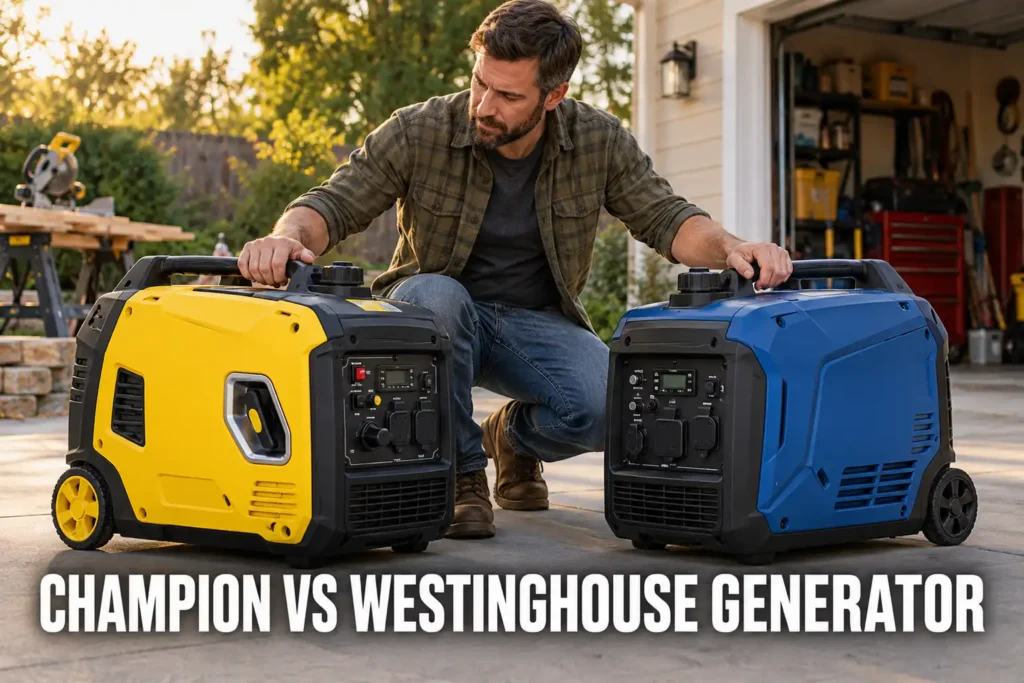
The Champion vs Westinghouse generator choice comes down to weight against power. I recommend the Champion 201050 to most buyers: it is a 51.8 lb dual fuel inverter with a CO shutoff. The Westinghouse iGen5000DF wins when you need about 900 more running watts, a bigger tank and a key fob start. I size every motor load by its nameplate, because my drip irrigation pump does not care what the box says. Below I compare both units on power, weight, noise, run time and safety.
Champion vs Westinghouse Generator: The Short Answer
Both machines are dual fuel inverters with one 120 V household outlet and one TT-30R RV outlet, and both carry a 3-year warranty. The Champion 201050 4,000-Watt Dual Fuel Inverter Generator is the lighter, lower-output unit with a CO Shield shutoff. The Westinghouse iGen5000DF Dual Fuel Inverter Generator is the heavier, stronger unit with no CO sensor. The Westinghouse vs Champion inverter generator figures sit side by side below, and every figure names its fuel and load. My roundup of the top inverter generators lists more units in this class.
| Spec | Champion 201050 | Westinghouse iGen5000DF |
|---|---|---|
| Fuel | Gasoline or propane (LPG hose in the box) | Gasoline or propane (propane hose in the box) |
| Running watts on gasoline | 3,000 | 3,900 |
| Running watts on propane | 2,700 | 3,500 |
| Starting watts, gasoline / propane | 4,000 / 4,000 | 5,000 / 4,500 |
| Run time on gasoline at 25% load, maker’s figure | Up to 10 hours (1.54 gal tank) | Up to 18 hours (3.4 gal tank) |
| Run time on propane at 25% load, maker’s figure | Up to 25 hours on a 20 lb cylinder | Up to 22 hours, cylinder size not published |
| Noise, maker’s figure | 64 dB(A) at 23 ft | As low as 52 dBA, no load or distance stated |
| Weight, dry | 51.8 lb | 104.7 lb |
| CO shutoff | Yes, CO Shield | No |
| Start | Recoil only | Key fob, push button, recoil backup |
| Outlets | One 5-20R duplex, one TT-30R (25 A), one 12 V DC | One 5-20R duplex, one TT-30R (30 A), two USB |
| Warranty | 3 years limited | 3 years limited residential, 1 year commercial |
Two rows decide it for most people: weight and the CO shutoff favor the Champion, while running watts and tank size favor the Westinghouse. Neither unit has a 240 V outlet or GFCI receptacles.
Power and Fuel: Gasoline vs Propane
Running watts decide a Westinghouse vs Champion dual fuel generator choice, because that is what the unit holds for hours. According to Champion, the 201050 delivers 3,000 W on gasoline and 2,700 W on propane. The Westinghouse iGen5000DF delivers, in its maker’s words, 3,900 W on gasoline and 3,500 W on propane. Starting watts are a short surge for motor start-up, not a rating you can run on. Keep everything plugged in within 3,000 W on gasoline or 2,700 W on propane for the Champion, and within 3,900 W or 3,500 W for the Westinghouse. Then check the biggest motor’s start-up demand against the starting rating. My roundup of the top dual fuel generators compares running watts on both fuels across more models.
Propane costs both units about 10 percent of their running watts, so plan on the lower figure when you switch fuel. The tank sizes, 1.54 gal and 3.4 gal, set how often you refuel. Both run times are the makers’ figures at 25% load. A heavier load shortens them, so a unit sized close to its limit will not reach the hours on the box.
Start with no load, let the engine warm, then add the biggest motor first and the small loads after it. Both manuals ask for this order, and I follow it with the drip pump before the workshop charger. Neither unit can run a 240 V well pump, because neither has a 240 V outlet.
Winner: Westinghouse iGen5000DF, because it holds 900 more running watts on gasoline and 800 more on propane.
Weight and Portability
The Champion weighs 51.8 lb dry and the Westinghouse weighs 104.7 lb dry. That gap is the real difference in daily use. Westinghouse builds in a telescoping handle and wheels, which helps on level ground, but a lift into a truck bed is a two-person job. My roundup of the top portable generators shows how other units compare on weight.
I carried the lighter unit to the gravel pad behind the machinery shed by hand and set the exhaust away from the house. For the heavier unit the wheels do the work over the gravel, and I keep a second person for any lift. For camping or tailgating, the Champion vs Westinghouse inverter generator choice is mostly a weight choice.
Winner: Champion 201050, because half the weight means one person can move it.
Noise: Why 52 dBA and 64 dB(A) Cannot Be Compared
Champion lists the 201050 at 64 dB(A) at 23 ft. Westinghouse lists the iGen5000DF as low as 52 dBA, with no load and no distance printed. A noise figure without a distance and a load tells you nothing about what you will hear at your fence line. My roundup of the quiet generators sorts units by noise rating and distance.
Both are inverters with an eco mode that lowers engine speed at light load, which is where most of the quiet comes from. The Champion’s manual says to turn eco mode off for high loads or sudden swings. Westinghouse’s manual has eco off for starting. Because the figures do not match, I will not call either one quieter.
The better noise control is distance. Setting the unit as far from the house as your cords allow cuts what you hear far more than a label does, and it is also what the safety rules ask for.
Winner: none on the evidence, because the two figures use different conditions.
Safety: CO Shield, No CO Sensor and Placement
Both generators burn fuel and make carbon monoxide, which is colorless and odorless. According to the CPSC, run a portable generator outside only, at least 20 feet from the house, with the exhaust pointed away from the home and other buildings. Both manuals forbid running them in a garage, shed or enclosed space, even with doors open.
Studies after real outages show why. After a Maine ice storm, a generator in a basement or an attached structure such as a garage was the strongest risk factor for poisoning (1). In NIST tests in an attached garage, peak house CO ranged from under 10 ppm to over 10,000 ppm, depending on the generator’s emissions and the garage and door setup (2). After a 2002 North Carolina ice storm, 96.2% of severe poisonings happened in homes with no working CO alarm (3).
The Champion 201050 has CO Shield, which shuts the engine off when it senses unsafe CO and flashes a red light. Champion’s manual says it can trip from another engine’s exhaust pointed at the unit, and it is not a replacement for a CO alarm. The Westinghouse iGen5000DF has no CO sensor, so it needs the same placement and a battery CO alarm inside the house, with no safety net behind them. My head-to-head of Generac and Champion generators compares this Champion 201050 with the Generac iQ5200DF.
Propane does not fix this: a small-engine test on LPG found CO emissions 22% higher than on gasoline (4), and that engine was a woodchipper, not a generator, so take it as a caution only. Keep the unit outdoors on either fuel. Never plug a generator into a wall outlet: it can energize utility lines and kill line workers. Connect to a house only through a transfer switch or interlock that a licensed electrician installs.
CO Safety
A CO shutoff is a backup. It is never a reason to run the generator closer to the house, and it never replaces battery CO alarms inside.
In the cold months, the pressure to bring a generator closer to the door is real. Lutterloh and colleagues tied eight of ten deaths after a Kentucky ice storm to inappropriate generator location (5). I keep the unit out on the gravel and run the cord in.
Winner: Champion 201050, because it adds a backup shutoff the Westinghouse does not have.
Starting, Outlets and Daily Use
The Champion starts by recoil only. Its manual warns that rapid cord retraction can injure a hand or arm. The Westinghouse starts from the key fob, which works up to 99 ft and less as the fob battery drains, or from a push button, with recoil as a backup. With a unit that must sit 20 feet from the house, starting it from the porch is a real convenience. For a closer look at the Westinghouse option, see my full Westinghouse iGen5000DF review.
Both have a 120 V 20 A duplex and a TT-30R RV outlet, rated 25 A on the Champion and 30 A on the Westinghouse, and neither has GFCI receptacles. Champion’s manual says to use a GFCI in damp areas. Use a grounded, outdoor-rated cord rated at least for the receptacle’s voltage and amperage, not only for the load, and keep it off the walkway.
On a cold morning the Champion’s EZ Start dial needed the choke position before it caught. Break-in is the same on both: keep the first 5 hours at or below 50 percent of running watts, which is 1,500 W on the Champion and 1,950 W on the Westinghouse on gasoline. I used the workshop lights and a charger for that, then changed the oil. My full Champion 201050 review takes a closer look at this 4,000-watt dual fuel inverter.
Check the oil on level ground before each run. The Westinghouse holds 0.63 qt and the Champion holds 0.5 qt, and both shut off on low oil. Both makers say to keep the unit out of rain and snow. The Champion’s manual allows only a fire-retardant canopy that keeps the exhaust open.
Winner: Westinghouse iGen5000DF, because the key fob and push button spare you the pull cord.
Warranty, Engines and Support
Westinghouse vs Champion generator support is close to a tie. Both makers give a 3-year limited warranty and lifetime technical support. Westinghouse adds a 1-year commercial term. Tampering with Champion’s CO Shield voids the Champion warranty, so leave the sensor alone. My Westinghouse and DuroMax generators comparison puts the larger WGen9500DF and XP13000EH side by side.
The engines differ in size: the Champion uses a 149 cc 165FS-C, and the Westinghouse uses a 224 cc overhead valve four-stroke. The bigger engine is what lets the Westinghouse hold 900 more running watts. Westinghouse says the iGen5000DF is not CARB compliant, so check your state before you order if you live in California.
Neither unit is a whole-house backup. For house loads, a licensed electrician installs a transfer switch or interlock, and a 120 V unit still cannot run 240 V loads. For more home backup options, see my roundup of the top generators for home backup and check each model against your load list.
Choose the Champion 201050 If
The Champion 201050 4,000-Watt Dual Fuel Inverter Generator suits you if portability and a safety backup matter more than output. Pick it if you:
- Carry the generator alone from shed to pad.
- Want a CO shutoff behind your placement and battery CO alarms.
- Need about 3,000 W on gasoline for lights, a fridge, chargers and a few tools.
- Camp or tailgate and want a TT-30R RV outlet (25 A) in a 51.8 lb frame.
Skip it if you need more than 3,000 W, a start without a pull cord or a long run time. RV owners can check outlet matches in my roundup of the top RV generators.

Choose the Westinghouse iGen5000DF If
The Westinghouse iGen5000DF Dual Fuel Inverter Generator suits you if output and convenience matter more than weight. Pick it if you:
- Need about 3,900 W on gasoline or 3,500 W on propane from one unit.
- Want a 3.4 gal tank and up to 18 hours at 25% load.
- Value key fob and push button start for a unit that must sit far from the house.
- Can handle 104.7 lb on wheels and have a second person for lifts.
Skip it if you want a built-in CO shutoff, because it has none, or if you must buy a California-compliant unit. When the gas can ran low, I stopped the engine, let it cool for at least five minutes, moved the hose to the propane cylinder and checked the fittings with soapy water.

Which Dual Fuel Inverter Fits Your Yard
Pick the Champion 201050 when you move the generator often, want the CO Shield behind your placement, and run a few essential loads. Choose the Westinghouse iGen5000DF when you need 3,900 W, a bigger tank and a start from the porch. Both give you propane as a stable fuel, both need a battery CO alarm inside, and both stay at least 20 feet from the house. Settle it with the load list you wrote down before shopping. For most buyers the lighter unit with the CO shutoff wins the Champion vs Westinghouse generator choice. My roundup of the top camping generators lists more units that one person can carry.
Frequently Asked Questions
Who makes Champion inverter generators?
Champion Power Equipment makes Champion inverter generators, including the 4,000-watt 201050 compared in this article. The 201050 carries a 3-year limited warranty with free lifetime technical support, and its operator’s manual covers setup, fuel, propane use, maintenance and safety, so read it all before the first start and again before each season.
Who makes the engines for Westinghouse generators?
The engine in the Westinghouse iGen5000DF is a Westinghouse 224 cc overhead valve four-stroke, according to the maker. Other Westinghouse models use different engines and ratings, so read the manual of the exact model, and compare its running watts and tank size, before you assume it matches this one in any way.
Who makes the best quality generators?
Quality in a generator depends on the job, and between these two the better pick follows your load. The Champion 201050 adds CO Shield at about half the weight, while the Westinghouse iGen5000DF adds about 900 running watts, a bigger tank and key fob start, so write down your loads before you choose.
Is Westinghouse generator a good brand?
Westinghouse is a good brand for buyers who need output and a convenient start, as the iGen5000DF shows with dual fuel, a 30 A RV outlet and a 3-year residential warranty. Skip the iGen5000DF if you want a built-in CO shutoff, because it has none, and plan on a battery CO alarm inside the house.
Are Champion inverter generators any good?
The Champion 201050 is a good inverter generator for camping, tailgating and a few essential loads through cords. It makes 3,000 W on gasoline in 51.8 lb with CO Shield and a 3-year warranty, but it starts only by recoil and is not a whole-house backup, so match it to a short list of loads.
References
- Daley WR, Smith A, Paz-Argandona E, Malilay J, McGeehin M. An outbreak of carbon monoxide poisoning after a major ice storm in Maine. J Emerg Med. 2000;18(1):87-93. doi:10.1016/S0736-4679(99)00184-5
- Emmerich SJ, Wang L, Persily AK. Measured carbon monoxide concentrations from stock and reduced-emission prototype portable generators operated in an attached garage. J Air Waste Manag Assoc. 2017;67(8):889-898. doi:10.1080/10962247.2017.1300202
- Centers for Disease Control and Prevention. Use of carbon monoxide alarms to prevent poisonings during a power outage – North Carolina, December 2002. JAMA. 2004;291(14):1691. doi:10.1001/jama.291.14.1691
- Wargula L, Kukla M, Lijewski P, Dobrzynski M, Markiewicz F. Influence of the use of liquefied petroleum gas (LPG) systems in woodchippers powered by small engines on exhaust emissions and operating costs. Energies. 2020;13(21):5773. doi:10.3390/en13215773
- Lutterloh EC, Iqbal S, Clower JH, et al. Carbon monoxide poisoning after an ice storm in Kentucky, 2009. Public Health Rep. 2011;126(Suppl 1):108-115. doi:10.1177/00333549111260S114
Safety Note: Generator exhaust contains carbon monoxide, which can kill in minutes. Run a fuel generator outdoors only, never in a home, garage, basement, shed or other enclosed or partly enclosed space, even with doors or windows open. The CPSC says to place it at least 20 feet from your home and other buildings, with the exhaust pointed away from doors, windows and vents. Install battery-operated or battery-backup carbon monoxide alarms on every level of the home and outside sleeping areas. Never plug a generator into a wall outlet: connect it to a house only through a transfer switch or interlock installed by a licensed electrician. Refuel only with the engine off and cool, and read the manufacturer’s manual, including for a portable power station.