
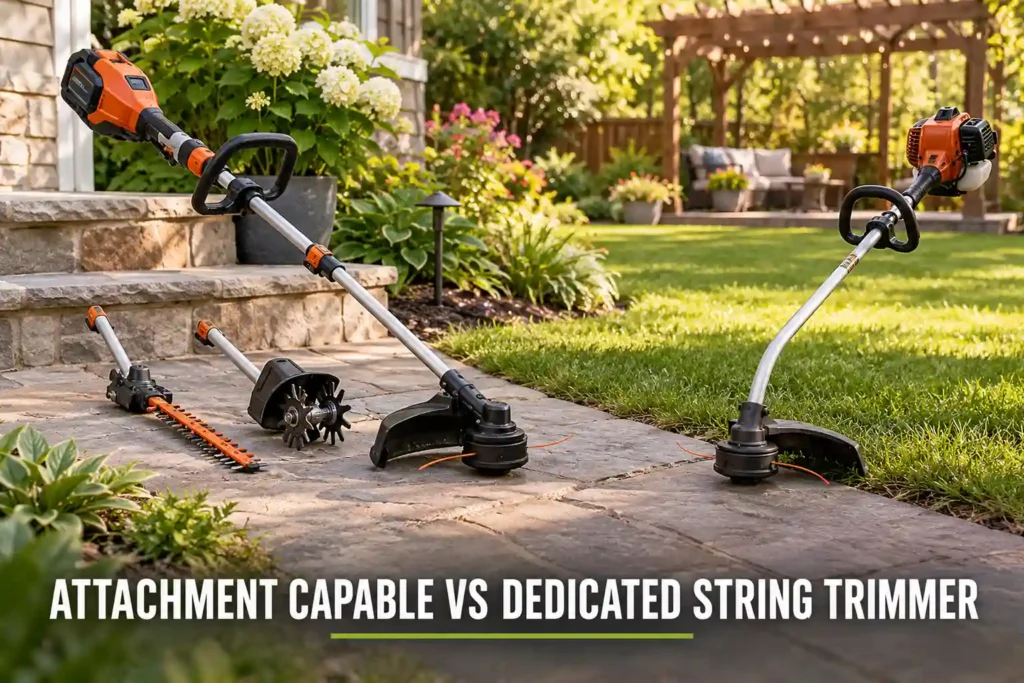
The attachment capable vs dedicated string trimmer choice comes down to how many jobs you give one motor: buy a dedicated trimmer if line trimming is all you do, and buy an attachment capable one only if you will really fit a second tool on the same power head.
I keep the lawns, the gravel yard and the sheds around a 3.7-acre orchard, so I have used both layouts on the same edges, and the maker’s manual settles more than the box does. Below I explain how each one works, what each weighs, which jobs justify a system and what to check before you buy.
Attachment Capable vs Dedicated String Trimmer: The Short Answer
A dedicated string trimmer is one machine built for one job: a motor or engine, a shaft and a line head in a single piece. An attachment capable trimmer is a power head with a coupler on the end of its shaft, and the line head is only the first of several tools that lock onto it. If trimming is the only thing you ask of the motor, buy the dedicated trimmer. If you will also edge, cut hedges or prune with that same power head every season, the system earns its place.
| Point | Dedicated trimmer | Attachment capable system |
|---|---|---|
| Tools on one motor | One: the line head | Several, from the maker’s own list |
| Joints in the shaft | None, apart from a height hinge on some models | A coupler between power head and attachment |
| Brand freedom | Not an issue, the trimmer is complete | Tied to one maker’s attachment list |
| EGO weight, as the manuals list it | 7.67 lb for the ST1623T (battery basis not stated) | 9.56 lb for the PH1420 power head plus STA1600 attachment, without battery |
| Storage | One long tool | One power head plus a rack of attachments |
Pick a Dedicated Trimmer If
- You only trim. Grass along fences, beds and trunks is a line job, and the dedicated tool does it without a coupler or a compatibility list to check.
- You want the simplest tool. A one-piece trimmer has one part list, one set of parts to inspect and nothing to line up before you start.
- You dislike keeping track of compatibility. A dedicated trimmer has no attachment list to check.
Pick a System If
- You will use a second attachment often. An edger attachment, hedge trimmer or pole saw on the same power head is where the idea pays off.
- You are happy to stay with one maker. Every attachment comes from that maker’s list.
- You have room for a rack. The attachments need a place in the shed, ideally hung beside the power head.
How an Attachment Capable System Works
An attachment capable string trimmer is really two parts sold as one. The power head holds the motor or engine, the trigger and the grips. The attachment, which is a trimmer shaft with its guard and line head in this case, slides into the coupler at the end of the power head’s shaft and locks there. Swap the attachment and the same power head becomes a different tool.
The Coupler and the Maker’s List
EGO shows how the fit works on its 56V power head. According to EGO’s trimmer attachment manual, you switch off the motor, wait for it to stop, remove the battery, loosen the wing knob on the coupler, line up the arrows and push the shaft in until you hear a click. The red line on the attachment shaft must sit flush with the coupler edge, and you pull on the shaft to check it before you tighten the knob. I pull on the shaft every time, because a click you only think you heard is not a lock. If you are still choosing a battery platform, my 56V and 40V string trimmers comparison helps you choose one for your yard.
The maker’s list decides what fits. EGO’s manual for the PH1420 power head names the attachments it may be used with, from the string trimmer and edger to a hedge trimmer, pole saw, cultivator, brush cutter, brushes and a snow shovel. The gas version is Echo’s Pro Attachment Series, and the PAS-225VP kit is the Echo attachment capable string trimmer I use as the gas example here. According to Echo, that power head takes twelve listed attachments, and Echo does not recommend the straight shaft edger, the ProSweep, the ProPaddle or the Bed Redefiner on it. For the cultivator in that list, I set out what changes in the beds when you pick a tiller versus a cultivator attachment.
So the list matters even inside one maker’s range. A tool that sits on the same store shelf as your power head may still not be approved for it. If you want to see this idea on a 60V model, read my review of the Greenworks ST60L413.
Why You Stay With One Maker
Every maker’s rule points the same way: EGO tells you not to use attachments it does not recommend, and Echo says to use only Echo attachments. DeWalt’s manual for its attachment capable power head says the power head is only to be used with DeWalt attachments. None of those three manuals says a coupler from another brand fits, so I use only attachments the maker lists for the exact power head.
What a Dedicated String Trimmer Gives You
A dedicated trimmer puts its whole design into one job. The EGO ST1623T is a good battery example. According to EGO, its head feeds line by itself when an end wears below about 7 inches, a button winds a new spool in roughly 12 seconds, and the shaft folds at a hinge and locks at the length you set. The manual lists a 16 inch swath, 0.095 inch line and no attachment of any kind. To see how each head releases line, read my bump and automatic feed trimmer guide.
The attachment version of the same idea is different in one detail I notice at once. The STA1600 trimmer attachment in EGO’s multi-head kit uses a bump head, which releases line when you tap it on bare ground while it spins, with the push-button winding added on the PH1420 power head. I like the dedicated EGO more for this, because I do not have to look for bare ground to tap on while I work along the fence line.
Gas shows the same split. The Husqvarna 130L is a 28 cc two-stroke with an 18 inch swath and a straight shaft, and its manual’s accessory table lists only the trimmer head and its guard. It is a trimmer and says so. The shaft has no coupler to loosen, and the manual has one job to describe. My review of the Husqvarna 130L goes through the engine, the shaft and the swath in more detail.
Key Takeaway
A dedicated trimmer asks one question before you buy: does it cut the grass you have. A system asks four: which power head, which attachments, from which list, and will you really use them.
Weight, Run Time and Reach Compared
Weight is where the two layouts differ most plainly, and it is easy to compare wrongly. The makers list weights for different parts, with and without the battery, so the only fair comparison puts each figure on its own basis.
A Worked Weight Example
| Setup | Parts | Weight |
|---|---|---|
| EGO attachment capable (battery) | PH1420 power head, 6.2 lb, plus STA1600 trimmer attachment, 3.36 lb | 9.56 lb without battery |
| EGO dedicated (battery) | ST1623T trimmer including guard | 7.67 lb, battery basis not stated |
| Echo attachment capable (gas) | PAS-225 power head, 9.3 lb dry, plus Speed-Feed trimmer attachment, 2.3 lb | About 11.6 lb dry |
| Husqvarna dedicated (gas) | 130L trimmer | 11.0 lb without fuel, cutting attachment and guard |
For the EGO system, 6.2 plus 3.36 gives 9.56 pounds without the battery. EGO’s manual gives 7.67 pounds for the dedicated tool and does not say whether that figure includes the pack, so I do not subtract one from the other. The gas figures also leave out different parts. In the Echo, most of the weight sits in the power head, and the attachment adds 2.3 pounds at the shaft end.
Weight feels small at minute five and larger at the end of a long edge. Before I buy, I find the weight of the exact kit I would carry, with the battery in, and compare it on that basis. A tool I carry the whole length of a row matters more to me than an attachment I use twice a year. If weight decides it for you, my lightweight string trimmer roundup compares the stated weight of each pick.
Run time is harder to compare. According to EGO, the MHC1603 kit with a 4.0 Ah battery runs up to 45 minutes on the STA1600 trimmer, and the ST1623T with a 4.0 Ah battery runs up to 60 minutes. The conditions are not stated for either, and the two tools are different designs, so I read them as a planning range. I do not read them as proof that one layout outlasts the other.
Battery choice does not split the two layouts for EGO, which is useful. A cordless attachment capable string trimmer and the dedicated ST1623T both list the same family of 56V packs in their manuals, so one set of batteries can serve either choice. My review of the EGO ST1623T covers its Line IQ feed, the folding shaft and the 4.0Ah kit.
Which Jobs Justify a System
Count the jobs before you count the attachments. On my land the trimming jobs are the tilled strips under the tree rows, the fence lines, the base of the hedgerow and the edges of the house lawn and gravel yard, and most of them are plain line work. A second attachment has to beat that.
- Tree-row edges and young trunks: line work. The line strips thin bark, so I keep the head off the trunks. A system adds nothing here.
- House lawn edges: the lawn job where an edger attachment helps. EGO’s edger attachment has an 8 inch blade and cuts up to 3 inches deep, which a line head cannot do. My string trimmer and edger guide sorts out which of the two jobs needs which tool.
- Gravel yard edge: EGO’s edger manual says not to use the edger on or near graveled surfaces. On my gravel yard that attachment would stay on the rack, and line does the work.
- Hedgerow base: grass at the base is line work. Thick woody growth is brush cutter work, and a blade goes only on a tool, guard, handle and harness that the maker lists for it, as my string trimmer and brush cutter guide explains.
- Hedges and overhead branches: hedge trimmer and pole saw attachments exist on EGO’s list. They only pay off if you would otherwise buy those tools. If you are weighing a separate hedge tool, my guide to hedge and string trimmers shows which jobs each one covers.
My rule is simple. If I would not use a second attachment at least a few times a season, I do not buy the power head to carry it.
Safety With Changeable Heads
Every rule for a one-piece trimmer applies to a system too. The system adds three of its own, because there is a coupler, a spinning shaft inside it and a step where you swap tools.
Three Rules That Only Systems Add
- Never run the power head without an attachment fitted. EGO’s manual says never to operate the power head without an attachment. DeWalt’s manual explains why: inside the upper pole a coupling spins when the power head is on, and it can injure you if you touch it.
- Take the power source out before you change anything. Switch off, wait for the head to stop, then remove the battery. On a gas head, stop the engine, wait for the head to stop, let the engine cool and disconnect the spark plug lead. EGO says a battery tool is always in operating condition until the pack is out.
- Check the lock before you pull the trigger. Pull on the attachment shaft after the click, as EGO’s manual tells you, and tighten the knob.
Safety Step
Fit or remove an attachment only after you switch off, wait for all movement to stop and take the power source out: battery removed, or the engine stopped and the spark plug lead off. A switch in the off position is not enough.
Protective Gear and Bystanders
Wear ANSI Z87.1 eye protection, hearing protection, gloves, long pants and sturdy boots every time, with either layout. The Husqvarna 130L manual asks for heavy long pants, long sleeves and heavy slip-resistant steel-toe boots, so read the clothing rules in the manual of your exact tool and each attachment, and follow the stricter one. Researchers using US injury data estimated 81,907 lawn trimmer injuries treated in emergency departments from 2000 to 2009, and 42.5% of them involved the eye (1). Most came from foreign objects, which is the reason to keep the guard on and the glasses on.
Bystander distance depends on the maker and the attachment. EGO’s manual for the STA1600 says 50 feet, its older STA1500 manual says 100 feet, and Echo says 50 feet. Use the figure in the manual for the exact attachment, and stop the tool when someone comes closer. I stop the head and wait for the person to leave, because a guard cannot catch every stone.
Hands take a beating too. A laboratory test with two participants measured gloved hand vibration of 3.5 to 5.8 m/s2 on a grass trimmer, more than on a backpack blower (2). I treat that as a reason for breaks and good gloves.
Gas Systems Add Noise, Fumes and Fuel
Engines make the extra exposure, whichever layout carries them. Two petrol grass trimmer engines measured about 100 and 105 dB(A) at the operator, above the limits for an 8-hour day (3). NIOSH sampling of 80 landscaping workers found significantly more noise and carbon monoxide with fuel-powered trimmers than with battery versions (4), and EPA testing found short bursts of carbon monoxide above 120 ppm on some gasoline lawn and garden equipment, string trimmers included (5). My battery and gas string trimmer comparison weighs noise, fumes and upkeep against power and run time.
So a gas head means ear plugs under ear muffs from the first minute, fueling outdoors on a cool engine, moving away from the fuel spot before you start, and never running the engine in a shed or garage, even with the door open. I keep fuel and the gas tool out of the shed that holds the charger and the battery tools. Use the fuel mix, oil and octane in your manual; the Echo PAS-225VP manual, for example, calls for 50:1 gasoline to ISO-L-EGD or JASO FD two-stroke oil.
Mistakes People Make When Buying Into a System
Most mistakes come from assuming that a coupler means universal fit. Two more are worth a line of their own.
- Mixing generations. EGO’s older PH1400 power head lists only an extension pole, an edger, the STA1500 trimmer and a pole saw, a shorter list than the PH1420. The newer STA1600 trimmer attachment loads line by hand on the older head, because the push-button winding does not work there.
- Counting attachments that are not in the box. The EGO MHC1603 kit contains the STA1600 trimmer and the EA0820 edger. Everything else on the list is a separate purchase. My DeWalt DCST970X1 and EGO MHC1603 comparison sets that EGO kit against a DeWalt cordless trimmer kit.
The mistake I would make myself is buying the attachment first. I write the power head model and the attachment model on the same line and check both against the maker’s list before I order either.
What to Check Before You Buy
Three things settle the choice. Count the jobs you will really do, because a second attachment you use twice a year is dead weight. Check the maker’s list for the exact power head and attachment model, and compare each tool’s weight on the same basis, battery in or out. Also check what the kit actually contains and which battery it needs. My best string trimmer roundup is a good place to start once you know which layout you want.
If your list is trimming only, buy the dedicated trimmer. If it holds an edger or a hedge trimmer you will use every season, buy the system, with the power head and the attachments from the same maker. My tip is to write the jobs of one season on a card and tick the ones a line head cannot do. Match each ticked job to an attachment on the exact power head’s list, buy only the ones you can name, and the attachment capable vs dedicated string trimmer decision is made by your own jobs. If an edger is the job on your card, my guide to a dedicated edger or edger attachment sets the two routes side by side.
Frequently Asked Questions
Which string trimmers are attachment capable?
The string trimmers that are attachment capable are the ones sold as a power head with a coupler, such as the EGO PH1420 power head and the Echo PAS-225 gas head. Each maker lists its approved attachments in the manual or on its product page, so check that list for your exact model.
Are attachment capable string trimmers worth it?
Attachment capable string trimmers are worth it when you will fit at least one more tool, such as an edger or a hedge trimmer, to the same power head. If trimming is the only job, a dedicated trimmer is the simpler tool, with no coupler to check and no maker list to follow.
Is my string trimmer head part of a multi-head system?
Your string trimmer head is part of a multi-head system only if the shaft ends in a coupler and the maker’s manual lists your model as a power head or attachment. A one-piece trimmer with no coupler and no attachment list, like the dedicated EGO and Husqvarna examples above, is not.
Can I use any attachment on my trimmer?
You cannot use any attachment on your trimmer, only the ones your maker lists for your exact power head. EGO, Echo and DeWalt each say to use their own attachments, and none of their manuals says a coupler from another brand fits.
Should I get a fixed shaft trimmer or an attachment capable one?
Get a fixed shaft trimmer if you only trim, and get an attachment capable one if you will use a second tool from the same maker. The system ties you to one maker’s list and adds a coupler to check, so count your jobs first.
References
- Leinert J, Griffin R, Blackburn J, McGwin G. The epidemiology of lawn trimmer injuries in the United States: 2000-2009. J Safety Res. 2012;43(2):137-139. doi:10.1016/j.jsr.2012.03.001
- Oh J, Chen N, Boyd C. Laboratory evaluation of occupational exposure to hand-arm vibration (HAV) during grounds maintenance equipment operations. Ann Agric Environ Med. 2023;30(2):384-389.
- Mallick Z, Badruddin IA, Khaleed Hussain MT, Salman Ahmed NJ, Kanesan J. Noise characteristics of grass-trimming machine engines and their effect on operators. Noise Health. 2009;11(43):98-102. doi:10.4103/1463-1741.50694
- Alexander BM, Graydon PS, Pena M, Feng HA, Beamer BR. Hazardous exposures and engineering controls in the landscaping services industry. Journal of Occupational and Environmental Hygiene. 2025;22(3):189-202.
- Baldauf R, Fortune C, Weinstein J, Wheeler M, Blanchard F. Air contaminant exposures during the operation of lawn and garden equipment. J Expo Sci Environ Epidemiol. 2006;16(4):362-370. doi:10.1038/sj.jes.7500471
Safety Note: Read your manual first. A string trimmer or brush cutter throws debris with force, so clear stones, glass and wire from the area before you cut. Wear impact-rated eye protection with side coverage that meets ANSI Z87.1, hearing protection, gloves, heavy long pants, long sleeves and sturdy slip-resistant boots (steel-toe where your manual says so). Keep people and pets at least as far away as your manual says (50 feet in some manuals, 100 feet in others), and stop if anyone comes closer. Keep the correct guard fitted, use only the cutting attachments, handles and harness the maker approves for your exact tool, and never replace trimmer line with wire. A blade can kick sideways when it hits a stump or a thick stem, so fit the handlebar and harness your manual requires for blade work, hold both handles firmly and keep secure footing. Before you clear a jam, clean the tool or change line, a blade or an attachment, switch it off, wait for all movement to stop, then remove the battery, unplug the cord or disconnect the spark plug wire. Refuel a gas model outdoors with the engine off and cool, away from flames or sparks, and move away from the fueling spot before starting, as far as your manual says (often 10 to 30 feet); never run it in a garage, shed or other closed space. For a battery model, use only the maker’s battery and charger, charge it within the temperature range in your manual and never use a damaged or swollen pack. For a corded model, use a GFCI outlet, keep the cord clear of the cutting line and avoid wet conditions.