
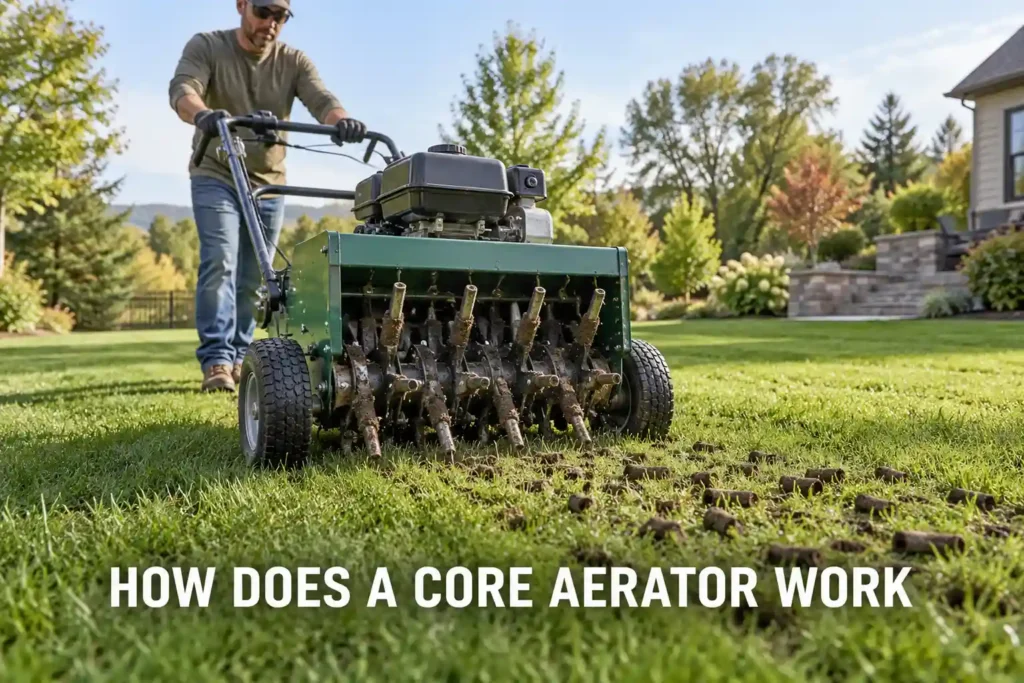
A core aerator works by pushing hollow tines into the soil, cutting plugs about three-quarters of an inch wide and up to 3 inches long, and dropping them on the lawn. The holes let air, water and roots reach soil that foot traffic and wheels have pressed tight, and that is why extension services rate coring above spiking.
On the orchard I read the soil with a spade before I put any tool into it, and I do the same on a lawn. Below I follow one pass from tine to core to root, then cover depth, moisture, timing and safety.
How Does a Core Aerator Work? The Tine Cycle in Four Steps
A core aerator is a set of hollow metal tubes called tines, and a way to push them into the ground and pull them out again. Kansas State Extension says coring is the most effective aeration method, though it can damage the turf. Every tine repeats the same four steps. My guide on core aerator types explains what each kind does and who needs one.
- The tine enters. Weight and motion drive the tube into the turf. Your foot does it on a hand tool, the roller on a push or tow-behind unit, the engine on a rental machine.
- The tube fills. The soil inside the tine is cut free from the soil around it. This is the plug.
- The plug comes out. The tine lifts, and the plug is dropped on the surface. Kansas State warns that in wet soil the tines clog and do not deposit the cores.
- The hole stays open. The gap lets air and water move down and gives roots room to grow into loosened soil.
The four steps depend on a few parts doing their jobs. When one fails, the machine only dimples the lawn.
| Part | Its job | What goes wrong |
|---|---|---|
| Hollow tine | Cuts and lifts a plug of soil | Clogs in wet, sticky soil |
| Weight | Pushes the tine down to depth | Too little weight and the tine skips on hard ground |
| Drive | Moves the tine in and out: foot, roller or engine | A drum or roller only reaches the depth the soil allows |
| Soil moisture | Lets the tine slide in and release the plug | Dry soil is too hard, wet soil smears |
Only the hollow tine removes soil. I keep that in mind whenever I compare tools, because a spike tool does a different job, which I explain in my guide on how a spike aerator works, and a hand tool does the same job more slowly.
What Happens in the Soil During One Pass
Compaction is the pressing together of soil particles, which squeezes air out of the soil. Kansas State says most compaction sits in the top 2 inches, and the main cause is activity on turf when the soil is moist. A core aerator targets exactly that layer. My roundup, best lawn aerator for compacted soil, lists seven picks that cut through hard ground.
What Compaction Does to Roots
In a field study on Kentucky bluegrass, roller compaction cut the share of air-filled pores in the top 3 centimeters of soil from 18.1 to 12.5 percent and lowered turf density and cover (1). A greenhouse study found that compacted soil kept oxygen supply low for 143 hours after wetting, against 26 hours in uncompacted soil (2). Roots need that oxygen. A hole through the packed layer gives them a short path to it.
Why a Plug Opens More Than a Poke
Wisconsin Extension explains the difference. A solid tine pushes soil downward and aside, so it may increase compaction, while a hollow tine takes the soil out. My comparison of core and spike aerators sets the two tools side by side.
In a two-year trial on Kentucky bluegrass under simulated traffic, hollow-tine plots lost the least green cover per traffic event (3). On the orchard I prefer to take soil out of a packed spot than push it aside, and I trust a plug over a poke for that reason.
A bermudagrass trial on a fairway found that sequential hollow-tine cultivation cut penetration resistance over time, while monthly liquid aeration did not (4). Those are fairway and sports plots, not home lawns, so I read them as support for the extension advice and not as a promise for your yard. I compare lawn and liquid aerators in a separate guide, with a look at what each does to compacted soil.
Piston, Drum, Tow-Behind and Hand Tools
All core tools use the same hollow tine. They differ in how the tine gets into the ground, and that decides how deep it goes and how much work it takes.
| Type | How the tines enter | What to expect |
|---|---|---|
| Piston machine | Straight down and straight up | Round holes, and most extract cores of about 3 inches |
| Drum machine | On a rolling drum, at an angle | Elongated holes, and rarely deeper than 2 inches in dry soil |
| Tow-behind plug unit | Rolls behind a mower or tractor | Needs tray weight to bite, set by the maker’s manual |
| Step-on tool | Your foot pushes the tines in | Depth set by your weight and the soil |
Piston and Drum Machines
Wisconsin Extension describes both. Piston tines enter and leave vertically, so they disturb the turf surface less. Drum tines enter at an angle, and Wisconsin notes that drum units are the most common type at rental agencies. A walk behind core aerator from a rental yard is usually a drum unit, and it is heavy, so follow the safety rules at the end of this article. Hold a gas machine with both hands, because it can pull forward.
Tow-Behind Units and the Weight Tray
A tow behind core aerator has no motor. It is a frame with coring tines on an axle, pulled by a lawn tractor or riding mower, and its own weight is low. The maker’s manual therefore calls for added weight in a tray.
The weight is set by the soil. According to the manual for the Brinly PA-40BH and PA-48BH, the weight needed for 2 to 3 inches of penetration varies with soil type and conditions, and usually three concrete blocks are enough. The Agri-Fab 45-0299 and 45-0518 manuals allow up to 140 pounds in the tray. Other models have their own limits, so read yours.
Never add more than the maker’s limit. The tray is there to push the tines down, and extra weight beyond the rated figure stresses the frame and the hitch.
Hand Tools
A manual core aerator is a foot-operated tool with two or so hollow tines. It pulls small cores, and every plug costs a step. A tool this size suits a worn patch or the strip beside a path, and a whole lawn is a long job for the knees and back. My guide to manual and tow-behind lawn aerators helps you choose by lawn size and tractor.
How Deep a Core Aerator Really Goes
Extension sources agree on the target and differ on the details. Kansas State gives a guideline of holes about 3 inches deep, 3 inches or less apart and about 3/4 inch wide. Wisconsin says to remove cores as deep as possible, usually 3 inches. The core aeration depth you actually get depends on the machine, the weight and the moisture.
Tine Length Is Not Hole Depth
A listed tine length is the length of the metal, not the depth of the hole. A long tine on dry ground can still barely enter. Kansas State says that when soil is too dry the tines do not penetrate to a sufficient depth, and Wisconsin advises watering thoroughly one to two days before if the ground is dry. I wait for damp soil and do not add force, because more force wears the tool and tires my arms without fixing the dry ground.
A Test Pass on a Tow-Behind Unit
Brinly’s manual gives a simple check. Drive about ten feet and look at the result. There should be a plug hole about every ten to twelve inches and not more than 3 inches deep. If the holes are shallow, add weight within the limit, and if the tines clog, wait for drier soil. My roundup of the top tow-behind lawn aerators lists five picks to pull behind a tractor or mower.
Hole Math for a Quarter Acre
Iowa State Extension says properly aerated lawns have 20 to 40 holes per square foot. A quarter acre is 10,890 square feet.
At 20 holes per square foot that is about 218,000 holes, and at 40 it is about 436,000. Kansas State says three or more passes may be needed for proper spacing. I make a test pass first, check the hole spacing, and repeat passes at right angles until the pattern fits the guideline.
Pro Tip
Check the pattern on the first strip before you do the whole lawn. If the holes are farther apart than the guideline, make another pass across the first one instead of pressing harder.
What Happens to the Cores
The plug stays on the surface. The cores look untidy, but they are soil, grass and roots, and extension advice is to leave them to break down. Wisconsin says to let them dry for one to two days, then mow to help break them up, and that they generally fall apart within several days to a few weeks.
Leave Them or Break Them Up
Iowa State suggests pulling a drag mat or a weighted piece of fencing across the lawn to break up clumps. Kansas State notes that the cores carry microbes that help break down thatch. One manual adds a practical point: small rocks and gravel in the plugs can damage mower blades, so rake the plugs if you find stones in them. I walk the lawn after the pass and look at what the cores contain before I mow. I also keep the mower off the lawn until the plugs have dried, because wet plugs smear under the deck. My guide to dethatching and core aeration shows how to pick between the two jobs.
How Long the Lawn Looks Rough
A freshly cored lawn looks rough, and Wisconsin says it may look in poor condition until the grass regrows. Kansas State asks for at least four weeks of good growing weather after the pass.
A putting green trial, turf quality dropped for about four weeks after each coring event (5). In a bermudagrass soccer field trial, aerating in mid-June left the turf below acceptable quality for 2 to 6 weeks (6). Those are putting-green and sports-field results. I could not find a recovery time for a home lawn, so I judge it by the grass: when it is growing and the holes close, it has recovered.
When the Mechanism Stops Working
A hollow tine is only as good as the soil it enters and the grass that has to fill the hole. Three conditions defeat it.
Soil Too Dry or Too Wet
Wisconsin asks for soil that is slightly moist but not overly wet. Dry soil is too hard for the tines.
Wet soil bogs down the machine, clogs the tines and smears. Core aeration for clay soil is the clearest case, because clay packs easily and also sticks when wet, so the window is narrow. Kansas State says clay is more likely to become compacted, and a ball of moist soil that holds together tells you it is clay. My roundup of the lawn aerators for clay soil lists seven core and plug picks for heavy ground.
Wrong Grass or Wrong Season
Every source says to aerate while the grass is actively growing so it can fill the holes. Cool-season grasses such as Kentucky bluegrass and tall fescue are cored in early fall or in spring growth.
Wisconsin puts September first for cool-season lawns, Kansas State lists March, April and September, and warm-season grasses such as bermudagrass and zoysiagrass go in late May through July. Wisconsin also warns that coring in a hot, dry spell can dry turf out and kill it. Confirm the date for your grass and region with your state extension office.
No Compaction to Fix
Wisconsin says sandy soils rarely become compacted and rarely need aeration, and that a lawn with less than 3/4 inch of thatch and no compaction does not need it either. Bunch-type grasses such as tall fescue and perennial ryegrass recover slowly from aeration, so Wisconsin says to overseed immediately if you core them. I probe first, and I note where the screwdriver stops. Wisconsin says the ground is compacted if you cannot push a pen into dry soil. My guide on how to tell whether your lawn needs aeration covers the signs and tests in more detail.
Safety Before the Tines Go In
Tines cut whatever lies under the grass, and tools that weigh more than a person can lurch. Do these steps before the first pass, every time.
Safety Note
Mark every sprinkler head, valve box, drip line, low-voltage lighting wire and buried pet fence wire, and walk the lawn for stones, sticks, toys and dog waste. Tines cut or crush shallow lines. Contact 811 before aerating, wait the required time and confirm every utility has responded. Never aerate an area where buried lines have not been located.
Wear sturdy closed shoes with thick soles, long pants and gloves when you handle tines or clear cores. Keep other people and all pets out of the work area, and never let children use or handle an aerator. Aerating at the wrong time, on dry hard soil, on waterlogged soil or on dormant or stressed grass can harm a lawn.
Tow-Behind and Rental Machines
Follow both the aerator’s manual and the manual of the mower or tractor that pulls it, including the hitch, travel speed, slope limit and weight limit. Tow only with a vehicle the manuals allow, start in low gear at low engine speed, and keep the unit off public roads. Stay off steep slopes and wet ground, and follow the slope rule in your manual, because makers differ. Nobody rides on the frame or the towing vehicle.
Lift the tines into the transport position before you cross a drive or turn sharply, and never turn sharply with the points in the ground. Rental gas machines are heavy and can lurch forward, and the engine must never run in a garage or shed because of carbon monoxide. Wear eye and hearing protection and refuel outdoors with the engine off and cool.
- Stop the machine or the tractor.
- Stop on level ground, switch the engine off, set the parking brake, take out the key and wait until every part has stopped moving. On a gas rental machine, also pull the spark plug wire.
- Only then clear a clogged tine or adjust the aerator.
Step-On Tools
A step-on tool puts the strain on feet, knees and back. Work in short sessions, keep your back straight and step down with the whole foot. Do not stand on the frame unless the maker designs it for that.
Read the Soil Before You Start the Machine
Start with a spade or a screwdriver, not the machine. After a rain, probe the lawn in several spots, note where the tool stops, and mark every sprinkler head, drip line and cable you find. Call 811 and wait for every utility to answer before the first pass.
My tip: begin on the worn strips along the path and the parking edge, and make one test strip first. Look at the plugs and the spacing, add weight within the maker’s limit if the holes are shallow, and wait for damper soil if the tines clog. Then read your state extension page for the dates that fit your grass, and a core aerator will have damp, growing soil to work in.
Frequently Asked Questions
Does core aeration really help?
Core aeration helps a lawn when the soil is compacted, because the hollow tines remove plugs and leave holes for air, water and roots. It does little for sandy soil with no compaction, and trials back it mostly on turf plots, not on home lawns.
How deep does core aeration go?
Core aeration goes about 3 inches deep in the extension guidelines, and Kansas State sets the holes 3 inches or less apart. The real depth depends on tine length, added weight and soil moisture, and a drum machine rarely goes beyond 2 inches in dry soil.
How to do core aeration?
To do core aeration, mark every buried line and call 811, then make one test pass on damp soil and check that the holes reach about 3 inches. Repeat passes at right angles until the spacing fits the guideline, and leave the plugs to break down.
What are common mistakes to avoid when aerating my lawn?
Common mistakes are aerating dry or waterlogged soil, working at the wrong time for the grass, and running tines over unmarked sprinkler or irrigation lines. Skipping the 811 call and aerating a lawn that has no compaction are the other two.
What to do after core aeration?
After core aeration leave the plugs to break down, mow after they dry for a day or two, and keep the lawn watered while it regrows. Extension sources also say to overseed and fertilize, with the timing set by your grass and region.
References
- O’Neil KJ, Carrow RN. Kentucky bluegrass growth and water use under different soil compaction and irrigation regimes. Agronomy Journal. 1982;74(6):933-936.
- Agnew ML, Carrow RN. Soil compaction and moisture stress preconditioning in Kentucky bluegrass. I. Soil aeration, water use, and root responses. Agronomy Journal. 1985;77(6):872-878.
- Dalsgaard TO, Thoms AW, Christians NE, Mertz I, Horton R. Comparison of Shockwave aerification and conventional aerification methods on athletic fields. Agronomy Journal. 2020;112(5):3470-3477.
- Henry GM, Wang CJ, Begitschke EG, Tucker KA. Hybrid bermudagrass and soil response to liquid aeration compared with hollow-tine cultivation. Agronomy Journal. 2025;117(2):e70062.
- Atkinson JL, McCarty LB, Bridges WC. Effect of core aerification frequency, area impacted, and topdressing rate on turf quality and soil physical properties. Agronomy Journal. 2012;104(6):1710-1715.
- McCauley RK, Pinnix GD, Miller GL, Heitman JL. Fraise mowing and hollow-tine aerification impact bermudagrass surfaces. Crop, Forage & Turfgrass Management. 2025;11(1):e70023.
Safety Note: Read your manual first. Before the first pass, walk the lawn and remove stones, sticks, toys, loose wire, hoses and pet waste. Locate and mark sprinkler heads, irrigation and drip lines, low-voltage lighting wire and buried pet fence wire, keep tines and spikes clear of them, and do not aerate any area where buried lines have not been located. Contact 811 before you aerate, wait the time your state requires and confirm that every utility has responded: never assume short tines cannot reach a buried line. Wear sturdy, slip-resistant closed shoes with thick soles and long pants whenever you aerate, and gloves when you handle tines or spikes. Keep everyone else and all pets out of the work area, keep the clearance your manual gives and stop if anyone comes closer. Never let children use or handle an aerator. With manual and rolling aerators, keep hands and feet clear of the points and the roller, and set the tool down securely before you clear cores or adjust it. On a step-on tool, step only on the foot bar or platform made for it, never on another part of the frame, and take breaks before your feet, knees or back start to hurt. Never aerate dry, rock-hard soil or waterlogged ground, and stay off steep and wet slopes. For a tow-behind aerator, follow both the tow vehicle’s and the aerator’s manuals for hitch, towing capacity, top speed, slope limits and direction of travel. Tow it only behind an approved lawn tractor or riding mower, never behind a car or truck and never on a public road. Start slowly, avoid sudden turns and stops, and raise the tines or use the transport position before sharp turns and hard surfaces. Carry less weight on slopes as your manual says, never more than it allows, and strap the weights so the straps stay clear of the tines. Never use people as weight and never carry riders. Before you clear, adjust, hitch or unhitch a tow-behind aerator, stop on level ground, turn the engine off, set the parking brake, remove the key and wait for all movement to stop. Block the wheels as the manual instructs before disconnecting, and keep hands and feet out from under the towbar. Get off the tractor before you raise or lower an aerator that carries added weight. For a gas core aerator, read the machine’s and the engine’s manuals and ask the rental shop to show you the controls. Wear safety glasses with side protection and hearing protection, keep both hands on the handle because the machine can pull forward, and raise or disengage the tines as the manual describes before turns and hard surfaces. Before you clear, clean, inspect or adjust it, stop the engine, wait for every moving part to stop and disconnect the spark plug wire. Exhaust contains carbon monoxide, which can kill: start and run the engine outdoors only, away from doors, windows and air intakes, and never in a garage, shed or other enclosed or partly enclosed space, even with doors or windows open. Refuel outdoors with the engine off and cool, away from flames and sparks. Aerating at the wrong time of year or on stressed or dormant grass can damage a lawn, so match the timing to your grass type.