
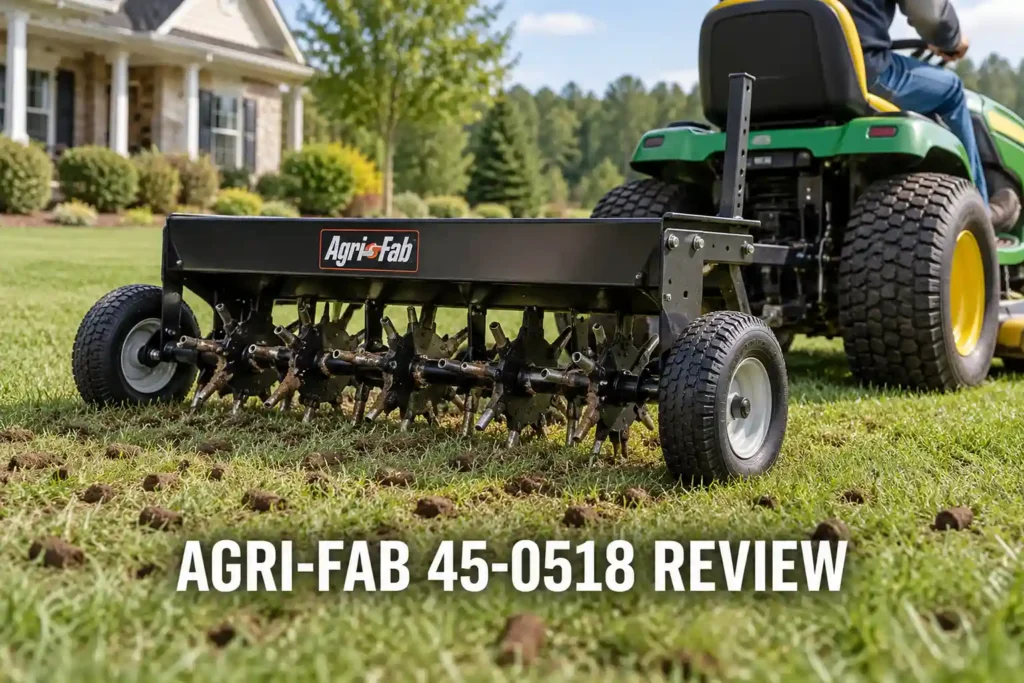
Here is my Agri-Fab 45-0518 review in one line: buy the 40-inch tow-behind plug aerator if you already own a lawn tractor or riding mower and want a budget-tier way to pull soil cores from a flat lawn, and skip it if you push-mow or expect it to bite without weight in the tray. I put it together on the concrete work pad in front of my machinery shed and strapped four concrete blocks into the tray. Below you get the specs, the assembly job, how the knives work, the safety order before the first pass, the drawbacks and the three alternatives to compare it with.
Agri-Fab 45-0518 Review: My Verdict
The 45-0518 is a towed plug aerator with no motor: a steel frame that carries 24 galvanized coring knives, a weight tray and a lift handle, pulled by a lawn tractor or riding mower on a hitch pin. It pulls small plugs of soil out of the lawn and leaves them on the surface, which Kansas State Extension calls the most effective way to aerate, though it can damage turf if the timing is wrong. It sits in the budget to mid-range price tier, the lowest of the tow-behind plug aerators here. My ranking of the top lawn aerators compares nine hand and tow-behind picks across lawn sizes.
- Who it is for: a lawn tractor or riding mower owner with a flat, open lawn who will add ballast.
- What it does best: pulls real soil plugs, not spike holes, in the budget tier of the tow-behind plug aerators compared here.
- Main trade-off: depth depends on added weight and soil moisture, and the tray stops at 140 lb.
Agri-Fab 45-0518 Specs and What Comes in the Box
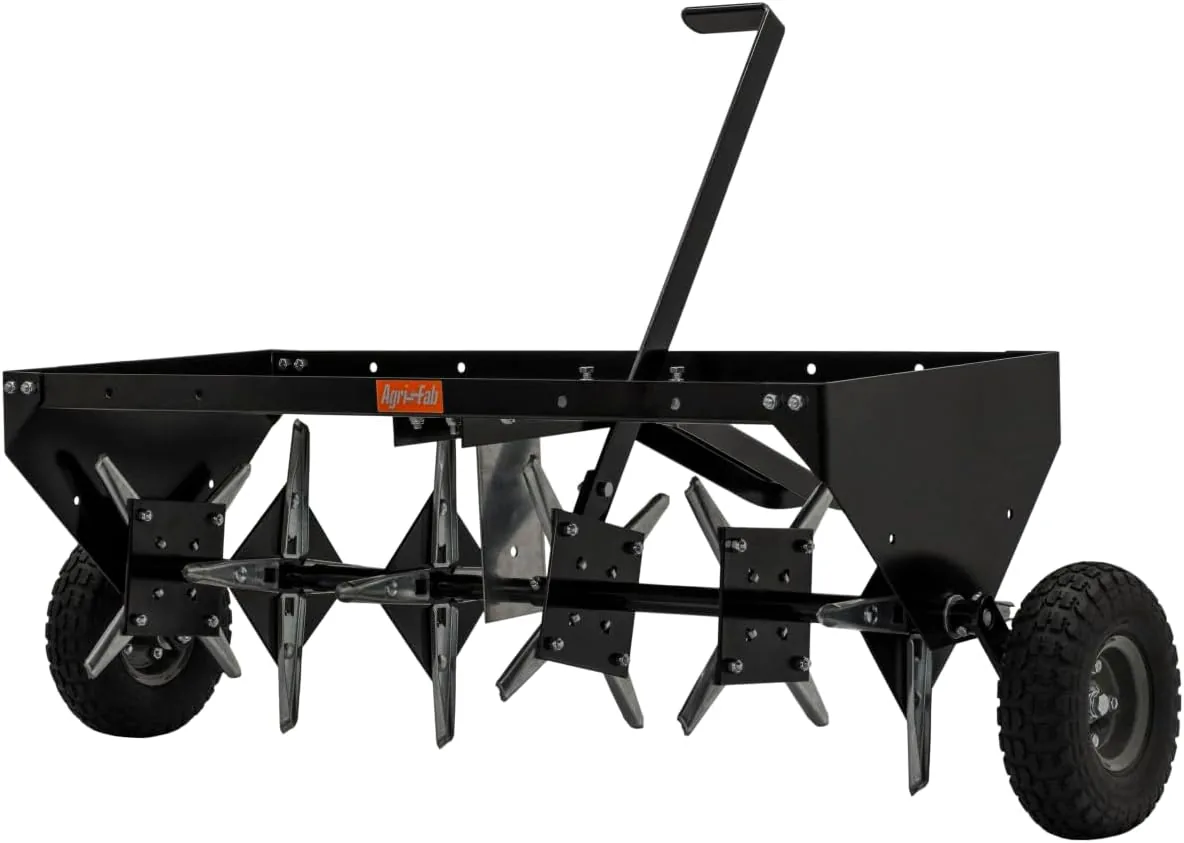
On the 45-0518, compare two specs first: the knife count and the weight tray limit, because together they set how many holes you get and how deep the knives can reach.
| Spec | Agri-Fab 45-0518 |
|---|---|
| Aerator type | Tow-behind plug (core) aerator, no motor |
| Working width, maker’s figure | 40 in. |
| Knives, maker’s figure | 24 galvanized plug-pulling knives |
| Plug length, maker’s claim | Up to 3 in. (plug length, not a promised hole depth) |
| Weight tray limit, manual | Up to 140 lb of added weight |
| Own weight, maker’s figure | 79 lb |
| Weight with a full tray | About 219 lb |
| Hitch or handle | Hitch pin with hair cotter pin; lift handle and lever |
| Warranty | Agri-Fab 3-Year Limited Warranty, original retail purchaser |
Agri-Fab’s manual describes plugs “ranging up to three inches in length”. That describes the plug, not the hole, and Wisconsin Extension ties the depth any aerator reaches to tine length and soil moisture. Agri-Fab publishes no plug diameter or holes-per-square-foot figure.
The manual’s carton list for this Agri-Fab 40 inch plug aerator has 12 line items, from the tray and tongue to four knife spools, the shaft and two wheels, plus a hardware pack with the hitch pin. No weights, straps or ties come in the box, so buy the ballast and ties separately.
This Agri-Fab tow behind plug aerator exists in two builds on paper. The maker’s page lists pneumatic tires, and Agri-Fab also prints a parts sheet for a later 45-05183 version with different wheel brackets, so your box may hold either one. Follow the manual in your carton.
Assembly Takes the Time
Agri-Fab plug aerator assembly is the longest job in owning this tool. The manual lists four wrench sizes, 7/16, 1/2, 9/16 and 3/4 inch, two of each, and its English section is short on pictures, so I laid every spool, bracket and bolt bag out on the concrete pad before I turned the first nut.
The manual warns about the sharp knife points and asks for caution at all times while you assemble and use the aerator. I wore gloves and thick-soled closed shoes for the whole build.
The lift handle and lever assembly is the step to follow exactly as printed, because that handle raises and lowers all 24 knives at every walk, drive and turn. Agri-Fab gives no assembly time, so plan a long session on a flat surface and check every fastener again before the first pass.
How the 45-0518 Pulls Cores
Hollow plug knives press into the soil as the frame rolls and lift out small cores, so soil leaves the ground instead of being pushed sideways. That is the line between a plug aerator and a spike tool, and field data backs it: in a two-year Kentucky bluegrass trial under simulated traffic, hollow-tine plots lost the least green cover per traffic event, ahead of solid-tine and untreated plots (1). My ranking of the top core aerators lists the hollow-tine tools I rate highest.
Check Whether Your Lawn Needs Coring
Compaction is the reason to buy any core aerator. In a field study with a power roller, perennial ryegrass, Kentucky bluegrass and tall fescue lost quality and cover as compaction rose, and tall fescue and bluegrass were still below normal eight months after the rolling stopped (2). Wisconsin Extension gives a simple test: the ground is compacted if you cannot push a pen into dry soil.
I run that test with a screwdriver on the house lawn, on the worn line by the path to the door as well as in the open grass. If the screwdriver goes in easily, skip the job. If it does not go in, my roundup of the lawn aerators for compacted soil shows the tools that break hard ground.
Weight Tray and Ballast
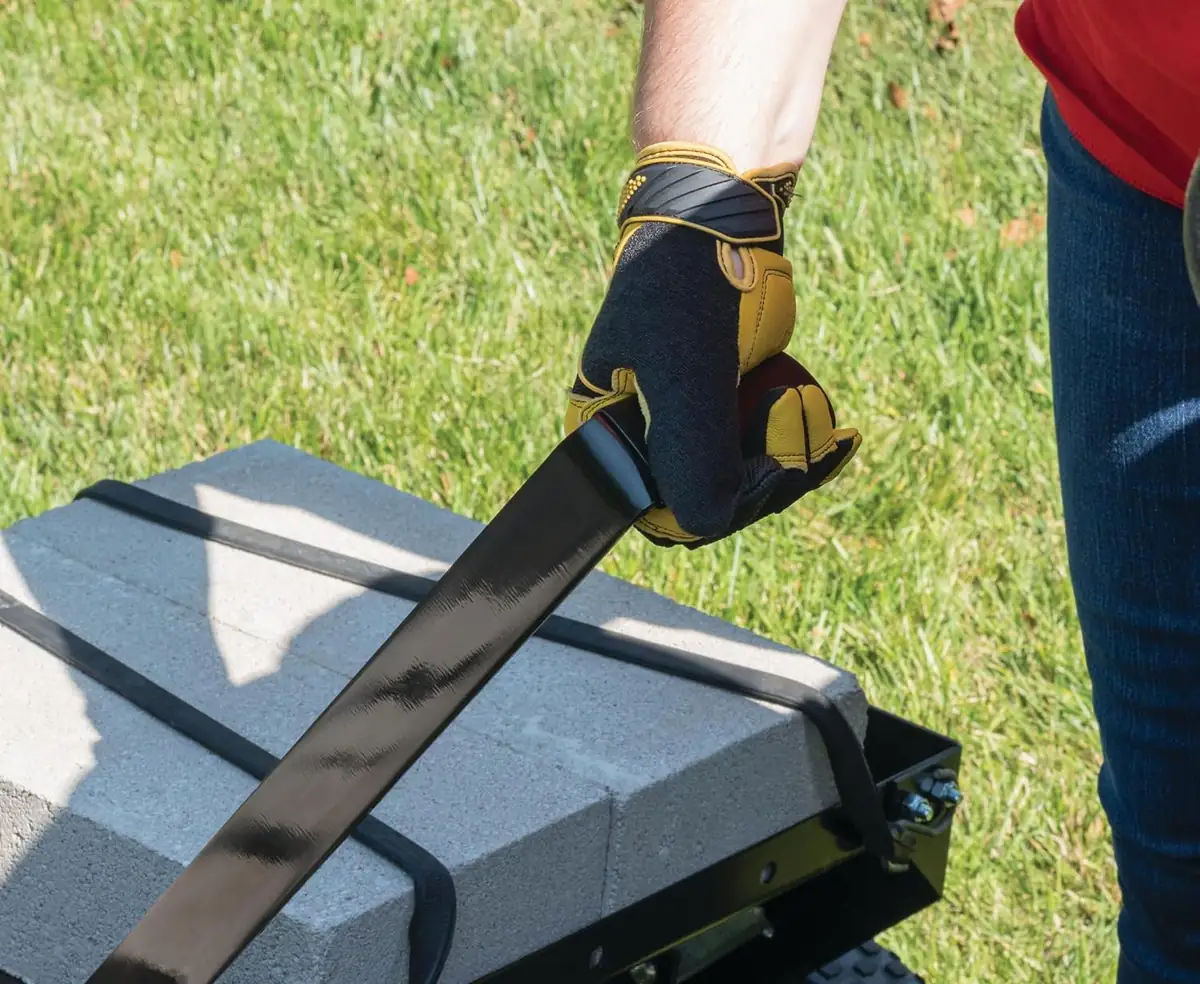
Weight is the depth control on this tool. Agri-Fab says up to 140 lb may be added “such as bags of sand or (4) concrete blocks”, and the manual ties that added weight to deeper penetration of the plugger points. I set four concrete blocks in the tray and ran ties through the front and rear so no strap could reach the rotating spools, which is what the manual requires.
I add weight one block at a time and stay at or below 140 lb. A full tray brings the unit to about 219 lb, so dismount before you raise or lower it, as the manual instructs.
Soil Moisture and Timing
The manual and the extension services agree on the soil: not muddy, not rock hard. Agri-Fab says to skip wet ground and to water extremely hard, dry ground for one to two hours first, while Wisconsin Extension wants soil slightly moist and, if it is dry, a thorough watering one to two days ahead. Kansas State Extension adds that tines clog in wet ground.
Timing follows your grass. Cool-season lawns such as Kentucky bluegrass and tall fescue are cored in early autumn or in spring, and Wisconsin calls September best. Wisconsin also warns that spring coring can encourage weed seed, although a New Jersey trial found no significant rise in crabgrass cover after spring hollow-tine cultivation (3).
Warm-season lawns such as bermudagrass and zoysiagrass are cored in late spring or summer, once they grow hard, with Kansas State naming late May through July. St. Augustinegrass and centipedegrass need your state’s own extension advice.
Core only while the grass is growing, never in a hot, dry spell. Expect a rough lawn for a while: a bermudagrass soccer field trial rated every treatment, hollow-tine aeration included, as unacceptable turf quality for 2 to 6 weeks (4). Your state extension office has the local dates.
Width, Passes and Cores
A 40 inch frame is 3.3 feet wide, so on a quarter-acre lawn you count about 3,300 feet of straight travel before overlap and turns, a bit over half a mile. Agri-Fab asks for overlapping passes in the straightest line you can manage, and Kansas State Extension says three or more passes may be needed for proper hole spacing. For wide lawns, my roundup of the lawn aerators for large yards covers more tow-behind picks.
The manual and the extension sources disagree about the cores. Agri-Fab says to rake the plugs, because small rocks and gravel in them can damage mower blades, while Wisconsin Extension says to let them dry for a day or two, mow, and expect them to fall apart in several days to a few weeks. I leave the cores to break down unless the soil holds stones, and then I follow the manual and rake.
Safety and Setup Before the First Pass
Read Agri-Fab’s short manual in full before you hitch anything.
The knives are sharp, so wear substantial footwear whenever you handle or run the aerator. I add gloves and long pants for handling and cleaning, and thick-soled closed shoes, never sandals, for every pass. Nobody rides on the frame or the towing vehicle, children never operate either one, and the work area stays clear of people and pets.
Start in first (low) gear with the engine at low speed and raise the speed gradually. The manual gives no speed, tow-vehicle weight or slope angle, so your tractor’s manual sets those limits. Work up and down a slope, never across its face, and stay off steep ground. Raise the aerator to the transport position before any sharp turn and before you cross a walk, drive or other hard surface, and never tow it on a highway or any public road. Skip wet ground.
Before you clear mud from the knives, adjust anything or unhitch, stop on level ground, shut the engine off, set the parking brake, take out the key and wait until every moving part has stopped. The manual does not spell that sequence out, so treat it as general practice. With added weight in the tray, dismount before you raise or lower the aerator.
Locate Buried Lines First
The Agri-Fab manual says nothing about buried lines. Walk the lawn and clear stones, sticks, toys and dog waste, locate and mark every sprinkler head, irrigation pipe and drip line, low-voltage lighting wire and buried pet-fence wire, and call 811 before you aerate. Wait the time it gives, confirm every utility has answered, never assume short knives cannot reach a line, and never aerate an area where buried lines have not been located.
Care, Knives and Parts
The manual’s care list is short: check for loose fasteners before each use, oil the spools, shaft and wheel hubs as needed, and clean dirt off the knives after each use. Before the tool goes into the machinery shed, I brush the soil off the knives and coat the bare steel with a light oil, which is the storage step the manual describes.
Agri-Fab plug aerator tines are called knives or plugger points in the manual, and Agri-Fab says they can be sharpened with a small grinder, points removed first, at the original angle.
The 3-Year Limited Warranty leaves tires out from the start, and from year 2 it no longer covers plug groomer wheels and tines. It covers the original retail purchaser only, not products from unauthorized online resellers, so confirm that your seller is authorized. For Agri-Fab plug aerator parts, match the model number on your carton’s manual.

Who Should Buy It and Who Should Skip It
The 45-0518 suits a narrow group of owners, and I draw the line at a hitch and a flat lawn.
- Buy it if you own a lawn tractor or riding mower with a hitch and want to pull real soil plugs on a flat, open lawn.
- Skip it if you push-mow, because the tool has no motor and no push handle.
- Skip it if your soil stays too hard to penetrate when it is slightly moist and the tray carries the full 140 lb.
- Skip it if your lawn is steep, because the manual says to stay off steep slopes.
Drawbacks and Limits
I count four real limits on the 45-0518.
- The 140 lb cap: the tray is the only depth control, so hard soil limits how far 24 knives can go.
- Knife count: 24 knives across 40 inches is a little thinner than 32 across 48 inches on the larger Agri-Fab.
- Rocks in the plugs: the manual says to rake them, which adds time after the pass.
- Warranty terms: original purchaser, authorized sellers only, tires excluded from the start and plug groomer wheels and tines excluded from year 2.
How It Compares With the Alternatives
Three other tow-behind plug aerators make a fair comparison, and one is this design under another name. I put the figures in one table after the three notes.
Agri-Fab 45-0299 48-Inch Plug Aerator
The Agri-Fab 45-0299 48 Inch Tow-Behind Plug Aerator is the wider sibling: 48 inches and 32 knives on the same plug design, with the same 140 lb tray limit and a 94 lb frame. Pick it for a bigger lawn, where eight extra inches save passes. If you want the wider frame set beside this one, my comparison of the Agri-Fab 45-0299 and 45-0518 puts 48 inches against 40.
CRAFTSMAN CMXGZBF7124213 40-Inch Plug Aerator
The CRAFTSMAN CMXGZBF7124213 40 Inch Tow-Behind Plug Aerator is the 45-0518 design under another name: its manual names Agri-Fab as the maker, and the width, the 24 coring points and the 140 lb tray match. It carries a 3-year Craftsman warranty and publishes no weight. The shared design and the headline warranty give no demonstrated reason to switch, so pick it only if you prefer the Craftsman name. My comparison of the 45-0518 and CRAFTSMAN CMXGZBF7124213 goes through the shared design and the small differences.
Brinly PA-403BH-A3 40-Inch Plug Aerator
The Brinly PA-403BH-A3 40-Inch Tow-Behind Plug Aerator has 24 spoons and a 150 lb tray, and its manual gives 66 lb empty and 2 years on steel parts. That manual covers the PA-403BH family. Pick it if you want the higher tray limit and the lower empty weight. My comparison of the Agri-Fab 45-0518 and Brinly PA-403BH-A3 sets the two 40-inch units side by side.
| Spec | Agri-Fab 45-0518 | Agri-Fab 45-0299 | CRAFTSMAN 7124213 | Brinly PA-403BH-A3 |
|---|---|---|---|---|
| Working width | 40 in. | 48 in. | 40 in. | 40 in. |
| Knives or spoons | 24 | 32 | 24 | 24 |
| Added weight limit | 140 lb | 140 lb | 140 lb | 150 lb |
| Own weight | 79 lb | 94 lb | Not published | 66 lb |
| Warranty | 3 years | 3 years | 3 years | 2 years on steel parts |
My Final Verdict on the Agri-Fab 45-0518
I recommend the 45-0518 to anyone who already owns a lawn tractor or riding mower and wants real soil plugs from a flat lawn in the budget tier. Weight and moist soil decide what the 24 knives can do, so add ballast one block at a time once the soil is slightly moist. Skip it if you push-mow, or if it cannot pull adequate plugs at the 140 lb limit in suitable soil, and locate every buried line before the first pass. That is where my Agri-Fab 45-0518 review lands: buy it for a flat, open lawn behind a mower you already own, and load the tray only after the soil and the lines are checked. My roundup of the best tow-behind lawn aerators ranks five units to pull behind a tractor or mower.
Frequently Asked Questions
How long does it take to assemble the Agri-Fab 45-0518 40-inch tow plug aerator?
Agri-Fab gives no assembly time for the 45-0518, and the job runs through a 12-item carton, four wrench sizes and a lift handle sequence that needs careful work. Plan a long session on a flat surface, lay the parts out first and check every fastener again before the first pass.
Can you attach an aerator to a lawn mower?
You can tow the Agri-Fab 45-0518 behind a lawn tractor or riding mower through its hitch pin and hair cotter pin, but check both manuals first. Agri-Fab publishes no tow-vehicle weight or speed for this model, so your tractor’s manual sets the limits, and a push mower cannot pull it.
How many passes should I make with a plug aerator?
Make as many overlapping passes as it takes to reach the hole spacing your lawn needs, and Kansas State Extension says that can be three passes or more for a lawn. Agri-Fab asks for the straightest line you can manage, with overlap, and the knives raised before any sharp turn.
Does plug aeration really work?
Plug aeration removes soil cores, and field trials support parts of it: hollow-tine plots held green cover better under traffic than solid-tine or untreated plots, and a bermudagrass trial found lower surface hardness. Turf looked rough for 2 to 6 weeks in that trial, so time the pass to active growth.
How heavy a mower to pull a tow behind plug aerator?
Agri-Fab publishes no tow-vehicle weight for the 45-0518, so the mower or tractor manual sets the limit. A full tray brings the unit to about 219 lb, and Brinly’s manual for its own unit asks that tow vehicle and operator outweigh the loaded aerator, a sensible check here too before you hitch up.
References
- Dalsgaard TO, Thoms AW, Christians NE, Mertz I, Horton R. Comparison of Shockwave aerification and conventional aerification methods on athletic fields. Agronomy Journal. 2020;112(5):3470-3477.
- Carrow RN. Influence of soil compaction on three turfgrass species. Agronomy Journal. 1980;72(6):1038-1042.
- Elmore MT, Tuck DP. Effect of hollow-tine cultivation on crabgrass infestation in cool-season turf. International Turfgrass Society Research Journal. 2022;14(1):770-775.
- McCauley RK, Pinnix GD, Miller GL, Heitman JL. Fraise mowing and hollow-tine aerification impact bermudagrass surfaces. Crop, Forage & Turfgrass Management. 2025;11(1):e70023.
Safety Note: Read your manual first. Before the first pass, walk the lawn and remove stones, sticks, toys, loose wire, hoses and pet waste. Locate and mark sprinkler heads, irrigation and drip lines, low-voltage lighting wire and buried pet fence wire, keep tines and spikes clear of them, and do not aerate any area where buried lines have not been located. Contact 811 before you aerate, wait the time your state requires and confirm that every utility has responded: never assume short tines cannot reach a buried line. Wear sturdy, slip-resistant closed shoes with thick soles and long pants whenever you aerate, and gloves when you handle tines or spikes. Keep everyone else and all pets out of the work area, keep the clearance your manual gives and stop if anyone comes closer. Never let children use or handle an aerator. With manual and rolling aerators, keep hands and feet clear of the points and the roller, and set the tool down securely before you clear cores or adjust it. On a step-on tool, step only on the foot bar or platform made for it, never on another part of the frame, and take breaks before your feet, knees or back start to hurt. Never aerate dry, rock-hard soil or waterlogged ground, and stay off steep and wet slopes. For a tow-behind aerator, follow both the tow vehicle’s and the aerator’s manuals for hitch, towing capacity, top speed, slope limits and direction of travel. Tow it only behind an approved lawn tractor or riding mower, never behind a car or truck and never on a public road. Start slowly, avoid sudden turns and stops, and raise the tines or use the transport position before sharp turns and hard surfaces. Carry less weight on slopes as your manual says, never more than it allows, and strap the weights so the straps stay clear of the tines. Never use people as weight and never carry riders. Before you clear, adjust, hitch or unhitch a tow-behind aerator, stop on level ground, turn the engine off, set the parking brake, remove the key and wait for all movement to stop. Block the wheels as the manual instructs before disconnecting, and keep hands and feet out from under the towbar. Get off the tractor before you raise or lower an aerator that carries added weight. For a gas core aerator, read the machine’s and the engine’s manuals and ask the rental shop to show you the controls. Wear safety glasses with side protection and hearing protection, keep both hands on the handle because the machine can pull forward, and raise or disengage the tines as the manual describes before turns and hard surfaces. Before you clear, clean, inspect or adjust it, stop the engine, wait for every moving part to stop and disconnect the spark plug wire. Exhaust contains carbon monoxide, which can kill: start and run the engine outdoors only, away from doors, windows and air intakes, and never in a garage, shed or other enclosed or partly enclosed space, even with doors or windows open. Refuel outdoors with the engine off and cool, away from flames and sparks. Aerating at the wrong time of year or on stressed or dormant grass can damage a lawn, so match the timing to your grass type.