
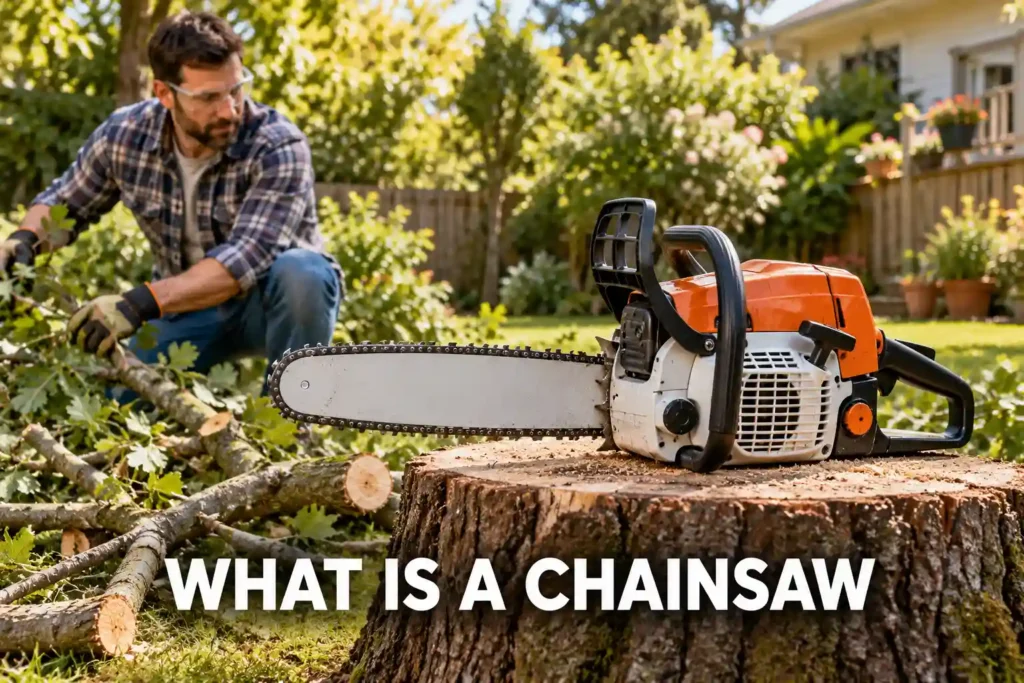
A chainsaw is a handheld power saw that cuts wood with a loop of toothed chain driven around a guide bar. Gas, battery and corded saws do the same basic job, and every one of them can hurt you in a second. I prune my plum and apricot trees with loppers and a hand saw, and a chainsaw is for the cut that is too big for them. Below you get the types, the parts, the jobs a chainsaw suits, the safety basics and the mistakes a first-time owner makes.
What Is a Chainsaw?
A chainsaw is a portable saw with a power unit, a guide bar and a chain of sharp links that runs around the bar. The power unit is a gas engine, a battery motor or a corded motor, and it spins a sprocket that pulls the chain. The chain does the cutting, and the bar holds it in line. I trace how the power, clutch, chain and brake fit together in my guide on how a chainsaw works.
A chainsaw cuts wood and nothing else. According to Husqvarna, it is for wood only. Soil, stones and a chain that touches the ground dull the cutters fast. I lift a log onto a stand before I cut it, so the chain stays out of the dirt. For hedges and thin growth, I compare a hedge trimmer against a chainsaw to explain which tool fits.
Read This Before Any Saw Is Bought
A chainsaw is the most dangerous tool on this site. Read the whole manual and get hands-on training before the first cut, because Clemson Extension and Alabama Extension both recommend it. A beginner starts with small, simple cuts of wood lying on the ground, and never starts by felling a tree.
What a Chainsaw Is Made Of
Every saw has the same core parts. The safety parts matter as much as the cutting parts, and a saw with one missing stays off the job until it is repaired.
- Power unit: a two-stroke gas engine, a battery motor or a corded motor.
- Guide bar: the metal rail the chain runs around. The length printed on the box is the bar length; the wood the saw can cut through in one pass is shorter.
- Chain: the loop of cutters joined to drive links that sit in the bar groove. Pitch and gauge must match the bar and sprocket. I show how to read and match the pitch in my piece on what chainsaw pitch means.
- Chain brake: a brake that stops the chain. Pushing the front hand guard forward engages it, and an inertia mechanism can engage it in a rotational kickback, but according to Husqvarna that release works only if the force of the kickback is large.
- Chain catcher, throttle lockout and rear hand guard: a catch pin for a broken chain, a lever that keeps the trigger from opening by accident, and a guard that shields the right hand.
- Oiler: a pump that feeds bar oil to the chain. Check the oil level before every use.
Gas, Battery and Corded Chainsaw Types
The power source is the first way to sort the types of chainsaws. It decides how much the saw can cut, how loud it is, how much upkeep it needs and where you can use it. I compare the two most common power sources on upkeep, noise and safety in my guide to battery and gas chainsaws.
| Type | Power comes from | Strength | Limit | Suits |
|---|---|---|---|---|
| Gas | Two-stroke engine, mixed fuel | Most power | Loud, mixed fuel, more upkeep | Long days and thick wood |
| Battery | Rechargeable pack | Quieter, push-button start, low upkeep | Less power; packs need recharging or swapping on a long job | Small, infrequent jobs |
| Corded | Wall outlet and cord | No fuel, no pack | Cord often only 100 feet; never wet | Work close to an outlet |
Gas Chainsaws
A gas chainsaw has a two-stroke engine that runs on gasoline mixed with oil in one tank. According to Alabama Extension, most commercial saws use a 50:1 mix, which is about 2.6 ounces of oil to a gallon, but your own manual sets the ratio. Husqvarna and Echo allow up to 10 percent ethanol, and Echo bans E15 and E85.
I measure the mix in a marked bottle and make only what the job needs, because stale fuel is a common cause of hard starting. When I refuel, I stop the saw first: release the trigger, engage the chain brake, switch the engine off and wait until the chain has stopped. I then let the engine cool, refuel outdoors with no smoking, open flame or sparks nearby, wipe up spills and move at least 10 feet away before I start it.
As an example of size, the Husqvarna 435 has a 40.9 cm3 (2.49 cubic inch) engine rated at 1.6 kW, and its manual recommends bars from 13 to 18 inches. I explain how to read displacement figures like that in my write-up on what cc means on a chainsaw.
Battery Chainsaws
A battery chainsaw swaps the engine for a motor and a rechargeable pack. According to Alabama Extension, battery saws are quieter, start at the push of a button, need little upkeep and have enough power for most smaller jobs. NC State says they are not designed for prolonged use or for cutting large material. The motor type makes a real difference in these saws, and I compare the two kinds in brushless and brushed chainsaw motors.
Battery saws are just as dangerous as gas saws, and Alabama Extension says so in as many words. Near the house a battery saw is the one I prefer, since it is quieter, but I still put on ear protection before the first cut. Alabama recommends two batteries for a long job. My battery chainsaw ranking sorts cordless saws by bar length, brake and battery.
Corded Electric Chainsaws
A corded saw plugs into an outlet. NC State notes that electric saws often have only 100 feet of cord. Use an outdoor-rated extension cord of the gauge your manual gives for its length, plug into GFCI-protected power, never use the saw in rain or wet conditions (GFCI protection does not make that safe), keep the cord away from the chain, and unplug it before any work on the chain. My corded electric chainsaw roundup covers plug-in saws for yard work.
As an example of the class, the Makita UC4051A has a 16 inch bar with a 14 inch cutting length, according to its manual. The difference between those two numbers comes back in the section on choosing a size.
Rear-Handle, Top-Handle and Mini Chainsaws
Handle layout is the second way to sort chainsaws. Most saws a homeowner meets are rear-handle saws, with the main handle at the back and a front handle over the top. Top-handle saws and small one-hand pruning saws are different tools with different rules. I compare the two layouts on safety in my comparison of top-handle and rear-handle chainsaws.
What Is a Top-Handle Chainsaw?
A top-handle chainsaw has its main handle on top of the body, which makes it compact. According to the Husqvarna T435 manual, the closely spaced handles raise the risk of losing control, so these saws are for work in a tree by persons trained in special cutting techniques who are properly secured. The same manual recommends regular saws with wider spaced handles for all other cutting at ground level. I go through that saw in my full Husqvarna T435 saw review.
A homeowner who works on the ground buys a rear-handle saw. I work on the ground, so I would not buy a top-handle saw for my yard.
Small one-hand pruning saws with bars of 4 to 8 inches are the third group. Each follows its own manual and its own rules. The free hand stays well clear of the chain. Never use a rear-handle saw one-handed. I set these small saws against a full-size saw on cutting limits, weight and safety in my comparison of mini and full size chainsaws.
What a Chainsaw Is Used For
A chainsaw suits cutting wood that is too thick or too many for a hand saw. Below shoulder height and on firm ground, that covers a short list of jobs. My comparison of a log splitter and a chainsaw shows what each tool does and when you need both.
- Limbing and pruning thick limbs: cutting branches off a downed tree or removing a limb too big for loppers.
- Bucking: cutting a log into lengths, for firewood or to clear a path.
- Storm cleanup of small wood: limbs and small trunks lying on the ground. Alabama Extension says a homeowner or farm-grade saw is enough for post-storm work.
- Small, straight, sound live trees: only after training. A standing dead tree is a job for a certified arborist.
NC State says most homeowners need a saw for storm cleanup, small tree removal and firewood, and do not need a professional-grade chainsaw. The live wood in my orchard is a different case. Loppers and a hand saw do that work with no engine, and the chainsaw comes out for the rare limb or dead tree that they cannot handle. When a storm leaves a pile of cut limbs, my guide to choosing a wood chipper or chainsaw explains which tool suits the next job.
Anything at or above my shoulder goes to a pole saw or a professional crew. After a storm I cut only what lies on the ground, and anything hung up in another tree or bent under tension I leave to people with the training and the equipment. I weigh the two tools against each other in my chainsaw and pole saw comparison.
Chainsaw Safety Basics Before Anyone Starts One
A review of US emergency department data from 2006 to 2016 found that power saws caused 89 percent of 18,250 nonfatal power saw and axe injuries, mostly lacerations to the fingers and hand, and 65 percent of them happened at home (1). That category covers more than chainsaws. Of 185 rural patients treated for non-occupational chainsaw injuries, 109 were hurt in the legs and 76 in the arms, and the authors conclude that protective gear and simple precautions can prevent such injuries (2).
Kickback in Plain Words
Kickback is the main reason the front handle, the chain brake and the grip matter. Rotational kickback happens when the upper part of the bar tip, the kickback zone, touches wood or another object and the bar is thrown up and back toward you. Pushback happens when wood pinches the chain along the top of the bar and pushes the saw straight back at you. Pull-in is the third case: wood pinches the chain on the bottom of the bar and the saw is pulled forward, away from you.
Laboratory tests on gas saws found that proper chain tension, anti-kickback chain links, guide bars with sliding ends and a quickly activated chain brake all influence kickback (3). A low-kickback chain, a chain brake and a correct grip lower the risk, and none of them removes it. Keep the bar tip clear of contact and watch for wood that is closing on the bar.
Hold the saw with both hands, right hand on the rear handle and left hand on the front handle, thumbs and fingers wrapped around the handles, with your body to the left of the chain line and firm footing. Never cut at or above shoulder height, and never cut from a ladder or a roof. A homeowner never cuts from a tree.
Protective Gear and Noise
Wear all of it, every time, even for one quick cut. Alabama Extension puts it as wear all your protective gear whether you run a saw for 5 minutes or 5 hours.
- Eyes: impact-rated safety glasses with side protection marked Z87+. A mesh face screen adds to them but never replaces them.
- Ears: hearing protection. Alabama Extension says gas saws operate at about 110 decibels, so the protection should cut well over 25 decibels.
- Head: a hard hat when you fell a tree or anything can fall from above.
- Legs: chainsaw chaps or chainsaw trousers used within their maker’s stated limits. Look for a UL label. Some are not designed to stop a battery or corded saw’s chain, and no clothing guarantees protection.
- Hands and feet: work gloves and sturdy boots with ankle support.
Noise and exhaust differ by power source. In NIOSH sampling of landscaping workers, those using fuel-powered chainsaws, leaf blowers and string trimmers had significantly more noise and carbon monoxide exposure than those using battery versions (4). A study of lawn and garden equipment by the EPA found that operators can have higher carbon monoxide exposure, with ten-second peaks above 120 ppm for some equipment (5). Never run a gas saw indoors or in a garage, a shed or any other enclosed space, because the exhaust contains carbon monoxide.
Vibration tires the hands too. In a study of groundskeepers in the southeastern United States, chainsaws gave the highest tool vibration, 8.0 m/s2 at the right hand (6). Take breaks, and stop if your hands tingle or go numb. See a doctor if it persists.
Stopping, Servicing and Carrying a Saw
Use the order that fits the task, and use all of it. A short version is how people get cut.
- Stopping, every saw: release the trigger, engage the chain brake (on a battery or corded saw, if it has a brake lever), switch the engine or motor off and wait until the chain has stopped.
- Maintenance, meaning touching the chain, clearing a jam, adjusting tension, sharpening or changing the bar or chain: stop as above. On a gas saw, let the engine and muffler cool and pull the spark plug cap off. On a battery saw, take the battery out. On a corded saw, pull the plug from the outlet by the plug, not the cord. Put on gloves before touching the chain. Release the chain brake only when the exact manual’s procedure requires it, and never force a locked chain or cover.
- Refuelling a gas saw: stop as above, let the engine cool, refuel outdoors with no smoking, open flame or sparks nearby, wipe spills and move at least 10 feet away before starting.
- Carrying and transport: stop as above, with the battery out or the saw unplugged, the chain brake engaged, the bar pointing behind you and the bar cover on for transport.
Before each use, inspect the saw as its manual describes: test the chain brake by the manual’s method, and check the throttle trigger lockout, the stop switch, the chain catcher, the guards and the chain’s sharpness, tension and condition. On a gas saw the chain must not move at idle. If any check fails, do not use the saw until it is repaired, and never disable a safety device.
Start a gas saw with the chain brake engaged, on the ground with the bar clear of anything or held firmly as the manual shows, never by drop-starting it, and at least 10 feet from where you fuelled it.
Jobs That Belong to Professionals
Felling is the most dangerous chainsaw job, and this article does not teach it. A tree that is large, leaning, dead, hung up in another tree, near a house or a road, or under tension after a storm is a job for a certified arborist or a professional crew. Never work alone, and keep bystanders and pets well away.
Power lines are a separate hazard. Treat every downed power line, and anything touching it, as live: stay well away and call the utility. Before any work near a power line, contact the utility and leave that work to its qualified line-clearance crews; a general arborist is not automatically qualified for it. According to Alabama Extension, stay at least 10 feet from distribution lines and 33 feet from energized trees.
Choosing a Chainsaw Size Class
Alabama Extension says a saw with an 8 to 15 inch bar suits light work such as small limbs. A midweight saw with a 16 to 20 inch bar suits frequent thick limbs and trunks, and saws over 20 inches are generally professional-grade and not recommended for homeowners. NC State adds that most household uses rarely need more than 16 inches. I turn those ranges into a pick for your own jobs in my guide to what size chainsaw you need.
A Worked Example With Real Numbers
The Makita UC4051A has a 16 inch bar, and its manual gives a cutting length of 14 inches. A log 15 inches thick is more than that single pass can cut, even though the box says 16. Always compare the log with the cutting length, never with the number on the box.
I judge weight at arm’s length. A saw that feels light at minute five feels heavy at minute thirty, so I trust the feel of the saw in my hands over the number on the box. I rank seven compact saws for limbs and small logs in my lightweight chainsaw roundup.
Common Mistakes With a First Chainsaw
Most first-saw trouble traces back to a short list of mistakes.
- Skipping gear for a quick cut: sunglasses and a cap are not impact eyewear or a hard hat.
- Running with a dull or loose chain: fine dust instead of chips means it is time to sharpen, and a dull chain raises the kickback risk.
- Using a saw with a missing safety part: with no chain brake, throttle lockout or chain catcher, the saw does not cut.
- Fitting a chain or bar the manual does not list: the wrong pitch, gauge or drive link count adds kickback risk. I explain how gauge fits the bar in my piece on what chainsaw gauge means.
- Leaving fuel in a gas saw for months: drain it or run it empty before long storage, as the manual says.
My own habit is to read the manual cover to cover before the first cut and to start on one log lying on the ground. If this is your first saw, my best chainsaws for beginners all come with chain brakes.
What to Remember About Chainsaws
Match the saw to the job first: gas for the most power, battery for small jobs near the house, corded for work close to an outlet. Then read the manual cover to cover, arrange hands-on training and put on the full protective kit before the first cut, starting with one log lying on the ground. Jobs at or above shoulder height, in a tree, under tension or near a power line belong to professionals. On my land, a chainsaw is the tool for the big cut, and it stays in the shed for everything else. A chainsaw is a sharp chain on a powered bar, and it earns respect before it earns a place in your shed. When you are ready to shop, my best chainsaw picks cover battery, gas and corded saws.
Frequently Asked Questions
What is a chainsaw used for?
A chainsaw is used for cutting wood that is too thick or too plentiful for a hand saw, such as limbing, cutting logs to length for firewood and storm cleanup of small wood on the ground. It suits work below shoulder height on firm ground, and felling and storm-damaged trees are jobs for a professional.
What’s the difference between a saw and a chainsaw?
A hand saw has a fixed blade that you push and pull, while a chainsaw has a loop of toothed chain driven around a bar by a gas engine, battery motor or corded motor. That power cuts thick wood quickly and also makes a chainsaw far more dangerous, so it needs protective gear and training that a hand saw does not.
What is kickback on a chainsaw?
Kickback on a chainsaw happens when the upper part of the bar tip touches wood or another object and the bar is thrown up and back toward you (rotational kickback). Wood pinching the chain on the top of the bar pushes the saw straight back at you (pushback), and wood pinching the bottom pulls it forward, away from you (pull-in). A low-kickback chain, a chain brake and a correct grip reduce these risks; none removes them.
What is a chain brake on a chainsaw?
A chain brake on a chainsaw is a safety brake that stops the chain, engaged by pushing the front hand guard forward or by an inertia mechanism in a rotational kickback. According to Husqvarna, the inertia release works only if the force of the kickback is large, so the brake never replaces correct technique. Engage it before you start the saw, and before you move it release the trigger, engage the brake, switch the engine or motor off, wait until the chain has stopped, take the battery out or unplug a corded saw, and carry it with the bar behind you and the bar cover on for transport.
What should you not cut with a chainsaw?
You should not cut anything but wood with a chainsaw, never at or above shoulder height or from a ladder or a roof, and never a large, leaning, dead, hung-up or storm-tensioned tree, which is a job for a certified arborist. Treat every downed power line, and anything touching it, as live: stay well away and call the utility. Before any work near a power line, contact the utility and leave that work to its qualified line-clearance crews; a general arborist is not automatically qualified for it.
References
- Sritharen Y, Hernandez MC, Zielinski MD, Aho JM. Weekend woodsmen: overview and comparison of injury patterns associated with power saw and axe utilization in the United States. Am J Emerg Med. 2018;36(5):846-850.
- Özdeş HU, Ergen E, Köroğlu M, et al. Chainsaw-related extremity injuries. Medicina (Kaunas). 2025;61(4):759.
- Dąbrowski A. Reducing kickback of portable combustion chain saws and related injury risks: laboratory tests and deductions. Int J Occup Saf Ergon. 2012;18(3):399-417.
- Alexander BM, Graydon PS, Pena M, Feng HA, Beamer BR. Hazardous exposures and engineering controls in the landscaping services industry. Journal of Occupational and Environmental Hygiene. 2025;22(3):189-202.
- Baldauf R, Fortune C, Weinstein J, Wheeler M, Blanchard F. Air contaminant exposures during the operation of lawn and garden equipment. J Expo Sci Environ Epidemiol. 2006;16(4):362-370. doi:10.1038/sj.jes.7500471
- Chen N, Yang S, Oh J. Evaluation of hand-arm vibration (HAV) exposure among groundskeepers in the southeastern United States. Annals of Work Exposures and Health. 2025;69(1):81-95.
Safety Note: Read your saw’s manual first and get hands-on training before your first cut. A chainsaw can react faster than you can: if the upper part of the bar tip touches wood or another object, the bar can kick back up and toward you; wood pinching the top of the chain can push the saw straight back at you, and wood pinching the bottom can pull it forward. Keep the bar tip out of contact and watch for wood closing on the bar. A low-kickback chain and a chain brake reduce these risks but never remove them. Before each use, inspect the saw as your manual describes: test the chain brake, and check the throttle lockout, the stop switch, the chain catcher, the guards and the chain. On a gas saw the chain must not move at idle. If any check fails or a part is missing or damaged, do not use the saw until it is repaired, and never disable a safety device. Wear impact-rated safety glasses with side protection marked Z87+ (a mesh face screen adds to them but does not replace them), hearing protection, chainsaw chaps or chainsaw trousers, work gloves and sturdy boots with ankle support, and a hard hat when you fell a tree or when anything can fall from above. Use leg protection within its maker’s stated limits: some chaps are not designed to stop the chain of a battery or corded saw, and no clothing guarantees protection. Hold the saw with both hands, right hand on the rear handle and left hand on the front handle, thumbs and fingers wrapped around the handles, and keep your body to the left of the chain line with firm footing. Never cut one-handed with a rear-handle saw, never cut at or above shoulder height, and never cut from a ladder or a roof. Top-handle saws are made for trained tree workers: follow that saw’s manual. Keep children, bystanders and pets well away while you cut. Never work alone. Start a gas saw with the chain brake engaged, on the ground or held firmly as the manual shows, never by drop-starting it, and at least 10 feet from where you fuelled it. Refuel outdoors with the engine off and cool, with no smoking, flames or sparks nearby, wipe up spills, and use only the fuel mix and ethanol content your manual allows. Exhaust contains carbon monoxide, which can kill: never run a gas saw indoors or in a garage, shed or other enclosed space. Before you touch the chain, clear a jam, adjust the tension or sharpen: release the trigger, engage the chain brake, stop the engine or motor and wait until the chain has stopped. Then, on a gas saw, let the engine and muffler cool and pull the spark plug cap off; on a battery saw, take the battery out; on a corded saw, unplug it by the plug. Put on gloves before you touch the chain, and release the chain brake only when your manual’s procedure calls for it. To carry the saw, stop it, take out the battery or unplug it, keep the chain brake engaged and the bar pointing behind you, and fit the bar cover for transport. Use a corded saw only with an outdoor-rated extension cord of the gauge your manual gives, plugged into GFCI-protected power. Never use it in rain or wet conditions: GFCI protection does not make that safe. Keep the cord away from the chain. Use only the chains and bars your manual approves. Felling trees is the most dangerous chainsaw job. Before any felling cut, keep everyone at least two tree lengths away, and plan and clear two escape routes angled back from the direction of fall; when the tree starts to fall, follow your manual’s retreat steps (release the trigger, stop the saw and set it down as it describes) and move away along that route; never delay escape to cool, unplug or cover the saw. A large, leaning, dead or hung-up tree, a trunk or limb under tension after a storm, and any tree near a house or a road are jobs for a certified arborist. Power lines are a separate danger: treat every downed line, and anything touching it, as live, stay well away and call the utility; before any work near a power line, contact the utility and leave that work to its qualified line-clearance crews. Stop when you are tired, and take breaks if your hands tingle or go numb.