
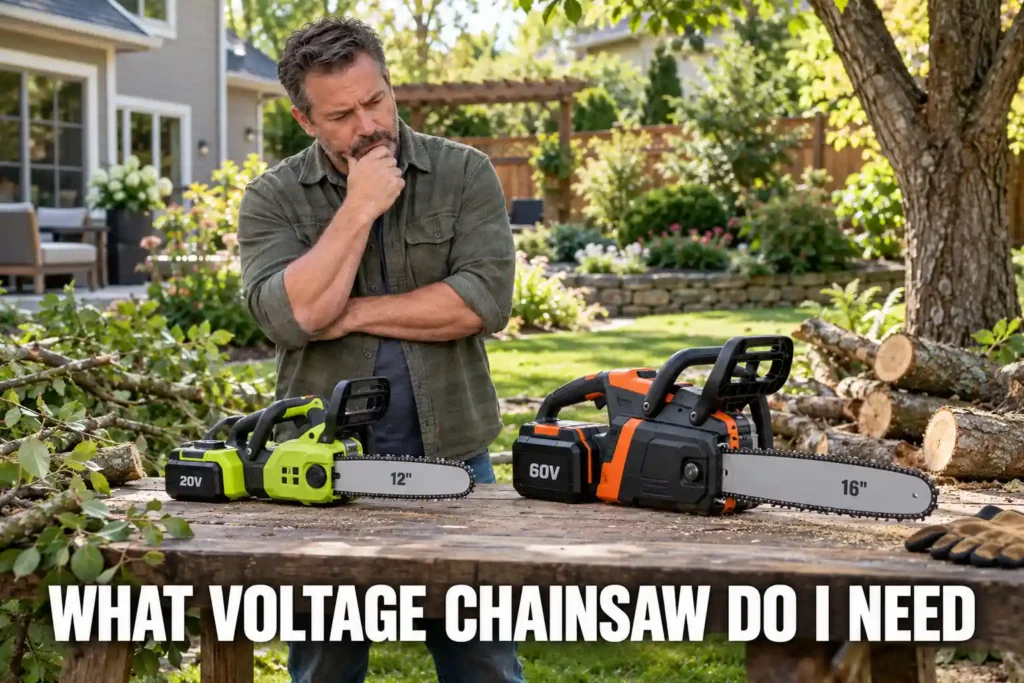
The chainsaw voltage you need is the one that comes with a bar length, a battery size and a maker’s log rating that fit your wood, because the volt number only names the battery family. I read battery labels the way I read any spec sheet, and the labels on cordless saws are easy to misread. Below I explain what the numbers mean, how amp-hours change the picture, and how to match a platform to the jobs on a farm or a yard.
What Voltage Chainsaw Do I Need? Match the Platform to the Job
Choose in this order: the biggest wood you will cut, the bar length and log rating the maker prints for the saw, the battery that comes in the box, and only then the platform. A volt number tells you which batteries fit the saw, and the manual tells you what the saw may cut. The table shows how makers rate saws on different platforms. If a yard cleanup is the job, my list of the top chainsaws for homeowners keeps to saws with a chain brake.
| Saw | Platform | Maker’s rating | Bar |
|---|---|---|---|
| Craftsman V20 CMCCS620M1 | 20V Max | Logs up to 10 in | 12 in |
| DeWalt DCCS621P1 | 20V MAX | Logs up to 10 in | 12 in |
| Black+Decker LCS1240 | 40V MAX | Pruning and logs up to 12 in | 12 in |
| Milwaukee 2727-21HD | M18 | Cutting capacity 15 in | 16 in |
| DeWalt DCCS672X1 | 60V MAX | Logs up to 16 in | 18 in |
The rating belongs to the saw. The 20V Max DeWalt and the 40V MAX Black+Decker sit within two inches of each other, while the 60V MAX DeWalt is rated for 16 inch logs. NC State Extension says you are unlikely to need a bar longer than 16 inches for most common household uses, so the 16 inch class covers most yards. I go through bar length in more detail in my guide on what size chainsaw do I need.
- Light pruning and small logs: a compact saw with a 10 to 12 inch bar and a rating to match.
- Storm cleanup and occasional firewood on the ground: a saw in the 16 inch class with a second pack on the charger.
- Long days on big wood: a gas saw, which has no volt number to compare.
What the Volt Number on a Battery Chainsaw Really Means
Cordless chainsaw voltage appears in more than one form, and one battery system can carry two numbers. Read the footnote before you compare two saws.
Max Voltage and Nominal Voltage
DeWalt’s manual for its 60V Max chain saws says the maximum initial battery voltage, measured without a workload, is 20, 60 or 120 volts, and the nominal voltage is 18, 54 or 108. Black+Decker prints the same kind of footnote for its 40V MAX saw (nominal 36 volts), and Craftsman and WORX do it for their 20V saws (nominal 18 volts). A “20V Max” label and an 18 volt nominal figure describe the same battery system, so comparing a 20V Max saw with an 18V saw tells you nothing.
Some makers print one number only. EGO prints 56V, Greenworks 80V and SKIL 40V in their manuals. I read those as the platform name and nothing more. I compare the brands’ battery platforms, saw line-ups and warranties in my EGO and Greenworks chainsaw comparison.
Platforms Built From Two Packs
Some saws pair two smaller batteries. The Makita XCU04PT1 runs at 36 volts from two 18 volt packs, and its manual lists “Two battery cartridges are not installed” as a reason the saw does not start. The WORX WG385 uses two 20V Max PowerShare packs, which WORX sells as 40V Max, and its manual says the machine runs only when two batteries are installed and runs to the lower common denominator if their capacities differ. I compare these two saws directly in my WORX WG385 against Makita XCU04PT1 matchup.
| Saw | How the maker prints it | Battery in the kit |
|---|---|---|
| DeWalt DCCS621P1 | 20V MAX, nominal 18V | One 5 Ah pack |
| Black+Decker LCS1240 | 40V MAX, nominal 36V | One 2.0 Ah pack |
| Makita XCU04PT1 | Rated 36V, from two 18V packs | Four 5.0 Ah packs, two in the saw at a time |
| WORX WG385 | 40V Max, from two 20V Max packs | Two 4.0 Ah packs |
| Greenworks 20312 | 40V DC | One 4.0 Ah pack |
| EGO CS1613 | 56V | One 4.0 Ah pack |
| Greenworks GCS80421 | 80V DC | One 2.0 Ah pack |
| Milwaukee 2727-21HD | M18 system, 18V | One 12.0 Ah pack |
Compare nominal figures where a maker gives one. Compare nothing else until you have read the bar length and the log rating.
Volts, Amp-Hours and Watt-Hours in a Battery Pack
Volts multiplied by amp-hours gives watt-hours, which is the energy a pack stores. The volt number alone says nothing about that, and the arithmetic below shows why.
A Worked Example With Real Packs
Multiply the label figures. An 80 volt pack of 2.0 amp-hours stores about 160 watt-hours. An 18 volt pack of 12.0 amp-hours stores about 216. The 18 volt system holds more energy than the 80 volt one in this pair, because the amp-hours differ.
These are label figures, and the true numbers are lower where a maker prints a nominal voltage below the headline one.
| Saw | Label volts | Pack amp-hours | Rough watt-hours |
|---|---|---|---|
| Greenworks GCS80421 | 80 | 2.0 | About 160 |
| Makita XCU04PT1 (two packs in the saw) | 36 | 5.0 | About 180 |
| Milwaukee 2727-21HD | 18 | 12.0 | About 216 |
| EGO CS1613 | 56 | 4.0 | About 224 |
Energy is the tank. It sets how long the saw can work, and a second pack on the same platform doubles the tank at the same voltage. On my property I count the total minutes of cutting across a day, not the length of one job, and that count is what sends me to a second pack. Power, upkeep and noise are weighed in my guide to the battery or gas chainsaw choice.
Makers publish cuts per charge, and the figure only means something with its wood size. According to Milwaukee’s chart for its M18 FUEL 16 inch saw, the HD12.0 pack makes 120 cuts in 6 inch wood, 40 in 10 inch wood and 20 in 14 inch wood. A thicker cut asks more of the pack, so the same pack runs out sooner. The saw behind that chart is in my Milwaukee M18 chainsaw review.
Power, Current and Pack Protection
Power in watts is volts multiplied by amps, so a saw that wants a lot of power pulls a lot of current from the pack. The internal resistance of a lithium-ion cell determines how much power it can deliver, how efficiently, and how much heat it loses (1). That is why saws carry protection. Makita’s manual describes the tool stopping when it draws an abnormally high current, when it overheats and when the battery runs low.
For an overload the manual says to turn the tool off, stop the work that caused it and start again. For overheating it says to let the tool cool down first. I treat a blinking lamp as an instruction to follow.
Why Voltage Alone Does Not Predict Cutting Power
If voltage set cutting power, the saws on the highest platforms would run the fastest chains. The manuals say otherwise. The same holds for blowers, as I show in my guide on voltage and leaf blower power.
| Saw | Platform | Chain speed |
|---|---|---|
| Greenworks GCS80421 | 80V | 10.5 m/s, no load |
| Milwaukee 2727-21HD | M18 | 12.4 m/s |
| WORX WG385 | 40V Max, two 20V Max packs | 18 m/s |
| EGO CS1201 (12 in) | 56V | Up to 20 m/s |
| Makita XCU04PT1 | 36V, two 18V packs | Up to 20 m/s |
| EGO CS2005 (20 in) | 56V | Up to 25 m/s |
The 80 volt saw prints the lowest figure, and two EGO saws on the same 56 volt platform print 20 and 25 meters per second. The Greenworks figure is a no-load speed, the EGO and Makita figures are maximums, and the Milwaukee and WORX figures come without a stated load, so I do not rank the saws on this table. I use it to show that a volt number and a chain speed are separate things.
Gas-Equivalent Claims
EGO compares its 56 volt saws to a 30cc gas engine for the 12 inch CS1201, a 40cc for the 16 inch CS1613, a 45cc for the 18 inch CS1803 and a 55cc for the 20 inch CS2005. One platform gives four different comparisons, which tells me the motor and the saw design decide the result. Ryobi says its 40V HP 14 inch saw “delivers more power than a 37cc gas chain saw”, yet its manual says never to cut a log or limb with a diameter greater than the length of the guide bar, and to leave those cuts to properly trained professionals. For the gas side of that comparison, my guide titled “how much horsepower does a chainsaw need” explains power needs for homeowners.
Matching a Voltage Platform to Your Yard Jobs
Match the saw to the largest piece you will cut and the longest session you will run. Never cut at or above shoulder height, and never cut from a ladder or a roof. The manuals for the Craftsman CMCCS620M1, the Black+Decker LCS1240 and the DeWalt DCCS621P1 and DCCS672 set a stricter limit, no cutting above chest height, and the stricter limit in your saw’s manual wins. Work above that line belongs to a pole saw or a professional.
Small Logs and Light Pruning
Compact saws on the 20V Max and 40V MAX platforms fit this work, and their manuals rate them for logs up to 10 inches (Craftsman, DeWalt) and 12 inches (Black+Decker). A 40V chainsaw in this class suits dead limbs on the ground, hedgerow stems and the odd wind-broken branch. NC State Extension calls battery saws great for small, infrequent tree and shrub projects and says they are not designed for prolonged use or for cutting large material. On my land the live fruit-tree wood still goes to the hand saw and the loppers, and the saw comes out for the big cuts only. One of those compact saws is covered in my DeWalt 20V cordless chainsaw review, which covers limbs and small logs.
Storm Cleanup, Firewood and Long Days
Saws on the 36 volt, 56 volt, 60 volt and M18 platforms offer 16 inch bars, and the rating decides what each may cut. Milwaukee prints 15 inches of cutting capacity for its 16 inch bar, and DeWalt rates the 60V MAX DCCS672 for logs up to 16 inches. Alabama Extension puts battery saw run time at approximately 30 minutes and recommends two batteries, and I recommend a second pack for anything longer than a short job. Two packs carried me through an afternoon of hedgerow stems, and the spare pack decided that, not the volt number.
A long day on big wood is gas work. Alabama Extension says gas saws are more powerful, and a gas saw has no volt number at all, because its size is the engine displacement. I match engine size to the work in my guide on what cc chainsaw you need.
Safety First
A battery powered chainsaw is as dangerous as a gas saw, and Alabama Extension says so in plain words. U.S. emergency department data counted 18,250 nonfatal power saw and axe injuries from 2006 to 2016, with power saws behind 89 percent of them and 65 percent happening at home (2). That category is wider than chainsaws. Read the manual and get hands-on training before the first cut. Wear impact-rated safety glasses with side protection marked Z87+ (a mesh face screen adds to them but never replaces them), hearing protection, chainsaw chaps or chainsaw trousers used within their maker’s stated limits (some are not designed to stop a battery or corded saw’s chain, and no clothing guarantees protection), work gloves and sturdy boots with ankle support, plus a hard hat when you fell a tree or anything can fall from above. Never cut at or above shoulder height, and never cut from a ladder or a roof.
Trees, Storms and Power Lines
Felling is the most dangerous chainsaw job. Never work alone, keep everyone at least two tree lengths away, and plan and clear two escape routes angled back from the direction of fall before any felling cut. A large, leaning, dead or hung-up tree, or a trunk or limb under tension after a storm, is a job for a certified arborist. Treat every downed power line, and anything touching it, as live: stay well away and call the utility. Before any work near a power line, contact the utility and leave that work to its qualified line-clearance crews; a general arborist is not automatically qualified for it.
Grip, Kickback and Pre-Use Checks
Hold the saw with both hands, right hand on the rear handle and left hand on the front handle, thumbs and fingers wrapped around the handles, with your body to the left of the chain line and firm footing. If the upper part of the bar tip touches wood or another object, the bar can kick back up and toward you (rotational kickback). Wood pinching the chain on the top of the bar pushes the saw straight back at you (pushback), and wood pinching the bottom pulls it forward, away from you (pull-in). A low-kickback chain, a chain brake and a correct grip reduce these risks; none removes them. Before each use, inspect the saw as its manual describes: test the chain brake by the manual’s method, and check the throttle trigger lockout, the stop switch, the chain catcher, the guards and the chain’s sharpness, tension and condition; on a gas saw the chain must not move at idle. If any check fails, do not use the saw until it is repaired, and never disable a safety device.
Pick the Platform You Will Keep Using
The volt number mostly promises which packs fit, which chargers work and which other tools run on them. Milwaukee says its M18 FUEL 16 inch saw takes all M18 batteries and recommends its High Output or FORGE packs. Milwaukee’s saw also appears in my Milwaukee and Makita chainsaw comparison, kit against kit.
If you already own a family of cordless tools, the platform you own is a strong reason to stay with it. A tool-only saw such as the Ryobi 40V HP RY405010BTL ships with no battery and no charger, so you still need a pack and a charger. I add a second pack to the platform I own before I consider starting a new one. The same platform rule holds for pruning from the ground, and my guide explains the voltage a pole saw needs by comparing 20V, 36V, 40V and 60V saws.
The pack changes the saw, and EGO’s manual for the 20 inch CS2005 shows how much. With a pack of 2.5 Ah or less only the ECO speed mode is available, and below 6.0 Ah the high speed is not reached. EGO strongly recommends 6.0 Ah or more, and the kit ships with a 6.0 Ah pack. I compare that 20 inch saw with its smaller sibling in my EGO CS2005 against CS1613 piece.
Use Only the Packs the Manual Lists
DeWalt’s manual for the DCCS672 and DCCS677 lists four packs, the DCB606, DCB609, DCB612 and DCB615, all 60V Max. It says to recharge only with the charger the manufacturer specifies and to use power tools only with specifically designated battery packs, because any other pack may create a risk of injury and fire. A saw from a third-party seller that says it fits another maker’s battery is not named in the battery maker’s manual. I stay with the saw maker’s own packs and chargers.
Stop, Then Battery Out
Before you swap a pack, adjust the chain, clear a jam or sharpen, release the trigger, engage the chain brake if the saw has a brake lever, switch the motor off and wait until the chain has stopped. Then take the battery out and put on gloves before you touch the chain. Release the chain brake only when the exact manual’s procedure requires it, and never force a locked chain or cover. On a gas saw the order is the same up to the engine switch: release the trigger, engage the chain brake, switch the engine off and wait until the chain has stopped, then let the engine and muffler cool, pull the spark plug cap off and put on gloves before you touch the chain, releasing the brake only when the exact manual’s procedure requires it. To carry or store the saw, stop it the same way, take the battery out, engage the chain brake, point the bar behind you and fit the bar cover.
Cold, Heat and Charging Limits That Voltage Cannot Fix
A pack delivers less in the cold, whatever its voltage. Lab work on lithium-ion cells found reduced energy and power at low temperatures, and at -20 C what a cell delivers depends on the discharge rate and on how much the cell warms itself (3). Another lab test found that internal resistance rises at subzero temperatures, which lowers capacity and power (4), and a review of vehicle batteries reports lost energy and higher impedance in the cold (5). These tests used cells and vehicle packs, so they show the direction and give no number for your saw.
On frost mornings I keep the spare pack in the house overnight and put it in the saw just before the first cut.
Charging and Storage Limits
OSHA’s bulletin on small lithium battery devices warns that charging a lithium-ion battery below freezing, 32 F, can cause permanent metallic lithium buildup on the anode and raise the risk of failure, and that lithium batteries can be damaged above 130 F (6). Each maker prints its own range, and the range in the manual wins. EGO prints operating temperatures of 5 to 104 F for its 56 volt saws, DeWalt says to charge between 40 and 104 F, and Makita says to charge between 50 and 104 F and not to store the tool and battery where the temperature may reach 122 F.
Corded Chainsaws and the Volts and Amps at the Wall
A corded saw has no battery platform. It plugs into household current, and the number that matters is amps. The Oregon CS1500 manual prints 120 VAC, 60 Hz, 15 A and 1800 W, and the WEN 4017 manual prints 120 V, 60 Hz and 12 A. A 15 amp electric chainsaw draws more current than a 12 amp one, so it asks more of the extension cord, and the cord table in the manual decides the cord. I set the two saws side by side in my Oregon CS1500 against WEN 4017 comparison.
Use an outdoor-rated extension cord of the gauge your manual gives for its length, plug into GFCI-protected power, never use the saw in rain or wet conditions (GFCI protection does not make that safe), keep the cord away from the chain, and unplug it before any work on the chain. Before any adjustment, release the trigger, engage the chain brake if the saw has a brake lever, switch the saw off and wait until the chain has stopped. Then pull the plug from the outlet by the plug, not the cord, and put on gloves before you touch the chain. Release the chain brake only when the exact manual’s procedure requires it.
Common Voltage Mistakes to Avoid
Most voltage mistakes come from reading the label and skipping the manual. My rule is to write the bar length, the log rating and the pack on a card before I look at the volts.
- Comparing 20V Max with 18V: DeWalt’s footnote gives 20 volts maximum and 18 volts nominal for the same system.
- Buying from a volt-to-diameter chart: a chart that promises a log size for each voltage has no maker behind it. The maker’s rating sits with the model, 10 inches for the DeWalt 20V Max compact saw and 16 inches for the 60V MAX one.
- Believing a gas comparison: EGO names four different gas engine sizes for four saws on one platform.
- Cutting beyond the bar and the rating: Ryobi and Milwaukee both tell the reader that larger logs belong to trained professionals.
- Fitting a small pack to a big saw: the EGO CS2005 never reaches its high speed on a pack below 6.0 Ah.
- Trusting chaps to stop a battery saw: Clemson Extension reports that makers of chaps say the material may not stop the chain of a corded or battery saw, so leg protection supports safe habits and never replaces them.
Choose the Platform, Then Follow the Manual
The volt number names a battery family, and its footnote tells you whether it is a maximum or a nominal figure. Amp-hours set how much the pack holds, and the maker’s log rating and bar length set what the saw may cut. My tip is to write down the biggest log you cut in a year and the minutes of cutting you do in a day before you open a shop page, and to buy the second pack with the saw. My list of the top battery chainsaws ranks nine cordless saws by bar, brake and battery kit.
Read the whole manual and arrange hands-on training before the first cut. The chainsaw voltage that serves a yard or an orchard is the platform whose saw, bar and battery match the wood in front of you. If a gas saw suits your wood better, my list of the top gas chainsaws covers five rear-handle saws.
Frequently Asked Questions
Is a 40 volt chainsaw good?
A 40 volt chainsaw is good for ground-level work within the log size its maker rates, such as pruning, dead limbs and small logs. Black+Decker rates its 40V MAX LCS1240 for logs up to 12 inches, and Greenworks, SKIL and WORX sell 40 volt saws with 14 and 16 inch bars. Check the rating in the manual of the exact model before you buy.
Can you use a 20 volt battery in a 60 volt DeWalt chainsaw?
A 20 volt battery is not one of the packs DeWalt lists for its 60V Max chain saws. The manual for the DCCS672 and DCCS677 names the DCB606, DCB609, DCB612 and DCB615 and says to use power tools only with specifically designated battery packs, since other packs may create a risk of injury and fire. DeWalt sells a separate 20V Max chainsaw, the DCCS621, for its 20V Max packs.
What gauge extension cord do I need for an electric chainsaw?
The cord gauge depends on the saw’s nameplate amps and the length of the cord, and the saw’s manual holds the table. Oregon’s manual for its 15 amp saws gives 14 gauge up to 50 feet and 12 gauge from 51 to 100 feet, while Makita’s table for a 12 to 16 amp saw gives 14 gauge at 25 feet and 12 gauge at 50 feet and does not recommend longer cords. Use an outdoor-rated cord and take the next heavier gauge if in doubt.
Can you run 110 in a chainsaw?
A corded electric chainsaw runs on household current. The manuals for these saws print 120 volts: Oregon’s CS1500 lists 120 VAC, 60 Hz and 15 A, and WEN’s 4017 lists 120 V, 60 Hz and 12 A. A battery saw runs only on its own battery pack and a gas saw runs on mixed fuel, so neither takes a plug.
Is there a difference between DEWALT 20V and 20V Max?
DeWalt’s own footnote shows 20V Max and 18 volts as two figures for one battery system. The maximum initial battery voltage, measured without a workload, is 20 volts, and the nominal voltage is 18; the DCCS621P1 chainsaw page lists it as 20V MAX with a nominal 18V. When you compare saws across brands, compare the nominal figures where makers print them.
References
- Schweiger H-G, Obeidi O, Komesker O, et al. Comparison of Several Methods for Determining the Internal Resistance of Lithium Ion Cells. Sensors. 2010;10(6):5604-5625.
- Sritharen Y, Hernandez MC, Zielinski MD, Aho JM. Weekend woodsmen: overview and comparison of injury patterns associated with power saw and axe utilization in the United States. Am J Emerg Med. 2018;36(5):846-850.
- Ji Y, Zhang Y, Wang C-Y. Li-Ion Cell Operation at Low Temperatures. J Electrochem Soc. 2013;160(4):A636-A649.
- Hossain Ahmed S, Kang X, Bade Shrestha SO. Effects of Temperature on Internal Resistances of Lithium-Ion Batteries. J Energy Resour Technol. 2015;137(3):031901.
- Jaguemont J, Boulon L, Dubé Y. A comprehensive review of lithium-ion batteries used in hybrid and electric vehicles at cold temperatures. Appl Energy. 2016;164:99-114.
- Occupational Safety and Health Administration. Preventing Fire and/or Explosion Injury from Small and Wearable Lithium Battery Powered Devices. Safety and Health Information Bulletin SHIB 06-20-2019. US Department of Labor; 2019.
Safety Note: Read your saw’s manual first and get hands-on training before your first cut. A chainsaw can react faster than you can: if the upper part of the bar tip touches wood or another object, the bar can kick back up and toward you; wood pinching the top of the chain can push the saw straight back at you, and wood pinching the bottom can pull it forward. Keep the bar tip out of contact and watch for wood closing on the bar. A low-kickback chain and a chain brake reduce these risks but never remove them. Before each use, inspect the saw as your manual describes: test the chain brake, and check the throttle lockout, the stop switch, the chain catcher, the guards and the chain. On a gas saw the chain must not move at idle. If any check fails or a part is missing or damaged, do not use the saw until it is repaired, and never disable a safety device. Wear impact-rated safety glasses with side protection marked Z87+ (a mesh face screen adds to them but does not replace them), hearing protection, chainsaw chaps or chainsaw trousers, work gloves and sturdy boots with ankle support, and a hard hat when you fell a tree or when anything can fall from above. Use leg protection within its maker’s stated limits: some chaps are not designed to stop the chain of a battery or corded saw, and no clothing guarantees protection. Hold the saw with both hands, right hand on the rear handle and left hand on the front handle, thumbs and fingers wrapped around the handles, and keep your body to the left of the chain line with firm footing. Never cut one-handed with a rear-handle saw, never cut at or above shoulder height, and never cut from a ladder or a roof. Top-handle saws are made for trained tree workers: follow that saw’s manual. Keep children, bystanders and pets well away while you cut. Never work alone. Start a gas saw with the chain brake engaged, on the ground or held firmly as the manual shows, never by drop-starting it, and at least 10 feet from where you fuelled it. Refuel outdoors with the engine off and cool, with no smoking, flames or sparks nearby, wipe up spills, and use only the fuel mix and ethanol content your manual allows. Exhaust contains carbon monoxide, which can kill: never run a gas saw indoors or in a garage, shed or other enclosed space. Before you touch the chain, clear a jam, adjust the tension or sharpen: release the trigger, engage the chain brake, stop the engine or motor and wait until the chain has stopped. Then, on a gas saw, let the engine and muffler cool and pull the spark plug cap off; on a battery saw, take the battery out; on a corded saw, unplug it by the plug. Put on gloves before you touch the chain, and release the chain brake only when your manual’s procedure calls for it. To carry the saw, stop it, take out the battery or unplug it, keep the chain brake engaged and the bar pointing behind you, and fit the bar cover for transport. Use a corded saw only with an outdoor-rated extension cord of the gauge your manual gives, plugged into GFCI-protected power. Never use it in rain or wet conditions: GFCI protection does not make that safe. Keep the cord away from the chain. Use only the chains and bars your manual approves. Felling trees is the most dangerous chainsaw job. Before any felling cut, keep everyone at least two tree lengths away, and plan and clear two escape routes angled back from the direction of fall; when the tree starts to fall, follow your manual’s retreat steps (release the trigger, stop the saw and set it down as it describes) and move away along that route; never delay escape to cool, unplug or cover the saw. A large, leaning, dead or hung-up tree, a trunk or limb under tension after a storm, and any tree near a house or a road are jobs for a certified arborist. Power lines are a separate danger: treat every downed line, and anything touching it, as live, stay well away and call the utility; before any work near a power line, contact the utility and leave that work to its qualified line-clearance crews. Stop when you are tired, and take breaks if your hands tingle or go numb.