
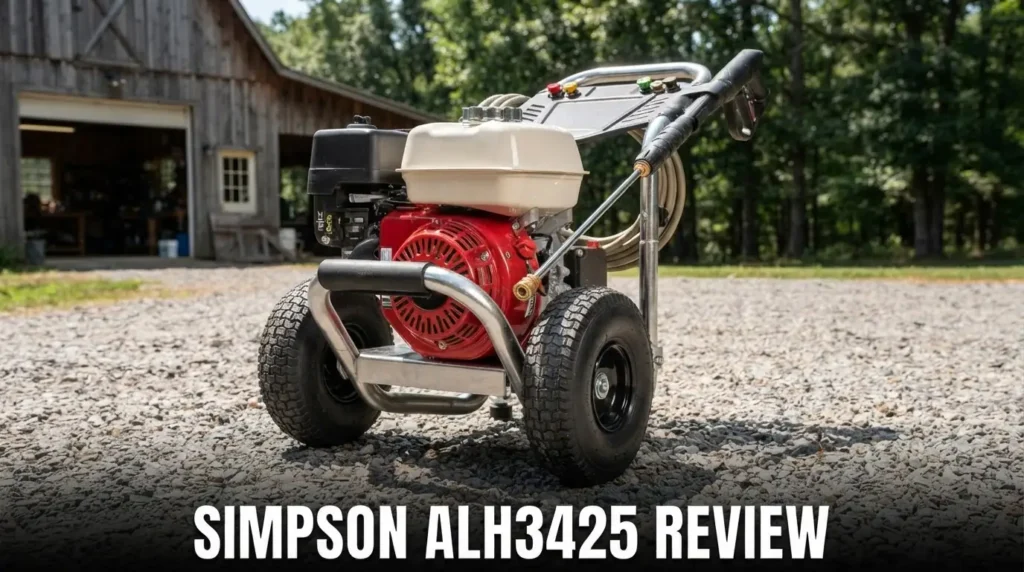

This Simpson ALH3425 review ends in a qualified yes: buy the Aluminum Series if you want a gas washer with a Honda GX200 engine and a 35-foot hose, rated 3600 PSI at 2.5 GPM by Simpson, and can handle a wheeled machine of 78 pounds, and skip it if you want a soap tank on the machine. My plant protection training taught me to read the label and the manual before any motor starts, and I did that here before I set the washer up and ran it in the open yard. Below you get the kit, the safety order, the soap hose, the care steps and the people who should pass.
Affiliate Disclosure: Garden Power Scout is a proud participant in the Amazon Services LLC Associates Program. As an Amazon Associate, we earn from qualifying purchases, at no extra cost to you.
Simpson ALH3425 Review: The Short Verdict
I recommend the Aluminum Series to a household that wants an engine-driven washer with a Honda GX200, a recoil start and a 35-foot hose, as Simpson prints them. Its main trade-offs are weight and soap: Simpson prints 78 pounds, and the soap comes from your own container through a siphon hose, as the manual describes. The rest of this page follows the order Simpson’s manual for this model family sets, from the first hose to the last drain. If you want to compare more engine-driven machines, my gas pressure washer picks set five side by side.
- Who it is for: a household that wants a Honda-powered gas washer rated 3600 PSI at 2.5 GPM by Simpson, and has open ground to run it and a dry place to keep it.
- What it does best: it pairs a 35-foot hose with an aluminum frame that Simpson calls aircraft grade, and a gun that Simpson says has a safety lock-out.
- Main trade-off: at 78 pounds, according to Simpson, it is too heavy for one person to lift, as the manual says, and the soap comes from your own container.
What the Simpson ALH3425 Aluminum Series Is
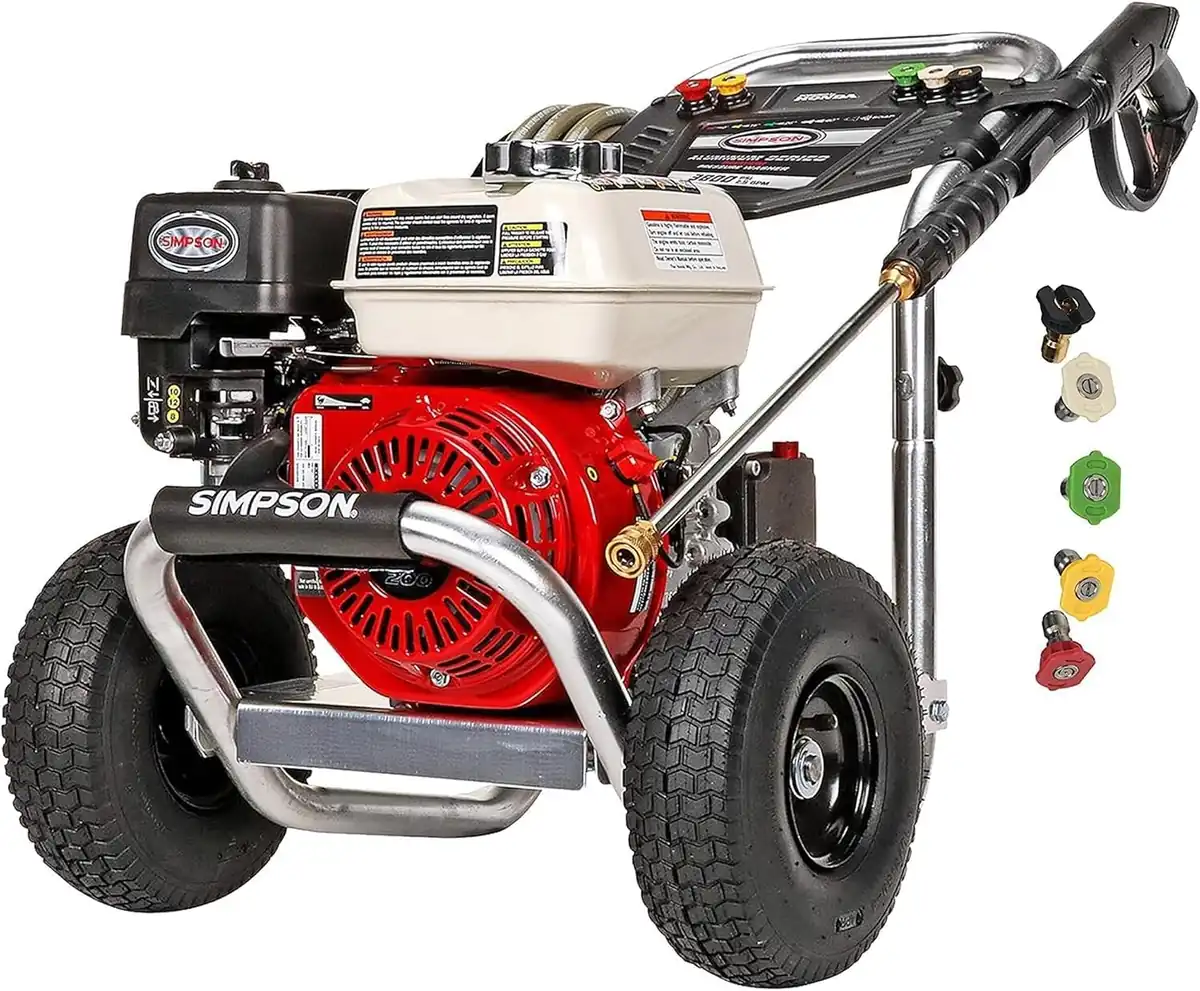
The Simpson Aluminum ALH3425 is a gas, cold-water washer on an aluminum tube frame, with a Honda GX200 engine, a recoil starter, 10-inch pneumatic wheels, a pump at the front and a 35-foot hose coiled on the frame. Simpson marks this version as 49-state compliant and not for sale in California.
According to Simpson, the engine is a Honda GX200 with a low oil shutdown feature, and the pump is an AAA triplex plunger pump with an integrated, adjustable unloader and a thermal relief valve. Simpson’s manual for this model family says to use cold water only.
The kit holds the washer, a rear-load gun that Simpson says has a safety lock-out, a 16-inch quick-connect lance, a siphon soap hose and five quick-connect nozzle tips, at 0, 15, 25 and 40 degrees plus a black soap tip, according to the product listing. Fuel is yours to supply.
Specs as Simpson Prints Them
Two rows decide whether the Simpson Cleaning ALH3425 fits your yard: the weight and the hose. Every figure below is Simpson’s own, with the maker’s basis word kept where it prints one.
| Spec | Simpson prints |
|---|---|
| Washer type | Gas (engine) cold-water pressure washer |
| Pressure rating, maker’s figure | 3600 PSI at 2.5 GPM |
| Water flow, maker’s figure | 2.5 GPM |
| Engine | Honda GX200 with recoil start; displacement Not listed |
| Hose | 35 feet, 5/16 inch, dual braided |
| Nozzles and soap | Five quick-connect tips (0, 15, 25 and 40 degrees and soap) on a 16-inch lance; siphon soap hose from your own container (manual) |
| Weight, maker’s figure | 78 pounds (basis not stated) |
| Size | 21 x 24 x 34 inches, as Simpson prints it |
| Warranty | Household term: Not listed. Manual’s commercial limited warranty: pump 5 years, frame 10 years, accessories 90 days, engine by the engine maker’s warranty (3 years on Simpson’s sheet) |
These are Simpson’s ratings for this model, not a promise about any job. Simpson’s manual for this model family also asks for a clean, cold water supply of at least 5 GPM at 20 PSI, so your tap and garden hose are part of the setup.
Safety and Setup Before the First Start
Read the pressure washer’s manual before you connect water or power, and follow it. Its warnings, its operator rules and its steps for your exact model come before anything in this article.
Every hands-on step on this page starts from one set of steps, so I wrote them once in the box below and point back to it whenever a task needs them.
Safe-State Box: Stop and Make Safe
Stop and make safe before you connect or disconnect a hose, change a nozzle, wand or accessory, clear a clogged nozzle, clean a filter, add detergent, refuel, check the oil, charge or change a battery, drain the washer, move it, store it or leave it. Release the trigger and engage the trigger lock on the spray gun. Gas washer: turn the engine off with its switch as the manual says and wait until all moving parts have stopped. Let the engine and the muffler cool for the time your manual gives before you refuel, store the washer or touch hot parts, and disconnect the spark plug wire before maintenance where your manual directs it. Every washer, after the steps above for your type: follow your manual’s water-supply shutdown and pressure-relief procedure. Point the gun away from people, pets and electrical equipment at a discharge location your manual and the detergent label permit. Disengage the trigger lock, squeeze the trigger to relieve the trapped pressure as the manual directs, then engage the lock again. Do not disconnect hoses or change nozzles before the pressure is relieved. If the manual’s procedure does not release the pressure, stop and get service; do not loosen a fitting to release it. Only then disconnect hoses or change nozzles. Where your manual gives a different order for these steps, follow your manual’s order. Follow every applicable step in your manual, in the order it specifies, and check that every hose, fitting and nozzle is attached and undamaged before water or power goes back on.
Simpson’s manual for this model family gives its own order for shutting this washer down, and that order takes precedence for this machine: engage the trigger lock, set the throttle to slow if the machine has one, turn the engine switch off, turn the fuel valve off if it has one, turn the water supply off, then release the trigger lock and squeeze the trigger to relieve the pressure in the hose and pump, and engage the trigger lock again as the box says.
Simpson says turning off the water with the engine running damages the pump, and it says to let the engine cool completely before handling, moving or storing the washer. It also says to disconnect the spark plug wire, let the engine cool and release all water pressure before any maintenance or repair.
Protective Equipment, Spray and Footing
Wear safety glasses or goggles and closed footwear when you operate the washer, and put them on before you start; where your manual requires goggles, side shields or a face shield, that requirement replaces the minimum here. Follow the manual’s additional protective-equipment requirements, including hearing protection where the manual requires it, and the detergent label’s requirements when you handle detergent. Keep your hands and feet away from the spray. Protective equipment does not make contact with the stream safe.
The manual for this model family lists four items to use at all times: ear plugs or muffs, ANSI-approved Z87.1 safety glasses or goggles, long pants with a long-sleeved shirt, and rubber-soled shoes that fully cover your feet. A NIOSH field study of landscaping crews found that fuel-powered outdoor tools exposed operators to more noise than battery tools did (1). An emergency department case series describes open-eye injuries with permanent vision loss after pressure washer use (2).
Never point the spray at yourself, another person, a pet or any part of the body. Keep your hands and feet away from the nozzle and the stream. Get medical care without delay for a spray wound, even if it looks minor at first. Tell the clinician that a pressure washer caused the injury.
Simpson’s manual says not to treat fluid injection as a simple cut and to see a physician immediately. A case report describes a pressure washer jet injecting water into a hand (3). Another describes a finger injured at close range with no fracture on X-ray that still needed emergency surgery (4).
Engage the trigger lock on the spray gun whenever you stop spraying, even for a moment, before you set the gun down, and before you walk away or change position. Disengage the lock only for controlled spraying or for the manual’s pressure-relief procedure, with the gun pointed in a safe direction. Simpson’s manual says to secure the lock whenever the gun is not in use and never to secure the trigger permanently in the pulled-back, open position.
Hold and brace the spray gun as your manual instructs, keep firm footing on a surface that is not slippery, and follow your manual’s warning about the push of the gun when you squeeze the trigger. Start the stream away from your feet and from anyone else, and never swing the gun toward people or pets as you turn. Simpson’s manual says to grip the gun and lance firmly with both hands, to expect the gun to kick back when triggered and not to overreach or stand on an unstable surface. It also says not to use the pressure washer while standing on a ladder.
Keep children, pets and other people away from the work area while the machine runs, and never let a child use the machine. Store the washer and its fuel where children cannot reach them. Simpson’s manual says that only someone who has read the owner’s manual should operate the washer, never anyone tired or under the influence of drugs or alcohol, and that you turn the washer off before you leave the area.
If someone is hit by the stream, get medical care without delay, even if the wound looks small. Anyone who swallows a cleaning product or gets it in the eyes needs the label’s first-aid section, so follow the label’s first-aid section and call Poison Control (America’s Poison Centers) at 1-800-222-1222. Call 911 for a fire or immediate danger.
Gas Exhaust, Fuel and Hot Parts
Operate a gas pressure washer outdoors, never inside a building or a partly enclosed space. CDC says to keep it at least 20 feet from any window, door or vent, and your manual may set a stricter placement, which you follow. Engine exhaust contains carbon monoxide, which you cannot see or smell and which can kill.
Opening a door or a window does not make it safe to run an engine inside. If anyone develops symptoms such as headache, dizziness, weakness, nausea or confusion, move to fresh air and get emergency medical care. A medical examiner’s review of fatal carbon monoxide cases tied to small engines, one of them a pressure washer, found the deaths in poorly ventilated spaces (5).
On the same point, Simpson’s manual for this model family adds that you never run the washer inside a house, garage or any enclosure even with doors and windows open, that you consider wind direction and air currents, and that you keep all flammable materials at least five feet away from all sides of the product.
Before you refuel, complete the applicable stop and make-safe steps in the safe-state box, including letting the engine cool as the manual directs. Add only the fuel and oil the manual names, keep fuel away from flame and sparks, and wipe up spilled fuel before you start the engine. The engine and the muffler stay hot after the engine stops, so keep your hands, skin and clothing away from them.
The manual says to refuel outdoors in a well-ventilated area with the engine stopped and cool, to wipe up spilled gasoline and let the engine dry before starting, to keep a fire extinguisher handy while refueling and not to run the engine with leaks in the fuel system. It calls for clean, fresh regular unleaded gasoline of at least 87 octane, no older than 30 days and with no more than 10% ethyl alcohol, and it says not to mix oil into the gasoline. E15, E20 and E85 are not approved, and fuel system cleaning additives can damage the engine.
Connecting Water and Starting the Engine
Before you inspect parts or connect hoses, complete the applicable stop and make-safe steps in the safe-state box. Inspect the high-pressure hose, the spray gun and every fitting before each use, as your manual describes, and do not use a damaged part. Replace a damaged high-pressure hose; never repair or patch it. Connect the hoses and turn on the water before you start the machine, and purge and start it in the order your manual specifies.
Simpson’s manual for this model family sets that order. It tells you to check the engine oil level before each use, as the engine manual describes. Check the inlet screen with its convex side facing out, run the garden hose for 30 seconds to purge debris before you thread it onto the pump inlet, and connect each hose end the way its fitting is made. The manual shows two ways: thread the connector on, or pull back the collar, insert the connector, release the collar and tug the hose gently to make sure it is locked.
Then aim the gun in a safe direction and hold the trigger for at least 30 seconds until the water runs steady and the air is purged. Check hoses and connections for leaks and engage the trigger lock.
Simpson says never to attach or remove wand or hose fittings while the system is pressurized, never to thread the lance directly onto the high-pressure hose, never to use hot water and that running the pump without water severely damages the seals and internal parts.
I seated the inlet screen with the convex side out and flushed the garden hose for the 30 seconds Simpson asks for, and I did both before I threaded the hose onto the pump inlet. I started the engine in the open yard, well beyond 20 feet from any door, window or vent, with the choke closed for a cold start.
I pulled slowly until I felt resistance and then pulled fast, as the manual says, and I returned the starter grip gently by hand so it could not snap back. Simpson warns that the recoil cord can pull your hand and arm toward the engine faster than you can let go. Simpson then says to warm the engine for one to two minutes, occasionally pulling the spray gun trigger so water flows through the pump and the pump does not overheat.
The manual sets two limits I kept in mind while the engine ran. More than two minutes without pulling the trigger overheats the pump, and the thermal relief valve then opens and sprays water, which Simpson says never to tamper with; it says to shut off the engine if the washer is not in use for longer than two minutes. If the engine does not start after two pulls, Simpson says to squeeze the gun trigger to release stored pressure, with the gun aimed in a safe direction.
Soap, Nozzles and the Siphon Hose
The ALH3425 takes its soap through a hose from your own container, so the tips and the hose are the two parts to learn, and both start with the safe-state steps.
Use only the nozzles and accessories your manual permits, following its instructions for the job. Never direct any nozzle at skin, people or animals. Before you change a nozzle, complete the stop and make-safe steps in the safe-state box. Simpson’s manual adds that the trigger lock must be engaged before a nozzle comes off or goes on.
To fit a tip, Simpson says to pull the quick-connect coupler back, insert the nozzle, let the coupler snap back and then pull on the nozzle to make sure it is secure. After the safe-state steps, I seated each tip that way and gave it the tug the manual asks for. Simpson’s manual warns that high-pressure spray can damage plants and surfaces such as wood, glass, automobile paint and trim, and delicate objects.
Check both your washer’s manual and the care instructions of the surface or finish maker before you wash, and follow their restrictions. If they prohibit pressure washing, do not use a different nozzle or setting as a workaround.
Before you add detergent or connect or adjust a detergent accessory, complete the applicable stop and make-safe steps in the safe-state box. Use only the detergents your manual allows, through the detergent system the manual describes, and read the detergent label before you open it. Wear the protective equipment the detergent label requires, and avoid contact of detergent with your eyes and skin. Do not run a detergent that your manual does not name through the pump.
Simpson’s manual says to use only approved soaps and chemicals, never bleach and never volatile, flammable or corrosive liquids. For this machine, the manual says to attach the open end of the soap hose to the barbed fitting on the pump, put the filtered end into a container of soap and fit the black soap nozzle on the wand, because soap does not siphon without it. I ran those steps in that order, and the black tip is the part I check first now.
Before you move the filtered end of the soap hose, complete the stop and make-safe steps in the safe-state box. Then Simpson says to put the filtered end of the hose in clean water, restart the washer in the order above and run it until the system is thoroughly rinsed. It warns that soap or chemical residue can damage the pump and that this damage is not covered by the warranty.
Before you wash, plan how to keep wash water, detergent and debris out of streets, storm drains, ditches and streams, because a storm drain carries what enters it to local waters without treatment. Check with your city or county stormwater office about collecting and disposing of the wash water for the job. Send wash water to landscaping only where local rules and the detergent label permit it and the soil can absorb it without runoff or contamination. Otherwise contain and collect it for an approved disposal route. Do not assume that water carrying oil, paint debris, pesticide residue or material from an old treated deck is suitable for a lawn.
Living With a 78 Pound Gas Washer
Simpson prints the weight at 78 pounds and does not say what the figure includes. The manual is direct about the practical side: the washer is too heavy for one person to lift, so get help before you lift it. I walked the 35-foot hose out to its full length and back before the first start and looked along it for damage, as the manual’s check before each use asks.
Before you move, drain or store the washer, complete the stop and make-safe steps in the safe-state box. Simpson says to keep the washer upright and level when you move it. For transport it says to turn the fuel shut-off valve to off if the washer has one and otherwise to drain the tank, to carry fuel only in an OSHA-approved container and to set the washer on a protective mat in the vehicle.
Simpson warns that fuel can vaporize in an enclosed space where temperatures rise, so secure the washer in a well-ventilated place out of direct sunlight and heat, do not transport it on rough roads unless the fuel has been drained, and take it out of the vehicle as soon as you arrive. On the gravel yard I let the 10-inch pneumatic wheels do the carrying, and I asked for a second pair of hands for every lift.
Before you store the pressure washer, complete the stop and make-safe steps in the safe-state box. Drain and store it as your manual directs, in a place the manual allows and away from children. Store fuel as the manual and the fuel container’s label describe.
Per the manual, store the washer in a clean, dry area out of direct sunlight, and never cover it during operation or directly after use. For freezing weather, it says that water left in the pump causes severe damage and that you should treat the pump with a pump protector the manual names, which is a separate purchase. If your shed freezes, I put that purchase on the list before the first cold snap.
Care and Maintenance
Upkeep on this washer is short, and Simpson’s manual puts a stop in front of every job.
Before you clean the machine, check or clean the inlet filter, or do any other maintenance, complete the stop and make-safe steps in the safe-state box. Do the maintenance your manual describes, in the order it describes it, and do not use a part or an accessory the maker does not name.
Simpson’s manual says to check the inlet filter before each use, to clear nozzles with the supplied cleaning tool and to put a thin film of lithium grease on the hose, gun and pump connections regularly. It sends you to the engine manual for engine care and oil, and it lists oil changes for AAA pumps, which you follow as the manual prints them. Simpson says never to repair a high-pressure hose, to use only accessories and replacement parts rated equal to or higher than the washer, and not to use a lance or lance and gun combination shorter than the one provided. I checked the inlet filter before each run and greased the three connections the way the manual describes.
Who Should Buy It and Who Should Skip It
Buy the Simpson ALH3425 if the first list below describes your yard, and skip it if the second one does.
- Buy it if you want a Honda-powered gas washer with a recoil start and wheels.
- Buy it if you can run an engine outdoors, more than 20 feet from any window, door or vent, and keep a fire extinguisher handy for refueling.
- Buy it if you will follow Simpson’s order for start-up, shutdown and care every time, and are content to draw soap from your own container.
- Skip it if you want a soap tank on the machine.
- Skip it if nobody can help you lift it.
- Skip it if you live in California, because this version is marked not for sale there.
- Skip it if your shed freezes and you will not buy the pump protector the manual names.
Drawbacks to Know
The real drawbacks of this Simpson ALH3425 pressure washer are about size, soap, warranty and storage, and each has a workaround.
The machine is heavy and wide. It measures 21 x 24 x 34 inches as Simpson prints it, so plan a rolling path for the wheels and a clear space in the shed for the frame and the coiled hose. The black soap tip must be fitted or nothing siphons.
The fuel rules are strict, and the engine has its own manual. For oil and other engine details, follow the engine manual. Simpson’s fuel rules: gasoline no older than 30 days, no more than 10% ethyl alcohol and no fuel system cleaning additives.
The warranty in the manual is a commercial one. Simpson’s manual prints a commercial limited warranty, with the pump at 5 years, the frame at 10 years, accessories at 90 days and the engine under the engine maker’s warranty, and it prints no household term. Read that warranty page before you buy, and plan for the pump protector if freezing weather is possible, since Simpson says freezing damage to the pump is not covered.
How It Compares With Alternatives
Two other gas washers show the choices around the Aluminum Series. I compare them by what each maker prints, and I do not rank one maker’s pressure or flow against another’s.
Westinghouse WPX3400

The Westinghouse WPX3400 3400 PSI Gas Pressure Washer with Soap Tank is rated 3400 PSI and 2.6 GPM, according to Westinghouse, with a 212 cc engine and a soap tank on the machine that holds 0.42 gallons. Pick that one if a built-in soap tank matters more to you than the longer hose of the ALH3425. My page on Simpson against Westinghouse washers sets the ALH3425 and the WPX3400 side by side.
Simpson PowerShot PS61002
The Simpson PowerShot PS61002 3500 PSI Honda GX200 Gas Pressure Washer is rated 3500 PSI at 2.5 GPM, according to Simpson, with a Honda GX200 engine, a 25-foot hose and a steel frame. Pick that one if a steel frame and a shorter hose suit your storage better; it uses a siphon soap hose like the ALH3425.
| Row | Simpson ALH3425 | Westinghouse WPX3400 | Simpson PS61002 |
|---|---|---|---|
| Pressure and flow, maker’s figures | 3600 PSI at 2.5 GPM | 3400 PSI, 2.6 GPM | 3500 PSI at 2.5 GPM |
| Engine | Honda GX200 | 212 cc | Honda GX200 |
| High-pressure hose | 35 feet | 25 feet | 25 feet |
| Frame | Aluminum | Not listed | Steel |
| Soap system | Siphon hose | Onboard tank, 0.42 gallons | Siphon hose |
Common Problems and What Simpson’s Manual Says
Most trouble with a gas washer starts at the pump, the nozzle or the engine, and in each case the first move is to stop and make safe.
A leak at a hose or fitting. Complete the stop and make-safe steps in the safe-state box before you inspect anything. Simpson’s manual says to turn off the machine, aim the gun in a safe direction, squeeze the trigger to relieve built-up pressure and never touch a leak in a high-pressure hose or fitting. The manual says to tighten loose hose connections or replace damaged hoses immediately, and never to repair a high-pressure hose. Resume only when you have found the cause, replaced any damaged hose, handled other damage as the manual allows or through service, and met the manual’s restart conditions.
A weak, uneven or pulsing stream. A nozzle that gives a weak, uneven or pulsing stream may be blocked, and Simpson’s table lists an obstructed nozzle as the cause of a pulsating pump or nozzle. Complete the stop and make-safe steps in the safe-state box, then clear the nozzle only with the tool and the method your manual describes. Never look into the nozzle or point it at anyone to check it.
Water at the pump area. One cause is the thermal relief valve opening after the pump ran more than two minutes without the trigger pulled. Complete the stop and make-safe steps in the safe-state box before you inspect, never tamper with the valve, and do not restart until the cause is found and any damage is repaired or serviced.
Soap that will not draw. Simpson’s table lists several causes: the black soap nozzle is not on the wand, the detergent filter is clogged or not fully submerged, or the detergent is too thick. Complete the stop and make-safe steps in the safe-state box before you check any of them.
My Final Verdict on the Simpson ALH3425
I recommend the Aluminum Series to a household with open ground to run an engine and a dry place to store it. The Honda engine, the 35-foot hose and the quick-connect tips make it a plain, workable gas washer for that household. Skip it if you want a soap tank on the machine, if nobody can help you lift it, or if your shed freezes and you will not buy the pump protector, and treat the safe-state box as part of the machine, because every hose, nozzle and soap job here starts with it. That is where my Simpson ALH3425 review lands: a clear yes for a household that follows Simpson’s order every time. For driveway work, my best pressure washer for driveways roundup compares nine gas and electric models.
Frequently Asked Questions
What is the Simpson ALH3425?
The Simpson ALH3425 is a gas, cold-water pressure washer from Simpson’s Aluminum Series, rated 3600 PSI at 2.5 GPM by Simpson. It has a Honda GX200 engine, a recoil starter, an aluminum frame and a 35-foot MorFlex hose, and Simpson marks this 49-state version as not for sale in California.
What engine does the Simpson ALH3425 have?
The Simpson ALH3425 has a Honda GX200 engine with a recoil starter and a low oil shutdown feature, according to Simpson, and the washer’s manual gives no displacement for it. Before you refuel or check the oil, complete the stop and make-safe steps in the safe-state box above, then follow the engine manual for its oil type.
How long is the hose on the Simpson ALH3425?
The hose on the Simpson ALH3425 is a 35-foot MorFlex high-pressure hose with a 5/16-inch diameter, according to Simpson. Before you connect or disconnect it, complete the stop and make-safe steps in the safe-state box above, and never try to repair a damaged high-pressure hose, because Simpson’s manual forbids it.
What is the frame of the Simpson ALH3425 made of?
The frame of the Simpson ALH3425 is aluminum, which Simpson calls aircraft grade, and it rolls on two 10-inch pneumatic wheels. Simpson prints the weight at 78 pounds without saying what that includes, and its manual says the washer is too heavy for one person to lift, so get help.
What nozzles come with the Simpson ALH3425?
The Simpson ALH3425 comes with five quick-connect nozzle tips, at 0, 15, 25 and 40 degrees plus a black soap tip, according to the product listing. Before you change a nozzle, complete the stop and make-safe steps in the safe-state box above, then follow Simpson’s manual for the quick-connect coupler.
References
- Alexander BM, Graydon PS, Pena M, Feng HA, Beamer BR. Hazardous exposures and engineering controls in the landscaping services industry. J Occup Environ Hyg. 2025;22(3):189-202. doi:10.1080/15459624.2024.2439810
- Placide J, Yang MY, Gross AW, Crowell EL. Case series: traumatic ocular lacerations secondary to pressure washers. Am J Ophthalmol Case Rep. 2022;27:101612. doi:10.1016/j.ajoc.2022.101612
- Funato N, Sugizaki Y, Ri Y, Ichibayashi R. High-pressure injection damage caused by a high-pressure washer. Cureus. 2024;16(1):e52498. doi:10.7759/cureus.52498
- Choi JH, Choi SY, Hwang JH, Kim KS, Lee SY. Finger compartment syndrome due to a high-pressure washer injury: a case report. World J Clin Cases. 2023;11(13):3017-3021. doi:10.12998/wjcc.v11.i13.3017
- Hyson BE, Friedman BM, Spear B, Bishop-Freeman SC. Lethal carbon monoxide generated from small internal combustion engines. J Anal Toxicol. 2024;48(8):625-629.
Safety Note: Read your pressure washer’s manual before you connect water or power, and follow it. Never point the spray at yourself, another person, a pet or any part of the body. Keep hands and feet away from the nozzle and stream. Get medical care without delay for a spray wound, even if it looks minor at first. Tell the clinician that a pressure washer caused the injury. Wear safety glasses or goggles and closed footwear before operating the washer, plus any additional protection required by the manual and the detergent label. Follow the manual’s instructions for the trigger lock, grip, footing and recoil, and engage the trigger lock whenever you stop spraying. Use only the nozzles, accessories and detergents the manual permits, and never point any nozzle at skin, people or animals. Do not perform a task at height without instructions expressly permitting the equipment and method in the exact manual. Gas models: operate outdoors, never inside a building or a partly enclosed space. Keep the engine at least 20 feet from any window, door or vent, following CDC’s pressure washer guidance and any stricter manual requirement. Exhaust contains carbon monoxide, which cannot be seen or smelled and can kill. Opening doors or windows does not make indoor operation safe. Refuel only with the engine off and cool, following the manual. Corded models: use the manual’s specified electrical supply and GFCI protection, and test the GFCI before use according to its instructions. After an operating GFCI or breaker trip, do not reuse the washer until a qualified repair person has examined it. Where the washer has a grounding prong, connect it to a properly grounded receptacle and never remove the prong. Wear closed, rubber-soled footwear that provides some electrical insulation, plus any additional footwear required by the manual; footwear does not replace GFCI protection or the other electrical precautions. Never cut or splice cords. Use an extension cord only as the manual permits. Keep connections dry and away from runoff, standing water and the washing area, and keep spray away from electrical equipment. Battery models: use only the battery and charger the maker specifies for your exact model. Emergency first: if you notice an unusual odor, a change in color, too much heat, a change in shape, leaking or odd noises from a lithium-ion battery, stop using the washer and follow your battery manual’s emergency instructions. Otherwise, complete the applicable stop and make-safe procedure before hose, nozzle, wand or accessory work, clearing a blockage, cleaning, maintenance, refueling, checking oil, adding detergent, battery changes or charging, draining, moving, transporting, storing or leaving the washer. Follow your exact manual’s procedure and order. Release the trigger and engage its lock. Gas: switch the engine off and wait for it to stop; disconnect the spark plug wire before service as the manual directs, and let hot parts cool before refueling, storage or contact. Corded: switch off and unplug by the plug with dry hands. Battery: switch off, remove a removable battery as the manual directs and keep it away while working; for a built-in battery, follow the manual’s isolation procedure and do not open the battery compartment. Complete the manual’s water-supply shutdown and pressure-relief steps: point the gun in a safe direction at a permitted discharge location, disengage the trigger lock, squeeze the trigger as directed to relieve pressure, then reengage the lock. Do not disconnect hoses or change nozzles until pressure is relieved. If pressure cannot be relieved by the prescribed procedure, obtain service without loosening fittings. Refit and inspect parts before restoring water or power. Replace a damaged high-pressure hose; never repair or patch it. Before you wash, plan how to keep wash water, detergent and debris out of streets, storm drains, ditches and streams, and check with your city or county stormwater office about collection and disposal. Send wash water to landscaping only where local rules and the detergent label permit it and the soil can absorb it without runoff or contamination. Keep children and pets away, and never let a child use the machine. Drain and store the washer as its manual directs. For exposure to a cleaning product, follow the label’s first-aid instructions and call Poison Control at 1-800-222-1222. Call 911 for a fire or immediate danger.