
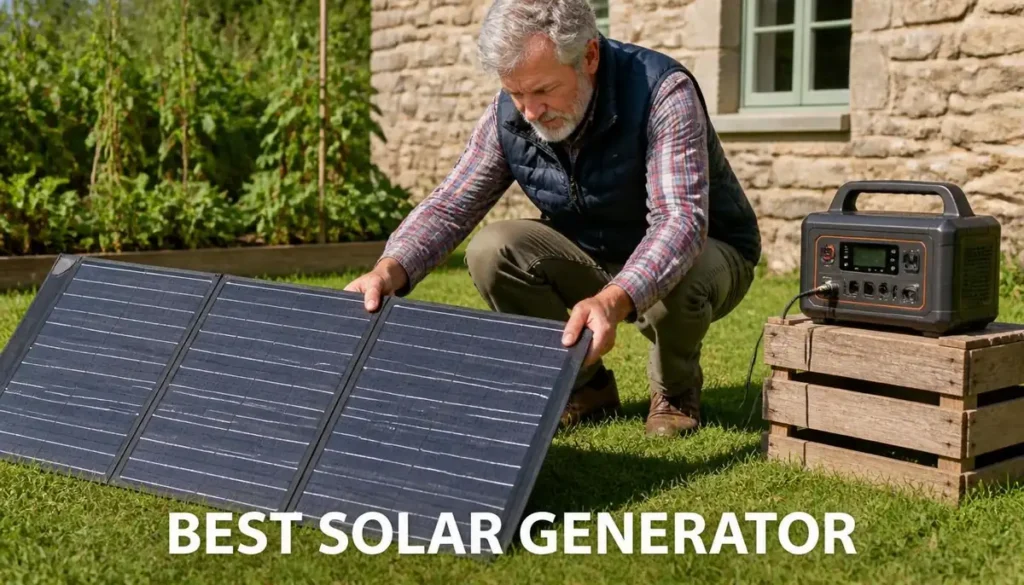
The best solar generator on this page is the Anker SOLIX F3800 Plus, a power station with two solar inputs of up to 1,600 W each and panels you add. I match panels to a station’s printed solar window before I look at its capacity, and the other six stations suit smaller or different setups.
Affiliate Disclosure: Garden Power Scout is a proud participant in the Amazon Services LLC Associates Program. As an Amazon Associate, we earn from qualifying purchases, at no extra cost to you.
All seven listings are the station only, with no panel in the box. My top pick, Anker SOLIX F3800 Plus 3840Wh Portable Power Station, ships with two solar charging cables.
Best Solar Generator 2026: 7 Power Stations for Different Solar Setups
The F3800 Plus leads for a large array, the Jackery for a dry indoor room and a high-voltage string, and the C2000 Gen 2 for one modest panel. Weight and price tier move the lower ranks.
1. Anker SOLIX F3800 Plus 3840Wh Portable Power Station Best Overall
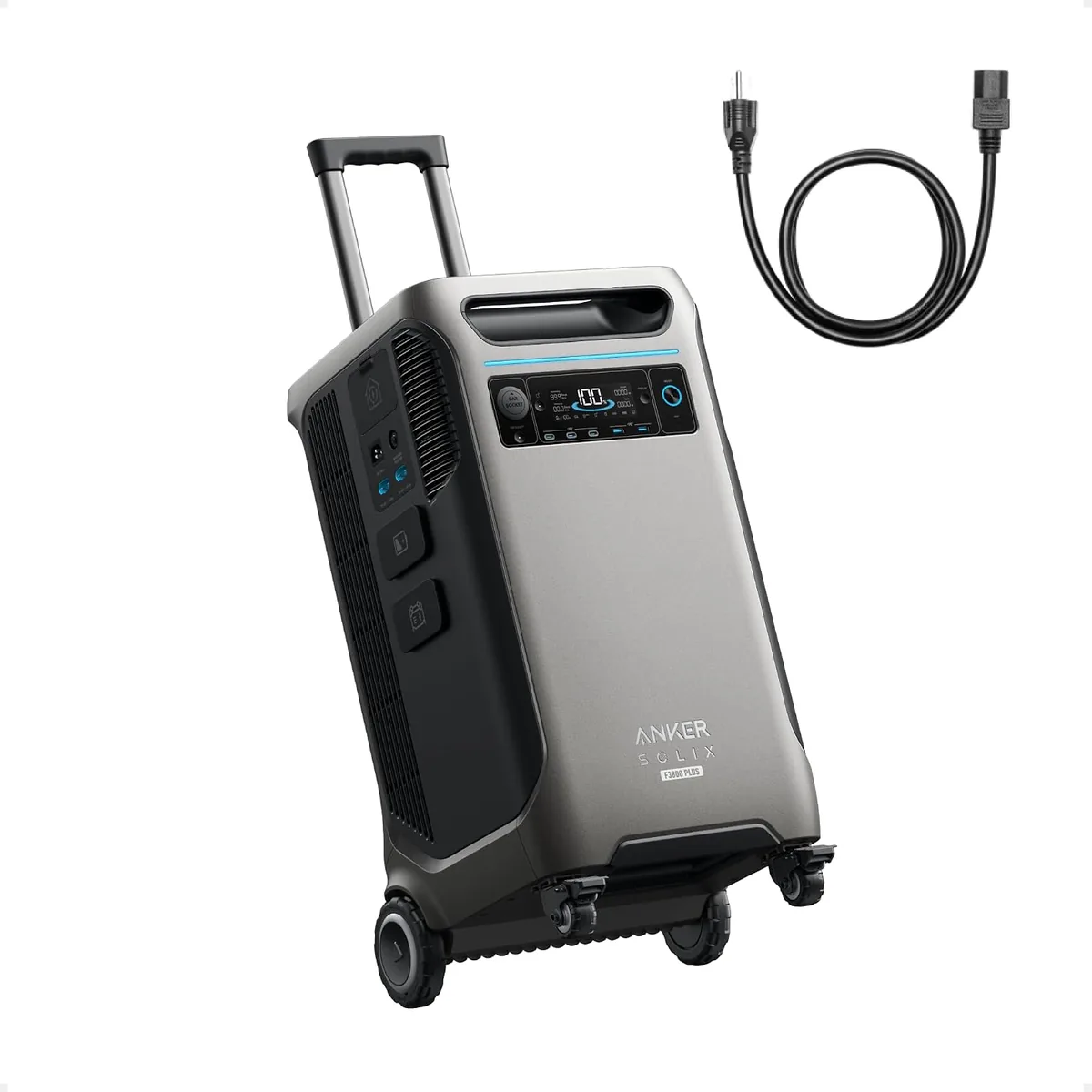
The Anker SOLIX F3800 Plus has two solar inputs, each rated 11 to 165V, 17A and 1,600 W, and Anker’s US product page lists dual MPPT. The station is sold alone: the box holds two solar charging cables and no panel. That makes it the pick for a buyer who plans a large array and wants a wide voltage window to choose panels from.
WHY I CHOSE THIS ✓
I put this station first because it offers two inputs of 11 to 165V and 1,600 W each, with two solar cables in the box. A wide window leaves room for more than one panel design, and that choice of panels is why it ranks first.
Anker SOLIX F3800 Plus 3840Wh Portable Power Station Specs
Key Features:
- Two solar inputs: Each takes 11 to 165V at up to 17A and 1,600 W, so two panel strings can feed the station at once.
- 3,200 W maximum solar: The guide prints 3,200 W as the total solar input.
- Two solar cables in the box: The packing list holds the station, an AC charging cable, two solar charging cables, the manual and a warranty card, and no panel.
- A printed voltage ceiling: The guide says voltage above 165V will damage the product.
- A printed current note: Above 17A on an input, the guide says the panel’s output power cannot be fully used.
- A cell-temperature charging table: The guide lists charging power by input mode and cell temperature, down to 760 W at 32 to 50 F (0 to 10 C).
- Wheels and a retractable handle: At 135.6 lb (61.5 kg) the wheels do the moving, and BP3800 expansion batteries, sold separately, raise capacity to 26,880 Wh.
Anker’s guide says the total solar voltage must stay inside 11 to 165V and that voltage above 165V will damage the product. It also says that above 17A on an input the panel’s output power cannot be fully used, and that parallel wiring takes the Solar Parallel Connection Connector, which Anker sells separately. Series and parallel wiring appear as diagrams in the guide. Anker’s US product page describes the two inputs as dual MPPT across 11 to 165V.
The guide’s charging table is by cell temperature and by input mode. At 59 to 122 F (15 to 50 C) it lists 1,800 W from AC alone and 3,300 W from AC and solar combined. At 50 to 59 F (10 to 15 C) it lists 1,800 W from AC and 2,000 W combined, and at 32 to 50 F (0 to 10 C) it lists 760 W for both. The charging temperature on the spec page, 32 to 104 F (0 to 40 C), is a separate limit.
The guide names Anker’s own portable solar panels once, to say their packages include 10 ft (3 m) extension cables, and it lists a Double Power Hub that links two F3800 Plus stations for up to 12,000 W of output. At 135.6 lb the unit needs its wheels, and I weigh that against the gravel yard between my sheds and the house before I choose where it lives. By default the AC outlets switch off after 15 minutes with no plug detected, and the unit powers off after 12 hours with no load and the outputs off.
Anker’s guide rates each input at up to 17A and says that total solar voltage above 165V damages the product.
The guide gives no tolerance on its voltage line: 165V is the ceiling for the total solar voltage, and the damage wording is Anker’s. Its discharging range is -4 to 104 F (-20 to 40 C), wider at the cold end than the 32 to 104 F (0 to 40 C) charging range.
Anker’s guide says to keep the station in a dry and cool place and to check the remaining charge each week while it sits, charging fully when it falls below 30 percent. The outputs have their own limits: two groups of three NEMA 5-20R outlets at 2,400 W per group, one TT-30R at 3,000 W and 25A, and one L14-30R at 120V/240V, 25A and 6,000 W, all inside the 6,000 W total. The three left-hand 5-20R outlets carry a 20 ms UPS function, and while the station recharges from 120V the guide says only those three 120V UPS outlets can be used. The guide lists the locked rotor current as 80A and prints no surge rating.
I count the 135.6 lb as part of the price of this station. Pick it if you plan a large array and can give a 135.6 lb unit a place on level ground. Anker’s US product page lists a five-year warranty, and the guide’s 27.6 by 15.3 by 15.6 in size means a car trunk needs measuring first. Skip it if one person has to lift it into a vehicle.
FINAL VERDICT
Choose the F3800 Plus when your array is big enough to use two separately rated inputs. The premium tier and the 135.6 lb weight are the cost of that room.
It is the station for a large array.
2. Jackery Explorer 5000 Plus 5040Wh Power Station Best Premium
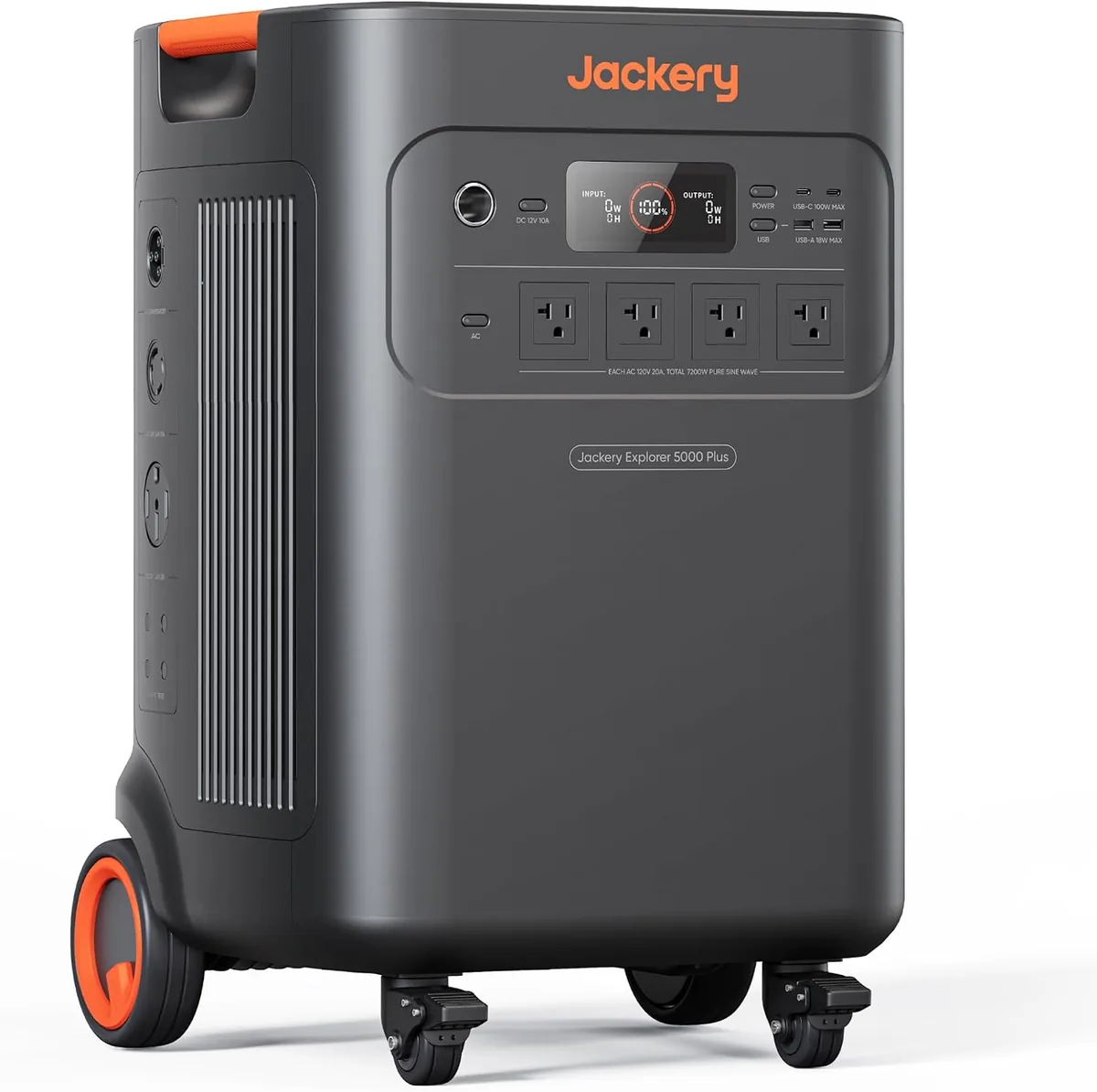
The Jackery Explorer 5000 Plus is the only station on this page with two different kinds of solar input: one High-PV port for a total greater than 135V and less than 450V, and two Low-PV ports for a total greater than 16V and less than 60V. It holds 5,040 Wh and ships with a wrench for the MC4 connectors but no panel and no solar cable. Jackery’s manual limits the station to indoor use, with the panels outside.
WHY I CHOSE THIS ✓
I rank this station second because it is the only one here with a High-PV input printed as greater than 135V and less than 450V, and it gives the most capacity to put solar into: 5,040 Wh. The indoor-only rule is a real limit, and I accept it because the panels can do the outdoor work.
Jackery Explorer 5000 Plus 5040Wh Power Station Specs
Key Features:
- High-PV input: One MC4 input takes a total solar input greater than 135V and less than 450V at up to 15A, built for panel strings with a high total voltage.
- Low-PV inputs: Two 8mm DC ports take a total greater than 16V and less than 60V at up to 10.5A each, with 1,200 W as the combined maximum. The manual lists a separate 11 to 16V working condition at 8A, which stays 8A even with both ports combined.
- A printed single-panel rating: Each Low-PV port supports direct connection of one 500W panel. For several panels on one port, the manual specifies a solar panel connector that is sold separately.
- One panel type on both inputs: When both inputs run together, the manual says to use the same type and number of panels on each, to avoid damage or charging problems.
- A High-PV switch: The manual says to keep the High-PV switch off while connecting the High-PV input or during maintenance, and to set it to OFF or LOCK before using the MC4 wrench on the connectors.
- 5,040 Wh with expansion: Battery packs, up to five, are listed in the manual as the way to add capacity.
- A cycle rating with its basis: Jackery prints 4,000 cycles to 70% or more capacity, and the 70% is the basis the number rests on.
The two input types suit a particular kind of array. The manual words the High-PV limit as 135V < total solar input < 450V at 15A and the Low-PV limit as 16V < total solar input < 60V, and both limits are strict inequalities, so the endpoints themselves are not inside the window. Series strings fall under the same caution: the maximum voltage output of all panels must stay inside the window of the port they feed.
Two lines in the manual stay with me from the solar pages. When both inputs run at the same time, the manual says to use the same type and the same number of panels on each. The box holds the station, an AC charging cable, the MC4 wrench and the manual, so every solar cable and every panel is a separate purchase.
Placement decides whether this station works for your yard. The manual’s danger line says the device is for indoor use only, with examples such as an RV, a tent or an off-grid cabin, and says not to use it outdoors under any circumstances, including where rain or snow reaches it. It also says not to use or store it in a dusty or wet environment. My machinery shed collects chaff and pruning sawdust, so that shed is the wrong spot by Jackery’s own wording, and a dry room in the house is the place I plan around, with the panels outside on the shed roof side.
Jackery’s manual puts dust and wet conditions outside the unit’s environment: its danger line names rain and snow, and a separate line rules out a bathroom or an area exposed to rain or moisture.
Jackery’s manual says the charging range is 32 to 113 F (0 to 45 C), and outside that range the unit may restrict charging and discharging, or be unable to do either. Solar charge times, it adds, depend on weather and on how much direct sunlight the panel gets.
Warranty terms come with a condition: Jackery’s US product page lists 5 years and adds that the five-year warranty is available exclusively when you buy directly from Jackery.com, while the manual gives 5 years standard, with 2 more through a paid extension, for buyers from its official website, Jackery-branded third-party platforms or local authorized dealers. The weight is 134.5 lb, and the manual’s size is 16.5 by 15.5 by 25 in. Between 5 and 14 F (-15 and -10 C) the manual says maximum output falls to 3,600 W, and the backup UPS is on by default at 20 ms. The 14,400 W surge figure is a short peak and does not show that a motor will start.
Plan this station around a dry indoor room, because Jackery’s manual limits it to indoor use, with the panels outside and a high-voltage array in mind. Skip it if the station would have to live in a shed, a porch or a trailer exposed to weather, or if the listing’s seller is not one the warranty accepts.
FINAL VERDICT
The Explorer 5000 Plus is the high-voltage, high-capacity pick, and the indoor-only rule decides whether it fits your property. Where a dry room exists, it takes a large array.
It is the indoor station for a high-voltage array.
3. Anker SOLIX C2000 Gen 2 2048Wh Portable Power Station Best Value
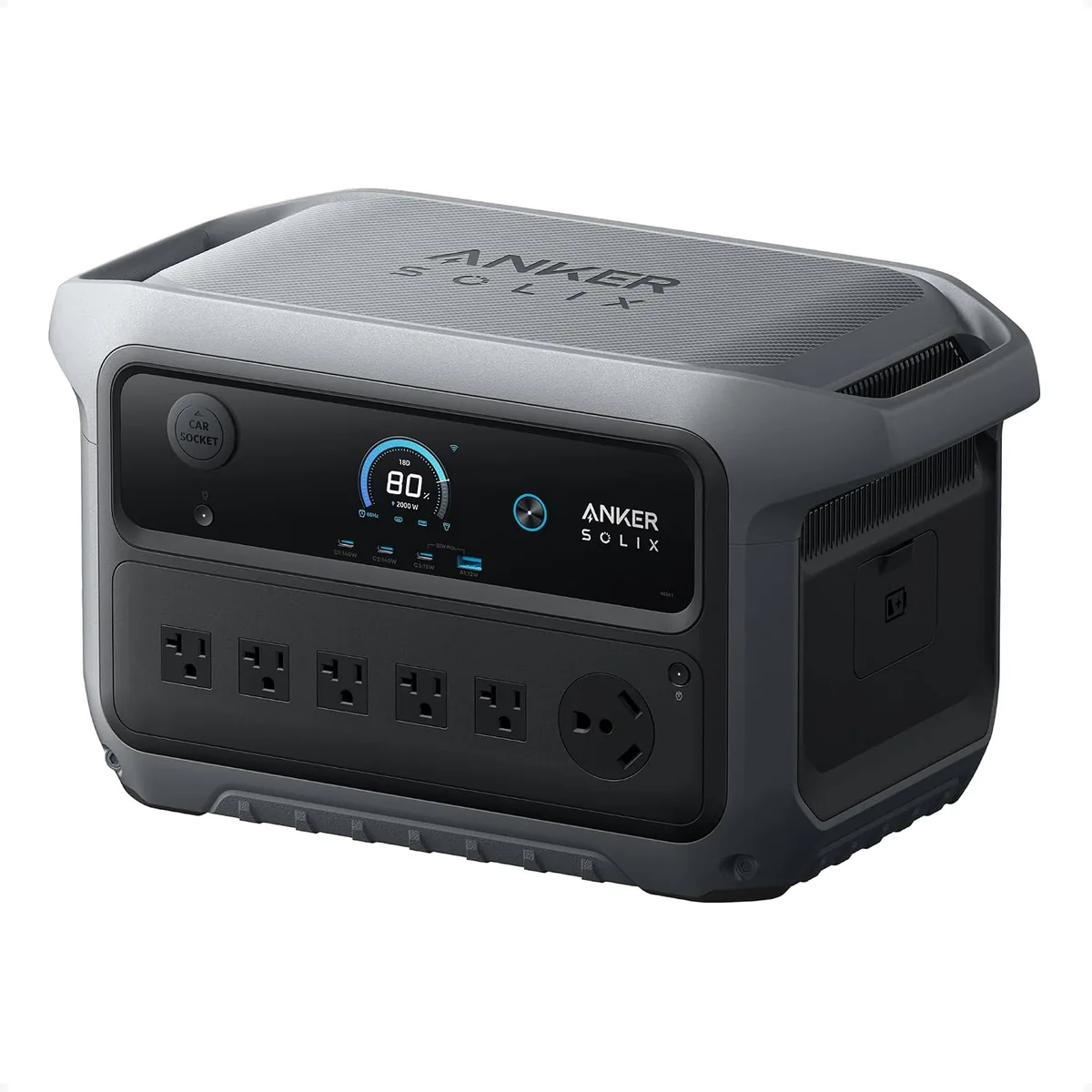
The Anker SOLIX C2000 Gen 2 takes up to 800 W of solar through a single XT60i port, and it is the pick for one modest array on one input. Behind that port sits a 2,048 Wh battery that Anker’s US product page lists as LFP. The box holds the station, an AC charging cable and a car charging cable, with no panel and no solar cable.
WHY I CHOSE THIS ✓
I give this station third place and the Best Value label for one modest panel: 2,048 Wh behind a 10 ms switchover in a 41.7 lb body. The single 800 W input is the limit I weigh most.
Anker SOLIX C2000 Gen 2 2048Wh Portable Power Station Specs
Key Features:
- One XT60i solar input: The port takes 11 to 60V, with a maximum of 800 W, and the manual says the PV connector to XT60i cable is bought separately.
- Two current limits: The input allows 8.2A between 11 and 28V and 17A between 28 and 60V, so the voltage you feed decides the current it accepts.
- A parallel rule: With several panels, the manual says each panel is connected in parallel and the input voltage stays at or below 60V, or the power supply may be damaged.
- The cables you still need: The manual says solar panel extension cables are bought separately, which is a cost to add to the station.
- App charge limits: The app sets a lower charge limit of 1 to 20% and an upper limit of 80 to 100%.
- 10 ms UPS switchover and SurgePad: The manual says the station switches to battery within 10 ms when wall power drops, and SurgePad gives up to 3,000 W for heating-type loads but not in bypass mode.
- A 2,400 W AC total: The single AC rating is 2,400 W at 120V, so the unit has no 240V outlet.
Anker’s FAQ says the XT60i input takes 11 to 60V, with a maximum current of 8.2A from 11 to 28V and 17A from 28 to 60V, and a maximum input power of 800 W overall. A caption on the manual’s solar recharging display page separately says to charge at a voltage greater than or equal to 20V, so 11V is the bottom of the input range and 20V is the figure on that caption. With multiple panels, each is wired in parallel and the input voltage stays at or below 60V. Panels and the connecting cable to the XT60i port come from other sources, because the box holds none.
Solar and DC input share the one port, and the AC charging limit is 1,800 W. A full recharge from the sun therefore takes as long as the panels and the weather allow, and a small array stretches it further. The charging range is 32 to 104 F (0 to 40 C), and the manual’s UPS line says the station can switch to battery power within 10 ms after a power outage.
The app and the weight shape daily use. Its charging limits sit in the app, with the lower bound at 1 to 20% and the upper bound at 80 to 100%, and the manual lists a Storm Guard mode that charges at the fastest speed ahead of severe weather. At 41.7 lb by Anker’s US page the body is a handle carry, and I weigh that against the walk from my sheds to the nearest plum row, about 100 to 150 feet.
Compare the voltage and current on a panel’s label with the two current bands and the 60V limit on the port. The manual’s storage page lists a weekly capacity check for the days when the station sits unused.
Because the box holds no panel and no solar cable, the station alone cannot charge from the sun. Anker’s guide describes dry and cool storage, a weekly battery check and a full charge to 100% at least once every three months, plus a note that lithium batteries self-consume power.
SurgePad does not work in bypass mode, according to the manual, and the unit uses a floating ground design, so some devices need a ground-neutral plug that Anker sells separately. The weakest point on this page for this station is solar: one input and 800 W suit a modest array and a long recharge. Anker’s manual says to power the unit off when it is not in use. The manual’s spec table rates the inverter-mode outlets and the TT-30 outlet at 120V, 20A and 2,400 W, and its discharging range is -4 to 104 F (-20 to 40 C).
Buy this one for a modest array on one input and a 2,048 Wh battery you can carry. The 120V-only outlets and the 2,400 W total suit lamps and a router on cords, with each outlet held to the limit the manual prints for it. Skip it if you need more than 800 W of accepted solar input, a second input or a 240V outlet.
FINAL VERDICT
The C2000 Gen 2 is the pick for a buyer whose array fits one 800 W input. A larger array or a 240V load needs another station.
It is the station for a modest array on one input.
4. EcoFlow DELTA Pro 3600Wh Portable Power Station Best 3,600Wh Solar Generator
The EcoFlow DELTA Pro holds 3,600 Wh, takes 1,600 W of solar through one input, and its manual supports up to two Smart Extra Batteries. The box holds the station, an AC cable, a car charging cable and a DC cable, with no panel and no solar cable.
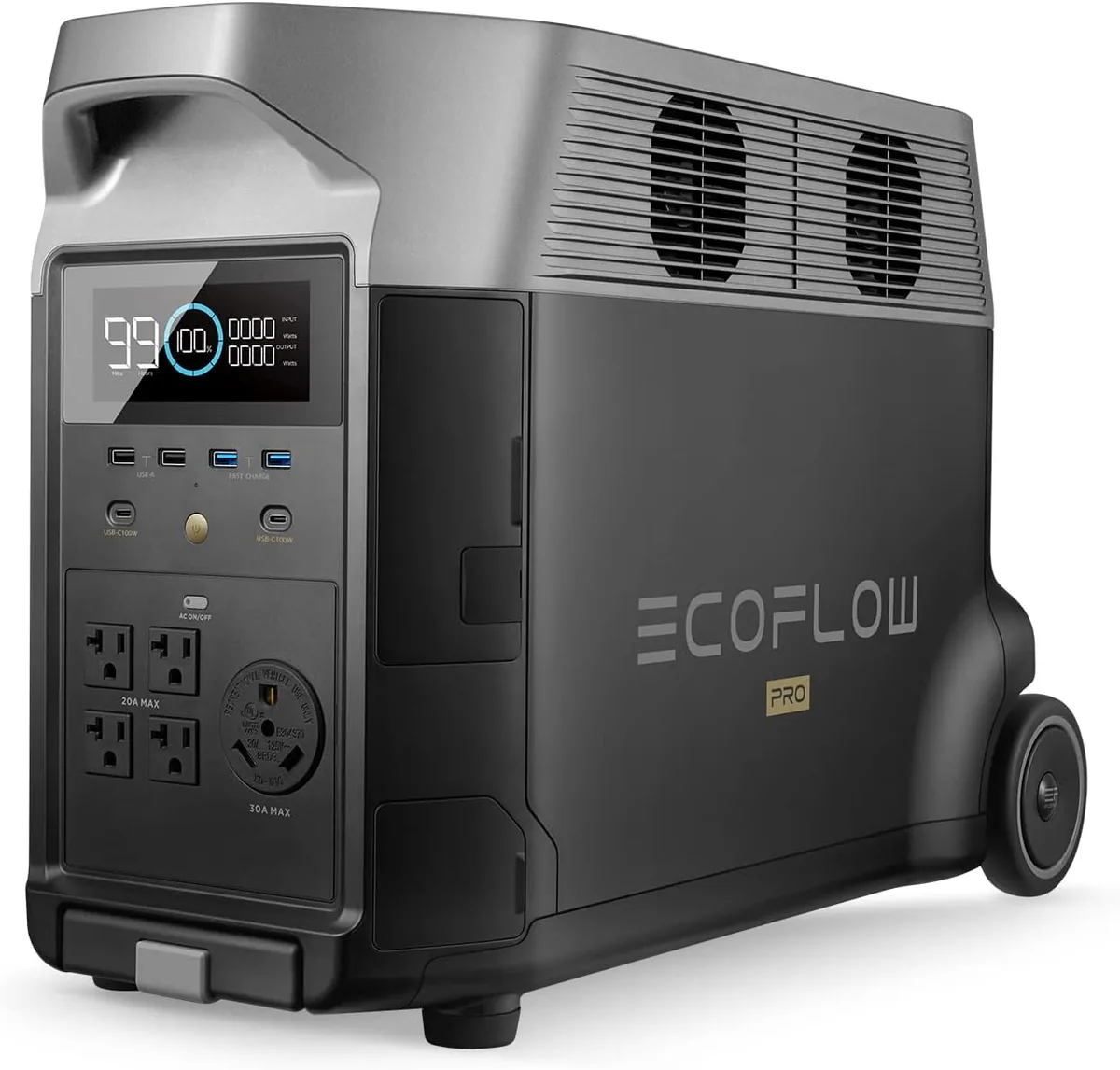
WHY I CHOSE THIS ✓
I rank it fourth because 3,600 Wh and a 1,600 W input sit beside support for two extra batteries in one manual. Capacity and growth are the two reasons I keep it on the list for a larger array.
EcoFlow DELTA Pro 3600Wh Portable Power Station Specs
Key Features:
- One solar input: The manual prints 11 to 150V, 15A and 1,600 W maximum, and the same port serves solar and car charging.
- A 150V ceiling: EcoFlow says to confirm that the panel’s output voltage is within 150V to avoid damage to the product.
- A separate adapter cable: The manual says the MC4-XT60 adapter cable and the solar panel are supplied separately, so neither is in the box.
- Two Smart Extra Batteries: The manual supports expansion with up to two of them, which is how the 3,600 Wh base grows.
- A cycle rating with its basis: EcoFlow prints 3,500 cycles to 80% or more capacity for the LFP pack.
Solar charging is a single-port job on this station. The manual gives 11 to 150V and 15A, with 1,600 W as the maximum, and its one line of caution is to keep the panel’s output voltage within 150V. With an EcoFlow panel as the source, the manual says to follow that panel’s own instructions. The adapter cable is a separate purchase, so I order the cable and the panel together.
The station weighs 99 lb, which makes it a two-handed carry. The manual’s charging range is 32 to 113 F (0 to 45 C), and it notes that whether the unit charges depends on the actual temperature of the battery pack. On AC, the manual says the unit is fully charged in 2.7 hours.
EcoFlow’s manual says not to use the product in rain or humid environments, and to store it in a dry and ventilated place.
The manual says the product is not recommended for powering medical emergency equipment, and its EPS switchover is within 30 ms. It also describes X-Boost, which lets suitable heating loads run up to 4,500 W while the rated output stays 3,600 W, and which does not work in bypass.
The single input is shared with car charging, as the manual’s port list shows, so solar and the car cable cannot run at once. The outputs are 120V only, capped at 3,600 W, with each of the five outlets held to the limit the manual prints for it. I count the cable first, because the station cannot charge from the sun without the MC4-XT60 adapter cable. The safety section below holds the shared rules.
This station fits a buyer who wants 3,600 Wh now and room for two more batteries, with a dry place to stand it. Skip it if the unit has to stay outdoors, or if you need a 240V output.
FINAL VERDICT
Choose the DELTA Pro when capacity and expansion matter more than a second solar input. The adapter cable and the panel are the first purchases after the station.
It is the large-capacity station that can grow.
5. PECRON F3000LFP 3072Wh Portable Power Station Best 3,072Wh Solar Generator
The PECRON F3000LFP holds 3,072 Wh and takes 1,600 W of solar through one XT60 input rated 25 to 120V and 25A, and PECRON’s manual says the port has one independent built-in MPPT controller. The box holds the station, an AC cable and a single-port XT60 to MC4 solar cable, with no panel.

WHY I CHOSE THIS ✓
I rank this one fifth because the manual itself states the MPPT controller and the 1,600 W limit for a 3,072 Wh unit. Separate rules for series and parallel strings give me numbers to size panels against.
PECRON F3000LFP 3072Wh Portable Power Station Specs
Key Features:
- Built-in MPPT: The manual’s FAQ says there is one independent built-in MPPT controller on the XT60 port, which accepts 25 to 120V and up to 1,600 W.
- A series voltage rule: The manual says the total open-circuit voltage of panels in series must be less than 120V and the operating voltage above 25V.
- A parallel current rule: For panels in parallel, the total current should be close to the port’s 25A maximum.
- A solar cable in the box: A single-port XT60 to MC4 cable is on the packing list, and the parallel charging cable is sold separately.
- A printed warning on mixing: PECRON says not to mix different types of solar panels, as it may damage the unit.
The solar pages of this manual give each rule its own sentence. The port takes 25 to 120V at up to 25A and 1,600 W, and PECRON recommends its own solar panels to avoid damage to the adapter module and the power supply. PECRON’s product page gives about 2.3 hours at 1,600 W of input, with no start or end level stated.
The display is a built-in LCD: a fan icon shows when the fan is cooling under load, a battery heating icon can appear, and an overload makes it flash OVERLOAD while the buzzer sounds twice. I weigh those three signals against the wattage on the label.

PECRON’s manual says not to immerse the unit in liquid or expose it to rain or wet conditions, and says the product has no waterproof function. It also says to avoid direct sunlight on the power supply and the adapter module to prevent overheating and damage, and not to leave the device in a non-ventilated or dusty space.
The manual’s charging range is 32 to 113 F (0 to 45 C), and it asks you not to block the air vents. The sheds’ chaff and sawdust make the dusty-space line one I weigh.
At 63.3 lb for the unit alone, the F3000LFP is a two-handed lift. The XT120 port takes up to two PECRON battery packs, per the manual. PECRON advertises 2+3 years of warranty; the extra 3 years need registration within 30 days of purchase, the manual voids the warranty if the unit is left uncharged or unused for more than six months, and the extra years for an Amazon purchase are worth confirming with PECRON.
Choose it if you want to size a string against clear printed rules. Skip it if the station has to stand in the rain, or if you want a solar recharge time in the manual itself.
FINAL VERDICT
Choose the F3000LFP when you want printed series and parallel rules and a built-in MPPT controller in a 3,072 Wh unit. Its rain and sunlight wording sets where it can stand.
It is the station with the clearest series and parallel rules.
6. BLUETTI Elite 300 3014.4Wh Portable Power Station Best 3,000Wh-Class Solar Generator Under 60 lb
At 57.98 lb for 3,014.4 Wh, the BLUETTI Elite 300 is a handle-carry unit with one XT60 solar input of 12 to 60V and 1,200 W. The box holds the station, an AC charging cable and a grounding screw, and BLUETTI’s manual lists the solar charging cable as an accessory that is not included.
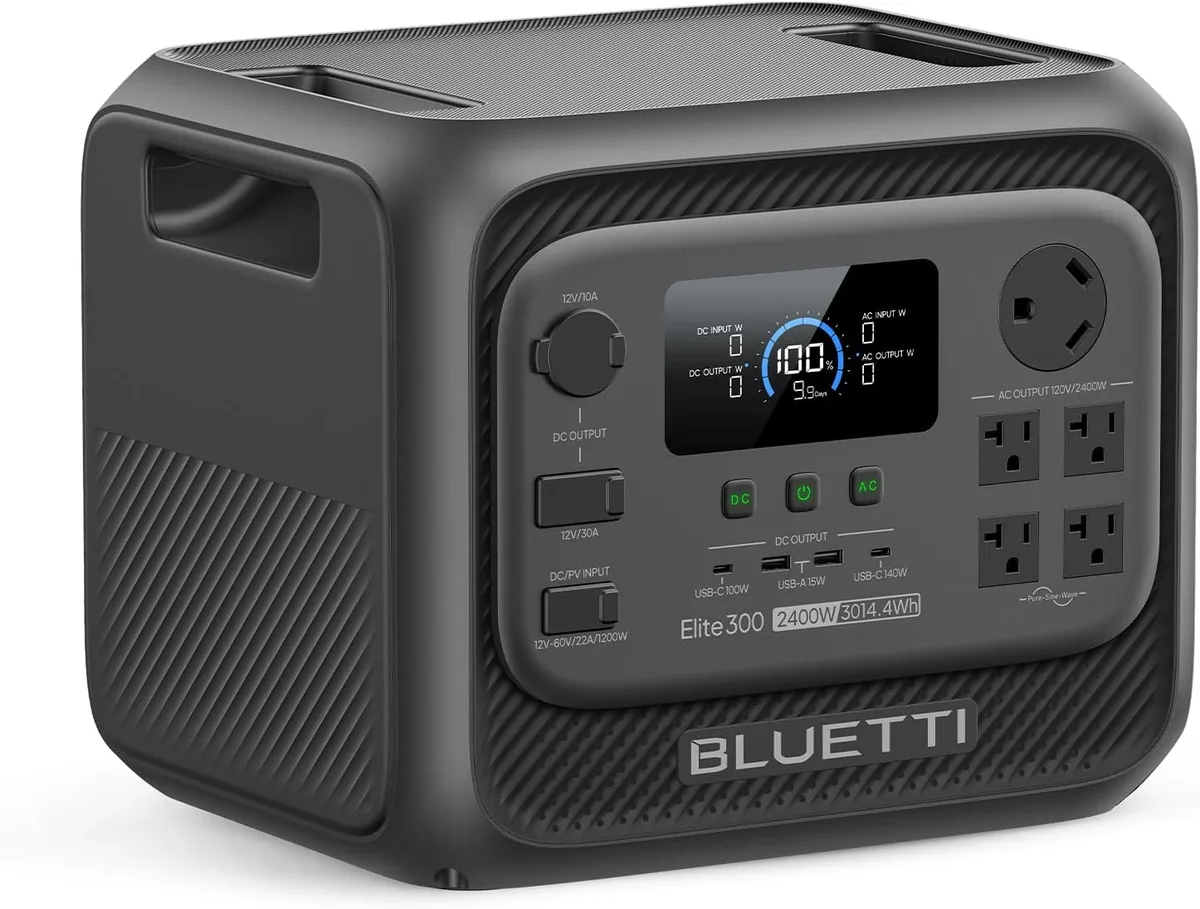
WHY I CHOSE THIS ✓
I rank it sixth because 57.98 lb for 3,014.4 Wh puts a 3 kWh battery in a handle-carry body that still takes a real solar input. The 60V limit is strict, and the manual states it more than once.
BLUETTI Elite 300 3014.4Wh Portable Power Station Specs
Key Features:
- One XT60 solar input: The manual prints 12 to 60V, 22A and 1,200 W maximum for the DC input.
- A 60V open-circuit limit: BLUETTI says not to use solar panels with an open circuit voltage higher than 60V.
- A solar cable that is not in the box: The manual’s accessory list says the 1.5 m solar charging cable is not included.
- AC and solar together: The charging-mode table lists 1,500 W in Standard mode and 2,400 W in Turbo for AC plus solar.
- A 57.98 lb body: The weight is printed in the spec table, and the Elite 300 has a carry handle.
The solar rule on this station is short and strict. The DC input takes 12 to 60V at up to 22A and 1,200 W, and the manual says not to use solar panels with an open circuit voltage higher than 60V or to mix different types of solar panels. The solar cable is an accessory that is not included, so the cable goes on the shopping list with the panels.
At 0% charge, the manual says that if you use solar energy you should make sure the input is over 100 W. The charging-mode table gives 1,200 W as the solar maximum in each mode and lists AC charging times such as 100% in 2.8 hours in US Turbo mode. The charging range is 32 to 104 F (0 to 40 C).
BLUETTI’s manual says not to use the product in the rain or in high humidity, and its spec table gives the unit an IP20 protection rating. I treat that wording as the placement rule for this station.
For a unit that sits longer than three months, the manual’s storage line is a charge of 40 to 60%, and it says a state of charge below 5% should be recharged in time.
The manual describes Wi-Fi and Bluetooth app control and a combined AC and solar charging mode of 1,500 W in Standard and 2,400 W in Turbo. Power Lifting is a separate resistive-load mode for loads of 2,400 to 4,800 W, and the actual output stays 2,400 W. The weight is the reason to look at this station, and I weigh the 57.98 lb against the 4-foot concrete path to the house door.
Choose this station if you want 3,000 Wh in a body with a carry handle and panels that stay under 60V open-circuit. Skip it if the station has to stand outdoors in wet weather.
FINAL VERDICT
Choose the Elite 300 when carrying weight decides among 3 kWh stations. Its solar input is modest, its 60V limit is firm and the solar cable is an extra purchase.
It is the 3 kWh station with a carry handle.
7. BLUETTI Elite 200 V2 2073.6Wh Portable Power Station Best 2,074Wh Solar Generator
BLUETTI’s manual for the Elite 200 V2 prints a solar recharge time along with the input it assumes. The box holds a 1.5 m MC4 to XT60 solar cable and no panel.

WHY I CHOSE THIS ✓
I rank it seventh because it prints a solar recharge time and the manual gives its basis. A basis is what makes a time usable, and a buyer can compare that time with the panels they plan to buy.
BLUETTI Elite 200 V2 2073.6Wh Portable Power Station Specs
Key Features:
- One DC solar input: The XT60PM-M input takes 12 to 60V at up to 20A and 1,000 W, and the supplied cable has two MC4 leads that join in parallel.
- A matching rule for the two leads: The manual says to use the same power rating and type of panel on both MC4 leads.
- A printed solar recharge time: The manual states the continuous input it assumes and gives no panel count.
- A 60V open-circuit limit: BLUETTI says not to use solar panels with an open circuit voltage above 60V, and the error list shows PV overvoltage outside 12 to 60V.
- Silent mode at 800 W: The charging-mode table cuts the solar maximum to 800 W in Silent mode and keeps 1,000 W in Standard and Turbo.
The recharge line is the manual’s most useful solar number: with a continuous 1,000 W input the unit reaches full capacity in about 2.4 hours, with no starting level and no panel count stated.
Within the 12 to 60V solar range, the manual’s input table for non-advanced mode gives 8.2A up to 30V and 20A above 30V up to 60V, and the supplied cable’s two MC4 leads join in parallel. The safety page says no panels with an open circuit voltage above 60V, and the manual says to avoid mixing panel types. I weigh those lines against a panel label before anything else.
BLUETTI’s manual says not to use the product in the rain or in high humidity, and it calls the unit off-grid only, with a line against connecting its AC output to the grid.
The charging range is 32 to 104 F (0 to 40 C), and the manual advises a firmware update through the app before first use. AC charging runs 1,440 W in Standard mode, and the manual’s Turbo maximum of 1,800 W is on a charging-plus-bypass basis and needs the app and a call to BLUETTI support to enable.
At 53.35 lb with no wheels, the Elite 200 V2 is a handle carry, and I weigh that against the concrete work pad in front of my machinery shed. The four 120V outlets share 2,600 W. Power Lifting is a resistive-load mode in which loads of 2,600 to 3,900 W run while the actual output stays 2,600 W.
It suits a buyer who wants a printed solar recharge time to compare with a planned panel setup, and a 2 kWh battery with a handle. Skip it if you need a large solar input, wheels for rough ground or a unit that stands outdoors in wet weather.
FINAL VERDICT
Choose the Elite 200 V2 when a solar recharge time with its basis matters more than input size. Its input is modest and its rain warning is firm.
It is the 2 kWh station with a stated solar recharge time.
How to Choose the Best Solar Generator
Choose by the solar input window, then by what is in the box, then by capacity and weight. These six factors follow the order I use when I read a manual, and each one is a printed number you can check.
The Solar Input Window and Its Limit
A solar input is a window of printed figures for each port: a lowest and a highest voltage, a current limit and a maximum wattage. Manuals word the voltage limit differently, as total solar input voltage, panel output voltage or open-circuit voltage, and some also state an operating voltage minimum, so the wording of your model’s manual is the one that counts. Exceeding the voltage limit is the line manuals warn about most firmly.
| Figure | What it tells you | Where it sits |
|---|---|---|
| Voltage window | The voltage range the port accepts, in the manual’s own wording | The solar input spec and the wiring page |
| Current limit | The amps the port accepts | The solar input spec |
| Watt ceiling | The most solar power the station takes | The charging table or spec |
| Mixing wording | Which panel types a manual says not to combine | The wiring or safety page |
- Voltage: the manual’s limit is the figure to compare with a panel’s label.
- Current: a manual may print a current limit per input or per voltage band.
- Power: the watt ceiling is the most the station accepts at that port.
Pro Tip
I copy the window from the manual onto a card and set it beside the panel’s label figures before I order anything.
Inputs, Connectors and the Cable in the Box
Stations take solar through different connectors, such as XT60, MC4 or an 8mm DC port, and some ship with a solar cable while others list it as a separate purchase. On the seven ranked listings the panel is never in the box. Interviews with 15 Puerto Rico families who used solar-powered battery systems reported problems that included inadequate power, defective cables and blown fuses (1). I check the station end and the panel end of a cable as two separate decisions.
- Station end: the cable’s station-side connector fits the input named in the manual.
- Panel end: the cable’s panel-side connector fits the leads on the panel, and an adapter can use different connector types at its two ends.
- Extra cables: extension and parallel cables are often separate purchases.
A Printed Recharge Time and Its Basis
A recharge time means something only with its basis: the input wattage, whether the charge runs to full or to 80%, and the conditions. Real sun varies with weather and angle. I treat a time without a basis as a sales line and a time with one as a number I can use.
Worked Estimate, Before Losses
A 2,000 Wh station on a continuous 1,000 W input divides to 2 hours. That is arithmetic at constant input, and a maker’s printed time with its own basis replaces it.
Capacity, Weight and Where It Stands
Capacity is stored energy in watt-hours, and weight is the part you carry. The best portable solar generator for your yard is the one whose weight suits the spot its manual allows, and the weights on this page run from about 42 lb to 135.6 lb. The gravel pad by my sheds suits a station with wheels.
| Check | Why it matters |
|---|---|
| Weight and wheels | Decides who can move it and where it can stand |
| Indoor or rain wording | Each manual prints its own placement rule |
| Charge temperature range | Each manual prints its own range |
| Seller and warranty | Some terms apply only to buyers from the maker’s channels |
Charging Temperature and Water Wording
Each manual prints its own charging range, and the seven on this page all start at 32 F (0 C) and end at 104 or 113 F (40 or 45 C). Research on lithium-ion cells sits apart from those model limits. A review of lithium-ion battery thermal safety says low temperatures cause capacity fade and lithium plating, and that side reactions speed up and lifespan falls above 104 F (40 C) in lithium-ion batteries in general (2). Laboratory tests of LiMnNiO and LiFePO4 batteries from 122 F (50 C) down to -4 F (-20 C) found higher internal resistance, and so lower capacity and power, at subzero temperatures (3).
The water wording differs by model: one manual says indoor use only, others warn against rain or humidity, and one prints an IP20 rating.
- Range: the charging range is the one your manual prints, in Fahrenheit and Celsius.
- Water: the rain and humidity line differs between models.
- Sunlight: one manual also names direct sunlight on its adapter module.
Cycle Ratings and Warranty Terms
A cycle rating is a tested capacity-retention figure: a count of cycles to a remaining capacity such as 80% or 70%, and two ratings with different bases cannot be compared. In cycling tests of commercial LFP, NCA and NMC cells, the time to reach 80% capacity varied by thousands of hours with discharge rate, depth of discharge and temperature (4). I read the warranty seller line on the listing before I buy.
- Basis: the remaining capacity the rating stops at.
- Warranty: some terms cover only buyers from the maker’s own channels.
- Source: a figure from a maker’s product page and a figure from a manual are not always the same.
Which Solar Cables and Panels Come in the Box?
None of the seven ranked listings includes a panel, and only three include a solar cable. Some makers sell panel bundles under other listings, and these seven are the station only.
Solar Input Side by Side
| Station | Maximum solar input | Inputs |
|---|---|---|
| Anker SOLIX F3800 Plus (guide) | 3,200 W across two inputs, 1,600 W each | 2 |
| Jackery Explorer 5000 Plus (manual) | Low-PV ports 1,200 W combined; High-PV rated by voltage and 15A | 1 High-PV, 2 Low-PV |
| Anker SOLIX C2000 Gen 2 (manual) | 800 W | 1 XT60i |
| EcoFlow DELTA Pro (manual) | 1,600 W | 1 |
| PECRON F3000LFP (manual) | 1,600 W, built-in MPPT | 1 XT60 |
| BLUETTI Elite 300 (manual) | 1,200 W | 1 XT60 |
| BLUETTI Elite 200 V2 (manual) | 1,000 W | 1 input with two MC4 leads |
What Each Box Holds
| Station | Solar cable in the box | Panel in the box | Listed as a separate purchase |
|---|---|---|---|
| Anker SOLIX F3800 Plus | Two solar charging cables | None | Solar Parallel Connection Connector for parallel wiring |
| Jackery Explorer 5000 Plus | None; an MC4 wrench | None | Solar panel connector for several panels on one Low-PV port |
| Anker SOLIX C2000 Gen 2 | None | None | PV connector to XT60i cable and extension cables |
| EcoFlow DELTA Pro | None | None | MC4-XT60 adapter cable and the panel |
| PECRON F3000LFP | One single-port XT60 to MC4 cable | None | Parallel charging cable |
| BLUETTI Elite 300 | None | None | 1.5 m solar charging cable |
| BLUETTI Elite 200 V2 | One MC4 to XT60 cable, 1.5 m | None | None listed for solar |
Three makers name their own panels in their manuals: Anker says its portable solar panel packages include 10 ft (3 m) extension cables, EcoFlow says to follow the instructions that come with its panels, and PECRON recommends its own panels for its adapter.
Solar Input Limits and Station Safety
Each manual below prints its own limits, and a panel array above a station’s printed voltage limit can damage it.
| Station | Limits per input and condition |
|---|---|
| Anker SOLIX F3800 Plus | Two inputs, each 11 to 165V and 17A, 1,600 W. “Voltage exceeding 165V will damage the product.” Above 17A the panel’s output power cannot be fully used. Parallel wiring uses the Solar Parallel Connection Connector, sold separately. |
| Jackery Explorer 5000 Plus | Low-PV: total solar input greater than 16V and less than 60V, up to 10.5A per port. A separate 11 to 16V working condition is limited to 8A, even with both ports combined. High-PV: total solar input greater than 135V and less than 450V, 15A. Using both inputs together needs the same type and number of panels on each. Several panels on one Low-PV port need the solar panel connector, sold separately. |
| Anker SOLIX C2000 Gen 2 | XT60i input 11 to 60V: 8.2A from 11 to 28V and 17A from 28 to 60V, 800 W overall; a caption on the solar recharging display page says to charge at a voltage greater than or equal to 20V. With several panels, the manual says each is connected in parallel and the input voltage stays at or below 60V, otherwise the power supply may be damaged. |
| EcoFlow DELTA Pro | Input 11 to 150V, 15A, 1,600 W. The manual says the panel’s output voltage must be within 150V to avoid product damage. |
| PECRON F3000LFP | XT60 input 25 to 120V, 25A, 1,600 W. In series the total open-circuit voltage (Voc) must be less than 120V and the operating voltage (Vmp) more than 25V; in parallel the total current (Imp) should be close to the 25A maximum. The manual warns against mixing different types of panels. |
| BLUETTI Elite 300 | Input 12 to 60V, 22A, 1,200 W. “Do not use solar panels with open circuit voltage higher than 60 V.” The manual says to avoid mixing different types of panels. |
| BLUETTI Elite 200 V2 | Input 12 to 60V, 20A, 1,000 W; open-circuit voltage not above 60V. Both MC4 leads need the same panel power rating and type. The input table for non-advanced mode gives 8.2A up to 30V and 20A above 30V up to 60V. |
| Station | Charging range as printed | Rain, water or indoor wording | Storage or other wording |
|---|---|---|---|
| Anker SOLIX F3800 Plus | 32 to 104 F (0 to 40 C) | Not covered in the guide | Store in a dry and cool environment |
| Jackery Explorer 5000 Plus | 32 to 113 F (0 to 45 C) | Indoor use only; do not use outdoors under any circumstances | Do not use or store in a dusty or wet environment |
| Anker SOLIX C2000 Gen 2 | 32 to 104 F (0 to 40 C) | Not covered in the manual | Store in a dry and cool area |
| EcoFlow DELTA Pro | 32 to 113 F (0 to 45 C) | Do not use in rain or humid environments | Store in a dry and ventilated place |
| PECRON F3000LFP | 32 to 113 F (0 to 45 C) | Do not expose to rain or wet conditions; no waterproof function | Avoid direct sunlight on the power supply and adapter module; do not block the vents |
| BLUETTI Elite 300 | 32 to 104 F (0 to 40 C) | Do not use in rain or high humidity; IP20 | Charge in a well-ventilated area |
| BLUETTI Elite 200 V2 | 32 to 104 F (0 to 40 C) | Do not use in rain or high humidity | Off-grid use only |
- Anker: the F3800 Plus guide and the C2000 Gen 2 manual both say to stop using the station while a high or low temperature icon shows.
- EcoFlow: the DELTA Pro manual says to keep the unit away from heat sources and from children and pets, and not to reuse a unit that was damaged or dropped into water.
- Ventilation: the Jackery manual says to charge in a well-ventilated area without restricting ventilation, the PECRON manual says not to block the air vents, and the Elite 300 manual says to charge in a well-ventilated area.
Never feed power from a station into a wall outlet, because backfeed can cause a fatal shock, and the Elite 300 and Elite 200 V2 manuals each say not to connect the unit’s AC output to the grid.
My Overall Verdict
Seven stations take solar differently, and the window printed in the manual decides which panels fit. My top three suit three different setups.
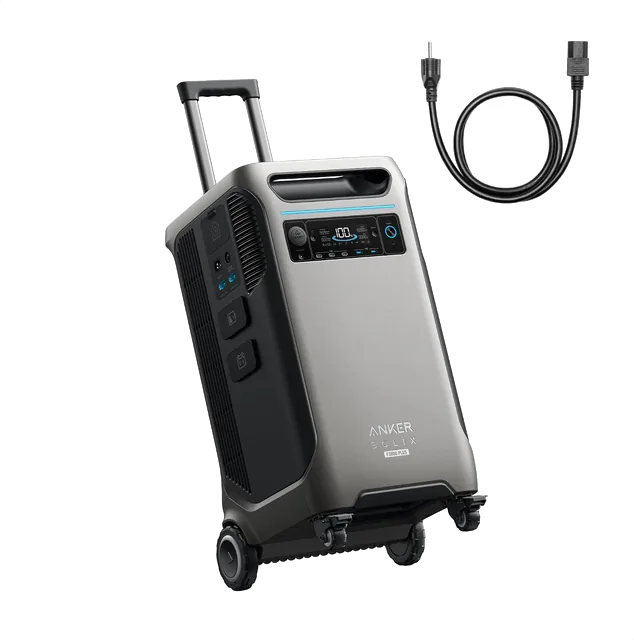
1. Anker SOLIX F3800 Plus 3840Wh Portable Power Station Best Overall
Best for a large array: two inputs of 11 to 165V and two solar cables in the box.
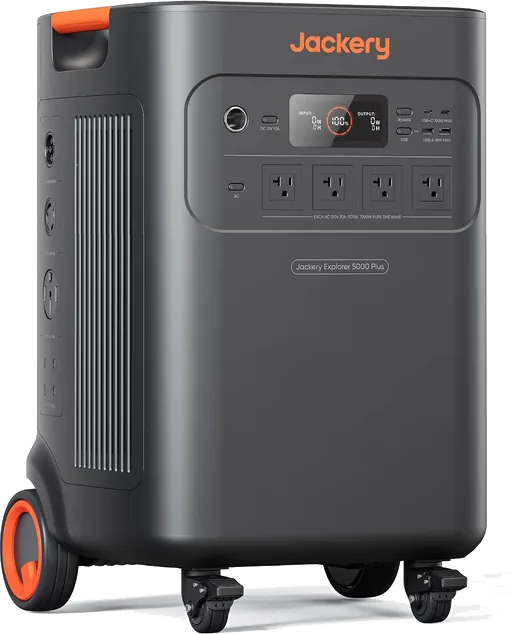
2. Jackery Explorer 5000 Plus 5040Wh Power Station Best Premium
Best for a dry indoor room and a high-voltage string, with 5,040 Wh.
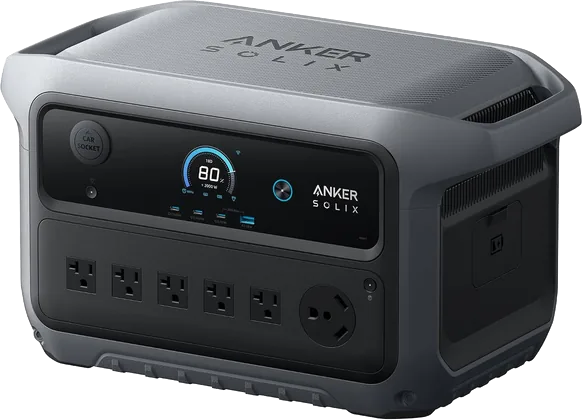
3. Anker SOLIX C2000 Gen 2 2048Wh Portable Power Station Best Value
Best value for one modest panel: 800 W over a single port.
If I have to choose one, it is the Anker SOLIX F3800 Plus, because its two wide inputs give the most choice of panels and two solar cables come in the box. For a buyer who plans a large array, it is the best solar generator on this page.
Why Anker SOLIX F3800 Plus 3840Wh Portable Power Station Might Be the Best Choice
Two separately rated inputs are worth the weight when the array is large enough to use them, and the F3800 Plus is the only station here that offers two.
A buyer with one modest panel can pass on it, because the 135.6 lb unit and the premium tier pay for headroom that a single panel never uses. I accept the weight for a station that takes a large array.
Here is when the F3800 Plus is the right call:
✓ Large array: two inputs let two strings feed the station at once.
✓ Panel choice: the 11 to 165V window leaves room for several panel designs.
✓ Cables: the box holds two solar cables, and the parallel connector is a separate purchase.
✓ Weight: 135.6 lb needs wheels and level ground.
✓ Premium tier: the price tier is the cost of the second input.
Frequently Asked Questions
What is the best solar generator?
The best solar generator on this page is the Anker SOLIX F3800 Plus, which has two solar inputs of 11 to 165V and up to 1,600 W each, with two solar charging cables in the box. Its panels are a separate purchase, as they are for all seven stations on this page.
What should I look for in a solar generator?
Look for the solar input window in a solar generator’s manual first: the voltage range, the current limit and the maximum watts. Then check the cable in the box, the capacity, the weight and the charging temperature range, because every station on this page ships without a panel and some ship without a solar cable.
How do you charge a solar generator?
A solar generator takes charge from solar panels, from a wall outlet and, on some models, from a car port, each through its own rated input, and the sources a model accepts are listed in its manual. The manual’s limits decide which panels suit the solar port, and each manual prints its own charging temperature range.
Who makes the best solar generator?
Anker makes the best solar generator on this page, the SOLIX F3800 Plus, which has two solar inputs and two solar cables in the box. Jackery, EcoFlow, PECRON and BLUETTI also make stations with printed solar limits, so read the limit and the placement wording for the exact model you buy.
How long do solar generators last?
How long a solar generator lasts depends on its battery’s cycle rating, which describes retained capacity to a stated basis, while runtime per charge depends on the load. The EcoFlow DELTA Pro manual gives 3,500 cycles to 80% or more capacity and the Jackery Explorer 5000 Plus manual gives 4,000 cycles to 70% or more.
References
- Tosado GA, Matos M, Ahumada-Paras M, Chapko MK, Pozzo LD; Puerto Rico Solar Health Study Group. Evaluation of solar-powered battery systems for individuals using electricity-dependent medical devices in Puerto Rico following Hurricane Maria. Disaster Med Public Health Prep. 2023;17:e15. doi:10.1017/dmp.2021.114
- Lyu P, Liu X, Qu J, Zhao J, Huo Y, Qu Z, Rao Z. Recent advances of thermal safety of lithium ion battery for energy storage. Energy Storage Mater. 2020;31:195-220. doi:10.1016/j.ensm.2020.06.042
- Hossain Ahmed S, Kang X, Bade Shrestha SO. Effects of Temperature on Internal Resistances of Lithium-Ion Batteries. J Energy Resour Technol. 2015;137(3):031901.
- Preger Y, Barkholtz HM, Fresquez A, Campbell DL, Juba BW, Roman-Kustas J, Ferreira SR, Chalamala B. Degradation of Commercial Lithium-Ion Cells as a Function of Chemistry and Cycling Conditions. J. Electrochem. Soc. 2020;167(12):120532.
Safety Note: Use a portable power station only as its manual allows. Keep it dry, keep its vents clear and keep it away from heat and children. Charge it only within the temperature range your manual gives, with the maker’s charger or inputs inside their rated limits. Never open the case, and stop using a unit that is damaged, swollen or overheating. Never feed power from a power station into a wall outlet: backfeeding can cause a fatal electric shock. Connect one to the wiring of a home or an RV only in a way its own manual supports. A fuel generator is different: its exhaust contains carbon monoxide, which can kill in minutes. Run it outdoors only, never in a home, garage, basement, shed, tent, camper, RV or other enclosed or partly enclosed space, even with doors or windows open. The CPSC says to place it at least 20 feet from your home with the exhaust pointed away from doors, windows and vents, and to install battery-operated or battery-backup carbon monoxide alarms. At a campsite, keep it at least 20 feet from people, tents, campers and RVs, your neighbors’ included, with the exhaust pointed away from them, and keep a working carbon monoxide alarm in the RV.