
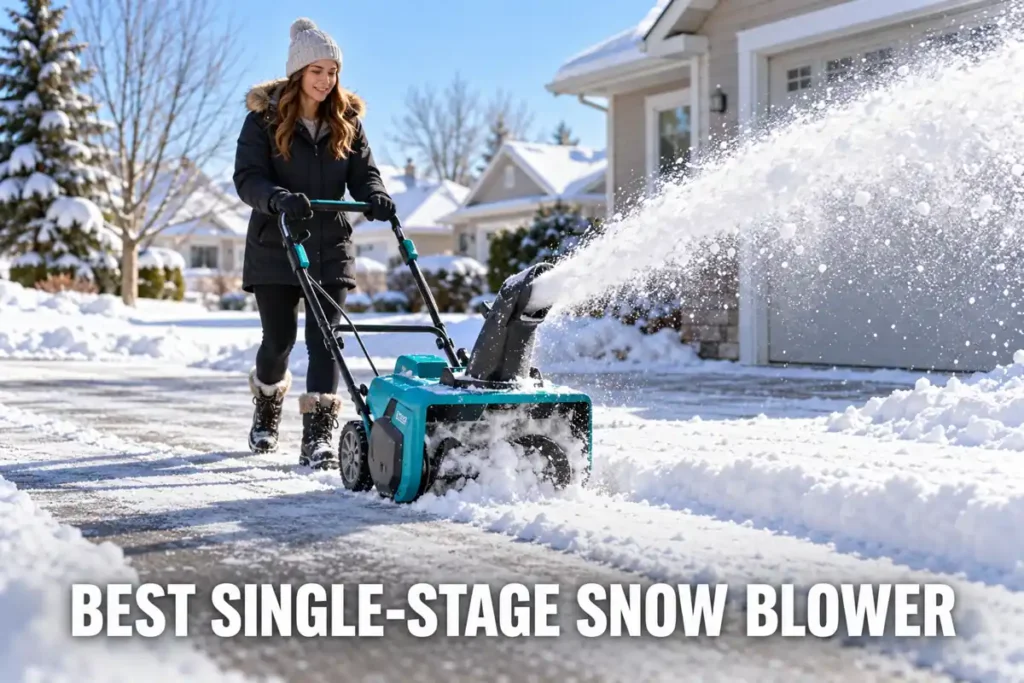
The best single-stage snow blower for a paved drive scrapes down to the surface and tells you plainly where it stops. I clear the pad and the path to my house door on a family farm in northern Serbia, where snow work is occasional and the snow often falls near freezing, so I judge these machines by that heavy snow and not by a best-case claim.
I rank seven, five on battery packs and two on a cord, led by the EGO Power+ SNT2134 21-Inch Single-Stage Snow Blower. Below you get the reviews, how to choose a single-stage snow blower, and what an auger that touches the ground means for your surface.
Best Single-Stage Snow Blower Reviews 2026: 7 Picks for Paved Drives and Walks
These are my picks for a paved drive and a snowfall that arrives a few inches at a time. Five run on battery packs and two on a cord, their intake runs from 8 to 13 in by the makers’ figures, and every review says who should skip it.
1. EGO Power+ SNT2134 21-Inch Single-Stage Snow Blower Best Overall
The EGO SNT2134 is the single-stage I recommend to anyone whose drive is paved and whose snow comes a few inches at a time: a 21 in path and a 13 in intake that scrape down to the surface, with both 6.0 Ah packs and the dual port charger already in the box. It takes Best Overall because the kit matches what EGO’s own manual asks for, and that manual is plain about where the machine stops.

WHY I CHOSE THIS ✓
I put it first because the box already holds the setup the manual asks for. The 21 in path keeps the number of passes down, the 13 in intake gives it a taller opening than most machines here, and EGO backs the tool for 5 years. I recommend it to a buyer with a paved drive, a warm place to charge and no gravel to clear.
EGO Power+ SNT2134 21-Inch Single-Stage Snow Blower Specs
Key Features:
- Two 6.0 Ah packs in the box: EGO’s manual recommends two packs of 5.0 Ah or more, so the kit is the working setup and needs no second purchase.
- Steel auger with rubber paddles: The auger touches the ground and scrapes to the surface, which is what lets a single-stage leave a clean paved drive.
- 13 in intake: This is the height of the housing opening, and snow taller than it is cleared in layers.
- Variable auger speed dial: It sets how far the snow travels, so you can shorten the stream beside a bed or a parked car.
- 200 degree chute from handle levers: You turn the chute 100 degrees each way and set the deflector in its detents without leaving the handle.
- Electric brake: The auger stops within 3 seconds of releasing the bail switch, though EGO still tells you to wait 10 seconds before clearing a clog.
- Heated grips and LED headlights: The grips hold 95 F to 131 F and switch off after 10 idle minutes, and the lights turn off after 5.
Because the auger touches the ground, this machine cleans a concrete pad right down to the surface, and that is also where it stops. EGO’s manual says not to use it on a graveled surface, since the stones are picked up and thrown. My work pad in front of the machinery shed is concrete and the yard beside it is crushed stone, so I end each pass a machine length short of the seam and shovel the strip between. The skid shoes adjust for cracks and uneven pavement, and I do not read them as permission for stone.
The sharpest line in the manual is the pack rule: on one pack, EGO says not to work in snow deeper than 3 inches or in very wet or icy snow, because the pack overheats. The second pack is therefore the working setup and not a spare. According to EGO, the pair clears up to a 14-car driveway with 8 inches of snow on a single charge, a best-case claim with no minutes, snow type or car length behind it. I plan a short drive as one job and a long drive as two.
Weight is the other limit. At 66 lb without the packs, and about 79 lb with both, the SNT2134 is easy to lift onto a shelf, but it is a push machine, and on a long drive you are the drive system; EGO caps slopes at 10 percent. The wear parts are the second-season detail, because a worn scraper bar leaves a layer of snow on the ground and worn paddles shorten the throw. I look at the bar and the paddles before the first fall, not after the first disappointing pass.

After the last pass, run the motor a few minutes and swing the chute handle back and forth, which keeps ice from locking the auger and chute.
Hands stay out of the chute. EGO calls hand contact with the auger inside the chute the most common cause of snow blower injury, so release the bail switch, take out both packs, wait 10 seconds and use a clean-out tool or a stick, with eye protection on and people and pets 100 ft away.
A pack at -4 F or colder may not start the machine, and EGO wants charging between 41 F and 104 F, so my packs live in the house. That is rarely the limit on my plain, where near-freezing snow is the real test, and the manual’s overload behavior, a slower auger before a flashing orange light, is the signal to narrow the swath. Wipe up melt that drips from the machine and store it dry, away from rock salt and fertilizer. What annoyed me is that no clean-out tool comes in the box.
Buy it for a paved drive and walks of a few car lengths, snow that arrives a few inches at a time, and a household that wants no gas can and no cord. Skip it for gravel or crushed stone, for the packed ridge a plow leaves at the end of the drive, for a long drive with deep wet snow, and for slopes steeper than 10 percent. A buyer who wants the machine to pull itself will want a different drive system.
FINAL VERDICT
Choose the SNT2134 when your drive is paved, your snow is moderate and you want a battery machine that works as sold, with both packs in the box. It is the page’s most balanced single-stage. If your surface is stone or your snow is deep, it is the wrong class.
It is the single-stage I recommend first for a paved drive.
2. EGO Power+ SNT2125AP 21-Inch Auger-Propelled Snow Blower Best Premium
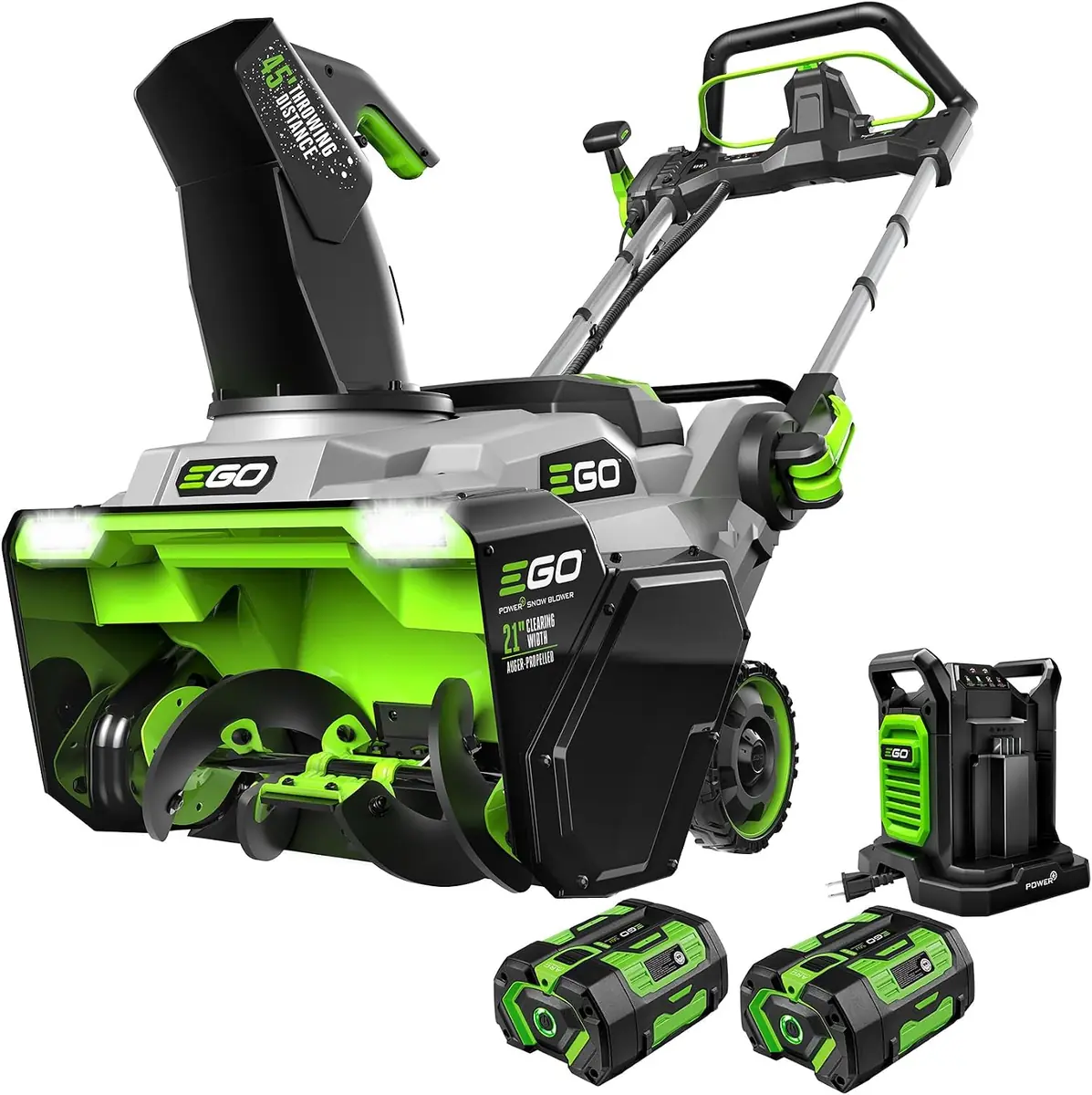
The EGO SNT2125AP is the one machine on this page that pulls itself along: lift the handle and the rubber paddles grip the pavement and walk the blower forward, while a 21 in path and a 13 in intake clear the snow ahead. It holds Best Premium because it carries the largest pack pair on the list, 7.5 Ah each, and that drive, at the top of the price range. I recommend it to a buyer with a long paved drive who wants the machine to share the pushing.
WHY I CHOSE THIS ✓
The drive is the only one of its kind on this list, and the paddles do part of the pushing. The 7.5 Ah packs give it the most stored energy of the seven, and EGO backs the tool for 5 years. I recommend it to a buyer who pays for relief on a long paved drive and has no gravel to cross.
EGO Power+ SNT2125AP 21-Inch Auger-Propelled Snow Blower Specs
Key Features:
- Auger-propelled drive: Lift the main handle and the paddles contact the ground and pull the machine ahead, which takes some of the push out of a long pass.
- Two 7.5 Ah packs with fuel gauges: The kit carries the largest pack pair on this page, and the gauge on each pack shows what is left.
- Peak Power: Both packs feed the motor together, and EGO recommends two packs of 5.0 Ah or more for this machine.
- Two LED headlights: A handle switch turns them on for a start before daylight, and they turn off after 5 idle minutes.
- Heated grips: They hold 95 F to 131 F and switch off after 10 idle minutes.
- 180 degree chute: A rotation handle sets the direction and a trigger on the deflector handle sets the height of the stream.
- Variable auger speed dial: It sets the throw, so a short stream beside a car or a bed is one turn of the dial.
Lifting the handle is the whole trick. Normally the paddles rest lightly on the ground, and each bit of lift gives them more grip and more pull. The first time I tried it on my level concrete pad, the machine walked ahead of me, so I now lift just enough to keep it moving, because more lift on cleared concrete is more pull than my boots want. The maker calls this auger-propelled, and it is not self-propelled in the wheel-drive sense: nothing powers the 7 in wheels, and you still steer and carry the weight on a turn.
The paddle drive works on pavement, and that is exactly why the surface decides everything. The paddles need pavement to grip, and the manual says not to use the machine on a graveled surface, since the stones are picked up and thrown. On stone the paddles have nothing to grip, so the drive earns its keep only on pavement, and a stone yard stays a shovel job.
Reverse is the awkward part, because the manual warns about slipping when you work in reverse, so I do not back this machine up; I tip it onto its wheels, swing the front around and start the next pass. The second limit is depth. The maker’s claim is up to 16 cars with 8 inches of snow on a single charge with the pair in the kit, while the class of battery single-stage machines sits nearer 6 to 9 inches, so I read EGO’s number as a ceiling for a good day, not a plan for a wet one.

One pack is allowed, but EGO’s manual says not to use a single pack in snow deeper than 3 inches or in very wet or icy snow. Seat both packs every time.
Hands stay out of the chute. EGO calls hand contact with the rotating auger in the chute the most common cause of snow blower injury, so release the bail switch, take out both packs, wait 10 seconds and clear a clog with a clean-out tool or a stick.
No clean-out tool comes in the box, so I cut a length of wooden rod and hang it on the hook by the shed door. The scraper bar, the rubber paddles and the drive belt are wear parts, and the manual points to a worn paddle when the machine loses its pull. The packs start only above -4 F pack temperature and charge between 41 F and 104 F, so they live in the house. Wear hearing protection, and wipe the machine dry after use.
The fit is a long paved drive and walks where the push is the tiring part, snow of a few inches per fall, and a household that already owns EGO 56V tools. Skip it for gravel or crushed stone, the packed plow ridge, deep wet snow, grades steeper than 10 percent and a tight budget. The drive is a help, and the machine is still a single-stage.
FINAL VERDICT
The SNT2125AP earns its premium on a long paved drive, where a paddle drive spares your back, and the big packs and the headlights make it the comfortable machine on the page. On a short drive or a stone surface that money buys you nothing.
It is the auger-propelled single-stage I pick for a long paved drive.
3. SENIX STX2-M1 40V 21-Inch Cordless Snow Blower Best Value
The SENIX STX2-M1 is my answer for the best single stage snow blower for the money when the drive is short and paved: a 21 in path at a 36 lb tool weight, with two 5.0 Ah packs and a charger in the box. It holds Best Value for that scope only, because its own manual gives a maximum runtime of 15 minutes, and a short job is where that number is enough.

WHY I CHOSE THIS ✓
Best Value rests on one fact: the kit has no hidden purchase for the job it fits. The packs and charger are in the box, the path is a full 21 in, and the tool weighs 36 lb. I recommend it to a buyer with a short paved drive and a walk who wants a battery machine without a premium bill.
SENIX STX2-M1 40V 21-Inch Cordless Snow Blower Specs
Key Features:
- Steel auger with rubber paddles: The auger touches the ground and scrapes down to a paved surface, as any single-stage does.
- 21 in clearing width: A full-width path means fewer passes on a walk or a short drive than a narrow machine needs.
- 36 lb tool weight: It lifts into a car trunk or onto a shed shelf, and you tip it onto one pair of wheels to pivot.
- Electronic chute button: One press turns the chute through 180 degrees, and a squeeze trigger sets the height of the stream.
- Variable auger speed: A button changes the no-load speed between 1,400 and 1,800 rpm, which sets how hard the snow is thrown.
- Two 5.0 Ah packs and a charger: The kit is complete, and SENIX prints a maximum runtime of 15 minutes on the pair.
- Replaceable scraper bar and belt: The manual gives the steps for both, so wear parts are an owner’s job and not a shop visit.
SENIX lists a 12 in plow depth and up to 33 ft of throw. Both are the maker’s best case, and the manual adds that heavy wet snow loads the belt, which then needs replacing more often. So I keep this machine for light powder and moderate dry snow on pavement, and I let the shovel handle a half-frozen pile. The chute button earns its place beside a parked car: I turn the chute without letting go of the grip, and the stream swings away from the paint.
Runtime decides the whole purchase. SENIX prints a maximum of 15 minutes with the two 5.0 Ah packs, with no conditions stated, and the pair holds about 180 Wh by a simple sum of 36 V times 5.0 Ah. The 1,800 W rated output is a peak, not what a charge delivers across a run. I treat 15 minutes as the ceiling for one charge, and I stop and charge when the packs run down.
Gravel is the second test. The manual lets you cross a graveled surface only by pushing down on the handle so the scraper lifts above the stones, and there are no skid shoes to set. I tried that once at the edge of my stone yard, and the stones still rattled out of the chute, so that strip stays a shovel job. The manual also says to push gently and evenly and never to force the machine.
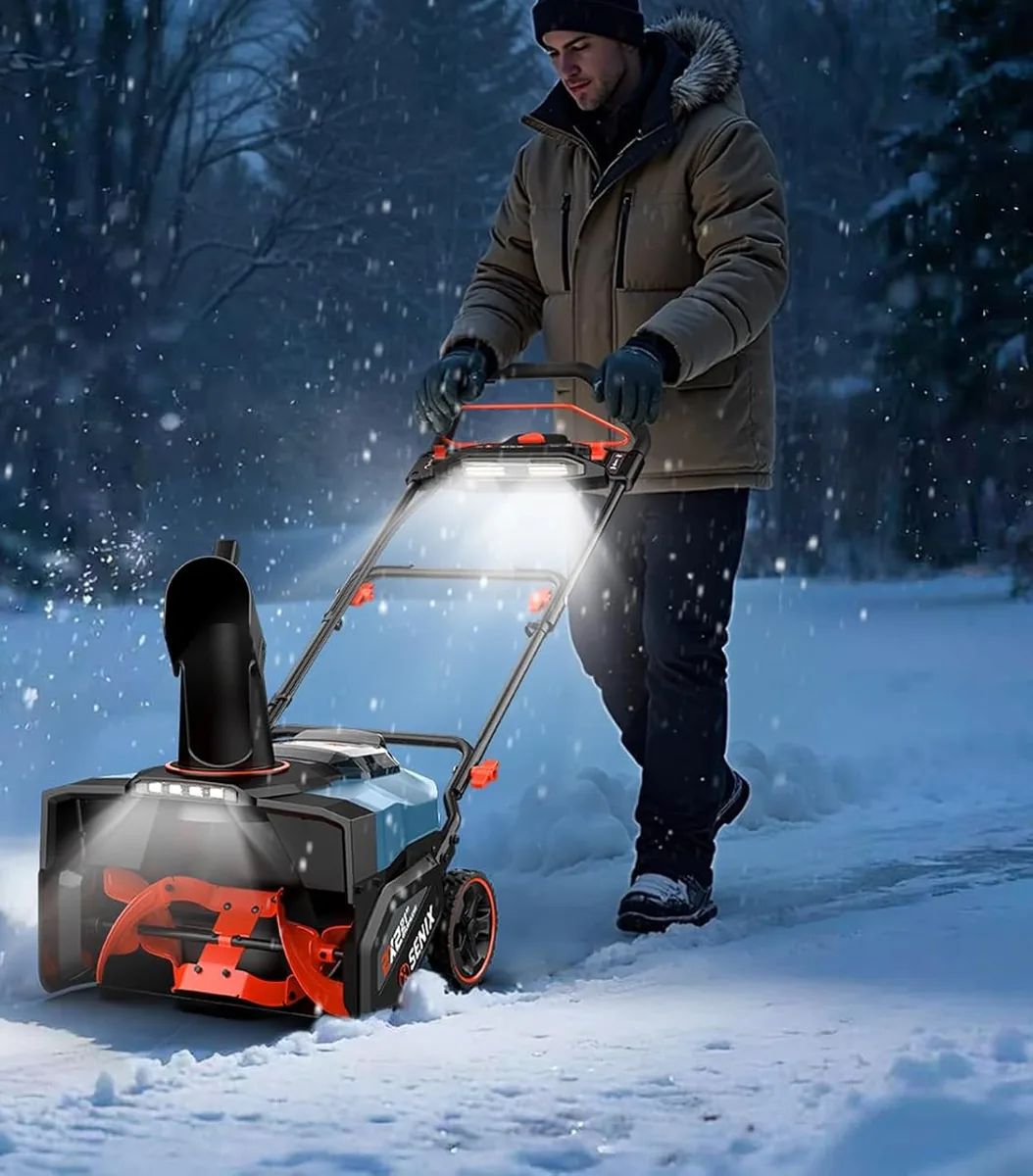
Do not walk faster than the auger can clear. If the chute packs, release the lever, take out the battery packs, wait 10 seconds and use a stick, because the kit has no clean-out tool.
Wear hearing protection and eye protection, clear stones, toys and cords before the first pass, and aim the chute away from people, vehicles and windows. The manual’s symbol table keeps bystanders at least 33 ft away.
SENIX prints no weather rating, and its symbol table says do not expose the unit to rain or wet conditions and keep it dry. So I wipe it down after use with a damp cloth and a soft brush, never a hose, and store it dry with the packs out. A pack that is too cold will not start the machine, and SENIX’s fix is ten minutes on the charger. After the last pass I run the machine a few minutes, turn the deflector several times and wipe off the ice, which is the shutdown the manual asks for, so the auger does not freeze overnight.
Use it on a walk, a patio and a paved drive of one to three cars, with light powder, in a household that already owns SENIX X2 tools. Skip it for a long or wide drive, gravel, heavy wet snow, the plow ridge, and for anyone who wants a machine that stays outdoors in the rain. Its weakest point is runtime.
FINAL VERDICT
Pick the STX2-M1 when the job is short, the surface is paved and you want a full-width battery machine without a premium bill. The 15 minute maximum is its limit, and it is the honest price of the low entry cost. A long drive in one go needs more stored energy than this kit holds.
It is the low-cost 21 in single-stage for a short paved job.
4. Westinghouse WSnow20 20-Inch Corded Electric Snow Blower Best Corded Electric
The Westinghouse WSnow20 is the best corded electric snow blower on this page for a short paved drive, a walk and a porch apron: a 20 in path at 31.1 lb, with no battery to charge and no pack to keep warm. It carries Best Corded Electric because it is the lighter of the page’s two plug-in machines on the maker’s own weights, and a published two-year warranty sits behind it.

WHY I CHOSE THIS ✓
The deciding fact is weight: it is the plug-in machine I can carry up the shed step without thinking about it. At 31.1 lb it stays out of the way when the weather turns, and Westinghouse publishes its warranty terms. I recommend it to a buyer with a short paved run and an outlet at the house.
Westinghouse WSnow20 20-Inch Corded Electric Snow Blower Specs
Key Features:
- 15 A corded motor: It runs for as long as the cord reaches, and no pack goes flat halfway down the drive.
- Start button plus bail lever: The machine cannot start by accident with the cord plugged in.
- Crank chute and squeeze deflector: The crank turns the chute 180 degrees and the deflector sets the height of the stream.
- Cord retainer hook: The hook holds the extension cord loop so the plug does not pull out on a turn.
- Dual LED headlights: They light the pass before sunrise.
The WSnow20 takes a 10 in bite and cuts a 20 in path, so a 40 by 30 ft pad is a handful of passes on a hard, level surface where a low scraper works cleanly. Westinghouse rates the throw at up to 29.5 ft, a best-case figure. The manual rates continuous work above 23 F, and on my plain that covers most winter days, since the January mean at lowland stations sits close to freezing.
The cord sets the real working radius. Westinghouse’s chart calls for 14 AWG up to 25 ft and 12 AWG up to 50 ft, with an outdoor-rated cord and a GFCI outlet, and I do not run it across a longer reach than that chart allows. Start each pass on the outlet side of the drive. I begin at the outlet and work away, so the cord trails behind me.

The manual says to unplug the machine before you turn the chute crank or set the deflector. I pull the plug first, every time, because a tired hand can find the lever.
Keep hands out of the chute. Unplug the cord, wait until every moving part has stopped and use a stick or a clean-out tool, because the kit includes none.
The WSnow20 is not for gravel: the manual says stones can be picked up by the air inlet and thrown at the operator or bystanders, so a stone yard stays a shovel job. It is not for rain or ice either. Wipe it dry and fold the handle down for storage; the drive belt is the first suspect when the auger turns but the snow does not move.
A short paved drive within reach of an outlet fits it, along with light to moderate dry snow and a buyer who wants the lightest plug-in machine. Skip it for gravel, deep or wet snow, long drives and anyone who dislikes dragging a cord.
FINAL VERDICT
Plug in the WSnow20 if an outlet is close to the work and the job is light. At 31.1 lb it asks little of you, and the cord is a cost you accept up front.
It is the light plug-in blower I keep by the shed door.
5. SKIL PWR CORE 40 SB2001C-10 20-Inch Snow Blower Best for Small Driveways
The SKIL PWR CORE 40 SB2001C-10 is the single-stage I pick for a small paved drive: a 20 in path, a 10.5 in intake and a printed splash rating of IPX4, all on one 6.0 Ah pack. SKIL’s own claim is 6 inches of snow from a 6-car driveway on a single charge, and that is the size of job it is built for.

WHY I CHOSE THIS ✓
The small-drive label fits because one pack covers the job it is built for, with no premium pack pair. It comes with a printed weather rating and a printed temperature range, and the chute crank means I turn the stream without stopping. I recommend it to a buyer with a short paved drive and a walk.
SKIL PWR CORE 40 SB2001C-10 20-Inch Snow Blower Specs
Key Features:
- One 6.0 Ah pack and a 150 W charger: The kit is complete, and the pack fits one port, so the machine runs on one pack at a time.
- Remote crank at the grip: It turns the chute 180 degrees from the handle, and a trigger sets the deflector from 0 to 48 degrees.
- IPX4 splash rating: SKIL prints it for splashing water, which is not the same as standing water or rain.
- Printed operating range: The manual recommends -4 F to 50 F for the tool.
- Quick-fold handle: It folds to a storage position for a shelf.
A small drive is the right scale for this machine. The 20 in path and the 10.5 in intake set the pace for a paved drive, and snow taller than the intake goes in layers, top first. SKIL says up to 30 ft of throw, a best-case figure, and I aim the stream at the nearest open strip.
The one-port design is the trade-off. A long drive needs a second 40V pack swapped in, and SKIL publishes no minutes of runtime. The machine cuts out at 158 F battery temperature, and the manual says to slow down and narrow the swath afterwards, so I treat a cut-out as a signal to ease off.

The manual wants the pack stored in an enclosed area that does not fall below 32 F. Keep the spare pack in the house, not in the shed.
Never reach into the chute. Release the bail switch, take out the battery, wait 10 seconds and use a wooden rod or a stick, because no clean-out tool is in the box.
The SKIL manual says not to use it on a graveled surface and warns against ice, so a stone yard and a frozen puddle are both shovel jobs. IPX4 covers splashes, so on a thaw day with water standing on the pad I leave the machine in the shed until it drains. The belt is a job for an authorized station, and the warranty does not cover belts or scraper bars.
Its home is a small to medium paved drive, a walk and a porch, and a household on the SKIL 40V platform. Skip it for gravel, ice, deep wet snow, a plow ridge and an unheated shed for the pack. Check the seller, delivery terms and return policy on the listing before you order.
FINAL VERDICT
Take the SB2001C-10 for a small paved drive where one pack covers the job and a printed weather rating matters to you. The single port is its limit. A long drive in one go asks for a second pack.
It is the compact single-stage for a small paved drive.
6. SENIX 40V 18-Inch Cordless Snow Blower Best Budget Battery
The SENIX STX2-M is the cheapest way onto this page’s battery side: an 18 in path, 8 in of cutting depth and a 31.1 lb tool, with both packs and the charger in the box. It carries Best Budget Battery because it has the lowest price of the battery kits here, and I name the cost plainly, which is a short runtime. SENIX prints a maximum of 18 minutes.

WHY I CHOSE THIS ✓
It is the lowest entry price for a real battery single-stage. Both packs and the charger come in the box, and the 18 in path handles a walk and a small drive. I recommend it to a first-time buyer with a short paved run and a modest budget.
SENIX 40V 18-Inch Cordless Snow Blower Specs
Key Features:
- Rated output of 1,500 W: The brushless motor drives a dual-blade steel auger with rubber plates.
- Auger speed lever: It sets how fast the snow is removed and how far it travels, between 0 and 1,800 rpm no-load.
- Chute control rod: The handle at the grip turns the chute 180 degrees, and a squeeze trigger sets the deflector height.
- Built-in LED light: It comes on with the machine.
- Complete kit: Two packs and a charger come in the box.
The 18 in path is the size of a walk, a landing and a small drive. On the 4 ft path to my house door it means three passes with a little overlap, and the 8 in cutting depth is the figure to respect, since anything taller goes in layers. SENIX rates up to 460 lb of snow a minute, a maker figure with no test method behind it.
As a single-stage battery snow blower it is light at 31.1 lb per the manual, and that matters on steps and tight corners. The auger touches the ground, and the manual’s gravel line is blunt: the machine is not for a graveled surface unless you push down on the handle to lift the scraper above the stones. Stones can still be thrown, so I keep it on pavement.
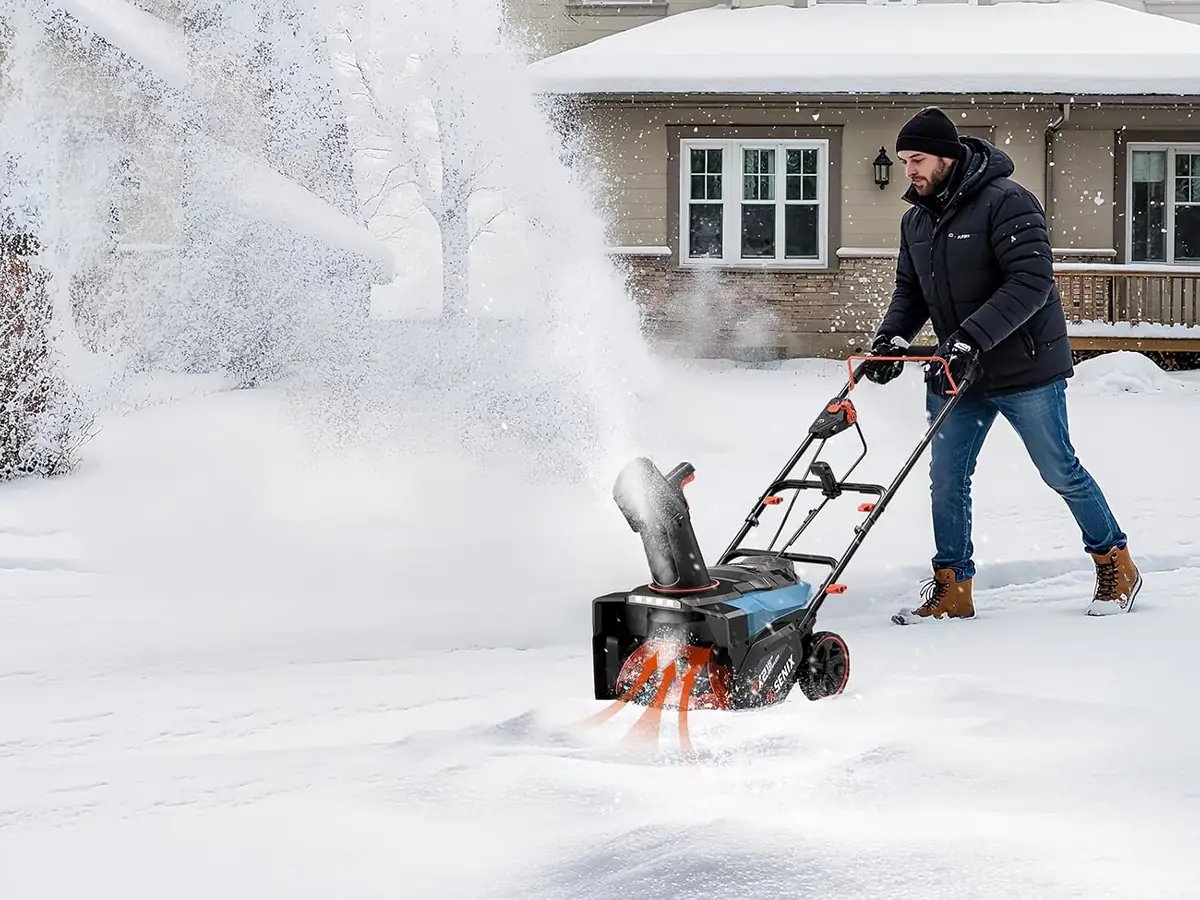
Before the first run, check that the rubber plates are screwed down and face the right way, then run the auger and see that it turns freely. That check takes a minute and prevents a bad first pass.
Never put a hand into the chute. Stop the motor, wait 10 seconds, take out the packs and use a stick or a clean-out tool, which the delivery list does not include; keep people and pets 33 ft away.
SENIX’s manual recommends storing the tool and packs at 50 F to 80 F, so my unheated machinery shed is outside that range and the machine winters in the house. The symbol table says do not expose it to rain or wet conditions and keep it dry, and I clean it with a damp cloth only. The belt and the scraper bar are the serviceable parts. There is no drive, so you do the pushing.
It fits a deck, a landing, a short walk, and a one- or two-car paved drive with light powder. Skip it for a long drive, gravel, heavy wet snow, the plow ridge and an unheated storage shed. Its depth and runtime limit it to small jobs.
FINAL VERDICT
Take the STX2-M when the job is a walk or a small drive and the budget is tight. The short runtime and the 8 in depth are what the low entry price buys.
It is the entry-level battery single-stage for walks and small drives.
7. PowerSmart 21-Inch 15-Amp Corded Electric Snow Blower Best 21-Inch Corded
The PowerSmart DB7521 is the plug-in I look at when the outlet sits far from the work: a 21 in path, a 12.5 in cut and a cord allowance of up to 150 ft on 12 AWG wire. It carries Best 21-Inch Corded because it cuts a wider path than the page’s other corded pick and the manual allows the longest extension cord of the two.

WHY I CHOSE THIS ✓
It cuts the widest path of the plug-in pair and tolerates the longest cord, which suits a wide pad or a long run from the house. The 21 in cut means fewer passes across a parking pad, and the long cord allowance keeps the outlet at the house. I recommend it to a buyer who has the outlet and a long walk to clear.
PowerSmart 21-Inch 15-Amp Corded Electric Snow Blower Specs
Key Features:
- 15 A corded motor: It runs for as long as the cord reaches, with no pack to charge.
- Long cord allowance: The manual allows 14 AWG up to 100 ft and 12 AWG from 100 to 150 ft, and no cord longer than 150 ft.
- Three-mode LED headlight: It has high, low and flash settings for a start before daylight.
- Crank chute: The crank turns the chute 180 degrees, and two knobs set the deflector.
- 8 in rear wheels: The maker lists large rear wheels for rolling over the pad.
A 21 in path and a 12.5 in cut make the passes on a wide parking pad or a two-car drive count. PowerSmart rates the throw at up to 30 ft, which is a best-case figure, and I set the chute downwind with the crank before the first pass. On open ground the Košava can send the stream back at you.
The cord is the planning problem. From an outlet at the machinery shed the pad is well inside 100 ft, so a 14 AWG outdoor cord is enough, and a longer run to the farm gate is the case where the manual’s 12 AWG allowance matters. The manual says to start near the outlet and work outward, and to stop over the cord and pivot to reverse direction. That is how a corded electric snow blower earns its keep: you plan the pass around the cord before you press the start button.
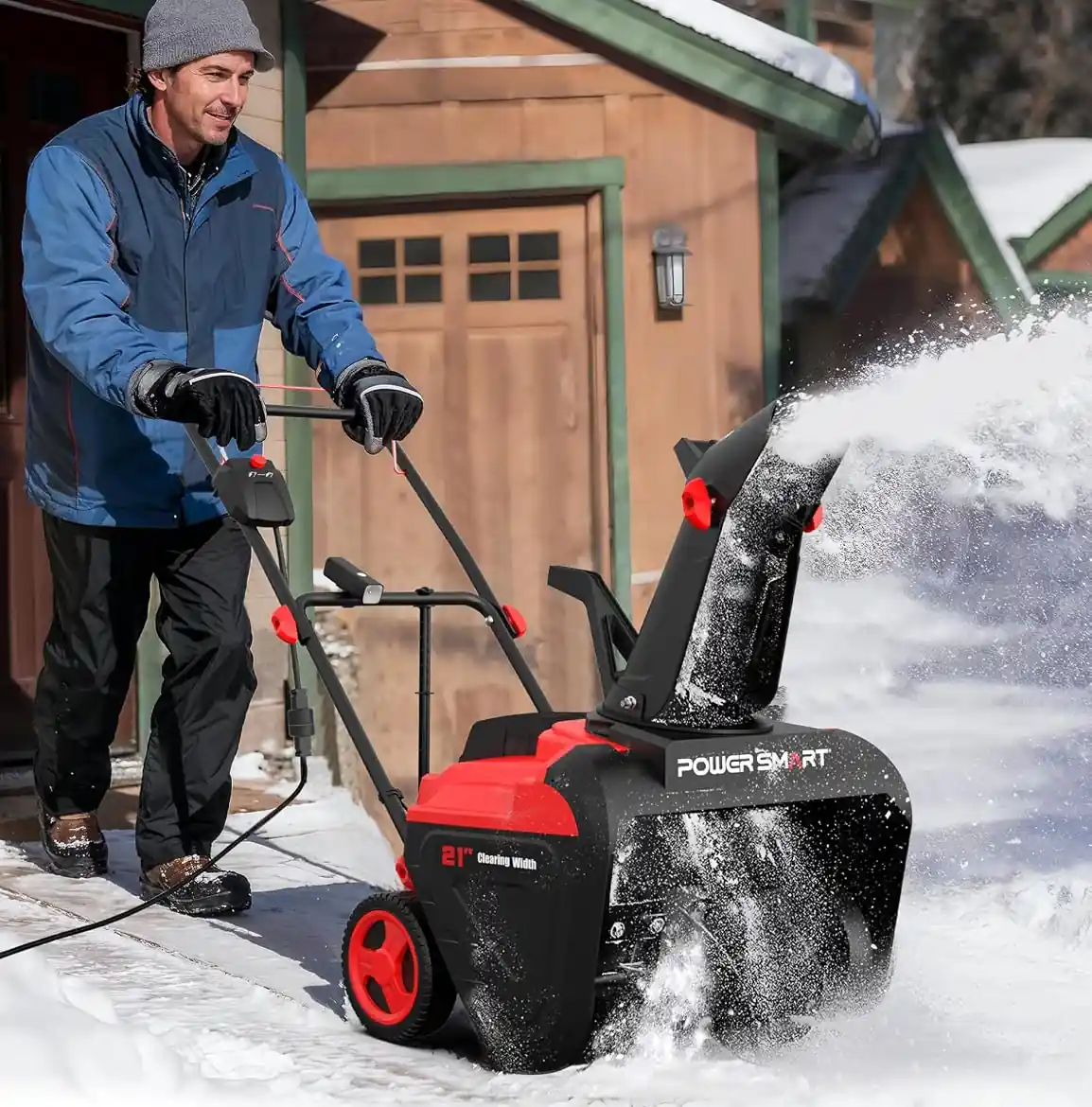
Hold the start button, pull the bar to the handle and release the button once the auger runs. Release the bar to stop.
Unplug the machine and wait for every part to stop before you touch the chute, and use a stick or a clean-out tool, never a hand. Keep a stick by the door, because the box may not hold a tool.
At 40 lb net, this is the heavier of the page’s two corded machines, and I feel it on a turn at the end of a pass. The manual says the machine is intended for paved surfaces: on pebbles you push down on the handle to lift the scraper, and stones can still be thrown, so a stone yard stays a shovel job. The motor has carbon brushes, a wear part, and the drive belt is the first suspect when the auger turns but the snow does not move. Use a UL-rated outdoor cord, and never run the machine in rain or in damp or wet places.
Put it on a wide paved pad or a two-car drive with an outlet nearby, and a buyer who wants the wider path. Skip it for gravel, deep or wet snow, and a home with no outlet near the work.
FINAL VERDICT
Choose the DB7521 when a wide paved area sits within reach of an outlet and 40 lb on a turn does not bother you. The path is the draw.
It is the wide plug-in for a paved pad with an outlet close by.
How to Choose the Best Single-Stage Snow Blower
A single-stage machine has one auger that does all the work and touches the ground, so the surface and the snow decide the buy. I check eight things in the order below, and the first is snow depth, because the housing sets how much snow a machine takes in one bite. If your drive is short and narrow, my best snow blower for small driveway list ranks seven machines for exactly that.
Snow Depth, Intake Height and Wet Snow
Intake height is the height of snow the housing takes in at once, and a machine clears anything taller in layers, top first. In independent testing, battery single-stage machines handle roughly under 6 inches, some to 9, and gas single-stage machines about 9, so the class limit comes well before the print on the box.
| Class | Typical intake | Depth it handles |
|---|---|---|
| Single-stage battery or corded | 8 to 13 in | Roughly under 6 in, some to 9 in |
| Single-stage gas | 12 to 13 in | About 9 in |
| Two-stage battery | 20 to 21 in | 12 in or less, some to 16 in |
| Two-stage gas | 20 to 23 in | About 16 in |
Snow near freezing changes the sum. In a forecasting study of snow density, the fluffiest snow, at ratios above 25 to 1, turned up less than 5 percent of the time when the low-level air was near or above about 27 F, and snow with more liquid water in it is denser and heavier per inch (1). On my plain the January mean sits close to freezing, so I judge a machine by the heavy inch and not by the deep one.
Key Takeaway
Buy for the wettest inch you get in a bad week. A machine that clears dry powder with ease can still pack its chute in snow near freezing.
Clearing Width Against Your Route
Width sets the number of passes, and the narrowest point on your route sets how wide you can go. The seven machines here cut 18 to 21 in, and the overall width runs wider than the cut, so I read the dimensions before I trust a number. My Senix versus Skil snow blower comparison sets a 21 in machine beside a 20 in one.
| Clearing width | Suits | Watch for |
|---|---|---|
| About 18 in | A deck, a landing, a short walk and a one- or two-car drive | Shallow cutting depth and a short runtime |
| 20 to 21 in | A short to mid-length paved drive and the walks around a house | Weight, and the cord or the second pack |
Before I read any width I mark the narrowest point on my route, which is the 4 ft path to the house door.
- Door and gate: the machine’s overall width plus a hand’s width on each side.
- Turning room: the end of the pad, where you tip the machine onto its wheels to pivot.
- Steps and lips: a raised edge catches the scraper bar, and a machine that does not fit the route stays in the shed.
Single-Stage Electric Snow Blower: Battery or Corded
A single-stage electric snow blower comes in two forms, and each moves its limit somewhere else. A battery machine makes no exhaust and trails no cord, and its limit is the energy in the packs. A corded machine runs as long as the cord reaches, and the cord is its limit. My best electric snow blower list covers corded and battery machines for easier clearing.
- Battery: count the packs in the box and read the rule for one pack. One maker rules out a single pack above 3 inches of snow, and in very wet or icy snow.
- Corded: read the cord chart. One manual calls for 14 AWG up to 25 ft and 12 AWG up to 50 ft, and another allows 12 AWG up to 150 ft. My Westinghouse versus PowerSmart comparison sets the two plug-in machines side by side.
- Both: treat a maker’s throw distance and driveway claim as a best case, since snow type and wind change them.
Keep It Dry
A corded machine is not for rain, and its manual says so. A GFCI outlet protects you from a shock and does not make wet use acceptable.
Weight, Pushing and Turning
Most machines here are push machines, and the makers’ tool weights run from 31 lb to 66 lb, so you lift, steer and pivot the weight yourself. One is auger-propelled, which I explain in my EGO SNT2125AP full review: lift the handle and its paddles pull it ahead, but nothing powers its wheels, so it is not self-propelled in the wheel-drive sense. Against the shovel I used before, my shoulders and lower back notice the difference.
The effort gap has a measurement behind it. In a small test, ten healthy men cleared heavy, wet snow 10 cm deep at 2 C, and heart rate, blood pressure and perceived effort were lower with an electric snow thrower than with a shovel (2). The men were healthy, so the test says nothing about a heart condition, and anyone with one should ask a doctor before clearing snow by any means.
- Slopes: one maker caps its machine at grades of 10 percent, so work across the grade and not up it. If your drive climbs more steeply than that, my steep driveway snow blower list covers tracked and wheeled models for slopes.
- Reverse: one manual warns about slipping when you work in reverse, so plan the pass to avoid backing up.
- Storage: a lighter frame lifts onto a shelf, and a heavier one needs a ramp or a plan.
Throw Distance and Chute Control
Makers print throw as “up to” a distance in good snow, and the seven range from about 20 ft to 45 ft. Wet snow, wind and a low auger speed shorten it, so I read the number as a ceiling. I aim the stream at the open grass strip, with the wind or across it, and never at the tree strips or the drip lines.
- Chute rotation: a crank, handle levers, a rod or a button turns the chute 180 to 200 degrees.
- Deflector: it sets the height of the stream, and a low setting shortens the throw.
- Auger speed: a dial or lever on some machines sets the distance, and a worn paddle shortens it.
Packs, Charging and the Cold
Cold costs a battery twice. Lithium-ion cells lose available energy in the cold and their internal resistance rises, according to a review of vehicle batteries (3), and charging has its own window. A corded machine has a cold limit too: one manual rates continuous work above 23 F.
| Question | What the manuals say |
|---|---|
| Start | EGO: a pack at -4 F or colder may not start the machine, so warm it indoors for 10 minutes or more |
| Charge | EGO and SKIL: charge between 41 F and 104 F |
| Store | SENIX 18 in: tool and pack at 50 F to 80 F. SKIL: battery where it stays above 32 F. EGO: packs where it stays above -4 F |
I charge both packs the night before a forecast storm and keep every pack in the house until I need it. My best battery snow blower list ranks battery machines by pack size, runtime and cold weather.
Surface and the Gravel Limit
In a single-stage the auger touches the ground, which is why it leaves pavement clean and why gravel is its hard limit. The manuals say so plainly. One maker rules out a graveled surface outright, another allows it only if you push down on the handle to lift the scraper, and a third says the machine is for paved surfaces. Stones can be thrown either way. For a stone drive, my best snow blower for gravel driveway list compares five two-stage options.
- Hard, level pavement: the scraper rides close and leaves a clean finish.
- Gravel or crushed stone: the auger picks up stones and throws them, so shovel that strip.
- A raised edge or a seam: the scraper bar catches, so slow down and take it square.
- Cracks: the skid shoes on one maker’s machine adjust for uneven pavement, and not for stone.
Before the first fall I walk my route and mark every place where concrete gives way to stone.
Safety First
Clear stones, boards, toys, cords and wires before the first pass, and keep people, pets and windows out of the throw. One maker keeps bystanders 100 ft away.
Clearing a Clog and Staying Safe
The real danger sits at the chute. In a US sample of emergency department visits, hand injuries from clearing a clogged snow blower ran into the tens of thousands, and about 22 percent of them were amputations (4). Across 2003 to 2018, putting a hand into the chute was 44.5 percent of the injury mechanisms (5).
Wet snow near freezing is where machines clog, and my best snow blower for wet snow list ranks the models that fight clogs. After one heavy, dense snowfall in Worcester, 37 patients came in with snow blower hand injuries, 95 percent of them admitted reaching into a running machine, and 30 percent believed the blades were disengaged (6). The same order works for every machine here:
- Release the controls.
- Stop the motor and take out every battery pack, or unplug the cord.
- Wait the time the manual gives, 10 seconds in the EGO, SENIX and SKIL manuals, until every moving part has stopped.
- Use the clean-out tool, or a stick when the kit has none, and never a hand.
Most of the kits here list no clean-out tool in the box, so I tell everyone who helps me the same rule: nobody’s hand goes near the chute, even for a second.
Never a Hand
Never clear a jam with a hand, and only after the motor is stopped, the packs are out or the cord is unplugged, and the wait is over. Wear eye protection and hearing protection every time the machine runs.
Single-Stage vs Two-Stage Snow Blower: Which One Do You Need?
The difference is where the work happens. A single-stage auger scoops and throws the snow in one step and rides close to the ground, while a two-stage auger breaks the snow and a separate impeller throws it, with the machine resting on skid shoes.
| Question | Single-stage | Two-stage |
|---|---|---|
| Intake | 8 to 13 in for the machines here | 20 to 23 in |
| Depth it handles | Battery under 6 in, some to 9 in; gas about 9 in | Battery 12 in or less, some to 16 in; gas about 16 in |
| Gravel | Auger touches the ground and picks up stones | Auger stays off the ground, and gravel works only where the manual allows it with the skid shoes set high; stones can still be thrown |
| Weight | 31 to 66 lb, makers’ tool figures | About 143 lb for a 24 in battery tool without packs, over 230 lb for a gas machine |
| Best fit | A short paved drive with light snow | A long drive, a plow ridge, deep or wet snow |
I work two surfaces: the paved pad and path by the house, and the stone lane to the orchard. A single-stage cleans the first, and the second is a job for a two-stage snow blower or a shovel.
Skip the single-stage when the drive is gravel, when the snow often runs deeper than the intake, or when a plow leaves a hard ridge across the gate. Choose it when the drive is short and paved, you want less to store and less to push, and the snow arrives a few inches at a time. For a long drive, my large driveway snow blower list covers wider machines.
Gas, Battery or Corded: What Fits a Single-Stage
The three power sources differ in what they ask of you before the first storm, and gas is the one this page does not rank. My cordless snow blower list covers machines from porch steps to long driveways.
A single-stage gas snow blower is a real category, with an engine where the motor would be and a depth of about 9 in against under 6 in for battery in independent testing. I rank none here, so this page covers battery and corded machines, and the notes below say what a gas buyer takes on.
- Fuel: makers warn that gasoline can go stale in as little as 30 days, so plan for fresh fuel and a stabilizer.
- Outdoors only: a gas engine starts and runs outdoors only, never in a garage with the door open, because the exhaust carries carbon monoxide.
- Upkeep: oil, spark plug and storage steps differ by engine, so read that engine’s manual. My gas snow blower list covers two-stage machines for gas buyers.
A corded electric snow blower trades the pack for a cord, so the outlet decides where it works. Start at the outlet, work away from it and keep the cord behind you.
| Source | Before the storm | During the job | Its limit |
|---|---|---|---|
| Battery | Charge the packs indoors | Swap packs on a long drive | Stored energy |
| Corded | Lay out a cord of the right gauge | Work away from the outlet | Cord reach |
| Gas | Fresh fuel and a stabilizer | Refuel outdoors on a cool engine | Fuel plan, noise and weight |
If your winters bring snow only a few days a year, as mine often do, I weigh the storage plan more than the raw power. A corded machine waits in the shed without going stale, and a battery machine waits with its packs in the house.
My Overall Verdict
I ranked these seven on what decides a single-stage: the surface it can touch, the snow depth it takes, the pack or cord plan behind it and the weight you push. The top three suit three different drives. If the power source is still open, my snow blower picks cover gas, battery and corded machines side by side.
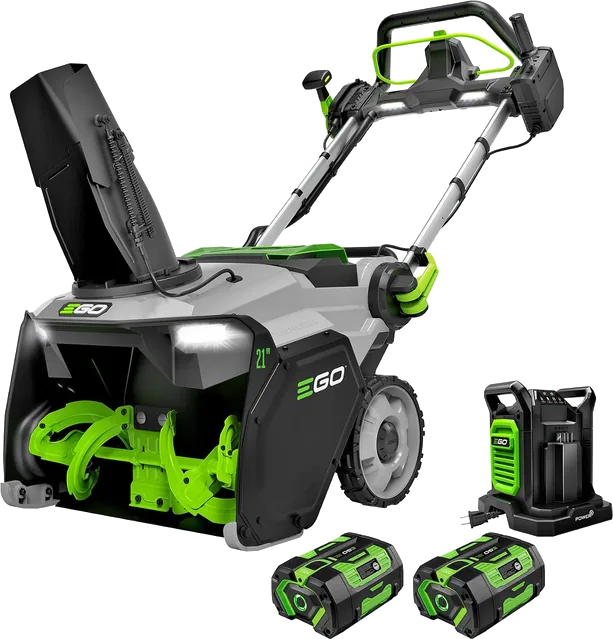
1. EGO Power+ SNT2134 21-Inch Single-Stage Snow Blower Best Overall
For a paved drive and walks of a few car lengths, where a complete kit with two 6.0 Ah packs and a 21 in path matters most.
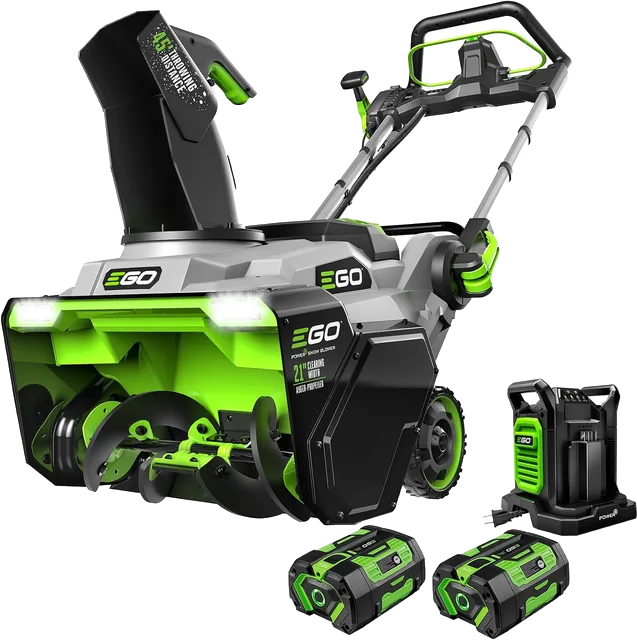
2. EGO Power+ SNT2125AP 21-Inch Auger-Propelled Snow Blower Best Premium
For a long paved drive, where a paddle drive that helps pull the machine and 7.5 Ah packs are worth a premium.

3. SENIX STX2-M1 40V 21-Inch Cordless Snow Blower Best Value
For a short paved drive and a walk, where a 21 in battery machine at a budget to mid-range tier matters more than runtime.
Walk your route first and mark where the pavement ends, then buy for the wettest inch you get. The EGO SNT2134 covers the most paved-drive jobs with the least extra to buy, which makes it the best single-stage snow blower for most paved drives. I weigh the push model against the auger-propelled option in my EGO SNT2134 vs SNT2125AP comparison.
Why EGO Power+ SNT2134 21-Inch Single-Stage Snow Blower Might Be the Best Choice
I put the EGO Power+ SNT2134 21-Inch Single-Stage Snow Blower first because the box already holds the setup its manual asks for: two 6.0 Ah packs and a dual port charger, behind a 21 in path and a 13 in intake.
The trade is push weight and a hard stop at stone. At 66 lb without the packs you are the drive system on a long drive, and EGO’s manual says not to use the machine on a graveled surface. My EGO SNT2134 full review gives my verdict on this 21-inch cordless machine.
What puts it first:
✓ Kit: two 6.0 Ah packs and a dual port charger come in the box.
✓ Path: 21 in per pass keeps the number of passes down.
✓ Intake: a 13 in opening, the tallest of the seven, with snow beyond it cleared in layers.
✓ Controls: the chute and the deflector are set from the handle, with 200 degrees of rotation.
✓ Warranty: EGO backs the tool for 5 years.
Frequently Asked Questions
Is a single stage snow blower good?
A single stage snow blower is good for a paved drive with a few inches of snow at a time, because its auger scrapes down to the surface. It is the wrong tool for gravel, a plow ridge or deep wet snow, where the auger throws stones, stalls or leaves a layer behind.
What is the difference between a single and double stage snow blower?
The difference between a single and double stage snow blower is that a single stage uses one auger to gather and throw the snow, while a double stage adds an impeller that throws it. That extra stage handles deeper, packed snow, and gravel only where the manual allows it, at more weight and cost.
Which snow blower throws snow the farthest?
Of the seven machines here, the EGO SNT2134 and SNT2125AP throw snow the farthest, up to 45 ft by EGO’s figure. That is a best-case maker number for ideal snow, and wet snow, wind and a low auger speed shorten the throw, so plan for less on a heavy day.
What is a single-stage snow blower?
A single-stage snow blower is a walk-behind machine whose one auger gathers the snow and throws it out of the chute in a single step. Because that auger touches the ground, it leaves pavement clean on a paved drive, but it is not meant for gravel, and its intake is shallower than a two-stage machine’s.
Can you provide a comparison chart of EGO snow blowers?
The two EGO snow blowers here share a 21 in path, a 13 in intake and a 45 ft maker throw. The SNT2134 is a 66 lb push machine with 6.0 Ah packs, while the SNT2125AP is a 60 lb auger-propelled machine with 7.5 Ah packs, both weights without packs.
References
- Ware EC, Schultz DM, Brooks HE, Roebber PJ, Bruening SL. Improving Snowfall Forecasting by Accounting for the Climatological Variability of Snow Density. Weather Forecast. 2006;21(1):94-103.
- Franklin BA, Hogan P, Bonzheim K, et al. Cardiac Demands of Heavy Snow Shoveling. JAMA. 1995;273(11):880-882.
- Jaguemont J, Boulon L, Dubé Y. A comprehensive review of lithium-ion batteries used in hybrid and electric vehicles at cold temperatures. Appl Energy. 2016;164:99-114.
- Hammig B, Jones C. Hand injuries associated with reaching into a snow blower to clear clogged snow. Am J Emerg Med. 2020;38(4):785-788.
- Loder RT, Solanki D. Events Due to Snowblower Use Seen in US Emergency Departments From 2003 Through 2018. Cureus. 2020;12(12):e11836.
- Tetz DJ, Aghababian R. Hand Injuries From Snow Blowers: A Report of an Epidemic. Prehosp Disaster Med. 1995;10(4):265-267.
Safety Note: Snow blowers throw snow, ice and hidden objects with force. Never reach into a clogged chute or auger. Shut the machine off first: stop the engine on a gas model, unplug a corded model, or remove the safety key and every battery pack from a battery model. Wait at least as long as your manual says, often 10 seconds, and until every moving part has stopped, then remove the key and disconnect the spark plug wire where your manual says so, and clear the clog with the clearing tool. Keep people and pets out of the discharge path, run gas models outdoors only, and read the manufacturer’s manual.