

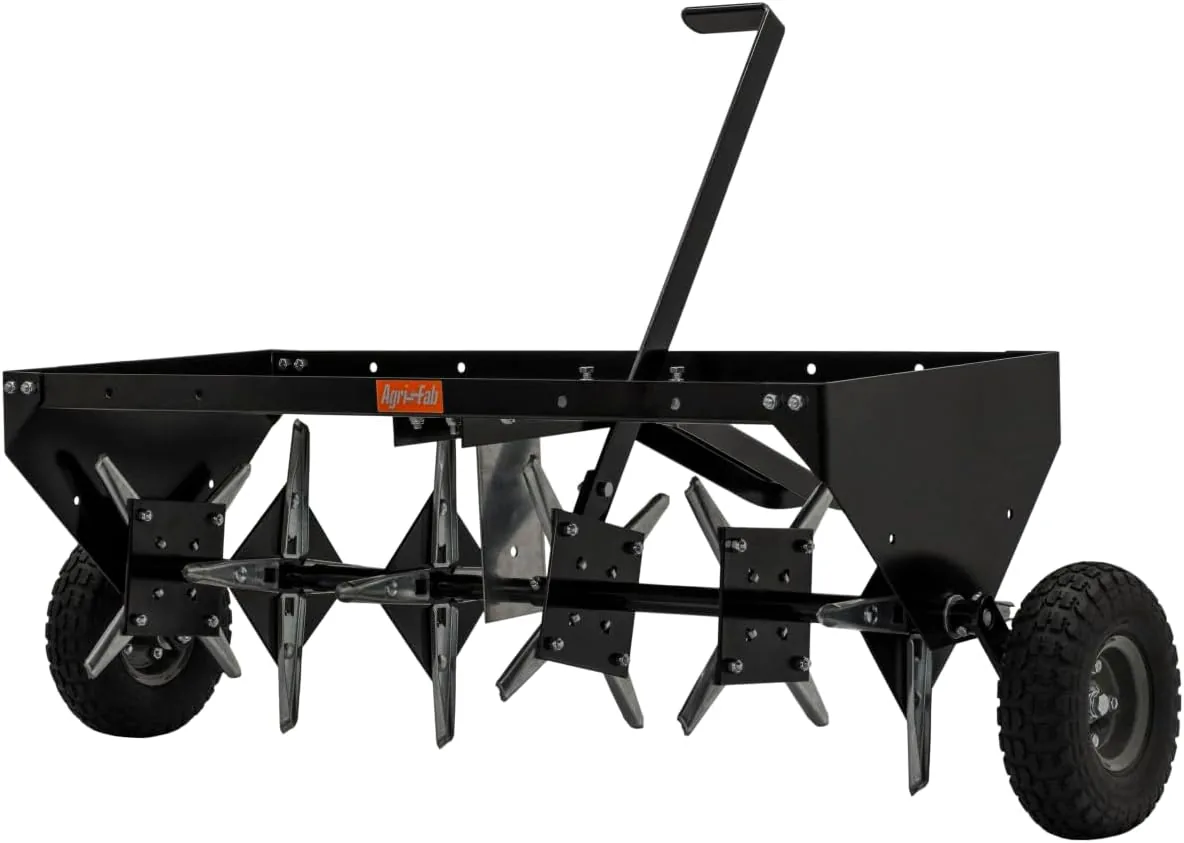
Agri-Fab 45-0518 vs CRAFTSMAN CMXGZBF7124213 is a choice between two badges on one machine, and I pick the Agri-Fab 45-0518 for most yards. Both are 40 inch tow-behind plug aerators with 24 knives and a tray for up to 140 lb of ballast, and the Agri-Fab sits in the lower price tier. The CRAFTSMAN wins when flat-free tires, a printed plug size and a numbered manual matter more to you than the saving. I checked both carton lists against the parts and read both manuals line by line, the way I once checked a seed drill against its setup sheet before sowing.
Agri-Fab 45-0518 vs CRAFTSMAN CMXGZBF7124213 Short Answer and Specs Table
Buy the Agri-Fab 45-0518 if you want the job done at the lowest cost of entry, and buy the CRAFTSMAN CMXGZBF7124213 if you want extras around the same job. Both are one Agri-Fab design: the same 40 inch width, the same 24 galvanized knives, the same 140 lb tray and the same promise of plugs up to three inches long, as both manuals put it. The table gives each figure with the party that states it.
| Feature | Agri-Fab 45-0518 | CRAFTSMAN CMXGZBF7124213 |
|---|---|---|
| Aerator type, per the manual | Tow-behind plug (core) aerator | Tow-behind plug (core) aerator |
| Working width, maker’s figure | 40 inches | 40 inches |
| Knives, maker’s figure | 24 galvanized knives | 24 galvanized steel coring points |
| Plug size, maker’s figure | Up to 3 inches long per the manual; diameter not published by the maker | 3/4 inch plugs up to 3 inches, per CRAFTSMAN’s product page |
| Weight tray, per the manual | Up to 140 lb of ballast | Up to 140 lb of ballast |
| Unit weight, maker’s figure | 79 lb empty | Not published by the maker |
| Tires, maker’s product page | 10 by 3 inch pneumatic on the 45-0518 build | Flat-free |
| Hitch and handle, per the manual | Hitch pin, hair cotter pin, lift handle with lever | Hitch pin, hair cotter pin, cantilever lift handle |
| Assembly, per the manual | Required; four wrench sizes listed | Required; 13 steps, one called difficult |
| Warranty, maker’s terms | 3 years, original purchaser | 3 years, defects in materials and workmanship |
| Storage, maker’s pitch | Not covered in the manual | Stands upright against a wall |
| Price tier | Lower tier of the plug units | Mid-range |
Price tier, tires and paperwork decide it. On the knives and the tray, the two units are level, so the choice comes down to what you value around the soil work.
Same Design Under Two Names
Agri-Fab builds both machines. The CRAFTSMAN listing says it is built by Agri-Fab, and the CRAFTSMAN manual is an Agri-Fab booklet. The carton lists back that up: tray, middle brace, hitch bracket, tongue, two end plates, a shaft, two single spool assemblies, two double spool assemblies, two wheels and 24 knives appear in both.
Two details differ in the lists. The Agri-Fab 45-0518 40 Inch Tow-Behind Plug Aerator manual counts two wheel brackets and a separate lift lever assembly, while the CRAFTSMAN CMXGZBF7124213 40-Inch Tow-Behind Plug Aerator manual counts three wheel brackets. I counted the parts on the bench against both lists and the totals matched.
The Agri-Fab 40 inch plug aerator on the listing is the 45-0518, yet Agri-Fab also publishes a parts sheet for a later 45-05183 build that lists three wheel brackets, the same count as the CRAFTSMAN manual. The box may therefore hold either build. Count the parts against the carton list in your manual before you open the hardware bag.
The CRAFTSMAN manual cover reads CMXGZBF71242131, the model number with a 1 on the end. CRAFTSMAN does not explain the extra digit, so I read it as a part or revision suffix. Treat the CRAFTSMAN as an Agri-Fab plug aerator with another badge, and compare the carton marking with the listing before you buy.
How the Two Compare on Each Deciding Factor
Seven factors separate these two units: plug size, ballast, wheels, assembly, warranty, storage and cost.
Plug Size and Depth
Both makers promise plugs up to three inches long, which matches the 2 to 3 inch core depth that university extension services describe for lawns. Plug length is the figure they state, and hole depth is a separate matter. According to Kansas State Extension, tines do not penetrate far enough in soil that is too dry and clog in soil that is too wet, so real depth depends on moisture and on how much weight sits in the tray. CRAFTSMAN also prints a plug diameter of 3/4 inch, the diameter Kansas State names as its guideline, while Agri-Fab publishes none.
Neither maker gives holes per square foot. Kansas State Extension says three or more passes may be needed for proper hole spacing, so I plan passes. On my quarter-acre house lawn I cross the first set of lines with a second set at right angles.
Winner: CRAFTSMAN, because it prints the plug diameter. For depth it is a tie.
Weight Tray and Ballast
Both trays take up to 140 lb, and both manuals give the same example: bags of sand or four concrete blocks. Added weight can push the knives deeper, and how much you add depends on the soil and on what both manuals and your mower allow, up to 140 lb. Never use people as ballast. Both manuals tell you to dismount before raising or lowering the aerator with ballast in the tray, and to tie the load with straps at the front and rear that cannot reach rotating parts.
Agri-Fab lists 79 lb empty, so a full tray puts the 45-0518 near 219 lb, and I take the blocks out before I move it by hand. Load only what your mower’s manual allows for towing. CRAFTSMAN publishes no weight, so I cannot give you the same sum for its unit. My comparison of Agri-Fab 45-0299 and 45-0518 shows how the 48 inch and 40 inch units differ.

Winner: Agri-Fab, because it tells you what the unit weighs. The tray is a tie.
Tires, Wheels and Hitch
According to Agri-Fab, the 45-0518 build rolls on 10 by 3 inch pneumatic tires, and the later 45-05183 build may differ, so confirm the wheels in your box before you count tires for or against it. CRAFTSMAN says its unit rolls on flat-free tires. An air-filled tire can lose pressure, and Agri-Fab’s warranty excludes tires from the first day. A flat-free wheel has no air to lose, and CRAFTSMAN sells that as a reason to pick it.
On the pneumatic build, Agri-Fab gives no tire pressure, and that bothered me more than I expected: I had a gauge in my hand and no number to hold the tires to. With the CRAFTSMAN there is one check fewer at the start of a season.
Both hitch with a pin and a hair cotter pin through a bracket on the tongue. CRAFTSMAN says its universal design fits any brand of riding mower, and the Agri-Fab listing also calls its hitch universal. Neither maker publishes a minimum tractor size, so the manual of your mower sets the limit. My tow-behind lawn aerator picks compare five units that hitch to a tractor or mower.
Winner: CRAFTSMAN, because flat-free wheels need no pressure checks, if your Agri-Fab box holds the pneumatic build.

Assembly and the Manual
Both units need assembly, and both manuals come in English, Spanish and French. The 45-0518 manual lists two each of 7/16, 1/2, 9/16 and 3/4 inch wrenches, and its English section is short on pictures. The CRAFTSMAN manual walks through 13 numbered steps from a numbered carton list, and it says outright that the lift-handle step is difficult. Both manuals warn that the knife points are sharp, so wear substantial footwear while you build.
I sorted the bolts by size on the bench before the first step, and with the CRAFTSMAN the numbered list let me tick parts off as I counted them. Step 12, the lift handle, is where I stopped and laid the parts out again.
Winner: CRAFTSMAN, for the numbered steps and the numbered parts list.
Warranty and Support
Both come with a 3-year limited warranty. Agri-Fab says its warranty covers the original retail purchaser only, does not transfer and does not apply to products bought from unauthorized online resellers, and that commercial use cuts it to 90 days. It excludes tires, and from the second year it does not cover plug groomer wheels and tines. CRAFTSMAN’s warranty covers defects in materials and workmanship for three years from purchase and excludes normal wear and tool abuse.
For a home owner the two read close to equal, since knives are wear parts under both. Before you rely on either, ask the seller whether your purchase counts as authorized, and keep the receipt.
Winner: CRAFTSMAN, on plainer wording. Neither covers wear.
Storage and Handling
According to CRAFTSMAN, its unit stands upright against a garage or shed wall. The Agri-Fab manual says nothing about standing it up. Both manuals give the same storage steps: clean the dirt off the knives, store the aerator dry and coat exposed metal with light oil.
The knives are sharp whichever way the frame stands, so I handle either unit in gloves and thick-soled boots. Cleaning is the same job on both: I knock the soil off the knives, wipe them and oil the bare steel before the shed door closes.
Winner: CRAFTSMAN, for the wall-storage design.
Value Over Several Seasons
The Agri-Fab 45-0518 sits in the lower price tier of the plug units I compared, and the CRAFTSMAN sits in mid-range. The extra tier changes nothing on the soil side. On the pneumatic build, a tire that fails is not covered by Agri-Fab’s warranty, which is the one cost that can eat part of the saving. My comparison of Agri-Fab 45-0518 and Brinly PA-403BH-A3 puts this Agri-Fab against a 40 inch Brinly plug aerator.
Winner: Agri-Fab 45-0518, because the same machine costs less.
Using Either Unit Safely and Getting the Soil Right
A tow-behind aerator is a heavy tool with sharp knives, and the Agri-Fab tow behind plug aerator and the CRAFTSMAN share the same safety text. Here is what I do and what both manuals require.
- Before the first pass: Mark every sprinkler head, irrigation and drip line, low-voltage lighting wire and buried pet fence wire, call 811, wait the time your state requires and confirm that every utility has responded, and locate private lines yourself. Neither manual covers buried lines, so this comes from general practice. Never aerate where lines are not located.
- Footwear and people: Wear sturdy closed shoes with thick soles, long pants and gloves for handling knives. Both manuals say to keep the work area clear of children and pets, never to let anyone ride on the frame or the towing vehicle, and never to let children operate the tractor or the aerator.
- Slopes and turns: Start in first (low) gear at low engine speed. Stay off steep slopes and work up and down a slope, never across its face. Raise the aerator to the transport position before any sharp turn and before you cross a walk or drive, turn wide, and stay off wet slopes as well.
- Ballast: Never load more than 140 lb. Dismount before you raise or lower the aerator with weight in the tray.
- Clearing and cleaning: Park on level ground, stop the engine, set the parking brake, take out the key and wait until everything has stopped moving, then clear the knives or adjust anything. That order is general practice, not a line from either manual. Keep the aerator off highways and public roads.
Before any pass I walk the lawn where it meets the orchard strip and flag the drip lines, because a knife that reaches a line pierces it. Next to the gravel yard edge, where stones work into the grass, I rake the plugs, as both manuals advise.
Soil moisture decides more than the badge. Both manuals say to water extremely hard, dry ground for one or two hours first and never to aerate muddy ground. Kansas State Extension says the same in its own words: too dry and the tines do not penetrate, too wet and they clog and fail to drop the cores.
Aerate while the grass is growing hard, the soil is moist and the lawn is under no drought stress. Kansas State Extension gives these windows for Kansas, so adjust them to your region:
- Cool-season lawns such as Kentucky bluegrass and tall fescue: March, April and September in Kansas.
- Warm-season lawns such as bermudagrass and zoysiagrass: late May through July in Kansas, after full green-up.
- Growth first: at least four weeks of good growing weather so the plants can fill the holes.
A trial on a sand-based bermudagrass putting green found turf quality dipped for about 4 weeks after each core aerification event (1), so time the pass for fast growth.
Compaction is the reason to aerate. In a field study on Kentucky bluegrass, roller compaction cut aeration porosity in the top 3 cm from 18.1 to 12.5 percent, and the turf used 20 percent less water over four months (2). A greenhouse study found the oxygen diffusion rate in compacted soil stayed below a set level for 143 hours after wetting against 26 hours in uncompacted soil (3). My guide to lawn aerators for compacted soil lists seven picks for hard ground.
The damage lasts. Tall fescue and Kentucky bluegrass were still below normal eight months after compaction stopped in one field trial (4). A plug aerator pulls cores, and that is the method extension services recommend. In a two-year bluegrass trial, hollow-tine plots lost the least green cover under simulated traffic, ahead of solid-tine plots and untreated ground (5).
If you plan a spring pass, a New Jersey trial on bluegrass and tall fescue found that spring hollow-tine cultivation did not significantly raise crabgrass cover (6).
Know Your Lines
Aerating at the wrong time, on dry hard soil, on waterlogged soil or on dormant grass can harm a lawn, and knives cut buried lines. Call 811, mark every line and head, and follow your mower’s manual as well as the aerator’s.
Choose the Agri-Fab 45-0518 If
Choose the Agri-Fab 45-0518 if you want a 40 inch plug aerator at the lower price tier and you are willing to check tire air yourself. My review of the Agri-Fab 45-0518 goes through the 40 inch unit on its own.
- You already own a lawn tractor or riding mower whose manual permits towing this attachment at its loaded weight, and your lawn is too big for a step-on tool.
- You want the unit weight in writing before you load the tray: 79 lb empty, about 219 lb with 140 lb of ballast.
- You can build from a manual that is short on pictures, with four wrench sizes on the table.
- You will keep the receipt and buy from a seller the maker authorizes, because the warranty is for the original retail purchaser.
Skip it if you hate checking tire pressure on a machine that sits in a shed all winter, and the pneumatic build is the one in your box. I check the air in any pneumatic tire before the first job of a season, with or without a maker figure to hold it to, and that is the price of the lower tier.
Choose the CRAFTSMAN CMXGZBF7124213 If
Choose the CRAFTSMAN CMXGZBF7124213 if you want the extras around the knives and accept one tier up in price. My review of the CRAFTSMAN aerator looks at this 40 inch unit on its own.
- You want flat-free tires and no pressure to set.
- You want the plug diameter in writing: 3/4 inch plugs up to three inches, per CRAFTSMAN.
- You want a manual with 13 numbered steps and a numbered carton list.
- You have a free stretch of shed wall to stand the unit against.
The higher tier of this CRAFTSMAN tow behind aerator pays for the extras, since the knives do the same job. Skip it if you want a published unit weight, because the maker prints none. Stood against a shed wall, the way CRAFTSMAN designs it, the unit frees the floor a 40 inch frame would otherwise take, and I still reach for gloves every time I move it.

My Pick Between the Two
I pick the Agri-Fab 45-0518 for most yards, because the knives, the width and the 140 lb tray are the same and the lower price tier is the one difference you feel. I switch to the CRAFTSMAN 40 inch plug aerator when flat-free wheels, a printed plug size or a wall-stored frame matter more than that saving. Whichever badge you buy, aerate moist soil, add ballast only within what the manuals and your mower allow, mark every line and stay off steep slopes. In the Agri-Fab 45-0518 vs CRAFTSMAN CMXGZBF7124213 choice, buy the Agri-Fab if your box holds the build you expect, and spend the saving on ballast, boots and gloves. My best lawn aerator picks cover hand and tow-behind tools for every size of lawn.
Frequently Asked Questions
Do plug aerators really work?
Plug aerators really work because pulling cores is the method extension services recommend for relieving compaction. Results still depend on soil moisture, tray weight and a pass timed to your grass type, so wait for damp soil and active growth, mark every buried line and follow your mower’s manual before you hitch up.
What is the best plug aerator for lawn aeration?
The best plug aerator for lawn aeration is one that pulls cores and carries enough ballast to bite, and both of these units hold up to 140 lb in the tray. For most buyers the Agri-Fab 45-0518 does the same work at a lower price tier than the CRAFTSMAN, which is why I pick it.
Are tow-behind plug aerators any good?
Tow-behind plug aerators are good when you already own a lawn tractor or riding mower and a lawn too big for a step-on tool. They are lighter than the machines rental yards stock, so add ballast within the 140 lb limit and your mower’s manual, work moist soil and plan a second pass where the ground is hard.
What type of aerator should I use?
The type of aerator to use on a compacted lawn is a core aerator, because it removes plugs of soil instead of pushing it aside. A bluegrass trial found hollow tines limited green cover loss best under simulated traffic, and both of these tow-behind units pull plugs up to three inches long with 24 knives.
How much does a pull behind aerator cost?
A pull behind aerator costs the least in the lower price tier, where the Agri-Fab 45-0518 sits, and the CRAFTSMAN sits one tier up in mid-range. Ballast is a separate cost, since neither tray ships with weights, so plan for bags of sand or four concrete blocks before the first job.
References
- Atkinson JL, McCarty LB, Bridges WC. Effect of core aerification frequency, area impacted, and topdressing rate on turf quality and soil physical properties. Agronomy Journal. 2012;104(6):1710-1715.
- O’Neil KJ, Carrow RN. Kentucky bluegrass growth and water use under different soil compaction and irrigation regimes. Agronomy Journal. 1982;74(6):933-936.
- Agnew ML, Carrow RN. Soil compaction and moisture stress preconditioning in Kentucky bluegrass. I. Soil aeration, water use, and root responses. Agronomy Journal. 1985;77(6):872-878.
- Carrow RN. Influence of soil compaction on three turfgrass species. Agronomy Journal. 1980;72(6):1038-1042.
- Dalsgaard TO, Thoms AW, Christians NE, Mertz I, Horton R. Comparison of Shockwave aerification and conventional aerification methods on athletic fields. Agronomy Journal. 2020;112(5):3470-3477.
- Elmore MT, Tuck DP. Effect of hollow-tine cultivation on crabgrass infestation in cool-season turf. International Turfgrass Society Research Journal. 2022;14(1):770-775.
Safety Note: Read your manual first. Before the first pass, walk the lawn and remove stones, sticks, toys, loose wire, hoses and pet waste. Locate and mark sprinkler heads, irrigation and drip lines, low-voltage lighting wire and buried pet fence wire, keep tines and spikes clear of them, and do not aerate any area where buried lines have not been located. Contact 811 before you aerate, wait the time your state requires and confirm that every utility has responded: never assume short tines cannot reach a buried line. Wear sturdy, slip-resistant closed shoes with thick soles and long pants whenever you aerate, and gloves when you handle tines or spikes. Keep everyone else and all pets out of the work area, keep the clearance your manual gives and stop if anyone comes closer. Never let children use or handle an aerator. With manual and rolling aerators, keep hands and feet clear of the points and the roller, and set the tool down securely before you clear cores or adjust it. On a step-on tool, step only on the foot bar or platform made for it, never on another part of the frame, and take breaks before your feet, knees or back start to hurt. Never aerate dry, rock-hard soil or waterlogged ground, and stay off steep and wet slopes. For a tow-behind aerator, follow both the tow vehicle’s and the aerator’s manuals for hitch, towing capacity, top speed, slope limits and direction of travel. Tow it only behind an approved lawn tractor or riding mower, never behind a car or truck and never on a public road. Start slowly, avoid sudden turns and stops, and raise the tines or use the transport position before sharp turns and hard surfaces. Carry less weight on slopes as your manual says, never more than it allows, and strap the weights so the straps stay clear of the tines. Never use people as weight and never carry riders. Before you clear, adjust, hitch or unhitch a tow-behind aerator, stop on level ground, turn the engine off, set the parking brake, remove the key and wait for all movement to stop. Block the wheels as the manual instructs before disconnecting, and keep hands and feet out from under the towbar. Get off the tractor before you raise or lower an aerator that carries added weight. For a gas core aerator, read the machine’s and the engine’s manuals and ask the rental shop to show you the controls. Wear safety glasses with side protection and hearing protection, keep both hands on the handle because the machine can pull forward, and raise or disengage the tines as the manual describes before turns and hard surfaces. Before you clear, clean, inspect or adjust it, stop the engine, wait for every moving part to stop and disconnect the spark plug wire. Exhaust contains carbon monoxide, which can kill: start and run the engine outdoors only, away from doors, windows and air intakes, and never in a garage, shed or other enclosed or partly enclosed space, even with doors or windows open. Refuel outdoors with the engine off and cool, away from flames and sparks. Aerating at the wrong time of year or on stressed or dormant grass can damage a lawn, so match the timing to your grass type.