
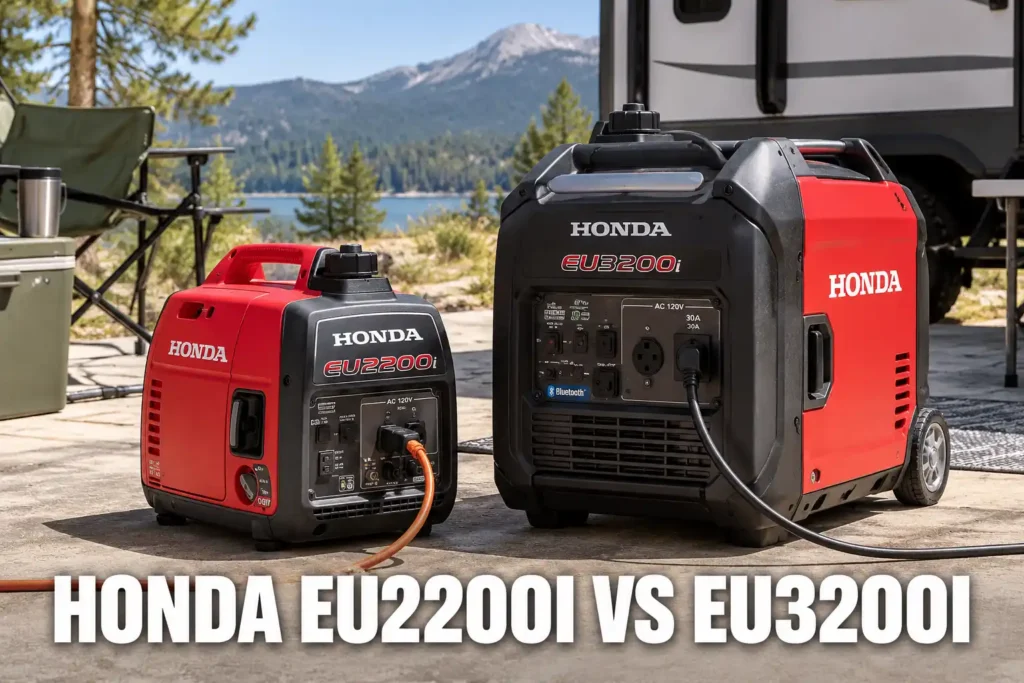
The Honda EU2200i vs EU3200i choice comes down to one number: 1,800 W or 2,600 W of rated power. Buy the EU2200i if a fridge, lights, a router and chargers are your loads and you want a generator one person can carry. Pick the EU3200i if you need the extra 800 W or a 30 A twist-lock outlet, and skip the EU2200i if bigger motors are on your list. When the power drops, my farm yard and machinery shed go dark, so I judged both by what each runs, how it carries and where it can stand.
Honda EU2200i vs EU3200i Short Answer and Spec Table
For most buyers the Honda EU2200i 2,200-Watt Inverter Generator is the better pick. It suits a modest list of fridge, lights and electronics within its 1,800 W rated output, weighs 47.4 lb dry and has one handle to lift it by. The Honda EU3200i 3,200-Watt Inverter Generator wins when your list needs more, because it holds 2,600 W rated and adds a 30 A twist-lock outlet. The table compares them like for like: every weight is dry, every output is for 120 V, and run time and noise are Honda’s own figures.
| Spec | Honda EU2200i | Honda EU3200i |
|---|---|---|
| Maximum output (starting) | 2,200 W | 3,200 W |
| Rated output (running) | 1,800 W | 2,600 W |
| Outlets | Two 20 A | One 30 A twist-lock, one 20 A duplex |
| Run time at rated load, Honda’s figure | 3.2 hours | 3.3 hours |
| Run time at 1/4 load, Honda’s figure | 8.1 hours | 8.6 hours |
| Noise at rated load and 1/4 load, Honda’s figure, distance not stated | 57 and 48 dB(A) | 58 and 54 dB(A) |
| Dry weight | 47.4 lb | 59.0 lb |
| Dimensions | 20.0 x 11.4 x 16.7 in | 22.5 x 12.0 x 17.8 in |
| Fuel tank | 0.95 gal | 1.21 gal |
| Engine and start | 121 cc, recoil start | 130 cc with fuel injection, recoil start |
| Parallel use | With another EU2200i, an EU2200i Companion or listed EU2000i units | With another EU3200i only |
| CO-MINDER shut-off | Yes | Yes |
Two rows decide it. Rated output sets how many loads can run together, and dry weight sets who can move the unit alone.
Honda EU3200i Specs Next to the EU2200i
The two generators share a family look and most of their safety hardware, so in a Honda EU3200i vs EU2200i comparison the spec differences are narrower than the price gap suggests. Start with what they have in common.
- CO-MINDER: both carry Honda’s carbon monoxide shut-off sensor, which stops the engine when CO builds near the unit.
- Eco Throttle: both lower engine speed at light load, which cuts fuel use and noise.
- Oil Alert: both stop the engine when the oil runs low.
- 120 V only: neither makes 240 V, so neither starts a 240 V well pump.
- Bluetooth: both can be monitored from a phone through Honda’s app.
One difference the table cannot show is the outlet limit. The 20 A duplex on the EU3200i shares 20 A between its two sockets, so the two sockets together never exceed 20 A.
Read the output rows with care. Honda prints the starting figure large because it sounds big, and a generator holds that figure for only a few seconds. The rated figure is what the unit carries for hours, so 1,800 W against 2,600 W is the real gap. I compare nine clean-power options for outages, RV and camping in my inverter generator picks.
Power and What Each One Can Run
Rated power is the number to plan around, and 2,600 W gives the EU3200i about 44 percent more headroom than the EU2200i’s 1,800 W. Whether a given fridge, freezer or compressor fits depends on its label: add the running watts of everything that will run together, then add the starting demand of the biggest motor on top, and compare both sums with the rated and maximum output. A fridge or freezer compressor also restarts on its own, so leave room for it while the other loads run.
On a small inverter generator I start the biggest motor first while nothing else is plugged in, then add the router and a work light. A brief red overload light is normal when a motor starts, because Honda’s manual says it should go out within 4 seconds. If it stays on, the output shuts off after about 4 seconds, and the cure is a smaller load.
Neither generator runs a house, a central air conditioner or a 240 V well pump. Whole-house backup is a separate job for a standby unit installed by a licensed electrician. Inside those limits, the EU2200i suits a short list of lights, a router, chargers and one fridge, and the EU3200i suits a longer list or a bigger motor, once you have checked each label.
Winner: Honda EU3200i, because 2,600 W rated and 3,200 W maximum leave more room for a motor start.
Honda EU3200i Weight, Size and Carrying
The EU2200i weighs 47.4 lb dry and the EU3200i weighs 59.0 lb dry, a gap of 11.6 lb. Both figures leave out fuel and oil, so the working weight is higher for each. The EU3200i is also larger at 22.5 x 12.0 x 17.8 in against 20.0 x 11.4 x 16.7 in. I weigh the EU2200i against Champion’s 201317 Ultralight in my Champion and Honda generator comparison.
On my property the difference shows up on the walk from the machinery shed to the gravel pad. I can lift the EU2200i by its handle and carry it there without setting it down. The EU3200i takes a firmer grip, and I plan on a second person or a short rest for it.
Winner: Honda EU2200i, because 11.6 lb less decides who can move it alone.
Honda EU3200i Run Time and Noise Next to the EU2200i
Honda gives each generator two run-time figures. At rated load the EU2200i runs 3.2 hours and the EU3200i 3.3 hours, and at 1/4 load they run 8.1 and 8.6 hours. The EU3200i holds 1.21 gal against 0.95 gal, so it gets slightly longer runs from a bigger tank while carrying a bigger load. Plan on a refill about every 3 hours at full load with either one.
Noise follows the same pattern, with a bigger gap at light load. Honda lists the EU2200i at 57 dB(A) at rated load and 48 dB(A) at 1/4 load, and the EU3200i at 58 and 54 dB(A). Honda does not state the distance for either, so compare the two figures with each other and not with another brand’s number. For a sense of scale, NIOSH sets its recommended limit at 85 dBA averaged over an eight-hour workday and halves the allowed time for every 3 dBA increase (1). I rank generators by noise rating and stated distance in my quiet generator picks.
The EU2200i wins on noise at light load, and I notice it most with Eco Throttle on. When only a light and a charger are plugged in, the engine note drops and I can talk beside it. The EU3200i is also quiet for its class, but its 1/4 load figure sits 6 dB(A) above the EU2200i’s.
Winner: Honda EU2200i, because it is quieter at light load and the run-time gap is too small to matter.

Outlets, Parallel Use and CO-MINDER
Outlets and parallel use are where the two generators part ways most clearly. The EU2200i in this listing has two 20 A outlets and no 30 A socket, which is a feature of the EU2200i Companion. The EU3200i has a 30 A twist-lock outlet and a 20 A duplex, and its parallel option is built around another EU3200i.
One EU3200i or Two EU2200i
Honda’s manuals pair each model with its own family only: an EU2200i joins another EU2200i, a Companion or a listed EU2000i, and the EU3200i joins another EU3200i. A 2200 and a 3200 do not go together, and the parallel cable is an optional extra for either route.
Combined, two EU2200i units are rated at 3.6 kVA, against 2.6 kVA for one EU3200i, and they weigh about 94.8 lb together against 59.0 lb. Two EU3200i units reach 5.2 kVA rated through a Honda EU3200i parallel kit.
Output and sockets are separate limits: each receptacle keeps its own rating, and Honda points to the cable kit’s instructions for plugging in a standard EU2200i pair. The 30 A socket on a single EU3200i does not lift its ceiling either, because Honda’s manual says more than 2.6 kVA from it needs a second EU3200i in parallel. A pair also means two tanks to fill and two units placed with their mufflers on one line, facing the same way, so a CO-MINDER does not read the other unit’s exhaust.
Winner: Honda EU2200i for a buyer who wants to start small and add a second unit later, because each unit is easy to carry. Honda EU3200i for a buyer who wants one machine and one cord.

CO-MINDER and Safe Placement
Both generators carry CO-MINDER, and both manuals call it a backup. According to the CPSC, a portable generator belongs outside at least 20 feet from the house, with the exhaust pointed away from the home and other buildings. Honda’s manual adds 3 feet of clear space from walls, vehicles and other equipment, and says never to run it in a garage, even with the door open.
The evidence for that rule is plain. A US review of 1,604 patients treated for CO poisoning found portable generators behind 264 of them, mostly in residences (2). After a major ice storm in Maine, the strongest risk factor was a generator in a basement or an attached structure such as a garage (3). After four Florida hurricanes, generators placed indoors, in garages or outdoors near windows caused nearly all the CO exposures a CDC analysis reviewed (4).
I stand a generator on the gravel pad with the exhaust pointing away from the house and the sheds, and I run it well clear of windows and doors. Battery-powered CO alarms go inside the house, because in one ice storm 96.2% of the severe poisonings happened in homes with no working CO alarm (5). NIST tests in a research house, not on these Honda models, recorded peak CO from under 10 ppm to over 10,000 ppm, depending on the generator and the garage door positions (6).
Wire neither generator into the house through a wall outlet. Backfeeding can energize utility lines and kill line workers. A house connection goes through a transfer switch or interlock that a licensed electrician installs; otherwise plug appliances into the generator with grounded, outdoor-rated cords.
Keep It Dry
Honda’s manuals say not to use either generator in rain or snow, near a pool or sprinkler, or with wet hands, and an outdoor-rated cord does not change that. Never cover or enclose a running unit with a tent or board.
Starting, Fuel and Care
Both generators start with a recoil pull, and there is no Honda EU3200i electric start. The EU2200i manual gives this order: all loads unplugged, fuel cap vent lever ON, Eco Throttle OFF, choke closed on a cold engine, engine switch ON, then a light pull until resistance and a brisk pull after it. The EU3200i manual lists no choke or vent lever step: loads unplugged, engine switch ON, then the same light pull and brisk pull.
Both burn regular unleaded gasoline. Honda’s manuals for both call for pump octane 86 or higher with no more than 10% ethanol (E10). Fill with the engine off and cool, outdoors, then move the generator at least 10 feet from the fueling spot before you start it, as Honda’s manual says.
The routine care is close to identical. The Honda EU3200i oil capacity is 15 oz against 14 oz for the EU2200i, both stop the engine on low oil, and both want a first oil change at 20 hours. I check the oil on level ground before each run, with the engine stopped, because the Oil Alert shutdown is a backstop and a surprise stop in the dark is the thing to avoid.
Storage differs by model. The EU2200i manual describes draining the fuel tank and carburetor for a long layoff. The EU3200i is fuel injected, and its manual calls for fresh gasoline with stabilizer for one month to a year, or draining the tank. Honda notes that fuel can deteriorate in as little as 30 days, so keep spare fuel in an approved container away from the house.
Honda EU3200i Problems and EU2200i Limits
The EU2200i is limited by output and sockets, the EU3200i by weight and cost tier, and both by the points below.
- EU2200i output: 1,800 W rated rules out a well pump, central air and a heavy workshop. Large motor starts can trip its overload alarm.
- EU2200i outlets: this listing has two 20 A outlets only, so there is no 30 A twist-lock for an RV cord.
- EU3200i weight: 59.0 lb is a firm carry, and it has no wheels in Honda’s specification.
- EU3200i cost tier: it sits at the premium end of generators in its class.
- Both: recoil start only, a CO-MINDER sensor that wears out and needs replacing, and a tank that wants a refill about every 3 hours at full load.
- Both: parallel needs an optional cable, and the two models cannot be paired with each other.
Honda’s manual says CO-MINDER cannot prevent all danger from carbon monoxide, so the CPSC distance and the battery alarms indoors still apply.
Choose the Honda EU2200i If
The EU2200i is the right generator for the person who needs steady basics and wants to move the unit without help.
- Your total running load stays under 1,800 W, such as a fridge, lights, a router and chargers, and your biggest motor starts inside 2,200 W.
- You carry the generator alone, from a shed to a pad or into a truck. My generators for camping list ranks light units for tent sites and trailers.
- You want a quiet unit at light load and the option to add a second unit later.
- You do not need a 30 A outlet.
It is the one I reach for when the job is to keep the crate room cold and the kitchen lights on. I lift it by the handle, set it on the gravel pad and have it running in a few minutes.

Choose the Honda EU3200i If
The EU3200i is the right generator for the person who wants one machine with headroom and a heavier outlet.
- Your running load tops 1,800 W, or a motor start pushes past 2,200 W, and you stay within 2,600 W rated and 3,200 W maximum.
- You want a 30 A twist-lock outlet, knowing it stays limited to 2.6 kVA on a single unit.
- You can handle 59.0 lb or will always have help.
- You may add a second EU3200i later for 5.2 kVA rated.
For the workshop it is the one I put on the long grounded cord to the machinery shed, with the unit staying outside on the gravel. The cord does the walking, so the extra weight matters only at setup.

Matching the Generator to Your Outage
Start with your loads. List what has to run together when the power is out, add the starting demand of the biggest motor on top, and compare the two sums with the ratings on the box. If the running total fits inside 1,800 W and the start fits inside 2,200 W, the lighter generator does the job. If it needs up to 2,600 W running and 3,200 W at start, the bigger one earns its place. For other options, I compare models for home backup, camping and job site power in my best generator picks.
A list above those limits fits neither single unit, and a second unit in parallel or a larger generator is the answer.
Either way, keep the unit outside, far from the house, and keep battery alarms inside. The Honda EU2200i vs EU3200i decision is a question of loads and lifting, and it should be settled before the outage, not during it. I compare nine options for home backup, camping and RV trips in my portable generator picks.
Frequently Asked Questions
Is the Honda EU3200i a good generator?
The Honda EU3200i is a good generator for buyers who want 2,600 W rated output, a 30 A twist-lock outlet and a CO shut-off sensor in a 59.0 lb inverter unit. It suits a fridge, lights and workshop tools, but its premium cost tier and recoil-only start make the lighter EU2200i the better pick when 1,800 W covers your loads.
Can a Honda EU2200i run an air conditioner?
A Honda EU2200i can run an air conditioner only if the unit’s starting and running draw stay inside Honda’s 2.2 kVA maximum and 1.8 kVA continuous ratings. Honda’s manual says most motorized appliances need more power to start than their rating, so read the air conditioner’s label and add every other load before you plug it in.
What type of gas does a Honda generator require?
A Honda generator like the EU2200i requires regular unleaded gasoline with a pump octane of 86 or higher and no more than 10% ethanol, according to its manual. The EU3200i manual gives the same octane and ethanol limits, so fill either one outdoors with the engine off and cool, and keep the fuel in an approved container.
What is the difference between the Honda EU2200i and the EU2200ITAN?
The EU2200ITAN is the sales code of the Honda EU2200i 49-state model, which carries Honda’s CO-MINDER shut-off sensor and two 20 A outlets. The EU2200i Companion is the version that adds a 30 A twist-lock outlet, and this listing is the standard version, which does not have it, so it has two 20 A outlets.
How to use a Honda 2200i generator?
To use a Honda 2200i generator, put it outdoors at least 20 feet from the house exhaust pointed away, check the oil, unplug all loads, set the fuel cap vent lever ON and Eco Throttle OFF, close the choke if cold and switch the engine ON. Pull lightly then briskly, open the choke as it warms, and plug in.
References
- National Institute for Occupational Safety and Health. Noise-Induced Hearing Loss. Noise and Hearing Loss. Centers for Disease Control and Prevention; 2024.
- Hampson NB, Dunn SL. Carbon Monoxide Poisoning from Portable Electrical Generators. J Emerg Med. 2015;49(2):125-129.
- Daley WR, Smith A, Paz-Argandona E, Malilay J, McGeehin M. An outbreak of carbon monoxide poisoning after a major ice storm in Maine. J Emerg Med. 2000;18(1):87-93. doi:10.1016/S0736-4679(99)00184-5
- Centers for Disease Control and Prevention. Carbon monoxide poisoning from hurricane-associated use of portable generators – Florida, 2004. JAMA. 2005;294(12):1482. doi:10.1001/jama.294.12.1482
- Centers for Disease Control and Prevention. Use of carbon monoxide alarms to prevent poisonings during a power outage – North Carolina, December 2002. JAMA. 2004;291(14):1691. doi:10.1001/jama.291.14.1691
- Emmerich SJ, Persily AK, Wang L. Modeling and Measuring the Effects of Portable Gasoline Powered Generator Exhaust on Indoor Carbon Monoxide Level. NIST Technical Note 1781. National Institute of Standards and Technology; 2013. doi:10.6028/NIST.TN.1781
Safety Note: Generator exhaust contains carbon monoxide, which can kill in minutes. Run a fuel generator outdoors only, never in a home, garage, basement, shed or other enclosed or partly enclosed space, even with doors or windows open. The CPSC says to place it at least 20 feet from your home and other buildings, with the exhaust pointed away from doors, windows and vents. Install battery-operated or battery-backup carbon monoxide alarms on every level of the home and outside sleeping areas. Never plug a generator into a wall outlet: connect it to a house only through a transfer switch or interlock installed by a licensed electrician. Refuel only with the engine off and cool, and read the manufacturer’s manual, including for a portable power station.