

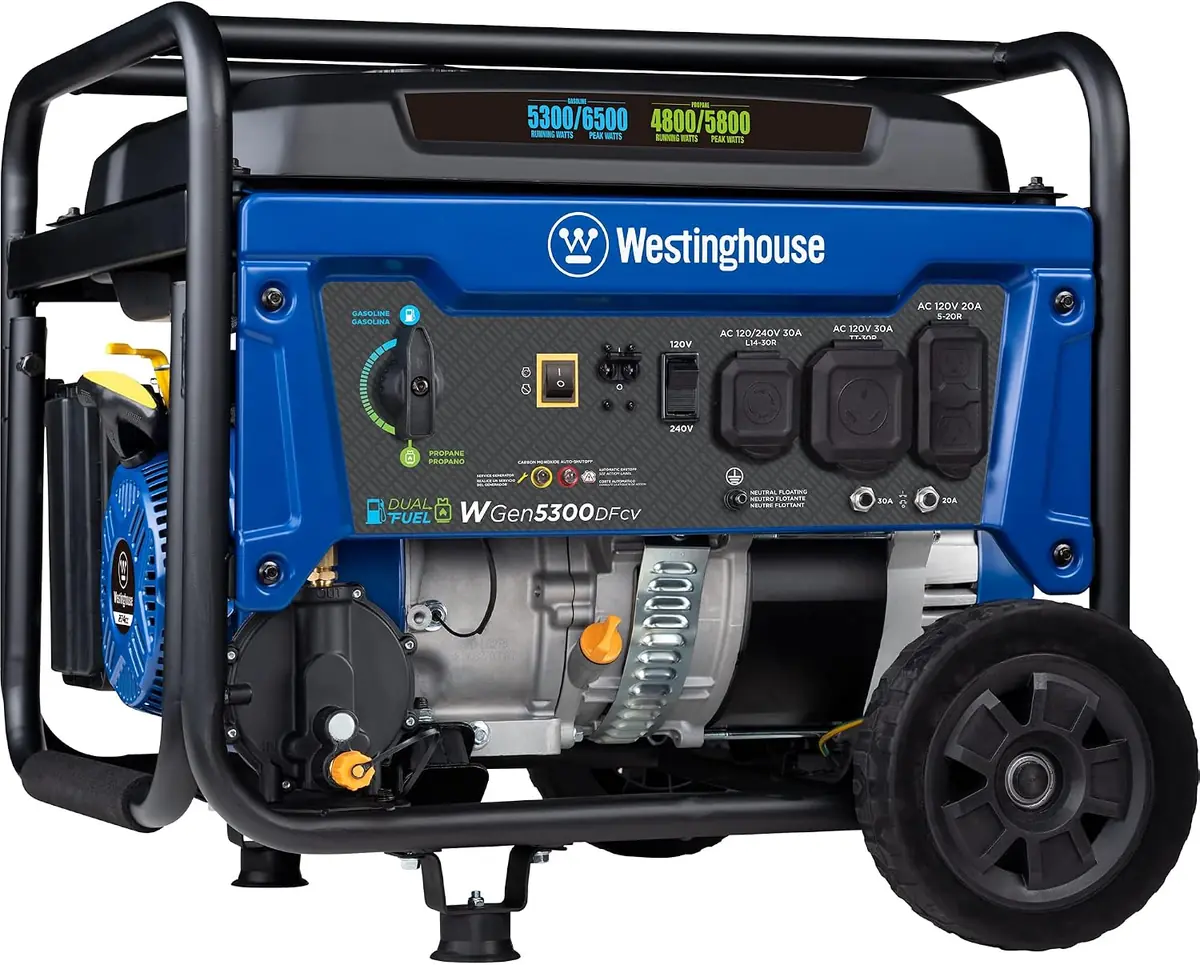
My Westinghouse WGen5300DFcv review verdict is a buy for budget backup power with a CO sensor and a propane option, and a pass if you want quiet or light. I pick a generator the way I size an irrigation pump, by the nameplate and the load, and this one gives 5,300 running watts on gasoline and 4,800 on propane. The listing says 6,500, but that is the short peak, not what it holds.
Westinghouse WGen5300DFcv Review and My Verdict in Brief
I recommend the WGen5300DFcv for a farm or house that needs a fridge, a freezer, lights and a small pump on backup power through a 30 A transfer switch circuit. It holds 5,300 running watts on gasoline, runs on propane too, and shuts itself off when its CO sensor trips. Skip it if you want a quiet, light unit or push-button start.
- Who it is for: owners who want dual fuel backup with a CO shutoff at a budget to mid-range tier.
- What it does best: a 30 A twist-lock outlet for a transfer switch and a 30 A RV outlet.
- The main trade-off: weight, noise and a pull cord.
Specs and What the 6500 in the Listing Means
The Amazon listing calls this a Westinghouse 6500 watt dual fuel generator, and 6,500 is the gasoline peak, not the running figure. Two rows decide the purchase in the table below: the running watts and the dry weight.
| Spec | Figure and condition |
|---|---|
| Running watts, gasoline | 5,300 W |
| Peak watts, gasoline | 6,500 W |
| Running watts, propane | 4,800 W |
| Peak watts, propane | 5,800 W |
| Run time, maker’s figure | Up to 14.5 hours at 25% load on gasoline, 4.7 gal tank |
| Noise, maker’s figure | 68 dBA, distance and load not stated |
| Weight, dry | 135.6 lb |
| Outlets | One 20 A household duplex, one TT-30R 30 A RV outlet, one L14-30R 30 A twist-lock |
| Start | Recoil, manual choke |
| Warranty | 3 years limited residential, 1 year limited commercial |
Setup, Oil and First Start
The Westinghouse WGen5300DFcv manual is the first thing I read, because this unit ships with no oil in the engine and the manual says cranking it dry damages it. The box holds the propane hose and regulator, a bottle of 10W-30 and the wheel kit, which you bolt on yourself with the unit tipped on its side before any oil or fuel goes in. Get help lifting it.
First Start on Gasoline
- Set the unit outdoors on level ground, at least 20 feet from the house with the exhaust pointed away from doors, windows and vents, and 5 ft of clear space on every side including overhead. Check that the battery CO alarms indoors work.
- Add oil in small steps up to 0.74 qt (0.7 L) of SAE 10W-30, checking the dipstick each time, then fill the tank with unleaded gasoline to the red ring.
- Unplug every load and set the fuel selector to gasoline.
- Set the Run/Stop switch to Run and the choke to ON for a cold engine.
- Pull the cord slowly until you feel resistance, then pull fast.
- Move the choke to OFF after several seconds, then add loads one at a time, largest first.
Break-in is the first five hours at or below 50% of the rated running watts, about 2,650 W, with a varied load. The first oil change comes after 25 hours or one month, then every 50 hours or six months.
I poured the oil in small steps and checked the dipstick after each pour, because the manual says factory oil may remain in the engine. The wheels then carried the unit across the gravel pad without fuss, and I stopped at the shed step, because 136 lb is no lift for one man.
Performance in Real Work
A 5,300 W open-frame unit is a home-backup tool, so the useful question is what it can carry and in what order.
Gasoline and Propane Output
Propane lowers the running figure from 5,300 W to 4,800 W, about 9% less, and the peak from 6,500 W to 5,800 W. The manual allows a fuel switch while the engine runs if the propane tank was connected before starting, and the engine may run rough for a few seconds as it clears the carburetor. I compare propane and gasoline output across nine units in my dual fuel generator roundup.
I connect the propane tank before the first pull, so the selector is the only thing I touch when I change fuel. The engine ran rough for a few seconds after I moved the selector with the engine running, as the manual says it may, and then it settled. The tank stands upright with an OPD valve, the hose goes on hand tight and then a 19 mm wrench, and soapy water checks the fittings for leaks. Never use a flame to look for a propane leak.

Loads and Outlets
The manual’s sample load chart gives approximate running and starting watts: a refrigerator or freezer at 700 and 2,200, a 1/3 hp sump pump at 800 and 1,300, a 1/3 hp well pump at 1,000 and 2,000, and a 1/2 hp furnace at 800 and 2,350.
I add the running watts of everything that must run, put the largest start-up surge on top, and read the pump nameplate before I trust any chart. That sum fits inside 5,300 W for a freezer, a sump pump and lights, but not a large central air conditioner.
A 240 V load runs through the L14-30R with the selector on 240 V. Switch the selector only with the engine off. In the 120 V position each outlet is limited by its own rating.
With the selector on 240 V, the work light on the 120 V duplex went dark, which is exactly what the manual says happens.
Power Quality
Total harmonic distortion runs up to 23% and the neutral floats, per the manual. That is not clean power, so I ask the device maker before I plug in sensitive electronics.
CO Sensor, Placement and Safety
Carbon monoxide is the hazard that kills with a generator, and the rule has no exception: this unit runs outdoors only, never in a garage, shed, basement, crawl space or carport, even with the doors open. According to the CPSC, keep it at least 20 feet from the house with the exhaust pointed away, and the CDC says to stay far from doors, windows and vents. The manual’s 5 feet is a clearance minimum, not an exhaust distance.
Weather and Fuel
Never run it in a wet or damp location, in rain, snow, water spray or standing water, or with wet hands: the manual describes no cover for running. Stop the engine and let it cool for two minutes before adding fuel or oil, and store fuel in approved containers away from the generator and the house.
After a major Maine ice storm, a generator in a basement or an attached garage was the strongest risk factor for CO poisoning (1). In Kentucky, eight of ten ice storm CO deaths were related to inappropriate generator location (2). In NIST garage tests of stock and low-emission prototype generators, peak house CO ranged from under 10 ppm to over 10,000 ppm across seven door and ventilation setups, and the highest came from a stock unit with the garage bay door closed and the house door open a crack (3).
On the gravel pad in the farm yard I park it with the exhaust pointing away from the house and the sheds, and I use the agencies’ 20 feet as my number. I roll it to a hard, level spot and leave it there.
The CO sensor is a backup. The manual describes a sensor that stops the engine: a flashing red light means CO shutoff, and a flashing yellow light means a sensor fault that needs an authorized service center. It does not replace battery CO alarms, which belong in the living areas. In a North Carolina outage, 96.2% of the severe poisonings happened in homes with no working alarm reported (4).
Hospitals in one three-year US report treated 264 people for generator CO poisoning with hyperbaric oxygen, and most incidents were in residences (5).
Never plug the generator into a wall outlet to feed the house. That backfeed can kill utility line workers and neighbors. Home connection goes through a transfer switch installed by a licensed electrician, and the L14-30R outlet is the one made for it.
Noise, Weight and Upkeep
Westinghouse lists 68 dBA with no distance or load, so I do not read it as quiet. An open-frame engine at 3,600 rpm is loud, and it weighs 135.6 lb dry. My quiet generator roundup ranks the models by noise rating at a stated distance.
I wear ear protection when I stand next to it, and I keep the cord run long so I am not standing there. Long outdoor-rated grounded cords go from the yard to the workshop, sized for the load from the manual’s chart.
The manual wants unleaded gasoline of 87 to 93 octane with up to 10% ethanol, and no E15 or E85. A DOE test of 28 small engines found that open-loop engines ran leaner as ethanol rose, with exhaust 20 to 70 C hotter on E20 than on gasoline (6). That is one reason I keep to the manual’s limit.
I add stabilizer to the gasoline and close the propane valve when the unit is not running. For storage, the manual asks for no service under a month and stabilizer plus a drained float bowl for two to six months. For longer, drain the tank and the bowl, then add a teaspoon of oil to the cylinder.
Who Should Buy It and Who Should Skip It
The decision comes down to the load you need to carry and how much you mind weight and a pull cord. For more options, my portable generator roundup covers nine picks for home backup, camping and RV trips.
Buy It If
- You want a fridge, a freezer, lights and a sump pump or small well pump on backup power through a 30 A transfer switch circuit.
- You have an RV and need a TT-30R outlet. My roundup of generators for RV trips shows which units carry that outlet.
- You want propane storage and a CO shutoff at a budget to mid-range tier.
Skip It If
- You want a quiet or light unit.
- You need push-button or remote start.
- You need 240 V loads above about 5 kW, or a 50 A outlet.
- You cannot lift or move about 136 lb.
Drawbacks to Know About
Five limits matter in daily use:
- Recoil start only: whoever is home must be able to pull the cord.
- Weight: plan a hard path from storage to the spot.
- Noise: wear ear protection near it.
- Power quality: ask the maker of any sensitive device.
- Propane output: check the load before switching.
How It Compares With Alternatives
Two other dual fuel units show where this one sits in the class.
| Spec | WGen5300DFcv | Champion 201050 | WEN DF475T |
|---|---|---|---|
| Type | Open frame | Inverter | Open frame |
| Running watts, gasoline | 5,300 W | 3,000 W | 3,800 W |
| Weight | 135.6 lb dry | 51.8 lb dry | 105.8 lb net |
| Start | Recoil | Recoil | Electric and recoil |
Champion 201050
The Champion is an inverter with 3,000 running watts on gasoline and a weight of 51.8 lb. Pick that one if quiet and light matter more to you than raw output, and you do not need 240 V.
WEN DF475T
The WEN gives 3,800 running watts and electric start in a 105.8 lb frame. Pick that one if push-button start matters more than the extra 1,500 W and the CO sensor.
Common Problems and How to Prevent Them
- Cranking without oil: the unit ships dry. Fill it and check the dipstick before the first pull.
- Stale fuel: gasoline can go bad in 30 days. Use stabilizer and drain the float bowl for long storage.
- Dead 120 V outlets: the selector sits on 240 V. Stop the engine and move it.
- Overload: loads added all at once. Add them one at a time, largest first.
- CO shutdown: treat it as a hazard. Stop, move away from the unit, check that it stands outdoors with its exhaust away from openings and that your indoor CO alarms work, and read the manual before restarting. The manual adds that exhaust from another engine pointed at the unit can also trip the sensor.
- Weak output at altitude: above 2,000 ft the manual calls for a high altitude kit.
My Final Verdict on the WGen5300DFcv
Buy it for backup power at a budget to mid-range tier. I will roll 136 lb across the yard, with help for any lift, before I lose a freezer of fruit. My Westinghouse WGen5300DFcv review verdict is a buy when the job is backup power for a freezer, a pump and a 30 A circuit, and a pass when you need quiet. My roundup of the best generators for home backup compares nine options for keeping household loads running.
Frequently Asked Questions
Are Westinghouse generators reliable and worth the money?
Westinghouse generators are worth the money when the specs match the job, and the WGen5300DFcv gives 5,300 running watts, a CO sensor and a 3-year limited residential warranty. The manual sets duties that protect the engine: an oil change at 25 hours or one month, then every 50 hours or six months, and approved fuel.
What are some common problems with Westinghouse generators?
The common problems with Westinghouse generators are avoidable ones: cranking the engine without oil, leaving stale gasoline in the carburetor, and overloading the unit by switching on every load at once. On the WGen5300DFcv, dead 120 V outlets mean the voltage selector sits on the 240 V position, so stop the engine and move it.
Can a 5700 watt generator run a house?
A 5700 watt generator can run the essentials of a house, not all of it at once, and the WGen5300DFcv gives 5,300 running watts on gasoline. Its 30 A outlet can carry a fridge, a freezer, lights and a small pump through a transfer switch that a licensed electrician installs.
Why would my generator keep surging?
A generator keeps surging when the load is too big, the fuel is stale or the engine has just changed fuels. On the WGen5300DFcv, stay under 5,300 running watts on gasoline, add loads one at a time, largest first, and use fresh fuel, since the manual says the engine can run rough for a few seconds after a fuel change.
How to start Westinghouse 5300 generator?
To start the Westinghouse 5300 generator outdoors, add oil and fuel, unplug every load, set the fuel selector to gasoline, the Run/Stop switch to Run and the choke to ON for a cold engine. Pull the cord slowly until it resists, then fast, move the choke to OFF after a few seconds, and add loads one at a time.
References
- Daley WR, Smith A, Paz-Argandona E, Malilay J, McGeehin M. An outbreak of carbon monoxide poisoning after a major ice storm in Maine. J Emerg Med. 2000;18(1):87-93. doi:10.1016/S0736-4679(99)00184-5
- Lutterloh EC, Iqbal S, Clower JH, et al. Carbon monoxide poisoning after an ice storm in Kentucky, 2009. Public Health Rep. 2011;126(Suppl 1):108-115. doi:10.1177/00333549111260S114
- Emmerich SJ, Persily AK, Wang L. Modeling and Measuring the Effects of Portable Gasoline Powered Generator Exhaust on Indoor Carbon Monoxide Level. NIST Technical Note 1781. National Institute of Standards and Technology; 2013. doi:10.6028/NIST.TN.1781
- Centers for Disease Control and Prevention. Use of carbon monoxide alarms to prevent poisonings during a power outage – North Carolina, December 2002. JAMA. 2004;291(14):1691. doi:10.1001/jama.291.14.1691
- Hampson NB, Dunn SL. Carbon Monoxide Poisoning from Portable Electrical Generators. J Emerg Med. 2015;49(2):125-129.
- Knoll K, West B, Clark W, et al. Effects of Intermediate Ethanol Blends on Legacy Vehicles and Small Non-Road Engines, Report 1 – Updated. NREL/TP-540-43543; ORNL/TM-2008/117. National Renewable Energy Laboratory; 2009.
Safety Note: Generator exhaust contains carbon monoxide, which can kill in minutes. Run a fuel generator outdoors only, never in a home, garage, basement, shed or other enclosed or partly enclosed space, even with doors or windows open. The CPSC says to place it at least 20 feet from your home and other buildings, with the exhaust pointed away from doors, windows and vents. Install battery-operated or battery-backup carbon monoxide alarms on every level of the home and outside sleeping areas. Never plug a generator into a wall outlet: connect it to a house only through a transfer switch or interlock installed by a licensed electrician. Refuel only with the engine off and cool, and read the manufacturer’s manual, including for a portable power station.