
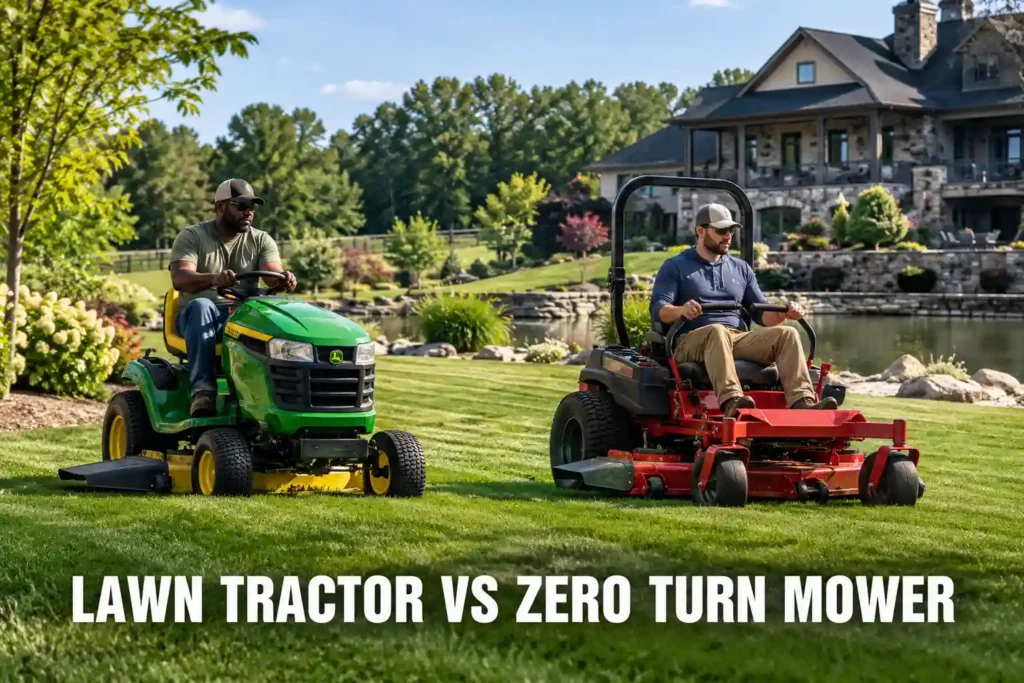
The lawn tractor vs zero turn mower choice comes down to slope first: the slope limit in each manual rules machines out before speed matters, a zero-turn finishes flat, open ground with trees and beds sooner, and a lawn tractor is the usual pick when you tow. I mow the alleys between our orchard rows and the lawns around the farm, so I judge a rider by its turns, its edges and its slope limit before its top speed. Below you get the steering mechanism, a worked time example, the slope and rollover rules, and the safety habits that apply to both machines.
Lawn Tractor vs Zero Turn Mower: Which Should You Buy?
Buy a zero-turn for flat, open ground with many trees and beds, and buy a lawn tractor for towing and a steering wheel you already know. Check the slope limit in the manual of either one first. A zero-turn pivots on the spot and runs faster, so it removes the time you lose at row ends and around obstacles. A lawn tractor steers with its front wheels, like a car, and keeps a hitch ready for a cart or a spreader. Neither machine wins on every lawn, and the table shows where each one leads.
| Factor | Lawn tractor | Zero-turn |
|---|---|---|
| Steering | Wheel turns the front wheels | Lap bars drive the rear wheels (lap-bar models) |
| Turning radius | About 16 inches (one maker’s 42-inch model) | Zero |
| Forward speed | About 5.5 to 8.5 mph | About 7 to 12 mph |
| Slope limit | The manual’s figure; 15 degrees is common | The manual’s figure; 15 degrees is common |
| Towing | Hitch common; the manual gives the rating | The manual says whether it can tow |
| Trees and beds | Sweeps an arc at each turn | Pivots in place at each turn |
| Typical cost | Budget to mid-range | Mid-range to premium |
The level quarter-acre lawn beside my house is a job for a walk-behind lawn mower, so a rider only enters the picture once a yard grows into long alleys and open fields. From there I decide in this order: slope, obstacles, then towing, and I give speed less weight than most buyers do.
How a Lawn Tractor and a Zero-Turn Steer and Drive
The two machines turn in different ways, and that difference shapes their handling at a row end and the way each one reacts on a hill.
How a Lawn Tractor Steers
A lawn tractor has a steering wheel that points the front wheels, and the rear wheels push the machine along. A turn is a sweep, and one maker lists a turning radius of about 16 inches for its 42-inch lawn tractor, so a row-end turn takes a small arc and sometimes a reverse. The front wheels point the machine while the rear wheels push it. A pedal sets speed and direction, and many models carry a hitch at the back. I explain the different types and who should buy one in my guide to what a lawn tractor is.
How a Zero-Turn Steers
A lap-bar zero-turn has no steering wheel, and this section describes that common layout; some models steer with a wheel and a pedal, so read the manual for yours. Two lap bars set the speed and direction of the two rear wheels separately, and the front wheels are casters that swivel freely. With both bars forward the machine runs straight, and with one forward and one back it pivots on the spot, which gives the zero in the name. A maker’s listing for one 42-inch zero-turn gives a turning radius of 0. I explain how a zero turn mower steers and who should buy one in a separate guide.
The rear wheels both drive and steer, so the grip of those two tires decides how the machine behaves on a slope. According to Toro, hills can cause loss of traction, and the lap bars call for smooth, even pressure, with no sudden changes in speed or direction on a hill.
Speed, Deck Width and Cut Quality
Speed gives the zero-turn its edge on open ground, and deck width can take it back. One maker lists 7 mph forward and 3.5 mph in reverse for its 42-inch zero-turn, against 5.5 mph forward and 3 mph in reverse for its 42-inch lawn tractor. A maker’s dealer page lists lawn tractors at 5.5 to 8.5 mph and zero-turns at 7 to 12 mph, with decks from 42 to 60 inches on both. My review of the TS 354XD covers its 54-inch deck and 24 HP engine in real mowing.
Worked Example of Acres per Hour
Area per hour equals the deck width in feet times the speed in mph times 0.1212, where 0.1212 is the 5,280 feet in a mile divided by the 43,560 square feet in an acre. Here is the arithmetic for three machines, using the speeds above.
| Machine | Deck width | Top speed | Acres per hour, ceiling |
|---|---|---|---|
| 42-inch lawn tractor | 3.5 feet | 5.5 mph | About 2.3 |
| 42-inch zero-turn | 3.5 feet | 7 mph | About 3.0 |
| 54-inch lawn tractor | 4.5 feet | 5.5 mph | About 3.0 |
A 54-inch lawn tractor matches a 42-inch zero-turn on straight passes, because the extra 12 inches of deck make up for the slower speed. The table is a ceiling that assumes top speed with no overlap, turns, stops or trimming, and thick grass, wet grass and rough ground pull both machines below it. I treat top speed like the run time on a battery box, as a best case. If the deck figures confuse you, I break down lawn mower deck size in plain steps.
Around obstacles the zero-turn’s pivot can add time savings at the row end, where a tractor turns on a radius of about 16 inches, and the amount depends on how many turns your lawn has. Across a long open field the speed gap is nearly all you get. For half an acre or more, I compare five options in my list of the best mowers for large yards.
Lawn Tractor vs Zero Turn Cut Quality
Cut quality comes from the blade, the grass height and your ground speed, and the machine type decides none of them. A dull blade lowers turf quality, and in a Nebraska field trial it also raised leaf spot on a susceptible grass and raised gasoline use by 22 percent (1). I sharpen the blade before the spring mow and read the cut afterwards, because ragged, brown-tipped leaf ends mean the blade has gone dull.
Height matters as much. Mow by the one-third rule, removing no more than a third of the leaf height at one mowing: a university field study found it cut the number of required mowings by 31 percent, about eight a year, compared with mowing weekly (2). Ground speed is yours to set, and at a fixed blade speed faster travel spreads each blade pass over more ground. I slow down in thick grass on any machine, and I mow on a dry day, because wet grass clogs the deck and tears instead of cutting.
Slopes, Rollovers and Edges
The slope you mow decides the machine before speed does, and the limit that counts is the figure on your own machine’s decal and in its manual. Read this section before you buy. For steep ground, my ranking of the best lawn mowers for hills compares the drive and the slope limit of each pick.
Zero Turn vs Lawn Tractor for Hills
According to OSHA, you should not operate a mower on slopes that exceed the manufacturer’s angle limit, and with no other information you should avoid slopes over 15 degrees. Toro tells zero-turn owners never to drive on slopes greater than 15 degrees, and a maker’s spec page for a 42-inch zero-turn gives the same figure. A published safety paper reports 15 degrees as the commonly recommended maximum for ride-on mowers and adds that many people cannot judge a slope by sight (3).
The manual’s angle decides, whichever type you own. A lawn tractor steers with its front wheels and a lap-bar zero-turn with its rear wheels, and Toro warns that hills can cause loss of traction. Measure the steepest part of your yard instead of judging it by eye.
OSHA says not to mow side to side on sloped ground, and Ohio State Extension says to mow up or down slopes to avoid overturns. Your machine’s manual and decals govern the exact direction rule, so read them before the first pass on any slope.
Wet Grass and Slopes
Do not mow a slope when the grass is wet. Toro says so for its zero-turns, and OSHA lists wet surfaces and slopes among the places that present a rollover risk. On a wet day, wait or mow flat ground only.
Rollover, Roll Bar and Seat Belt
An engineering review of ride-on mower accidents calls rollovers the most prominent type of fatal accident and says the typical injury comes from the machine’s weight pinning the operator, even on lighter mowers (4). The roll bar and the belt work as a pair. OSHA says not to run a mower that was meant to have a roll-over protective structure without it, and to use the belt while the structure is up.
Toro tells zero-turn owners to keep the rollbar fully raised and locked and to lower it only when absolutely necessary. With the bar lowered for low clearance, OSHA says the belt comes off, so raise the bar again as soon as the clearance allows.
A roll bar does not make a slope safe. OSHA notes that a protective structure is not unlimited in its ability to protect the operator, and it describes an incident with a zero-radius-turn mower that had one, adding that agility and quickness do not ensure invincibility.
Edges need distance too. OSHA says to keep the drive wheels at least five feet from unprotected edges such as ditches and embankments, and one Toro zero-turn manual asks for twice the width of the machine, so use the larger distance. A drainage ditch runs along one border of our orchard, so I keep a rider well back from it and cut the bank with a push mower or a trimmer.
Trees, Beds and Orchard Rows
The end of the row is where the extra cost of a zero-turn pays off or does not. The alleys between my plum and apricot rows show how much that is worth. I compare acreage, slopes and upkeep in my guide to robot versus zero turn mowers.
The alleys are long, straight and mown every two to three weeks from May, so a deck that fits an alley with a small overlap saves passes, and a deck too wide for the alley hits the tree rows. Measure the alley before you choose the deck width, because a wider deck means fewer passes where it fits and costs you at every obstacle. I explain how wide should a lawn mower deck be in a separate guide to matching the width to your yard and gates.
Drip lines lie on the soil beside the tree rows, so I mow parallel to them and never across, since a low deck can catch a line. The trees went in during 2016 and the bark at the trunk is still thin, so the deck stays out of the tree strip and a trimmer does the trunk base. A zero-turn can tuck into a corner or round a bed in one move, but the last few inches still need a trimmer on either machine.
Towing, Storage, Cost and Upkeep
Towing, storage, cost and upkeep decide the rest once the slope and the turns are settled. If you are also considering automatic mowing, my comparison of robot and riding mowers helps you choose between them.
Towing and Storage
Towing is the lawn tractor’s job. A hitch and a front-steer layout suit a cart or a spreader, and the number that counts is the towing rating in the manual. Check a zero-turn’s manual before you hook anything to it, and note that Toro’s zero-turn manual says to reduce the towed weight and slow down on a slope. Before you buy, measure four things:
- Gate and shed door: the width of the machine and of the deck decides what passes through.
- Steepest slope: compare it with the angle in the manual, not with a guess.
- Longest run or alley: it sets how much a faster machine saves you.
- Towing job: write down the total weight of the loaded cart or spreader and compare it with the manual’s towing, hitch and slope limits.
A gas rider lives in the machinery shed outside the season, and I drain its fuel or add stabilizer first, because it never runs inside a closed shed. A smaller rear-engine rider is a third option, and my comparison of rear engine rider and tractor covers deck, engine and storage.
Cost and Upkeep
A zero-turn usually costs more for the same deck width, with lawn tractors sitting from budget to mid-range and zero-turns from mid-range to premium. A gas model of either type needs the same engine care: UF/IFAS Extension advises a tune-up about every three months or every 25 hours of use, and your manual sets the interval and the oil grade. Refuel outdoors with the engine off and cool, and keep fuel in an approved container away from the house. A battery rider swaps that for charging and pack care, and its manual sets the charger, the temperature range and the storage rules. Sharpen the blades on the manual’s schedule either way. I compare run time, cost and safety in my write-up on battery and gas riding mowers.
Safe Use of Either Machine
Both machines carry a spinning blade deck and enough weight to injure, so the habits below apply to either one.
Reverse and Children
In a survey of 140 injured children, 69 percent were bystanders, and 59 percent of the injuries happened while a riding mower was reversing (5). A 25-year review at one US trauma center found that 38 percent of 142 injured children needed an amputation, and that riding mowers caused more operations and longer stays than push mowers (6).
According to the CPSC, you should never let a child ride on a mower. Toro’s zero-turn manual says not to mow in reverse unless absolutely necessary and to look behind, down and to both sides for small children before and while backing. Children stay out of the yard while I mow, another adult keeps them inside, and I stop the mower if one comes near.
Thrown Objects, Noise and the Blade
I walk the lawn before the first pass and pick up sticks, stones, wire and fallen fruit. In a national analysis of lawn mower eye injuries, 77 percent came from projectiles such as grass, dirt and rocks, and only 2 percent of those injuries were documented as involving eye protection (7). Wear safety glasses, keep the chute guard, bag or mulch plug in place, and never point the discharge at people, windows or cars. Keep people and pets away, at least 50 feet for thrown objects according to Ohio State Extension. Riding mower use went with noise exposures above 85 and 90 dBA over a work shift among university groundskeepers (8), so wear ear protection for every mowing session.
The Blade Rule
Never reach under the deck or into the chute while the blade can turn. Turn off the deck, stop the engine or motor and wait until the blades and wheels have stopped, because Ohio State Extension warns that blades may keep spinning after the engine is off. Before you clear the deck, check the blade or tip the mower, take out the key, switch the power off as the manual says on a battery rider, and on a gas rider disconnect the spark plug wire. Wear heavy gloves on the blade. Never disable the seat switch or tie a control on.
Three Checks That Settle the Choice
Three checks settle the choice, in this order. First, measure the steepest ground you mow and read the angle your manual allows; a rider does not go on anything steeper, and a slope or bank that is too steep for a rider gets another tool only if that tool’s manual allows the ground and your footing is safe, or it stays unmown. Second, count the turns on your lawn, because trees, beds and short rows reward a zero-turn and long open runs do not. Third, decide whether you will tow, because that is the lawn tractor’s ground. My picks for the best riding lawn mowers show which riders suit acre-plus lawns.
I walk each alley before the first pass, which protects the blade, the deck and my eyes. Take the manual to the steepest part of your yard before you buy. Settle the lawn tractor vs zero turn mower choice by slope first, turns second and towing third. If you still doubt the size, I cover the lawn mower size you need for your yard.
Frequently Asked Questions
What are the downsides of a zero-turn mower?
The downsides of a zero-turn mower are its slope limit, its loss of traction on hills and its cost. Toro puts the limit at 15 degrees for its zero-turns and warns that hills can cause loss of traction, and a zero-turn usually costs more than a lawn tractor with the same deck width. Check the manual for a towing rating before you plan on pulling a cart.
Is a zero-turn or tractor better for hills?
Neither type is better for hills by default, because each machine’s manual sets its own slope limit and its own direction rule. OSHA gives 15 degrees as the limit when you have no other information, and Toro gives 15 degrees for its zero-turns. Measure the slope before you trust your eye.
Are zero turns faster than lawn tractors?
Zero turns are faster than lawn tractors in most lines, and one maker lists 7 mph for its 42-inch zero-turn against 5.5 mph for its 42-inch lawn tractor. A wider deck can cancel that gap on straight passes, and a zero-turn’s tight turns can add savings around obstacles, depending on the layout.
What riding mower has the least problems?
Mower type alone does not decide which riding mower has the least problems, and lawn tractors and zero-turns share the same wear points: the engine, the blades and the deck. What you control is upkeep, so keep to the manual’s schedule. UF/IFAS Extension advises a gas engine tune-up about every three months or every 25 hours of use, and a service shop near you is worth knowing before you buy.
Is a zero turn mower better than a lawn tractor?
A zero turn mower is better than a lawn tractor on flat, open ground with trees and beds, and a lawn tractor is the usual pick for towing. Check the slope limit in each manual first, then count the turns, then decide whether you tow.
References
- Steinegger DH, Shearman RC, Riordan TP, Kinbacher EJ. Mower Blade Sharpness Effects on Turf1. Agronomy Journal. 1983;75(3):479-480. doi:10.2134/agronj1983.00021962007500030015x
- Law QD, Bigelow CA, Patton AJ. Selecting Turfgrasses and Mowing Practices that Reduce Mowing Requirements. Crop Science. 2016;56(6):3318-3327. doi:10.2135/cropsci2015.09.0595
- Karnes EW, Leonard SD, Lenorovitz DR. Ride-on lawnmowers warnings: Slope measurements and safety-by-separation. WORK: A Journal of Prevention, Assessment & Rehabilitation. 2012;41(S1):3629-3632. doi:10.3233/wor-2012-0116-3629
- Sevart KB. Ride-On Mower Rollover Accidents: Study and Design Solutions. Volume 14: Emerging Technologies; Materials: Genetics to Structures; Safety Engineering and Risk Analysis. 2016. doi:10.1115/imece2016-67718
- Jennissen CA, Krupp TD, Vakkalanka JP, Hoogerwerf PJ. Pediatric lawn mower-related injuries and contributing factors for bystander injuries. Injury Epidemiology. 2023;10(S1). doi:10.1186/s40621-023-00468-z
- Khansa I, Pearson GD, Bjorklund K, Fogolin A, Kirschner RE. Pediatric Lawnmower Injuries: a 25-year Review. JPRAS Open. 2021;29:135-143. doi:10.1016/j.jpra.2021.05.001
- Stange NR, Jennissen CA. Lawnmower-Related Eye Injuries in the U.S., 2004 to 2023. Am J Ophthalmol. 2025;277:7-16.
- Balanay JAG, Kearney GD, Mannarino AJ. Assessment of Occupational Noise Exposure among Groundskeepers in North Carolina Public Universities. Environmental Health Insights. 2016;10:EHI.S39682. doi:10.4137/ehi.s39682
Safety Note: A mower blade can cut through a hand or foot and throw stones and sticks with force. Pick up debris before you mow, keep the discharge guard, bag or mulch plug in place, never point the discharge at people, windows or cars, and keep children and pets indoors while the mower runs; never let a child ride on a riding mower. Never disable the operator-presence control. Before you clear a clog, tip the mower or touch the blade, stop the engine or motor, wait until the blade has stopped, then remove the safety key or battery, or disconnect the spark plug wire on a gas model. Mow across slopes with a walk-behind mower and up and down with a riding mower, within the slope limit in your manual, and stay off wet slopes, drop-offs and ditch edges; on a rider with a rollover protection bar, keep it up and wear the seat belt as the manual says. Refuel only outdoors with the engine off and cool, wear closed shoes and eye and hearing protection, and read the manufacturer’s manual.