
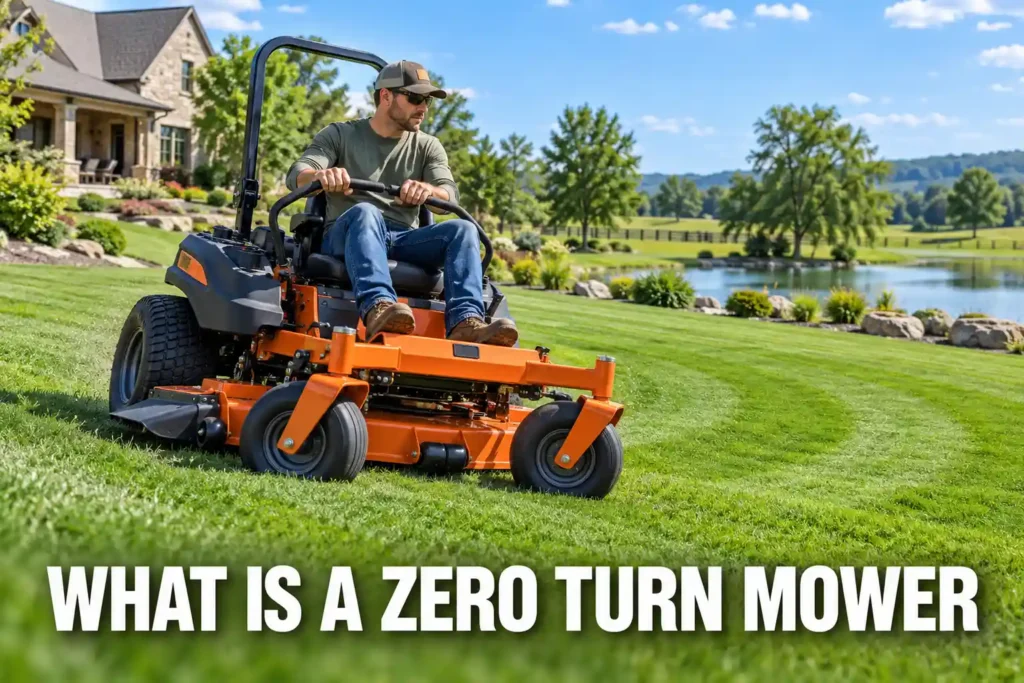
A zero turn mower is a riding mower with independently driven rear wheels, usually controlled by two levers, so it can pivot on the spot and turn with a radius of zero. I mow the alleys between our orchard rows and the lawns around the house, and I judge any rider by its turns, its slope limit and its gate clearance before its top speed. Below you get the steering mechanism, the types and sizes, the slope and roll bar rules, a worked time example and the safety habits for every ride.
What Is a Zero Turn Mower and What Makes It Different?
A zero turn mower is a riding mower whose drive wheels are controlled independently, so it can turn with a radius of zero. On the common lap-bar layout, each rear wheel has its own drive and the two front wheels are free-swiveling casters that follow along. Push both levers forward and the mower goes straight. Push one forward and pull the other back, and the mower rotates around a point between the rear wheels.
Three facts follow from that layout.
- A turning radius of zero: the mower pivots around a point between its drive wheels, so it needs no wide arc at a row end or around a tree. Leave clearance for the whole machine as it swings.
- Steering that depends on grip: the rear wheels do the driving and the steering together, so a wheel that slips takes part of the steering with it.
- Levers instead of a steering wheel: on the lap-bar layout, speed grows with lever travel, and the levers respond quickly.
Read the Decal First
The slope limit, the roll bar rule and the seat belt rule for your machine are in its manual and on its decals. Read them before the first pass. The sections on slopes and safe use below explain why they matter.
How a Zero Turn Mower Steers and Drives
The machine steers by changing the relative speed of its two drive wheels. Everything else on the machine serves that one job.
Two Drive Wheels and Two Levers
Each lever controls one wheel. According to the Greenworks manual for its MZ546 to MZ608 battery zero turn models, the further you move a lever from neutral, the faster that wheel turns. Equal travel drives straight. Ease one lever back toward neutral while rolling forward and the mower curves toward that side.
Push one forward and pull the other back, and the mower pivots. The pivot is the move that makes the machine what it is, and it is also the one that tears turf if you rush it.
The casters at the front do not steer. They swing to follow whichever way the rear wheels push, which is why grip at the rear wheels matters so much. On those models, tilting the levers outward from neutral also sets the parking brake, so the levers double as the brake control.
Hydrostatic Drives and Battery Motors
A gas machine usually drives its wheels hydrostatically: fluid under pressure, not a set of gears, carries the power to each wheel. The layout gives the mower two independent outputs, one per side, and that is what lets the wheels turn in opposite directions.
A battery machine skips the hydraulics and drives its wheels with electric motors. Those Greenworks models list three drive speed settings of 4, 6 and 8 mph. The upkeep differs too: a gas machine has fuel, oil and a drive unit on a service schedule, and a battery machine has a pack to charge and store within the manual’s limits. If you are also considering a cordless walk-behind, my battery lawn mower picks cover small and large lawns.
Learning the Controls
The levers respond quickly, so the Greenworks manual tells new riders to practice in a clear, open lawn area at low speed. Start by moving both levers evenly forward and back. Then ease one lever toward neutral while rolling to make a gentle curve. Keep a slight forward motion in both wheels through a turn, so the machine does not pivot on the tire tread and tear the turf.
When someone new rides with us, I send them to the widest open alley, away from trunks and drip lines, and let them cover the same strip back and forth until the levers stop surprising them.
Zero Turn Mower Types and Sizes
Zero turn mowers differ in power source, drive layout, deck width and speed. The manual names the exact class of your machine, so read it before you rely on a sales page. My guide on horsepower a lawn mower needs helps you match engine power to the deck and the ground.
| Type | Power and drive | Deck width | Speed |
|---|---|---|---|
| Gas, lever steered | Gas engine, hydrostatic drive, two levers | Riding decks run up to 60 inches and wider | Check the maker’s forward and reverse speeds |
| Battery, lever steered | Battery pack, electric motors, two levers | 55 and 61 inches on the Greenworks models | 4, 6 and 8 mph settings |
Some makers fit a steering wheel and a foot pedal instead of levers and still call the machine a zero turn. How tightly such a mower turns depends on the maker’s drive layout, so check the turning radius in its manual. For comparison with a different riding layout, my guide on what a lawn tractor is explains how that type works.
Deck Width and Speed
Deck width sets how much grass one pass cuts, and speed sets how fast you cover it. Riding decks run from the mid-30s of inches up to 60 inches and wider. A wider deck covers more ground per pass and can cut total mowing time, and it is harder to turn around obstacles, so measure your tightest gate, shed door and gap between obstacles before you choose one. My answer to how wide should a lawn mower deck be covers gates, sheds and tight spots.
In our alleys, the deck width against the row spacing matters more to me than the engine or the battery, because a deck that is too wide for the alley meets the tree rows. Where the rows are shorter and the ground is gentle, my page on robot versus zero turn mowers shows how a machine with no rider fares.
Gas or Battery
A gas machine keeps cutting as long as it has fuel, and you refuel outdoors with the engine off and cool. A battery machine has no fuel to handle and no exhaust, and it runs for the number of minutes its pack gives under the maker’s test conditions. A large set of measurements found electric mowers significantly quieter than gas mowers (1). My battery versus gas riding mower comparison puts run time, cost and safety side by side.
Heavy, tall or wet grass and steep ground cut a battery’s run time, so read the maker’s figure with its pack and conditions rather than as a promise.
Slopes, Roll Bars and Edges
The slope decides whether a zero turn mower belongs on a piece of ground at all, and the limit that counts is the one in your manual. For walk-behind options on slopes, see my picks of lawn mowers for hills.
Slope Limits and Traction
OSHA tells operators not to mow slopes that exceed the angle limit the maker specifies, and to avoid slopes over 15 degrees when no other information is available. The Greenworks manual sets 15 degrees as its own limit and defines that as 5.4 feet of drop over a 20 foot run. Your decal and your manual settle the number, not a rule of thumb from another machine.
Traction is the reason. The machine steers with the grip of its rear wheels, so a slipping wheel takes steering with it. That manual says never to operate where you feel wheels slipping or sliding, to avoid wet, soft or slippery grass, and to avoid starting, stopping and sudden changes of direction on a slope. Many people cannot judge a slope by eye (2), so measure it with a gauge or an inclinometer app.
OSHA says to mow slopes up and down, and only on slopes within the limit. The Greenworks manual adds a turning rule: turn up slopes and avoid turning down them. Keep every other restriction in your own manual and on its decals.
Roll Bar and Seat Belt
A roll bar is a roll-over protective structure, called a ROPS. OSHA’s rule has two halves: do not run a mower that was meant to have a ROPS without it, and use the approved seat belt when the ROPS is installed. With the ROPS lowered, do not wear the belt. The Greenworks manual adds that there is no roll over protection with the bar down.
Lower the bar only when you must pass under a branch or fit through a low door, and raise and lock it again as soon as there is clearance. Rollovers are the most prominent type of fatal ride-on mower accident, and the usual injury is the machine’s weight pinning the operator, even on light mowers (3). OSHA states that a protective structure is not unlimited in its ability to protect the operator, so a roll bar never makes a steep slope acceptable.
Ditches, Banks and Drop-Offs
OSHA tells operators to keep the drive wheels at least five feet from unprotected edges such as ditches, embankments and retaining walls, and to use a string trimmer or a push mower there. Along our drainage ditch I keep the rider well back and cut the bank with a push mower. The Greenworks decal adds that its mower should not be used on slopes near open water.
Where a Zero Turn Mower Works Best
This machine earns its cost on open, mostly level ground with many things to go around: trees, beds, posts and fence lines. The pivot turn saves the wide arc a steering-wheel rider makes at every obstacle. A lawn tractor, with its engine in front and a steering wheel, sweeps a turning arc instead, as my tractor versus zero turn mower comparison shows.
What Is a Zero Turn Lawn Mower Best Used For?
A zero turn lawn mower suits long, straight strips with row ends, lawns cut up by trees and beds, and open acreage where time per acre counts. My list of mowers for a large yard helps once you know how much ground you cover.
- Good fit: orchard alleys, paddocks and large lawns with trees, beds or posts to go around.
- Good fit: a rider who will practice and who can store the machine in a dry, locked space.
- Poor fit: slopes beyond the manual’s limit and edges near ditches or drops, which a walk-behind mower or a trimmer handles where its own manual allows it.
- Poor fit: a small level lawn, where a push mower is the lighter and cheaper tool.
The first thing I noticed in our alleys was how much faster a rider crosses a long strip than my old gas push mower, and how little time the row end takes. I still keep the push mower for the bank and the house lawn, where a zero turn is too much machine. My comparison of a riding lawn mower vs walk-behind lawn mower explains when each one earns its place.
Worked Example of Acres per Hour
Area per hour equals deck width in feet times speed in mph times 0.1212. The constant comes from 5,280 feet in a mile divided by 43,560 square feet in an acre.
Take a 55-inch deck, which is 4.58 feet. At 8 mph the ceiling is 4.58 x 8 x 0.1212, or about 4.4 acres an hour. At 4 mph it is about 2.2 acres an hour.
Those are ceilings: straight passes with no overlap, no turns, no trimming and no stops. A quarter acre at the 8 mph ceiling is just over 3 minutes of pure cutting, so on a small lawn the time goes to getting the machine out, going around beds and trimming. The saving of a zero turn mower sits at turns and obstacles, and it depends on how many your ground has.
Safe Use Every Time You Ride
The Greenworks manual states that its zero turn mower can amputate hands and feet and throw objects at high speed. The habits below apply every time you ride.
Reverse and Children
Do not mow in reverse unless you must, and look down, behind and to the side before you back up and while you do. In a survey of 140 children hurt by riding mowers, 69 percent were bystanders and 59 percent of the injuries happened while the mower was reversing (4). A 25-year review of 142 injured children found that 38 percent needed an amputation, and that riding mowers caused more operations and longer stays than push mowers (5).
Keep children and pets out of the yard while you mow. Never carry anyone, even with the blades off, and keep both hands on the levers. If a child comes near the lawn, I stop the mower and wait until the child is gone.
Thrown Objects, Noise and the Blade
Before the first pass I walk the lawn and pick up sticks, stones, wire and fallen fruit. Projectiles such as grass, dirt and rocks caused about three quarters of lawnmower eye injuries in a national study, and only 2 percent of those cases documented eye protection (6). I wear safety glasses, long trousers and sturdy shoes, and I keep bystanders well away. The Greenworks manual says at least 100 feet. Keep the discharge cover or grass bag in place, and never point the discharge toward people, windows or cars.
Hearing protection belongs to the job. Riding mower use was associated with daily noise exposure above 85 and 90 dBA in a study of university groundskeepers (7). I put earmuffs on before I start the engine, not after the noise bothers me.
Never reach under the deck or into the chute while the blade can turn. Stop the engine or motor, wait for the blade to stop, take out the key or the battery (on a gas machine, also disconnect the spark plug wire), and wear heavy gloves on the blade. Every time you dismount, stop on level ground, disengage the blades, set the parking brake, switch off the engine or motor, take out the key and wait for all moving parts to stop. A gas engine never runs in a shed or garage, even with the door open. Never disable the seat switch or any other safety interlock, and stop using the mower until a dealer fixes one that fails.
Mow on a Dry Day
Wet grass clogs the deck and lowers traction, and wet slopes raise the rollover risk. I wait for a dry day. A clogged deck gets the full sequence: stop the engine or motor, wait for the blade to stop, then take out the key or battery, or disconnect the spark plug wire on a gas mower.
Is a Zero Turn Mower Right for You?
Buy one when your ground is open, mostly level, and full of things to go around. If you are unsure about size, my guide on which size mower you need helps you check before you decide.
Choose a Zero Turn Mower If
- You mow long strips with row ends: the pivot turn is where the machine pays you back.
- Your slope is within the manual’s limit: you have measured it, not guessed.
- Your gates and storage fit the deck: you measured the narrowest gap first.
- You will practice: the levers respond quickly, and the first rides belong in open grass.
Skip It If
- Your ground is steep, wet or full of banks: the manual’s slope limit rules the machine out.
- You want a roll bar you can leave down: a mower built for a ROPS runs with it up and the belt on.
- You cannot store it dry and locked: a rider left outside suffers and invites trouble.
What to Check Before You Buy One
Three checks settle most purchases. Compare your narrowest gate and shed door with the mower’s overall width in the manual, including the discharge chute. Read the slope limit and the roll bar rules in the manual before you pay, and measure your steepest ground with an inclinometer app. Then find the nearest authorized service shop, because your model’s manual sets the schedule for blades, belts, and either gas and hydrostatic service or battery care. My tip is to spend the first few rides in the widest open strip at low speed, with the deck off, until the levers feel natural. That habit keeps a zero turn mower safe to learn. My top riding lawn mower picks show how the main riding types compare for larger lawns.
Frequently Asked Questions
Why are they called zero-turn mowers?
They are called zero-turn mowers because their turning radius is zero: the two rear drive wheels can run in opposite directions, so the mower rotates around a point between them. A tractor sweeps an arc instead. The name describes how the mower turns, not how fast it goes.
What is a good turning radius for a riding mower?
There is no single ideal turning radius for a riding mower: pick the one that clears your actual obstacles and row ends. A zero turn radius helps most around frequent obstacles on suitable ground, while a lawn tractor’s wider arc is workable where trees and beds sit far apart. Compare the manual’s figure for each exact machine.
What is a hydro on a zero turn mower?
A hydro on a zero turn mower is its hydrostatic drive, where fluid under pressure carries power to each drive wheel with no gears to shift. Each side has its own output, which lets the wheels turn in opposite directions. Fluid and service steps differ by maker, so follow the manual.
What is ROPS on a zero turn mower?
ROPS on a zero turn mower is the roll-over protective structure, the roll bar behind the seat. OSHA says to use the approved seat belt with the ROPS up and not to wear it with the ROPS lowered. Lower the bar only when you must pass under something, and raise it again at once.
What is the advantage of a zero turn mower?
The main advantage of a zero turn mower is that it pivots in place, so it makes fewer wide turns at row ends and around trees and beds. The Greenworks battery models also offer drive speeds up to 8 mph. That advantage ends where traction does, so the slope limit comes first.
References
- Blomberg L, Trezza D. The evolution of quiet lawn mowers and their impact on community noise and hearing conservation. INTER-NOISE and NOISE-CON Congress and Conference Proceedings. 2021;263(2):4896-4902. doi:10.3397/in-2021-2877
- Karnes EW, Leonard SD, Lenorovitz DR. Ride-on lawnmowers warnings: Slope measurements and safety-by-separation. WORK: A Journal of Prevention, Assessment & Rehabilitation. 2012;41(S1):3629-3632. doi:10.3233/wor-2012-0116-3629
- Sevart KB. Ride-On Mower Rollover Accidents: Study and Design Solutions. Volume 14: Emerging Technologies; Materials: Genetics to Structures; Safety Engineering and Risk Analysis. 2016. doi:10.1115/imece2016-67718
- Jennissen CA, Krupp TD, Vakkalanka JP, Hoogerwerf PJ. Pediatric lawn mower-related injuries and contributing factors for bystander injuries. Injury Epidemiology. 2023;10(S1). doi:10.1186/s40621-023-00468-z
- Khansa I, Pearson GD, Bjorklund K, Fogolin A, Kirschner RE. Pediatric Lawnmower Injuries: a 25-year Review. JPRAS Open. 2021;29:135-143. doi:10.1016/j.jpra.2021.05.001
- Stange NR, Jennissen CA. Lawnmower-Related Eye Injuries in the U.S., 2004 to 2023. Am J Ophthalmol. 2025;277:7-16. doi:10.1016/j.ajo.2025.04.038
- Balanay JAG, Kearney GD, Mannarino AJ. Assessment of Occupational Noise Exposure among Groundskeepers in North Carolina Public Universities. Environmental Health Insights. 2016;10:EHI.S39682. doi:10.4137/ehi.s39682
Safety Note: A mower blade can cut through a hand or foot and throw stones and sticks with force. Pick up debris before you mow, keep the discharge guard, bag or mulch plug in place, never point the discharge at people, windows or cars, and keep children and pets indoors while the mower runs; never let a child ride on a riding mower. Never disable the operator-presence control. Before you clear a clog, tip the mower or touch the blade, stop the engine or motor, wait until the blade has stopped, then remove the safety key or battery, or disconnect the spark plug wire on a gas model. Mow across slopes with a walk-behind mower and up and down with a riding mower, within the slope limit in your manual, and stay off wet slopes, drop-offs and ditch edges; on a rider with a rollover protection bar, keep it up and wear the seat belt as the manual says. Refuel only outdoors with the engine off and cool, wear closed shoes and eye and hearing protection, and read the manufacturer’s manual.