
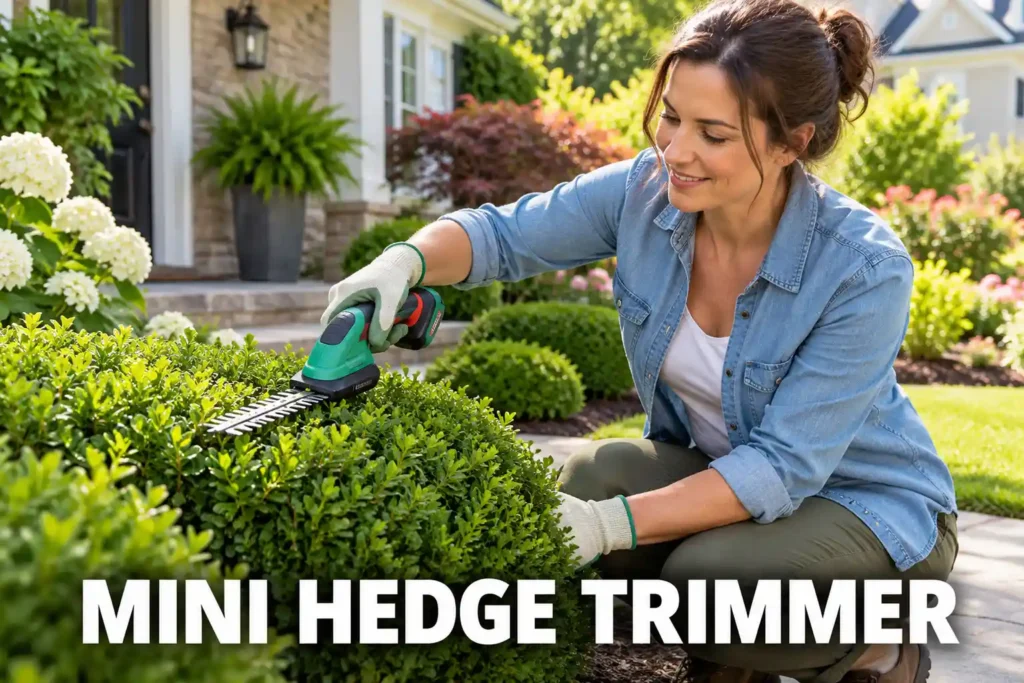
A mini hedge trimmer is a small handheld cordless cutter with a short blade, made for light trimming of shrubs and lawn edges around a home. Most carry two swappable blades on one handle, and the Sun Joe HJ604C and Scotts LSS10172S print a cutting diameter of 8 mm (5/16 in). I judge any cutter by the stem size it is rated for, because that number decides whether the tool belongs on the shrubs along my yard edge or only on the lawn trim. Below you will find what a mini is, how it differs from a full-size model, what it cuts, how to run it safely and who should skip it.
What a Mini Hedge Trimmer Is
A mini hedge trimmer is a one-handed battery tool: a motor housing, a trigger with a lock-off button and a short blade bar. It suits soft growth on small shrubs and the edge of a lawn, not a whole hedge. According to Sun Joe, its HJ604C is “intended for light-duty trimming of shrubs and lawn edges for residential properties”, and Scotts says the same of its LSS10172S in nearly the same words: “light trimming of shrubs, hedges and lawn edges”.
No standard defines the class, so sizes vary by maker. The numbers here come from the Sun Joe HJ604C and Scotts LSS10172S manuals, both 7.2 V tools, and a different model can print different figures, so read the manual of the one you buy. Each is a mini cordless hedge trimmer in the plain sense: a lithium-ion battery charged through the tool, a charger in the box and no cord to drag through the shrubs. For the full-size parts and types, I explain what a hedge trimmer is in a separate guide.
Why One Tool Has Three Names
Makers do not print the words mini hedge trimmer. Sun Joe calls its tool a cordless grass shear + hedge trimmer, and Scotts calls its a cordless shrub shear. Stores add a third name, shear shrubber, for the same idea: one motor housing with a grass-shear blade for edges and a shrub blade for bushes.
Specs as the Makers Print Them
| Detail | Sun Joe HJ604C | Scotts LSS10172S |
|---|---|---|
| Battery, maker’s figure | 7.2 V, 1.5 Ah lithium-ion | 7.2 V DC, 2.0 Ah lithium-ion |
| Blades in the box | Hedge blade 6 in (15.2 cm); grass shear blade 4 in (10.2 cm) | Shrub blade 6.69 in (170 mm) cutting length; grass shear blade 3.54 in (90 mm) wide |
| Cutting limit, maker’s figure | Hedge blade cutting diameter 0.3 in (8 mm) | Shrub blade maximum cutting diameter 5/16 in (8 mm) |
| Weight, as printed | 2.5 lb (1.14 kg) | Not published by the maker |
| Charging time, maker’s figure | Up to 5 hours | 3 to 5 hours |
| Warranty | 2 years, residential use only | 2 years limited, personal and household use |
Shear Shrubber vs Hedge Trimmer and What a Full-Size Model Changes
A mini and a full-size hedge trimmer cut the same way, with two reciprocating blades. What changes is how much hedge one pass covers, what the blade is rated to cut and how the tool is held. I explain the motion behind those two blades in how a hedge trimmer works.
| Detail | Sun Joe HJ604C | Scotts LSS10172S | Makita XHU02 |
|---|---|---|---|
| Blade length, maker’s figure | 6 in hedge blade | 6.69 in shrub blade | 560 mm (22 in) |
| Cutting limit, maker’s wording | Cutting diameter 8 mm | Maximum cutting diameter 8 mm | Do not cut branches thicker than 10 mm |
| Battery platform | 7.2 V | 7.2 V | 18 V |
| Weight, as printed | 2.5 lb (1.14 kg) | Not published by the maker | 3.0 to 3.3 kg (6.7 to 7.4 lb), by battery pack |
| Grip | One handle | One handle | Two handles, two triggers |
The Makita’s 10 mm branch figure sits only a little above the minis’ 8 mm, and the three makers use three different kinds of number (cutting diameter, maximum cutting diameter, branch). Read the model’s own words and do not compare one maker’s wording with another’s. What a 22 in blade really changes is passes per hedge: a 6 in blade needs many more along a long row. My 20 or 24 inch trimmer guide compares blade lengths for different hedges.
Posture matters on small hedges. In a study of 120 Chinese garden workers pruning hedges, the trunk was inclined 40 to 50 degrees when they cut short hedges horizontally (1). A survey of 55 landscape workers in Malaysia found awkward posture to be the main risk factor for their symptoms (2).
A light tool does not cancel a bent back. When I cut low shrubs I stop and stand upright every few minutes, and I take a break before the shoulders start to complain.
What a Mini Hedge Trimmer Cuts and What Goes to Loppers
A mini cuts soft shoots, small shrubs, climbing plants and lawn edges, and it stops at its printed limit. These one-hand tools are for light stems up to the manual’s printed cutting diameter, 8 mm (5/16 in) on the Sun Joe and the Scotts, and everything thicker belongs to another tool.
Soft Growth, Small Shrubs and Lawn Edges
Scotts says the shrub blade is for “trimming and shaping individual bushes, shrubs, and climbing plants” and is not intended for grass or edging. Its grass-shear blade is for “the edges of lawns and small areas of grass” and is not intended for hedges. Use each blade for its own job.
Hard surfaces wear the blade fast. Scotts says it must not touch paved surfaces, stones or garden walls. Around my yard edge that means checking for stakes and wire before the first cut.
Thicker Stems Go to Other Tools
Sun Joe tells you to cut branches thicker than 0.3 in (8 mm) with pruning shears or another device first. Both manuals warn against forcing the blades through dense growth: if they slow down, reduce your cutting pace. On the old stems at the edge of my yard I cut the thick wood with loppers first and keep the mini for the soft growth on top. My hedge trimmer or pruning shears guide sorts out which jobs belong to each tool.
A stem past the rating stalls the blade. When that happens I follow the stop order in the safety section, with the blades stopped completely and my gloves on, before I reach for the loppers, because forcing the cut is how a small tool jams.
Shaping a Small Hedge
Sun Joe gives a short method for the hedge blade, and it suits a formal hedge:
- Angle: keep the cutting device at about 15 degrees to the cutting surface.
- Shape: trim a trapezoid, wider at the bottom, with about 4 in (10 cm) of slant for each 39 in (1 m) of height.
- Order: cut both sides first, bottom to top, then cut the top in stages, along a taut line between the hedge ends.
The shape matters for the plant too: according to Clemson Cooperative Extension and Iowa State University Extension, a hedge wider at the top than at the base loses its lower leaves. Shearing is not right for every plant: University of Maryland Extension recommends thinning boxwood rather than shearing it, while Iowa State, Colorado State and Delaware list boxwood among the shrubs that take shearing. I stretch a string along the shrubs before the first pass, because a short blade makes a wavy top easy to cut.
Battery, Charging and Care
The Sun Joe and the Scotts are each a mini battery hedge trimmer with a small 7.2 V pack, and how you charge and store it decides how long the pack lasts. The two manuals differ in places, so follow the one for your model.
- Charging: Sun Joe says do not charge below 50 F (10 C) or above 104 F (40 C), and charge indoors only. Scotts allows 32 to 100 F (0 to 37.8 C) and asks you to let a hot battery cool before recharging.
- Storage: Sun Joe says to charge fully, clean the tool, fit the blade covers and store it dry between 41 and 104 F (5 and 40 C), recharging every 6 months in long storage. Scotts asks for a recharge more often and no direct sunlight.
Use only the maker’s battery and charger for your trimmer, charge and store them within the temperatures your manual gives and never in rain or wet places, never use or charge a damaged, swollen or leaking pack, and keep loose batteries away from metal objects such as keys, coins and nails that could short the terminals.
Blade care is short. Do it only after the stop order in the safety section. Sun Joe says to clean the blade rail and treat it with light machine oil or spray lubricant after each use, and Scotts says to oil the blades before and after each use. A cordless shear shrubber that stays clean and oiled cuts with less effort, so I oil the blades once they have stopped and the charger is unplugged.
Safety With a Mini Hedge Trimmer
A mini has the same hazard as a full-size model: sharp reciprocating blades that keep moving for a moment after the trigger is released. Both manuals say the blades continue to move for a few seconds after the tool is switched off. A UK review of hand injuries from tools at home and in leisure settings names hedge trimmers among the main causes of power tool hand injuries (3). The study does not split trimmers by size, so give a small one the same respect.
Hold It and Start It
The mini has a single handle, so the two-handed grip of a full-size trimmer does not apply. Hold the tool by its insulated gripping surfaces only, because the blade can contact hidden wiring (the grips do not make the tool insulated or wire contact safe). Keep your free hand and every other body part clear of the blade whenever it moves, and never remove cut material or hold the stem you are cutting while the blade moves.
Never hold a branch with your free hand or reach toward the blade, through the hedge or into any opening while the blade moves. On a gas trimmer never reach into any opening while the engine is running: a blade that has stopped in a jam does not stop the engine, so first complete the full maintenance shutdown. Do not overreach: keep your footing and balance, and trim only what you can see.
To start, push the lock-off button and press the trigger, then release the lock-off button, as both manuals describe. I keep my free hand behind the grip and watch the stem, not the blade. The blade cover comes off before you start, because it is for carrying and storage only.
Stop It, Clear a Jam and Put It Away
The two manuals give one short order for every stop, and it applies to a jam, cleaning, a blade change and storage:
- Release the trigger, and make sure the lock-off or safety button is not pushed.
- Wait until the blades have stopped completely. They keep moving for a few seconds.
- Put on gloves before you handle the blades, and never use your fingers to free a jammed blade, because jammed blades can release suddenly. The exception is a jam on a wire or a cord: then touch nothing, as described under wire below.
- Unplug the charger from the outlet by the plug, and fit the blade cover or guards before you carry or store the tool.
- Store it indoors, dry and out of children’s reach.
Full-size battery trimmers with a removable pack add a step: the pack comes out before any blade work. Sun Joe’s general rules say to disconnect the battery pack before adjustments, changing accessories or storage, and its HJ604C manual describes an integrated battery charged through the tool, so for that model keep the charger unplugged and keep the lock-off button unpressed. If your mini’s battery lifts out, take it out first. Check that the blade sits flat and the cover is fitted before you power up again, carry the tool with the blades pointing behind you, and never touch a blade that can still run.
Wire, Weather, Light and Gear
Before you cut, look through the hedge for fence wire, cable and cords. If the blade jams on a wire or a cord, do not touch the blade, the wire or the cord and do not try to free the trimmer: stopping the blade does not remove the electrical danger, so the electrical supply to the damaged line or cord must be disconnected first. Treat anything touching a wire as live, and if it is a utility line, never go back to the trimmer to switch it off or unplug it: follow the line contact steps below. Scotts prints this as a danger notice, and I check a hedge for wire before the first pass.
Line Contact
If the trimmer or a branch touches a utility wire, the trimmer, the branch, the wire and the ground around them can become live. Do not go to the trimmer or pick it up, touch nothing that is in contact with the line, keep everyone away, and call the utility at once, and 911 if anyone is hurt, a fire starts or a line comes down. Only the utility frees the trimmer.
Wear safety glasses with side shields marked ANSI Z87.1, and a face shield over them where your manual asks for one; hearing protection; sturdy work gloves; long pants and long sleeves with no loose clothing or jewelry; and closed, non-slip shoes or boots. A UK review of surgically treated penetrating eye injuries found that DIY and gardening were behind many of the home cases, and none of those patients wore eye protection (4). Glasses go on before the tool comes out of its box.
Never trim in rain, in wet or damp conditions, in dense fog, strong wind, a storm or when lightning is possible, and wait until the hedge is dry. Trim only when the light lets you see the stems, any wire in the hedge and your footing clearly. Keep people, pets and helpers away at the distance your manual gives (Sun Joe and Scotts say a safe distance and print no number), stop trimming if anyone comes closer, and look behind you before you swing the tool.
Look for nests before you cut and leave a hedge where birds are nesting. Weight at arm’s length builds up: take breaks and stop when you are tired or your grip weakens.
Ladders
Do not use a hedge trimmer on a ladder, a roof, a tree or any unstable support; the manuals of EGO, Ryobi, Milwaukee and Echo ban it, and Husqvarna bans work from any raised position that is not fully secured. For a tall hedge, stay on the ground and use a pole or long-reach hedge trimmer, or hire a professional.
Who Should Buy a Mini Hedge Trimmer and Who Should Skip It
Buy a mini when the job is small, soft and reachable from the ground. Skip it when the hedge is long, the stems are thick or the work is daily.
- Buy it for: low shrubs and soft growth, shaping single bushes and climbing plants, and lawn edges and small grass areas, the jobs a grass shear and shrubber is sold for, where a long blade is awkward next to a window, a path or a border.
- Skip it for a long hedge: a 6 in blade means many passes, and a full-size battery trimmer covers the row in far fewer, which is why I consider blade length in my roundup of hedge trimmers for large hedges.
- Skip it for thick stems: anything above your model’s printed cutting diameter (8 mm on the Sun Joe and the Scotts) goes to pruning shears, loppers or a saw.
- Skip it for tall hedges: a hedge too tall to reach from the ground goes to a pole or long-reach model from my roundup of hedge trimmers for tall hedges or a professional, and stems thicker than the stated capacity or a large overgrown hedge cut back hard do too.
- Skip it for commercial work: both warranties exclude it.
Anything near a power line goes to the utility and its qualified line-clearance crews, never to a trimmer of any size.
On my land the mini job would be the shrubs at the yard edge, where the cutting is light. The hedgerow along the orchard is a different job, and I would reach for a full-size model there, such as those in my roundup of full-size hedge trimmers.
Choosing a Small Cutter for Small Jobs
Three things settle the choice. Match the printed cutting diameter to your stems: it is 8 mm (5/16 in) on the Sun Joe HJ604C and the Scotts LSS10172S, and your model’s own manual sets its limit. Check the blade length against the length of the shrub or edge you trim. Learn the stop order before the first cut, because the blades run on for a few seconds after you let go of the trigger.
My own tip is to keep the loppers beside the cutter and decide on each stem before the blade touches it. Read the manual of the exact model you plan to buy, since this class has no standard size. A mini hedge trimmer earns its place on soft shrub growth and lawn edges, and loppers or a full-size trimmer take everything else. My roundup of hedge trimmers for small bushes lists light models for tidy shrubs.
Frequently Asked Questions
Are small hedge trimmers any good?
Small hedge trimmers are good for soft growth on small shrubs and lawn edges, and a poor fit for long hedges or woody stems. The Sun Joe HJ604C and Scotts LSS10172S manuals print a cutting diameter of 8 mm (5/16 in) and blades of 6 to 6.7 in, against 22 in for a full-size Makita.
What is the best mini hedge trimmer?
The best mini hedge trimmer is the one whose printed limits match your job: a printed cutting diameter that matches your stems (8 mm on the Sun Joe HJ604C and the Scotts LSS10172S), a blade length that suits the shrub and a weight you can hold at arm’s length. Compare the maker’s own wording for blade length, cutting diameter and weight, and check that the battery and charger come in the box.
What’s the difference between a hedge trimmer and a shrub trimmer?
The difference between a hedge trimmer and a shrub trimmer is the size of the blade and the job. Scotts calls its 6.69 in tool a shrub shear for shaping single bushes, while a full-size hedge trimmer such as the Makita XHU02 has a 22 in blade and a 10 mm branch limit. Pick by the length of the hedge and the thickness of the stems.
What is a shear shrubber?
A shear shrubber is a small cordless tool with one motor housing and two swappable blades, a grass-shear blade for lawn edges and a shrub blade for bushes. Sun Joe sells the same idea as a cordless grass shear + hedge trimmer, and Scotts as a shrub shear. It cuts light stems only, up to 8 mm (5/16 in) cutting diameter in the Sun Joe and Scotts manuals.
What is a mini cordless hedge trimmer used for?
A mini cordless hedge trimmer is used for light trimming of small shrubs, climbing plants and lawn edges around a home. Scotts says its tool is intended for light trimming of shrubs, hedges and lawn edges, and Sun Joe limits its tool to light-duty residential trimming. It is not for stems over the printed limit (8 mm on those two), tall or long hedges or commercial work.
References
- Yang W, Li S, Li B, Liu W, Ning F, Gao S. Analysis of the effects of working position on muscle fatigue during hedge pruning: a cross-sectional study based on Chinese garden workers. J Mech Med Biol. 2023;23(2):2350027.
- Lim MC, Awang Lukman K, Giloi N, et al. Landscaping Work: Work-related Musculoskeletal Problems and Ergonomic Risk Factors. RMHP. 2021;Volume 14:3411-3421.
- Williams STB, Power D. Hand injuries from tools in domestic and leisure settings: relative incidence and patterns of initial management. J Hand Surg Eur Vol. 2011;36(5):408-412.
- Bhogal G, Tomlins PJ, Murray PI. Penetrating ocular injuries in the home. J Public Health. 2007;29(1):72-74.
Safety Note: Only an adult who has read the manual and understands the controls should use a hedge trimmer, never a child or anyone tired or impaired. The blades are sharp, a hand that touches them is cut in a fraction of a second, and they keep moving for a moment after you release the switch. Hold the trimmer with both hands on the handles, by the insulated gripping surfaces only because the blades can contact hidden wiring (the grips do not make the trimmer insulated or wire contact safe), whenever the blades move; on a trimmer with two switches, both hands must be on the switches to start. Never hold a branch or reach toward the blades, through the hedge or into any opening while they move, and never reach into any opening of a gas trimmer while the engine is running, because a blade that stops in a jam does not stop the engine. Never overreach, and trim only what you can see. Before you start, look through the hedge for wire, fence wire, cords, posts, stakes, irrigation lines, nests, people and pets, and keep the cord or hose out of the blade’s path. If a blade jams on a wire or a cord, do not touch the blade, the wire or the cord: stopping the blade does not remove the electrical danger, so the electrical supply to the damaged line or cord must be disconnected first. Cut only stems up to the capacity your manual states, in the maker’s own wording, and leave thicker wood to loppers or a saw. Do not use a hedge trimmer from a ladder, a roof, a tree or any unstable support, so for a tall hedge stay on the ground and use a pole or long-reach hedge trimmer, or hire a professional. Power lines can kill. With a pole or long-reach hedge trimmer, look for every overhead wire, including wires hidden in leaves, and keep yourself, the trimmer, the pole and any branch that could fall or swing at least 50 feet (15 m) from every line, the distance Ryobi and Echo print in their pole hedge trimmer manuals, or farther if your manual asks for more. A pole hedge trimmer is not insulated, and electricity can jump through the air and travel through branches, especially wet ones. Treat every wire as live, and leave a hedge that has grown into or near a wire to the utility and its qualified line-clearance crews. If the trimmer, the pole or a branch touches a wire, treat the trimmer, the branch, the wire and anything touching them as live: do not go back to the trimmer to switch it off or unplug it, do not touch anything in contact with the line, keep everyone away and call the utility, which alone frees the trimmer, and 911 if anyone is hurt, a fire starts or a line comes down. Wear safety glasses with side shields marked Z87.1, a face shield over the glasses where your manual asks for one, hearing protection, sturdy gloves, long pants, long sleeves with no loose clothing or jewelry, and closed, non-slip shoes. Wear head protection when you work a pole or long-reach model overhead, as the Ryobi, Husqvarna and Echo pole manuals require, and a respirator when dust is present, as the DeWalt manual states; where a manual forbids cutting overhead, do not. Keep people and pets away at the distance your manual gives, and stop trimming if anyone comes closer. Never trim in rain, fog, strong wind, a storm or when lightning is possible, trim only in good light, and let the hedge dry first. Before each use, remove the blade cover (it is for carrying and storage only), and check the blades, the operating guards, the switches and every handle and pole coupling as your manual describes, and do not use a trimmer that fails a check. Before you clear a jam, remove cut material, clean, lubricate or touch the blades: release the switch, switch the motor or engine off and wait until the blades have stopped completely, then take the battery pack out, unplug a corded trimmer from the outlet by the plug, or on a gas trimmer let the engine and muffler cool and pull the spark plug wire off; put on gloves and check every lock and coupling before power goes back on. To carry or store the trimmer, release the switch, switch the motor or engine off and wait until the blades have stopped completely, then take the battery out, unplug a corded trimmer by the plug, or on a gas trimmer let the engine and muffler cool and pull the spark plug wire off; fit the blade cover, carry the trimmer by the handle with the blades pointing behind you, and keep it indoors, dry and out of children’s reach. Use only the maker’s battery and charger, charge and store them within the temperatures your manual gives and never in the wet, never use or charge a damaged, swollen or leaking pack, and keep loose batteries away from metal objects that could short the terminals. Use a corded trimmer only with an outdoor-rated extension cord of the gauge your manual gives, plugged into GFCI-protected power, with the cord behind you and away from the blades, and never in rain or wet conditions: GFCI protection does not make that safe; if the cord is cut or damaged, disconnect it at once by pulling the plug from the outlet by the plug, before you touch the cord or the blades. Refuel a gas trimmer outdoors with the engine off and cool, with no smoking, flames or sparks nearby, wipe up spills, move at least 10 feet from where you fuelled before you start it, wear hearing protection, and never run it indoors or in a garage or shed, because the exhaust contains carbon monoxide. Look for nests before you cut and leave a hedge where birds are nesting. Take breaks and stop when you are tired.