
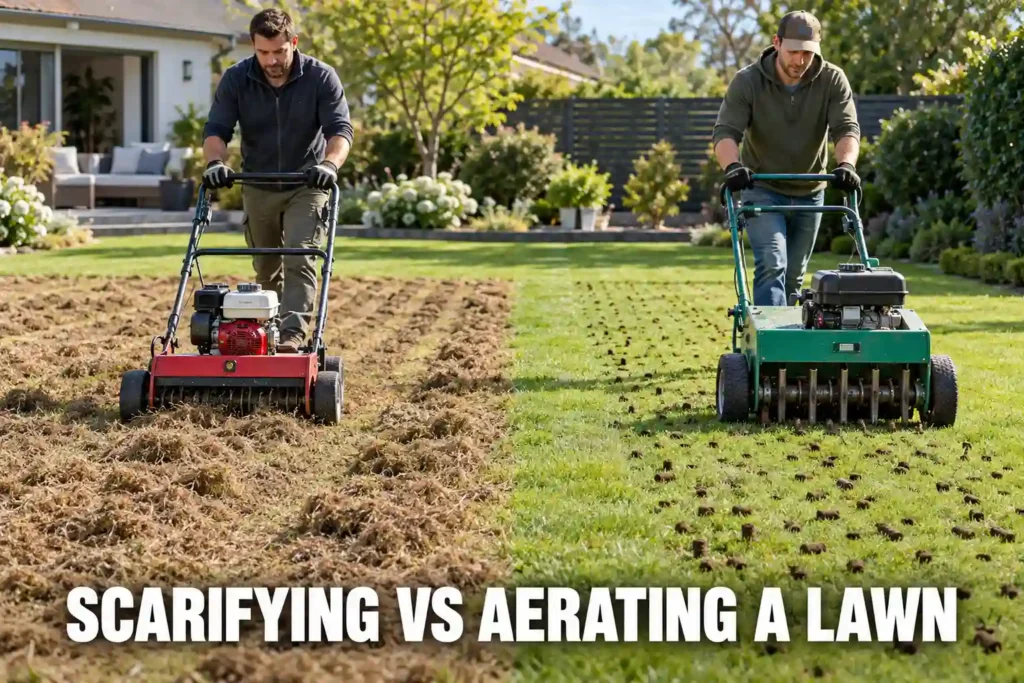
Scarifying vs aerating a lawn comes down to where the trouble sits: scarifying cuts away thatch at the surface, while aerating opens packed soil underneath. Pick the job that matches the problem, because the wrong one thins the grass and fixes nothing.
In field crop production I verified seed drill calibration on weighing trays, so I judge any lawn job by how much seed ends up touching soil. Below you will find what each job does, the signs that call for it, the right season for your grass, and the safety steps before a machine starts.
Scarifying vs Aerating a Lawn and What Each One Fixes
Scarifying and aerating work at different depths on different problems. Scarifying removes what sits on top of the soil, and aerating opens the soil itself. The table sets the two side by side before I take each job in turn.
| Question | Scarifying | Core aerating |
|---|---|---|
| Where it works | The thatch layer and the surface of the soil | The soil below the grass, in plugs about 3 inches long |
| What comes out | Thatch, dead grass and moss | Plugs of soil, left on the lawn |
| What it fixes | A thick, spongy thatch mat and a surface seed cannot reach soil through | Packed soil that holds water on top and starves roots of air |
| What it does not fix | Compaction, poor drainage and shade | A heavy thatch mat on its own, in some grasses |
| Risk to the lawn | High: blades tear live grass and roots when set too deep | Lower: holes close as the grass grows, but the lawn looks rough for a while |
| Cool-season timing | Late summer to early fall | September, or spring with a weed risk |
What Scarifying Does to the Lawn
Makers use the word scarifying for a drum of fixed blades that cuts shallow grooves in the turf. The drum pulls up thatch, dead grass and moss and leaves the surface open for seed. The nearest extension term is vertical mowing. According to Penn State Extension, the rotating blades of a vertical mower slice into the thatch and bring organic debris to the surface. The blades, the depth setting and what the drum does to turf are laid out in my explainer on how a lawn scarifier works.
The cost is real. According to University of Illinois Extension, mechanical dethatching is very destructive to the lawn because roots grow in the thatch instead of the soil. Excess depth can tear live grass and roots, so on any machine I start on the lightest position and drop one step only if the first pass left the mat in place.
Scarifying also leaves the cause alone. Illinois Extension points to excess nitrogen and overwatering, and says thatch returns unless the cause is corrected. Clippings are not the cause, so mulching them back is no reason to scarify.
What Aerating Does to the Lawn
A core aerator pulls plugs of soil out of the lawn. Iowa State Extension describes hollow tubes that remove cores about three-fourths of an inch across and 3 inches long, with 20 to 40 holes per square foot as the goal, which takes several passes. The holes let air and water reach the roots and give them room to grow. My guide on how a lawn aerator works explains the tines, plugs, depth and what happens after aeration.
Aeration also touches thatch, but the evidence is mixed. Penn State Extension calls core aeration an important preventive practice for thatch control, yet a four-year trial on a bermudagrass lawn found that coring once or twice a year did not reduce thatch and thinned the stand (1). What coring does is mix soil into the thatch, and in field studies on bentgrass and Kentucky bluegrass that changed the density and chemistry of the layer within six weeks (2). I compare dethatching and core aeration directly in a separate guide, if you want that trade laid out job by job.
Aerating vs Scarifying and Why Spikes Do Not Count
Spike aerators, spiked shoes and slicing blades get sold as aerating, and they are a different job. Wisconsin Extension says spikers poke holes under a quarter inch wide, often under an inch deep, while slicers cut narrow grooves, and both bring little thatch or soil to the surface. Solid tines can even add compaction, because they push the soil down instead of removing it, and Iowa State Extension tells homeowners to avoid spike tools for the same reason. My “lawn aerator against aerator shoes” comparison explains which option opens compacted soil.
A blade drum on an electric machine falls into the same group. It cuts grooves and does not pull cores, so treat it as scarifying and use a hollow-tine core aerator when the problem is packed soil. My dethatcher vs aerator comparison explains which machine to buy or rent for each job.
Signs Your Lawn Needs Scarifying
A lawn needs scarifying when the layer above the soil is thick enough to block water, air and seed. You cannot judge that by eye, so measure the layer before you rent or buy anything. When the measured layer says yes, I compare cordless dethatchers in a roundup.
Measure the Thatch First
- Choose three or four spots across the lawn, away from the edges.
- Cut a small wedge of turf, about 3 inches long and 2 inches deep, with a pocketknife or a spade.
- Look for the brown, spongy layer of stems and roots between the green leaves and the soil.
- Measure that layer with a ruler and leave out any part that holds soil.
- Average the spots, because thatch is rarely even across a lawn.
According to Wisconsin Extension, a moderate layer is useful because it protects the growing point of the grass and slows water loss from the soil. Most extension services start to treat thatch as a problem at about half an inch, although some warm-season guidance waits until about an inch. I cut a wedge from the house lawn before I decide anything, and the ruler settles the question faster than my opinion does. Where a layer tips from helpful to harmful is the subject of my guide to healthy lawn thatch levels.
The depth matters for water as well. In a column study with Kentucky bluegrass and red fescue thatch, thatch delayed the start of water infiltration, and the thicker red fescue thatch delayed it longer (3). A lawn where water sits on the surface before it soaks in is a candidate, but only after the wedge shows the layer is thick.
Other Signs That Point to Scarifying
- A spongy feel underfoot. A bouncy feel can point to thatch buildup.
- Matted dead grass after winter. On my house lawn it shows up as flattened brown grass and leaf litter in spring, and raking comes before any machine.
- Thin grass where seed cannot reach the soil. Seed that lands on a thick mat has a hard time reaching the soil.
Moss Is Not Always a Thatch Problem
Moss under my shade trees tells me about shade, damp and packed soil before it tells me about thatch. Scarifying lifts the moss out, and it comes back unless the light, the drainage or the fertility change. When the patch is also hard to push a screwdriver into, aeration belongs in the plan too. My lawn scarifier picks for moss and matted turf list corded and cordless machines.
Signs Your Lawn Needs Aerating
A lawn needs aerating when the soil is packed hard enough to stop water, air and roots. The clearest sign is water that puddles and drains slowly after rain, according to Cornell turf extension, and the soil under those puddles is the place to test.
Run the Screwdriver Test
- Wait for moist soil, a day after a good watering or rain, because dry ground is hard everywhere.
- Push a long screwdriver into the lawn in several spots.
- Note the spots where it will not go in easily. University of Illinois Extension says that in those places the lawn likely has compaction.
- Compare a busy strip, such as a path or a gate, with a quiet corner of the same lawn.
I push the screwdriver into the packed path beside the vegetable plot and into a quiet corner under the trees, then compare how the two feel. Weeds give a second clue: Illinois Extension lists yellow nutsedge, prostrate knotweed and spotted spurge as plants that grow in wet, compacted areas where grass struggles. I put the checks in order in my guide to signs your lawn needs aeration.
Soil type and traffic set how often the job comes round. Iowa State Extension says lawns on heavy clay, or with heavy foot and pet traffic, should be aerated twice a year, while one aeration a year is enough on well-drained soil with little traffic.
When Aerating Will Not Help
Wisconsin Extension warns that aeration is not right for every lawn, and in some cases it can do more harm than good. Skip it in these cases:
- The soil is not compacted. Sandy soils generally do not become compacted and rarely need aerating.
- Thatch is the only reason you were considering it. Wisconsin Extension counts a layer under three-quarters of an inch as no reason to aerate, because a thin layer protects the grass. Confirmed compaction can still justify coring.
- The grass is tall fescue or perennial ryegrass. These bunch-type grasses make no thatch and recover slowly from aeration, so overseed right away if you aerate them to cure compaction.
My own rule is blunt. If the soil is loose and the thatch is thin, I skip both jobs, because neither one fixes shade or drainage.
Timing, Grass Type and Recovery for Each Job
Both jobs injure the turf, so both belong in a window when the grass grows fast enough to close the gaps. Timing matters more than the machine, and it follows your grass type, not the calendar. Dates below are Midwest and mid-South examples, and climate shifts them.
Cool-Season Lawns
Kentucky bluegrass, tall fescue, perennial ryegrass and fine fescue are cool-season grasses. Iowa State Extension names September and April as the best months to aerate them, and Wisconsin Extension picks September 1 to 30, with a spring window from May 1 to June 15 that carries a weed risk because weed seeds are germinating. For thatch removal, Penn State Extension says late summer and early fall, and Illinois Extension says late August for the best recovery.
Early spring is the poor choice for scarifying. K-State turf extension notes that weeds are more likely to invade after an early spring dethatching. For a cool-season lawn, late summer to early fall suits both jobs and the seed that follows.
Warm-Season Lawns
Bermudagrass, zoysiagrass, St. Augustinegrass and centipedegrass are warm-season grasses. Mississippi State Extension says to remove thatch only when the turf is actively growing, from late spring through mid-summer, and K-State turf extension puts zoysia in late spring and early summer. NC State Extension adds that hot, dry periods are the time to stay off the lawn, because digging exposes grass roots suddenly. Zoysia mowed tall recovers slowly: in a five-year trial, zoysia mowed at about three-quarters of an inch recovered faster after thatch removal than zoysia mowed at about 1.5 inches, and annual vertical slicing cut its thatch depth by 12 to 18 percent a year (4).
St. Augustinegrass and centipedegrass need extra care. University of Florida IFAS Extension says power rakes should not be used on grasses that only produce above-ground stems, and that vertical mowing of St. Augustinegrass should wait until the grass is actively growing. That warning names power rakes. For these two grasses the Florida advice also calls for wide blade spacing, about 3 inches for St. Augustinegrass, and Clemson Extension says to work them in one direction only. Skip any machine whose blades cannot be set that wide, and read its manual before the first pass. My power rake vs dethatcher comparison covers what each machine does and when to use it.
How Long the Lawn Looks Rough
An aerated lawn looks rough for a while. Wisconsin Extension says the turf recovers quickly when the grass is actively growing, and a putting green trial recorded a drop in turf quality from coring that lasted about two weeks (5). A home lawn is not a putting green, so use that number as a sign of the order of magnitude, not as a promise.
Scarifying recovery varies with the grass, the weather and how deep the blades cut, so watch the turf instead of the calendar. New green growth through the gaps means the lawn is closing. Before the pass, mow the lawn shorter than usual, and keep it off wet soil, which smears and packs under the wheels.
What to Do After Scarifying a Lawn
Rake up the loose thatch and dead grass, and take it to the compost pile rather than leaving it in rows on the turf. Water the lawn thoroughly, and wait about a week before you fertilize, as NC State Extension advises. Mow at the highest setting for the first cut. If the pass thinned the turf, overseed while the soil is still open. My guide on pairing dethatching with overseeding shows how the two jobs fit together.
Lawn Damage Warning
Scarifying or aerating in the wrong season, with the blades too deep, on wet soil or on a stressed lawn can badly damage the grass. Stay off the lawn in heat, drought and dormancy, and set the shallowest depth first.
Which Job Gives Grass Seed a Better Start
Seed needs to touch soil, and both jobs open the surface for it. Illinois Extension says aerating creates holes that help seed contact the soil, and that overseeding after aerating is a good way to thicken a lawn and fill bare spots. For cool-season fescue, ryegrass and bluegrass, fall is the best time. My lawn spreader picks cover the push and handheld models for getting the seed down evenly.
The two jobs hold up well against each other as seedbeds. A Kansas State University trial on seeded tall fescue found that core aerification and verticutting were equally successful as seedbed preparation (6). Wisconsin Extension adds that some seeding machines carry a slicer or spiker to cut small holes or grooves, because seed-to-soil contact decides how well seed establishes.
Bare soil goes to weeds first. In a four-year bermudagrass trial, vertical mowing without herbicides increased large crabgrass in summer and chickweed, henbit and brome in winter (7). After a scarifying pass I sow the same day, while the soil is open.
When a Lawn Needs Both Jobs
Some lawns show both problems: a thick mat and packed soil. A two-year trial on an established bentgrass green found that core cultivation combined with vertical mowing and grooming lowered organic matter by 19 percent, while untreated plots gained 32 percent (8). A golf green is managed far more closely than a home lawn, so that finding covers that three-practice treatment on a bentgrass green and no more. For your lawn, decide by the problems you found: thick thatch from the wedge test points to scarifying, and compaction from the screwdriver test points to coring.
Safety Before Either Job Starts
A scarifier throws stones, sticks and soil, and a drum or a set of tines can catch whatever lies in the turf. A core aerator pulls cores from as deep as 3 inches. Set up the lawn and yourself before the first pass.
- Protect yourself every time. Wear eye protection with side coverage that meets ANSI Z87.1 or the standard your manual names, hearing protection, long pants, sturdy closed shoes and gloves.
- Clear the lawn. Walk it first and pick up stones, sticks, toys, wire and dog waste.
- Mark what lies in the soil. Flag sprinkler heads, irrigation and drip lines, low-voltage lighting wire and buried pet fence wire. Wisconsin Extension says to adjust the depth or avoid the area if irrigation lines lie less than 3 inches deep.
- Keep people and pets back. Hold them at the distance your manual gives, and stop when someone comes closer.
On my house lawn I pick up pruning twigs, fruit drop and stones before any machine goes out, and I mark the drip lines near the tree-row strips because a blade or a tine set deep can catch one. Eye, ear and dust protection and closed boots come on before I start the machine, every time.
Stop the Drum Before You Touch Anything
Never lift or tilt a machine, or reach under it, while the drum turns. To clear a jam, empty or fit the bag, change the depth, turn the machine over or touch tines or blades: switch off, wait for the drum to stop completely, unplug the cord or remove the battery, and only then reach in. Wear gloves when you handle blades.
A corded machine needs an undamaged outdoor extension cord of the gauge and length the manual gives, a GFCI outlet, and a cord kept behind you and clear of the drum. Never run it on wet grass or in wet conditions. A battery machine takes only the maker’s charger and battery, charged and stored within the manual’s temperature range, and never a damaged or swollen pack.
Match the Job to the Problem
Three things carry this guide. Measure the thatch before you decide on scarifying, test the soil before you decide on aerating, and work only while the grass grows fast. One habit saves me most of the trouble: I cut a wedge and push a screwdriver in before I touch a machine, and those two checks tell me which job, if any, the lawn needs. Deciding on scarifying vs aerating a lawn takes a ruler and a screwdriver: scarify for thick thatch, and core aerate for confirmed compaction. If the wedge says scarifying, I rank machines with both a tine drum and a blade drum in my list of the best dethatcher and scarifier picks.
Frequently Asked Questions
Is a scarifier the same as aeration?
A scarifier is not the same as aeration, because a scarifier cuts away thatch and moss at the surface while aeration opens the soil underneath. Core aeration pulls plugs of soil, and a scarifier blade drum only cuts shallow grooves.
Can you over scarify a lawn?
You can over scarify a lawn by setting the blades too deep, working too often or scarifying stressed grass. Extension services warn that mechanical dethatching tears live grass and roots, and Penn State Extension advises a high first setting and a test in an out-of-the-way spot. If the lawn looks thin afterward, overseed so that weeds do not take the bare soil.
What to do immediately after aeration?
Right after aeration, leave the cores to dry for a day or two and then break them up with a mow, a rake or a drag mat. Water if the weather is dry, and overseed and fertilize if the lawn needs thickening. The turf looks rough for a short time while the grass grows through the holes.
Can you scarify and aerate at the same time?
You can scarify and aerate in the same growth window when the wedge test shows thick thatch and the screwdriver test shows compaction. Both jobs open the turf, so do them only while the grass grows fast and the soil is moist, not wet. If only one test is positive, do only that job.
What is the difference between thatching and aerating?
Thatch is the layer of dead and living stems and roots above the soil, and aerating is the job of opening the soil below it. Removing thatch, by raking or with a scarifier, treats a buildup on top of the soil. Core aeration pulls plugs of soil to relieve compaction, so the two answer different problems.
References
- Carrow RN, Johnson BJ, Burns RE. Thatch and Quality of Tifway Bermudagrass Turf in Relation to Fertility and Cultivation. Agronomy Journal. 1987;79(3):524-530.
- Danneberger TK, Turgeon AJ. Soil Cultivation and Incorporation Effects on the Edaphic Properties of Turfgrass Thatch. Journal of the American Society for Horticultural Science. 1986;111(2):184-186.
- Liang X, Su D, Wang Z, Qiao X. Effects of Turfgrass Thatch on Water Infiltration, Surface Runoff, and Evaporation. Journal of Water Resource and Protection. 2017;9(7):799-810.
- Dunn JH, Sheffer KM, Halisky PM. Thatch and Quality of Meyer Zoysia in Relation to Management. Agronomy Journal. 1981;73(6):949-952.
- Fu J, Dernoeden PH, Murphy JA. Creeping Bentgrass Color and Quality, Chlorophyll Content, and Thatch-Mat Accumulation Responses to Summer Coring. Crop Science. 2009;49(3):1079-1087.
- Bach AP, Bremer DJ, Lavis CC, Keeley SJ, Hong M. Effects of Drip Irrigation and Cultivation Methods on Establishment of Seeded Tall Fescue. Kansas Agricultural Experiment Station Research Reports. 2022;8(5).
- Johnson BJ. Vertical Mowing and Herbicide Treatments on Thatch in Bermudagrass (Cynodon dactylon) Turf. Weed Science. 1979;27(1):14-17.
- McCarty LB, Gregg MF, Toler JE. Thatch and Mat Management in an Established Creeping Bentgrass Golf Green. Agronomy Journal. 2007;99(6):1530-1537.
Safety Note: Read your manual first. A dethatcher or scarifier throws stones, sticks and other debris with force, so walk the lawn first and remove stones, sticks, toys, wire, hoses and pet waste. Mark sprinkler heads, irrigation and drip lines, low-voltage lighting wire and buried pet fence wire, keep the drum clear of them, and follow your manual’s limits near underground cables and pipes. Wear impact-rated eye protection with side coverage that meets ANSI Z87.1, hearing protection, gloves, long pants and sturdy non-slip closed shoes, plus a dust mask when the work raises dust. Keep people and pets as far away as your manual says, and stop at once if anyone comes closer. Never use a powered dethatcher on wet grass or in rain. The machine can jump up or forward when the tines hit hard or frozen ground, roots, stumps or buried rocks, so avoid those spots and hold the handle with both hands. Never lift or tilt the machine or reach under it while the drum turns. Before you clear a jam, empty or fit the collection bag, change the depth, clean, inspect or adjust the machine, turn it over, leave it, or touch the tines or blades, switch it off, wait for the drum to stop completely, then unplug the cord or remove every battery pack, and remove the safety key if it has one. Let hot tines cool before you handle them. If the machine starts to vibrate hard, switch it off, wait for the drum to stop completely, then unplug the cord or remove every battery pack and any safety key before you check it for damage. For a corded model, use an undamaged outdoor extension cord of the gauge and length your manual gives, plugged into a GFCI outlet, keep the cord behind you and clear of the drum, and never handle the plug with wet hands. For a battery model, use only the battery and charger approved for your tool, charge and store them within the temperature range in your manual, and never use a damaged or swollen pack. Stay off steep and wet slopes and work slopes only in the direction your manual gives. For a tow-behind dethatcher, follow both your tractor’s and your dethatcher’s manuals: tow it only behind a lawn tractor or riding mower that meets the maker’s requirements, never on public roads or behind a car or truck, keep a slow, steady speed, avoid sudden turns and stops, carry less weight on slopes and never more than the manual allows, never carry riders, and fit any tine safety wires the manual requires. Before you adjust or clear it, stop the tractor, set the parking brake, remove the key and disconnect the dethatcher as its manual describes. Dethatching at the wrong time of year, too deep or on stressed turf can badly damage a lawn, so match the timing and depth to your grass type.