
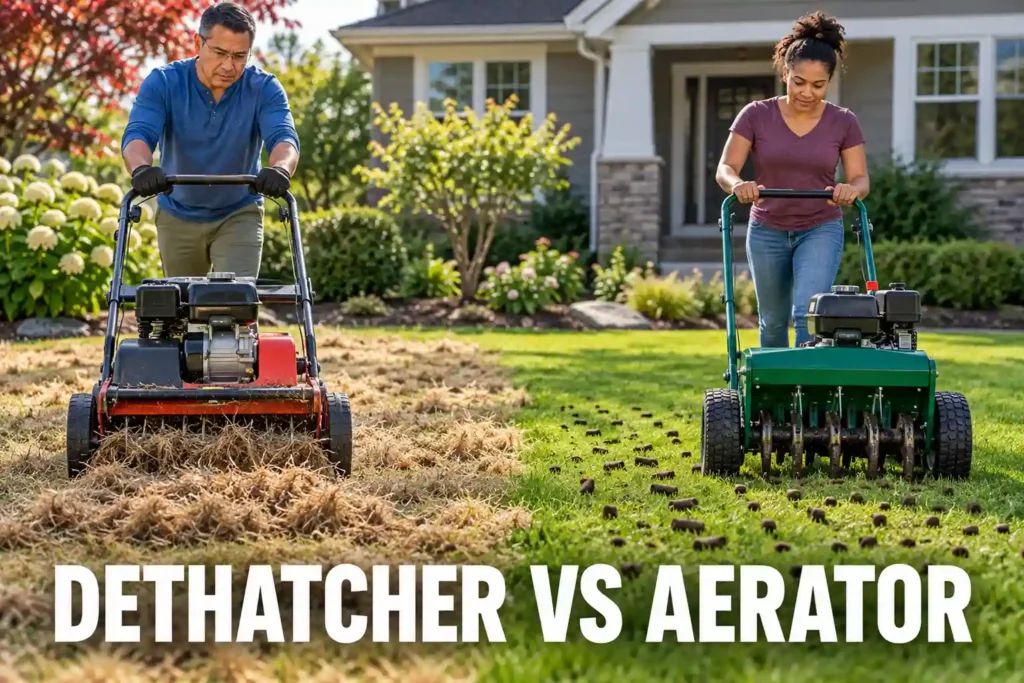
In the dethatcher vs aerator choice, one machine pulls dead plant material up and the other pulls plugs of soil out. They fix different problems, so the right one depends on what is wrong under the grass, not on which costs less.
I look at the soil with a spade before any machine touches a lawn, the same habit I use in the orchard. Below you will find how each machine works, how core, spike and slicing aerators differ, whether to buy or rent, and the safety steps for both.
Dethatcher vs Aerator: Which Machine Does Which Job
A dethatcher works on top of the soil. Its spinning tines or blades reach into the layer of dead and living stems and roots between the green grass and the dirt, and they drag that layer up so you can bag or rake it away. An aerator works in the soil. It opens channels, and the best kind pulls out cylinders of soil so water, air and roots can get down. My guide on what a lawn dethatcher is goes through its types and parts.
Put simply, a dethatcher removes plant material and an aerator removes soil. If your lawn feels spongy and a cut plug shows a thick brown mat, you have a thatch problem. If the soil is hard and sheds water, you may have a compaction problem. Many lawns have only one of the two, and some have neither.
| Question | Dethatcher | Core aerator |
|---|---|---|
| What it removes | Thatch: dead and living stems and roots above the soil | Plugs of soil, left on the lawn to break down |
| What it fixes | A thick, spongy mat that blocks water and air | Compacted soil that sheds water |
| Working part | Spring tines, wire tines or slicing blades on a spinning drum | Hollow metal tines that push into the soil |
| Does it harm grass | It can tear out live grass, and can thin the stand badly | It causes a short dip in turf quality |
| Collection | A bag or a rake pass to remove the debris | Nothing to collect; cores stay on the lawn |
| Rent or buy | Sold in walk-behind and tow-behind forms for home use | Core machines are often available at rental agencies |
A third group of machines sits between them. Retail scarifiers cut grooves into the soil surface and are a close cousin of the dethatcher, and my guide to dethatchers and scarifiers sets the two machines side by side. In the scarifier vs dethatcher vs aerator tangle, remember that only a core aerator takes soil out.
How a Dethatcher Works
A dethatcher is a drum or tray of tines or blades that turns or drags over the lawn. Turf references describe three families: vertical mowers with rotating blades that slice into the thatch, power rakes with vertically rotating wire tines, and plain hand rakes. Mechanical dethatchers use spinning vertical blades or spring teeth to pull thatch out of the turf.
Walk-Behind Electric Machines
Most home machines are walk-behind units with a motor, a stepped depth lever and a rear bag. Many carry two drums: a spring-tine drum for dethatching and a slicing-blade drum for scarifying, and you swap them by hand. The depth scale in the manuals runs from plus numbers (tines above the soil) to minus numbers (tines or blades working below the surface), and the highest position is the transport setting. My guide on how a dethatcher works follows the drum, the tines, the depth setting and the bag in detail.
The deepest step is never the dethatching step. On the makers who label their steps, the deepest positions are for the blade drum, and dethatching a healthy lawn uses a light setting. I start light and drop one step only if the first pass leaves the mat behind.
Tow-Behind Dethatchers
A tow-behind unit is a tray of spring tines dragged by a lawn tractor, riding mower or other vehicle the manual permits, and I weigh it against a walk-behind machine in my guide to the walk-behind vs tow-behind dethatcher choice. It has no motor and no bag, so the thatch stays on the lawn until you sweep or rake it. The weight tray, travel speed and slope limits come from both your tractor manual and the dethatcher manual. Slope limits are not a guess: if the manual does not allow a slope, do not tow on it.
What Dethatching Does to the Grass
Mechanical dethatching is very destructive to a lawn, because many roots live in the thatch instead of the soil. Removing more thatch than you meant to can severely thin the stand, so test in a low-visibility area first. That is why a dethatcher is not a machine to run every spring just in case. I try a corner out of sight first, and I stop at one pass if the grass looks thin.
How an Aerator Works
An aerator makes holes in the lawn so water, air and nutrients reach the roots. In my comparison of core and spike aerators, I explain that core aerators use hollow metal tubes or tines to remove plugs of soil, while spike-type devices simply punch holes and can compact the soil. Hollow-tine aeration is the most efficient compaction reliever. I leave the cores lying on the lawn rather than raking them up.
Core, Spike and Slicing Aerators
Retail lists use the words plug, core, spike and slicing, and they overlap. A plug aerator is a core aerator: both pull cylinders of soil out. A spike aerator pushes solid spikes in and removes nothing, and a slicing aerator cuts narrow slots. The table keeps the three apart. My guide on scarifying and aerating a lawn shows how to tell which job yours needs.
| Type | How it works | What extension sources say |
|---|---|---|
| Core (plug, hollow tine) | Hollow tines pull plugs of soil out | Most efficient compaction reliever; do it during active growth |
| Spike (solid tine) | Solid spikes push into the soil | Can relieve compaction, but Iowa State warns spikes can compact the soil around the hole |
| Slicing | Blades cut narrow slits | Less disruption than coring; less efficient at relieving compaction |
A proper core aerator takes cores about three-fourths of an inch across and 3 inches long, with several passes often needed. Those figures describe a proper core machine, not every hand tool or pair of spiked aerator shoes sold under that name.
In crop production I learned that compaction is found with a spade and a look at the roots, not with a catalogue. A hard lawn calls for a core machine only after you have looked at what the roots are doing.
What Aeration Does to the Grass
Aeration is gentler on the lawn than dethatching, but it is not free. In a creeping bentgrass putting-green trial, coring cut turf quality for about two weeks (1). That is a golf green, not a home lawn, and I take it as a reminder to aerate when the grass is growing and the soil is moist, not as a number for your yard. My guide on how a lawn aerator works covers what happens after the tines go in.
Aerate when the soil is moist, and avoid dry or wet soil. The rule travels better than the dates: aerate in active growth, on moist soil.
Where the Two Machines Overlap
The two jobs are not sealed off from each other. A core aerator can help with thatch over time, and a dethatcher can open a seedbed. The overlap is real, but it is small, and the studies show why you cannot swap one machine for the other. I explain how to choose between dethatching or core aeration based on what your lawn needs.
Why Aeration Does Not Remove a Thick Mat
Core aeration mixes soil into the thatch, speeding its breakdown and helping prevent buildup; I explain the tool’s tine, core and depth in my guide on how a core aerator works. In a four-year Tifway bermudagrass study, though, core aeration once or twice a year did not reduce thatch, and vertical mowing twice a year cut thatch by only 8 percent (2). The bermudagrass lost stand density under coring in that trial.
A short study of bentgrass and Kentucky bluegrass sites found that core cultivation and vertical mowing both mix soil into thatch and change its density and chemistry within six weeks (3). Mixing soil in is not the same as taking thatch out, so a thick mat needs a dethatching method. Identify your grass first, because power rakes and aggressive vertical mowing can harm stoloniferous grasses such as St. Augustinegrass and centipedegrass. My guide on power rake vs dethatcher shows what each machine does and when to use it.
Why Dethatching Does Not Relieve Compaction
A dethatcher pulls plant material, and compaction sits in the soil below it. In a newly seeded bentgrass trial, core cultivation combined with vertical mowing lowered organic matter by 38 to 45 percent against untreated plots (4). In that trial the two treatments worked best together. If you are weighing a power rake against an aerator, my guide on picking a power rake or lawn aerator sorts out which machine fits.
There is one job where either machine can serve. In a Kansas trial on seeded tall fescue, core aeration and verticutting worked equally well as seedbed preparation (5). That result covers seeded tall fescue under the trial’s irrigation, so do not read it as a rule for every grass and soil. I explain how to pair thatch removal with seeding in my guide to dethatching vs overseeding.
Key Takeaway
A dethatcher cannot relieve compaction, and an aerator cannot clear a thick mat. Match the machine to the problem you confirmed with a spade.
Should You Buy or Rent
The lawn tells you how often you will need each machine. Perennial ryegrass and tall fescue are bunch-type grasses that do not build significant thatch, so a dethatcher may sit unused for years. Kentucky bluegrass, bermudagrass and zoysia build more, and those lawns may justify owning one. A lawn on heavy clay or with heavy foot and pet traffic is aerated more often than a lawn on well-drained soil with little traffic. My comparison of a manual vs powered dethatcher helps you choose by lawn size and thatch.
Buy a Dethatcher If the Job Returns
Buy a walk-behind electric dethatcher when your grass builds thatch season after season and the lawn is a quarter acre or so. With a walk-behind model I compare the bag size and the weight first, because a bag fills quickly on a dethatched lawn and the machine has to be carried back to storage. My roundup of cordless dethatcher picks compares five battery machines for the lawn.
A tow-behind unit makes sense only if you already own a riding mower or tractor with a rear hitch, and my list of the top tow-behind dethatchers covers five picks for that setup. Tow it only with a vehicle the attachment manual permits, and follow both manuals for hitch height, added weight, speed and slope limits.
Rent an Aerator Unless the Lawn Is Large
Core aerators are used once or twice a season, so renting makes sense for most homeowners. For my quarter-acre house lawn I rent rather than store a machine. Core aerators are often available at rental agencies. In an aerator vs dethatcher comparison on cost over years, a rental day beats a machine that sits in the shed ten months a year.
A walk-behind 2-in-1 sold with the word aerator in its name usually carries a blade drum that cuts slits, and my guide to tine and blade scarifier drums explains which drum your lawn needs and when. It is a scarifier, not a core aerator, and it does not remove plugs. Check the box for hollow tines before you count on compaction relief.
Hire a Professional
For a large, steep or thickly thatched lawn, a professional with a power rake or a self-propelled core aerator may cost less than your time and the damage a first-timer can do. Vertical mowing is difficult for most homeowners to do properly. Ask the contractor which tool and which depth setting they use.
Safety Before You Run Either Machine
Both machines work below the surface and both throw things. Eye injuries from lawnmower projectiles are common: in a U.S. emergency department study, 77 percent came from thrown grass, dirt and rocks, and only 2 percent of those cases documented eye protection (6). That study covers mowers, not dethatchers, but the thrown-stone hazard is the same.
Safety First
Wear eye protection with side coverage that meets ANSI Z87.1, hearing protection, long pants, sturdy non-slip closed shoes and gloves every time. Keep bystanders and pets at the distance your manual gives, and stop when someone comes closer.
I walk the lawn the day before and again just ahead of the machine, because shade-tree roots near the surface and stones at the gravel edge are exactly what tines hit. Follow these steps in order.
- Remove stones, sticks, toys, wire and dog waste.
- Mark sprinkler heads, drip lines, low-voltage lighting wire and buried pet fence wire, because tines and blades can catch or cut them.
- Check the soil moisture the manual asks for, since a dethatcher should not run on a wet lawn.
- Before you set the depth, switch off, wait for the drum to stop completely, then unplug the cord or remove the battery.
- Work at the right season, with the grass growing, not in heat, drought or stress.
Never lift or tilt a machine while the drum turns. Before you clear a jam, empty the bag, change the depth or touch tines or blades, switch off, wait for the drum to stop completely, then unplug the cord or remove the battery. Wear gloves when you handle tines and blades.
Lawn harm is a hazard too. Dethatching at the wrong time, too deep or on stressed grass can badly damage a lawn. Timing matters more than the machine, so check the season and the weather before you hire or rent anything.
Make the Call Before You Rent Anything
Cut a small plug with a spade and look at it. This spade check costs nothing. A brown, spongy mat is the sign of thatch, and a hard lawn that sheds water points to the soil. Plenty of lawns show neither, and for those the right answer is to buy nothing. My guide on what lawn thatch is explains how much is healthy and when it becomes a problem.
My orchard alleys and the tilled strips under the trees are a good reminder that not every grass strip needs a machine. A mown alley is managed as a cover crop, and tines near young trees can damage shallow roots, so I leave those areas out of the plan.
A dethatcher pulls thatch up and a core aerator takes soil out, so rent the aerator and think hard before you buy the dethatcher. My own habit is to mark every drip line the day before, and a reader with sprinklers should mark every head too. Do that, and the dethatcher vs aerator decision stops being a guess and becomes a rental booking or a skip. If you do buy, my ranking of the top lawn dethatchers sorts the machines by yard size and budget.
Frequently Asked Questions
Can a dethatcher be used as an aerator?
A dethatcher cannot do the job of a core aerator, because its tines and blades rake or slice and do not pull plugs of soil out. Hollow-tine coring is the most efficient way to relieve compaction. For a compacted lawn, rent a core aerator.
Is an aerator worth it?
An aerator is worth it when the soil is compacted or the lawn takes heavy traffic, and a rented core aerator gives that benefit without storage or upkeep. On loose, well-drained soil with little traffic, the machine adds little.
Do lawn dethatchers actually work?
Lawn dethatchers work when the lawn has a real thatch problem and the grass is growing. On a lawn with little thatch they mostly tear out live grass, and the thatch returns unless its cause is fixed.
How to aerate soil?
To aerate soil in a lawn, run a core aerator over moist soil so its hollow tines pull cores about three-fourths of an inch wide and 3 inches long, and make several passes. Leave the cores to break down, or drag a mat across the lawn to break them up.
How often should you use a spike aerator?
A spike aerator is best used rarely, if at all, because it pushes holes without removing soil and can compact the soil around each hole. For a compacted lawn, a core aerator is the better machine.
References
- Fu J, Dernoeden PH, Murphy JA. Creeping Bentgrass Color and Quality, Chlorophyll Content, and Thatch-Mat Accumulation Responses to Summer Coring. Crop Science. 2009;49(3):1079-1087.
- Carrow RN, Johnson BJ, Burns RE. Thatch and Quality of Tifway Bermudagrass Turf in Relation to Fertility and Cultivation. Agronomy Journal. 1987;79(3):524-530.
- Danneberger TK, Turgeon AJ. Soil Cultivation and Incorporation Effects on the Edaphic Properties of Turfgrass Thatch. Journal of the American Society for Horticultural Science. 1986;111(2):184-186.
- McCarty LB, Gregg MF, Toler JE, Camberato JJ, Hill HS. Minimizing Thatch and Mat Development in a Newly Seeded Creeping Bentgrass Golf Green. Crop Science. 2005;45(4):1529-1535.
- Bach AP, Bremer DJ, Lavis CC, Keeley SJ, Hong M. Effects of Drip Irrigation and Cultivation Methods on Establishment of Seeded Tall Fescue. Kansas Agricultural Experiment Station Research Reports. 2022;8(5).
- Stange NR, Jennissen CA. Lawnmower-Related Eye Injuries in the U.S., 2004 to 2023. Am J Ophthalmol. 2025;277:7-16.
Safety Note: Read your manual first. A dethatcher or scarifier throws stones, sticks and other debris with force, so walk the lawn first and remove stones, sticks, toys, wire, hoses and pet waste. Mark sprinkler heads, irrigation and drip lines, low-voltage lighting wire and buried pet fence wire, keep the drum clear of them, and follow your manual’s limits near underground cables and pipes. Wear impact-rated eye protection with side coverage that meets ANSI Z87.1, hearing protection, gloves, long pants and sturdy non-slip closed shoes, plus a dust mask when the work raises dust. Keep people and pets as far away as your manual says, and stop at once if anyone comes closer. Never use a powered dethatcher on wet grass or in rain. The machine can jump up or forward when the tines hit hard or frozen ground, roots, stumps or buried rocks, so avoid those spots and hold the handle with both hands. Never lift or tilt the machine or reach under it while the drum turns. Before you clear a jam, empty or fit the collection bag, change the depth, clean, inspect or adjust the machine, turn it over, leave it, or touch the tines or blades, switch it off, wait for the drum to stop completely, then unplug the cord or remove every battery pack, and remove the safety key if it has one. Let hot tines cool before you handle them. If the machine starts to vibrate hard, switch it off, wait for the drum to stop completely, then unplug the cord or remove every battery pack and any safety key before you check it for damage. For a corded model, use an undamaged outdoor extension cord of the gauge and length your manual gives, plugged into a GFCI outlet, keep the cord behind you and clear of the drum, and never handle the plug with wet hands. For a battery model, use only the battery and charger approved for your tool, charge and store them within the temperature range in your manual, and never use a damaged or swollen pack. Stay off steep and wet slopes and work slopes only in the direction your manual gives. For a tow-behind dethatcher, follow both your tractor’s and your dethatcher’s manuals: tow it only behind a lawn tractor or riding mower that meets the maker’s requirements, never on public roads or behind a car or truck, keep a slow, steady speed, avoid sudden turns and stops, carry less weight on slopes and never more than the manual allows, never carry riders, and fit any tine safety wires the manual requires. Before you adjust or clear it, stop the tractor, set the parking brake, remove the key and disconnect the dethatcher as its manual describes. Dethatching at the wrong time of year, too deep or on stressed turf can badly damage a lawn, so match the timing and depth to your grass type.