

In the Scotts vs PetraTools sprayer choice, I pick the Scotts 190752 for most buyers and the PetraTools HD2000-S for one case: you want a trigger lock and a tank carried at your hip. Both are 2 gallon battery sprayers. One rides on your back with the pump in the wand, and the other hangs on a strap with the pump in its base. My plant protection training taught me to read a sprayer’s controls and shutdown steps before its spec sheet, so that is how I compare them here. You get the printed figures side by side, how each one fills, carries and sprays, and who should skip each.
Affiliate Disclosure: Garden Power Scout is a proud participant in the Amazon Services LLC Associates Program. As an Amazon Associate, we earn from qualifying purchases, at no extra cost to you.
Scotts vs PetraTools Sprayer: The Short Answer
Pick the Scotts 2-Gallon Power Wand Backpack Sprayer 190752 if you want the load on your back and a manual that prints how to relieve pressure before you open the tank. Pick the PetraTools HD2000-S 2 Gallon Battery Sling Sprayer if you want a trigger lock, two nozzles in the box and a strap you wear on one shoulder. Both come with a charger, and both are sold as the same 2 gallon size.
| Feature | Scotts 190752 | PetraTools HD2000-S |
|---|---|---|
| Sprayer type | Battery backpack sprayer with a rechargeable power wand (Scotts’ words) | Battery handheld sling sprayer (PetraTools’ words) |
| Power source | Built-in rechargeable lithium-ion battery inside the power wand | 12V rechargeable battery, 1.3Ah, in the manual’s parts list |
| Tank capacity | 2 gallon (the manual’s model title) | 2 gallon (PetraTools product page and listing) |
| Pump and pressure | Pump inside the power wand; pump type and pressure ceiling not listed | Pump in the tank base; pump type and pressure ceiling not listed |
| Battery and charger | Charger with USB-C cord in the box; battery sealed inside the wand; charge time not listed | Charger in the box; charging may take up to 4 to 6 hours (manual); battery removal not described |
| Runtime | Not listed with a condition | Not listed with a condition |
| Nozzle and wand | One 3-in-1 nozzle (stream, fan, cone) and a wand extension | Two nozzles (adjustable brass, flat fan tip), a 4 foot hose and an extendable wand |
| Trigger lock | None printed | Red trigger lock (manual) |
| Weight | Not listed | Not listed |
| Kit contents | Tank, nozzle, wand extension, ready-to-use bottle cap and dip tube, power wand, hose, harness, charger and USB-C cord | Sprayer, valve handle, hose, wand, nozzles, charger, shoulder strap |
| Pressure relief step | Printed in the manual (switch off, squeeze the trigger until flow stops) | Not printed |
| Warranty | Not listed (the manual points to the maker’s website) | 1 year on the maker’s page; the manual says 2 years if you register before spraying |
Two rows decide it for me: the carry style and the shutdown steps. Neither maker prints a weight, so I compare how each one sits on the body and not a number. Where a cell says Not listed, the maker prints nothing for it. My roundup of battery powered garden sprayers lists nine handheld and backpack picks.
What Is Actually Different Between These Two Sprayers
The names confuse buyers, so here is what this page covers. The Scotts is the 190752, a 2 gallon unit; Scotts also sells a 4 gallon 190753 that shares its manual, and a separate handheld, and neither is compared here. The PetraTools is the base HD2000-S kit with two nozzles; a Pro Series kit with nine nozzles is a different box.
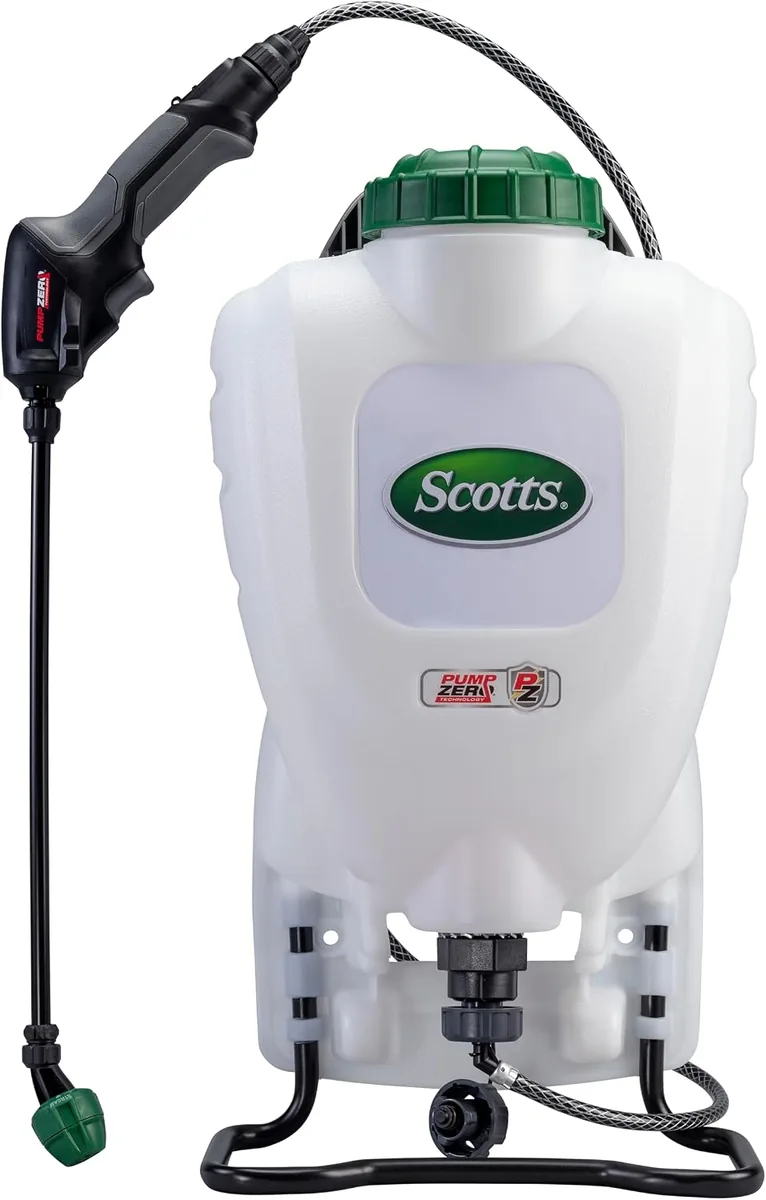
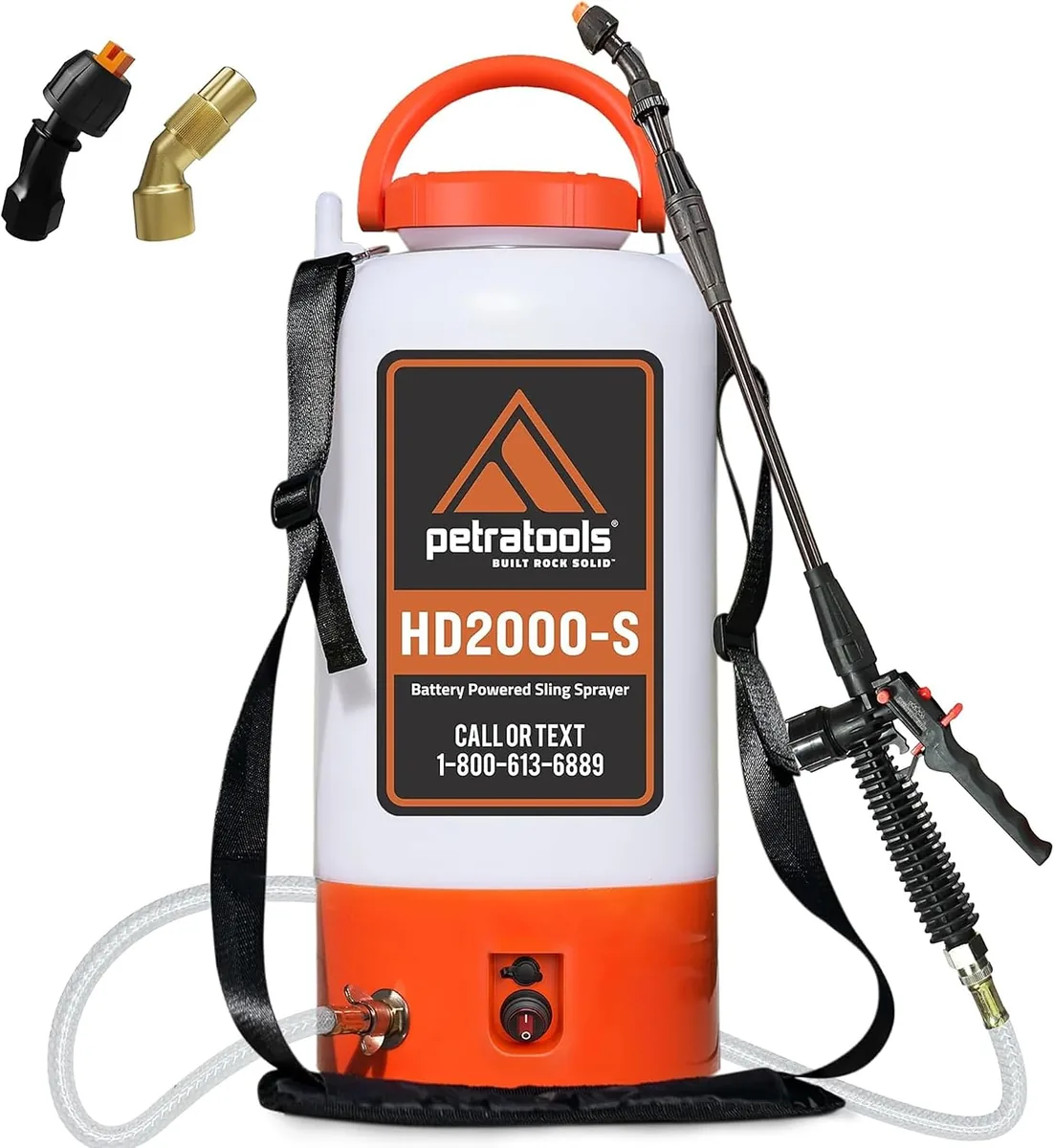
The bigger split is where the parts sit. The HD2000-S is a hip sling, not a PetraTools backpack sprayer; the older HD2000 is the backpack. On the Scotts, which Scotts sells as a backpack sprayer, the tank looks like a backpack unit while the pump and battery sit in the wand you hold. On the PetraTools, the pump sits in the tank’s orange base, and you hold only a valve handle and a wand on a 4 foot hose.
Setup, Filling and Carrying: Backpack Harness or Hip Sling
Every hands-on step in this section, from filling to putting the unit on, starts with the full shutdown, so the box comes first and the later sections point back to it. The first fill of a new sprayer is also the best moment to check the seams, the cap and the hose joints with clean water.
Full Shutdown Box
Emergency first: if a battery becomes unusually hot, swells, hisses, gives off an unusual odor or smokes, stop using the sprayer without handling or removing the battery, keep people away and follow the battery manual’s emergency instructions; if it smokes, burns or presents immediate danger, move away and call 911 or the fire department without finishing the routine shutdown. Shutdown before you open the tank, fill or refill it, change or clean a nozzle, clear a clogged nozzle, clean or rinse the sprayer, adjust or repair anything, charge or change the battery, move, store or leave the sprayer. Never point the wand at yourself, another person or a pet. During normal spraying, move only as the equipment manuals and the product label permit; walking while spraying with a backpack unit, or driving a mounted boom at the spraying speed its manual describes, is operation, not transport. Never ride while operating a hand-held wand or lance. Battery sprayer (handheld or backpack): release the trigger or close the wand valve, then switch the pump off. Relieve all trapped pressure using only your exact manual’s procedure and a discharge destination consistent with the product label, without opening the tank or loosening any part beforehand unless that procedure expressly requires it, and never toward yourself, another person or an animal. Then remove the battery and keep it away from the sprayer. Wear the protective equipment the product label requires while you clean the tank, the strainer or a nozzle. Clear a clogged nozzle only with the method in your exact manual; never clear a nozzle with your mouth and never by blowing into it. Add every step your manual gives, in its order. Refit every part, close the lid and check for leaks with clean water before product goes back in.
Two manual details change one step of the box. The Scotts battery is sealed inside the power wand, and its manual calls the wand not serviceable, so never open the wand to take the battery out: switch the pump off, relieve the pressure with the manual’s method and keep the wand away from the tank while you work. The HD2000-S manual does not say whether its battery can be removed, so switch it off at the red switch, do not open the base, and get PetraTools’ guidance before you open anything. The emergency exception in the box stays in force for both.
Filling and Carrying
Before you open or fill the tank, complete the full shutdown in the shutdown box. Then fill only to the level your manual allows and, for a carried sprayer, only to a weight you can handle with the straps and hip belt adjusted as the manual describes. Before you lift, put on or take off a backpack unit, or load, unload, transport or leave the sprayer, complete the full shutdown again. During normal spraying, move only as your manual and the product label permit, and never ride while operating a hand-held wand or lance. Carrying a full tank is tiring work: rest when you are tired, and stop before you lose your footing.
First Water Test
Before the first water test, complete the full shutdown in the shutdown box, then fill the tank with clean water and close the lid as your manual directs. Connect the power (install the battery or connect the 12V supply) only when you are ready to test. Run the sprayer and watch the wand, hose, fittings and tank seams for leaks without touching pressurized parts. Before you open the tank, correct a leak or add product, complete the full shutdown again. Before every use, check the tank, strainer, hose and nozzle, and fix any leak before product goes in. Follow your manual’s first-use steps.
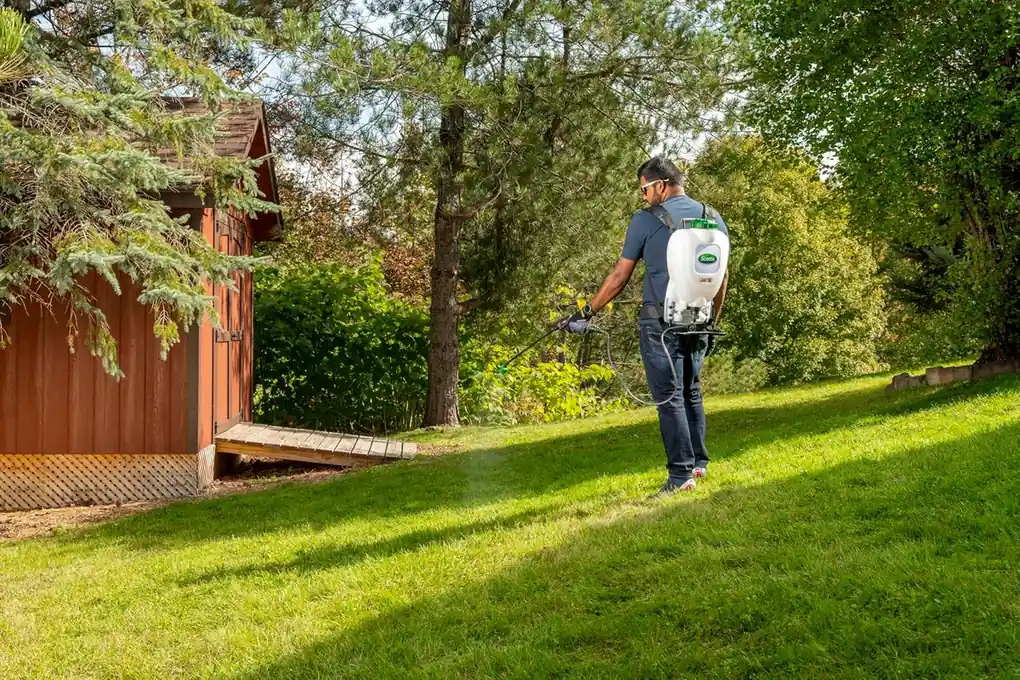
On the Scotts I set the harness with the shoulder pads high and the lower straps looped around the wire foot stand, so the flat-backed tank sat against my back and did not swing. I liked the foot stand most: it let me stand the tank upright on the path while I refilled it with clean water, and the wand stayed off the ground. Filling means unscrewing the green cap, lifting out the filter basket, and pouring through it up to the graduation marks on the tank side. The manual says the sprayer must not run without the in-tank filter, so I checked the in-tank filter was seated before the first water test. Complete the full shutdown before you lift or put on the unit.
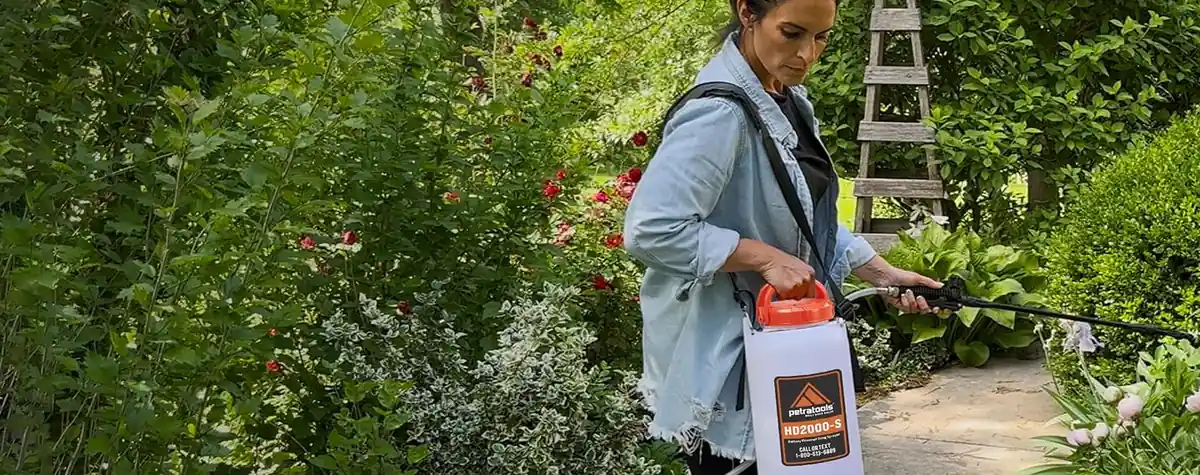
On the PetraTools, the tank hangs at the hip on a padded strap, and I noticed the wide-mouth lid and the filter below it make a clean-water fill easy to watch. The manual’s own water test is clean water only: power on, squeeze the handle for 10 to 15 seconds until the spray is steady with no air bubbles, then empty the tank. I ran that test and watched the hose and wand connections, because the manual itself says connections may leak over time if not fully tightened. The strap has no hip belt, and the manual prints no strap limit, so a full tank rides on one shoulder. Complete the full shutdown before every lift.
Winner: the Scotts 190752 for carry, because the harness and foot stand put the tank on your back and leave your other hand free. The PetraTools suits you if a tank at the hip and a single strap is what you prefer.
Trigger, Wand and Nozzles
The controls are where the two feel most different in the hand. Before you do this, complete the full shutdown for your sprayer in the shutdown box above. That covers the next three paragraphs: a nozzle change, a clog and any adjustment to the wand all count as hands-on work.
The Scotts battery powered sprayer has a power switch and a trigger on one pistol grip. The switch must be on before the trigger does anything, and the manual says to make sure the trigger is not engaged when you power on. I looked for a trigger lock on the Scotts and found none, which fits the manual’s line to never tape the trigger switch in the ON position. The 3-in-1 nozzle gives stream, fan and cone patterns, and I turned through the three settings with clean water against a wall to see how the pattern changes. The manual asks you to allow at least 30 seconds for the pump to prime.
The PetraTools gives you a red switch to turn the sprayer on, a squeeze handle and a red trigger lock for extended spraying. Beside the Scotts, the lock is the part I count as a real advantage in the hand, because a long pass along a fence line needs no sustained squeeze. The base kit holds two nozzles, an adjustable brass one that goes from mist to stream and a flat fan tip. I held the wand against a drip-line height and tried both tips with water to see the mist and the fan.
Nozzle choice matters more than the tip’s looks. A test-rig study of agricultural nozzles found that nozzle type, nozzle size and pressure each change the droplet size and speed (1). A wind-tunnel test of five agricultural nozzles found that drift-reducing designs made larger droplets and far fewer very fine ones (2). Both studies used field-crop nozzles, not these tips, so I read them as a reason to use only the nozzle your manual lists.
Pressure and Nozzle
A sprayer’s maximum pressure is the limit of the machine, not a setting to aim for. The product label and the nozzle’s maker decide the pressure and the nozzle for a job. Higher pressure makes more fine droplets that drift, and the nozzle you choose changes the droplet size.
Winner: the PetraTools HD2000-S, because it has a trigger lock and ships with two nozzles in the base kit.
Battery, Charger and Power
Both sprayers charge through a charger in the box, but the batteries live in different places. Before you do this, complete the full shutdown for your sprayer in the shutdown box above. Charging, changing or moving a battery counts as hands-on work.
The Scotts battery sits inside the power wand and cannot be taken out. The manual says the wand is not fully charged out of the box, and you charge it with the USB-C cord in the port above the power switch until the light stays green. I found the USB-C port above the power switch easy to reach with the wand in my hand, and the light colors told me where the battery stood. The manual calls the wand and the charger not serviceable, so a clogged or failed wand is replaced, not repaired. It also says to recharge the wand at least once every three months when it is not in use.
The PetraTools runs on a 12V 1.3Ah battery listed in the manual’s parts list. Charging may take up to 4 to 6 hours, with a red light while charging and green when full, and the manual says to use the original charger. For storage it says to keep a full charge and recharge every three to six months. The manual does not say whether you can remove the battery.
Battery and Charger
Use only the battery and charger the maker supplies or lists for your exact sprayer, and charge, store and handle the battery only as your manual describes. To change or charge a battery, first complete the full shutdown in the shutdown box, including its emergency exception, which ends with removing the battery; begin the change or the charging only after that. Lithium-ion batteries can overheat and catch fire (thermal runaway), so do not use a damaged battery or charger, and follow the manual’s directions if a battery or charger gets wet. If a battery becomes unusually hot, swells, hisses, gives off an unusual odor or smokes, stop using it without handling or removing it, keep people away and follow the battery manual’s emergency instructions; if it smokes or burns, move away and call 911 or the fire department.
For the Scotts, the shutdown ends at the switch and the pressure-relief step because the battery cannot be removed; for the HD2000-S, the manual describes charging only, so charge it only as described and do not open it to reach the battery.
The reason for the caution is plain: OSHA’s fact sheet on lithium-ion batteries says they can undergo thermal runaway, which can cause fire and explosion, and it lists following the maker’s instructions for storage, use, charging and maintenance as a control (3). That sheet is written for workplaces, not yards, but the maker’s-charger rule is the same.
Winner: the PetraTools HD2000-S, because its manual prints a charging time of up to 4 to 6 hours, while the Scotts battery lives in a power wand that the manual calls not serviceable.
Shutdown, Pressure Relief and What Each Manual Says
This is the factor that moved my pick. Before you open a tank, change a nozzle or put the sprayer away, a pressurised hose and wand must be safe to touch. Before you do this, complete the full shutdown for your sprayer in the shutdown box above. The order below is the baseline for both sprayers, and a maker’s extra steps come on top.
The Scotts manual gives a method: turn the sprayer off, then squeeze the trigger on the power wand to spray until liquid flow stops. It does not say where to aim, so aim away from yourself, other people and animals, at a destination the product label allows. Its cleaning warning adds that taking apart a sprayer that is still pressurised may eject parts at high speed. I kept the Scotts pressure-relief line beside the power switch in my head as the first step of every nozzle change, because it is the only method a manual gives me here.
The PetraTools manual prints no pressure-relief step, and the red switch is the only off control it names. If your manual gives no procedure, get the maker’s guidance before you open anything. Its leak section says to stop immediately if chemicals leak during use. Complete the full shutdown in the shutdown box above, then tighten the connections, and for a base leak stop using the sprayer and call PetraTools.
The emergency rule comes before any routine step: if a battery becomes unusually hot, swells, hisses, gives off an unusual odor or smokes, stop using the sprayer without handling or removing the battery, keep people away and follow the battery manual’s emergency instructions. If it smokes, burns or presents immediate danger, move away and call 911 or the fire department.
Winner: the Scotts 190752, because its manual prints the pressure-relief method that the PetraTools manual leaves out.
Label, Protective Equipment and Mixing
What goes in the tank is a separate safety layer from the sprayer itself. Before you do this, complete the full shutdown for your sprayer in the shutdown box above. The rules below apply to either sprayer, and the product label always comes first.
The Label Is the Law
The product label is the law. It tells you what protective equipment to wear, how and where you may use the product, what weather it allows, how long to stay out of the treated area, how long to wait before you harvest, how to protect bees and other pollinators, and how to dispose of leftover product and the empty container. Using a registered pesticide in a way its label does not allow is against federal law. Your sprayer’s manual does not replace the label, and the label does not replace the manual: read the label before you open the container, and follow both.
Protective Equipment
Wear the protective clothing and equipment the product label requires, and put it on before you open the container. Wear the eye protection and gloves the label names every time you mix, load, spray, clean the tank or clear a nozzle. Cornell’s pesticide safety program also advises chemical-resistant gloves, goggles and a respirator when you handle moderately toxic products, even when the label does not call for them. Wear every respirator the label requires, of the type the label names, and follow the respirator maker’s instructions for fit, use and care. If you follow Cornell’s advice and wear one the label does not require, or if it is unclear which respirator or filter is right, get qualified guidance on the respirator and filter before you handle the product. Protective equipment lowers your exposure; it does not make spraying safe.
Each manual adds its own equipment to the label’s. The Scotts manual says to use the protective equipment the chemical maker recommends or its safety data sheet lists, which includes at least goggles, gloves and protective clothing. The PetraTools manual says to wear sturdy shoes or boots with non-slip soles, protective clothing and gloves, and eye and respiratory protection as the chemical maker instructs. Wear whichever list is stricter, and keep it on while you clean the tank, strainer or a nozzle.
A critical review of protective equipment in agricultural pesticide use found that its real-world effect may be over-estimated (4). A systematic review of 121 articles on pesticide handlers found goggles and gloves among the least-worn items (5). Both reviews cover agricultural handlers, not home gardeners, so I take from them only that gear lowers exposure and never makes spraying safe.
No Rates Here
The product label, not this page, gives the amount of product, the dilution and the mixing order, so read it before you mix. Do not combine products unless the mixture complies with every product’s label and its compatibility has been established through the manufacturers or a qualified pesticide specialist; nobody’s advice overrides a label prohibition.
Mixing and Loading
Before you load the sprayer, complete the applicable full shutdown in the shutdown box, including its emergency exception, and wear the protective equipment the product label and your manual require for the task. Mix and load outdoors, away from other people (including children), pets and livestock, and where a spill or overflow cannot reach a well, a drain or other water. Read the label before you open the container, stand upwind, and do not eat, drink or smoke while you handle pesticides. Never use your mouth to siphon a pesticide from its container. Keep the fill hose above the level of the liquid in the tank so the product cannot siphon back into your water supply, and never leave the sprayer unattended while you fill it. Use measuring tools kept only for pesticides, never kitchen utensils or food containers. Mix only as much as the job needs so the tank ends empty; do not store leftover mix in the sprayer for later, because it can damage the sprayer’s parts.
If Product Spills
If product spills, keep people and animals away and follow the emergency directions on the product label and its safety data sheet. Try to contain a small spill only if the label says that is safe and you have the protective equipment it requires; when it is safe to do so, complete the shutdown before hands-on work on the sprayer. For a spill you can safely manage, use only absorbents and waste containers that are compatible with the spilled product, as its label, its safety data sheet or qualified emergency guidance specifies, and dispose of the collected waste as directed. If the spill is more than you can manage safely, call the emergency number on the label; call Poison Control at 1-800-222-1222 if anyone is exposed, and call 911 for a fire, immediate danger or a large spill.
Pollinators
Many pesticide labels warn that the product can kill bees and other insect pollinators, and some tell you not to apply while bees are foraging or to notify a beekeeper first. The label’s pollinator wording decides when you may spray around flowering plants; keep spray from drifting onto beehives and flowering plants. Cornell notes that spraying in the early morning or evening can lower the chance that bees are in the area, but do not spray during a temperature inversion and do not assume those times are suitable: check the actual conditions and follow the label’s weather and pollinator restrictions.
Children, Pets and Others
Keep children, pets and other people out of the area while you mix, load and spray, and keep them off the treated area for as long as the label says. Before you spray, remove toys and take away or cover pet food and water dishes.
Each maker adds a limit on the liquids. The Scotts manual says never to use caustics, bleach, acids, hot water, vinegar or pressure-producing chemicals in the sprayer, never to use flammable or combustible chemicals, and to use only chemicals indicated for spraying applications. The HD2000-S manual has no tank-wide list of banned liquids. It does say the brass nozzle is not for acids or bleach because they damage the brass, which never means those liquids are fine in the tank or through another nozzle, and it says never to leave chemicals in the tank.
Drift, Cleaning, Leaks and Storage
Weather and cleanup decide how a sprayer behaves between jobs. Before you do this, complete the full shutdown for your sprayer in the shutdown box above. Cleaning, draining and putting the unit away all count, and a leak means stop, shut down, inspect and resume only on the manual’s conditions.
Wind and Drift
Drift is spray carried off target by the air, and wind speed is the factor extension sources stress most. Their figures differ and none fits every situation, and your product label may be stricter than all of them. K-State Extension suggests spraying when the wind is under 10.1 miles per hour and says there is no maximum wind speed that fits every situation. LSU AgCenter says to avoid applying when the wind is above about 10 miles per hour. NC State says under 5 miles per hour when you calibrate with the product in the tank. Cornell gives no number and says not to take a chance by spraying in the wind. Do not spray during a temperature inversion, when cool air near the ground holds small droplets in the air, and do not assume that calm air, early morning or evening is suitable: check the actual conditions and follow every weather restriction on the product label. High temperature and low humidity make spray evaporate faster. Do not spray just before rain. Droplets smaller than about 150 micrometers drift most easily, and higher pressure makes more of them.
The Scotts manual is stricter than those extension figures: it says to spray only when the air is calm, with no wind or air movement, to keep spray off non-target surfaces. The extension figures come from field and boom sprayer guidance, so they do not override the Scotts manual or your product label, and calm air is not automatically suitable air.
Cleaning
Before you clean the sprayer, complete the applicable full shutdown in the shutdown box, including its emergency exception, and wear the protective equipment the label and your manual require. Clean the sprayer as soon as you can after use, because dried product is harder to remove than product still in solution. Empty the tank, rinse the tank, hose, wand and nozzle, and clean the strainers and screens, following the product label and your manual; extension guidance warns that water alone may not remove every product. Clean it away from desirable plants, wells and other water, and wash the outside. Do not pour leftover product or rinse water down a sink, a toilet or a storm drain, or onto bare ground.
Container Rinsing and Disposal
Follow the product label’s instructions for rinsing the empty container, handling the rinse water and disposing of the container, and rinse only a container the label directs you to rinse. Add rinse water to a spray mixture only when the label permits it and the mixture can take it without exceeding the permitted fill level or changing the label-directed mixture. Never reuse an empty pesticide container for any purpose. For leftover product, follow the label’s disposal steps, or call your state pesticide agency or a household hazardous waste program.
Dedicated Sprayer
Illinois Extension advises a dedicated sprayer for the home orchard, one that has never been used for weed control products. Penn State and Iowa State warn that even small amounts of herbicide left in tanks, hoses, screens and fittings can harm crops, and that water alone is generally not enough to remove pesticide residue. Treat a sprayer that has held weed killer as a weed-killer sprayer, and keep a separate one for fruit trees, vegetables, ornamentals and liquid fertilizer.
Leaks deserve their own attention. A field study of 32 backpack-sprayer applications among Nicaraguan farmers found that how the work was done and the equipment itself explained more of the skin exposure than clothing and hygiene did (6). Those were subsistence farmers, not yard owners, but it supports checking the lid, hose and fittings before every use.
The Scotts manual has you rinse the tank, spray clean water through the wand for at least 30 seconds, and hang the tank upside down to dry; it adds that after heavy use rinsing may not be enough and the nozzle may need a soak or a soft brush. When I looked at how the Scotts drains, the hose barb at the cap and the tank bottom were the places I expected water to pool, so I hung it upside down as the manual says.
The PetraTools manual says to empty the tank, rinse with clean water until it runs clear, wash with soapy water, run the soapy water through every component, then rinse with clean water again, and your product label governs all of it. Both manuals say to keep the unit away from rain and extreme temperatures: the Scotts indoors, warm and dry, and the PetraTools away from blazing sun and freezing cold.
Storage
Before you store the sprayer, complete the applicable full shutdown in the shutdown box, including its emergency exception. Store pesticides in their original containers, with the label on, locked up or under the control of a person who can keep others away, and out of the reach of children. Never put a pesticide in a container used for food, drink or household products. Keep pesticides away from food, animal feed and protective equipment, and store pesticides and fertilizers apart, because they can react with each other and start a fire. Store the sprayer drained, cleaned and dry, as your manual describes, with the battery stored as the battery manual describes.
If Someone Is Exposed
If someone is exposed to a pesticide, follow the first-aid section of the product label and call Poison Control at 1-800-222-1222, and keep the product label with you. Call 911 in an emergency.
Winner: neither one outright. The Scotts adds a nozzle soak or soft brush after heavy use and a hang-to-dry step, the PetraTools runs soapy water through every component, and both leave the product label in charge.
Choose the Scotts 190752 If
The Scotts 190752, covered in my review of the Scotts sprayer, is my pick for most homeowners who spray a lawn, a garden bed or a hedge row with a product labeled for that use. Choose it if:
- You want the load on your back: the harness and foot stand carry and rest the tank.
- You want a printed pressure-relief method: its manual gives one before you open anything.
- You value a clear banned-liquids list: it names bleach, acids and vinegar.
- You want a fill bottle option: the wand also fits a bottle with a 38 mm opening using the included cap.
Skip it if you want a trigger lock, a battery you can swap, or a tank that hangs at your hip. When I handled the wand, the missing trigger lock was the one thing I noticed on a longer pass along a bed edge. Complete the full shutdown before you lift it or put it on.
Choose the PetraTools HD2000-S If
The PetraTools HD2000-S fits a buyer who wants a lighter-feeling hip carry and more controls in the hand, and my review of the PetraTools sprayer covers the sling in more detail. Choose it if:
- You want a trigger lock: the red lock holds the trigger for extended spraying.
- You want two nozzles in the box: an adjustable brass tip and a flat fan tip.
- You want a stated charging time: the manual says up to 4 to 6 hours.
- You want a 4 foot hose and an extendable wand: you hold a light handle, not the pump.
Skip it if you want a back-carried tank or a printed pressure-relief method. The warranty is also split: the maker’s page says 1 year, and the manual says 2 years if you register before you spray. In the hand, the wand and the red lock were what I reached for first, and the pump base stayed at my hip. Complete the full shutdown before you lift it or hang it on your shoulder.
Making the Final Call Between the Two
Both sprayers fit a small yard, and both put the product label ahead of the machine. The Scotts 190752 earns my recommendation for most buyers because it carries on the back and prints the pressure-relief method. The PetraTools HD2000-S earns its place for a buyer who values a trigger lock and a hip carry. I run the clean-water test and check every joint before I trust either one with product. Whatever you pick, read the manual and the label before the first fill. In the Scotts vs PetraTools sprayer decision, I recommend the Scotts 190752 for most buyers, and the PetraTools HD2000-S only if the trigger lock and the hip carry matter more to you. Both are 2 gallon models, and my roundup of 2 gallon battery powered sprayers compares five handheld, sling and backpack picks.
Frequently Asked Questions
Which is better, the Scotts 2 gallon power wand sprayer or the PetraTools HD2000-S?
The Scotts 2 gallon power wand sprayer is the better pick for most buyers, because it rides on your back and its manual prints the pressure-relief steps before you open anything. The PetraTools HD2000-S is better if you want a trigger lock, two nozzles in the box and a tank carried at your hip.
Do the Scotts 190752 and the PetraTools HD2000-S hold the same amount?
The Scotts 190752 and the PetraTools HD2000-S hold the same amount on paper, because both are sold as 2 gallon sprayers. Scotts prints 2 gallon in its manual title and PetraTools gives it on its product page, and each manual’s own filling steps decide how high you fill the tank.
Where do the pump and battery sit on the Scotts 190752 and the PetraTools HD2000-S?
On the Scotts 190752 the pump and the rechargeable battery sit inside the power wand in your hand, and the battery cannot be taken out. On the PetraTools HD2000-S the pump sits in the orange base of the tank, and the manual lists a 12V battery without saying where it sits.
Which comes with a charger, the Scotts 190752 or the PetraTools HD2000-S?
Both the Scotts 190752 and the PetraTools HD2000-S come with a charger in the box, so you can charge either one on day one. The Scotts kit lists a charger and a USB-C cord, while the PetraTools manual lists a charger among its box contents and tells you to charge only with the original charger.
Which has a trigger lock, the Scotts 190752 or the PetraTools HD2000-S?
The PetraTools HD2000-S has a trigger lock, which its manual calls the red trigger lock for extended spraying. The Scotts 190752 manual prints no trigger lock and says never to tape the trigger switch in the ON position, so operate the switch and the trigger only as that manual describes.
References
- Nuyttens D, Baetens K, De Schampheleire M, Sonck B. Effect of nozzle type, size and pressure on spray droplet characteristics. Biosyst Eng. 2007;97(3):333-345.
- McGinty J, Baumann P, Hoffmann W, Fritz B. Evaluation of the spray droplet size spectra of drift-reducing agricultural spray nozzle designs. Am J Exp Agric. 2016;11(3):1-5.
- Occupational Safety and Health Administration. Lithium-ion Battery Safety. Fact Sheet DTSEM FS-4480. US Department of Labor; January 2025.
- Garrigou A, Laurent C, Berthet A, et al. Critical review of the role of PPE in the prevention of risks related to agricultural pesticide use. Saf Sci. 2020;123:104527.
- Sapbamrer R, Thammachai A. Factors affecting use of personal protective equipment and pesticide safety practices: a systematic review. Environ Res. 2020;185:109444.
- Blanco LE, Aragon A, Lundberg I, Liden C, Wesseling C, Nise G. Determinants of dermal exposure among Nicaraguan subsistence farmers during pesticide applications with backpack sprayers. Ann Occup Hyg. 2005;49(1):17-24.
Safety Note: Read your sprayer’s manual and the product label before you open any container. The label is the law: it tells you what protective equipment to wear, how and where you may use the product, what weather it allows, how long to stay out of the treated area, how long to wait before you harvest, how to protect bees and other pollinators, and how to dispose of leftovers and the empty container. Using a registered pesticide in a way its label does not allow is against federal law. This page never gives an amount of product, a dilution or a mixing order: the label does. Wear the protective clothing and equipment the label requires, put it on before you open the container, and wear the eye protection and gloves it names whenever you mix, load, spray, clean the tank or clear a nozzle. Protective equipment lowers your exposure; it does not make spraying safe. Wear every respirator the label requires, of the type it names, and follow the respirator maker’s fit, use and care instructions. Before you clean or store the sprayer, or wire a 12V pump, complete the shutdown below first. Before you mix or load, complete the shutdown below, including its emergency exception. Mix and load outdoors, away from other people (including children), pets and livestock, and where a spill cannot reach a well, a drain or other water. Stand upwind, never use your mouth to siphon a product, keep the fill hose above the liquid so it cannot siphon back into your water supply, and never leave the sprayer unattended while you fill it. Mix only what the job needs, and do not store leftover mix in the sprayer. Never point the wand at yourself, another person or a pet, and never test a spray against your hand. Emergency first: if a battery becomes unusually hot, swells, hisses, gives off an unusual odor or smokes, stop using the sprayer without handling or removing the battery, keep people away and follow the battery manual’s emergency instructions; if it smokes, burns or presents immediate danger, move away and call 911 or the fire department without finishing the routine shutdown. Otherwise, before you open the tank, fill it, change or clean a nozzle, clear a clogged nozzle, clean or rinse the sprayer, adjust or repair anything, charge or change the battery, load, unload, transport, store or leave the sprayer, or lift, put on or take off a backpack unit, complete the shutdown. During normal spraying, move only as your manual and the product label permit, and never ride while operating a hand-held wand or lance. Battery sprayer: release the trigger or close the wand valve, then switch the pump off. Relieve all trapped pressure using only your exact manual’s procedure and a discharge destination consistent with the product label, without opening the tank or loosening any part beforehand unless that procedure expressly requires it, and never toward yourself, another person or an animal. Then remove the battery. 12V vehicle sprayer: first stop and secure the vehicle as its manual directs, then release the trigger, close the wand or boom valve and switch the pump off. Relieve all trapped pressure using only your exact manual’s procedure and a discharge destination consistent with the product label, without opening the tank or loosening any part beforehand unless that procedure expressly requires it, and never toward yourself, another person or an animal. Then disconnect the pump’s 12V supply at the connection your manual specifies, and reconnect it only after the work is complete, every part is secured and the pump switch is off. Wear the label’s protective equipment while you clean the tank, the strainer or a nozzle. Clear a clogged nozzle only with the method in your exact manual, never with your mouth and never by blowing into it. Refit every part and check for leaks with clean water before product goes back in. For the first water test, complete the shutdown first, fill the tank with clean water and close it as your manual directs, connect the power only when you are ready, and watch the wand, hose, fittings and tank seams for leaks without touching pressurized parts; complete the shutdown again before you open the tank, fix a leak or add product. Wind, heat and fine droplets carry spray off target: the label may be stricter than any extension guideline, and extension sources give different wind figures, so no single number fits every situation. Do not spray during a temperature inversion, and do not assume that calm air, early morning or evening is suitable. Do not spray just before rain. Keep children, pets and other people out of the area while you spray and off the treated area for as long as the label says, and remove toys and cover pet food and water dishes first. The label’s pollinator wording decides when you may spray around flowering plants, and early morning or evening is not automatically suitable. A sprayer that has held weed killer should stay a weed-killer sprayer: extension services advise a dedicated sprayer, and rinsing may not remove every residue. Follow the product label’s instructions for rinsing empty containers, handling rinse water and disposing of them, and never reuse an empty pesticide container; for leftover product, call your state pesticide agency or a household hazardous waste program, and never pour it down a sink, a toilet or a storm drain. Store pesticides in their original containers, locked up and out of the reach of children, away from food and animal feed, and keep pesticides and fertilizers apart. If someone is exposed, follow the first-aid section of the label, call Poison Control at 1-800-222-1222 and keep the label with you; call 911 in an emergency. If product spills, keep people and animals away and follow the label’s emergency directions; try to contain a small spill only if the label says that is safe and you have the protective equipment it requires, and otherwise get help (the emergency number on the label, Poison Control if anyone is exposed, 911 for a fire, immediate danger or a large spill). Use only the battery and charger the maker supplies or lists for your exact sprayer, charge and store the battery as your manual describes, and do not use a damaged battery or charger: lithium-ion batteries can overheat and catch fire. Wire a 12V pump the way your manual says and use the fuse it lists. On an ATV or UTV, wear the helmet and protective gear the Consumer Product Safety Commission recommends, get hands-on training, sit only in the positions the manufacturer designed, never ride with more passengers than there are seats, and in a UTV fasten the seat belts and keep every part of your body inside the vehicle; stay within the rack and tow capacity in your vehicle’s owner’s manual, and remember that sloshing liquid shifts weight and changes how the vehicle handles; Montana State University Extension advises against riding and spraying if you have to hold a wand or lance. Stop at once, complete the full shutdown and inspect if the sprayer leaks, loses pressure or runs without spraying, and restart only as the manual allows. If a battery becomes unusually hot, swells, hisses, gives off an unusual odor or smokes, do not handle or remove it: keep people away, follow the battery manual’s emergency instructions, and if it smokes or burns, move away and call 911 or the fire department. Before you fill the tank, complete the shutdown, and fill it only to the level your manual allows. Carrying a full tank is tiring: rest when you are tired.