
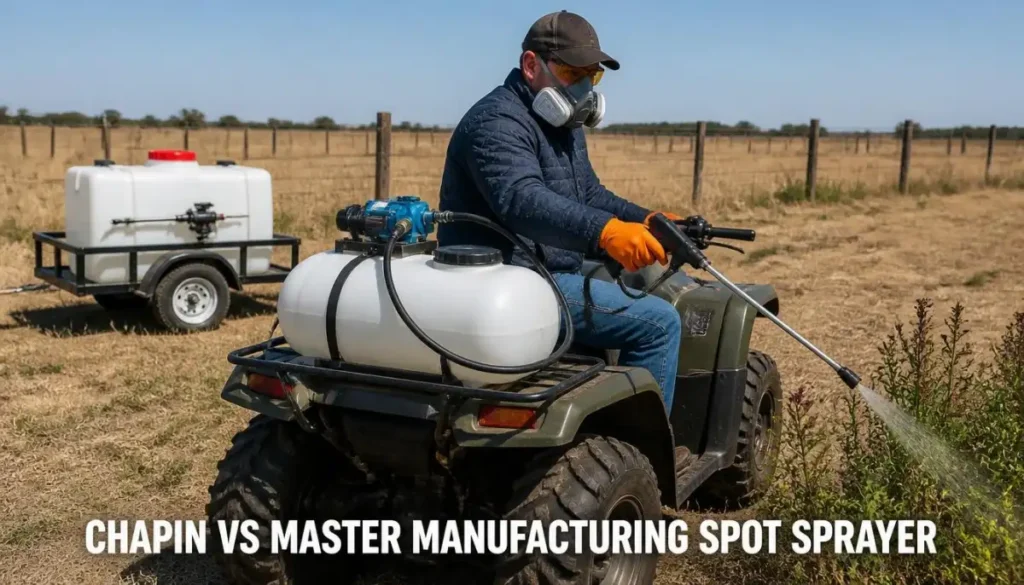

For most buyers, the Master Manufacturing SSN-01-015A-MM takes the Chapin vs Master Manufacturing spot sprayer match-up, and the Chapin wins when you want a pump that shuts itself off at 60 PSI and a wide tank opening. Both are 15 gallon spot sprayers that run on a vehicle’s 12 volt supply, never on a battery of their own. My plant protection training taught me to read a sprayer by what its manual says to do before the first fill, so that is how I compared them.
Affiliate Disclosure: Garden Power Scout is a proud participant in the Amazon Services LLC Associates Program. As an Amazon Associate, we earn from qualifying purchases, at no extra cost to you.
Chapin vs Master Manufacturing Spot Sprayer: The Short Answer
The Chapin 97200E EZ Mount 15-Gallon 12V Spot Sprayer and the Master Mfg 15-Gallon UTV and ATV Spot Sprayer are the same class of tool: a white 15 gallon polyethylene tank, a 12 volt diaphragm pump, a hose and a hand gun, made to be attached to a vehicle. The photos show what arrives, and the table sets the printed figures against each other. My comparison of Chapin 15 and 25 sprayers shows how the 97200E fares against Chapin’s larger tank.
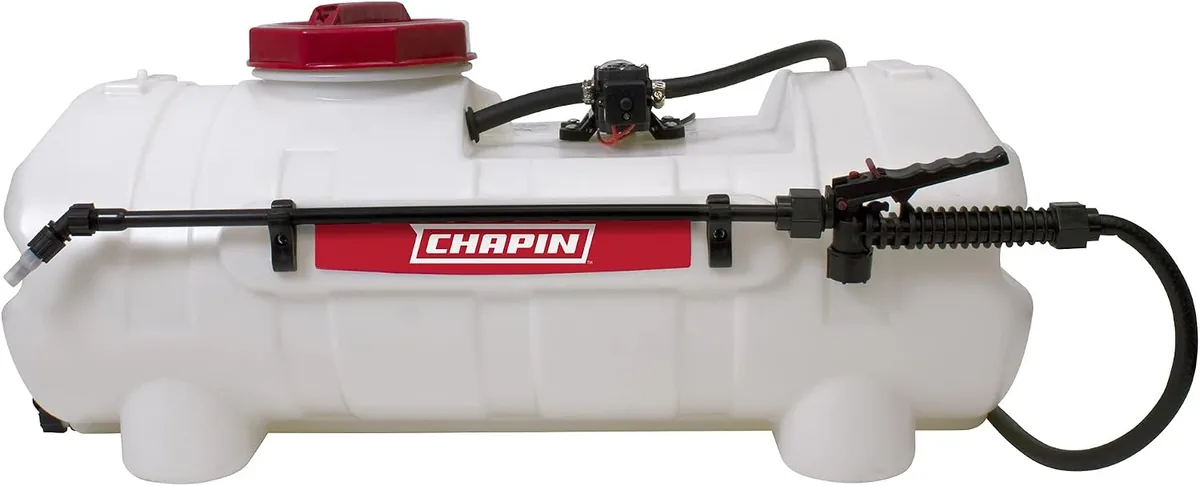
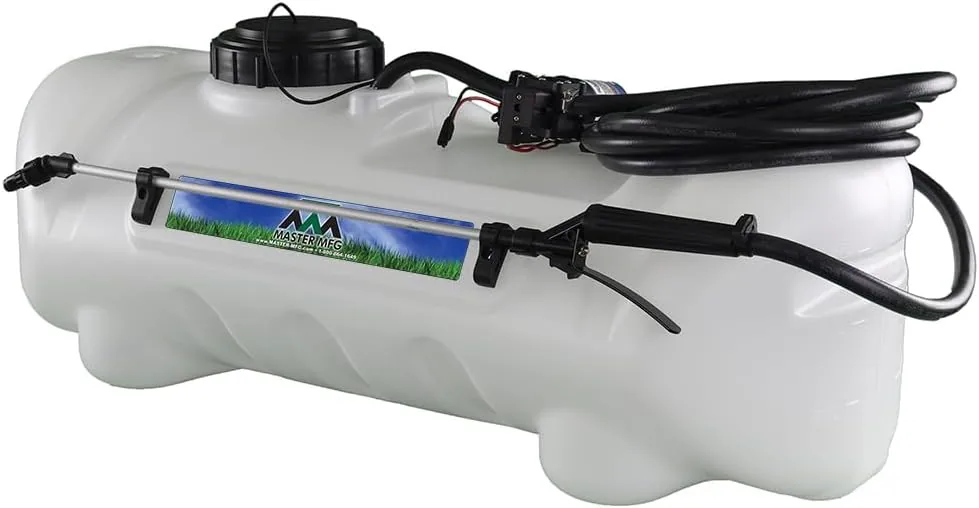
| Row | Chapin 97200E | Master SSN-01-015A-MM |
|---|---|---|
| Sprayer type, in the maker’s words | EZ Mount 12-volt ATV/UTV mounted spot sprayer | 15 Gallon Spot Sprayer for UTV and ATV |
| Power source | 12 V DC from a vehicle battery, harness with an in-line fuse | 12 VDC, clamps to the battery posts, 8 ft harness |
| Tank capacity | 15 gallon polyethylene tank | 15 gallon UV-resistant polyethylene tank |
| Tank opening, as printed | 6 inch wide opening (Chapin’s listing) | 5 inch lid (Master’s parts list) |
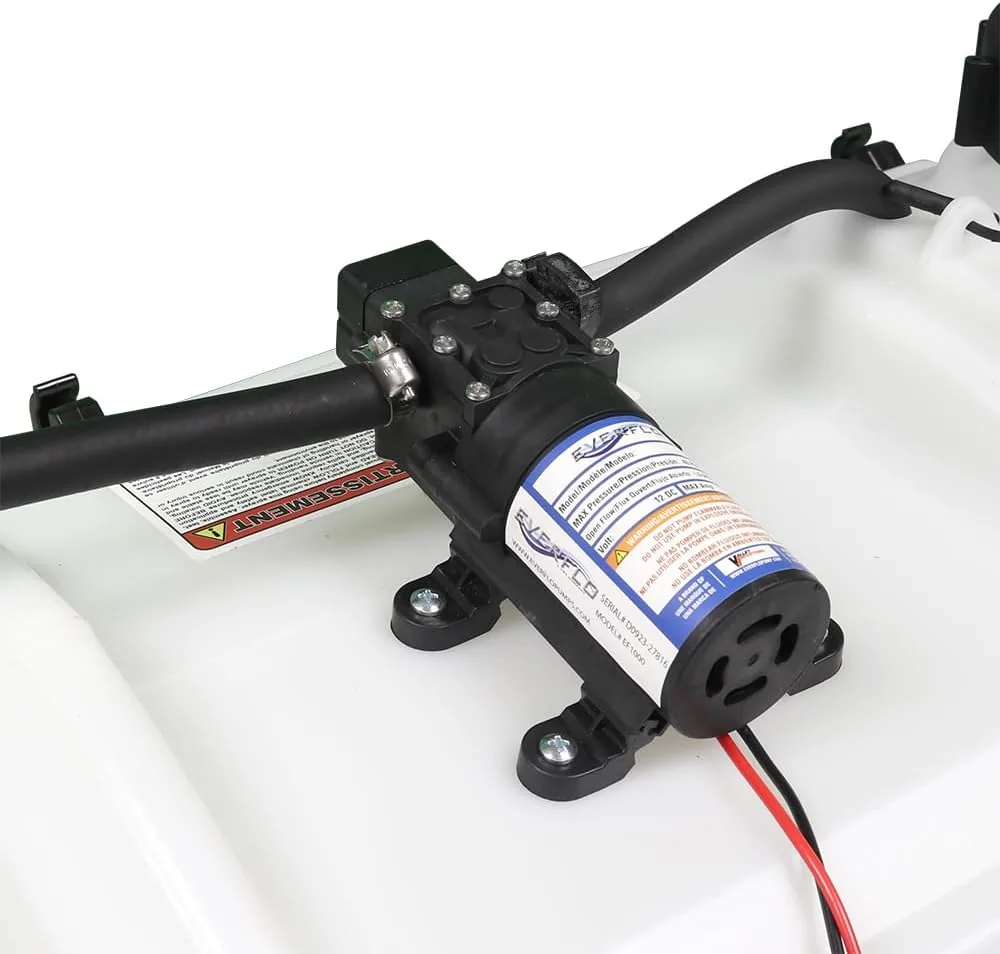
| Pump, as the maker names it | 2 chamber positive displacement diaphragm, self-priming, can run dry | Everflo 12V on-demand diaphragm pump |
| Flow, maker’s figure | 1.0 GPM | 1.0 GPM |
| Pressure, maker’s ceiling | Up to 60 PSI; the pump switch shuts the pump off at 60 PSI | Up to 40 PSI |
| Wand and hose | 18 inch poly wand with lock-on shut-off, 15 ft hose (Chapin’s listing) | Trigger-lock gun with in-handle filter, 15 ft hose |
| Weight | Not listed | Not listed |
| Warranty, household use | 1 year after purchase | 2 years from purchase, replacement parts only |
| Mounting hardware in the box | None named | None: no rack, strap or mounting kit |
Two things decide it for most readers: the warranty term and how much each manual says about the vehicle. The Chapin’s strength is the 60 PSI switch setting its manual describes, and Master’s is the two-year term and its printed vehicle steps. The printed pressure figures are each maker’s ceiling for its own unit and not a score, because pressure changes only at the nozzle on both. I compare both units with three other 12V models in my ATV spot sprayer picks.
Shutdown First on a 12 Volt Vehicle Sprayer
Every hands-on job on either unit starts with one order, and I follow it before I touch a lid, a hose or a clamp. The box below is the full order for a 12 volt vehicle sprayer, and every section after it points back here.
Full Shutdown for a 12 Volt Vehicle Sprayer
Emergency first: if a battery becomes unusually hot, swells, hisses, gives off an unusual odor or smokes, stop using the sprayer without handling or removing the battery, keep people away and follow the battery manual’s emergency instructions; if it smokes, burns or presents immediate danger, move away and call 911 or the fire department without finishing the routine shutdown. Shutdown before you open the tank, fill or refill it, change or clean a nozzle, clear a clogged nozzle, clean or rinse the sprayer, adjust or repair anything, charge or change the battery, move, store or leave the sprayer. Never point the wand at yourself, another person or a pet. During normal spraying, move only as the equipment manuals and the product label permit; walking while spraying with a backpack unit, or driving a mounted boom at the spraying speed its manual describes, is operation, not transport. Never ride while operating a hand-held wand or lance. 12V vehicle sprayer (ATV, UTV, cart or tow-behind): first stop and secure the vehicle as its manual directs. Then release the trigger, close the wand or boom valve and switch the pump off at its switch. Relieve all trapped pressure using only your exact manual’s procedure and a discharge destination consistent with the product label, without opening the tank or loosening any part beforehand unless that procedure expressly requires it, and never toward yourself, another person or an animal. Then disconnect the pump’s 12V supply at the connection your manual specifies. Reconnect it only after the work is complete, every part is secured and the pump switch is off. Wear the protective equipment the product label requires while you clean the tank, the strainer or a nozzle. Clear a clogged nozzle only with the method in your exact manual; never clear a nozzle with your mouth and never by blowing into it. Add every step your manual gives, in its order. Refit every part, close the lid and check for leaks with clean water before product goes back in.
Master’s manual adds its own order, and for the SSN-01-015A-MM that order governs where it differs from the box: make sure power to the sprayer and the vehicle is off and the brakes are set before filling, disconnect power to the sprayer first, and only then relieve the system pressure by squeezing the gun trigger, at a discharge point consistent with the product label and never toward yourself, another person or an animal. Chapin’s manual gives no pressure-relief method and no clog-clearing method, so contact Chapin for its guidance before you open anything on the 97200E, and do not improvise one.
Power Source and Wiring on a 12 Volt 15 Gallon Spot Sprayer
Neither unit has a battery or a charger, so the vehicle supplies the power and the harness is the part that matters. Before any wiring work, complete the full shutdown in the shutdown box above. The two manuals say different things about that harness, and the difference shows up before the first fill.
The Chapin manual describes an in-line fuse in the wire harness, lists a 7.5 amp replacement and warns that a pinched or damaged harness can overheat, melt down or cause a fire. According to Chapin’s listing, the clips are quick-connect alligator clips.
Master’s manual tells you to connect the red clamp to the battery’s positive post and the black clamp to the negative post, and warns that clamps on opposite posts make the pump run backwards. According to Master Manufacturing, the harness is 8 feet long. Master’s manual prints no fuse size.
Before the first water fill of each unit I traced the harness along the rack to find where it could get pinched, because the Chapin manual makes that its warning. On the Master I tagged the red clamp before I went near a battery, since a reversed pair is the one wiring mistake its manual names.
12 Volt Wiring
Before any wiring work on the pump, complete the full shutdown in the shutdown box, including its emergency exception and securing the vehicle. Wire the pump the way your sprayer’s manual says, and use the fuse the manual lists. To disconnect the supply, follow the shutdown box through securing the vehicle, stopping the pump and relieving the pressure, then disconnect it as your manual directs; reconnect it only after the work is complete, every part is secured and the pump switch is off. On the Master, the manual’s order applies: disconnect power first, then relieve the pressure at the trigger.
Winner: the Chapin 97200E, because its manual names the in-line fuse and the replacement size while Master’s manual leaves the fuse size out.
Pump, Pressure Ceiling and Nozzle
Both units use a 12 volt diaphragm pump, and North Dakota State University Extension notes that diaphragm pumps are commonly used with ATV sprayers (1). The printed figures differ in where they come from and in the ceiling they name.
According to Chapin, the 97200E has a two chamber positive displacement diaphragm pump that primes itself and can run dry, a pump flow of 1.0 GPM on its parts list, and a maximum of 60 PSI. Its pump switch shuts the pump off when it reaches 60 PSI, and pressure can only be adjusted at the nozzle. According to Master Manufacturing, the SSN-01-015A-MM has an Everflo 12V on-demand pump rated 1.0 GPM with up to 40 PSI as the maker prints it.
Master’s manual also names a pressure switch in its troubleshooting table without printing a switch-off setting. This model has no regulator or gauge listed, so the nozzle is the only pressure control on both units and the pump setting never changes it.
Pressure and Nozzle
A sprayer’s maximum pressure is the limit of the machine, not a setting to aim for. The product label and the nozzle’s maker decide the pressure and the nozzle for a job. Higher pressure makes more fine droplets that drift, and the nozzle you choose changes the droplet size. A test rig measuring 32 nozzle and pressure combinations found that nozzle type, size and pressure all change droplet size and velocity (2). That rig used agricultural boom nozzles, not a hand gun on a vehicle.
Winner: the Chapin 97200E, because its manual states the switch-off setting of its pressure switch.
Tank, Lid and Filling
Both tanks hold 15 gallons, and if you shop for a 15 gallon, 12 volt spot sprayer these two keep turning up side by side. Filling is where they feel different. Before you open the tank, complete the full shutdown in the shutdown box above.
According to Chapin’s listing, the Chapin 15 gallon ATV sprayer has a 6 inch wide opening, and its manual says to inspect the suction supply screen inside the tank regularly and flush it with water. Master’s parts list shows a 5 inch tank lid on a tether, a drain cap with a gasket and tether, and a suction strainer to clean. Master’s manual also says to test with fresh water before adding chemicals, to look for cracks and leaks and to repeat the water test after any repair.
On my first clean-water fill of the Chapin I could see the water level and the strainer screen through the wide opening without leaning over the tank. On the Master I checked the lid tether and the drain cap gasket first, because its manual points to those two places for leaks on the first fill.
First Water Test
Before the first water test, complete the full shutdown in the shutdown box, then fill the tank with clean water and close the lid as your manual directs. Connect the power (install the battery or connect the 12V supply) only when you are ready to test. Run the sprayer and watch the wand, hose, fittings and tank seams for leaks without touching pressurized parts. Before you open the tank, correct a leak or add product, complete the full shutdown again. Before every use, check the tank, strainer, hose and nozzle, and fix any leak before product goes in. Follow your manual’s first-use steps.
Winner: the Chapin 97200E, because the opening it lists is wider than the 5 inch lid on the Master and lets you see inside the tank.
Wand, Hose and Trigger Control
Both units carry a hose and a hand gun, and the spray pattern comes from the nozzle you twist or swap, so treat nozzle work as a shutdown job. Before you change or clean a nozzle, complete the full shutdown in the shutdown box above, and wear the gloves the label and the manual require.
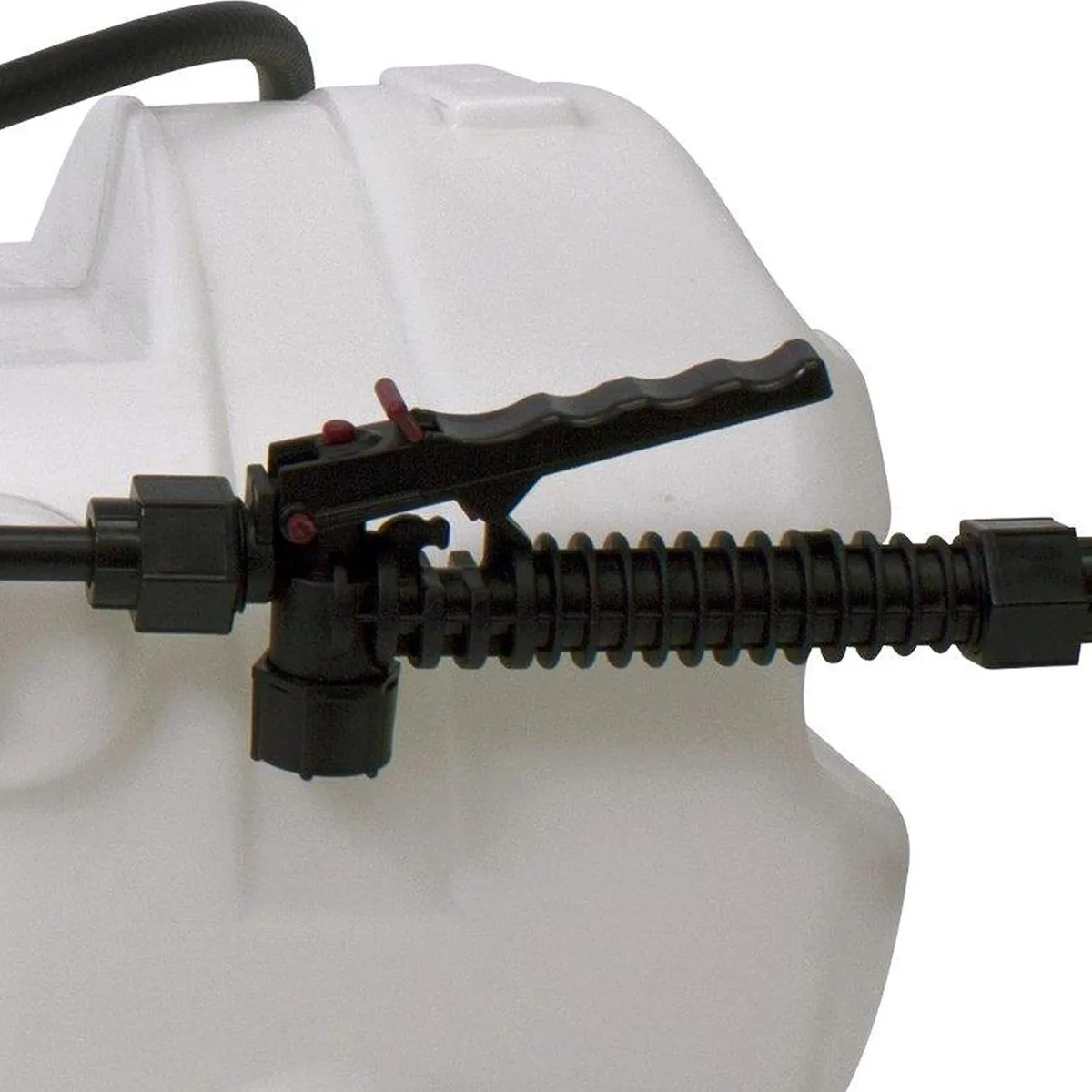
According to Chapin’s listing, the 97200E has an 18 inch poly wand, a 15 foot hose and a poly shut-off with a lock-on feature, and its manual FAQ says the wand comes with a #18 tip as the standard. Master Manufacturing lists the SSN-01-015A-MM with a trigger-lock gun with an in-handle filter, a 15 foot hose and a twist nozzle that goes from a straight stream to a wide mist, with a reach of 18 feet vertical and 20 feet horizontal. Master’s manual tells you to use chemical resistant gloves when twisting the nozzle.
In a gloved hand the Chapin’s lock-on held the shut-off open without my finger working the trigger. With clean water at a concrete wall, the Master’s nozzle went from a tight stream to a wide mist as I twisted it, and I looked for the in-handle filter before I put the gun back on its clip.
Hand Wand on a Vehicle
Montana State University Extension advises not to ride and spray if you have to hold a wand or lance.
Winner: the Master Manufacturing SSN-01-015A-MM, because it pairs a trigger lock with an in-handle filter and states a reach of its own.
Mounting on a Vehicle
Both units are made for a vehicle, and a 15 gallon ATV sprayer of either make is heavy once filled. Neither box carries a rack, strap or mounting kit, so the mounting is your job. The Chapin ATV sprayer manual says the 97200E is designed to be attached to stable surfaces. Master’s manual says to make sure the sprayer is securely attached to the vehicle, and its product page says molded inserts take Master’s broadcast mounting kits, which are sold separately. My 25 gallon spot sprayer comparison covers the larger size from the same two makers.
Neither manual gives a load, slope or surge figure, so the vehicle’s own manual sets the limits. A full tank also changes how the vehicle handles, and a trauma-center series of ATV injuries linked uphill travel to backward rollovers (3).
ATV and UTV Riding
Wear the helmet and other protective gear the Consumer Product Safety Commission recommends, get hands-on training from a qualified instructor, and sit only in the positions the manufacturer designed for occupants. The CPSC says never to ride with more passengers than there are seats. In a UTV, fasten the seat belts and keep every part of your body inside the vehicle as its manual directs. The CPSC says riders younger than 16 should drive only age-appropriate youth model ATVs, never adult ATVs, and that off-road vehicles are designed for off-road terrain, not paved surfaces. Most ATVs seat one rider.
Load, Surge and Slopes
Stay within the rack and tow capacity in your vehicle’s owner’s manual. Sloshing liquid shifts weight and changes how the vehicle handles: Montana State University Extension advises a spray tank with internal baffles and the lowest practical center of gravity, a boom that works as low to the ground as possible, and a rear-mounted boom or equipment that lowers the operator’s exposure. On an ATV, follow its manual and your hands-on training for body position and for the slopes it permits with a sprayer load; Montana State’s advice for ATVs on a hill is to lean your body uphill, and body position does not guarantee protection against a rollover. In a UTV, stay properly restrained inside the vehicle and follow its manual’s slope limits. Water weighs about 8.3 pounds per gallon according to the U.S. Geological Survey, which holds for clean water only and not for a product mix.
Winner: the Master Manufacturing SSN-01-015A-MM, because its manual states the vehicle steps of power off and brakes set that Chapin’s manual leaves out.
Cleaning, Storage and Warranty
Cleaning and storage decide how long a pump and its valves last, and the two manuals ask for different routines. Before you clean or store either unit, complete the full shutdown in the shutdown box above.
The Chapin manual says to fill the sprayer part way with water after use, run it and let clear water pump through the plumbing and out of the wand. It also says to flush the pump with water after use and not to leave chemicals in the pump or in the tank, to drain through the drain plug and to store the tank upside down. Master’s manual says to flush the sprayer per the chemical maker’s recommendations, never to store it with chemicals in the tank and to run RV anti-freeze through the system before end-of-season storage, because freezing without winterization steps voids the warranty.
With clean water in the Chapin I watched the drain plug empty the tank and noted that the manual stores it upside down. On the Master I checked how the drain cap, its gasket and its tether sat once the tank was empty.
Cleaning
Before you clean the sprayer, complete the applicable full shutdown in the shutdown box, including its emergency exception, and wear the protective equipment the label and your manual require. Clean the sprayer as soon as you can after use, because dried product is harder to remove than product still in solution. Empty the tank, rinse the tank, hose, wand and nozzle, and clean the strainers and screens, following the product label and your manual; extension guidance warns that water alone may not remove every product. Clean it away from desirable plants, wells and other water, and wash the outside. Do not pour leftover product or rinse water down a sink, a toilet or a storm drain, or onto bare ground. Illinois Extension advises a dedicated sprayer for the home orchard, one that has never been used for weed control products. Penn State and Iowa State warn that even small amounts of herbicide left in tanks, hoses, screens and fittings can harm crops, and that water alone is generally not enough to remove pesticide residue. Treat a sprayer that has held weed killer as a weed-killer sprayer, and keep a separate one for fruit trees, vegetables, ornamentals and liquid fertilizer.
Storage
Before you store the sprayer, complete the applicable full shutdown in the shutdown box, including its emergency exception. Store pesticides in their original containers, with the label on, locked up or under the control of a person who can keep others away, and out of the reach of children. Never put a pesticide in a container used for food, drink or household products. Keep pesticides away from food, animal feed and protective equipment, and store pesticides and fertilizers apart, because they can react with each other and start a fire. Store the sprayer drained, cleaned and dry, as your manual describes, with the battery stored as the battery manual describes.
On warranty, the SSN-01-015A-MM manual gives two years, where the Chapin manual says one year after purchase, and Chapin’s listing shows a document image reading lifetime on the tank and one year on parts. Master covers replacement parts only, from the date of purchase.
Winner: the Master Manufacturing SSN-01-015A-MM, because its manual gives the longer household warranty term.
Safety Before You Spray
A spot sprayer puts liquid on plants and soil, and some liquids are pesticides, so two layers of safety apply: the sprayer and the product in the tank. The Chapin manual says to wear goggles, gloves, a long sleeve shirt, long pants and full foot protection when spraying. Master’s manual says the operator must be 16 years of age or older.
The Label
The product label is the law. It tells you what protective equipment to wear, how and where you may use the product, what weather it allows, how long to stay out of the treated area, how long to wait before you harvest, how to protect bees and other pollinators, and how to dispose of leftover product and the empty container. Using a registered pesticide in a way its label does not allow is against federal law. Your sprayer’s manual does not replace the label, and the label does not replace the manual: read the label before you open the container, and follow both.
Protective Equipment
Wear the protective clothing and equipment the product label requires, and put it on before you open the container. Wear the eye protection and gloves the label names every time you mix, load, spray, clean the tank or clear a nozzle. Cornell’s pesticide safety program also advises chemical-resistant gloves, goggles and a respirator when you handle moderately toxic products, even when the label does not call for them. Wear every respirator the label requires, of the type the label names, and follow the respirator maker’s instructions for fit, use and care. If you follow Cornell’s advice and wear one the label does not require, or if it is unclear which respirator or filter is right, get qualified guidance on the respirator and filter before you handle the product. Protective equipment lowers your exposure; it does not make spraying safe. A critical review found that the real protection of protective clothing in working conditions may be over-estimated (4), and a systematic review of handler studies found goggles and gloves worn less often than long sleeves and trousers (5).
No Rates on This Page
The product label, not this page, gives the amount of product, the dilution and the mixing order, so read it before you mix. Do not combine products unless the mixture complies with every product’s label and its compatibility has been established through the manufacturers or a qualified pesticide specialist; nobody’s advice overrides a label prohibition.
Mixing and Loading
Before you load the sprayer, complete the applicable full shutdown in the shutdown box, including its emergency exception, and wear the protective equipment the product label and your manual require for the task. Mix and load outdoors, away from other people (including children), pets and livestock, and where a spill or overflow cannot reach a well, a drain or other water. Read the label before you open the container, stand upwind, and do not eat, drink or smoke while you handle pesticides. Never use your mouth to siphon a pesticide from its container. Keep the fill hose above the level of the liquid in the tank so the product cannot siphon back into your water supply, and never leave the sprayer unattended while you fill it. Use measuring tools kept only for pesticides, never kitchen utensils or food containers. Mix only as much as the job needs so the tank ends empty; do not store leftover mix in the sprayer for later, because it can damage the sprayer’s parts.
Both manuals rule out some liquids. Chapin’s manual says never to spray flammable, caustic, acidic, chlorine, bleach, petroleum based or other corrosive solutions, or heat, pressure or gas producing chemicals, and not to leave the sprayer in hot sun or leave solution in the tank after use. Master’s manual says never to use flammable chemicals such as diesel fuel or corrosive chemicals such as bleach, and that the sprayer is not certified for potable water or other consumable liquids.
Wind and Drift
Drift is spray carried off target by the air, and wind speed is the factor extension sources stress most. Their figures differ and none fits every situation, and your product label may be stricter than all of them. K-State Extension suggests spraying when the wind is under 10.1 miles per hour and says there is no maximum wind speed that fits every situation. LSU AgCenter says to avoid applying when the wind is above about 10 miles per hour. NC State says under 5 miles per hour when you calibrate with the product in the tank. Cornell gives no number and says not to take a chance by spraying in the wind. Do not spray during a temperature inversion, when cool air near the ground holds small droplets in the air, and do not assume that calm air, early morning or evening is suitable: check the actual conditions and follow every weather restriction on the product label. High temperature and low humidity make spray evaporate faster. Do not spray just before rain. Droplets smaller than about 150 micrometers drift most easily, and higher pressure makes more of them. Kansas State Extension adds that droplets over 150 microns resist evaporation much more than smaller ones, and that higher pressures make many more droplets under 100 microns (6). Master’s manual goes further than any of those figures and says never to spray when the wind exceeds 4 MPH.
Children, Pets and Exposure
Keep children, pets and other people out of the area while you mix, load and spray, and keep them off the treated area for as long as the label says. Before you spray, remove toys and take away or cover pet food and water dishes. If someone is exposed to a pesticide, follow the first-aid section of the product label and call Poison Control at 1-800-222-1222, and keep the product label with you. Call 911 in an emergency.
Choose the Chapin 97200E If
Pick the Chapin when its printed protections and its wide opening matter more to you than a longer warranty. These situations point to it.
- You want a pump cut-off: the manual prints a pressure switch that shuts the pump off at 60 PSI.
- You want to see inside the tank: the 6 inch opening lets you watch the level and the suction screen.
- You want the fuse named: the manual lists an in-line fuse and a 7.5 amp replacement.
- You are happy to contact the maker for a relief method: Chapin’s manual gives none.
On the rack, the 97200E’s harness and lock-on trigger were the two parts I kept coming back to, because the first is where its manual puts its fire warning and the second is what your gloved hand holds all day.
Choose the Master Manufacturing SSN-01-015A-MM If
Pick the Master when the paperwork and the reach matter more to you than the Chapin’s printed 60 PSI switch setting. These situations point to it.
- You want the longer warranty: two years on parts, against one year on the Chapin.
- You want printed vehicle steps: power off and brakes set before filling, and a relief step at the trigger.
- You want a stated reach: 18 feet vertical and 20 feet horizontal, according to Master.
- You want a filter in the gun: the trigger-lock gun has an in-handle filter.
With the Master, the pieces I handled most were the red clamp, the drain cap and the twist nozzle, and each one has a line in its manual that tells you what to check. My comparison of Master and Ironton spot sprayers sets the Master against a second 12V rival.
My Pick for a Vehicle-Mounted Spot Sprayer
The Master Manufacturing SSN-01-015A-MM is the one I recommend to most buyers, because its manual prints the vehicle steps, the pressure-relief step and the first water test, and its warranty runs two years. The Chapin 97200E is the better pick if the 60 PSI pump switch, the in-line fuse or the wide tank opening matters more to you. Wire whichever you take as its own manual says, read the product label before you open a container and keep the shutdown box in mind every time your hands go near the tank. That order of priorities is how I settle the Chapin vs Master Manufacturing spot sprayer question for a vehicle rack. The winner gets its own write-up in my Master spot sprayer review.
Frequently Asked Questions
Is the Chapin 97200E or the Master Manufacturing 15 gallon spot sprayer the better buy?
The Master Manufacturing 15 gallon spot sprayer is the better buy for most readers, because its manual prints the vehicle steps and a two year warranty on parts. The Chapin 97200E is the better buy if you want a pump pressure switch that shuts the pump off at 60 PSI.
Which has the higher printed pressure ceiling, the Chapin 97200E or the Master Manufacturing spot sprayer?
The Chapin 97200E prints up to 60 PSI according to Chapin, and the Master Manufacturing spot sprayer prints up to 40 PSI on its product page. Each figure is that maker’s ceiling for its own unit and not a setting to aim for, so the label and the nozzle’s maker decide the pressure for a job.
How does each 15 gallon 12 volt spot sprayer connect to a vehicle?
Each 15 gallon 12 volt spot sprayer connects to the vehicle’s 12 volt supply through a wire harness and has no battery of its own. Chapin’s harness carries an in-line fuse and Master’s ends in red and black clamps for the battery posts, so follow your own manual after the full shutdown.
What happens if the Master Manufacturing sprayer’s clamps go on the wrong battery posts?
If the Master Manufacturing sprayer’s clamps go on the wrong battery posts, the pump runs backwards, according to Master’s manual. Before you connect or reconnect anything, complete the full shutdown in the shutdown box above, then put the red clamp on the positive post and the black clamp on the negative post.
What does the pressure switch on the Chapin 97200E do?
According to Chapin, the pressure switch on the 97200E shuts the pump off when it reaches 60 PSI. Pressure can only be adjusted at the nozzle, so the switch sets the ceiling for the pump and the nozzle you fit shapes the spray pattern and the droplets below that ceiling when you spray.
References
- Proulx R. Spray Equipment and Calibration. AE73. North Dakota State University Extension; revised October 2025.
- Nuyttens D, Baetens K, De Schampheleire M, Sonck B. Effect of nozzle type, size and pressure on spray droplet characteristics. Biosyst Eng. 2007;97(3):333-345.
- Brandenburg MA, Brown SJ, Archer P, Brandt EN. All-terrain vehicle crash factors and associated injuries in patients presenting to a regional trauma center. J Trauma. 2007;63(5):994-999.
- Garrigou A, Laurent C, Berthet A, et al. Critical review of the role of PPE in the prevention of risks related to agricultural pesticide use. Saf Sci. 2020;123:104527.
- Sapbamrer R, Thammachai A. Factors affecting use of personal protective equipment and pesticide safety practices: a systematic review. Environ Res. 2020;185:109444.
- Wolf RE. Strategies to Reduce Spray Drift. MF-2444. Kansas State University Agricultural Experiment Station and Cooperative Extension Service; March 2000.
Safety Note: Read your sprayer’s manual and the product label before you open any container. The label is the law: it tells you what protective equipment to wear, how and where you may use the product, what weather it allows, how long to stay out of the treated area, how long to wait before you harvest, how to protect bees and other pollinators, and how to dispose of leftovers and the empty container. Using a registered pesticide in a way its label does not allow is against federal law. This page never gives an amount of product, a dilution or a mixing order: the label does. Wear the protective clothing and equipment the label requires, put it on before you open the container, and wear the eye protection and gloves it names whenever you mix, load, spray, clean the tank or clear a nozzle. Protective equipment lowers your exposure; it does not make spraying safe. Wear every respirator the label requires, of the type it names, and follow the respirator maker’s fit, use and care instructions. Before you clean or store the sprayer, or wire a 12V pump, complete the shutdown below first. Before you mix or load, complete the shutdown below, including its emergency exception. Mix and load outdoors, away from other people (including children), pets and livestock, and where a spill cannot reach a well, a drain or other water. Stand upwind, never use your mouth to siphon a product, keep the fill hose above the liquid so it cannot siphon back into your water supply, and never leave the sprayer unattended while you fill it. Mix only what the job needs, and do not store leftover mix in the sprayer. Never point the wand at yourself, another person or a pet, and never test a spray against your hand. Emergency first: if a battery becomes unusually hot, swells, hisses, gives off an unusual odor or smokes, stop using the sprayer without handling or removing the battery, keep people away and follow the battery manual’s emergency instructions; if it smokes, burns or presents immediate danger, move away and call 911 or the fire department without finishing the routine shutdown. Otherwise, before you open the tank, fill it, change or clean a nozzle, clear a clogged nozzle, clean or rinse the sprayer, adjust or repair anything, charge or change the battery, load, unload, transport, store or leave the sprayer, or lift, put on or take off a backpack unit, complete the shutdown. During normal spraying, move only as your manual and the product label permit, and never ride while operating a hand-held wand or lance. Battery sprayer: release the trigger or close the wand valve, then switch the pump off. Relieve all trapped pressure using only your exact manual’s procedure and a discharge destination consistent with the product label, without opening the tank or loosening any part beforehand unless that procedure expressly requires it, and never toward yourself, another person or an animal. Then remove the battery. 12V vehicle sprayer: first stop and secure the vehicle as its manual directs, then release the trigger, close the wand or boom valve and switch the pump off. Relieve all trapped pressure using only your exact manual’s procedure and a discharge destination consistent with the product label, without opening the tank or loosening any part beforehand unless that procedure expressly requires it, and never toward yourself, another person or an animal. Then disconnect the pump’s 12V supply at the connection your manual specifies, and reconnect it only after the work is complete, every part is secured and the pump switch is off. Wear the label’s protective equipment while you clean the tank, the strainer or a nozzle. Clear a clogged nozzle only with the method in your exact manual, never with your mouth and never by blowing into it. Refit every part and check for leaks with clean water before product goes back in. For the first water test, complete the shutdown first, fill the tank with clean water and close it as your manual directs, connect the power only when you are ready, and watch the wand, hose, fittings and tank seams for leaks without touching pressurized parts; complete the shutdown again before you open the tank, fix a leak or add product. Wind, heat and fine droplets carry spray off target: the label may be stricter than any extension guideline, and extension sources give different wind figures, so no single number fits every situation. Do not spray during a temperature inversion, and do not assume that calm air, early morning or evening is suitable. Do not spray just before rain. Keep children, pets and other people out of the area while you spray and off the treated area for as long as the label says, and remove toys and cover pet food and water dishes first. The label’s pollinator wording decides when you may spray around flowering plants, and early morning or evening is not automatically suitable. A sprayer that has held weed killer should stay a weed-killer sprayer: extension services advise a dedicated sprayer, and rinsing may not remove every residue. Follow the product label’s instructions for rinsing empty containers, handling rinse water and disposing of them, and never reuse an empty pesticide container; for leftover product, call your state pesticide agency or a household hazardous waste program, and never pour it down a sink, a toilet or a storm drain. Store pesticides in their original containers, locked up and out of the reach of children, away from food and animal feed, and keep pesticides and fertilizers apart. If someone is exposed, follow the first-aid section of the label, call Poison Control at 1-800-222-1222 and keep the label with you; call 911 in an emergency. If product spills, keep people and animals away and follow the label’s emergency directions; try to contain a small spill only if the label says that is safe and you have the protective equipment it requires, and otherwise get help (the emergency number on the label, Poison Control if anyone is exposed, 911 for a fire, immediate danger or a large spill). Use only the battery and charger the maker supplies or lists for your exact sprayer, charge and store the battery as your manual describes, and do not use a damaged battery or charger: lithium-ion batteries can overheat and catch fire. Wire a 12V pump the way your manual says and use the fuse it lists. On an ATV or UTV, wear the helmet and protective gear the Consumer Product Safety Commission recommends, get hands-on training, sit only in the positions the manufacturer designed, never ride with more passengers than there are seats, and in a UTV fasten the seat belts and keep every part of your body inside the vehicle; stay within the rack and tow capacity in your vehicle’s owner’s manual, and remember that sloshing liquid shifts weight and changes how the vehicle handles; Montana State University Extension advises against riding and spraying if you have to hold a wand or lance. Stop at once, complete the full shutdown and inspect if the sprayer leaks, loses pressure or runs without spraying, and restart only as the manual allows. If a battery becomes unusually hot, swells, hisses, gives off an unusual odor or smokes, do not handle or remove it: keep people away, follow the battery manual’s emergency instructions, and if it smokes or burns, move away and call 911 or the fire department. Before you fill the tank, complete the shutdown, and fill it only to the level your manual allows. Carrying a full tank is tiring: rest when you are tired.