
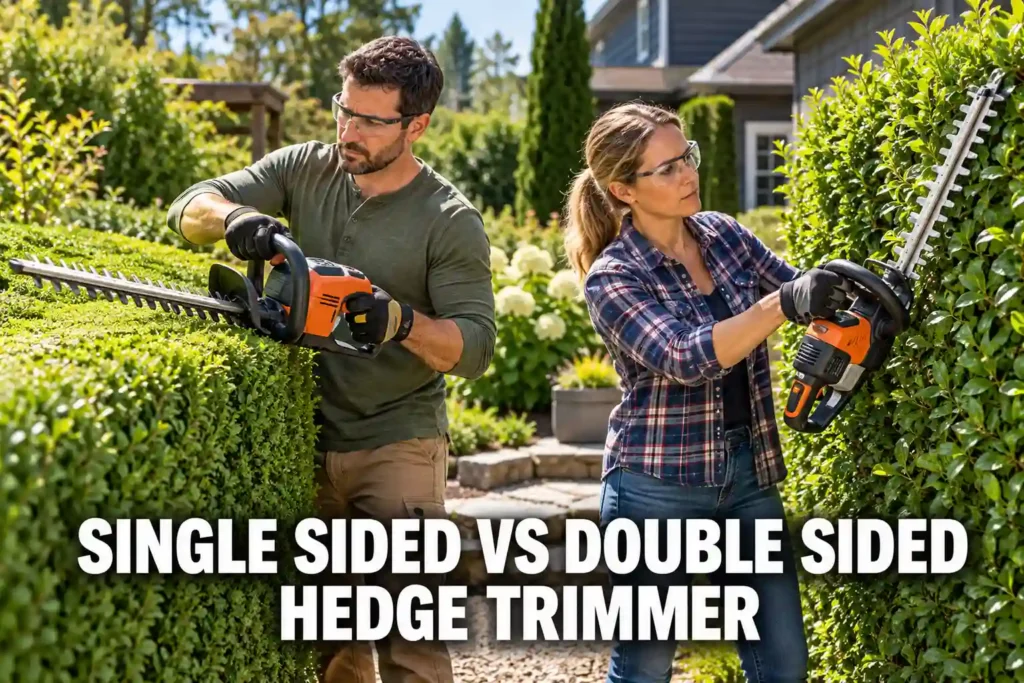
In the single-sided vs double-sided hedge trimmer choice, the double-sided blade fits most home hedges, because its teeth cut on both sides of the bar, so it cuts whichever way you sweep. A single-sided blade has teeth on one side only, which lets a maker build it longer and lighter, and it suits long, straight faces.
I look after the hedgerow along the edge of my orchard, so the length of the run and the weight in my arms decide what I reach for. Below I cover how each blade cuts, where length and weight differ, what the blade side does not change, and the safety steps that apply to both.
Single-Sided vs Double-Sided Hedge Trimmer: Which One Fits Most Hedges
Pick a double-sided blade unless your hedge is a long, straight face and you want the longest, lightest blade a maker offers. Three checks settle it, and the third has nothing to do with the blade side.
- Corners, tops and mixed shrubs: choose double-sided. According to Husqvarna, the double-sided trimmer is the optimal choice if you are shaping hedges.
- Long, straight faces: choose single-sided. According to Husqvarna, with teeth on only one side of the cutting bar the blade can be longer without the machine becoming too heavy.
- Stems thicker than the model’s printed capacity: choose neither. Those go to loppers or a pruning saw.
The Short Version
The blade side changes direction, length, weight and cleanup. It does not change how thick a stem the trimmer may cut: each model prints its own capacity.
Echo gives the same split. According to Echo, double-sided units offer more versatility and finish the job in less time, while its single-sided units sweep the cut material to one place to reduce cleanup time. The sections below cover length, weight and cleanup in turn.
What Single-Sided and Double-Sided Blades Are
A hedge trimmer blade is a pair of toothed bars that slide against each other. The words single-sided and double-sided say where the teeth sit, and the maker’s own wording for each model is the one to trust. The types, parts and limits of the tool are in my guide on what a hedge trimmer is.
Double-Sided Blades
A double sided hedge trimmer has teeth on both edges of the blade bar. That is why you can sweep forward and back, or change direction at a corner, without turning the tool over. Husqvarna prints “Double sided” in the manuals of its 122HD60 gas and Hedge Master 320iHD60 battery trimmers, and Echo prints “Double reciprocating blade, double edge” for its HC-2020.
Single-Sided Blades
A single-sided blade has teeth on one edge only. The other edge is flat, and on Echo’s gas models it carries a full-length debris shield, so the cuttings fall to one side. The shield is part of the cleanup claim, and it is not a guard for your hands.
Side and Action Are Two Labels
Side tells you where the teeth are. Action tells you how the two bars move. “Double reciprocating” means both bars of the pair move against each other, and Echo’s single-sided models are described that way too: its catalog lists the HCS-2810 and HCS-3810 with single-sided, double-reciprocating blades, and its battery DHCS manual says “Dual action, single sided blades.” So single-sided does not mean that only one bar moves. I sort out the two action labels in my guide to single and dual action trimmers.
| Model | Maker’s wording | Side |
|---|---|---|
| Husqvarna 122HD60 (gas) | Double sided | Double-sided |
| Husqvarna Hedge Master 320iHD60 (battery) | Type: Double sided | Double-sided |
| Echo HC-2020 (gas) | Double reciprocating blade, double edge | Double-sided |
| Echo HCS-2810 and HCS-3810 (gas) | Single-sided, double-reciprocating | Single-sided |
| Echo DHCS-2800 and DHCS-3400 (battery) | Dual action, single sided blades | Single-sided |
Many listings print “dual-action” and say nothing about the side. I read the manual’s specification table before I trust either word, because the two labels answer different questions.
How Each Blade Cuts and Where the Clippings Go
The cut is the same scissor action in both designs: the teeth of the two bars close on the stem and shear it. What differs is how you move the tool and where the cut material ends up. The motor, gears and blades behind that scissor action are in my guide to how a hedge trimmer works.
Sweep and Direction
Makers describe the same technique for either blade. DeWalt, EGO, WORX and Ryobi all say to use a wide, sweeping motion, feeding the teeth through the twigs, with a slight downward tilt of the blade in the direction of motion. On sides, DeWalt, EGO, WORX, Husqvarna and Makita say to work from the bottom up.
With a double-sided blade you can finish a pass and sweep back without repositioning, which helps at corners and around the tight curves of a shaped bush. A single-sided blade keeps the toothed edge facing the stems you want gone, so the path of the tool matters more. On a long, straight face that is no hardship, and the longer blade covers more hedge per pass. For the tight curves of a shaped bush, my picks of hedge trimmers for small bushes stay with light models.
Clippings and Cleanup
This is where a single-sided blade earns its place. According to Echo, its single-sided units sweep the cut material to a particular location, and the HCS models carry a full-length debris shield for reduced cleanup time. On my own hedgerow the cleanup is not a small matter, because clippings fall on the drip lines and the alley strip beside the trees, and I rake them off the emitter lines and away from the tree bases after every cut.
A shield or a sweeper does not make the blade safer. Ryobi warns not to use a debris remover as a gripping surface, and Echo describes its front-handle shield as a guard against debris that also stops the front hand from moving forward by accident. Keep your hands on the handles, whatever the blade carries.
Blade Length and Weight
Length is where the two designs separate most clearly in the catalogs. Echo lists its gas hedge trimmers with the same 21.2 cc engine, so its figures compare one design against the other in one maker’s range. Blade length gets its own comparison in my guide to 20-inch and 24-inch hedge trimmers.
| Model | Side | Blade length | Weight (lb) |
|---|---|---|---|
| HC-2020 | Double-sided | 20 in | 10 |
| HC-2210 | Double-sided | 22 in | 11 |
| HC-2810 | Double-sided | 28 in | 11.4 |
| HCS-2810 | Single-sided | 28 in | 10.2 |
| HCS-3810 | Single-sided | 38 in | 10.8 |
At 28 inches, the single-sided HCS-2810 is listed about 1.2 pounds lighter than the double-sided HC-2810, and the 38-inch HCS-3810 is listed lighter than the 28-inch double-sided model. The catalog does not print what the weights include, so treat the comparison as Echo’s own and as a guide to direction, not to the pound. The Echo single sided hedge trimmer models are professional-line gas machines, which is why I use them to show the principle, and not as a buying tip.
A Husqvarna single sided hedge trimmer follows the same logic in the maker’s words: teeth on one side let the blade grow longer without the tool becoming too heavy. For comparison, the Husqvarna 122HD60 double-sided gas trimmer has a 590 mm (23.2 in) cutting length and weighs 10.8 pounds without fuel, according to Husqvarna. Long blades are made for wide hedges, and my picks of hedge trimmers for large hedges list nine of them.
Why Weight Matters More Than Length
A longer blade means more reach and a heavier load held out in front of your body. In a study of 120 Chinese garden workers, pruning high hedges with the arms above shoulder height gave the highest load on the trapezius and biceps, and pruning low horizontal hedges gave the highest load on the back (1).
A test of 20 young operators using a brushcutter, an electric saw and a hedge trimmer also found asymmetric posture, with the trunk inclined about 34 degrees at work, and the authors call for preventing musculoskeletal disorders (2). A tool you cannot hold steady makes that posture worse.
That matches what I feel on a long run: the weight on the spec sheet is the weight of the first cut, and my forearms notice the rest after a stretch of work. A long single-sided blade on a long straight face makes sense only if you can hold it steady. When weight is the limit, my lightweight hedge trimmer picks state the basis of each weight.
Fatigue
Weight at arm’s length builds up over a long hedge: take breaks and stop when you are tired or your grip weakens.
Cutting Capacity, Noise and Vibration: What the Blade Side Does Not Decide
Three things buyers often tie to the blade side are really set by something else. Capacity is a number each maker prints for each model, noise follows the power source and the engine, and vibration depends on the machine’s design and mounts.
Cutting Capacity
Makers use different words and measure different things, so a capacity figure only means something with its kind attached.
| Model | Printed wording | What kind of number |
|---|---|---|
| Echo HC-2020 | Maximum diameter cut: 1 in soft material, 1/2 in woody material | Stem diameter, two kinds |
| Echo DHC-2300 (battery) | Cutting capacity 1.1 in (28 mm) | Capacity as printed |
| Husqvarna 122HD60 | Teeth opening 1.1 in on the maker page; no stem figure in the manual | Tooth gap |
| Ryobi RY40602 | Never cut any material with a diameter larger than 1 in | Stem diameter |
| Milwaukee 3033-20 | Cutting capacity (blade gap) 1-1/4 in | Tooth gap |
A tooth gap is the space between the teeth, and it is not a promise that a stem of that size will cut cleanly. A longer blade covers more hedge per pass; it does not cut thicker wood. Wood thicker than the stated capacity goes to loppers or a pruning saw, never through the blade. For wood that outgrows the trimmer, my hedge trimmer against chainsaw guide covers which tool suits which branches.
Noise
A NIOSH field comparison of two hedge-trimming crews found that the battery-powered crew had significantly lower noise exposure than the gas-powered crew (3). The comparison is power source against power source, and it says nothing about the blade side. Noise is mapped around the operator, and a Brazilian field study of a hedge trimmer concluded that a work regime and hearing protection were needed (4). I wear hearing protection with a gas trimmer from the first minute, and I do not rely on a battery model being quiet enough to skip it. The power source drives the noise gap, and I weigh battery against gas hedge trimmers in a guide of their own.
Vibration
Vibration figures in the manuals belong to a model and its edition, and Echo’s catalog prints a full-spring suspension line for both its single-sided HCS and its double-sided HC-2210 and HC-2810. I do not choose the blade side to manage vibration. I choose the machine, and I stop for breaks.
Which Hedge Jobs Suit Each Design
Match the blade to the shape of the job and to how far you can hold it comfortably. The table gives a starting point, and the sections after it cover the two jobs where the blade side is not the answer. The tall hedge is the subject of my guide on pole and standard hedge trimmers.
| Job | Better fit | Reason |
|---|---|---|
| Formal shapes, corners and curves | Double-sided | Cuts in either direction; changes direction without turning the tool |
| Level top along a string line | Either | Use a string as a guide and a slight angle on the blade (DeWalt, EGO, Ryobi, Makita and Milwaukee all describe it) |
| Long, straight faces | Single-sided | Longer, lighter blade; cuttings sweep to one side |
| Mixed shrubs along a yard edge | Double-sided | Short sections and many direction changes |
| Tall hedge you cannot reach from the ground | Pole or long-reach model, or a professional | Never a ladder |
| Stems thicker than the printed capacity | Loppers or a saw | The trimmer is the wrong tool |
On my property the hedgerow along the orchard edge is the long straight run, and the shrubs along the yard are short, mixed sections. For both jobs I pick a double-sided trimmer.
Tall Hedges
Do not use a hedge trimmer on a ladder, a roof, a tree or any unstable support; the manuals of EGO, Ryobi, Milwaukee and Echo ban it, and Husqvarna bans work from any raised position that is not fully secured. For a tall hedge, stay on the ground and use a pole or long-reach hedge trimmer, or hire a professional.
Before you start with a pole or long-reach model, look for every overhead wire, including wires hidden in leaves. Keep yourself, the trimmer, the pole and any branch you cut or that could fall or swing at least 50 feet (15 m) from every overhead line, the distance Ryobi and Echo print in their pole hedge trimmer manuals, or farther if your own manual asks for more.
A pole hedge trimmer is not insulated, and electricity can jump through the air and travel through branches, especially wet ones. Treat every wire, including service drops and communication lines, and anything touching one, as live. If you cannot keep that distance the whole time, stop, and leave a hedge that has grown into or near a wire to the utility and its qualified line-clearance crews.
Thick or Old Stems
Makita says branches thicker than 10 mm should first be cut with shears down to the hedge trimming level, and EGO suggests a non-powered hand saw or pruning saw for the large stems first. I follow the same order on any overgrown stretch: loppers for the thick stems, then the trimmer for the green growth. For stems at the limit, my hedge trimmers for thick branches picks show how each maker words its capacity.
What Home Buyers Will Find
Most handheld hedge trimmers sold to homeowners are double-sided, or the maker does not say which side the teeth are on. Single-sided blades are mostly a professional-line choice.
| Model | Power | Blade wording | Blade length |
|---|---|---|---|
| Husqvarna 122HD60 | Gas, 21.7 cc | Double sided | 590 mm (23.2 in) cutting length |
| Husqvarna Hedge Master 320iHD60 | Battery | Double sided | 24 in (609 mm) |
| Echo HC-2020 | Gas, 21.2 cc | Double reciprocating blade, double edge | 20 in, as Echo calls it |
Echo makes battery-powered hedge trimmers with single-sided blades. The DHCS-2800 and DHCS-3400 have 28.1 and 34.1 inch blades and weigh 2.9 and 3.1 kg without the battery, according to the Echo manual. I read the battery, charger and wiring warnings in the manual of whichever model I buy before the first cut. My battery hedge trimmer picks cover nine cordless models for every hedge and budget.
Safe Use With Either Blade
Both designs are two sharp reciprocating blades in a handheld tool. A hand that touches the blade is cut in a fraction of a second, and the blade keeps moving for a moment after the switch is released. That is the reason for every step in this section.
Hands, Reach and Protective Gear
Hold the trimmer with both hands on the handles, by the insulated gripping surfaces only because the blade can contact hidden wiring (the grips do not make the trimmer insulated or wire contact safe), whenever the blade is moving; one hand can cost you control of the tool. On a trimmer with two switches, both hands must be on the switches to start the blade, and the blade stops when you let go of either one. Keep your body parts clear of the blade and never remove cut material or hold the stem you are cutting while the blade moves.
Never hold a branch with your free hand or reach toward the blade, through the hedge or into any opening while the blade moves. On a gas trimmer never reach into any opening while the engine is running: a blade that has stopped in a jam does not stop the engine, so first complete the full maintenance shutdown. Do not overreach: keep your footing and balance, and trim only what you can see.
Wear safety glasses with side shields marked ANSI Z87.1, and a face shield over them where your manual asks for one; hearing protection; sturdy work gloves; long pants and long sleeves with no loose clothing or jewelry (Echo says never wear shorts); and closed, non-slip shoes or boots. Wear head protection when you operate a pole or long-reach trimmer overhead (the Ryobi RY40603, Husqvarna 520iHE3 and Echo DHCS and DHCA manuals require it). The Echo DHCA-2600 manual also prints a symbol that says not to cut branches overhead, and head protection does not override that prohibition. Wear a respirator when dust is present, as the DeWalt manual states.
Before You Start and When the Blade Jams
Before each use, check the trimmer as your manual describes: the blades sharp, undamaged and lubricated, the operating guards fitted, the blade cover removed before you start (it is for carrying and storage only), the switches and the lock-off working, every handle and pole coupling tight, and the battery, cord or fuel system undamaged. If anything fails the check, do not use the trimmer until it is fixed.
To clear a jam, remove cut material, clean, lubricate or touch the blade, release the switch, switch the motor or engine off and wait until the blade has stopped completely. Then on a battery trimmer take the battery pack out, on a corded trimmer pull the plug from the outlet by the plug, not the cord, and on a gas trimmer let the engine and muffler cool and pull the spark plug wire off. Put on gloves before you touch the blade, and check every lock and coupling before power goes back on. A gas engine can keep running after the blade stops in a jam, so never reach into the tool until it is off, cool and the spark plug wire is off.
Fuel, Batteries and Weather
Refuel a gas hedge trimmer outdoors with the engine off and cool, with no smoking, flames or sparks nearby, wipe spills, and move at least 10 feet (3 m) from where you fuelled before you start it. Mix the fuel only in the ratio your manual gives, in an approved container. Never run a gas trimmer indoors or in a garage or shed: the exhaust contains carbon monoxide. Wear hearing protection; gas models are louder than battery models.
Use only the maker’s battery and charger for your trimmer, charge and store them within the temperatures your manual gives and never in rain or wet places, never use or charge a damaged, swollen or leaking pack, and keep loose batteries away from metal objects such as keys, coins and nails that could short the terminals. Never trim in rain, dense fog, strong wind, a storm or when lightning is possible, and trim only when the light lets you see the stems, any wire in the hedge and your footing clearly.
Look through the hedge before you cut, and look behind you before you swing the tool. Keep people, pets and helpers away from the work area, at the distance your manual gives (Ryobi asks for 50 feet from a pole hedge trimmer), and stop trimming if anyone comes closer. People with pacemakers should consult their physician before using a hedge trimmer, as the EGO and Echo gas manuals say. Look for nests before cutting and leave a hedge where birds are nesting.
Mistakes to Avoid When You Choose
Most bad purchases come from reading one label and ignoring the rest of the specification table. These are the ones to avoid.
- Choosing by blade side alone: the side is one line in the table. Capacity, weight, balance and the handle matter as much.
- Reading dual-action as double-sided: the two labels answer different questions, as Echo’s single-sided, double-reciprocating models show.
- Assuming a longer blade cuts thicker wood: length is reach per pass, and capacity is a separate printed figure with its own kind.
- Buying a blade you cannot hold steady: a long blade is a heavy load at arm’s length, and the spec weight is the first-cut weight.
- Forcing the blade through thick wood: Ryobi, EGO and Milwaukee all say not to, and Milwaukee warns that the tool may stall or kick back.
- Trimming blind: look through the hedge for fence wire, posts, hoses and nests first.
Match the Blade to Your Hedge
Three things to remember: the double-sided blade is the all-round choice, the single-sided blade pays off on long straight faces, and neither one changes how thick a stem your trimmer may cut. My own tip is to lay a string along the top of a long run before you cut, because a straight guide gives a single-sided blade its best result and lets a double-sided blade stay level. Read your manual for its capacity and its shutdown steps before the first cut. For a home hedge, the single-sided vs double-sided hedge trimmer decision comes down to the shape of the run and the weight you can hold steady. For specific models, my hedge trimmer picks cover cordless, corded and gas options.
Frequently Asked Questions
Which is better, double or single bladed hedge trimmer?
For most home hedges a double-sided blade is the better choice, because it cuts in either direction and handles corners and tops. A single-sided blade is better on long, straight faces, where a longer, lighter blade and cuttings swept to one side save time. Neither design changes how thick a stem the model may cut.
Does a hedge trimmer work on branches?
A hedge trimmer works on branches only up to the capacity its maker prints for that model, such as 1/2 in of woody material on the Echo HC-2020 or 1 in on the Ryobi RY40602. Anything thicker goes to loppers or a pruning saw, never through the blade.
Does Echo make a single sided hedge trimmer?
Echo makes single-sided hedge trimmers: its catalog lists the gas HCS-2810 and HCS-3810 with 28 and 38 inch blades, and its battery DHCS-2800 and DHCS-3400 manual says “Dual action, single sided blades.” Read the manual of the exact model for its capacity and shutdown steps.
Is there a single-sided hedge trimmer battery model?
Echo makes battery hedge trimmers with single-sided blades, and that is the single-sided hedge trimmer battery option: the DHCS-2800 and DHCS-3400 have 28.1 and 34.1 inch blades and weigh 2.9 and 3.1 kg without the battery. Use only the maker’s battery and charger for the trimmer, and never use or charge a damaged, swollen or leaking pack.
Can a double sided hedge trimmer cut in both directions?
A double sided hedge trimmer has teeth on both sides of the blade bar, so it cuts as you sweep either way. According to Greenworks, its double-sided blade lets you cut in either direction. Sweep with a slight tilt of the blade in the direction of motion, as DeWalt, EGO, WORX and Ryobi describe.
References
- Yang W, Li S, Li B, Liu W, Ning F, Gao S. Analysis of the effects of working position on muscle fatigue during hedge pruning: a cross-sectional study based on Chinese garden workers. J Mech Med Biol. 2023;23(2):2350027.
- Roggio F, Vitale E, Filetti V, Rapisarda V, Musumeci G, Romano E. Ergonomic evaluation of young agricultural operators using handle equipment through electromyography and vibrations analysis between the fingers. Saf Health Work. 2022;13(4):440-447. doi:10.1016/j.shaw.2022.07.003
- Beamer B, DiFrancesco J. Field Comparison of Gas-Powered vs. Battery-Powered Equipment for Grounds Maintenance – Hedge Trimming Operations. Inter-Noise 2019, 48th International Congress and Exposition on Noise Control Engineering (Madrid); Spanish Acoustical Society. 2019.
- Silva MO, Yanagi Junior T, Schiassi L, Rossoni DF, Barbosa JA, Yanagi SNM. Spatial variability of the noise level of a hedge trimmer and backpack blower. Rev Bras Cienc Agrar. 2014;9(3):454-458.
Safety Note: Only an adult who has read the manual and understands the controls should use a hedge trimmer, never a child or anyone tired or impaired. The blades are sharp, a hand that touches them is cut in a fraction of a second, and they keep moving for a moment after you release the switch. Hold the trimmer with both hands on the handles, by the insulated gripping surfaces only because the blades can contact hidden wiring (the grips do not make the trimmer insulated or wire contact safe), whenever the blades move; on a trimmer with two switches, both hands must be on the switches to start. Never hold a branch or reach toward the blades, through the hedge or into any opening while they move, and never reach into any opening of a gas trimmer while the engine is running, because a blade that stops in a jam does not stop the engine. Never overreach, and trim only what you can see. Before you start, look through the hedge for wire, fence wire, cords, posts, stakes, irrigation lines, nests, people and pets, and keep the cord or hose out of the blade’s path. If a blade jams on a wire or a cord, do not touch the blade, the wire or the cord: stopping the blade does not remove the electrical danger, so the electrical supply to the damaged line or cord must be disconnected first. Cut only stems up to the capacity your manual states, in the maker’s own wording, and leave thicker wood to loppers or a saw. Do not use a hedge trimmer from a ladder, a roof, a tree or any unstable support, so for a tall hedge stay on the ground and use a pole or long-reach hedge trimmer, or hire a professional. Power lines can kill. With a pole or long-reach hedge trimmer, look for every overhead wire, including wires hidden in leaves, and keep yourself, the trimmer, the pole and any branch that could fall or swing at least 50 feet (15 m) from every line, the distance Ryobi and Echo print in their pole hedge trimmer manuals, or farther if your manual asks for more. A pole hedge trimmer is not insulated, and electricity can jump through the air and travel through branches, especially wet ones. Treat every wire as live, and leave a hedge that has grown into or near a wire to the utility and its qualified line-clearance crews. If the trimmer, the pole or a branch touches a wire, treat the trimmer, the branch, the wire and anything touching them as live: do not go back to the trimmer to switch it off or unplug it, do not touch anything in contact with the line, keep everyone away and call the utility, which alone frees the trimmer, and 911 if anyone is hurt, a fire starts or a line comes down. Wear safety glasses with side shields marked Z87.1, a face shield over the glasses where your manual asks for one, hearing protection, sturdy gloves, long pants, long sleeves with no loose clothing or jewelry, and closed, non-slip shoes. Wear head protection when you work a pole or long-reach model overhead, as the Ryobi, Husqvarna and Echo pole manuals require, and a respirator when dust is present, as the DeWalt manual states; where a manual forbids cutting overhead, do not. Keep people and pets away at the distance your manual gives, and stop trimming if anyone comes closer. Never trim in rain, fog, strong wind, a storm or when lightning is possible, trim only in good light, and let the hedge dry first. Before each use, remove the blade cover (it is for carrying and storage only), and check the blades, the operating guards, the switches and every handle and pole coupling as your manual describes, and do not use a trimmer that fails a check. Before you clear a jam, remove cut material, clean, lubricate or touch the blades: release the switch, switch the motor or engine off and wait until the blades have stopped completely, then take the battery pack out, unplug a corded trimmer from the outlet by the plug, or on a gas trimmer let the engine and muffler cool and pull the spark plug wire off; put on gloves and check every lock and coupling before power goes back on. To carry or store the trimmer, release the switch, switch the motor or engine off and wait until the blades have stopped completely, then take the battery out, unplug a corded trimmer by the plug, or on a gas trimmer let the engine and muffler cool and pull the spark plug wire off; fit the blade cover, carry the trimmer by the handle with the blades pointing behind you, and keep it indoors, dry and out of children’s reach. Use only the maker’s battery and charger, charge and store them within the temperatures your manual gives and never in the wet, never use or charge a damaged, swollen or leaking pack, and keep loose batteries away from metal objects that could short the terminals. Use a corded trimmer only with an outdoor-rated extension cord of the gauge your manual gives, plugged into GFCI-protected power, with the cord behind you and away from the blades, and never in rain or wet conditions: GFCI protection does not make that safe; if the cord is cut or damaged, disconnect it at once by pulling the plug from the outlet by the plug, before you touch the cord or the blades. Refuel a gas trimmer outdoors with the engine off and cool, with no smoking, flames or sparks nearby, wipe up spills, move at least 10 feet from where you fuelled before you start it, wear hearing protection, and never run it indoors or in a garage or shed, because the exhaust contains carbon monoxide. Look for nests before you cut and leave a hedge where birds are nesting. Take breaks and stop when you are tired.