
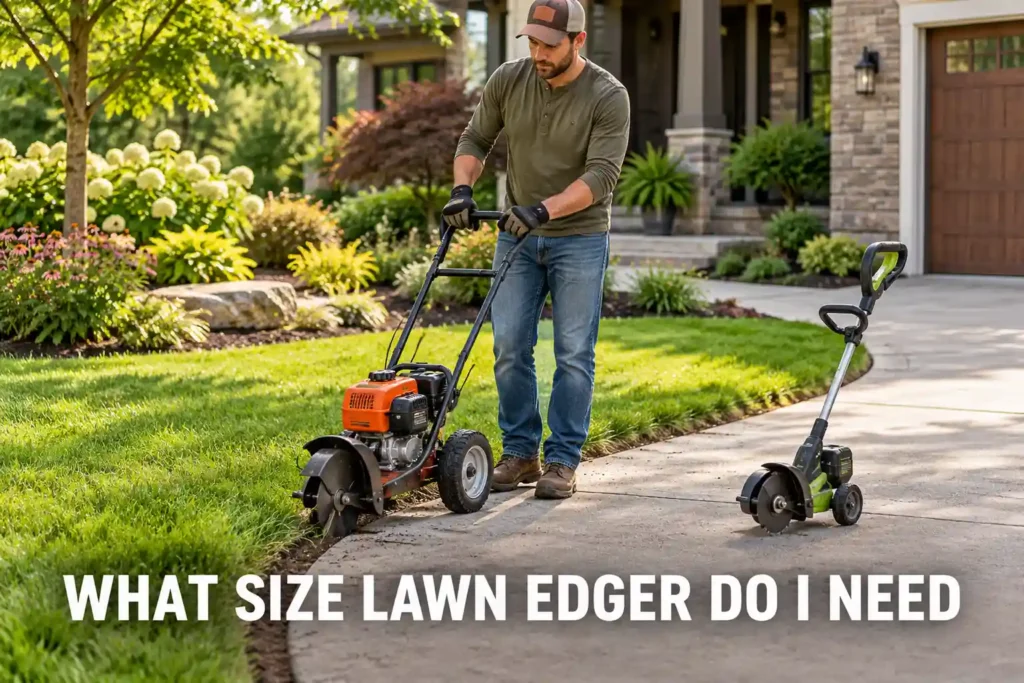
The right lawn edger size is set by the length of hard edge you cut, how often you cut it and how much weight and cord you are ready to carry. A short edge suits a light stick edger, and a long run suits a machine with more reach. On my farm the concrete work pad in front of the machinery shed is my test case: about 140 feet of edge if grass meets all four sides, and I size a tool to a job like that before I read a spec sheet. Below you will find a way to measure your edge, three real machines side by side, the limits of cord, pack and tank, and the safety rules that stay the same at every size.
What Size Lawn Edger Do I Need? The Short Answer
Match the machine to three numbers: the feet of hard edge you cut, how many times you cut it each season and how thick the growth is on the first cut. A short edge that you cut often fits a light stick edger. A long edge cut in one session needs a tank, a spare pack or a long cord, and I only consider a walk-behind machine when the run is long and the ground is open. If a light tool matters most, my roundup of the best lightweight edger picks lists seven that spare the arms.
Size here means the whole machine, not only the blade. Weight, format, power source and reach decide how the tool feels at the end of the edge. Blade width, cutting depth and motor power follow from that first decision, and each gets a short section further down.
| Your job | Format to look at | What limits it |
|---|---|---|
| A short run: a path, a patio, a few bed edges | Stick edger; a manual lawn edger also works | A manual tool is slow on anything long |
| A whole lot, cut in one session | Stick edger with a spare pack, a long cord or a tank | Pack life, cord reach or fuel upkeep |
| Long straight runs on open ground | Walk-behind edger | Weight, storage space and the slope limit in its manual |
| You already own a compatible power head | Edger attachment | Fits only the power heads its maker lists |
Short Version
Measure the hard edge, time one stretch of it on your first cut, then check that the cord, pack or tank covers the whole edge in one session. Pick the lightest format that does.
Measure Your Hard Edge Before You Shop
Every sizing decision starts with a number you can get with a garden hose and a tape measure. Guessing from the porch is how people end up with a machine that is too heavy for a short path or too small for a whole lot.
How to Measure the Edge
Lay the hose along every line where lawn meets concrete, pavers or a bed border, then straighten it and measure it. I measure an edge this way for the same reason I walk a drip line before a season: a number on paper beats an estimate. Count hard edge and bed edge separately, because a bed border is a landscaping cut and a hard edge is the line where the guide wheel rides.
My typical count starts with the work pad. If grass meets all four sides of a 40 by 30 foot slab, the edge is 2 x (40 + 30) = 140 feet. Add the path to the house door and the border of the vegetable plot, and the total is long enough that I want a powered tool for it.
How Often You Cut the Edge Changes the Size
Frequency matters as much as length. Echo advises edging regularly, so that one pass keeps a neat edge, and WORX notes that the first edging each season is the slowest because the grass is thickest then. Growth you let run over needs more passes, and that costs time plus battery or fuel. The cord is a separate limit: it reaches only as far as the routed distance from the outlet to your farthest point. If your edge sits near an outlet, my list of corded lawn edgers I ranked gives you five plug-in options to compare.
Size for the First Cut, Not the Average One
The Earthquake manual says a new edge may need several passes, lowering the depth step by step. The first cut of the year is the one that decides whether a small machine copes, so I size for it and treat the later trims as a bonus. On a thick first cut I prefer three shallow passes to one forced deep one. My guide on how deep an edger cuts gives depth by job, model and soil.
Pro Tip
Edge only when the grass and soil are dry. WORX rules out wet or moist grass and soil, Earthquake rules out wet grass, and EGO warns that wet soil can clog the blade guard.
Machine Size, Weight, Format and What You Carry
The weight of the machine and the way you hold it decide how long you can edge before your arms say stop. Three real models show the spread. The figures are the makers’ own, and each weight counts different things, so read each cell with its note.
| Row | WORX WG896 | Echo PE-225 | Earthquake 41273 |
|---|---|---|---|
| Format | Corded stick edger and trencher | Gas curved-shaft stick edger | Gas walk-behind edger |
| Power | 120 V, 12 A | 21.2 cc two-stroke, 50:1 mix | 79 cc four-stroke, no mixing |
| Weight, maker’s figure | 14 lb, corded so no battery | About 13 lb dry, fuel adds to it | 57 lb net, 64 lb gross |
| Blade | 7-1/2 in | 7.75 in long, 2 in wide | 9 in |
| Reach or limit | Cord gauge by cord length | Fuel mix and refueling outdoors | Slope no more than 15 degrees |
| Bystander distance, manual | 100 ft | 50 ft | No figure; keep the area clear |
The spread in weight is wide. The Earthquake’s 57 lb is about 4.4 times the Echo’s 13 lb, and the Earthquake manual says to move the packaged machine with a partner. Weight decides where you can store the tool as much as how it feels in use.
Stick Edgers for Short and Medium Runs
You hold and steer a stick edger, so its balance matters as much as its weight. A wheeled model such as the WORX WG896 rests part of its weight on its wheels, with both rear wheels riding the pavement, while the Echo PE-225 has only a depth wheel and its shaft hangs from your hands. I judge a stick edger by how it feels at the far end of the edge, because the shaft keeps pulling on the wrists after the first stretch is done. A stick edger of the weights above suits a house lawn, a path and a few beds. I wrote up how the wheeled WG896 handled my concrete pad in my review of the WORX WG896.
Walk-Behind Edgers for Long, Open Runs
A walk behind lawn edger carries its own weight on wheels, which suits a long straight run on open ground. It needs storage room, since the Earthquake measures 42.2 by 19.5 in assembled, and level ground within its manual’s slope limit. On my property the tilled strips and the gravel lane make me hesitate, so a heavy machine would have to earn its place.
Edger Attachments Work Only With Their Own Power Head
Lawn edger attachments turn a power head you already own into an edger, which saves buying a second motor or engine. They fit only the heads the maker lists. EGO, for one, states that its edger attachment works only with its own 56V power head, so read the maker’s list before you buy. When you already own the power head, my guide to a dedicated edger or attachment weighs cost, weight and reach.
Match the Power Source to the Length of Your Edge
The power source decides how far one session reaches. Test it against the edge you measured, not against a box rating.
Corded Edgers and the Reach of the Cord
An electric lawn edger on a cord reaches as far as a safe cord reaches. The WORX manual gives a minimum gauge by cord length for its 12 amp motor: 16 AWG up to 50 ft, 14 AWG up to 100 ft and 12 AWG up to 150 ft. It also calls for an outdoor-rated cord and a GFCI outlet, says to use the next heavier gauge if in doubt and says not to run the edger on a circuit with other major appliances. My comparison of corded and cordless edgers goes deeper on reach, weight and run time.
Take a worked case. Your far corner is 60 feet of cord from the outlet. The 16 AWG cord stops at 50 ft, so you need 14 AWG, and a 14 AWG cord covers any run up to 100 ft. Route the cord behind you and clear of the blade and your feet, and never edge in wet conditions.
Battery Edgers and Planning in Packs
A battery powered lawn edger reaches as far as its pack. Voltage labels do not compare across brands: US makers print 20V Max for the voltage with no load, and the Black+Decker and DeWalt footnotes give 18 volts nominal. Compare amp-hours only within one voltage platform, check the maker’s list of approved tools, and use nominal volts times amp-hours (watt-hours) when you must compare across platforms. Stored energy alone does not tell you the cutting power or the length of edge a pack will cover. For specific packs and kits, my roundup of battery powered edger picks names seven cordless models.
Maker run times depend on soil, depth and speed, so I plan a long edge with a spare pack and charge both before the first cut of the year, the thickest cut. Charge within the temperature range in your manual, use only the maker’s charger and never charge a damaged or swollen pack.
Gas Edgers and Fuel Habits
A gas powered lawn edger keeps going as long as you refill it, which suits an edge too long for a pack. The price is fuel handling. The Echo PE-225 runs a 50:1 mix of gasoline and two-stroke oil, and Echo says to mix no more than you expect to use in 30 days, or 90 days with a stabilizer. The Earthquake’s four-stroke engine takes no mix, but it needs its own oil and engine upkeep. My guide to 2-stroke and 4-stroke edgers compares fuel, oil and upkeep in more detail.
Refuel outdoors with the engine off and cool, and move 10 ft away from the fuel spot before you start, as Echo directs. A gas edger never runs or stays fuelled in a closed shed or garage, even with the door open. I fuel mine on the gravel yard, never in the shed, because the carbon monoxide and the fuel fumes have to go somewhere.
A Worked Selection for a 140-Foot Pad
Take the 140 feet around the work pad, with the nearest outlet 60 feet of cord from the far corner. A corded stick edger fits: the WORX WG896 weighs 14 lb, and a 14 AWG cord covers 60 feet on the maker’s table, so there is no pack to plan. A battery edger fits too. Greenworks states up to 60 minutes of run time for its 40V edger with the included 4.0 Ah battery, without stating the conditions, so I treat that as a ceiling. My Greenworks 40V edger kit review covers the 8-inch brushless kit, battery and charger.
To turn minutes into feet, time one 50 foot stretch of your own edge on the first cut. If it takes 3 minutes, 140 feet takes about 8 minutes, well inside the maker’s figure, and the same arithmetic tells you when you need a spare pack. The three-minute stretch is an example, and your soil and depth will set your own number. A walk-behind machine adds nothing here, because 140 feet is short and the 57 lb Earthquake needs storage room.
Blade Size, Depth and Power Come After the Size Decision
Three questions come next, and each has its own guide on this site. A few rules hold for all of them:
- Blade size: use only the blade the maker lists for that exact edger. The three models above use 7-1/2 in, 7.75 in and 9 in blades, and none of them takes a blade from another tool. My guide to the edger blade size you need shows how to match size, hole and part to your model.
- Cutting depth: the manual gives a depth range for the model. Set the depth to only what the job needs, as WORX says.
- Power: motor amps, engine cc and battery capacity measure different things. Compare within one power type and read the cutting depth the maker states. My guide on the power an edger needs explains amps, volts and cc in plain terms.
The Cost of Going Too Big or Too Small
Both mistakes cost money and effort, and both are easy to avoid with the edge measured first.
What Oversizing Costs
A bigger machine than the job needs costs weight in your hands or in the shed, a longer upkeep list and, for gas, more fuel handling. In NIOSH sampling of 80 landscaping workers, fuel-powered leaf blowers, string trimmers and chainsaws gave significantly more noise and carbon monoxide exposure than battery versions (1). That study did not measure edgers, so I use it as a direction and not a number. On a short edge I do not need an engine at all.
What Undersizing Costs
A machine that is too small bogs down, needs more passes and runs out of pack or cord before the edge is done. EGO says a blade that begins to bog down means you are edging too fast, and WORX says to back the tool up an inch or two if it slows, because working on in a clogged state seriously overloads the motor. A long session also adds up for your hands: in a study of 17 groundskeepers, their lifetime hand-arm vibration dose was 33 times that of office workers on the right hand (2). Echo’s manual warns about vibration and advises breaks, so I rest my hands on a long edge and keep both hands firmly on the handles while the blade runs.
Safety Rules That Do Not Change With Size
Even a small edger can throw stones and soil with force, so the rules below hold for every machine in this guide.
Before You Touch the Blade
Switch off, wait for the blade to stop, remove the battery (gas: take the spark plug wire off; corded: unplug), then touch the blade. This order also applies before you adjust depth, clear a jam, change a blade or carry the tool.
- Eyes: wear eye protection with side coverage that meets ANSI Z87.1, or the standard your manual names. In US emergency-department data on lawnmower eye injuries from 2004 to 2023, 77% came from projectiles, mostly grass, dirt and rocks (3), and the eye took 42.5% of 81,907 lawn trimmer injuries from 2000 to 2009 (4). Neither study covers edgers, but an edger throws the same kind of debris.
- Ears: wear hearing protection every time. NIOSH recommends 85 dBA as an eight-hour average and halving the exposure time for every 3 dBA increase (5). A big lot means a long session, which is another reason to wear it.
- Clothing: long pants, close-fitting long sleeves, sturdy slip-resistant boots and gloves.
- Bystanders: use the distance in your model’s manual. It is 50 ft in the Echo manual and 100 ft in the WORX manual, and the Earthquake manual gives no figure. Stop the tool when someone comes closer.
- Ground: remove stones and loose objects first, keep the guard on, and never edge in gravel or lower the blade over concrete on purpose.
- Buried lines: call 811 before you cut a new edge or trench into soil, and mark sprinkler heads, drip lines and lighting wire, which 811 may not locate. A study of US utility locating notes that more underground lines have led to more dig-in strikes, with loss of services, injuries and deaths (6).
Pick the Size, Then Read the Manual
Three things matter most: measure the hard edge, size for the thickest cut of the year, and match the cord, pack or tank to your longest session. My tip is the hose: lay it along the edge before you shop, and write the length on the box you keep in the shed. Next, read the manual of the exact model for its blade, depth range and bystander distance, since the figures differ from model to model. Once the edge is measured, the size of lawn edger you need is a short decision. Once the size is clear, my best lawn edger picks put corded, battery and gas models side by side.
Frequently Asked Questions
How big of an edger do I need for a large lawn?
How big an edger you need for a large lawn depends on the length of hard edge, not the lawn’s area, so measure the edge first. A long edge calls for a cord, a pack with a spare or a tank that covers it in one session, and a walk-behind machine only on open ground within its slope limit. The Earthquake manual, for example, rules out slopes steeper than 15 degrees.
How much battery do I need to edge a large yard?
How much battery you need to edge a large yard depends on the maker’s stated run time and on your soil, depth and speed. Greenworks states up to 60 minutes for its 40V edger with the included 4.0 Ah battery, without stating conditions, so treat that as a ceiling and carry a spare. Compare amp-hours only within one voltage platform.
How heavy should a lawn edger be?
A lawn edger should weigh as little as the job allows, because you steer it along the whole edge. The makers’ figures run from about 13 lb dry for the Echo PE-225 and 14 lb for the corded WORX WG896 to 57 lb for the Earthquake walk-behind, so check what each weight includes. A wheeled model carries part of its weight on its wheels.
Does a bigger blade help on a large lawn?
A bigger blade does not by itself make a large lawn easier to edge, because the model sets the blade and the maker lists the only blade that fits. The three models above use 7-1/2 in, 7.75 in and 9 in blades, and reach and weight decide more of the work on a large lawn. Use only the blade your manual lists.
What size edger works for a small yard?
For a small yard, the edger that works is the lightest one whose cord, pack or tank covers your whole edge once. A corded stick edger such as the WORX WG896 at 14 lb suits a short edge near an outlet, since a 14 AWG cord reaches up to 100 ft on its table. A hand tool also works on very short runs.
References
- Alexander BM, Graydon PS, Pena M, Feng HA, Beamer BR. Hazardous exposures and engineering controls in the landscaping services industry. Journal of Occupational and Environmental Hygiene. 2025;22(3):189-202.
- Chen N, Yang S, Oh J. Evaluation of hand-arm vibration (HAV) exposure among groundskeepers in the southeastern United States. Annals of Work Exposures and Health. 2025;69(1):81-95.
- Stange NR, Jennissen CA. Lawnmower-Related Eye Injuries in the U.S., 2004 to 2023. Am J Ophthalmol. 2025;277:7-16.
- Leinert J, Griffin R, Blackburn J, McGwin G. The epidemiology of lawn trimmer injuries in the United States: 2000-2009. J Safety Res. 2012;43(2):137-139. doi:10.1016/j.jsr.2012.03.001
- National Institute for Occupational Safety and Health. Noise-Induced Hearing Loss. Noise and Hearing Loss. Centers for Disease Control and Prevention; 2024.
- Al-Bayati AJ, Sturgill RE, Panzer L, Victorio SM, Omer T. Locating underground utilities in the United States: A comparative analysis of services provided by private locators. Transportation Research Interdisciplinary Perspectives. 2022;16:100707.
Safety Note: Read your manual first. An edger can throw stones, soil and other debris with force, so remove loose stones, glass, wire and other objects before you start, keep the blade guard in place, and never edge in or near gravel or let the blade strike pavement or rocks on purpose. Wear impact-rated eye protection with side coverage that meets ANSI Z87.1, hearing protection, gloves, long pants, close-fitting long sleeves and sturdy slip-resistant boots. Keep people and pets at least as far away as your manual says (50 feet in some manuals, 100 feet in others), and stop if anyone comes closer. Use only the blade your manual lists for your exact edger or attachment, and fit an attachment only to a power head its maker approves, with the coupling fully locked. Before each use, with the tool switched off, all movement stopped and the battery removed, the cord unplugged or the spark plug wire disconnected (a gas engine cooled), check the blade, its bolts and the guard, and replace a cracked, bent or badly worn blade as your manual says; never sharpen a blade unless that manual allows it. Start the tool in the position your manual shows, with the blade clear of the ground, and let it reach full speed before you ease it into the cut. The blade can push the tool sideways when it hits concrete, a stone or a root, so hold both handles, keep firm footing and never force the cut. After the blade strikes something or the tool starts to vibrate, switch it off, wait for all movement to stop, disconnect the power the same way and inspect it before you go on. Before you clear a jam, change depth, clean the tool, fit or remove an attachment, or inspect or replace the blade, stop the motor or shut off the engine, wait for all movement to stop, then remove the battery, unplug the cord or disconnect the spark plug wire. On a gas edger, releasing the blade control can leave the engine running, and a blade that turns at idle means the edger must not be used until it is repaired. An edger cuts into the soil: in the US, contact 811 before you edge or trench into soil, and mark sprinkler lines, drip lines, landscape lighting wire and other private lines, which 811 may not locate. Refuel a gas model outdoors with the engine off and cool, away from flames or sparks, and move as far from the fueling spot as your manual says before starting; start and run it outdoors only, never in a garage, shed or other closed space, even with the door open. For a battery model, use only the battery and charger approved for your tool, charge and store them within the temperature range in your manual, and never use a damaged or swollen pack. For a corded model, use an undamaged outdoor extension cord of the gauge and length your manual gives, plugged into a GFCI outlet, keep the cord clear of the blade, the wheels and your feet, and avoid wet conditions.