
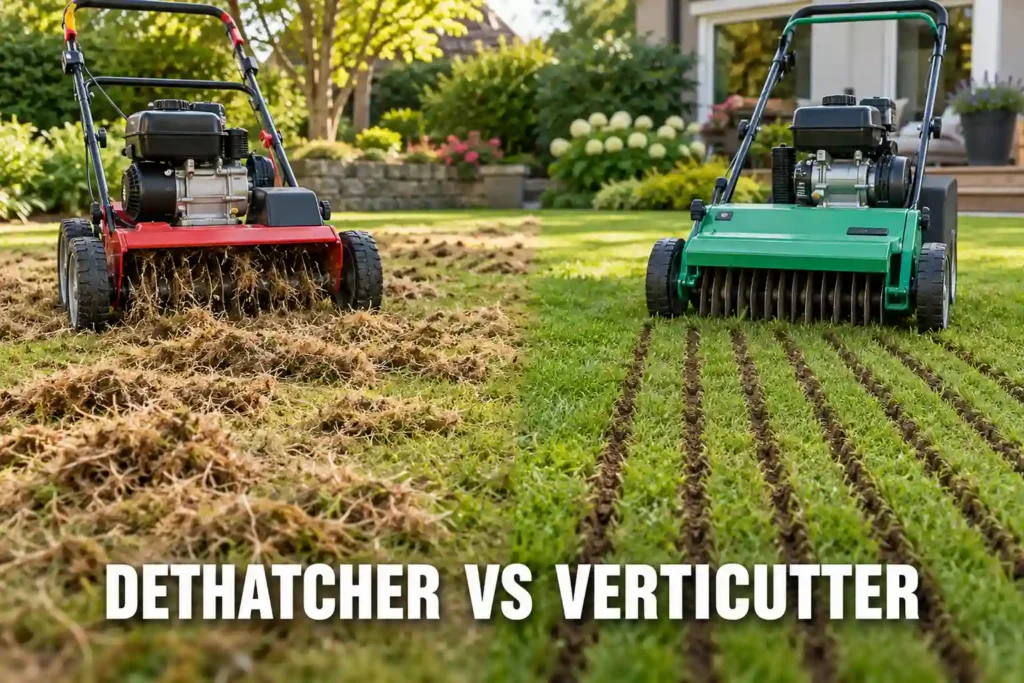
In store terms, dethatcher vs verticutter is a choice between spring tines that comb thatch up and vertical blades that slice through it and into the top of the soil. A dethatcher is the gentler pick for a thin to moderate mat, and a verticutter earns its place on thick thatch or before you overseed. I think of a verticutter the way I think of a seed drill coulter, a blade that cuts a slot where a tine only scrapes. Below you get how each machine works, which grasses take a blade, what field trials found, the safety rules and a pick by thatch depth.
Dethatcher vs Verticutter Short Answer
Choose a dethatcher when the mat of dead stems is thin to moderate and the grass is dense and growing. A verticutter suits thick thatch, or a lawn where you want slits in the soil to take seed. Both machines tear some living grass out with the dead material, so neither one is a routine chore. For a heavy mat, my roundup of dethatchers for thick thatch ranks the machines that suit it.
Rule of Thumb
Cut a plug and measure the thatch before you rent or buy either machine. I cut a plug and look at the brown, spongy mat before I spend anything on a lawn tool.
The table sets the two machines side by side in the terms retail makers use.
| Feature | Dethatcher | Verticutter |
|---|---|---|
| What turns | A drum of spring tines | Vertical blades set in rows |
| Reach | Lifts dead stems from the surface layer | Slices through the thatch and into the top of the soil |
| Best job | Thin to moderate thatch on dense turf | Thick thatch, or opening a seedbed |
| Main risk | Pulls up healthy grass along with thatch | Cuts crowns, runners and roots when set too deep |
| Debris | A lot to rake or bag | A lot, with some soil mixed in |
| Grass caution | Ask your extension service which machine your grass tolerates | Stolon grasses need wide spacing and one direction |
Retail machines blur this line, because some sell a tine drum and a blade drum in one box. The section on names further down explains where extension services draw the line. My guide to what a lawn dethatcher is covers the types and parts of the machine.
How a Dethatcher Works
A dethatcher pulls dead stems and roots up out of the thatch layer so you can rake or bag them. Penn State Extension describes power rakes as machines with vertically rotating wire tines that remove thatch. Retail walk-behind dethatchers use the same idea in a lighter machine: a motor spins a drum, and the tines reach down into the mat. My comparison of a tiller and a dethatcher shows which machine fits which lawn job.
Spring-Tine Walk-Behind Machines
Most electric and battery models carry a spring-tine drum for dethatching, and many add a second drum of slicing blades that you swap in. The depth lever has stepped positions, and a negative number in the manual means the tines or blades work below the soil surface. The first thing I look at on any of these machines is the depth chart, because it tells me which steps are meant for combing and which are meant for cutting. My explainer on how a dethatcher works walks through the drum, the tines and the depth setting.
The dual-drum manuals mark the shallow steps as the dethatching steps and the deepest steps as scarifying steps, and some say plainly not to dethatch at the deepest position. The tine drum lifts thatch, and the blade drum cuts grooves, so one machine does two different jobs depending on which drum is fitted.
Tow-Behind and Power Rake Versions
A tow-behind dethatcher is a tray of spring tines dragged by a riding mower or tractor, with no motor of its own. It combs the surface and does not go through the thatch the way a blade does. A power rake is a heavier, engine-driven machine with rotating wire tines, often rented for a big or neglected lawn. I explain how to choose for your lawn in my tow-behind dethatcher and power rake comparison.
How a Verticutter Works
A verticutter spins blades in a vertical plane, like a row of thin circular saws, and the blades slice down through the thatch. Penn State Extension says the rotating blades slice into the thatch as the unit moves over the turf, bringing up organic debris. UF/IFAS adds that the blades move in a vertical, up and down plane, and that the machine can remove thatch buildup in lawns.
What Is a Verticutter?
A verticutter is a vertical mower: a machine whose blades cut a series of thin vertical slits. According to Mississippi State Extension, special vertical mowers called dethatchers or verticutters are designed to slice vertically through the thatch. UF/IFAS Escambia County puts it in one line: a verticutter slices through the turf to reduce thatch.
What a Verticutter Does to the Soil
The blades do not stop at the thatch. They reach the top of the soil and cut it, which leaves slits where seed can drop. In a Kansas trial on tall fescue, verticutting and core aerification were equally successful as seedbed preparation (1). A golf-green trial found that two passes with a vertical mower prepared a better seedbed than tine cultivation when seeding into dead turf in the first year (2). Read the second result as a green-height result, because a lawn is mown much higher. My guide to dethatching and overseeding shows how to pair the two jobs.
Blade Spacing and Direction
Blade spacing decides how hard a verticutter is on the lawn. UF/IFAS gives about 3 inches between blades for St. Augustinegrass and says to work in one direction, without cross passes. On any grass that spreads by surface runners, I use only a machine that offers the spacing the extension advice gives for that grass, and I hire a professional when the machine cannot, rather than settle for its widest setting.
Where the Names Overlap
Dethatcher, verticutter, vertical mower and scarifier are used loosely, and the extension pages do not agree with the store shelf. Illinois Extension says thatch may be torn out with a dethatcher or vertical mower. Mississippi State uses dethatcher and verticutter for the same blade machine. A retail box that says dethatcher may hold spring tines, and a box that says scarifier may hold blades. My comparison of a dethatcher and a scarifier explains which machine your lawn needs and when.
Verticutter vs Scarifier
The extension pages do not use the word scarifier. Makers use it for a drum of slicing blades that cuts grooves into the soil surface. The nearest extension match to that drum is the vertical mower, though the makers do not use that name, so the manual of your machine settles what its blade drum is for. When a box says scarifier, I open the manual to the depth chart before I believe the label.
Verticutter vs Aerator
A core aerator pulls small plugs of soil to the surface, as Illinois Extension describes it, and a verticutter cuts slits and leaves the soil in place. They solve different problems: coring opens compacted soil, and slicing cuts through a thatch layer. For the related decision about which machine to buy or rent, I compare the options in my dethatcher and aerator comparison.
The power rake sits on the other side of the line from the verticutter in Penn State’s wording: wire tines against slicing blades.
Which Grass Takes a Verticutter
Grass growth habit decides how much a blade can safely cut. A grass that spreads by runners above and below the soil recovers from slicing better than one that only has runners on the surface. Grass type matters more than the machine you pick.
Bermudagrass and Zoysia
These grasses build thick thatch, and they have taken vertical mowing in field trials. In a four-year bermudagrass home lawn study, vertical mowing twice a year cut thatch by only 8% and reduced shoot density, while core aeration did not reduce thatch at all (3). Another bermudagrass trial found that vertical mowing reduced thatch more than herbicide treatments did, and that vertical mowing without herbicides increased crabgrass in summer and chickweed, henbit and brome in winter (4). UF/IFAS Escambia County says power rakes and verticutters can be used on zoysiagrass since it has above and below ground stems, and adds that zoysia dethatching is normally a job for a landscape professional. My roundup of dethatchers for Bermuda grass lists machines for dense warm-season turf.
NC State Extension says to dethatch warm-season grasses while they are actively growing in summer, and to avoid hot, dry periods because the roots are suddenly exposed.
St. Augustinegrass and Centipedegrass
These two grasses only produce stems above ground, and the warnings are blunt. UF/IFAS Escambia County says power rakes should not be used on turf such as St. Augustinegrass and centipedegrass. For St. Augustinegrass, UF/IFAS says vertical mowing may remove a thatch layer that exceeds 1 inch, only while the grass is actively growing, and you mow at the highest setting afterward without scalping the lawn. Wide blade spacing and one direction are the safe settings.
Cool-Season Lawns
Kentucky bluegrass, fine fescues and the other cool-season grasses are a different case. Penn State Extension says to remove thatch from cool-season turf in late summer to early fall, and Illinois Extension warns that mechanical dethatching is very destructive to a lawn because roots live in the thatch instead of the soil. A lawn with live roots in the mat is the case that worries me most, so I keep the machine on its lightest setting there.
A review of turf weed studies adds that unnecessary aeration or vertical mowing contributes to weed colonization (5). That finding concerns cool-season turf and crabgrass, so read it as a reason to cut only when the mat calls for it.
What Field Trials Say About Results
Verticutting removes thatch more slowly than most buyers expect. These trials ran on bermudagrass, zoysia and golf-green grasses, so treat the numbers as direction for a home lawn, not as a promise.
- Bermudagrass, 4 years: vertical mowing twice a year cut thatch by 8%.
- Meyer zoysia, 5 years: annual vertical slicing reduced thatch depth by 12 to 18% a year (6).
- Zoysia recovery: in the same study, zoysia mowed at 3.8 cm recovered more slowly after thatch removal than zoysia mowed at 1.9 cm.
- Weeds: bermudagrass and cool-season trials link extra vertical mowing to more weeds.
Illinois Extension says thatch will most likely return unless its cause is corrected. Penn State lists the causes: organic debris produced faster than microbes break it down, acid soil at pH 5.5 or lower, and nitrogen that boosts root and stem growth. I fix the cause of the mat first, because a blade only buys time.
Measure Your Thatch Before You Choose
NC State Extension gives the test: cut a pie-shaped wedge from the lawn and check whether the thatch layer is over half an inch. Identify your grass first, because the threshold depends on it. Most extension services start to treat thatch as a problem at about 1/2 inch, and some warm-season and St. Augustinegrass guidance waits until about an inch. A thin layer is helpful. Penn State says a layer of 1/2 inch or less provides insulation. My answer to the question “what is lawn thatch” shows when the layer turns into a problem.
| Thatch depth | Sensible action |
|---|---|
| Under your grass’s threshold | Leave it alone; neither machine is needed |
| Over the threshold, up to 1 inch | On a grass that tolerates it, a dethatcher on a light setting, one pass, then check the lawn |
| Over 1 inch | A verticutter or a rented machine on a grass that tolerates it, with a repair plan for the thinned turf |
Penn State’s own advice for a first try is to test a low-visibility area, set the blades high and make a second pass, which it calls the safer approach. It also warns that removing more thatch than you meant to can severely thin the stand, and that heavy thatch removal needs seed on the thinned turf.
A Worked Example for a Quarter Acre
Take a lawn of roughly 100 by 108 feet, about a quarter acre. A walk-behind machine in the 16 inch class cuts a strip of about 1.33 feet, so the lawn needs about 81 passes of 100 feet each, or roughly 8,100 feet of walking, a little over a mile and a half, in one direction. A second pass in the other direction doubles that. On the house lawn, which is about a quarter acre, I count the passes before I rent anything, because the walking sets the time. My guide to the walk-behind vs tow-behind dethatcher choice sets lawn size against the mower you own.
The thatch arithmetic is slow. On a 1 inch mat, a cut of 12 to 18% a year, as in the zoysia trial, is only about 0.12 to 0.18 inch. That is a small slice of a deep mat, and it shows why the cause of the buildup matters more than the number of passes.
Safety With Both Machines
A dethatcher and a verticutter both throw stones, sticks and debris, and both have sharp tines or blades that keep turning after the motor stops. Treat them as cutting machines. Lawn harm counts as a hazard too: cutting at the wrong season, too deep, on wet soil or on stressed grass can badly damage a lawn.
- Eyes and ears: eye protection with side coverage that meets ANSI Z87.1, or what the manual names, plus hearing protection every time.
- Body: long pants, sturdy closed shoes and gloves.
- Bystanders and pets: keep them at the distance in your model’s manual, and stop when someone comes closer.
- Walk the lawn first: remove stones, sticks, toys, wire and dog waste.
- Mark what the blades can catch: sprinkler heads, irrigation and drip lines, low-voltage lighting wire and buried pet fence wire.
- Corded machines: an undamaged outdoor extension cord of the gauge and length the manual gives, a GFCI outlet, the cord kept behind you and clear of the drum, and no use on wet grass.
- Battery machines: the maker’s charger and battery only, and never a damaged or swollen pack.
- Slopes: work across the slope only if the manual allows it, with firm footing, and never on a wet slope.
Before You Touch the Drum
Never lift or tilt the machine, and never reach under it, while the drum turns. Switch off, wait for the drum to stop completely, then unplug the cord or remove the battery. Only then clear a jam, empty or fit the bag, change the depth or touch the tines or blades, and wear gloves for the tines and blades. For a tow-behind unit, follow both the tractor’s manual and the dethatcher’s manual on slopes and speed, and disconnect it before you adjust anything.
Eyes are the injury to plan for. US emergency departments treated an estimated 81,907 lawn trimmer injuries from 2000 to 2009, and the eye alone accounted for 42.5% of them (7). That data covers trimmers, but a spinning drum throws stones and sticks the same way. NIOSH recommends limiting noise to 85 dBA averaged over an eight-hour day, and halving exposure time for every 3 dBA increase (8). I wear eye, ear and dust protection and closed boots for a pass like this, and I walk the lawn first to pick up sticks, fruit and stones.
Drip lines lie on the soil near the tree rows on my land, and a blade set deep can catch or cut one. I lift or mark my drip lines before any tool passes near the tree strips, and I keep tines and blades away from the tilled strips under the trees.
Renting or Buying for Occasional Use
Most lawns need this work rarely, because thatch comes back only when its cause is still there. That makes a rental yard worth a phone call before you buy a machine. If you plan to rent a verticutter, ask what blade spacing and depth steps it has and which grass it suits. For a job that comes once, I rent the machine and buy one only if the lawn needs a second season.
- Buy if you expect to use the machine again in later seasons and have room to store it.
- Rent if the job comes once in several years or the lawn is large.
The one cost the rental price misses is cleanup. A pass drops far more debris than a mowed lawn, enough for a tarp, a wheelbarrow or a rake. The debris from the house lawn goes to the compost pile after a pass.
Pick by Lawn, Grass and Goal
Match the machine to the thatch depth first, the grass second and the goal third. The table gives a pick for common cases. My guide to a manual or powered dethatcher sorts the choice by lawn size and thatch.
| Situation | Pick |
|---|---|
| Thin mat over the threshold, dense cool-season turf | Dethatcher, light setting, one pass |
| Thick mat on bermudagrass or zoysia | Verticutter, on a rental or a professional |
| Lawn on St. Augustinegrass or centipedegrass | Wide blade spacing, one direction, or a professional |
| Thin lawn of a seeded grass that needs seed in the soil | Verticutter or core aerator, then seed |
| Compacted soil and thin thatch | Core aerator |
Start With the Plug
Measure the thatch, match the machine to the grass, and wear the full safety set. My own tip is to try the lightest pass on a corner of the lawn first, since the corner shows how the turf takes the blades before I commit the whole lawn. When you are ready to compare machines, my ranking of lawn dethatchers sorts them by yard size and budget.
After the pass, rake up the debris, water, and follow your extension service’s aftercare for your grass, since seed suits some grasses and not others. Then read the manual of the machine for depth and spacing. That keeps the dethatcher vs verticutter decision tied to what the plug shows.
Frequently Asked Questions
Is verticutting better than dethatching?
Verticutting is better than dethatching when the thatch is thick or you want slits in the soil for seed, and dethatching is better for a thin to moderate mat. A verticutter cuts deeper and risks more damage to the grass, so a measured plug decides. Match the machine to the thatch depth and to your grass.
Does verticutting remove thatch?
Verticutting removes thatch, but slowly. Blades slice through the mat and bring organic debris to the surface, and field trials measured a thatch cut of 8% over four years of twice-yearly passes in bermudagrass and 12 to 18% a year in zoysia. Raking up the debris and fixing the cause of the buildup matter as much as the pass.
Is a verticutter the same as a scarifier?
A verticutter is closest to the retail scarifier, but the two words are not interchangeable. Extension pages call the blade machine a vertical mower or verticutter and never use the word scarifier, while makers use scarifier for a blade drum that cuts grooves in the soil. Check the manual of your machine to see what its blade drum is meant to do.
What does a verticutter do?
A verticutter spins blades in a vertical plane that slice down through thatch and into the top of the soil. It brings organic debris to the surface and leaves thin slits where seed can fall. Set too deep, it also cuts crowns, runners and roots.
How to use a verticutter?
To use a verticutter, clear the lawn of stones and sticks, mark sprinklers and drip lines, and work while your grass is actively growing, never in drought or a hot, dry spell. Start with the blades set high on a low-visibility patch, make a second pass only if needed, and use one direction on St. Augustinegrass and centipedegrass. Then rake up the debris and follow your extension service’s aftercare for your grass.
References
- Bach AP, Bremer DJ, Lavis CC, Keeley SJ, Hong M. Effects of Drip Irrigation and Cultivation Methods on Establishment of Seeded Tall Fescue. Kansas Agricultural Experiment Station Research Reports. 2022;8(5).
- Miltner ED, Stahnke GK, Rinehart GJ, Backman PA. Seeding of Creeping Bluegrass into Existing Golf Course Putting Greens. HortScience. 2005;40(2):457-459.
- Carrow RN, Johnson BJ, Burns RE. Thatch and Quality of Tifway Bermudagrass Turf in Relation to Fertility and Cultivation. Agronomy Journal. 1987;79(3):524-530.
- Johnson BJ. Vertical Mowing and Herbicide Treatments on Thatch in Bermudagrass (Cynodon dactylon) Turf. Weed Science. 1979;27(1):14-17.
- Busey P. Cultural Management of Weeds in Turfgrass. Crop Science. 2003;43(6):1899-1911. doi:10.2135/cropsci2003.1899
- Dunn JH, Sheffer KM, Halisky PM. Thatch and Quality of Meyer Zoysia in Relation to Management. Agronomy Journal. 1981;73(6):949-952.
- Leinert J, Griffin R, Blackburn J, McGwin G. The epidemiology of lawn trimmer injuries in the United States: 2000-2009. J Safety Res. 2012;43(2):137-139. doi:10.1016/j.jsr.2012.03.001
- National Institute for Occupational Safety and Health. Noise-Induced Hearing Loss. Noise and Hearing Loss. Centers for Disease Control and Prevention; 2024.
Safety Note: Read your manual first. A dethatcher or scarifier throws stones, sticks and other debris with force, so walk the lawn first and remove stones, sticks, toys, wire, hoses and pet waste. Mark sprinkler heads, irrigation and drip lines, low-voltage lighting wire and buried pet fence wire, keep the drum clear of them, and follow your manual’s limits near underground cables and pipes. Wear impact-rated eye protection with side coverage that meets ANSI Z87.1, hearing protection, gloves, long pants and sturdy non-slip closed shoes, plus a dust mask when the work raises dust. Keep people and pets as far away as your manual says, and stop at once if anyone comes closer. Never use a powered dethatcher on wet grass or in rain. The machine can jump up or forward when the tines hit hard or frozen ground, roots, stumps or buried rocks, so avoid those spots and hold the handle with both hands. Never lift or tilt the machine or reach under it while the drum turns. Before you clear a jam, empty or fit the collection bag, change the depth, clean, inspect or adjust the machine, turn it over, leave it, or touch the tines or blades, switch it off, wait for the drum to stop completely, then unplug the cord or remove every battery pack, and remove the safety key if it has one. Let hot tines cool before you handle them. If the machine starts to vibrate hard, switch it off, wait for the drum to stop completely, then unplug the cord or remove every battery pack and any safety key before you check it for damage. For a corded model, use an undamaged outdoor extension cord of the gauge and length your manual gives, plugged into a GFCI outlet, keep the cord behind you and clear of the drum, and never handle the plug with wet hands. For a battery model, use only the battery and charger approved for your tool, charge and store them within the temperature range in your manual, and never use a damaged or swollen pack. Stay off steep and wet slopes and work slopes only in the direction your manual gives. For a tow-behind dethatcher, follow both your tractor’s and your dethatcher’s manuals: tow it only behind a lawn tractor or riding mower that meets the maker’s requirements, never on public roads or behind a car or truck, keep a slow, steady speed, avoid sudden turns and stops, carry less weight on slopes and never more than the manual allows, never carry riders, and fit any tine safety wires the manual requires. Before you adjust or clear it, stop the tractor, set the parking brake, remove the key and disconnect the dethatcher as its manual describes. Dethatching at the wrong time of year, too deep or on stressed turf can badly damage a lawn, so match the timing and depth to your grass type.