
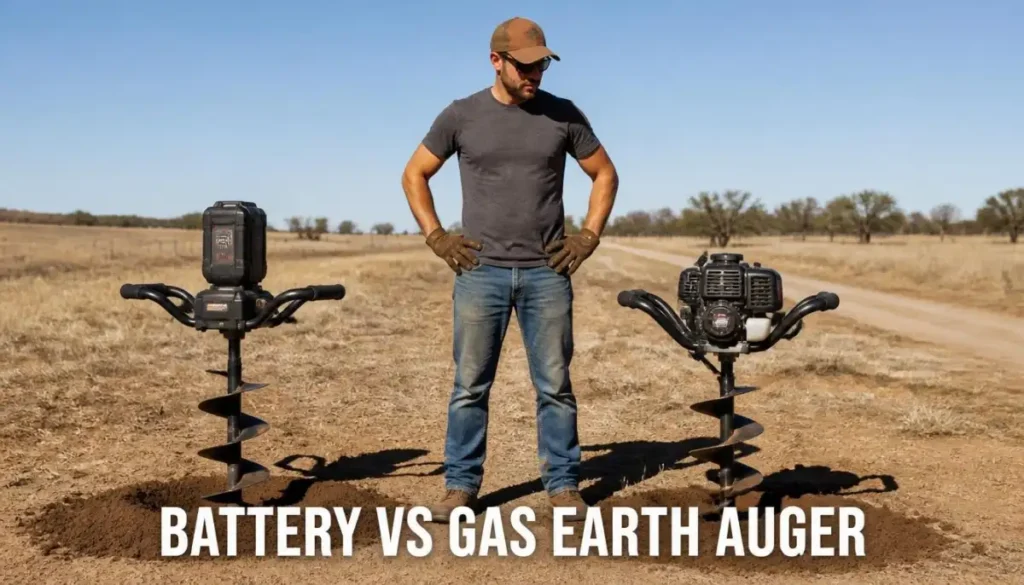
The battery vs gas earth auger choice comes down to the number of holes, the ground and the work you accept around the machine. A battery auger needs a charged pack; a gas auger needs fuel (mixed with oil on a 2-stroke), open air and ear protection. Neither makes hard ground easy. I count the holes before I pick a tool, because replacing an orchard tree is a different job from a long fence line. Below: the printed specs, handling, fuel and care, and the safety rules both share.
Battery vs Gas Earth Auger in Short
A battery auger suits a handful of planting holes and light posts near a place where you can charge packs, and it makes no exhaust at the tool. A gas auger suits longer jobs and places far from a charger, and it asks for fuel handling, upkeep, hearing protection and strictly outdoor use. Volts and engine cc are different measures, so neither shows which machine digs faster or lasts longer in clay, and I do not rank one as the stronger digger. My pick for most homeowners is battery, and I recommend gas only to someone who already mixes fuel for other tools. My guide on what an earth auger is covers the parts and the uses if the tool is new to you.
That gives a simple split for a homeowner or a small farm:
- Logistics decide the power source: battery when a charger is near, gas when the work is far from one.
- Capacity decides the machine: the job must sit inside the printed bit size and depth of your exact model.
- Beyond those limits the answer is a larger rental machine with its own manual, or a professional. If you own a tractor, my comparison with a tractor post hole digger shows when that larger machine fits a fence job.
One thing does not change between the two. Each type turns a steel bit that can bind and twist the machine in your hands, so the safety rules below apply to both.
What Each Power Source Is
Both types do the same job with the same idea: a power head turns a spiral bit through a gearbox, and you guide the machine and lift it to clear soil from the hole. The difference lies in what spins the gearbox and what you must look after. The power head, bit and torque are laid out in my explainer on how an earth auger works.
Battery Earth Auger
A battery earth auger has a brushless motor and a rechargeable pack. According to Ryobi’s RY40701 manual, its 40 V brushless auger has three modes: forward high, forward low and reverse. A battery powered earth auger changes direction only with the trigger released, and EGO’s EG0800E manual (Australia and New Zealand edition) says the same. The pack is the part you plan around, so I think of the charger socket and the spare pack as part of the tool.
Gas Powered Earth Auger
A gas powered earth auger has a 2-stroke or a 4-stroke engine. A 2-stroke runs on fuel mixed with 2-cycle oil: Champion’s 200940 manual for a 52 cc auger calls for 50:1 gasoline to oil. A 4-stroke runs on plain gasoline and keeps oil in its own sump; Champion’s 201092 manual for a 53.5 cc 4-stroke lists 0.3 US qt of oil. I compare fuel, oil and weight for two-stroke and four-stroke earth augers on a separate page.
Electric vs Gas Auger and the Word Electric
A battery earth auger is an electric auger that runs on a rechargeable pack. A corded electric auger plugs into the wall and is a third class that I leave out here, though corded and cordless earth augers get their own comparison. Ice augers drill ice and are a different tool, so this page compares battery and gas earth augers that drill soil.
What the Makers Print
Makers print different figures for each type, and many of them cannot be compared head to head. Engines are rated in cc, battery tools in volts, and torque appears in foot-pounds or newton-meters, or not at all. The table below puts two manuals side by side only where both print the same kind of fact.
| Item | Gas: Champion 200940, 52 cc 2-stroke | Battery: Ryobi RY40701, 40 V brushless |
|---|---|---|
| Power | 52 cc 2-stroke engine, 50:1 fuel mix | 40 V DC brushless motor |
| Bit size | 8 in (20.3 cm) bit | 8 in (200 mm) bit and hole |
| Bystander distance | At least 50 ft (15 m) | At least 50 feet |
| Eye protection | Side shields marked ANSI Z87.1 | Side shields marked ANSI Z87.1 |
| Hearing protection | Sound protection for long-term engine sound | Hearing protection with eye protection |
| At the tool | Exhaust contains carbon monoxide | No engine exhaust |
Weight needs its own warning. Makers print weight on different bases: EGO lists 15.5 kg for its EG0800E (Australia and New Zealand edition) without the battery, and Powermate’s PEA438.1 manual lists a 22 lb power head and a 13 lb 8 in bit as separate items. A figure with one basis does not compare with a figure on another, so I check what each number includes before I set two machines side by side. My look at one-person or two-person augers shows what makers print about the number of operators.
Power, Bit Size and Hard Ground
Bit size and printed depth show what a machine is built to drill, not what it does in your soil. The maker’s figures are ceilings, and every manual I rely on warns about the ground that stops the bit. My comparison of 8 or 10 inch bits shows what each hole size suits.
Bit Diameter and Depth Are Ceilings
Ryobi’s RY40701 manual prints a maximum hole depth of 31 in (800 mm) in its specification list. Its own text then says the recommended maximum depth of hole for that tool is approximately 24 in (600 mm), and it lists digging of light duty fencing and posts as an application. I read the lower figure as the planning number. EGO’s EG0800E manual lists an 800 mm maximum depth with a 200 mm bit. Champion’s 200940 manual gives the 8 in bit size, and the depth you can drill depends on the bit and any extension the maker supports.
Post depth is a separate question from machine depth. Penn State Extension, writing about horse fencing, gives about 36 in for a typical line post and often 48 in for corner and gate posts, deeper in sandy or wet soil. If the posts need a hole deeper than your machine’s printed maximum, the machine is the wrong tool for that job. For a fence line, my roundup of the top augers for fence posts shows which models suit the job.
Ground That Stops Either Type
Roots, rock, frozen ground and hidden metal stop a bit whatever drives it. Echo’s EA-400/EA-500 manual (2005 edition) says the auger may twist suddenly and forcefully if it meets large rocks, roots or hidden obstacles, and tells the operator not to drill in excessively rocky ground. EGO’s EG0800E manual tells the operator to avoid digging in material that may hold hidden nails, and to find another spot if an obstruction stops the machine. Do not dig in frozen or rock-hard ground or in ground full of roots and stones: the bit can bind and the machine can twist or kick.
Near my hedgerow and the old trees the roots run close to the surface, so I choose the spot for a hole before I choose the tool. A hole planned beside a root is a job for hand tools or for moving the hole, whichever power source you own. I sort the hand-tool side in my earth auger vs manual digger guide.
Weight, Handling and Torque Reaction
Torque reaction is the machine twisting back against you when the bit bites or binds. It is the main hazard of an earth auger, and it affects both types. A laboratory study of simulated torque reactions from hand-held power tools found that the wrist muscles worked hard even when the peak torque was a small share of a person’s maximum strength (1). That study used tool profiles in a lab, not augers, but it supports the plain point: hold the handles with both hands and keep a braced, balanced stance.
The two types also differ in how they are protected. Ryobi’s RY40701 and EGO’s EG0800E build an electronic stop into the tool, and a light shows when it acts. After any stop, complete the full shutdown in the shutdown box below and inspect for damage before you restart, in your manual’s order. Powermate’s PEA438.1 manual warns that a kick back can propel the unit and the operator in any direction, and Echo warns that the auger may twist suddenly. Read the manual for your exact model and never assume it has a stop or a clutch.
Before you lift, load, carry or move the auger, complete the full shutdown in the shutdown box below.
Shutdown Box
Shutdown before you clear or free the bit, change or attach the bit, free a stuck bit, adjust, check or add oil or fuel, clean, load, move, store or leave the auger. Never reach toward the bit while it turns, and never clear it or free it with the machine running. Battery auger: release the switch or trigger, wait until the bit has stopped completely, then remove the battery, and the switch key where your model has one, and keep it away from the auger. Gas auger: release the throttle, trigger or control, turn the engine off, wait until the bit and every moving part have stopped completely, then disconnect the spark plug wire (a spark plug cap on some makes) and secure it away from the plug. Let the engine and muffler cool before you touch the bit or anything near the exhaust. Only then free a stuck bit or clear wrapped material, using only the method your manual specifies (gloves do not make grabbing sharp wire or cutting edges safe), and check the bit and guards for damage. Do not handle unidentified wire, cables or pipes. Do not use reverse or run the engine or motor to back the bit out unless your manual expressly authorizes it for this task, with both hands on the designated handles and everyone clear of the bit; complete the full shutdown again before any further hands-on work. Add every step your manual gives, in its order, and refit every guard and shield before you restart.
The bit does not stop the moment you let go. Champion’s 200940 manual warns that the bit keeps turning after the control is released, so wait until the bit and every moving part have stopped completely, as the box says.
If the bit binds, keep firm, balanced footing and hold the designated handles with both hands. Keep hands and feet away from the bit, and never grasp or brace the bit or shaft. Release the throttle or trigger immediately if the bit binds or control is threatened, then complete the full shutdown in the shutdown box and inspect for damage before restarting. Use reverse only where your manual authorizes it for your model.
If the bit sticks in the hole or material wraps around it, do not force it and do not reach for the bit. Stop and complete the full shutdown in the shutdown box before touching or inspecting it. Use only the freeing or clearing method specified in your exact manual; gloves do not make grabbing sharp wire or cutting edges safe. Do not handle unidentified wire, cables or pipes. Powered reverse is permitted only when your manual expressly authorizes it for that task, with both hands on the designated handles and everyone clear of the bit. Complete the full shutdown again before any subsequent hands-on work. If your manual gives no procedure, obtain manufacturer or qualified service guidance.
Fuel, Charging and Upkeep
This is where the two types differ most in daily life. A gas auger asks you to look after fuel, an engine and a muffler. A battery auger asks you to look after a pack and a charger. Before you refuel, change a battery or do any hands-on work, complete the full shutdown in the shutdown box above.
What a Gas Auger Asks For
Fuel comes first. Champion’s 200940 manual for its 2-stroke calls for fresh unleaded gasoline with an ethanol content of 10% or less, forbids E15 and E85, and mixes it at 50:1 with premium 2-cycle oil. It tells you to fill the tank only to 80% of capacity, and warns against mixing fuel in the unit’s tank. Powermate’s PEA438.1 and Echo’s EA-400/EA-500 manuals tell the operator to move at least 3 m (10 ft) from the refuelling spot before starting the engine. Refuel outdoors on the ground, not in a truck or trailer, with the engine cooled, and mix fuel and oil only as your manual says.
Upkeep follows the engine: the spark plug, the air filter and the fuel system all sit in Champion’s 200940 maintenance section. For storage, complete the full shutdown in the shutdown box above first. The same manual then says to keep the engine switch and fuel valve off, to keep the unit away from heat, open flame, spark or pilot light because gasoline vapor can ignite even from an empty tank, and to follow its fuel stabilizer advice. I label every fuel can in my tool shed with its mix, because a can that nobody can identify is a fuel I will not use.
What a Battery Auger Asks For
A battery earth auger needs a charged pack and a dry place for it. Use only manufacturer-approved batteries and chargers for the exact model. Keep the switch off and fingers off the trigger when installing a battery, and follow the battery and charger manuals for moisture exposure, charging temperature, cooling and storage.
Before you clean or store the tool, complete the full shutdown in the shutdown box above. Ryobi’s RY40701 manual then lists simple care: clean the bit with a damp cloth, brush dust from the motor air vents, keep the locking pin in the auger when not in use, and let the tool cool before storing it. It also says not to expose the tool to rain or wet conditions. Cold affects packs: EGO’s EG0800E manual tells the user to bring the auger indoors to warm it when it shows a cold warning, and Makita’s DG001G manual says a tool run until the pack is depleted needs 15 minutes of rest before a fresh pack goes in.
Starting Temperatures and Seasons
Gas engines have a stated starting range too: Champion’s 201092 manual lists 5 to 104 degrees Fahrenheit. In late winter the ground may still be frozen on my land, and that is when I put tools away and wait for the thaw, whichever power source I own.
Noise, Exhaust and Vibration
A gas engine produces carbon monoxide, and a battery motor does not. Champion’s 200940 manual says the exhaust is a poison you cannot see or smell, that using the engine indoors can kill you in minutes, and that the auger must never run inside any building, including garages, basements and sheds. Never start or run a gas auger indoors or in a garage or shed, even with the doors open. Start and run it outdoors: the exhaust contains deadly carbon monoxide, which has no color, taste or smell.
Research backs the caution. A case series of fatal poisonings from small fuel-burning engines found that they emit lethal carbon monoxide in poorly ventilated spaces (2). A Wisconsin surveillance study counted gasoline-powered tools among the recognized sources of workplace carbon monoxide poisoning (3). Neither study looked at augers, so I use them for the plain point that a small gas engine and a closed room do not mix.
Hearing Protection
Champion’s 200940 manual tells operators to wear sound protection against the hearing loss that comes with long-term engine sound, and Ryobi’s RY40701 manual asks for eye protection along with hearing protection. A review of agricultural and forestry workers found that those exposed to both hand-arm vibration and noise had more hearing loss than non-exposed workers (4). Most of that work was chainsaw work, so it does not measure an auger, but it is a good reason to wear hearing protection on any loud, vibrating tool.
Vibration
Ryobi’s RY40701 manual carries a warning about Raynaud’s syndrome and Champion’s about white finger, so both types carry a vibration warning. A review of the powered hand tools railway maintenance workers use found that vibration data was limited or missing for many tools sold in North America (5). Look for a printed vibration value in your manual, and if there is none, take breaks and stop when your hands feel numb.
| Item | Battery earth auger | Gas earth auger |
|---|---|---|
| Power supply | Charged pack and approved charger | 2-stroke: fuel mixed with oil in a separate approved container. 4-stroke: plain gasoline, with oil in the sump |
| Where you run it | Outdoors, dry | Outdoors only, never in a garage or shed |
| Upkeep | After the full shutdown: clean the bit, clear motor air vents, keep the pin in the auger | After the full shutdown: spark plug, air filter, fuel system |
| Storage | Full shutdown first, then keep the tool dry and let it cool | Full shutdown first, then switch and fuel valve off and away from heat and flame |
| Hearing protection | Per your manual | Per your manual, tied to engine sound |
Safety Before You Dig With Either Type
These rules apply to both power sources, and a manual for your exact model comes first. Wear safety glasses with side shields or goggles meeting your manual’s specification, including ANSI Z87.1 where required, and add a face shield where required. Wear hearing protection with gas engines and wherever your manual requires it. Wear long pants and sturdy, closed footwear with secure traction, plus any additional protection your manual specifies.
Tie back long hair, remove jewelry and secure drawstrings; do not wear loose clothing or loose gloves. Use the gloves specified for the task and keep hair, clothing, gloves, hands and feet away from moving parts.
Call 811 First
Contact 811 before digging and include every planned hole in the locate request. Wait the required state notice period and confirm responses from every notified utility, including markings or a clear/no-conflict response for the work area.
Resolve missing or conflicting responses before digging. Follow state ticket-validity and tolerance-zone rules, preserve markings, and keep augers outside the required clearance area. Near marks, use careful hand digging or another locating method permitted by state rules and the utility; obey any stricter auger-manual prohibition. Arrange separate locating for private services that 811 does not cover (irrigation lines, cables). Do not dig where a service’s location remains uncertain.
Ryobi’s RY40701 manual says never to use the auger near any buried electrical power cables or buried gas lines, including water lines and pipes, and it warns against operating in an area with underground electric, gas, water or telephone lines. EGO’s EG0800E manual (Australia and New Zealand edition) says the same and adds that you should hold the machine by insulated gripping surfaces when the bit may contact hidden wiring. According to PHMSA, every state has a one-call center and the call is free, but notice periods are set by state law, so check yours.
Damage to buried utilities is a recognized safety risk, and a trial with utility workers found that careful training cut utility strikes (6). On my land I built the drip irrigation, so I know lines run through the ground, and I mark and avoid them before any hole.
Bystanders and Footing
Keep children, pets and other people out of the work area and at least the distance specified in your exact manual. Champion’s 200940 and Ryobi’s RY40701 manuals print 50 ft, and the 2005 edition of Echo’s EA-400/EA-500 manual prints 3 m (10 ft), so the distance depends on the exact model. Stop if anyone enters that area. No distance makes a work area safe on its own: keep watching it. On a slope or uneven ground, slow down, keep firm footing and follow only the slope or footing rule in your own manual. If your manual gives no such instruction, obtain guidance from the manufacturer before using the auger on a slope.
Pro Tip
Digging with an auger is heavy, jarring work that twists your arms and back. Take breaks, stop when you are tired or your attention slips, and use the gloves your manual recommends.
Which Type Fits Your Jobs
The right type follows the jobs you have. I sort my own jobs into three kinds and match each to a tool. For tree holes in particular, my picks for the top augers for planting trees cover both battery and gas models.
Choose Battery If
- You dig a few holes: I recommend battery for replacement trees, stakes and light posts, as long as the maker’s printed depth and bit size cover them. For one or two holes, my comparison of an auger or a shovel shows which digs better in a yard project.
- You want no fuel in the shed: with no fuel to store through the winter, the shed holds only a charger and packs.
- You can keep a spare pack charged: a second pack and a dry socket near the work let you swap and carry on.
Choose Gas If
- You work far from a charger: a gas auger runs on fuel you carry, and you refuel it only after the full shutdown, outdoors and on the ground. My roundup of the top gas earth augers covers the fuel-powered side of that choice.
- You will keep up the engine: fuel handling, a clean air filter and a good spark plug are part of the deal.
- You will wear hearing protection: it is part of the kit from the first minute.
When to Hire a Bigger Machine
A job past the printed bit size or depth of your exact model, or in hard clay or rock, is beyond that machine. For that work, rent a larger machine that comes with its own manual, or hire a professional. This is separate from the buried-line rule: if you cannot locate and mark a service, no auger is an option until 811 and every utility have answered.
What to Remember Before You Buy
Pick a battery auger when the holes are few and a charger is close, and a gas auger when no charger is near and you will keep up the engine. Check the printed bit size and depth against your posts, and treat every figure as a ceiling. Before you hand-clear, refuel, charge or store, complete the full shutdown in the shutdown box above. My own habit is to write the number of holes on a scrap of paper before I buy anything, since a short list points to battery, a longer list points to more packs or a fuel can, and a list that goes past the machine’s printed limits points to a rental or a professional. That small count makes the battery vs gas earth auger decision plain. If a handheld machine fits your job, I compare gas, corded and battery models in my roundup of the top earth auger picks.
Frequently Asked Questions
Are electric augers better than gas?
Electric augers are not better in every way, because the better type depends on the job, the ground and how you will fuel, charge and store the tool. A battery model makes no exhaust and needs no fuel mix, while a gas model runs on fuel you carry and asks for more upkeep. Neither type is proven to dig faster in clay, so match the choice to your hole count and your manual’s limits.
Is a gas powered earth auger more powerful than a battery powered earth auger?
A gas powered earth auger is not shown to be more powerful by the figures makers print, because engines are rated in cc and battery tools in volts, and torque appears in different units. Compare the printed bit size, maximum depth and operating limits in your own manual instead. Treat each depth as a ceiling and not as what the machine does in hard ground.
Can you use a gas powered earth auger in a shed or garage?
You cannot use a gas powered earth auger in a shed or garage, even with the doors open. The exhaust contains deadly carbon monoxide, which has no color, taste or smell, and Champion’s manual says using an engine indoors can kill you in minutes. Start and run it outdoors.
Does a battery earth auger need less maintenance than a gas powered earth auger?
A battery earth auger has fewer upkeep items than a gas engine, because it has no fuel, spark plug or air filter to service. It still needs a clean bit, clear motor air vents and a pack kept charged and stored as the maker describes. Before any service, complete the full shutdown for your auger in the shutdown box above.
Is a battery earth auger easier to store than a gas powered earth auger?
A battery earth auger is easier to store in one way, because there is no fuel to keep, and Ryobi’s RY40701 manual says to let the tool cool and to remove the bit from the drive shaft once the shutdown is complete. A gas auger needs its engine switch and fuel valve off and must stay away from heat, open flame and spark, since vapor can ignite even from an empty tank. Before you store either type, complete the full shutdown for your auger in the shutdown box above.
References
- Armstrong T, Bir C, Foulke J, Martin B, Finsen L, Sjogaard G. Muscle responses to simulated torque reactions of hand-held power tools. Ergonomics. 1999;42(1):146-159.
- Hyson BE, Friedman BM, Spear B, Bishop-Freeman SC. Lethal carbon monoxide generated from small internal combustion engines. J Anal Toxicol. 2024;48(8):625-629.
- Andreychak EM, Tomasallo CD, Idowu D, Gummin DD, Meiman JG. Occupational carbon monoxide poisoning in Wisconsin: results from a statewide electronic disease surveillance system and from the Wisconsin Poison Center, 2018-2021. Public Health Rep. 2024;139(4):443-450.
- Thaper R, Sesek R, Garnett R, Acosta-Sojo Y, Purdy GT. The combined impact of hand-arm vibration and noise exposure on hearing sensitivity of agricultural/forestry workers: a systematic literature review. Int J Environ Res Public Health. 2023;20(5):4276.
- Johanning E, Stillo M, Landsbergis P. Powered-hand tools and vibration-related disorders in US-railway maintenance-of-way workers. Ind Health. 2020;58(6):539-553.
- Gallagher AG, Hart M, Cleary D, et al. Proficiency based progression simulation training significantly reduces utility strikes: a prospective, randomized and blinded study. PLoS One. 2020;15(5):e0231979.
Safety Note: Only an adult who has read the manual and understands the controls should use an earth auger or post hole digger, never a child or anyone tired or impaired. Use the number of people your manual specifies, and keep everyone else out of the work area. The rotating bit can catch hair, clothing and gloves, and it can bind on a root, a rock or a buried object: the machine can then twist or kick in your hands. Stand with firm, balanced footing and hold the designated handles with both hands. Keep hands and feet away from the bit; never grasp or brace the bit or shaft. Never wrap the power cord around your hand, arm or body. If utility contact or a gas leak is suspected, stop work immediately. Do not touch, inspect, free or move the auger or exposed service, and do not attempt the normal hands-on shutdown or disconnect electrical connections in the suspected leak area. Leave the area, keep others away and contact the utility from a safe location; call 911 for a suspected gas leak or immediate danger. Otherwise, release the throttle or trigger immediately if the bit binds or control is threatened, then follow the shutdown procedure. On a two-person unit, both operators must understand the controls and agree on start and stop signals before starting; stop whenever either operator calls stop. Use reverse only where your manual expressly authorizes it. Never touch or clear the bit while it turns. Before you clear or free the bit, change or attach the bit, adjust, check or add oil or fuel, clean, load, move, store or leave the auger, complete the shutdown for its power type. Corded electric: release the switch or trigger, wait until the bit has stopped completely, then unplug it from the outlet by the plug, not the cord; before transport or storage, also let the motor cool. Battery: release the switch or trigger, wait until the bit has stopped completely, then remove the battery, and the switch key where the model has one. Gas: release the throttle, trigger or control, turn the engine off, wait until the bit and every moving part have stopped completely, then disconnect the spark plug wire and secure it away from the plug, and let the engine and muffler cool before touching the bit, engine, muffler or anything near the exhaust. For a drill-driven bit or any attachment system, follow the shutdown instructions in both the bit or attachment manual and the power-head or drill manual. If the bit sticks or material wraps around it, stop and complete the full shutdown before touching or inspecting it. Use only the freeing or clearing method specified in the exact manual; gloves do not make grabbing sharp wire or cutting edges safe. Do not handle unidentified wire, cables or pipes. Powered reverse is permitted only when the exact manual expressly authorizes it for that task, with both hands on the designated handles and everyone clear of the bit. Complete the full shutdown again before any subsequent hands-on work. Wear safety glasses with side shields or goggles meeting the manual’s specification, including ANSI Z87.1 where required; add a face shield where required. Wear hearing protection with gas engines and wherever the manual requires it. Wear long pants and sturdy, closed footwear with secure traction, plus any additional footwear protection the manual specifies. Tie back long hair, remove jewelry and secure drawstrings; do not wear loose clothing or loose gloves. Use the gloves specified for the task and keep them, clothing, hair, hands and feet away from moving parts. Contact 811 before digging and include every planned hole in the locate request. Wait the required state notice period and confirm that every notified utility has responded with markings or a clear/no-conflict response for the work area. Resolve missing or conflicting responses before digging. Preserve the marks and follow your state’s ticket-validity and tolerance-zone rules. Keep the auger out of the required clearance area; near marks, use careful hand digging or another locating method permitted by state rules and the utility. Follow any stricter prohibition in the auger’s manual. Marks do not show a safe drilling depth. Arrange to locate private irrigation lines, cables and other services that 811 may not cover. If a line’s location remains uncertain, do not dig there. Do not handle or move unidentified cables, pipes or utility lines. Before you start, remove rocks, sticks, wire and loose hoses, and identify irrigation lines, drip lines and sprinkler heads. Keep children, pets and other people out of the work area and at least the distance your exact manual specifies. Stop if anyone enters that area. If your manual gives no number, keep everyone well clear of the work area as it directs. No single distance is safe for every auger. On a slope or uneven ground, slow down, keep firm footing and follow only your manual’s rule. Do not dig in frozen or rock-hard ground. Before refuelling, complete the full gas shutdown described above. Refuel outdoors on the ground, not in a truck or trailer, with the engine cooled. Keep fuel away from smoking, flames, sparks and other ignition sources. Use an approved fuel container, avoid overfilling, secure the cap and follow the manual’s spill-cleanup and restart-location instructions; do not start with a fuel leak. Use the specified fuel and oil arrangement for that engine. Never start or run a gas auger indoors, in a garage or shed, or in an enclosed or poorly ventilated area, even with doors open. Operate outdoors where exhaust cannot accumulate or enter occupied spaces through doors, windows or air intakes. Exhaust contains deadly carbon monoxide. For a corded auger, inspect the cord and extension cord before use and do not use damaged cords or plugs. Use an outdoor extension cord meeting the exact manual’s gauge, length, plug and grounding requirements, and follow its GFCI instructions. Keep connections dry and the cord clear of the bit, heat, oil and sharp edges. Never carry the auger by its cord or wrap the cord around your body. Do not use it in rain or wet conditions prohibited by the manual. Use only manufacturer-approved batteries and chargers for the exact model. Complete the battery shutdown before removing or changing a battery, and keep the switch off and fingers off the trigger when installing one. Do not use damaged or modified batteries or chargers. Keep loose battery terminals away from metal objects, and follow the battery and charger manuals for moisture exposure, charging temperature, cooling and storage. Load and unload only as your manual describes, and store the auger dry and out of children’s reach. Take breaks and stop when you are tired.