
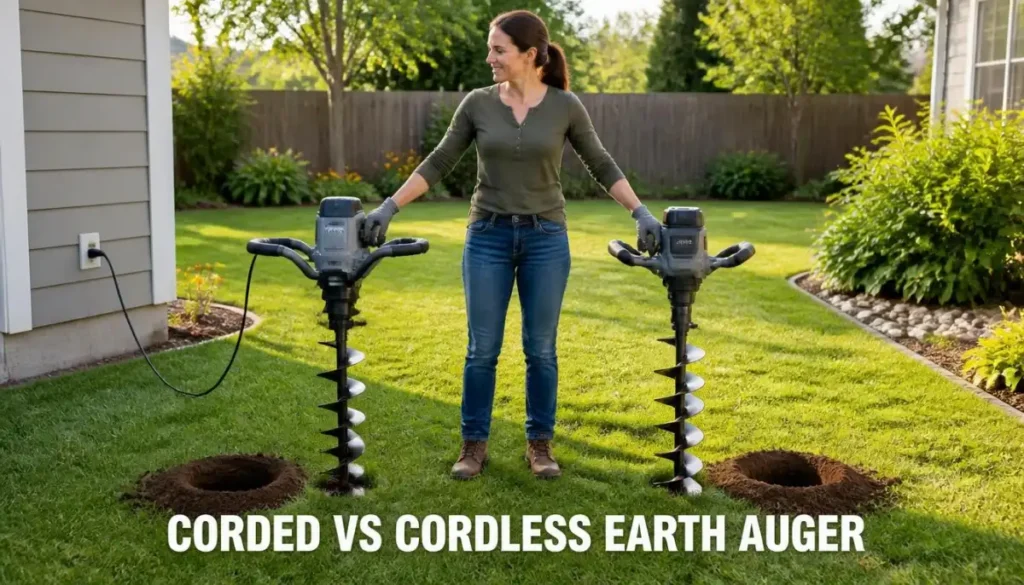
The corded vs cordless earth auger choice comes down to one thing: how far your holes are from an outlet. A corded unit plugs in and runs on mains power, a cordless unit runs on a battery pack, and the rest of the machine does the same job either way. On my farm every digging job starts with where the power will come from: the shed outlet, a charged pack or a fuel can. Below I cover reach, power, shock risk on wet ground, weight and care, then match each type to a job.
The Short Answer on Corded vs Cordless Earth Auger
Pick the corded type when an outlet sits close to every hole and you want a machine with no battery pack to run down. Choose the cordless type when the holes are spread across the property or far from power, because a charged pack goes where a cord cannot. Both types turn the same kind of bit, bind on the same roots and stones, and need the same full shutdown before you touch the bit. My page on what an earth auger is covers the parts, types and uses for property owners.
I plan the choice around three facts: the distance from the outlet to the farthest hole, the number of holes in one session and the state of the ground. Wet ground tilts the decision, since a mains cord lying in damp soil adds a shock path that a battery pack does not. The table below sums up what changes between the two.
| Factor | Corded | Cordless |
|---|---|---|
| Power source | Mains outlet through a cord | Rechargeable battery pack on the machine |
| Where it can work | Inside the reach of the cord and any extension cord | Anywhere you can carry a charged pack |
| What limits a session | The outlet circuit, the cord and the unit’s own limits | The charge left in the pack |
| Extra shock path | A mains cord lying on the ground | No cord on the ground; the charger stays at an outlet |
| Extra burden | A cord that drags and snags | A battery pack added to the machine’s weight |
| Reverse | Check the unit’s own manual | Printed in the manuals for the Ryobi RY40701, EGO EG0800E and Makita DG001G |
Key Takeaway
Power type alone does not settle digging power. Compare each machine through its own manual, and choose the power type by reach, session length and ground conditions.
How Each Type Gets Its Power
Both types of electric earth auger use an electric motor that turns a gearbox, and the gearbox turns the bit. What differs is what feeds the motor: a cord to an outlet or a battery pack on the machine. The two motor types behind these augers are set side by side in my comparison of brushless and brushed electric augers.
A Cordless Earth Auger Runs on a Battery Pack
A cordless earth auger is a power head with a battery port, handles and a gearbox, plus a bit that slides onto the output shaft and locks with a pin. According to Ryobi, its RY40701 40 V brushless hole auger runs at up to 210 RPM and has forward-high, forward-low and reverse modes. The Australian and New Zealand edition of the manual for the EGO EG0800E, a 56 V auger, prints two forward speeds and a reverse speed. Makita lists a reverse switch on its DG001G cordless earth auger.
The pack sets how long a session runs, and the charger needs an outlet in the shed or the garage. Use only the batteries and chargers the maker lists for that exact model.
A Corded Earth Auger Runs From an Outlet
A corded earth auger has the same motor, gearbox and bit, fed through a power cord and a switch. Bit sizes, depth and reverse differ by maker, so I read the exact manual of any corded model before I trust a figure on a listing. The manual for XtremepowerUS item 85060, a 1500W corded unit that I cover in my review of the XtremepowerUS digger, prints no reverse mode.
The cord is the main difference. It sets your reach, it drags behind you and it carries mains power into a job on bare soil. The next sections take each of those in turn.
Where Gas Engines and Drill-Driven Bits Fit
A gas earth auger is a separate class with its own engine rules, and my comparison of battery and gas augers covers it. A bit that fits a drill is not an earth auger machine. It needs a drill or power head with its own manual, so follow both manuals.
Reach, Cord Length and Setup
Reach decides more purchases than any other factor. A corded auger works inside the area its cord can cover, and a cordless one works wherever you can carry a charged pack.
Measure the Route From the Outlet
Measure the walking route from the outlet to the farthest hole, not the straight line. As an example, a 40 ft straight run plus a 15 ft detour around a bed makes a 55 ft route, and you need slack beyond that to move from hole to hole. Add the route up first, then read your manual for the cord gauge and length it allows.
On my farm the outlets I count on sit at the sheds and the house, so a corded unit would cover the ground near them and stop well short of the far end of the property. A cordless unit would go to the far end, and only the charger would stay at the shed.
What the Cord Asks of You
The EGO EG0800E manual (Australian and New Zealand edition) lists general rules for electric tools: use an extension cord suitable for outdoor use when you work outdoors, never carry, pull or unplug the machine by its cord, and keep the cord away from heat, oil, sharp edges and moving parts. The XtremepowerUS manual for item 85060 says the same about outdoor cords and adds that the cord must be heavy enough to carry the current, because an undersized cord causes a drop in line voltage, a loss of power and overheating. A corded earth auger runs with that cord lying on the ground beside a spinning bit.
Power, Runtime and Holes per Job
Power and runtime claims need careful reading, so here is what each printed figure means.
Read Torque and Speed Inside One Maker’s Range
Makers print torque in different units, newton metres or foot-pounds, and some print none at all. Bit speed is a maker figure too: Ryobi prints up to 210 RPM for the RY40701, and the EGO EG0800E manual (AU/NZ edition) prints 0 to 150 and 0 to 210 per minute for its two forward speeds. A bigger number from one brand does not rank it above another brand, so I compare figures only inside one maker’s own range and on the same basis.
Runtime Is a Battery Question
A cordless auger runs until the pack is flat. According to EGO, its US EG0803 kit with a 4.0 Ah battery bores up to 50 holes on a single charge. The claim names no soil and no hole size, so it cannot tell you the count for your ground.
A flat pack ends the session, and Makita’s DG001G manual adds a rest period before a fresh pack goes in, which the battery care section below covers. A plug-in unit has no pack to run flat, which suits a long row of holes close to power. It still depends on the outlet circuit and the cord feeding it, and your manual sets those limits. My comparison of WORX against the XtremepowerUS auger puts a two-battery cordless digger next to a plug-in unit.
Hard Ground Limits Both Types
Soil decides what a machine can do. Makita ties the capacity of its DG001G to the soil: a 200 mm hole in sandy soil but only 150 mm in clay, on low speed. Neither power type makes hard ground easy. Treat every printed depth as a maximum that clay, roots or rock can cut short, and I do the same for my own ground.
Soil Warning
Do not dig in frozen or rock-hard ground or in ground full of roots and stones: the bit can bind and the machine can twist or kick.
Shock, Wet Ground and Buried Lines
A cord brings mains power to a job done on bare soil, so this is where the two types differ most in risk. Both types share the hazard of a buried line, and both start every hands-on job with the same shutdown.
The Full Shutdown for Corded and Battery Augers
The shutdown below comes before any hands-on step in this article, from clearing the bit to storing the machine. Where your manual adds steps, follow them in the manual’s order.
Full Shutdown
Shutdown before you clear or free the bit, change or attach the bit, free a stuck bit, adjust, check or add oil or fuel, clean, load, move, store or leave the auger. Never reach toward the bit while it turns, and never clear it or free it with the machine running. Corded electric auger: release the switch or trigger, wait until the bit has stopped completely, then unplug the auger from the outlet by the plug, not the cord. Before transport or storage, also let the motor cool. Battery auger: release the switch or trigger, wait until the bit has stopped completely, then remove the battery, and the switch key where your model has one, and keep it away from the auger. For a drill-driven bit or any attachment system, follow the shutdown and isolation instructions in both the bit or attachment manual and the power-head or drill manual (a gas power head needs its own manual’s full shutdown). Only then free a stuck bit or clear wrapped material, using only the method your manual specifies (gloves do not make grabbing sharp wire or cutting edges safe), and check the bit and guards for damage. Do not handle unidentified wire, cables or pipes. Do not use reverse or run the engine or motor to back the bit out unless your manual expressly authorizes it for this task, with both hands on the designated handles and everyone clear of the bit; complete the full shutdown again before any further hands-on work. Add every step your manual gives, in its order, and refit every guard and shield before you restart.
Cord Hazards and Wet Ground
The EGO EG0800E manual says not to expose its machines to rain or wet conditions, because water entering a machine raises the risk of electric shock, and the XtremepowerUS manual for item 85060 gives the same warning for power tools. EGO adds that where damp use is unavoidable the supply should be protected by a residual current device, which US homes call a GFCI. That protection does not make wet digging acceptable, so I wait for dry ground and keep the cord out of puddles.
Extension Cords
Use an outdoor extension cord that meets your exact manual’s requirements for gauge, length, plug type and grounding. Keep the cord away from the bit, never carry the auger by the cord, and never use it in the rain. Follow your exact manual’s instructions for cord routing, disconnecting the plug, keeping connections dry and GFCI protection.
Call 811 First, With Either Type
A bit that strikes a buried line can cause electric shock, fire, explosion or damage to services, whether the auger is corded or cordless. A training trial with utility workers recognised the damage of buried utility strikes as a safety risk and a cost, and careful locating practice cut strikes in that trial (1). The steps below apply before every hole.
Before You Dig
Contact 811 before digging and include every planned hole in the locate request. Wait the required state notice period and confirm responses from every notified utility, including markings or a clear/no-conflict response for the work area. Resolve missing or conflicting responses before digging. Follow state ticket-validity and tolerance-zone rules, preserve markings, and keep augers outside the required clearance area. Near marks, use careful hand digging or another locating method permitted by state rules and the utility; obey any stricter auger-manual prohibition. Arrange separate locating for private services that 811 does not cover (irrigation lines, cables). Do not dig where a service’s location remains uncertain, and do not switch to a larger machine to get around it. No augering depth above a buried service is safe. According to PHMSA, every state has a one-call notification center and requires a call before digging, and your state sets the notice period.
Before you start, walk the spot and remove rocks, sticks, wire, hose, stakes and anything else the bit could catch or throw. Identify irrigation lines, drip lines, cables and sprinkler heads before you start, and take loose garden hoses out of the work area. Do not handle or move unidentified cables, pipes or utility lines: keep the auger away from them and contact the utility if their location is uncertain.
Weight, Handling and Torque Reaction
Weight and twist decide how tired you are at hole ten. Both types behave alike on twist, and they differ on what you carry.
Weight Comes From Different Parts
A cordless unit carries its battery pack on the machine. The EG0800E manual (AU/NZ edition) lists 15.5 kg, about 34 pounds, without the battery, so the pack adds to that figure. A corded unit has no pack but drags a cord. The XtremepowerUS manual for item 85060 prints 12.8 kg, about 28 pounds, without stating whether the bit is included, so check what any weight includes before you compare it with another unit. For another corded unit, my PROYAMA electric digger review covers a 1700W machine with three bits.
Torque Reaction Is the Same Hazard
When the bit binds on a root, a rock or a buried object, the machine twists against your hands. Laboratory work on handheld power tools found that sudden torque pulses load the wrist and forearm muscles heavily, even when the pulses are short and the peak is a small share of a person’s strength (2). A study of 69 assembly workstations found that predicted handle reaction force was higher on jobs with reported upper limb injuries than on injury-free jobs (3). My explainer on how an earth auger works covers the power head, bit and torque in more detail.
A scoping review of 40 publications on handheld tightening tools reported repeated handle reaction loads, and three of the studies linked that exposure to physiological changes that point to a higher risk of musculoskeletal disorders (4). These studies measured assembly tools, not augers, so I use them only for the general point that a kicking handle loads the arms.
The EG0800E manual tells you to stay alert to the torque reaction force of the machine and to keep an operating position you can withstand it. Ryobi (RY40701) and EGO (EG0800E) describe an electronic protection on those cordless models: the tool stops and an LED shows. Check your own manual for what yours does and for the restart order. After any bind, complete the full shutdown in the shutdown box above and check for damage before you start again.
Binding and Torque Reaction
If the bit hits a root, a rock or a buried object, it can bind and the machine can twist or kick. Keep firm, balanced footing and hold the designated handles with both hands. Keep hands and feet away from the bit; never grasp or brace the bit or shaft. Never wrap the power cord around your hand, arm or body. Release the throttle or trigger immediately if the bit binds or control is threatened, then complete the full shutdown in the shutdown box and inspect for damage before restarting. Use reverse only where your manual authorizes it for your model.
Stuck Bit
If the bit sticks in the hole or material wraps around it, do not force it and do not reach for the bit. Stop and complete the full shutdown in the shutdown box before touching or inspecting it. Use only the freeing or clearing method specified in your exact manual; gloves do not make grabbing sharp wire or cutting edges safe. Do not handle unidentified wire, cables or pipes. Powered reverse is permitted only when your manual expressly authorizes it for that task, with both hands on the designated handles and everyone clear of the bit. Complete the full shutdown again before any subsequent hands-on work. If your manual gives no procedure, obtain manufacturer or qualified service guidance.
Gear
Wear safety glasses with side shields or goggles meeting your manual’s specification, including ANSI Z87.1 where required, and add a face shield where required. Wear hearing protection with gas engines and wherever your manual requires it. Wear long pants and sturdy, closed footwear with secure traction, plus any additional protection your manual specifies. Tie back long hair, remove jewelry and secure drawstrings; do not wear loose clothing or loose gloves. Use the gloves specified for the task and keep hair, clothing, gloves, hands and feet away from moving parts.
Fatigue
Digging with an auger is heavy, jarring work that twists your arms and back. Take breaks, stop when you are tired or your attention slips, and use the gloves your manual recommends.
Lifting and Moving the Machine
Lift the unit by its handles, with the bit off the ground and the power source disconnected as the shutdown box describes. The weight in your manual, with its basis, tells you whether you need a second person for the lift.
Lifting and Transport
Before you lift, load, carry or move the auger, complete the full shutdown in the shutdown box. Load and unload only as your manual describes, never carry the auger by its cord, and refuel a gas unit on the ground, not in the truck bed. Follow the manual’s lifting and handling instructions.
Care, Charging and Storage
Care splits along the same line as risk: a cord asks for inspection, and a battery asks for the right charger and a sensible temperature. Before you do any of these jobs, complete the full shutdown for your auger in the shutdown box above.
Cord and Plug Care
Inspect the cord and plug for damage before every job and keep them away from the bit. The EGO EG0800E manual says damaged or entangled cords increase the risk of electric shock, and that a damaged machine should be repaired before use. If the cord or plug is damaged, have the machine serviced as your manual directs. Before I plug in any tool outdoors, I run my eyes along the whole cord first.
Battery and Charger Care
The EG0800E manual says to recharge only with the charger specified by the maker, and not to charge the pack or tool outside the temperature range in the instructions. It also shows a message that the auger is too cold and tells you to bring it indoors to warm up. Makita’s DG001G manual says that if the tool is run until the battery cartridge is depleted, it should rest for 15 minutes before you proceed with a fresh battery, and the full shutdown comes first when you change the pack. A battery powered earth auger therefore wants a charger shelf in the shed and a place for the packs inside the range your manual gives. My review of the WORX auger covers a cordless unit that needs two batteries to run.
Battery and Charger
Use only manufacturer-approved batteries and chargers for the exact model. Before changing a battery or doing hands-on work, complete the full shutdown in the shutdown box. Keep the switch off and fingers off the trigger when installing a battery. Do not use damaged or modified batteries or chargers. Protect loose battery terminals from contact with metal objects. Follow the battery and charger manuals for moisture exposure, charging temperature, cooling and storage.
Storage
Store the auger dry and out of children’s reach. Keep bits off the floor of the shed, and wipe the soil from the flights before they go back, with the power source disconnected as the shutdown box describes. The XtremepowerUS manual for item 85060 asks for a soft cloth dampened with mild soap and water, and no ammonia, chlorine or abrasives.
Which Power Type to Choose by Job
Match the power type to the job in front of you. I recommend deciding from the route, the number of holes and the weather, in that order.
Choose a Corded Unit If
- An outlet sits close to every hole: the route you measured is short enough for the cord your manual allows.
- You dig a run of holes in one place: a plug-in unit has no pack to run flat.
- You can keep the cord clear of the bit and the wet: the ground is dry and the cord stays outdoors-rated and undamaged.
Skip a corded unit if your holes are far from power or the ground is wet, because the cord becomes the main hazard.
Choose a Cordless Unit If
- The holes are spread out: a charged pack travels to the far end of the property.
- You want no cord on the ground: the mains shock path of a trailing cord is gone.
- You can plan breaks and packs: the charge sets the session, and the manual may call for a rest after a flat pack.
Skip a cordless unit if you expect one long session of digging with no way to recharge, because the pack, not the ground, will end your day.
When Neither Fits
Many holes, large bits, hard clay or rock call for a larger rental machine with its own manual or a professional. Where the position of a buried service is uncertain, the answer is no auger at all.
What to Remember Before You Buy
Three points carry the decision. Reach and the ground set the power type, and the power type alone does not settle digging power. The full shutdown comes before every hands-on step. In my roundup of earth augers for real digging, I compare gas, corded and battery models.
My tip is to walk the route from the outlet with a tape measure before you open a browser tab. Then read the exact manual of the model you are considering for cord rules, reverse and bit sizes. When that route is longer than the cord your manual allows, the corded vs cordless earth auger question is already answered for your yard. Once the power type is settled, my electric post hole digger picks cover corded and battery models for home digging.
Frequently Asked Questions
Which is better, a corded or a cordless earth auger?
A corded earth auger is better when an outlet sits close to every hole and the ground is dry, and a cordless one is better when the holes are far from power. The power type alone does not settle digging power, so choose by reach, session length and ground conditions.
Can you use an extension cord with a corded earth auger?
You can use an extension cord with a corded earth auger only if it is an outdoor cord that meets your exact manual’s requirements for gauge, length, plug type and grounding. XtremepowerUS says its item 85060 needs a cord heavy enough to carry the current, since an undersized cord loses power and overheats. Keep the cord away from the bit, never carry the auger by the cord and never use it in the rain.
Do cordless earth augers have reverse?
The Ryobi RY40701, EGO EG0800E and Makita DG001G manuals print a reverse mode or switch for those cordless earth augers. Ryobi says the trigger must be released to switch from forward to reverse, and EGO says direction can change only when the auger is stopped. Use reverse only where your own manual authorizes it for your model, and never as a general method for freeing a bit.
How do you shut down a corded earth auger safely?
To shut down a corded earth auger, release the switch or trigger, wait until the bit has stopped completely, then unplug the auger from the outlet by the plug, not the cord. Before transport or storage, also let the motor cool, and add any further steps your manual gives in its order.
What is a cordless earth auger?
A cordless earth auger is an earth auger whose motor runs on a rechargeable battery pack on the machine instead of a power cord. It turns the same kind of bit as a corded unit, and the pack sets how long a session runs.
References
- Gallagher AG, Hart M, Cleary D, et al. Proficiency based progression simulation training significantly reduces utility strikes: a prospective, randomized and blinded study. PLoS One. 2020;15(5):e0231979.
- Armstrong T, Bir C, Foulke J, Martin B, Finsen L, Sjogaard G. Muscle responses to simulated torque reactions of hand-held power tools. Ergonomics. 1999;42(1):146-159.
- Ku CH, Radwin RG, Karsh BT. Power hand tool kinetics associated with upper limb injuries in an automobile assembly plant. J Occup Environ Hyg. 2007;4(6):391-399.
- Mazaheri A, Rose LM. Reaction load exposure from handheld powered tightening tools: a scoping review. Int J Ind Ergon. 2021;81:103061.
Safety Note: Only an adult who has read the manual and understands the controls should use an earth auger or post hole digger, never a child or anyone tired or impaired. Use the number of people your manual specifies, and keep everyone else out of the work area. The rotating bit can catch hair, clothing and gloves, and it can bind on a root, a rock or a buried object: the machine can then twist or kick in your hands. Stand with firm, balanced footing and hold the designated handles with both hands. Keep hands and feet away from the bit; never grasp or brace the bit or shaft. Never wrap the power cord around your hand, arm or body. If utility contact or a gas leak is suspected, stop work immediately. Do not touch, inspect, free or move the auger or exposed service, and do not attempt the normal hands-on shutdown or disconnect electrical connections in the suspected leak area. Leave the area, keep others away and contact the utility from a safe location; call 911 for a suspected gas leak or immediate danger. Otherwise, release the throttle or trigger immediately if the bit binds or control is threatened, then follow the shutdown procedure. On a two-person unit, both operators must understand the controls and agree on start and stop signals before starting; stop whenever either operator calls stop. Use reverse only where your manual expressly authorizes it. Never touch or clear the bit while it turns. Before you clear or free the bit, change or attach the bit, adjust, check or add oil or fuel, clean, load, move, store or leave the auger, complete the shutdown for its power type. Corded electric: release the switch or trigger, wait until the bit has stopped completely, then unplug it from the outlet by the plug, not the cord; before transport or storage, also let the motor cool. Battery: release the switch or trigger, wait until the bit has stopped completely, then remove the battery, and the switch key where the model has one. Gas: release the throttle, trigger or control, turn the engine off, wait until the bit and every moving part have stopped completely, then disconnect the spark plug wire and secure it away from the plug, and let the engine and muffler cool before touching the bit, engine, muffler or anything near the exhaust. For a drill-driven bit or any attachment system, follow the shutdown instructions in both the bit or attachment manual and the power-head or drill manual. If the bit sticks or material wraps around it, stop and complete the full shutdown before touching or inspecting it. Use only the freeing or clearing method specified in the exact manual; gloves do not make grabbing sharp wire or cutting edges safe. Do not handle unidentified wire, cables or pipes. Powered reverse is permitted only when the exact manual expressly authorizes it for that task, with both hands on the designated handles and everyone clear of the bit. Complete the full shutdown again before any subsequent hands-on work. Wear safety glasses with side shields or goggles meeting the manual’s specification, including ANSI Z87.1 where required; add a face shield where required. Wear hearing protection with gas engines and wherever the manual requires it. Wear long pants and sturdy, closed footwear with secure traction, plus any additional footwear protection the manual specifies. Tie back long hair, remove jewelry and secure drawstrings; do not wear loose clothing or loose gloves. Use the gloves specified for the task and keep them, clothing, hair, hands and feet away from moving parts. Contact 811 before digging and include every planned hole in the locate request. Wait the required state notice period and confirm that every notified utility has responded with markings or a clear/no-conflict response for the work area. Resolve missing or conflicting responses before digging. Preserve the marks and follow your state’s ticket-validity and tolerance-zone rules. Keep the auger out of the required clearance area; near marks, use careful hand digging or another locating method permitted by state rules and the utility. Follow any stricter prohibition in the auger’s manual. Marks do not show a safe drilling depth. Arrange to locate private irrigation lines, cables and other services that 811 may not cover. If a line’s location remains uncertain, do not dig there. Do not handle or move unidentified cables, pipes or utility lines. Before you start, remove rocks, sticks, wire and loose hoses, and identify irrigation lines, drip lines and sprinkler heads. Keep children, pets and other people out of the work area and at least the distance your exact manual specifies. Stop if anyone enters that area. If your manual gives no number, keep everyone well clear of the work area as it directs. No single distance is safe for every auger. On a slope or uneven ground, slow down, keep firm footing and follow only your manual’s rule. Do not dig in frozen or rock-hard ground. Before refuelling, complete the full gas shutdown described above. Refuel outdoors on the ground, not in a truck or trailer, with the engine cooled. Keep fuel away from smoking, flames, sparks and other ignition sources. Use an approved fuel container, avoid overfilling, secure the cap and follow the manual’s spill-cleanup and restart-location instructions; do not start with a fuel leak. Use the specified fuel and oil arrangement for that engine. Never start or run a gas auger indoors, in a garage or shed, or in an enclosed or poorly ventilated area, even with doors open. Operate outdoors where exhaust cannot accumulate or enter occupied spaces through doors, windows or air intakes. Exhaust contains deadly carbon monoxide. For a corded auger, inspect the cord and extension cord before use and do not use damaged cords or plugs. Use an outdoor extension cord meeting the exact manual’s gauge, length, plug and grounding requirements, and follow its GFCI instructions. Keep connections dry and the cord clear of the bit, heat, oil and sharp edges. Never carry the auger by its cord or wrap the cord around your body. Do not use it in rain or wet conditions prohibited by the manual. Use only manufacturer-approved batteries and chargers for the exact model. Complete the battery shutdown before removing or changing a battery, and keep the switch off and fingers off the trigger when installing one. Do not use damaged or modified batteries or chargers. Keep loose battery terminals away from metal objects, and follow the battery and charger manuals for moisture exposure, charging temperature, cooling and storage. Load and unload only as your manual describes, and store the auger dry and out of children’s reach. Take breaks and stop when you are tired.