
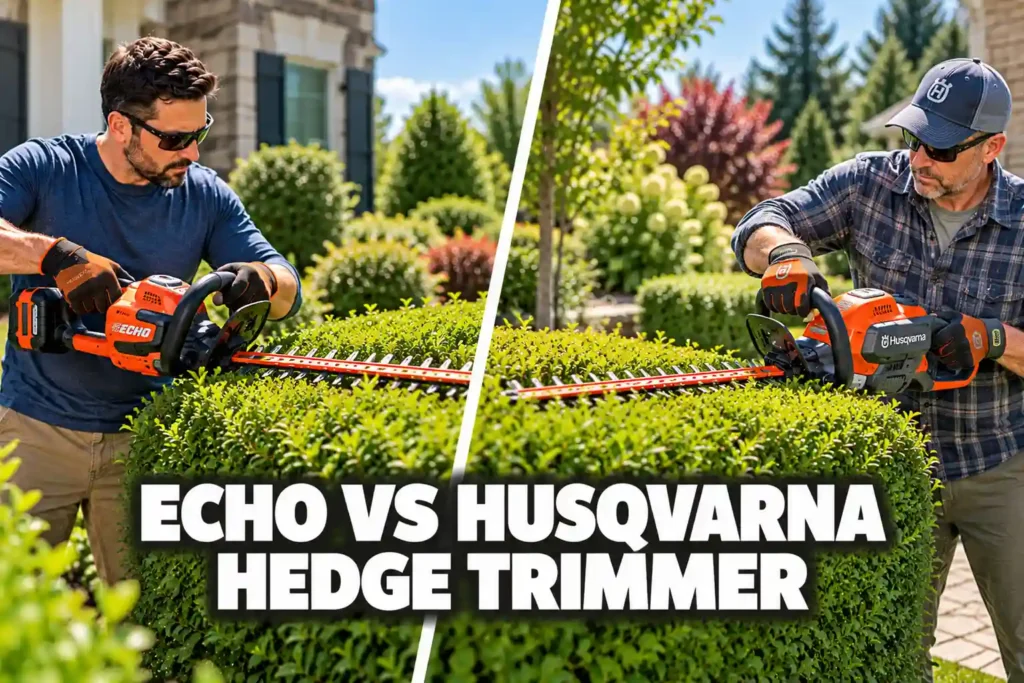
In the Echo vs Husqvarna hedge trimmer choice, the difference lies in what each maker prints: Echo’s gas model weighs the least and states a stem size, while Husqvarna offers adjustable handles, ear-level noise figures and a battery kit with a reverse button. Neither brand wins every count, so the right one depends on your stems, your hedge length and how long you hold the tool.
I read a trimmer’s numbers the way I read a calibration chart: the basis first, the number second. Below I compare the models Amazon sells, then capacity, weight, noise, fuel and upkeep, warranty and safety, and match each brand to a hedge job.
Echo vs Husqvarna Hedge Trimmer at a Glance
Pick Echo if the lightest gas handheld matters and you want a maker that prints a stem size. The Echo HC-2020 weighs 10 lb dry, and Echo’s manual gives 1 in for soft growth and 1/2 in for woody growth. Pick Husqvarna if you want an adjustable rear handle on a gas trimmer, a noise figure you can read before you buy, or a battery kit with a reverse function that clears packed material. For the battery kit on its own, my EGO against Husqvarna hedge trimmer comparison puts the 320iHD60 beside the EGO HT2601.
Nothing in either manual ranks one brand above the other, so I decide in a fixed order on my own land: stem size first, then how long I will hold the tool, then noise. A trimmer that fits the stems but tires your arms in ten minutes is the wrong trimmer.
Compare Lines, Not Equal Pairs
The comparison sets one Echo model, the gas HC-2020, against three Husqvarna models: the gas 122HD60 and 322HD60 and the 320iHD60 battery kit. The HC-2020 is a gas model, so the closest Husqvarna match is a gas model too, and the battery kit shows what the other power source offers.
What Each Brand Sells on Amazon
Each brand makes gas and battery hedge trimmers, so the cleanest comparison is the models you can actually buy today. The table gives each maker’s own figure and its basis, because a dry weight and a without-battery weight are different things.
| Item | Echo HC-2020 | Husqvarna 122HD60 | Husqvarna 322HD60 | Husqvarna 320iHD60 |
|---|---|---|---|---|
| Type | Gas, handheld, double-sided | Gas, handheld, double-sided | Gas, handheld, double-sided | Battery, handheld, double-sided |
| Power | 21.2 cc two-stroke | 21.7 cm3 two-stroke | 21.7 cm3 two-stroke | Husqvarna 36V system; the kit has a 4.0 Ah battery and charger |
| Blade length, as the maker calls it | 20 in | 23.2 in cutting length (590 mm) | 24 in cutting length (600 mm) | 24 in (609 mm) |
| Weight | 10 lb, dry | 10.8 lb, without fuel | 11.5 lb, without fuel | 8.42 lb, without battery |
| Cutting capacity, maker’s wording | Soft growth 1 in, woody growth 1/2 in | No stem figure; tooth gap 1.1 in | No stem figure; tooth gap 1.2 in | No stem figure in the manual; tooth gap 1 in |
| Rear handle | No rotating handle listed | 5 positions | 3 positions | Three rear handles for different angles |
Echo
The Echo hedge trimmer in this comparison is the HC-2020, a 21.2 cc gas model with a double-sided blade, a throttle handle and a support loop. Echo also makes battery models such as the DHC-2300, a 56V trimmer with a 22 in blade, and gas shaft models for taller work. My guide to single-sided against double-sided hedge trimmers shows what the blade layout changes in the cut.
Husqvarna
Husqvarna’s two gas models, the Husqvarna 122HD60 hedge trimmer and the 322HD60, share a 21.7 cm3 engine and differ in blade length and rear handle. The 320iHD60 is the battery kit: a brushless Husqvarna trimmer with a 24 in blade, a reverse button and a boost button. Husqvarna also sells a 522iHD60 battery trimmer, which I mention again under noise.
Stihl sells mainly through dealers rather than Amazon, so it sits outside this comparison.
Cutting Capacity and Blades
Both brands use double-sided blades, with teeth on both edges of the bar, so the blade does not separate them. What separates them is how they describe the largest stem the blade can take, and that wording decides which job each trimmer should get.
Echo Prints a Stem Size, in Two Kinds
According to Echo’s HC-2020 manual, the maximum diameter cut is 1 in for soft material and 1/2 in for woody material. The woody figure is half the soft one, so a hedge with old wood needs loppers sooner than a hedge of green growth. Read the two numbers as two limits, never as one. In my roundup of hedge trimmers for thick branches, I explain the capacity figures for seven picks.
Husqvarna Prints a Tooth Gap
Husqvarna’s manuals for the 122HD60 and 322HD60 print no stem or branch figure. Its US pages give a tooth gap of 1.1 in for the 122HD60 and 1.2 in for the 322HD60, and the 320iHD60 page lists 1 in. A tooth gap is the space between the teeth, not a permission to cut a stem that thick. According to Husqvarna, you use the trimmer to cut branches and twigs and for nothing else.
On the orchard hedgerow I look for the thickest stem before I start, because that one stem decides whether the loppers or the trimmer go first. I cut those stems with loppers and keep the trimmer for the green growth, whatever brand is in my hand. Wood thicker than the stated size goes to loppers or a saw, never through the blade, and my hedge trimmer against pruning shears guide sorts which cuts belong to which tool.
Do Not Compare Stroke Counts
Husqvarna prints blade strokes as cuts per minute, while Echo’s HC-2020 manual prints engine speed. Those are different quantities, so no number in either manual tells you which blade cuts faster.
Weight, Handles and Balance
Weight at arm’s length is what you feel after twenty minutes, and the spec sheet only gives the weight at the first cut. A study of 120 Chinese garden workers found the highest back load in horizontal pruning of low hedges and the highest shoulder and arm load when the arms were above shoulder height (1). It says nothing about brands or tool weight; it shows that posture drives muscle load, which is why I read the weight figures below with care.
Weight on the Same Basis
Echo lists the HC-2020 at 10 lb dry, and Husqvarna lists the 122HD60 at 10.8 lb and the 322HD60 at 11.5 lb, both without fuel. All three figures leave fuel out, so the Echo is lighter by 0.8 lb and 1.5 lb before you fill the tank. The Husqvarna 320iHD60 is a different case: the manual gives 8.42 lb without the battery, and its 4.0 Ah pack adds 2.6 lb, so the kit in your hands is about 11 lb.
By the end of a long row the tool felt heavier in my arms than it did at the first cut, so I read a weight figure together with what it leaves out. I never set a dry weight beside a without-battery weight and call the difference real. For the 320iHD60, Husqvarna’s manual also notes that its extended range position, where you press two triggers, can make you tired. If weight decides your purchase, my lightweight hedge trimmer picks list each weight together with what it includes.
Handles and Angles
On the Husqvarna 322HD60 hedge trimmer the rear handle turns to 3 positions and on the 122HD60 to 5, according to Husqvarna, which helps on side and top cuts. The 320iHD60 has three rear handles for different cutting angles, and its manual says not to cut above shoulder height, so keep top cuts to what you can reach from the ground. Echo lists a throttle handle and a support loop on the HC-2020 and no rotating handle, so for steep angles you turn your wrists and body instead. Weight at arm’s length builds up over a long hedge: take breaks and stop when you are tired or your grip weakens.
Two Hands, Always
Hold the trimmer with both hands on the handles, by the insulated gripping surfaces only because the blade can contact hidden wiring (the grips do not make the trimmer insulated or wire contact safe), whenever the blade is moving; one hand can cost you control of the tool. On a trimmer with two switches, both hands must be on the switches to start the blade, and the blade stops when you let go of either one. Keep your body parts clear of the blade and never remove cut material or hold the stem you are cutting while the blade moves.
Noise and Vibration
Husqvarna prints noise figures for its gas models, and Echo’s HC-2020 manual prints none, so you can compare only what exists. The numbers also change by edition and by basis, because sound pressure at the operator’s ear and sound power are different quantities.
What Husqvarna Prints
Husqvarna’s 2026 manual for the 122HD60 gives 96 dB(A) at the operator’s ear and 101 dB(A) stated sound power, while its US page lists 94 dB(A) at the ear. For the 322HD60, Husqvarna’s US page lists 98 dB(A) at the ear and 102 dB(A) sound power. The 320iHD60 manual prints no sound figure, and Husqvarna’s 522iHD60 battery trimmer is listed at 81 dB(A) at the ear. Read the manual in your box, since the editions differ.
What Echo Prints, and What It Means for You
Echo’s HC-2020 manual prints no sound or vibration figure, so I cannot say it is quieter or louder than a Husqvarna. Echo does recommend hearing protection whenever the unit is used. NIOSH recommends keeping exposure to 85 dBA averaged over eight hours and halving the time for each 3 dBA increase (2), a workplace recommendation, but a sensible yardstick for a long afternoon at the hedge.
A NIOSH field comparison of two hedge-trimming crews found that the battery crew had significantly lower noise exposure than the gas crew (3). That is a gas-against-battery result, not an Echo-against-Husqvarna one, and it comes from a conference paper. A Brazilian study that mapped hedge trimmer noise at ear height out to 22 m concluded that a work regime and hearing protection were needed (4). I put hearing protection on before a gas trimmer starts, not after the first minute.
Protective Gear
Wear safety glasses with side shields marked ANSI Z87.1, and a face shield over them where your manual asks for one; hearing protection; sturdy work gloves; long pants and long sleeves with no loose clothing or jewelry (Echo says never wear shorts); and closed, non-slip shoes or boots. Wear head protection when you operate a pole or long-reach trimmer overhead (the Ryobi RY40603, Husqvarna 520iHE3 and Echo DHCS and DHCA manuals require it). Wear a respirator when dust is present, as the DeWalt manual states. The Echo DHCA-2600 manual also carries a symbol that forbids cutting branches overhead, and head protection does not override it.
Fuel, Upkeep and Battery Platforms
Gas models trade a cord and a charger for a fuel can and a schedule. Both current gas manuals call for a 50:1 mix, but the oil, the octane scale, the fuel age and the grease interval differ, so mix and store fuel from your own manual, never from memory. I compare the two power sources in my battery against gas hedge trimmer guide to help you choose for your hedge and yard.
Echo Gas Hedge Trimmer Fuel and Grease
An Echo gas hedge trimmer such as the HC-2020 runs on a 50:1 mix of unleaded gasoline and two-stroke oil of ISO-L-EGD and JASO M345 FD standard, with 89 pump octane, up to 10 percent ethanol, and no E-15, E-85 or methanol. Echo’s manual says to use gasoline bought within the last 30 days and to mix no more than you expect to use in 30 days, or 90 days with a fuel stabilizer. The gear case takes 1 to 2 pumps of grease every 15 to 25 hours, and Echo asks you to inspect and clean the blades at every refuel.
Husqvarna Gas Hedge Trimmer Fuel and Grease
The Husqvarna 122HD60 manual calls for a 2 percent (50:1) mix with Husqvarna two-stroke oil and unleaded gasoline of at least 90 RON, which is a different octane scale from Echo’s pump rating, so the two numbers are not the same. Husqvarna says not to mix fuel for more than a month at a time and warns that small errors drastically change the ratio when you mix small batches. Both Husqvarna gas hedge trimmer models here need its gear housing checked for grease, but the interval differs by edition, so follow the interval in your manual.
I mark every fuel can with the date I mixed it, and I mix only what the next month needs. A can without a date goes to the recycling point, not into the tank.
Fuel and Fumes
To refuel, release the switch, switch the engine off and wait until the blade has stopped completely; the blade keeps moving for a moment after the switch is released, and makers print different waits, so follow your manual. Then let the engine and muffler cool. Refuel a gas hedge trimmer outdoors with the engine off and cool, with no smoking, flames or sparks nearby, wipe spills, and move at least 10 feet (3 m) from where you fuelled before you start it. Mix the fuel only in the ratio your manual gives, in an approved container. Never run a gas trimmer indoors or in a garage or shed: the exhaust contains carbon monoxide. Wear hearing protection; gas models are louder than battery models.
Blade Care
For blade care, Echo’s manual names its RedArmor Blade Cleaner and Lubricant or 20W oil. Husqvarna asks you to clean the blades before and after use and does not name a lubricant for its gas models. When the blade starts to gum up with sap, I stop and oil it instead of waiting for it to drag. After a pass I rake the clippings off the drip lines so no blade-length of cuttings lies over an emitter.
Clearing a Jam or Cleaning the Blade
To clear a jam, remove cut material, clean, lubricate or touch the blade, release the switch, switch the motor or engine off and wait until the blade has stopped completely. Then on a battery trimmer take the battery pack out, on a corded trimmer pull the plug from the outlet by the plug, not the cord, and on a gas trimmer let the engine and muffler cool and pull the spark plug wire off. Put on gloves before you touch the blade, and check every lock and coupling before power goes back on. A gas engine can keep running after the blade stops in a jam, so never reach into the tool until it is off, cool and the spark plug wire is off. If the blade has jammed on a wire, cable or cord, do not use these steps: follow the hidden wire warning in the safety section below, because stopping the blade does not remove the electrical danger.
Battery Platforms
As a Husqvarna battery hedge trimmer, the 320iHD60 runs on Husqvarna’s 36V system and accepts three approved packs of 4.0 to 7.5 Ah. Charge it only indoors, within 41 to 104 °F, and store packs at 41 to 77 °F, charged to 30 to 50 percent for a long storage. An Echo battery hedge trimmer such as the DHC-2300 uses Echo’s own 56V packs, and the packs of one brand do not fit the other. No maker prints a run time for these models. If you are weighing the 320iHD60 against a Milwaukee, my Husqvarna against Milwaukee hedge trimmer comparison covers that pairing.
Battery and Charger
Use only the maker’s battery and charger for your trimmer, charge and store them within the temperatures your manual gives and never in rain or wet places, never use or charge a damaged, swollen or leaking pack, and keep loose batteries away from metal objects such as keys, coins and nails that could short the terminals.
Warranty as Each Maker States It
According to Echo’s product page, the HC-2020 carries a 5-year consumer warranty and a 2-year commercial warranty. Husqvarna’s product pages say its warranty covers defects in material or workmanship and do not give a length, so check the term for your exact model on Husqvarna’s own warranty page before you buy. Read both as a promise about defects, not about how long the tool will last.
Where the Two Manuals Differ on Safety
The manuals agree on the main rules and differ in their words. Both ask for two hands, gloves and eye and hearing protection, both keep bystanders 15 m (50 ft) away, and both warn that the gear case and muffler of a gas model get hot. Echo’s gas manual says people with pacemakers should consult their physician, and Husqvarna’s says people with active or passive medical implants should consult their physician and the implant maker before use.
Ladders
Echo’s manual says not to work in odd positions or on ladders and not to over reach. Husqvarna’s manual says never to work from a ladder, stool or any other raised position that is not fully secured, which is weaker than a ban. Neither wording is permission to climb with a running blade. I read both as one rule for myself: my feet stay on the ground.
Ladders and Tall Hedges
Do not use a hedge trimmer on a ladder, a roof, a tree or any unstable support; the manuals of EGO, Ryobi, Milwaukee and Echo ban it, and Husqvarna bans work from any raised position that is not fully secured. For a tall hedge, stay on the ground and use a pole or long-reach hedge trimmer, or hire a professional.
Jams, Reach and Hidden Wire
Echo’s manual says the engine continues running even when the blades have stopped because of an obstruction, so on a gas model the engine must be off, cooled and the spark plug wire off before anyone reaches in, as the jam warning above sets out in full. Before I cut, I walk the length of the hedge and look through it for fence wire, posts and drip lines.
Blade and Reach
Never hold a branch with your free hand or reach toward the blade, through the hedge or into any opening while the blade moves. On a gas trimmer never reach into any opening while the engine is running: a blade that has stopped in a jam does not stop the engine, so first complete the full maintenance shutdown. Do not overreach: keep your footing and balance, and trim only what you can see.
Hidden Wire in the Hedge
Before you cut, look through the hedge for fence wire, cable and cords. If the blade jams on a wire or a cord, do not touch the blade, the wire or the cord and do not try to free the trimmer: stopping the blade does not remove the electrical danger, so the electrical supply to the damaged line or cord must be disconnected first. Treat anything touching a wire as live, and if it is a utility line, never go back to the trimmer to switch it off or unplug it: follow LINE CONTACT.
If a Trimmer or Pole Touches a Line
If the trimmer, the pole or a branch touches a wire, the trimmer, the branch, the wire and the ground around them can become live. Do not go to the trimmer or pick it up, touch nothing that is in contact with the line, keep everyone away, and call the utility at once, and 911 if anyone is hurt, a fire starts or a line comes down. Only the utility frees the trimmer.
Weather
Never trim in rain, dense fog, strong wind, a storm or when lightning is possible, and trim only when the light lets you see the stems, any wire in the hedge and your footing clearly.
Both makers also sell long-reach models, and their power line rules matter there, so the same safety sentence applies to any pole model you consider next.
Power Lines and Pole Models
Before you start, look for every overhead wire, including wires hidden in leaves. Keep yourself, the trimmer, the pole and any branch you cut or that could fall or swing at least 50 feet (15 m) from every overhead line, the distance Ryobi and Echo print in their pole hedge trimmer manuals, or farther if your own manual asks for more. A pole hedge trimmer is not insulated, and electricity can jump through the air and travel through branches, especially wet ones. Treat every wire, including service drops and communication lines, and anything touching one, as live. If you cannot keep that distance the whole time, stop, and leave a hedge that has grown into or near a wire to the utility and its qualified line-clearance crews.
Which Brand Fits Which Hedge Job
Match the job to the limits the makers print, not to a badge. The table gives the better fit for each job and the limit that comes with it.
| Hedge job | Better fit | Why | Limit |
|---|---|---|---|
| A medium hedge, gas, light arms | Echo HC-2020 | 10 lb dry, the lightest gas handheld here | Woody stems only to 1/2 in; no noise figure printed |
| A long hedge with steep side and top cuts | Husqvarna 122HD60 or 322HD60 | Rear handle turns to 5 or 3 positions | No stem figure printed; 10.8 or 11.5 lb without fuel |
| A wide hedge that needs a longer blade | Husqvarna 322HD60 | 24 in cutting length | The heaviest of the three gas models |
| Material packed in the blade | Husqvarna 320iHD60 | Reverse function, run with both triggers pressed and both hands on the handles, as the manual describes | Reverse is not a way to touch the blade; for hand work follow the full jam steps; about 11 lb with the pack |
| Noise you want to read before you buy | Husqvarna gas models | Ear-level figures are printed | Figures differ by edition; hearing protection stays on |
| Mostly woody stems | Neither trimmer | Loppers or a saw | Stems above the printed size are not a trimmer job |
For the short shrubs beside the house, I look at weight first and the cord or fuel can second, and I compare nine light options in my roundup of hedge trimmers for small bushes. On a long run far from an outlet, I look at how many times I will stop to refuel or swap a pack, because every stop is a chance to rush the shutdown steps.
Before You Choose
Three things carry over from the comparison, and each one points to a model. If your thickest stem is woody and near half an inch, Echo’s printed limit is the number to respect, and Husqvarna’s missing stem figure is a reason to keep loppers close. For steep side and top cuts, the turning rear handles of the Husqvarna gas models matter more than a pound of weight. If you want a battery tool, read Husqvarna’s reverse and shoulder-height rules before anything else.
My one habit is to write the thickest stem’s size on a card and keep it in the shed beside the manual. Your next step is the same: find your manual, compare its figures with the table above, and settle those answers before you buy, so the Echo vs Husqvarna hedge trimmer decision is short. If a battery tool is your pick, my battery hedge trimmer list compares cordless kits for different hedges.
Frequently Asked Questions
Which is better, an ECHO or Husqvarna trimmer?
Neither brand is better on every count, because the Echo HC-2020 is the lighter gas hedge trimmer at 10 lb dry and states a stem capacity, while Husqvarna offers adjustable rear handles and published ear-level noise on its gas models. Match your thickest stem, the weight on your arms and the noise you can accept to the model, then read that model’s manual. Husqvarna’s 320iHD60 battery kit adds a reverse function for clearing packed material.
Are Husqvarna hedge trimmers any good?
Husqvarna hedge trimmers are a good fit if you want an adjustable rear handle, a printed noise figure and a clear maintenance order in the manual. The 122HD60 weighs 10.8 lb without fuel and the 322HD60 weighs 11.5 lb, and neither manual prints a stem capacity, so thick wood goes to loppers or a saw. The 320iHD60 battery kit adds a reverse function and a boost button.
Are ECHO hedge trimmers any good?
Echo hedge trimmers are a good fit if you want the lightest gas handheld in this comparison and a stem capacity printed in the manual. According to Echo, the HC-2020 cuts soft growth to 1 in and woody growth to 1/2 in, and its product page lists a 5-year consumer warranty. The manual prints no noise figure, so plan on hearing protection.
What brand has the best hedge trimmers?
Hedge trimmer brands each win on different points, so no single brand is best for every hedge; the deciding facts are stem capacity, weight on the same basis, noise and the upkeep you accept. Echo and Husqvarna both make gas and battery models, and each is stronger on different points, as the table above shows. Match those facts to your own hedge rather than to a badge.
How heavy is the Echo HC-2020 hedge trimmer compared with a Husqvarna?
The Echo HC-2020 hedge trimmer weighs 10 lb dry, according to Echo, against 10.8 lb without fuel for the Husqvarna 122HD60 and 11.5 lb for the 322HD60. Each figure leaves fuel out, so the gap is at most a pound and a half before you fill the tank. The Husqvarna 320iHD60 battery kit is 8.42 lb without its 2.6 lb battery, about 11 lb together.
References
- Yang W, Li S, Li B, Liu W, Ning F, Gao S. Analysis of the effects of working position on muscle fatigue during hedge pruning: a cross-sectional study based on Chinese garden workers. J Mech Med Biol. 2023;23(2):2350027.
- National Institute for Occupational Safety and Health. Noise-Induced Hearing Loss. Noise and Hearing Loss. Centers for Disease Control and Prevention; 2024.
- Beamer B, DiFrancesco J. Field Comparison of Gas-Powered vs. Battery-Powered Equipment for Grounds Maintenance – Hedge Trimming Operations. Inter-Noise 2019, 48th International Congress and Exposition on Noise Control Engineering (Madrid); Spanish Acoustical Society. 2019.
- Silva MO, Yanagi Junior T, Schiassi L, Rossoni DF, Barbosa JA, Yanagi SNM. Spatial variability of the noise level of a hedge trimmer and backpack blower. Rev Bras Cienc Agrar. 2014;9(3):454-458.
Safety Note: Only an adult who has read the manual and understands the controls should use a hedge trimmer, never a child or anyone tired or impaired. The blades are sharp, a hand that touches them is cut in a fraction of a second, and they keep moving for a moment after you release the switch. Hold the trimmer with both hands on the handles, by the insulated gripping surfaces only because the blades can contact hidden wiring (the grips do not make the trimmer insulated or wire contact safe), whenever the blades move; on a trimmer with two switches, both hands must be on the switches to start. Never hold a branch or reach toward the blades, through the hedge or into any opening while they move, and never reach into any opening of a gas trimmer while the engine is running, because a blade that stops in a jam does not stop the engine. Never overreach, and trim only what you can see. Before you start, look through the hedge for wire, fence wire, cords, posts, stakes, irrigation lines, nests, people and pets, and keep the cord or hose out of the blade’s path. If a blade jams on a wire or a cord, do not touch the blade, the wire or the cord: stopping the blade does not remove the electrical danger, so the electrical supply to the damaged line or cord must be disconnected first. Cut only stems up to the capacity your manual states, in the maker’s own wording, and leave thicker wood to loppers or a saw. Do not use a hedge trimmer from a ladder, a roof, a tree or any unstable support, so for a tall hedge stay on the ground and use a pole or long-reach hedge trimmer, or hire a professional. Power lines can kill. With a pole or long-reach hedge trimmer, look for every overhead wire, including wires hidden in leaves, and keep yourself, the trimmer, the pole and any branch that could fall or swing at least 50 feet (15 m) from every line, the distance Ryobi and Echo print in their pole hedge trimmer manuals, or farther if your manual asks for more. A pole hedge trimmer is not insulated, and electricity can jump through the air and travel through branches, especially wet ones. Treat every wire as live, and leave a hedge that has grown into or near a wire to the utility and its qualified line-clearance crews. If the trimmer, the pole or a branch touches a wire, treat the trimmer, the branch, the wire and anything touching them as live: do not go back to the trimmer to switch it off or unplug it, do not touch anything in contact with the line, keep everyone away and call the utility, which alone frees the trimmer, and 911 if anyone is hurt, a fire starts or a line comes down. Wear safety glasses with side shields marked Z87.1, a face shield over the glasses where your manual asks for one, hearing protection, sturdy gloves, long pants, long sleeves with no loose clothing or jewelry, and closed, non-slip shoes. Wear head protection when you work a pole or long-reach model overhead, as the Ryobi, Husqvarna and Echo pole manuals require, and a respirator when dust is present, as the DeWalt manual states; where a manual forbids cutting overhead, do not. Keep people and pets away at the distance your manual gives, and stop trimming if anyone comes closer. Never trim in rain, fog, strong wind, a storm or when lightning is possible, trim only in good light, and let the hedge dry first. Before each use, remove the blade cover (it is for carrying and storage only), and check the blades, the operating guards, the switches and every handle and pole coupling as your manual describes, and do not use a trimmer that fails a check. Before you clear a jam, remove cut material, clean, lubricate or touch the blades: release the switch, switch the motor or engine off and wait until the blades have stopped completely, then take the battery pack out, unplug a corded trimmer from the outlet by the plug, or on a gas trimmer let the engine and muffler cool and pull the spark plug wire off; put on gloves and check every lock and coupling before power goes back on. To carry or store the trimmer, release the switch, switch the motor or engine off and wait until the blades have stopped completely, then take the battery out, unplug a corded trimmer by the plug, or on a gas trimmer let the engine and muffler cool and pull the spark plug wire off; fit the blade cover, carry the trimmer by the handle with the blades pointing behind you, and keep it indoors, dry and out of children’s reach. Use only the maker’s battery and charger, charge and store them within the temperatures your manual gives and never in the wet, never use or charge a damaged, swollen or leaking pack, and keep loose batteries away from metal objects that could short the terminals. Use a corded trimmer only with an outdoor-rated extension cord of the gauge your manual gives, plugged into GFCI-protected power, with the cord behind you and away from the blades, and never in rain or wet conditions: GFCI protection does not make that safe; if the cord is cut or damaged, disconnect it at once by pulling the plug from the outlet by the plug, before you touch the cord or the blades. Refuel a gas trimmer outdoors with the engine off and cool, with no smoking, flames or sparks nearby, wipe up spills, move at least 10 feet from where you fuelled before you start it, wear hearing protection, and never run it indoors or in a garage or shed, because the exhaust contains carbon monoxide. Look for nests before you cut and leave a hedge where birds are nesting. Take breaks and stop when you are tired.