
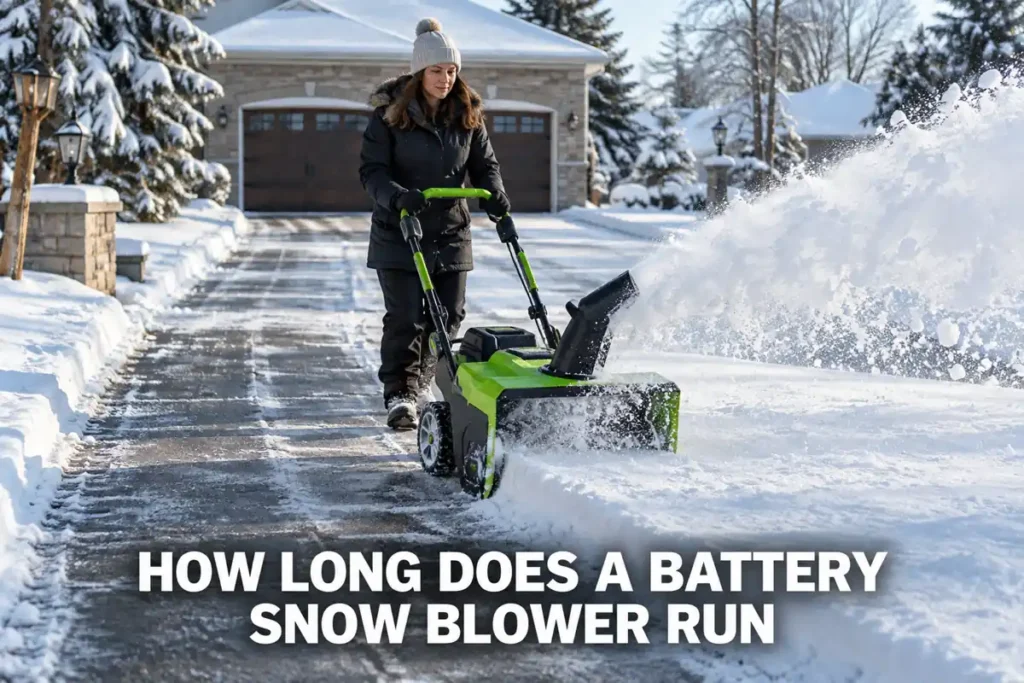
A battery snow blower runs for as long as its packs hold energy, and the makers who print minutes claim between 30 and 70, as a best case. EGO prints no minutes at all, only a count of car spaces it clears in 8 inches of snow, and snow weight, pack count and cold decide how much of either figure you get.
Before I mix a spray tank for the plum rows, I work out how many rows one fill covers, and I read a battery the same way. Below you get what each maker prints, what a car space means in square feet, what the manuals say about one pack, and how snow and cold change a charge.
How Long Does a Battery Snow Blower Run? The Short Answer
No maker prints a runtime that holds in every snow, so the honest answer is a range with conditions. Ryobi, Toro and DeWalt print minutes, always as “up to”, next to a car-space count, while EGO and Milwaukee print coverage only: car spaces, or feet of sidewalk in Milwaukee’s case. A charge is a fixed amount of energy and the snow decides how fast it goes, so a best-case minute count means little without the depth and the weight of the snow.
| Question | Answer |
|---|---|
| Minutes the makers print | 30 to 70, always as an “up to” figure |
| EGO car-space claims | 10 to 32 cars in 8 in of snow, on two packs of 5.0 to 12.0 Ah |
| Pack energy in the EGO kits | 560 to 1,344 Wh |
| One EGO pack allowed | 3 in or less on a single-stage, 8 in or less on a two-stage, never in very wet or icy snow |
| EGO recommended operating range | -4 F to 50 F (-20 C to 10 C) |
I treat every “up to” figure as the ceiling and plan the work on less. The sections below show what holds that ceiling down.
Key Takeaway
A car-space claim is coverage in one depth of snow. It is not a running time.
How Makers State Runtime in Minutes, Car Spaces and Square Feet
A battery powered snow blower gets its runtime stated in one of three ways, depending on the maker: minutes, car spaces or feet of sidewalk. Each maker also picks its own snow depth, which is why the claims in the table cannot be ranked against each other.
| Maker and model | Claim as printed | Snow depth | Minutes printed |
|---|---|---|---|
| EGO, SNT2102 to SNT2807 | 10 to 32 cars on a single charge | 8 in | None |
| Toro 39926 | Up to 30 car spaces; up to 70 minutes of run time | Up to 10 in | Up to 70 |
| Ryobi RY408150 | Up to 20 car spaces, or up to 30 minutes | Not stated | Up to 30 |
| DeWalt DCSNP2142Y2 | Up to 16 parking spaces; up to 45 minutes | 6 in | Up to 45 |
| Milwaukee 3036-22HD | Up to 11 car spaces or 500 ft of 3.5 ft sidewalk | 6 in of average density snow | None |
The depths run from 6 to 10 inches, Ryobi names none, and only Milwaukee names a snow density. A claim for 8 inches says nothing about the 12-inch day, so I explain depth limits by machine type in my answer to how much snow can a snow blower handle.
What a Car-Space Claim Means in Square Feet
A car space has a size on only one maker’s page. According to Milwaukee, 11 car spaces is 1,750 square feet, which makes a space about 160 square feet, roughly 9 by 18 feet. Its sidewalk claim agrees, since 500 feet of 3.5-foot walk is also 1,750 square feet.
Treat 160 square feet as one maker’s yardstick. EGO, Toro, DeWalt and Ryobi do not say how big their car is, so every conversion of their claims below is an illustration, not their figure.
Worked Example With a Pad, a Path and Two Claims
Using Milwaukee’s yardstick of about 160 square feet per space as an illustration only, the jobs below add up as follows, with the areas rounded.
| Job or claim | Area in square feet | Car spaces |
|---|---|---|
| A 40 by 30 foot concrete pad | 1,200 | 7.5 |
| 40 feet of a 4-foot path | 160 | 1 |
| A 10-space claim | 1,600 | 10 |
| A 14-space claim | 2,200 | 14 |
My machinery shed pad is 40 by 30 feet, so by that yardstick it is 7.5 spaces before I touch the path to the house door, where every 40 feet adds one more. The farm road to the public road is the biggest job of a snow day, so I count it first and the pad second. I compare the total with the claim and keep some reserve in the packs. For a job this large, I compare five models in my snow blower for large driveways guide.
As a rough guide, a small battery powered snow blower with a 10-space claim suits a short drive and a path. The claim is made for 8 inches in EGO’s case. In half that depth I expect more ground from the same packs, and in a deeper layer less, but no maker prints by how much. For a short drive, my compact snow blower picks cover corded and battery machines.
What One Charge Holds in Watt-Hours
A pack stores energy in watt-hours (Wh), which is its voltage times its amp-hours (Ah). A 56-volt EGO pack of 5.0 Ah holds 280 Wh and one of 12.0 Ah holds 672 Wh, so the larger pack holds 2.4 times the work. The voltage badge and the Ah alone say little, so I compare a snow blower battery by its watt-hours.
Compare inside one brand, because makers count volts differently. Toro prints 405 Wh for its 7.5 Ah pack, which is 54 volts typical on a pack sold as 60V Max, while the EGO figures below use 56 volts.
| EGO kit | Packs | Kit energy (Wh) | Claim in 8 in of snow | Wh per car space |
|---|---|---|---|---|
| SNT2102 | 2 x 5.0 Ah | 560 | 10 cars | 56 |
| SNT2112 | 2 x 5.0 Ah | 560 | 12 cars | 47 |
| SNT2134 | 2 x 6.0 Ah | 672 | 14 cars | 48 |
| SNT2125AP | 2 x 7.5 Ah | 840 | 16 cars | 53 |
| SNT2405 | 2 x 7.5 Ah | 840 | 18 cars | 47 |
| SNT2416 | 2 x 10.0 Ah | 1,120 | 24 cars | 47 |
| SNT2807 | 2 x 12.0 Ah | 1,344 | 32 cars | 42 |
Divide each kit’s energy by the cars in its claim and every kit lands between 42 and 56 watt-hours per car space, most near 47. EGO’s claims work out to about 45 to 55 watt-hours per car space, so the claim scales with the packs. That is arithmetic on printed claims, not a figure EGO publishes.
A rechargeable battery snow blower spends that energy on cutting the snow, feeding the auger, driving the machine and throwing the load, so a heavier job drains the packs faster. More packs mean more coverage. According to Toro, a third battery port adds up to 15 more car spaces with one more 7.5 Ah pack, and according to Milwaukee, four packs double its 11 car spaces to 22. I size a kit for the biggest storm I expect, not the average one.
One-Pack Limits on a Single-Stage or Two-Stage Battery Snow Blower
The manuals turn the one-pack question into a depth rule, and I explain where the design fits in my answer to what is a two-stage snow blower. According to EGO, you should not power the machine from a single battery when the snow is deeper than 3 inches on its single-stage models, or deeper than 8 inches on its two-stage models, or when the snow is very wet or icy. EGO recommends two batteries working together, which it says give a longer run time and an efficient power draw, and it recommends packs of 5.0 Ah or more.
| Machine | One-pack rule |
|---|---|
| EGO single-stage battery models | No single pack above 3 in of snow or in very wet or icy snow; two packs recommended |
| EGO two-stage battery models | No single pack above 8 in of snow or in very wet or icy snow; two packs recommended |
| Toro 39926 | The packs fitted must add up to at least 6.0 Ah, or the machine will not start |
| Milwaukee 3036-22HD | Does not work with one pack; extra packs add runtime |
| DeWalt DCSNP2142Y2 | Runs on one pack, but the maker advises against it |
| Ryobi RY408150 | At least two 40V packs |
Why EGO Limits a Single Pack
EGO ties the limit to battery heat protection. If a pack climbs above 158 F (70 C) in use, the machine shuts off until the pack cools, and the manual says to slow down and narrow the swath. Overload is a separate protection: when the load is too high, the auger slows by itself and the motor note drops, and if slowing down does not help, the auger stops and the indicator flashes orange.
On the farm road a pack once cut out in the middle of a pass at the gate and left a half-cleared strip. The stop was abrupt, and I now ease off the pace as soon as the motor note drops. For a single-stage machine, one pack is the wrong tool for anything over 3 inches. For the full answer to what is a single-stage snow blower and where it fits, see my separate page.
How Snow Depth and Weight Change a Charge
A charge holds a fixed amount of energy, and heavier snow spends it faster. Depth is only half of the load, because the same inch of snow can weigh very different amounts.
Equal Depth, Different Weight
Snow weight comes from the snow ratio, the depth of snow that melts down to one unit of water. A ratio of 10 to 1 equals a density of 100 kilograms per cubic meter, and measured ratios of fresh snow run from about 3 to 1 up to as much as 100 to 1 (1).
In a study of Rocky Mountain snow, fresh snow ranged from 10 to 257 kilograms per cubic meter, and 72 percent of daily snowfalls fell between 50 and 100 (2). Take 8 inches of snow over 1,000 square feet, roughly six car spaces. At 100 kilograms per cubic meter it weighs about 4,200 pounds, and at 257 it weighs about 10,700. The same depth can mean two and a half times the load. I compare five models for deep, packed drifts in my roundup of snow blowers for heavy snow.
Air temperature points the same way. When the air in the lowest layers of the atmosphere averaged warmer than about 27 F, snow ratios above 25 to 1, the fluffiest snow, occurred less than 5 percent of the time, and snowfalls with more liquid water in them tended to be denser (3). These are measurements of fresh snow, not of a driveway pile that has settled.
What Heavier Snow Does to a Pack
More weight per inch means more energy per foot of drive, and a full-width pass in heavy snow pulls the most from the packs. That is the case EGO’s heat protection and overload sequence exist for. No maker prints a runtime for wet or deep snow, and I do not guess one. Expect the same packs to cover less ground in dense snow and more in light snow.
Where I farm, snow often falls near freezing, and that kind of snow tends to be denser than cold powder. On the same machine I noticed the wet snow packing in the chute where cold powder did not, so I read the snow type before I read the depth. The manuals say more on how a snow blower handles wet snow, and I sum up each type in a separate page.
What Cold Does to a Battery Snow Blower
Cold reduces what a pack delivers, but no maker prints how much. The research and the manuals agree on the direction, and neither supports a percentage.
What the Studies Found
Lab work on lithium-ion cells points one way. A study of small cells found substantially reduced energy and power at low temperatures, and at -20 C (-4 F) what a cell delivers depends on the rate it is discharged at and on how much it warms itself (4). Another measured higher internal resistance in the cold, which gave lower capacity and power at subzero temperatures (5), and a review of vehicle batteries reports that low temperature reduces available energy and raises internal impedance (6).
These tests used small cells and vehicle batteries, not snow blower packs, so they show which way the loss goes and say little about its size.
What the Manuals Print
EGO recommends running its snow blowers between -4 F and 50 F (-20 C to 10 C). It says a machine may not start if the battery is at -4 F or below, and then you take the pack indoors for 10 minutes or more. EGO also says to store packs where the temperature will not drop below -4 F. According to Toro, its 39926 and its packs run from -22 F to 120 F. A pack that is too cold is one reason a snow blower won’t start, and the other fixes sit on that page.
On a cold morning I keep the second pair of packs in the house and swap them in when the first pair weakens. Where I farm, the weight of near-freezing snow is the usual runtime problem and deep cold the exception, while in the snow belt you meet both in one winter.
How to Get More From One Charge
You cannot change the energy in a pack, but you can change how fast the job spends it. The habits below come from the manuals and from how I run the snow work on the farm. I compare five cordless snow blower picks for jobs ranging from porch steps to long driveways.
A Routine That Stretches a Charge
- Fit two packs, the largest pair you own. On an EGO single-stage machine, fit both before the first pass, since a single pack is allowed only up to 3 inches.
- Charge before the forecast storm. I charge both packs the night before and not once the snow is falling, and the page on charging a snow blower battery lists the hours by maker. The manual gives the temperature range for charging.
- Take deep or wet snow in layers. Top layer first, then the base, and stay within the intake height in your manual. At the gate I take the plow ridge this way, top first and then the base, so the machine does not stall.
- Slow down and narrow the swath when the motor note drops. That is EGO’s own remedy for an overload.
- Throw with the wind. Snow thrown into a gust lands on the strip you just cleared, and clearing it twice spends the pack twice.
- Keep a charged spare pair in the house. On the two-pack machines above, swap both packs when the first pair is down, using only packs your maker approves.
- Plan the job by area. Add up the square feet with the yardstick above as a rough guide, compare the total with your kit’s claim and its stated snow depth, and keep a reserve. I walk through the snow blower size you need for each drive and snow type in another guide.
When the Machine Stalls Mid-Pass
A stall is a safety moment before it is a runtime one. In US emergency department data for 2009 to 2017, 22 percent of hand injuries from clearing a clogged snow blower were amputations (7).
Clear a Clog the Safe Way
Release the controls, take out the start key if the machine has one, and remove every battery pack. Wait 10 seconds until every moving part has stopped, then clear the chute with the clean-out tool or a stick. Never use a hand.
Planning Your Winter Around a Charge
Three things decide how long a charge lasts: the energy in the packs, the weight of the snow and the cold. Size the job by area and by the worst snow you get, then choose the number of packs to match, and read the pack and depth rule in your manual before the first storm. Readers who prefer cordless can compare battery snow blowers by pack size, runtime and cold weather.
I charge both pairs the night before a forecast and leave the spare pair in the house. For the machines themselves, start with the snow removal tools section. Plan the work by area and keep some reserve, and you will know roughly before the storm whether one charge on your battery snow blower covers it.
Frequently Asked Questions
How long does a battery last on an electric snow blower?
The electric snow blower models whose makers print minutes advertise up to 30 to 70 minutes on the packs they specify, which is a best case and not an expected runtime for every machine or pack setup. Heavier snow, a wider pass or cold air shorten that, and a maker that prints car spaces instead gives coverage in one depth of snow rather than a time.
Are battery snowblowers worth it?
Battery snowblowers are worth it when the job fits the energy in the packs, such as a short drive, a path or a pad in light to average snow. A long drive in heavy snow needs a larger kit and a spare pair, and the pack rule in the manual sets the depth at which one pack is no longer enough.
What are the downsides of using an electric snow blower?
The main downside of an electric snow blower with a battery is a finite charge: when the packs are empty, the job stops until you swap in spare packs or recharge. Deep or wet snow cuts the coverage, and the manuals limit a single pack to a thin layer. A second set of packs adds to the cost, so the choice comes down to the size of your job.
Do battery snow blowers work?
Battery snow blowers work within the limits the manuals set, which means fitting two packs in snow deeper than the single-pack rule and accepting that dense, wet snow near freezing cuts the coverage. EGO recommends running between -4 F and 50 F and asks you to warm a pack indoors if the machine will not start at -4 F or below.
Are battery snow blowers as good as gas?
On a long job, a battery snow blower is as good as gas only if you have enough charged spare packs to swap in. A gas machine can keep going after you stop the engine, let it cool and refuel it, while an exhausted set of packs has to be swapped for a charged set or recharged, which takes longer than a refill.
References
- Roebber PJ, Bruening SL, Schultz DM, Cortinas JV Jr. Improving Snowfall Forecasting by Diagnosing Snow Density. Weather Forecast. 2003;18(2):264-287.
- Judson A, Doesken N. Density of Freshly Fallen Snow in the Central Rocky Mountains. Bull Am Meteorol Soc. 2000;81(7):1577-1587.
- Ware EC, Schultz DM, Brooks HE, Roebber PJ, Bruening SL. Improving Snowfall Forecasting by Accounting for the Climatological Variability of Snow Density. Weather Forecast. 2006;21(1):94-103.
- Ji Y, Zhang Y, Wang C-Y. Li-Ion Cell Operation at Low Temperatures. J Electrochem Soc. 2013;160(4):A636-A649.
- Hossain Ahmed S, Kang X, Bade Shrestha SO. Effects of Temperature on Internal Resistances of Lithium-Ion Batteries. J Energy Resour Technol. 2015;137(3):031901.
- Jaguemont J, Boulon L, Dubé Y. A comprehensive review of lithium-ion batteries used in hybrid and electric vehicles at cold temperatures. Appl Energy. 2016;164:99-114.
- Hammig B, Jones C. Hand injuries associated with reaching into a snow blower to clear clogged snow. Am J Emerg Med. 2020;38(4):785-788.
Safety Note: Snow blowers throw snow, ice and hidden objects with force. Never reach into a clogged chute or auger. Shut the machine off first: stop the engine on a gas model, unplug a corded model, or remove the safety key and every battery pack from a battery model. Wait at least as long as your manual says, often 10 seconds, and until every moving part has stopped, then remove the key and disconnect the spark plug wire where your manual says so, and clear the clog with the clearing tool. Keep people and pets out of the discharge path, run gas models outdoors only, and read the manufacturer’s manual.