
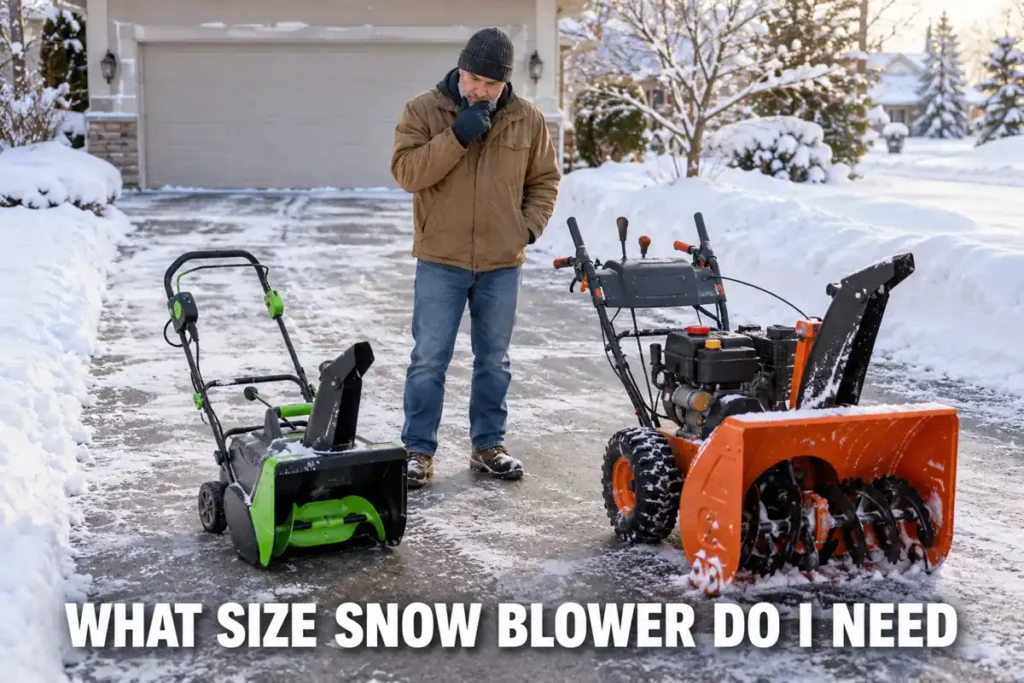
Size a snow blower by the area you clear, the heaviest snow you must move in one go and the surface under it, in that order. A paved drive of about 800 square feet with snow under 6 inches usually suits a single-stage machine, while a longer drive, gravel or deeper snow points to a two-stage machine.
Measure before you shop. I walked the farm road and the concrete pad with a tape and wrote the lengths down before I read a single spec sheet. Below you get the measuring method, the weight of wet snow, a size chart and three worked drives.
What Size Snow Blower Do I Need? The Short Answer by Driveway and Snow
Three numbers set the right snow blower size: the square feet of drive, the inches of the heaviest snow and the surface. Makers and independent testers suggest the classes below, and I treat them as a starting rule, not a limit.
- Single-stage, 18 to 22 inches wide: small paved drives of about 800 square feet, with snow up to about 6 inches, or 9 on some models. My page on single-stage snow blower basics explains how that class works.
- Two-stage, 24 to 30 inches wide: drives of about 800 to 1,200 square feet or longer than 60 feet, any gravel, and snow up to about 12 inches.
- Large two-stage or three-stage, 28 to 30 inches wide or more: the largest drives, such as 3 cars wide by 4 long, and regular snow of 12 to 18 inches or heavy packed snow. My page on three-stage snow blower basics explains what the extra stage adds.
A power shovel, 12 to 13 inches wide, takes steps and short walks in snow under about 6 inches. When the area and the snow point to different classes, I follow the snow. If you also need to clear a short drive, I compare seven snow blowers for small driveways.
Measure Your Driveway in Square Feet First
Length times width gives the area in square feet. Use a tape for the real numbers, then add the walk to the door, the pad in front of the shed and the strip a plow leaves across the end of the drive.
Best Size Snow Blower for Driveway Area, by Car Count
Makers and buying guides talk in cars, and no one defines a car. I count a car space as roughly 10 by 20 feet, so a drive two cars wide is about 20 feet across. On that rule of thumb, a grid of 2 cars by 2 is 20 by 40 feet, or 800 square feet, 2 by 3 is 1,200 square feet and 3 by 4 is 2,400. For the 2,400 square foot case, I compare five snow blowers for large driveways intended for long, wide drives.
Count Every Surface Separately
On my place the biggest job is the gravel road, about 150 feet long and roughly 12 feet wide, which is 1,800 square feet. The concrete pad in front of the machinery shed is 40 by 30 feet, another 1,200 square feet, and a 4 foot path runs to the house door. That is more than 3,000 square feet on three surfaces.
If a plow clears your road, add the ridge it leaves across the gate, a hard strip of packed snow deeper than the rest of the drive. I take it in layers, top first and then the base, and a regular ridge points to a two-stage machine. My ranking of snow blowers for heavy snow covers machines that suit that kind of ridge.
Match the Machine to the Snow You Really Get
Depth decides whether the machine can take the snow in at all. Intake height is the height of snow the housing swallows in one bite: about 12 to 13 inches on a single-stage machine and about 20 to 23 inches on a two-stage one. Snow deeper than the intake goes in layers, top first. My ranking of snow blowers for deep snow lists the two-stage models for that job.
Makers and independent testers also rate each class by depth, and my page on how much snow blowers handle lists those limits by machine type. A single-stage machine tops out at about 6 inches on batteries and about 9 on gas, a two-stage battery machine works best under 12 inches, and a two-stage gas machine is rated to about 16.
The 24 inch two-stage machine is the medium size snow blower of the range. It cuts a 20 foot drive in 11 passes and runs lighter on the turns than the 28 inch class.
Size for the Wet Snow Day
Depth is volume, and volume says little about weight. The old 10-to-1 rule assumes that 10 inches of snow melt to 1 inch of water, yet real snowfalls run from about 3-to-1 to as much as 100-to-1 (1).
Air temperature shifts the ratio. In a study of US snowfalls, when the low-level air was at or above about 27 degrees Fahrenheit, snow ratios of 25-to-1 or higher, the fluffiest snow, turned up less than 5% of the time (2). Snow where I farm is sporadic, and when it comes it often falls close to freezing, so I size for the wet, heavy day. My page on snow blowers handling wet snow looks at how each type copes with that load.
The heavy case here, 5-to-1, weighs twice as much as 10-to-1 at the same depth.
| Drive | Snow depth | Volume | Weight at 10-to-1 | Weight at 5-to-1 |
|---|---|---|---|---|
| 20 x 40 ft | 6 in | 400 cu ft | About 2,500 lb | About 5,000 lb |
| 20 x 40 ft | 8 in | 533 cu ft | About 3,300 lb | About 6,700 lb |
| 12 x 150 ft road | 8 in | 1,200 cu ft | About 7,500 lb | About 15,000 lb |
The same intake that fills with dry snow fills with twice the weight in wet snow, and that is where an undersized machine stalls or clogs. Wet snow is hard on people too. In a small test, healthy untrained men shoveling heavy wet snow near freezing reached 86% to 97% of their maximal heart rate within 10 minutes, and the effort was lower with an electric thrower (3). When a machine stalls like that, my page on why snow blowers keep clogging walks through the fixes.
Let the Surface Pick the Stage
The surface under the snow can overrule the area and the depth. A single-stage machine scrapes down to the pavement, and a two-stage machine rides above it on skid shoes and a scraper bar. According to Toro, its two-stage scraper bar sits about 1/8 inch above a level surface, so a thin layer of snow stays behind.
- Paved drive: a single-stage machine clears to bare pavement, though its scraper bar catches on raised or uneven pavement.
- Gravel and packed earth: according to Toro, single-stage machines should not be used on unpaved surfaces. A two-stage machine works on gravel once the skid shoes are lowered so the scraper rides above the stones, and it can still throw a stone, which my page on running a snow blower on gravel covers in full.
- Slopes: the EGO manual rules out grades steeper than 10%, and the Ryobi and Milwaukee manuals set 15 degrees.
On the raised edge of my concrete pad the scraper bar caught, which is the one place a single-stage machine gave me trouble. If a single-stage machine suits your drive, my list of single-stage snow blowers worth buying compares the models.
How Wide of a Snow Blower Do I Need? Passes, Weight and Gates
Width sets the number of passes, and weight sets what you pay for each inch of it. The table assumes each pass overlaps the last by 2 inches and rounds up.
| Drive width | 21 in | 24 in | 28 in | 30 in |
|---|---|---|---|---|
| 12 ft (one car) | 8 | 7 | 6 | 6 |
| 20 ft (two cars) | 13 | 11 | 10 | 9 |
| 24 ft | 16 | 13 | 11 | 11 |
On a 20 by 40 foot drive that is 13 passes, or 520 feet of walking, with a 21 inch machine, and 10 passes, or 400 feet, with a 28 inch one. That saves about one pass in four, and a 30 inch machine saves just one pass more. If the 28-inch machine is a tight fit, my roundup of compact snow blowers for driveways compares corded and battery options for short drives.
What Width Costs in Weight
Makers list single-stage battery machines at about 53 to 90 pounds and two-stage battery machines at about 143 to 187 pounds. The weight showed on the turns near the end of my farm road, where a self-propelled two-stage machine has to swing around. A 28 inch machine also needs more than 28 inches of clear space at the narrowest gate, door or turn. I explain where the design fits and where it does not in my guide to two-stage snow blower basics.
Snow Blower Size Chart by Driveway and Snowfall
Read across from your area and your heaviest snow, and when two rows fit, take the row for the wetter snow.
| Type | Width | Intake height | Snow depth class | Best for |
|---|---|---|---|---|
| Power shovel | 12 to 13 in | About 6 in | Under about 6 in | Steps, short walks |
| Single-stage, battery or electric | 18 to 22 in | 12 to 13 in | About 6 in, some to 9 | Small paved drives, about 800 sq ft |
| Single-stage, gas | Up to 22 in | 12 to 13 in | Up to about 9 in | Level paved drives |
| Two-stage, battery | 24 to 28 in | About 20 to 23 in | Best under 12 in, some to 16 | Mid-size drives |
| Two-stage, gas | 24 to 30 in | About 20 to 23 in | Up to about 16 in | Long, wide drives, gravel |
| Three-stage, gas | Often 30 in or more | About 23 in | 18 in or more of heavy snow | Very large drives and heavy snow |
Treat these as starting points. The maker’s manual for your model has the last word on depth, slope and surface. My notes on when to buy snow blowers cover what to settle before the first storm.
Snow Blower Engine Size and Battery Capacity
Snow blower engine size, given in cubic centimeters (cc), compares only inside one brand. Ariens pairs a 252 cc engine with its 24 inch machine, 301 cc with 28 inches and 420 cc with 30 inches, so the bigger engine goes with the wider, heavier bucket. Across brands the cc number says little, because design and tuning differ. For specific machines, my comparison of gas snow blowers by class focuses on five two-stage picks for heavy snow and long drives.
Battery Packs and Watt-Hours
For battery machines, compare watt-hours, which are volts times amp-hours, and ignore the voltage on the badge. EGO recommends two packs of 5.0 amp-hours or more. It warns against one pack in snow deeper than 3 inches on its single-stage machines and deeper than 8 inches on its two-stage ones, and against one pack in very wet or icy snow on both.
A car count on a box settles little, because makers use different snow depths and packs. Cold takes capacity as well: a review of lithium-ion batteries in electric vehicles found that low temperatures reduce the available energy and raise the internal impedance, the pack’s resistance (4). I keep spare packs indoors and swap them in when the first one goes cold. My page on battery snow blower run time shows what to expect from a pack in the cold.
Three Driveways, Sized Step by Step
Each example runs the same steps: area, snow, weight, passes and surface.
A 20 by 30 Foot Paved Drive With Light Snow
The area is 600 square feet, under the 800 square feet where guides suggest a bigger class, and the plan is 4 inches of snow, which is 200 cubic feet or about 2,500 pounds even at 5-to-1. A 21 inch machine needs 13 passes of 30 feet, about 390 feet of walking. A single-stage machine fits this drive, because the wet case stays inside its depth class and the surface is paved. On batteries, 4 inches is past the 3 inches where EGO warns against one pack on its single-stage machines, so plan for two packs.
A 20 by 60 Foot Paved Drive With a Plow Ridge
The area is 1,200 square feet and the length sits on the 60 foot line. The plan is 8 inches of wet snow: 800 cubic feet, or about 10,000 pounds at 5-to-1, which is past single-stage territory. A 24 inch two-stage machine needs 11 passes of 60 feet, about 660 feet, and a 28 inch one needs 10 passes, about 600 feet. I compare five gas and battery models for deep snow in my top two-stage snow blowers roundup.
I pick the 24 inch machine, because one saved pass does not pay for the extra weight. On batteries, plan for two packs, because EGO warns against one pack in very wet snow.
A 150 Foot Gravel Road With a Pad and a Path
The road is about 150 by 12 feet, so 8 inches of snow is 1,200 cubic feet and about 7,500 pounds at 10-to-1. Gravel rules out a single-stage machine. A 24 inch machine needs 7 passes of 150 feet, about 1,050 feet of walking, and a 28 inch machine needs 6 passes, about 900 feet. For a surface like mine, my ranking of snow blowers for gravel driveways names the two-stage models that suit it.
I size the machine for the road: a two-stage with the skid shoes lowered on the housing so the scraper rides above the stones. I pick the 28 inch width, because every pass saved is 150 feet less walking, and I accept the extra weight on the turns. The 40 by 30 foot pad takes the same machine with the shoes reset for smooth concrete, and the 4 foot path is a shovel job, because I do not buy a second tool for a path.
Sizing Mistakes to Avoid
Check the gate, the shed door and the storage floor before you buy. The gap beside my tool shed is narrower than a blower housing, so a shovel does that job. A large two-stage machine also takes real storage room. My page on storing a snow blower covers the off-season steps for a machine this size.
Clearing a Clog at Any Size
Release the controls. Stop the engine and remove the key on a gas machine, unplug the cord on a corded one, or take out every battery pack and remove the start key on a battery machine that has one. Wait the time your manual gives, 10 seconds in the EGO manual, and make sure every moving part has stopped. Then use the clean-out tool and never a hand. A gas machine runs outdoors only, even with the garage door open.
Your Sizing Checklist Before You Buy
Run this list before you open a shop page, and size for the wettest snow you expect. My picks of snow blowers for wet snow cover the machines that suit that case.
- Area: write the square feet of each surface on its own line.
- Snow: note the heaviest snow you plan for, in inches.
- Stage and width: match both lines to the chart above, then check the gate and the shed door against the machine’s width.
- Power: for gas, compare cc inside one brand; for battery, count the packs and the watt-hours in the kit. My list of battery snow blowers compared puts the kits side by side.
With those numbers and the manual’s limits checked, the right snow blower for your drive is usually clear. My best snow blower picks turn these sizes into specific models.
Frequently Asked Questions
Should I get a 24 or 28 inch snowblower?
A 24 inch snowblower suits most mid-size drives, and a 28 inch model pays off when a long, wide drive turns each saved pass into real walking. On a 20 foot wide drive the extra 4 inches saves one pass, from 11 to 10, which the heavier machine and the turning space at your gates may cancel.
What is the best size snowblower for my needs?
The best size snowblower for your needs is the smallest class that clears your drive in the heaviest snow you expect, on your surface. Makers and testers suggest a single-stage machine for a small paved drive and a two-stage machine for a larger one or for gravel, but snow depth and surface override the area.
Can a snowblower handle 20 inches of snow?
A snowblower can handle 20 inches of snow if it is a large two-stage or three-stage machine rated for that depth, because their intake is about 20 to 23 inches while a single-stage intake stops at 12 to 13. Check the model’s rated depth and the wetness of the snow, since deep or wet snow may still go in shallower passes.
What is better, a 2 stage or 3 stage snowblower?
A two-stage snowblower is the better choice for most drives, and a three-stage suits large drives with regular snow of 12 to 18 inches. According to Cub Cadet, which uses the term, its three-stage line is rated for up to 18 inches against 12 for its two-stage line.
How many cc snow blower do I need?
The cc you need depends on the width and stage you picked, because inside one brand the engine grows with the bucket. Choose width and stage first and take the engine the maker pairs with them.
References
- Roebber PJ, Bruening SL, Schultz DM, Cortinas JV Jr. Improving Snowfall Forecasting by Diagnosing Snow Density. Weather Forecast. 2003;18(2):264-287.
- Ware EC, Schultz DM, Brooks HE, Roebber PJ, Bruening SL. Improving Snowfall Forecasting by Accounting for the Climatological Variability of Snow Density. Weather Forecast. 2006;21(1):94-103.
- Franklin BA, Hogan P, Bonzheim K, et al. Cardiac Demands of Heavy Snow Shoveling. JAMA. 1995;273(11):880-882.
- Jaguemont J, Boulon L, Dubé Y. A comprehensive review of lithium-ion batteries used in hybrid and electric vehicles at cold temperatures. Appl Energy. 2016;164:99-114.
Safety Note: Snow blowers throw snow, ice and hidden objects with force. Never reach into a clogged chute or auger. Shut the machine off first: stop the engine on a gas model, unplug a corded model, or remove the safety key and every battery pack from a battery model. Wait at least as long as your manual says, often 10 seconds, and until every moving part has stopped, then remove the key and disconnect the spark plug wire where your manual says so, and clear the clog with the clearing tool. Keep people and pets out of the discharge path, run gas models outdoors only, and read the manufacturer’s manual.