
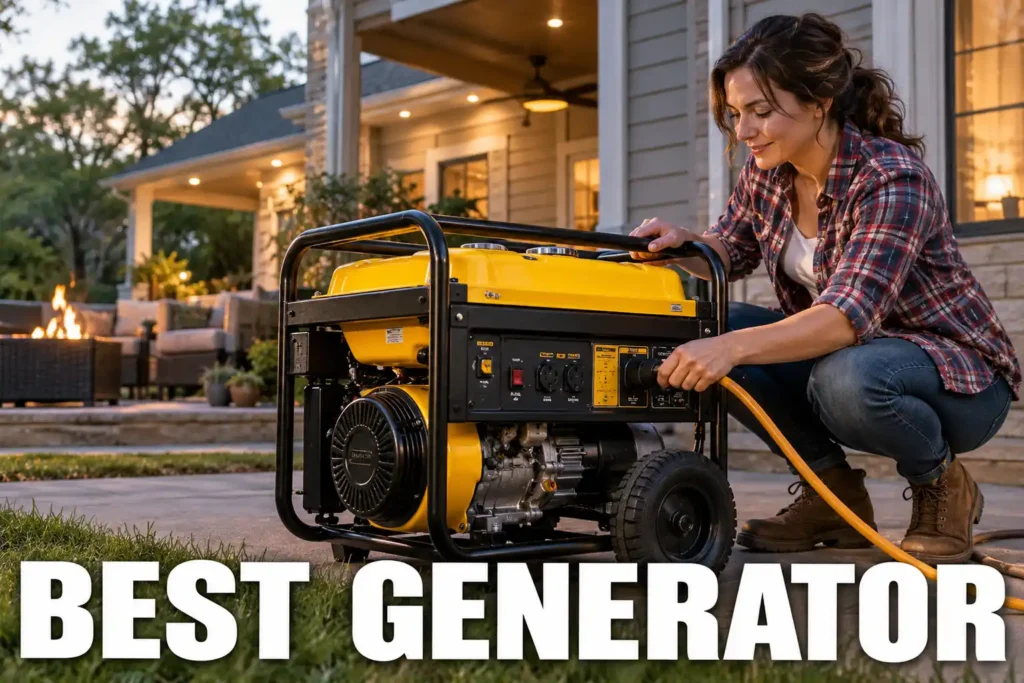
The best generator is the one whose running watts cover the loads you must keep alive, and on my farm that list starts with the irrigation pump, the chest freezer and the workshop lights. I have run gasoline units and a battery station on my own land, and I judge each one by what it does with those loads.
I rank nine, from dual fuel to tri-fuel to a battery station, led by the Westinghouse WGen9500DF 9,500-Watt Dual Fuel Generator. After the reviews I show how to size one, where to put it and what to leave to an electrician.
Best Generator Reviews 2026 With 9 Top Models for Home, Camp and Work
These nine cover the jobs a household hands to a generator: backup for a pump and a freezer, a small unit for a fridge, an RV cord, a job site and a short outage with no fuel at all. Every review says who should skip the machine.
1. Westinghouse WGen9500DF 9,500-Watt Dual Fuel Generator Best Overall
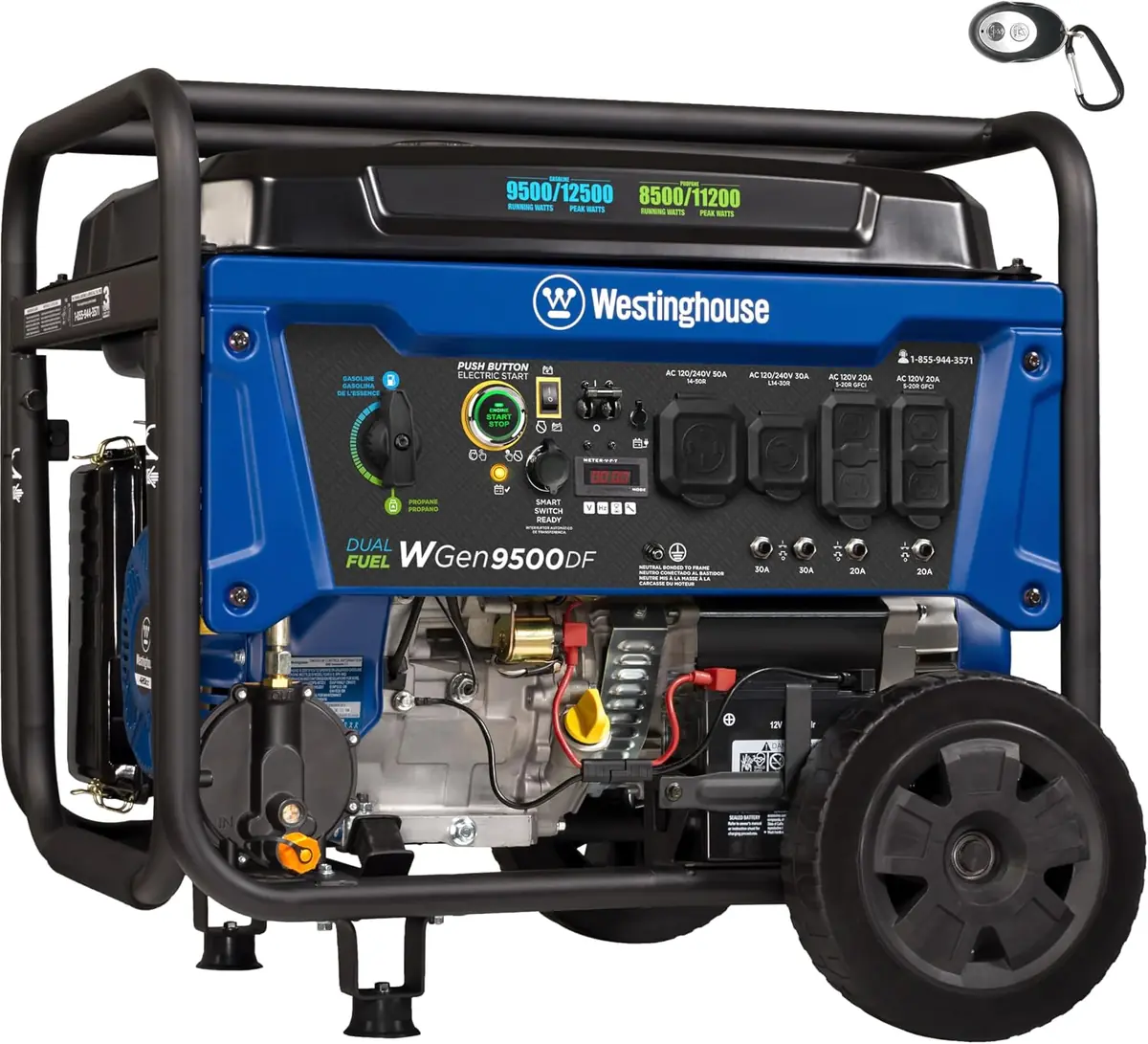
The WGen9500DF is the generator I size a farm backup around: 9,500 running watts on gasoline and 8,500 on propane, with a 120/240 V panel that takes a pump, a workshop subpanel or a transfer switch. It holds Best Overall because it covers most of what a household asks of a generator at a mid-range price, from a freezer to a 240 V motor. I recommend it when the must-run list includes a well or irrigation pump and a house hookup done by an electrician.
WHY I CHOSE THIS ✓
I put it first because it matches the way a farm loses power: a pump, a freezer, a workshop and a house, all wanting power in the same hour. Two fuels, 240 V and a 50 A outlet leave room that a smaller unit never has. The house connection stays with an electrician, through a transfer switch or an interlock.
Westinghouse WGen9500DF 9,500-Watt Dual Fuel Generator Specs
Key Features:
- Dual fuel selector: Run gasoline at 9,500 running watts, or switch to propane at 8,500 when gas stations are closed.
- 120/240 V output: A 50 A outlet and a 30 A twist-lock feed a 240 V pump or a subpanel.
- Key fob remote start: The manual gives a range of up to 99 ft, once the unit stands outdoors and fuelled.
- Push-button start: An electric starter with a battery supplied, and a recoil handle as backup.
- Transfer switch ready: The 30 A outlet is built for a switch an electrician installs, so no cord passes through a window.
- Low-oil shutdown: The engine stops and an indicator lights when the oil runs low.
- Data center: Volts, frequency, an hour meter and a maintenance timer sit on the panel.
The load that sets my size is the irrigation pump, a motor that pulls far more current at start than it does at steady load. I read its nameplate, ignore the 12,500 watts printed on the box, and start the largest load first, then add the rest one at a time, which is the order the manual gives. The pump caught on the second try, after I waited for the pressure to build. Westinghouse says output falls about 3.5% for each 1,000 ft above sea level and about 1% for each 10 F above 60 F, which my flat lowland rarely tests.
Fuel is where this unit earns the word dual. A selector swaps between gasoline and propane, and propane gives up 1,000 running watts, so I size the job for the 8,500 figure. According to Westinghouse it runs 8 hours at half load on gasoline and up to 7 hours at half load on a 20 lb propane cylinder, and I keep that cylinder next to the other farm fuel. Propane keeps in the cylinder where gasoline goes stale in a can, so it is my first choice for an outage that follows months of waiting.
New engines get light work from me, and the manual agrees: the first five hours stay at or under half of the rated running watts, on the supplied oil. The other cost is bulk. At 211 lb dry the wheels are for hand transport only, so I roll it from the machinery shed to the gravel pad over hard ground and take a second person for a step or a truck bed. The key fob is handy on a wet morning, but the unit must already stand outdoors, fuelled and in the right switch state.

Replace the key fob battery before storm season. Westinghouse notes that a weak battery shortens the range, and a fob that stops answering can be paired again.
Run it outdoors only, at least 20 feet from the house and from every door, window and vent, with the exhaust pointing away. The CPSC and CDC give that distance, Westinghouse lists no carbon monoxide sensor for it, and battery-powered CO alarms belong inside the house.
Check the oil on level ground before each run, and use fresh unleaded gasoline without E15 or E85. The first service comes at 25 hours, and the 6.6 gal tank gives a long day between fills. Expect a loud engine, since Westinghouse lists 74 dBA without a distance. What annoyed me was the weight, because I hesitate every time it has to move.
Buy it for a farm, a workshop or a house with a transfer switch, where a 240 V pump and a freezer must run together. Skip it for camping, tailgating or an apartment, if you cannot lift 211 lb into a truck, or if you want a quiet engine. Check the seller and the return terms on the listing before you order something this heavy.
FINAL VERDICT
Pick the WGen9500DF when one generator has to carry a 240 V pump, a freezer and a workshop through a long outage. It gives up quiet and portability for output and a second fuel. It suits the buyer whose must-run list starts with a motor.
It is the dual fuel generator I size a farm backup around.
2. Honda EU2200i 2,200-Watt Inverter Generator Best Premium
With only a work light plugged in, the EU2200i drops its engine note so far that I checked it was still running. Eco-Throttle slows the engine to match the load, and Honda lists 48 dB(A) at a quarter load against 57 dB(A) at rated load, with no distance stated. It holds Best Premium because the premium tier here buys a built-in carbon monoxide shutoff and a 47.4 lb frame, and it suits one person who needs a fridge, lights and a router kept alive.

WHY I CHOSE THIS ✓
I chose it as the premium pick because the money goes into safety and weight and buys little output. A sensor that stops the engine and a unit one person can carry are worth paying for if your list of loads is short. I do not buy it for a pump, and I do not pretend it replaces a bigger machine.
Honda EU2200i 2,200-Watt Inverter Generator Specs
Key Features:
- Eco-Throttle: The engine slows at light load for less fuel and less noise, and the manual says to switch it off when large loads start together.
- CO-MINDER: A sensor stops the engine when carbon monoxide builds near the unit, and a flashing light warns when the sensor is wearing out.
- Oil Alert: The engine stops when the oil is low, with 14 oz of 10W-30 in the sump.
- Two 20 A outlets: Two 125 V duplex receptacles run a fridge, a freezer, lights and chargers.
- Parallel option: Honda’s own cable links it to a second compatible Honda for more output.
- 47.4 lb dry weight: One person carries it from the shed to the work spot by hand.
- Recoil start: A pull cord, with no battery to charge or replace.
The 1,800 rated watts are a small number and I keep them in view. A fridge, a chest freezer, the shed lights and a router sit inside it, but a pump motor trips the Overload alarm. Next to my old generator, the Honda starts with less effort on the cord. Starting the biggest load first, then adding the small ones, kept the engine inside its line.
The 0.95 gal tank sets the rhythm of the day. Honda gives 3.2 hours at rated load and 8.1 hours at a quarter load, so the box figure is the light-load one. At full load I refill about every three hours, with the engine stopped and cooled, and I move the Honda at least 10 ft from the fuelling spot before I start it, as the manual says. The filler cap has a vent lever to open first, and the fuel stays below the red mark on the strainer.
The CO-MINDER is the feature I value most and trust least. It stops the engine when carbon monoxide builds near the unit, and a sensor light flashing every 4 seconds means 6 to 12 months of life left, every 2 seconds means 6 months or less. Honda still says to run the unit in the open, away from doors, windows and vents, so I treat the sensor as a backup and never as a reason to stand it closer. A second unit on Honda’s parallel cable doubles the outlets, provided both are compatible models.

Check the oil on level ground before every run, because Oil Alert shuts the engine down and blocks restarting when the level is low. Keep 3 ft of clear space around it and above it, since the muffler stays hot after the engine stops.
Stand it outdoors on open ground, at least 20 feet from the house and its doors, windows and vents, because the CPSC and CDC set that distance. A carbon monoxide shutoff is a second line of defense, and a battery-powered CO alarm belongs in the house.
Before the season ends I put stabilizer in the tank and follow the storage section of the manual, which covers draining the carburetor. The first oil change comes at 20 hours. Honda allows no more than 10 percent ethanol in the fuel. The engine is quiet at light load and loud at full load, so I run it at a distance from the house where the work allows.
The EU2200i suits outages that ask for a fridge, a freezer, lights and a router, for a workshop charger bench, or for a buyer who values a sensor and a light frame over output. Skip it for a well pump, a 240 V load or central air, and skip it if watts per dollar decide the purchase. The outlets are 20 A only, with no 30 A RV socket. Two units on Honda’s parallel cable raise the output, though they double the cost and the fuel stops.
FINAL VERDICT
The EU2200i is the premium choice for a short list of small loads and a buyer who wants a built-in CO shutoff and a unit that one person can carry. Its limit is the 1,800 rated watts. Choose it only if everything you must run fits under that number.
It is the small Honda inverter I keep for light loads.
3. WEN DF475T 4,750-Watt Dual Fuel Generator Best Value
The DF475T puts 120/240 V, a choice of gasoline or propane and a key start into a budget-tier frame, and that is why it holds Best Value. It is the best generator for the money if the job is 240 V backup through a transfer switch, a farm yard with room to set it outdoors and a workshop that wants steady power. WEN prints no noise figure for it, so read that trade before you click.

WHY I CHOSE THIS ✓
I rank it third and call it the value pick because it gives a farm yard the three things a backup unit needs: 240 V, a second fuel and a key start. It asks you to accept an engine that WEN does not describe in decibels, and a battery to keep alive. In the workshop it meets my priority, which is chargers and lights first and heavy tools last.
WEN DF475T 4,750-Watt Dual Fuel Generator Specs
Key Features:
- Voltage selector: A switch sets the 30 A twist-lock to 120 V or 240 V, and the two 20 A outlets go dead on 240 V.
- Dual fuel dial: Gasoline gives 3,800 running watts and propane 3,500, switched with the engine off or under half load.
- Electric key start: A 12 V battery starts the engine, gasoline needs it connected and charged, and the recoil cord is the backup on propane.
- Two GFCI outlets: Two 20 A duplex receptacles carry the ordinary 120 V loads.
- L14-30R twist-lock: WEN lists it as transfer-switch ready, and an electrician does the hookup.
- Wheel kit in the box: Two wheels and a handle come with the unit and need assembly.
- Low-oil shutoff: The engine stops on low oil, and the sump holds 20.3 fl oz.
Sizing this one is a sum I write on a card before I touch the starter. At 3,800 running watts it carries the chest freezer, the shed lights and the battery chargers on my workshop bench, but a motor load changes the arithmetic. The air compressor tripped the breaker once because I added its running watts and forgot the start-up surge. The breaker is a push-to-reset type, so I cut the load, waited and reset it.
The fuel dial is the budget story. On gasoline WEN gives up to 11 hours at half load from the 4 gal tank, and on propane about 7 hours at half load from a 20 lb cylinder, at 3,500 running watts. Propane lets stored fuel sit without gumming a carburetor, so I keep a full cylinder ready for the day gasoline is old. The cylinder must be a Type 1 right-hand Acme valve, kept upright, with the valve shut when the unit is idle.
Cold weather shows the battery. WEN ships it disconnected, and with a dead or unconnected battery the engine will not start on gasoline at all, while the recoil cord still works on propane. In the cold season I pull the battery and keep it on a trickle charger, as the manual advises. A monthly 20 to 30 minute run keeps it charged and keeps the carburetor honest, and WEN ties the warranty to the maintenance schedule.

Keep the first 8 hours at or below half of the rating and change the oil after 8 hours, after 25 and every 50 after that. The manual’s cord table allows #12 wire up to 100 ft at 15 A and #14 up to 65 ft.
The weak point is noise, because WEN prints no decibel figure, and I place it far from the house, 20 feet at the least as the CPSC says, with the exhaust pointed away. Battery CO alarms stay inside, and open-frame output is not inverter-clean, so ask the maker of any sensitive electronics before you plug them in.
At 105.8 lb the wheels help on a hard surface, but gravel and steps fight you, and I move it before I fuel it. Drain the carburetor after each use and before storage, and never leave fuel in the tank for more than two months. Above 2,000 ft WEN requires a high-altitude kit, and without it the warranty is void. I refuel outdoors on a cool engine, loosening the cap slowly, and move it 30 ft away if I spill any.
Pick it for a farm yard, a workshop or a home-backup plan where a 240 V load and a second fuel matter more than a quiet engine. Skip it for camping, an apartment, a tight lot or a buyer who will not look after a battery and a strict oil schedule. A central air conditioner or a large 240 V well pump needs a nameplate check against 3,800 running watts first. Check the seller and the return terms on the listing, since a 106 lb box is hard to ship back.
FINAL VERDICT
Choose the DF475T when your must-run list has a 240 V load, you have outdoor space and you want a second fuel at a budget price. It is weakest on noise, so it needs distance from the house and alarms inside. If peace and quiet matter most, look at an inverter.
It is the budget 240 V dual fuel unit for a farm yard.
4. Westinghouse iGen5000 5,000-Watt Inverter Generator Best Inverter
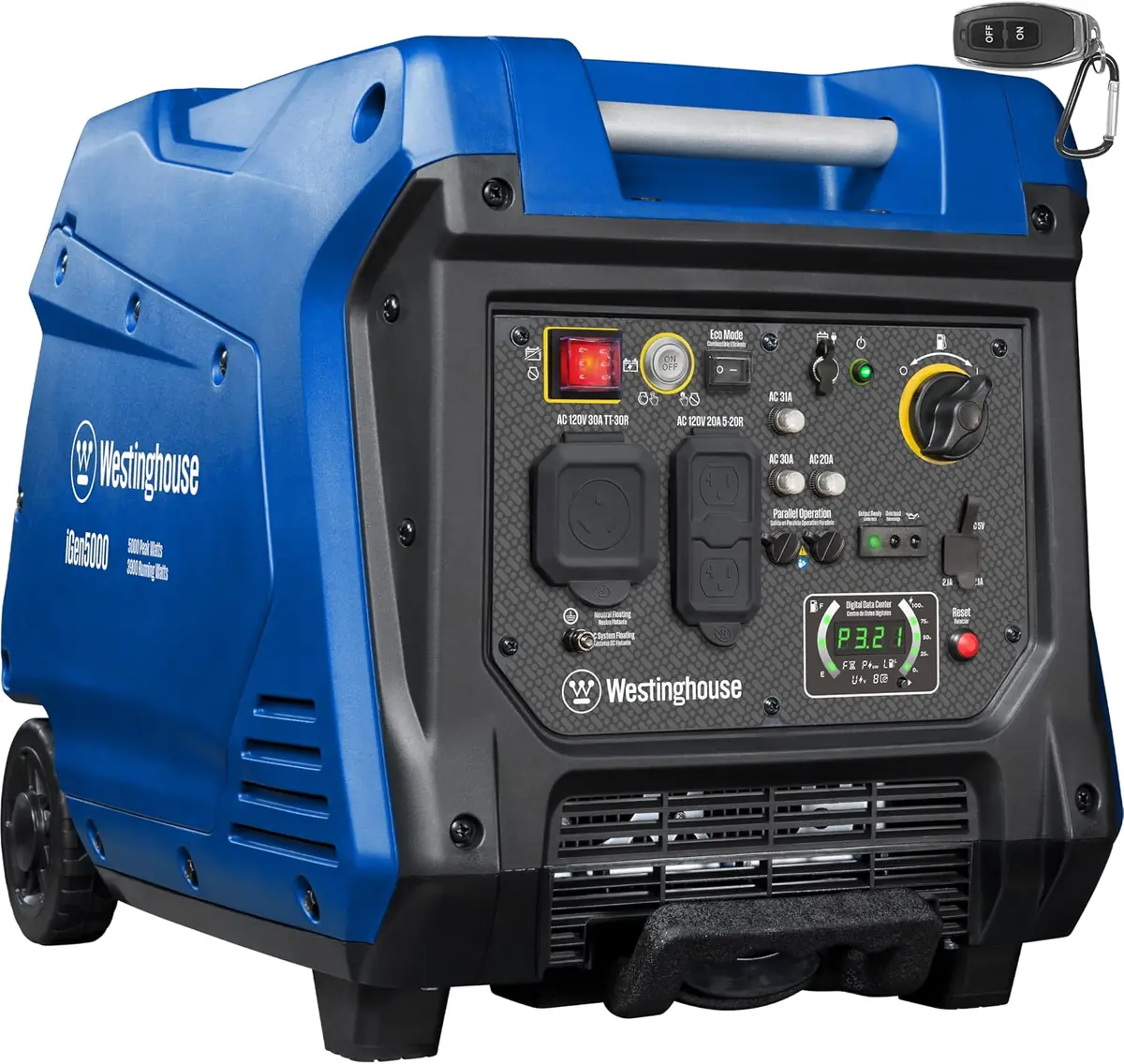
The iGen5000 is the largest inverter on this page, with 3,900 running watts and 5,000 peak, and Westinghouse quotes total harmonic distortion of 3 percent or less. It holds Best Inverter because that clean output sits beside a 30 A RV outlet and a 3.4 gal tank, so it fits an RV, a job site or the essentials of a house wired through a transfer switch. For anyone who needs more than a camping unit, it is the best inverter generator here.
WHY I CHOSE THIS ✓
I chose it as the inverter pick because it has the most running watts of any inverter here and keeps the output clean. A pump or a compressor is the load that decides whether that headroom matters. The 120 V outlets cannot run a 240 V motor, so I check the nameplate first.
Westinghouse iGen5000 5,000-Watt Inverter Generator Specs
Key Features:
- Eco mode: Engine speed follows the load for less fuel and noise, and it goes off for a pump or another big surge.
- 30 A TT-30R outlet: The RV socket sits beside a 20 A duplex and two USB ports.
- Remote key fob: Start it from the fob, the push button or the recoil handle.
- LED data center: It shows fuel level, kilowatts, volts, remaining run time and lifetime hours.
- Parallel capable: It links to a compatible Westinghouse inverter, with the cable sold separately.
I start it with eco mode off and switch eco on once the OUTPUT READY light shows, the order Westinghouse’s manuals describe. With eco on, the engine note follows the load. Overload protection cuts the AC output while the engine keeps running, so I unplug the loads, press reset and add them back one at a time.
The 3.4 gal tank gives up to 18 hours at 25 percent load, according to Westinghouse, and the data center shows remaining run time, so I plan a refill from the display. At 104.7 lb dry the wheels and handle are built in, yet loading it onto a trailer took two people. My review of the Westinghouse iGen5000 covers its 3,900 running watts and remote start.
Watch the kilowatt readout on the data center as you add loads, and stop adding at 3,900 running watts.
This model has no carbon monoxide sensor, so distance and alarms are the only protection. The CPSC and CDC set 20 feet from the house, and I follow that figure with the exhaust pointed away and battery CO alarms inside, while the manual’s 5 ft of clearance is the minimum around the unit.
A neighbor asked to borrow it, and I said yes to the loan and told him it never goes inside. Gasoline goes stale in the carburetor, so drain it before long storage as the manual says. The maker page lists it as not CARB compliant, so check that it ships to your state.
It fits an RV with a 30 A hookup, a job site that wants clean power, or the essentials of a house on an electrician’s transfer switch. Skip it if you want a CO shutoff, propane, a unit under 50 lb or a 240 V outlet.
FINAL VERDICT
The iGen5000 is the inverter to choose when 1,800 watts is too little and you still want clean power and a quiet engine at light load. Its price is weight and a missing CO sensor. It suits a buyer with an RV or a transfer switch.
It is the large inverter generator for an RV or a house on a transfer switch.
5. Champion 201050 4,000-Watt Dual Fuel RV Ready Inverter Generator Best RV Ready
A 30 A RV cord plugs straight into the 201050’s TT-30R socket, and that plug is what earns it the Best RV Ready label. Champion rates it at 3,000 running watts on gasoline and 2,700 on propane, and the propane hose comes in the box. At 51.8 lb it suits a campsite, a tailgate or a few essentials at home. I cover this dual fuel inverter in my review of the Champion 201050.

WHY I CHOSE THIS ✓
I picked it as the best generator for RV use at this size because a campsite gets its power through a cord, and this one takes the cord without an adapter. It lifts out of a truck bed and burns the propane you already carry. The 120 V limit keeps it honest.
Champion 201050 4,000-Watt Dual Fuel RV Ready Inverter Generator Specs
Key Features:
- TT-30R RV outlet: One 120 V, 25 A socket takes an RV cord, beside a 20 A duplex and a 12 V DC port.
- Dual fuel dial: One EZ Start dial runs OFF, RUN and CHOKE and sets gasoline or propane.
- CO Shield: A sensor shuts the engine off when it detects unsafe carbon monoxide, and a red light blinks.
- Parallel ready: Two parallel outlets take Champion’s kit, which is sold separately.
- Recoil start with cold start technology: A pull cord, with no battery to charge.
The outlet set decides what you plug in. The 20 A duplex and the RV socket share the same 3,000 watts on gasoline, so I add the running loads first and the start-up surge of the biggest motor on top. A rooftop air conditioner is a large start-up load, and Champion states no air-conditioner size, so read its nameplate against the rating before you count on it.
I switch fuels with the engine stopped. Champion gives up to 10 hours at a quarter load on gasoline and up to 25 hours at a quarter load on a 20 lb cylinder. Propane costs about 10 percent of running watts, and cold weather can ice the cylinder valve or hose and weaken the flow, so I warm a cylinder or swap it. I compare the two brands’ dual fuel inverters in my Champion vs Westinghouse generator comparison.
After connecting the hose I brush soapy water over every joint and watch for bubbles, a leak check the manual asks for.
CO Shield is a backup, and the unit runs outdoors only. Keep it 20 feet from the house per the CPSC and CDC, with the exhaust away from windows, doors and vents, and keep 3 ft clear on all sides and 5 ft from anything that burns.
There is no electric start, and the manual warns that fast retraction of the cord can injure a hand, so I pull smoothly. On a cold morning it wants the choke position of the dial, and I start it that way. Gasoline start needs the propane hose disconnected, and there are no GFCI outlets, so use a GFCI in damp spots. The manual forbids use in rain or snow. My Generac vs Champion generator comparison puts the 201050 next to the iQ5200DF.
Take it on RV and camping trips, tailgates, and a few essentials at home through cords and a licensed electrician’s transfer switch. Skip it for whole-house backup, a 240 V pump, or any buyer who wants push-button start.
FINAL VERDICT
Choose the 201050 for a 30 A RV cord, a propane option and a weight you can lift alone. It stops at 3,000 watts on gasoline and has no 240 V outlet. Pick it if you plug in at a campsite and not at the well.
It is the RV-ready inverter I take to a campsite.
6. DuroStar DS13000MXT 13,000-Watt Tri-Fuel Generator Best Tri-Fuel
Three fuels on one engine is the whole case for the DS13000MXT: 10,500 running watts on gasoline, 10,000 on propane and 9,000 on natural gas. It is the best tri-fuel generator on this page, since no other unit here can run from a house gas line when the cans are empty. Expect a big, heavy machine for a home with a transfer switch.

WHY I CHOSE THIS ✓
I put it here because it keeps running through a long outage on whatever fuel is left: propane from a cylinder, gas from the line or gasoline from the can. That choice matters to me more than the extra watts.
DuroStar DS13000MXT 13,000-Watt Tri-Fuel Generator Specs
Key Features:
- Tri-fuel selector: A switch picks gasoline, propane or natural gas, and both gas hoses come in the box.
- CO Alert: A red light comes on, the engine shuts down and it will not restart for 5 minutes.
- Remote fob and push button: The engine starts from either, with recoil as backup.
- Three high-power outlets: A 20 A GFCI socket and 30 A and 50 A 120/240 V sockets sit on the panel.
- Hour meter and low-oil shutdown: The panel tracks service hours, and the engine stops on low oil.
Natural gas is the reason to buy this model. A gas line feeds the engine for as long as the line stays up, at 9,000 running watts, 1,500 below gasoline. The hookup needs a licensed gas plumber, a quick connect of at least 3/4 in. and the inlet pressure the manual gives, 6 to 9 in. of water column. I leave that job to the plumber.
According to the manual, gasoline gives 8.5 hours at half load from the 8.3 gal tank, and propane gives 6.5 hours at half load from a 40 lb tank. DuroStar prints no natural gas run time. Both run times assume half load, so a lighter load runs longer and a heavier one runs shorter. My tri-fuel generator roundup compares the units that run on gasoline, propane and natural gas.
Press the engine switch for 1 second to start and hold it for 3 seconds to stop.
CO Alert is a backup, so the unit still stands outdoors, 20 feet from the house per the CPSC, exhaust pointed away. The red light also trips on another engine’s exhaust, so I keep it clear of the machinery shed.
At 211 lb it needs a route planned before fuelling, from the shed to the gravel pad, and the manual has a wheel kit step, so check that your listing includes wheels. Before storage I drain the gasoline tank, as the manual says, and switch the battery off. DuroStar is a lesser-known name with a free manual PDF and a service line printed in it, so ask where parts come from. The maker pages say it is not sold in California.
It belongs in a home with a gas line, a transfer switch and a long outage plan, or a workshop that wants 240 V. Skip it for camping, small loads, tight storage or a quiet engine. Oil changes come every 50 hours of heavy use or every 3 months.
FINAL VERDICT
Choose the DS13000MXT when a long outage is the risk and a gas line or a large propane tank is your fuel. It gives up quiet and weight for a third fuel. Pick it only if a plumber and an electrician are already on your list.
It is the tri-fuel unit for a home with a gas line.
7. WEN 56235i 2,350-Watt Inverter Generator Best for Camping
The 56235i arrives with an empty sump, so my first job was 15 fl oz of oil before a single pull. After that it asks little: 1,900 running watts, 39 lb according to WEN, and a 12 V port with two USB ports beside the household sockets. Those outlets and that size earn it Best for Camping, and I recommend it for tents, tailgates and small outages.

WHY I CHOSE THIS ✓
I called it the best generator for camping at this output because I can carry it by the handle across the yard in one hand. At 39 lb on WEN’s figure it moves from the truck to the gravel pad without a wheel kit. It is a small generator, and I treat it as one.
WEN 56235i 2,350-Watt Inverter Generator Specs
Key Features:
- Eco mode: Engine speed follows the load, and WEN keeps it on below 1,000 W and off above it.
- Camp outlets: Two 120 V sockets, a 12 V DC port and two USB ports cover lights, phones and chargers.
- Fuel shut-off position: The engine switch has a fuel-off position.
- Low-oil shutdown: The engine stops and will not start while the sump is low.
- Parallel port: WEN’s kit, sold separately, links it to a second WEN unit.
WEN’s own chart sets the sizes: a fridge or freezer 800 W running and 1,200 W to start, a sump pump the same, a window air conditioner 1,200 and 1,800. The manual advises staying at or under 1,710 W, 90 percent of the rating. Start it with nothing plugged in, let it run for several minutes, then add loads.
The 1.06 gal tank gives 5.7 hours at half load, according to WEN, so an overnight run at higher load needs a refill. A cold start takes the choke lever, and I pull slowly to the resistance and then briskly. The manual also asks for the unit to be grounded to a rod with No. 12 AWG wire. My review of the WEN 56235i covers this 39 lb inverter generator for camping and outages.

Run it for 20 to 30 minutes every month. WEN requires it, and skipping it shortens the engine’s life and voids the warranty.
Run it outdoors on open ground, 20 feet from the house per the CPSC and the same distance from a tent, exhaust pointed away, and the manual shows no carbon monoxide sensor. Keep the battery CO alarm inside.
Fuel goes stale, so use it within 30 days of purchase, never store it more than 2 months with fuel in the tank, and drain the carburetor after each use. The monthly run is my reminder on the calendar. WEN gives 51 dB at quarter load and no distance, so I do not compare it with other makers’ numbers. Above 2,000 ft the manual calls for an altitude kit.
It suits tents, tailgates, a campsite fridge or a small outage kit with lights and a router. Skip it for a well pump, central air or a 30 A RV outlet, since it is 120 V only. It ships without oil, so buy 10W-30 first.
FINAL VERDICT
The 56235i is a small, hand-carried inverter for camp and light outage loads, with a strict habit of monthly runs. It has no electric start and no CO sensor. Choose it if your list of loads fits inside 1,900 watts.
It is the small WEN inverter I carry by hand.
8. A-iPower GXS5000 5,000-Watt Generator Best for Power Tools
Saws, compressors and chargers are motor and battery loads, and the GXS5000 gives them 4,000 running watts at 120 V through four outlets: two 20 A sockets, a 30 A twist-lock and a 30 A RV socket. That outlet mix and a built-in CO shutoff make it the best generator for power tools here, at a budget-tier position. It is a big open-frame machine, so plan space and a helper.

WHY I CHOSE THIS ✓
I call it the power-tool pick because the outlets and the wattage fit a workshop bench. It has no inverter-grade output, since A-iPower lists total harmonic distortion under 23 percent. I keep sensitive electronics on another source.
A-iPower GXS5000 5,000-Watt Generator Specs
Key Features:
- CO WATCH-GUARD: The engine shuts off on rising carbon monoxide, with a red light for the shutoff and a yellow one for a sensor fault.
- Four outlets: Two 20 A sockets, a 30 A L5-30R and a 30 A TT-30R, with no 240 V output.
- Wheels and support legs: Both ship in the box, and the legs carry vibration mounts.
- Low-oil shutdown: The engine stops when oil runs low, including when the unit stands tilted.
- Data center: A panel shows volts, frequency and hours.
The CO light surprised me. When the tractor idled upwind, the red lamp came on and the engine shut off, and the manual says that is not a fault, since the sensor reacts to another engine’s exhaust. I moved the generator clear of the machinery shed and restarted it. Choose the spot with the sensor in mind, and keep every other engine’s exhaust pointed away from the generator.
Size the job by running watts. A saw or a compressor draws extra at start, so the 5,000 W starting figure is a short peak and 4,000 is the number to plan around. A-iPower gives up to 20 hours at a quarter load from the 6.3 gal tank, a best-case figure with no half-load number. Total draw across all outlets must stay under the nameplate watts.

Check the oil every 8 hours of running, and change it after the first 25 hours or the first month.
This is a loud machine. A-iPower lists 68 dB with no distance, so use hearing protection and 20 feet from the house per the CPSC, with a battery CO alarm inside, because the shutoff is only a backup.
The manual asks for the first 5 hours at or under 2,000 W, half of the rating. It has a pull cord only, and a 223 cc engine wants a firm pull on a cold morning. I check my irrigation pump nameplate before I count on it, because the outlets are 120 V only. A-iPower prints a support line and a parts diagram in the manual, and I would check where parts come from before buying.
Use it on a job site, at a workshop bench or a farm shed where corded saws, a compressor and chargers share one 120 V circuit. Skip it for a 240 V pump, quiet camping, push-button start or sensitive electronics. At 111.6 lb it needs two people to lift.
FINAL VERDICT
Choose the GXS5000 when corded tools are the job, a built-in CO shutoff matters and you can live with noise and weight. It cannot run a 240 V pump or electronics that need clean power. Buy it if your tool list is 120 V and fits under 4,000 watts.
It is the budget open-frame unit for a workshop bench.
9. Jackery Explorer 1000 v2 Portable Power Station Best Battery-Powered
The fridge ran longer on the Explorer 1000 v2 than I expected, because a compressor cycles on and off and its average draw sits far below its label. This is a battery with an inverter, so it makes no exhaust and no engine noise, and Jackery rates it at 1,070 Wh and 1,500 W. It is the best battery powered generator for home use on this page, and it suits short outages.

WHY I CHOSE THIS ✓
I chose it as the battery pick because it fits where a gas unit cannot go, such as a shed corner or a kitchen. The manual allows use indoors. I do not call it a replacement for a generator at the well.
Jackery Explorer 1000 v2 Portable Power Station Specs
Key Features:
- Three AC outlets: 120 V sockets run a fridge, lights and a router together.
- 100 W USB-C port: One port charges a laptop directly, beside a 30 W USB-C and a USB-A.
- Two solar ports: They take up to 400 W of panels, sold separately, across a 12 to 60 V window.
- 20 ms switchover: Wall power passes through, and the unit swaps to battery within 20 ms.
- LiFePO4 cells: Jackery rates them at 4,000 cycles to 70 percent capacity.
Fuel does not exist here, so the sum is watt-hours. Inverter loss means less than 1,070 Wh reaches an AC outlet, and Jackery publishes no efficiency figure, so I plan with about 85 percent. A kettle overloaded it and the unit cut out, which taught me that 1,500 W is a ceiling for the whole circuit, and a 1,500 W load empties the battery in well under an hour. I cover its 1,500 W output and limits in my Explorer 1000 v2 review.
At night I put the lights and the router on it and leave the freezer for the generator. Jackery’s Energy Saving Mode is on by default and shuts the outputs after 12 hours if the AC draw is 25 W or less, so a router alone can find the AC off in the morning. I turn it off in the app or use a USB port for the router.
Charge it fully within 7 days of purchase and again at least every 6 months, or Jackery excludes the battery cell from the warranty. My EcoFlow vs Jackery comparison puts the Explorer 1000 v2 against the RIVER 2 Pro.
The manual says indoor use only and not in rain, snow or wet places, so it is no porch unit. It has no engine, so the carbon monoxide rules for fuel units do not apply, but keep it out of heat, and charge it between 32 and 113 F.
A UPS passthrough exists, but it is not a 0 ms switch, so Jackery says to test it first, connect one device only and leave out equipment with high uninterruptible needs. A solar panel on the shed roof side recharges it slowly on a clear day, and charge time depends on weather. My Jackery vs Anker comparison sets the Explorer 1000 v2 beside the SOLIX C1000.
It fits a short outage with lights, a router, a laptop and a fridge, or for a shed or workshop corner. Skip it for a 240 V pump, central air, a space heater or a long cold winter outage. Buy from Jackery or an authorized dealer, as the warranty covers only those.
FINAL VERDICT
The Explorer 1000 v2 is for the owner who wants quiet power for a fridge, lights and a router without fuel to store. It stops at 1,500 watts and 1,070 watt-hours. Choose it when the outage plan is hours rather than days.
It is the fuel-free station for lights, a router and a fridge.
How to Choose the Best Generator
Seven checks sort a generator for your needs, and the first is the sum of your loads. I run them in the order below, because a wrong answer to the first makes the rest pointless.
Running Watts and Starting Watts
Running watts are what a unit holds for hours, and starting watts are a peak that lasts a few seconds. Compare the running figure, because the large number on the box is the start-up peak. The best emergency generator is the one sized to the loads you must keep alive.
| Load | Running watts | Starting watts |
|---|---|---|
| Refrigerator or freezer | 800 | 1,200 |
| Sump pump | 800 | 1,200 |
| Window air conditioner | 1,200 | 1,800 |
| Well pump, 120 V | 1,000 | 1,000 |
The sum is simple. A fridge and a sump pump together run on 1,600 watts, and the biggest start-up adds 400 more, so the unit must hold 2,000 watts for a moment. A chart is a guide, so I read the nameplate on my own pump and freezer before I trust any table.
- Add the running watts of everything that must run at the same time.
- Add the extra start-up watts of the single largest motor, which is the starting figure minus its running figure.
- Leave headroom, because OSHA warns that overloading a generator can overheat it and create a fire hazard.
Key Takeaway
Start the biggest motor first and add small loads one at a time, the order several manuals give.
Open-Frame, Inverter or Battery Station
The three types trade weight, noise and clean power against output. The best portable generator for you is the one you can actually move to a safe spot, and I have learned to check that before I check the watts. In my best portable generator roundup, I rank nine units for camping, home backup and RV trips.
| Type | What you get | What it costs you |
|---|---|---|
| Open-frame | The most watts and 240 V, simple build | Heavy, loud and not clean enough for sensitive electronics |
| Inverter | Clean output, lighter frame, lower noise at light load | Lower top output and a higher price per watt |
| Battery station | No exhaust, no fuel, indoor use | A fixed store of energy, so a 1,500 W load empties 1,070 Wh in well under an hour |
On the makers’ figures the open-frame units I rank weigh from 106 to 211 lb, and the weight basis, dry or filled, is not always stated. The inverters I rank are mostly lighter, and the battery station is the lightest of all. I move a generator with my own back, so weight decides half of my purchases.
Gasoline, Propane or Natural Gas as Fuel
A gasoline portable generator starts the longest list of problems after storage, because fuel goes stale in the carburetor. Propane stores for years without gumming it, and natural gas can feed from a house line, so dual and tri-fuel units trade some watts for choice. My best dual fuel generator roundup compares nine gas and propane units.
| Unit class | Gasoline | Propane | Natural gas |
|---|---|---|---|
| Dual fuel, large open-frame | 9,500 | 8,500 | Not offered |
| Dual fuel, mid-size open-frame | 3,800 | 3,500 | Not offered |
| Dual fuel inverter | 3,000 | 2,700 | Not offered |
| Tri-fuel, large open-frame | 10,500 | 10,000 | 9,000 |
Propane gives about 90 percent of the gasoline watts in the three dual fuel rows, and natural gas gives less again. I size the job for the lower number. Natural gas needs a licensed gas plumber and the pressure the manual gives, so I leave that work to the plumber. The manuals I read allow ethanol up to 10 percent, and several ban E15 and E85 by name.
Reading Noise Figures With Their Distance
A decibel figure means little without its distance and load. Makers quote 64 dB(A) at 23 ft, 57 dB(A) at rated load with no distance, or 74 dBA with no distance, and those numbers cannot be compared. Ask for the distance first, then the load.
- Inverters drop engine speed at light load and run quieter there, so a quarter-load figure flatters them. My best inverter generator roundup ranks nine units for outages, RV trips and camping.
- Open-frame engines hold one speed whatever the load, so expect the same note from a light job and a heavy one.
- Every unit deserves hearing protection beside it, and OSHA lists noise as a generator hazard. My best quiet generator roundup compares seven models by noise rating and distance.
In a pilot study of a university building, noise from portable generators averaged 60.26 dB indoors and 58.15 dB outdoors, above WHO guideline limits, and occupants reported ear pain, headache and tiredness (1). It is a small study with self-reported symptoms, and I read it as a reminder that a generator is a daily annoyance as well as a hazard. On my land the nearest house is far enough that noise is a family matter, but I still put the unit as far from the house as the cords allow. The best generator for home use on a quiet street is an inverter at light load.
Outlets, Voltage and the House Connection
Read the plug on your appliance before you read the generator. A 120 V unit cannot run a 240 V pump, and the best backup generator for a house still needs a transfer switch or interlock fitted by a licensed electrician. My roundup of the best generator for home backup compares nine options for household backup power.
- 20 A duplex sockets run ordinary household plugs and tools.
- A 30 A RV socket takes an RV cord, on 120 V units from small inverters to large open-frame machines.
- A 30 A twist-lock and a 50 A socket carry 120/240 V on the larger units, for a transfer switch, a subpanel or a 240 V pump.
OSHA says never to attach a generator to a building’s wiring without a transfer switch, because power fed back through the panel can energize lines and kill utility workers. I run a grounded, outdoor-rated cord from the generator to each appliance and lay it where nobody trips on it. The manual’s cord chart sets the gauge for the length, and a longer run needs thicker wire.
Carbon Monoxide, Placement and Fuel Handling
Carbon monoxide is the hazard that kills, and it is colorless and odorless. The CPSC says to run a portable generator outside only, at least 20 feet from the house, with the exhaust pointed away, and the CDC says to keep it 20 feet from doors, windows and vents.
After four hurricanes struck Florida in 2004, misplaced portable gasoline generators, indoors, in garages or outdoors near windows, caused nearly all of the CO exposures in a CDC analysis of six deaths and poisonings in 167 treated patients (2). After Hurricane Ike, one Houston hospital treated or triaged 37 people from 13 incidents in the first 36 hours, and in 5 of 9 incidents with a known reason the generator was powering video games or televisions (3). A garage with the door open is still indoors, and a porch is no safer.
Alarms matter as much as distance. After a 2002 ice storm in North Carolina, 96.2 percent of the severe poisonings occurred in homes with no reported working CO alarm (4). NIST tests of stock and low-emission prototype generators in an attached garage recorded peak house CO from under 10 ppm to over 10,000 ppm across seven door and ventilation setups, the highest with a stock generator, the garage door closed and the house door open 5 cm (5). I keep battery CO alarms on every floor of the house, and I test them when I check the generator.
- Four of the eight fuel units I rank have a built-in CO shutoff, and it is a backup that never justifies a closer spot.
- Refuel with the engine stopped and cool, outdoors, and keep fuel in approved containers away from the unit and out of the house.
- Keep it dry, use a cover or canopy only as the manual allows with the exhaust open, and never touch it with wet hands or while standing in water.
Never Indoors
Never run a fuel generator in a garage, basement, shed, carport or on a porch, even with the doors and windows open.
Maintenance, Storage and Battery Care
Service intervals differ by model, so the manual of the machine you buy is the schedule. One manual asks for an oil change after 8 hours, after 25 hours and every 50 hours after that, and another asks for a 20 to 30 minute run every month. Check the oil on level ground before each run, and drain a carburetor before long storage when the manual says so.
- Gasoline: use fresh fuel, add stabilizer and drain the carburetor when the unit will sit.
- Propane: keep the cylinder upright, check hose joints with soapy water and shut the valve when idle.
- Battery station: charge it fully within 7 days of purchase and again at least every 6 months, as Jackery’s manual requires to keep battery-cell warranty coverage.
For a closed room the best electric generator is a battery station, because it makes no exhaust. LiFePO4 cells age faster at high temperature and cycle with more wear at a high state of charge (6), so store a station cool and charged between jobs. My best portable power station roundup ranks nine battery units for outages, camping and solar use.
My Overall Verdict
I ranked these nine on running watts, fuel, the manual’s safety rules and how each one behaves under real loads. The top three suit three different households. My Westinghouse vs DuroMax generator comparison puts the WGen9500DF against the XP13000EH.

1. Westinghouse WGen9500DF 9,500-Watt Dual Fuel Generator Best Overall
For a farm, workshop or house with a transfer switch, where a 240 V pump and a freezer must run together.

2. Honda EU2200i 2,200-Watt Inverter Generator Best Premium
For a short list of small loads and a buyer who wants a built-in CO shutoff in a unit one person can carry.

3. WEN DF475T 4,750-Watt Dual Fuel Generator Best Value
For a farm yard that wants 240 V, a second fuel and a key start without paying for a premium frame.
Add up the running watts of what must run together, then add only the extra starting watts of the largest motor. Buy a unit whose running rating covers the first number and whose starting rating covers the second, run it outdoors and leave the house wiring to an electrician. For a household with a pump and a freezer, the WGen9500DF is my best generator on this page, and my review of the Westinghouse WGen9500DF covers its 9,500 watts of dual fuel backup power.
Why Westinghouse WGen9500DF 9,500-Watt Dual Fuel Generator Might Be the Best Choice
I put the Westinghouse WGen9500DF 9,500-Watt Dual Fuel Generator first because it carries the loads a farm cannot do without: a 240 V pump, the freezer and the workshop, on gasoline or propane. At 9,500 running watts on gasoline it leaves room for the surge that stops smaller units.
The trade is weight and noise. At 211 lb dry it stays where I roll it, and Westinghouse lists 74 dBA with no distance, so I place it far from the house.
What puts it first:
✓ Output: 9,500 running watts on gasoline and 8,500 on propane.
✓ 240 V: a 50 A outlet and a 30 A twist-lock for a pump or a subpanel.
✓ Start: a key fob from up to 99 ft, with push-button backup.
✓ Hookup: a transfer-switch-ready outlet for an electrician’s install.
✓ Protection: low-oil shutdown, and an hour meter with a maintenance timer.
Frequently Asked Questions
What are the different types of generators?
The different types of generators are open-frame portables, inverter generators, dual-fuel and tri-fuel units and battery power stations, plus standby units that a licensed electrician installs. Open-frame units give the most watts for the money, inverters run quieter and cleaner at lower output, and a station burns no fuel at all.
What size of a generator would you need to run a house?
The size of generator you need to run a house is the sum of the running watts of everything that must run at once, plus the extra start-up surge of the largest motor. Read each nameplate before you buy, and have a licensed electrician size and fit any hookup to the house.
Are generators noisy?
Generators are noisy at full load, and the figure depends on the type, the load and the distance it is measured at. Inverter models drop engine speed at light load and run quieter, while open-frame engines stay loud, so read every decibel figure with its distance and wear hearing protection nearby.
How often should a generator be serviced?
A generator should be serviced on the schedule in its own manual, and the intervals differ by model, so read yours before the first run. One manual asks for an oil change after 8 hours, after 25 hours and every 50 hours after that, plus a 20 to 30 minute run each month.
What is the best generator for a freezer?
The best generator for a freezer is one whose running watts cover the freezer’s nameplate and its start-up surge, and the Honda EU2200i is my pick on this page. A refrigerator needs the same check against its own nameplate, and a battery station can hold a chest freezer through a short outage if the nameplate fits its watts.
References
- Olamijulo JO. Noise from portable electric power generators in an institutional setting: a neglected risk factor. Int J Environ Monit Anal. 2016;4(4):115. doi:10.11648/j.ijema.20160404.11
- Centers for Disease Control and Prevention. Carbon monoxide poisoning from hurricane-associated use of portable generators – Florida, 2004. JAMA. 2005;294(12):1482. doi:10.1001/jama.294.12.1482
- Fife CE, Smith LA, Maus EA, et al. Dying to play video games: carbon monoxide poisoning from electrical generators used after Hurricane Ike. Pediatrics. 2009;123(6):e1035-e1038. doi:10.1542/peds.2008-3273
- Centers for Disease Control and Prevention. Use of carbon monoxide alarms to prevent poisonings during a power outage – North Carolina, December 2002. JAMA. 2004;291(14):1691. doi:10.1001/jama.291.14.1691
- Emmerich SJ, Persily AK, Wang L. Modeling and Measuring the Effects of Portable Gasoline Powered Generator Exhaust on Indoor Carbon Monoxide Level. NIST Technical Note 1781. National Institute of Standards and Technology; 2013. doi:10.6028/NIST.TN.1781
- Schimpe M, von Kuepach ME, Naumann M, et al. Comprehensive modeling of temperature-dependent degradation mechanisms in lithium iron phosphate batteries. J Electrochem Soc. 2018;165(2):A181-A193. doi:10.1149/2.1181714jes
Safety Note: Generator exhaust contains carbon monoxide, which can kill in minutes. Run a fuel generator outdoors only, never in a home, garage, basement, shed or other enclosed or partly enclosed space, even with doors or windows open. The CPSC says to place it at least 20 feet from your home and other buildings, with the exhaust pointed away from doors, windows and vents. Install battery-operated or battery-backup carbon monoxide alarms on every level of the home and outside sleeping areas. Never plug a generator into a wall outlet: connect it to a house only through a transfer switch or interlock installed by a licensed electrician. Refuel only with the engine off and cool, and read the manufacturer’s manual, including for a portable power station.