

The best quiet generator is the one whose noise rating comes with a distance and a load, because a bare decibel number cannot be set beside another. I farm a 3.7-acre orchard and keep every engine well away from the house, so I know what a loud unit costs on a still evening. I have run gasoline units and a battery station on my own land.
I rank seven, led by the WEN DF450i 4,500-Watt Dual Fuel Inverter Generator, the one fuel generator whose rating gives both. The reviews come first, then how to read a noise figure and where to set the unit.
Best Quiet Generator Reviews 2026: 7 Picks Compared by Their Noise Ratings
Six of these are fuel inverters and one is a battery unit with no engine. I never rank one maker’s figure above another’s unless the load and distance match, and I say where a number arrives without them. Every review names who should skip the unit.
1. WEN DF450i 4,500-Watt Dual Fuel Inverter Generator Best Overall
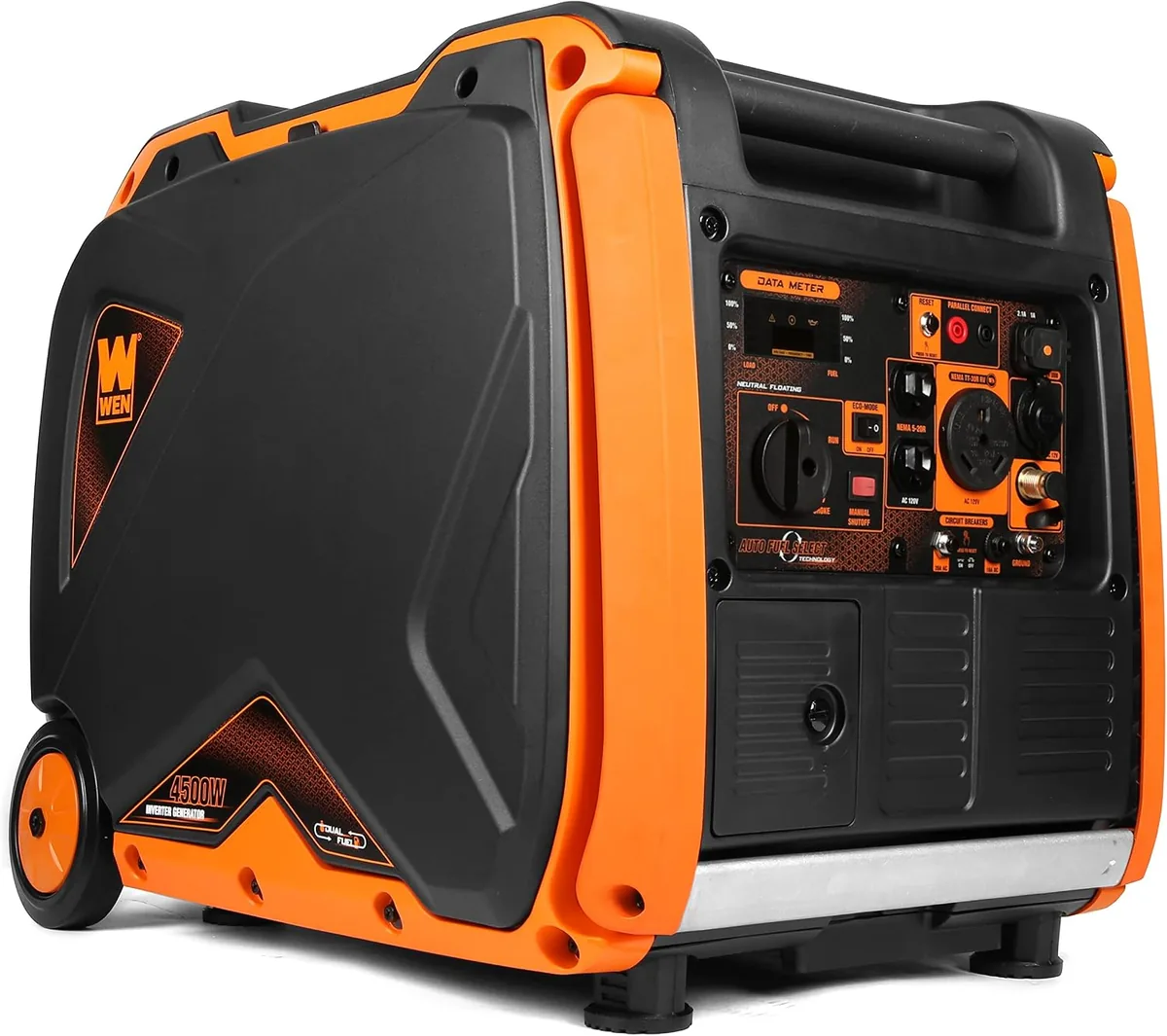
The DF450i is the quiet generator I can defend with a number: 58 dBA at 25% load from 22 feet, according to WEN. It is the only fuel generator on this page whose rating names both a load and a distance, so I know what the figure means when I stand at the house. It also runs on propane or gasoline, holds 3,500 running watts on gasoline and carries a 30 A RV outlet. I recommend it to anyone who wants a quiet unit for camp, RV or the odd outage and can live with 100 lb and a pull cord.
WHY I CHOSE THIS ✓
I put it first because it is the one quiet generator here that tells me what its number means. A rating at 25% load from 22 feet lets me judge the sound at the house, and two fuels with a 30 A outlet give it work beyond camping. I still read 58 dBA as a rating, because the engine speeds up with the load.
WEN DF450i 4,500-Watt Dual Fuel Inverter Generator Specs
Key Features:
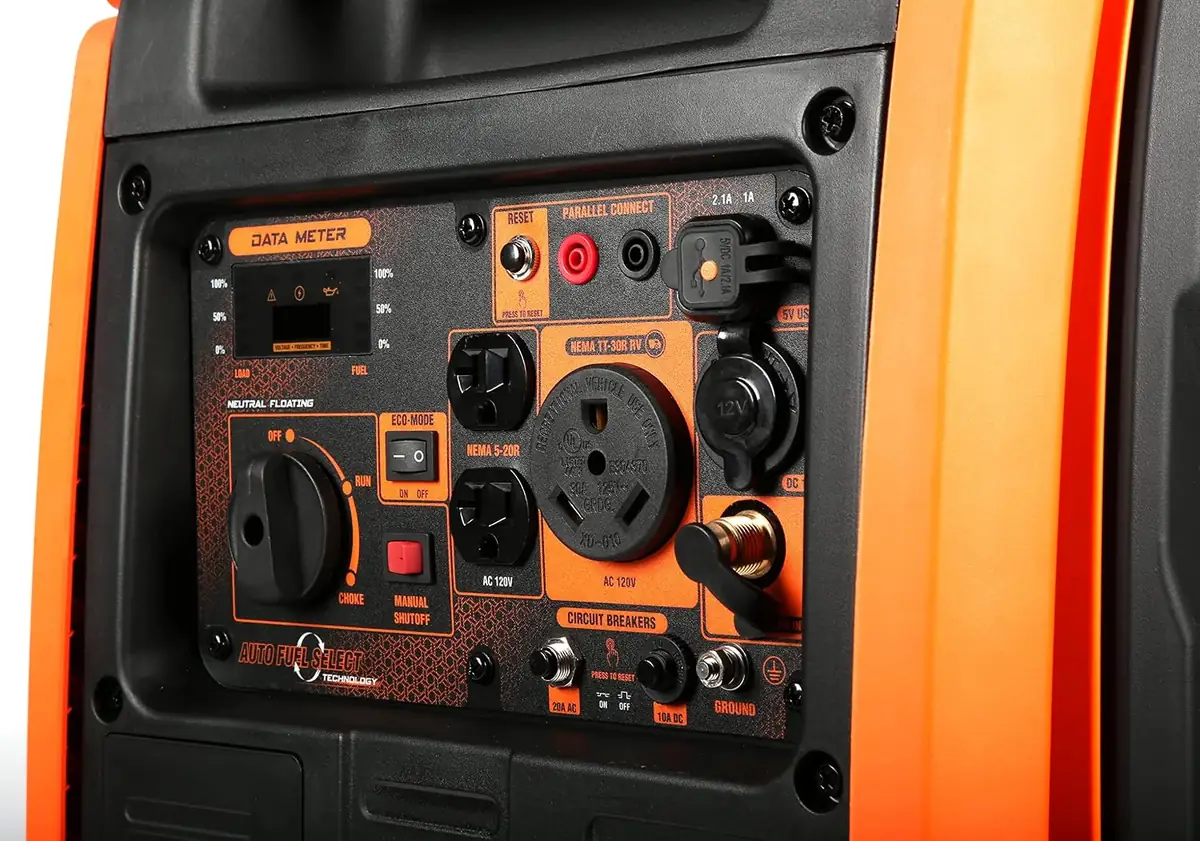
- A noise rating with its conditions: WEN prints 58 dBA at 25% load from 22 ft, so the number tells me how it will sound at a known distance and a light load.
- Automatic fuel selection: With a propane tank attached and its valve open the engine runs on propane, and it falls back to gasoline when the tank is shut or empty.
- Eco-Mode: Engine speed follows the load for less fuel and less noise, and WEN limits it to loads under 2,625 W on gasoline.
- 30 A RV outlet: A TT-30R socket sits beside two 20 A household outlets, a 12 V DC port and a USB port.
- 3-in-1 switch with fuel shut-off: The unit can burn off the fuel in the carburetor before it stops, which helps before storage.
- Digital meter: It shows voltage, frequency and run time, with a reminder every 50 hours and load and fuel bars.
- Parallel port: WEN sells a parallel connection kit separately, so a second unit can join this one later.
With only the workshop lights and a battery charger plugged in, the engine note dropped as Eco-Mode let the revs fall, and the unit became easy to ignore from the yard. The 58 dBA rating is a quarter-load figure, so a heavier load means a faster engine and a louder one. I keep Eco-Mode off above 2,625 W on gasoline, the limit in the manual. WEN advises holding continuous load to 90 percent of the rating, which is 3,150 W on gasoline.
Open the valve on a 20 lb propane tank and the unit takes propane first, close it and it runs on gasoline. Propane gives 3,150 running watts against 3,500, so I size the job for the lower figure. According to WEN the half-load run time is 8.5 hours on the 2.2 gal gasoline tank and 9 hours on a 20 lb cylinder. I keep the cylinder with the other farm fuel, because propane stays good in the tank where gasoline goes stale.
On a cold morning the dial goes to CHOKE, I pull slowly to resistance and then quickly, and the second pull sometimes decides it. I let it run several minutes before I add a load, as the manual says. At 100 lb the wheels and folding handle carry it from the machinery shed to the gravel pad, but a step or a truck bed takes two people. For a long cord run I use the manual’s chart, which allows 125 ft of #10 wire at 20 A.
Remove or switch off the loads before you change fuels, and test every propane joint with soapy water, as the manual requires.
Run it outdoors only, at least 20 feet from the house and from every door, window and vent, with the exhaust pointed away, as the CPSC and CDC advise. WEN’s manual describes no carbon monoxide shutoff for this model, so a quiet engine is no reason to move it closer, and battery CO alarms belong inside the house.
The unit ships without oil, takes 18.6 fl oz and has a low-oil sensor that stops it, so check the level on level ground before every run. Refuel outdoors with the engine off and cool for at least 2 minutes, and run it for 20 minutes once a month, as WEN asks. What annoyed me was the pull cord on days when I wanted the unit running before the coffee.
Buy it if you want a quiet generator for an RV with a 30 A cord, a camp or a few cord-connected loads at home, and you stand it 50 ft or more from where you sit. Skip it if you need electric start, a light carry, 240 V or a whole-house backup. WEN’s manual itself says a permanently installed standby generator suits house backup better.
FINAL VERDICT
Pick the DF450i when you want a quiet generator with a rating you can read and enough watts for an RV or a workshop. It costs you weight and a pull cord. It suits the buyer who runs one unit on two fuels and keeps it far from the house.
It is the dual fuel inverter whose noise rating I can read.
2. Honda EU2200i 2,200-Watt Inverter Generator Best Premium
Honda prints two noise figures for the EU2200i, 48 dB(A) at quarter load and 57 dB(A) at rated load, and names no distance for either. I read them as Honda’s own scale, because a figure without a distance cannot be set against another maker’s. The case for Best Premium is plainer: 47.4 lb, a built-in carbon monoxide shutoff and a 3-year residential warranty. It suits a fridge, lights, a router and chargers, and little else.

WHY I CHOSE THIS ✓
Second place goes to it because it is the Honda I hand to anyone who wants a CO shutoff on a unit one person carries. A sensor, 47.4 lb and a rating that covers a short load list sum up a short outage. The premium price is the cost, and I accept it for the sensor.
Honda EU2200i 2,200-Watt Inverter Generator Specs
Key Features:
- CO-MINDER: The engine stops before carbon monoxide near the unit passes a set level, and the manual says to move the unit and never cover it with a board or a tent.
- Eco Throttle: A switch lowers engine speed at light load for less fuel and less noise, and the manual says to turn it off when several big loads start together.
- Oil Alert: The engine stops on low oil, so the level check on level ground matters before each run.
- Parallel option: Honda’s optional cable links it to a second EU2200i, or to an EU2000i in the serial ranges the manual lists.
- Two 20 A outlets: Two 125 V receptacles carry household plugs, and this variant has no 30 A outlet.
- Small footprint: At 20.0 x 11.4 x 16.7 in. it stores easily once the tank is drained as the manual’s storage section describes.
- Overload indicator: A red light warns when the load is too high, and the manual says a marginal overload can shorten the unit’s life.
Next to my old open-frame generator, the EU2200i at light load is the difference between shouting and talking at the gravel pad. With Eco Throttle on, the engine note settles to a steady hum while the fridge cycles and the lights stay on. Honda rates it at 1,800 W, with 2,200 W as the maximum, so a fridge, lights, a router and chargers fit. A motor start can trip the overload alarm, and then I unplug a load and start again.
According to Honda the 0.95 gal tank gives 3.2 hours at rated load and 8.1 hours at quarter load, so the box figure is the light-load one. I plan the refill for the heavy day. The fuel filler has a vent lever, and I fill outdoors and stop at the red mark on the strainer.
On the gravel pad I stand it with the exhaust pointing across the yard, away from the sheds and the house, and with 3 ft clear on every side and above it. When the CO ALARM light flashes, the manual says to move the unit to a new spot and wait for the light to go out before a restart. If it stops again more than twice, take it to a dealer; the sensor wears out and needs replacing in time. The limit is the 1,800 W rating: a well pump, a 240 V motor or a big workshop belongs to a larger unit.

Watch the sensor light: a flash every 4 seconds means 6 to 12 months of CO sensor life left, and every 2 seconds means 6 months or less. The muffler stays hot after shutdown, so I keep my hands and the fuel can away from it and let it cool before it goes back in the shed.
The CO-MINDER is a backup, not permission. Honda says it cannot prevent all danger, so the unit stands outdoors, 20 feet from the house as the CPSC advises, with the exhaust pointed away from doors, windows and vents and battery CO alarms inside the house.
Oil is 14 oz of 10W-30, the first change comes at 20 hours. Before the season I add stabilizer and drain the carburetor, the manual’s storage advice, because fuel left there goes off first. At full load it is loud next to its idle, and the small tank means a refill about every 3 hours.
A fridge, lights, a router and phone chargers are what this unit was made for, and a workshop battery bench fits too. A second unit can join it through the parallel cable if the list grows. Skip it if the list holds a well pump, a 240 V motor, an RV air conditioner or a 30 A RV cord.
FINAL VERDICT
The EU2200i is for the household with a short must-run list and a wish for a CO shutoff on a unit one person carries. It trades watts and outlets for weight and a famous name. Pick it when the list fits inside 1,800 watts.
It is the small Honda with a CO shutoff for a short load list.
3. WEN 56235i 2,350-Watt Inverter Generator Best Value
The 56235i is the budget-tier inverter that gives me a printed noise figure on a light frame: 51 dB at quarter load, according to WEN, with no distance named. It weighs 39 lb and holds 1,900 running watts, which is enough for one fridge, the lights and a router. For small loads it is the best quiet generator for the money on this page, and it carries the Best Value label for that job only.

WHY I CHOSE THIS ✓
I chose it for value in one lane: a 39 lb inverter with a printed noise figure at a budget price. Under 1,900 watts, with a short load list, the budget tier is hard to argue with. Outside that lane I buy a bigger unit.
WEN 56235i 2,350-Watt Inverter Generator Specs
Key Features:
- Eco mode: Keep it on below 1,000 W and off above that, when engine speed has to follow a bigger load.
- Light frame: The manual gives 39 lb and does not say whether that is dry.
- Outlet set: One 120 V, 20 A duplex (two receptacles), a 12 V DC port and two USB ports, all on 120 V only.
- Fuel-off position: The engine switch has a fuel-off setting, so the carburetor can run dry before storage.
- Low-oil shutdown: A sensor stops the engine and blocks a restart until the oil is topped up.
- Overload light and breaker: The panel warns before the unit shuts a load down.
- Parallel port: WEN’s parallel kit, sold separately, links two WEN generators.
The first time I started a shop compressor with the lights already on, I had added only the compressor’s running watts, and the overload light came on at the start. WEN rates the unit at 1,900 W and advises staying at or below 1,710 W, which is 90 percent. Now I start the biggest motor alone and add the lights after it, the order the manual gives. Eco mode stays on for the lights and the router and goes off for the motor.
At 39 lb it is the unit I move without thinking. I carry it from the tool shed to the gravel pad by hand, and a truck bed is not a lift. According to WEN the 1.06 gal tank runs 5.7 hours at half load, so a night of lights and a router fits one tank on the lighter loads, and a heavier night needs a refill in the dark. WEN lists total harmonic distortion under 0.3 percent at no load and under 1.2 percent at full load, which suits chargers and a laptop.
WEN’s load chart lists a refrigerator or freezer at 800 W running and 1,200 W to start, and a sump pump at the same two numbers. I keep the running total under 1,710 W, and I check that the running total plus the largest motor’s extra start-up watts stays under the 2,350 W starting rating. Above 2,000 ft the manual calls for a high-altitude kit, which my flat lowland does not need, and it asks for 2 ft of clear space on every side. The limit I found is the plug count: two 20 A outlets run out fast when a charger bench, lights and a fridge all want a socket.

Match the cord to the run: the manual’s chart allows 100 ft of #12 wire or 65 ft of #14 at 15 A. The manual also asks for the frame to be grounded to a rod with No. 12 wire, and I follow that on a long cord run.
This model has no carbon monoxide shutoff, so distance and alarms are the only protection. Run it outdoors, 20 feet from the house as the CPSC advises, which is far past the 5 ft the manual gives as the minimum from buildings, and keep battery CO alarms inside.
The oil holds 15 fl oz, and the sensor stops the engine when the level falls. Refuel outdoors with the engine off and cool for at least 2 minutes, and drain the carburetor after each use and before storage, as the manual says. WEN also asks for a 20 to 30 minute run every month. Pull start is plain, with no electric start, and I expected nothing else at this tier.
Small loads fit when their nameplates add up: a fridge or a sump pump at 800 W running leaves room for the lights and a router, but both together pass 1,710 W once one of them starts. Skip it if you need a CO shutoff, a 30 A RV outlet, 240 V or more than 1,900 watts. It is also the weakest unit on this page on warranty, with 2 years for the original home purchaser. WEN says to use fuel within 30 days of purchase and never to leave it in the tank for more than 2 months.
FINAL VERDICT
Choose the 56235i when the load list stays under 1,900 watts and the budget is tight. It gives up a CO shutoff, a long warranty and a printed distance. Buy it for one fridge, the lights and a router, and nothing heavier.
It is the budget inverter I keep for small loads.
4. Westinghouse iGen5000 5,000-Watt Inverter Generator Best Quiet 5000 Watt
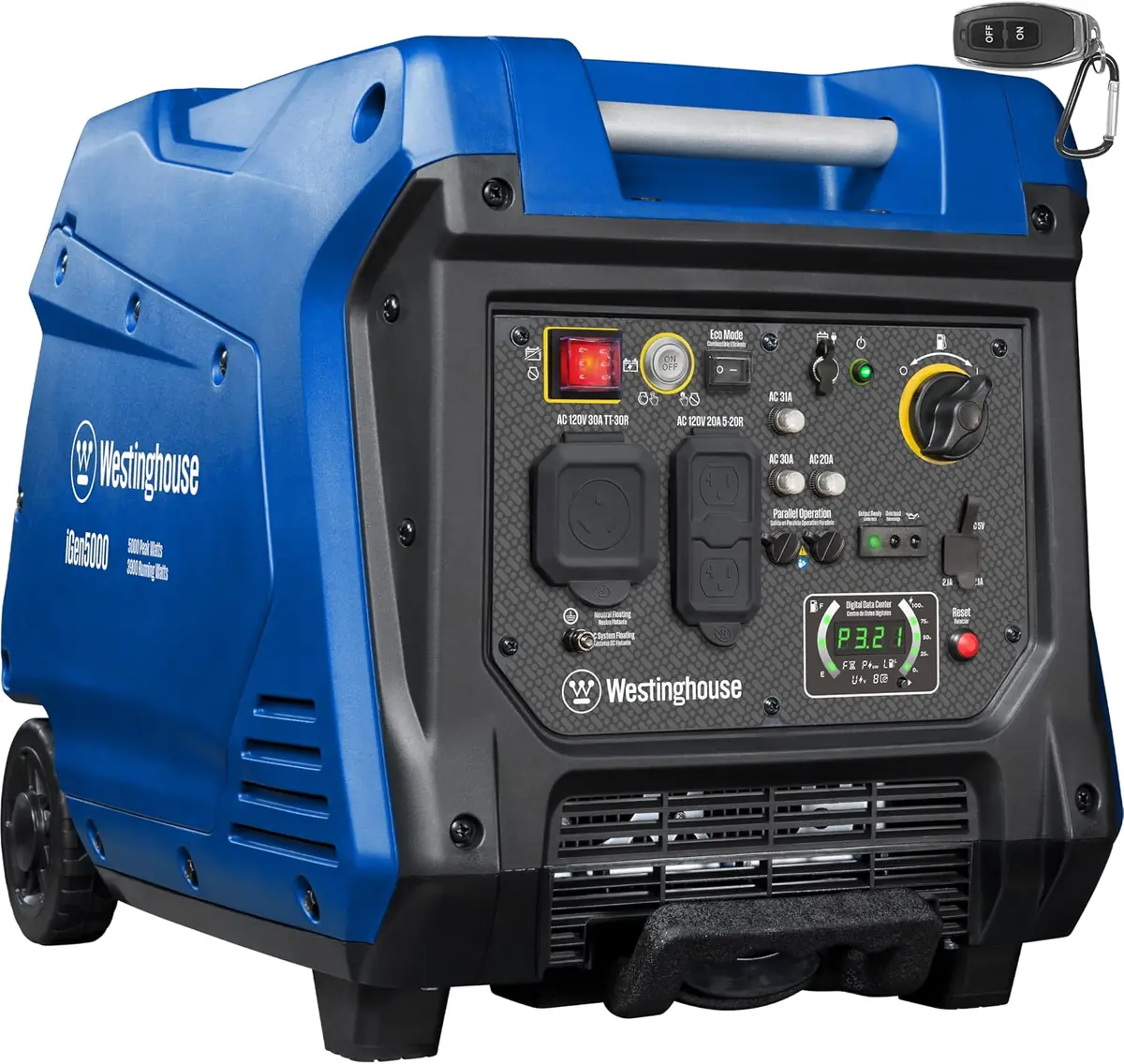
The iGen5000 is the largest inverter on this page, with 3,900 running watts and 5,000 peak, a 30 A RV outlet and a 3.4 gal tank. Westinghouse says the noise is as low as 52 dBA and names no load or distance, so I rank it for size, not for a decibel race. On a quiet generator 5000 watt shortlist, plan on the 3,900 running watts, because the 5,000 lasts a few seconds.
WHY I CHOSE THIS ✓
It sits fourth because it has the most running watts of any fuel unit on this page, with a 30 A RV outlet. Westinghouse quotes total harmonic distortion of 3 percent or less, so the power is clean for chargers and electronics. The noise claim carries no distance, so I pick it for size, not for quiet.
Westinghouse iGen5000 5,000-Watt Inverter Generator Specs
Key Features:
- Eco mode: Engine speed follows the load for less fuel and less noise, and it goes off for a pump or another large surge.
- 30 A TT-30R outlet: The RV socket sits beside a 20 A duplex outlet and two USB ports.
- Three ways to start: A remote key fob, an electric push button and a recoil handle, with the battery switch on before an electric start.
- LED data center: It shows fuel level, kilowatts, volts, remaining run time and lifetime hours.
- Parallel capable: It links to a compatible Westinghouse inverter, and the cable is sold separately.
The start order is eco mode off, a wait for the OUTPUT READY light, then eco mode on. Overload protection cuts the AC output while the engine keeps running, so I unplug a load, press reset and add loads back one at a time. I size every job for the 3,900 running watts and treat the 5,000 on the box as a few seconds of headroom for a motor start.
At 104.7 lb dry the built-in wheels and handle are a necessity. They roll well over the hard gravel yard, but they sink in the soft grass beside the plum rows, so I lay two boards across the strip and push from behind. According to Westinghouse the 3.4 gal tank runs up to 18 hours at 25% load.
Turn the battery switch on before a key fob or push-button start; the recoil handle works without the battery.
This model has no carbon monoxide sensor, so distance and alarms are the only protection. I keep it 20 feet from the house as the CPSC advises, give it the 5 ft of clear space the manual asks for on all sides and overhead, and keep battery CO alarms inside.
It burns E10 gasoline at most and takes 0.63 qt of 10W-30. The maker lists it as not CARB compliant, so check that it ships to your state. What annoyed me was the weight the moment a step was involved.
It suits an RV with a 30 A hookup, a job site that wants clean power, or the essentials of a house wired through an electrician’s transfer switch. Skip it if you want a CO shutoff, propane, a unit under 50 lb or a 240 V outlet. I cover this remote-start inverter in my review of the Westinghouse iGen5000.
FINAL VERDICT
Pick the iGen5000 when the load list needs 3,900 running watts at an RV socket or a transfer switch and you can move 104.7 lb. It gives up a CO sensor and an easy carry. The decision rests on watts, not on its 52 dBA.
It is the 3,900 watt inverter for an RV or a job site.
5. Champion 201050 4,000-Watt Dual Fuel RV Ready Inverter Generator Best Quiet RV Generator
At 51.8 lb the 201050 puts a 30 A RV outlet on a frame that one person can lift. Champion rates the noise at 64 dB(A) from 23 feet, though it does not state the load. Propane hose, oil and funnel come in the box, and the engine runs on gasoline or propane.

WHY I CHOSE THIS ✓
Fifth place suits it because it is the RV-ready unit I can lift alone. A 51.8 lb frame goes into a truck bed with a single heave. Output is the cost.
Champion 201050 4,000-Watt Dual Fuel RV Ready Inverter Generator Specs
Key Features:
- TT-30R RV outlet: A 25 A, 120 V RV socket sits beside a 20 A duplex outlet and a 12 V DC port.
- Dual fuel with a hose in the box: One EZ Start dial handles off, run, choke and fuel choice, and the gasoline start needs the propane hose disconnected.
- CO Shield: The engine shuts off when the sensor detects unsafe carbon monoxide, and a red LED blinks.
- Parallel ready: Two outlets take Champion’s parallel kit, which is sold separately.
- Eco mode: It lowers noise and fuel use at light load, and the manual says to turn it off for high loads or sudden swings.
Gasoline gives 3,000 running watts and propane 2,700, about 90 percent, while the 4,000 starting watts stay the same on both. The manual’s order is no load at start, a few minutes of warm-up, then the largest load first and the small ones after it. An RV air conditioner is the load to check first: I read its nameplate against the 3,000 running watts before I trust the outlet. My Generac and Champion generator comparison lines this unit up against the iQ5200DF.
In cold weather ice on the tank valve, the hose or the regulator weakens the propane flow, and the manual says to swap cylinders or warm one. On a frosty morning I swap to a second cylinder when the first one frosts over, and neither cylinder ever comes indoors. According to Champion a 20 lb cylinder runs up to 25 hours at 25% load, against 10 hours on the 1.54 gal gasoline tank.
Test every propane joint with soapy water before the first use and after each cylinder change, and check the hose for leaks every 8 hours of running.
CO Shield is a backup, and Champion says it is no substitute for a carbon monoxide alarm or for running outdoors. The unit stands 20 feet from the house as the CPSC advises, with 3 ft clear on all sides and 5 ft from anything that burns, and never in a garage, shed or RV compartment, even with the door open.
Recoil start is the only start, so every start is a pull, and the manual warns that rapid cord retraction can injure a hand or arm. The oil is 0.5 qt of 10W-30. Keep it out of rain and snow, as the manual says.
A 30 A RV cord, a camp, a tailgate and a few cord-connected loads at home are its work. Skip it for whole-house backup, a 240 V pump or a buyer who wants electric or remote start. I cover this 4,000-watt dual-fuel inverter in my Champion 201050 review.
FINAL VERDICT
Choose the 201050 for an RV trip or a camp where you lift the generator yourself. It costs you electric start and 240 V. The number to remember is 64 dB(A) at 23 feet.
It is the dual fuel RV unit I can lift alone.
6. Honda EU3200i 3,200-Watt Inverter Generator Best Quiet Home Generator
The EU3200i is the Honda for the day the must-run list outgrows 1,800 watts but still fits a house’s essentials. Honda prints 54 dB(A) at quarter load and 58 dB(A) at rated load, with no distance, so the figures describe this machine’s own range and not a rank against other makers. It carries 2,600 rated watts, a 30 A twist-lock outlet and a carbon monoxide shutoff, and the premium price tier is the first thing to weigh.

WHY I CHOSE THIS ✓
It sits sixth because it is the step up for a house’s essentials that keeps a CO shutoff on a 2,600 W machine. Honda’s printed figures stay modest at both loads. The premium price is why it sits below the top five.
Honda EU3200i 3,200-Watt Inverter Generator Specs
Key Features:
- CO-MINDER: The engine stops before carbon monoxide near the unit passes a set level, and a CO ALARM light flashes for about 5 minutes.
- Two outlet types: A 30 A twist-lock receptacle and a 20 A duplex, and the two sockets of the duplex share a 20 A limit.
- Eco Throttle: A switch, or the phone app, lowers engine speed at light load.
- Bluetooth app: It shows start-up status and handles Eco Throttle and stop from a smartphone.
- Parallel option: Honda’s optional cable links it to another EU3200i only, for a rated 5.2 kVA pair.
The 2,600 rated watts is the size where a fridge, a freezer, the lights and a router can share one unit, if their nameplates add up. In my workshop the battery chargers and the lights come first, and the heavy tools wait. Honda lists 3,200 W as the maximum, and a motor that starts above the rating trips the red overload indicator.
According to Honda the 1.21 gal tank gives 3.3 hours at rated load and 8.6 hours at quarter load. I plan the refill for the rated-load figure. I fuel it outdoors with the engine off and cool, and the manual wants it at least 10 ft from the fuelling spot before it starts, so I paced the distance once and set a stake in the gravel.

The 30 A outlet is a twist-lock type, so match the plug on your cord before you buy.
The CO-MINDER is a backup, and Honda says it cannot prevent all danger. It stands outdoors, 20 feet from the house as the CPSC advises, with 3 ft clear around and above it, and if the CO ALARM light flashes I move it and let the light go out before a restart.
Oil Alert stops the engine when the 15 oz level is low. At 59.0 lb dry, and 67.68 lb in operation per Honda, it has no wheels in the manual’s specification, so I carry it with two hands and avoid steps.
A fridge, a freezer, lights and a workshop battery bench fit, and a second EU3200i can join later through Honda’s cable. Skip it if the budget is tight, if you need electric start, a 240 V outlet, a well pump or a whole-house backup. The Honda EU2200i and EU3200i comparison on this site sets size, noise and weight side by side.
FINAL VERDICT
Buy the EU3200i when 1,800 watts is too little, a CO shutoff matters and the premium price is acceptable. It will not run a well pump or a central air conditioner. Its buyer pairs it with a second unit later, not with a bigger plan today.
It is the Honda step up for a house’s essentials.
7. EcoFlow DELTA 3 Max 2048Wh Power Station Best Portable Battery Generator
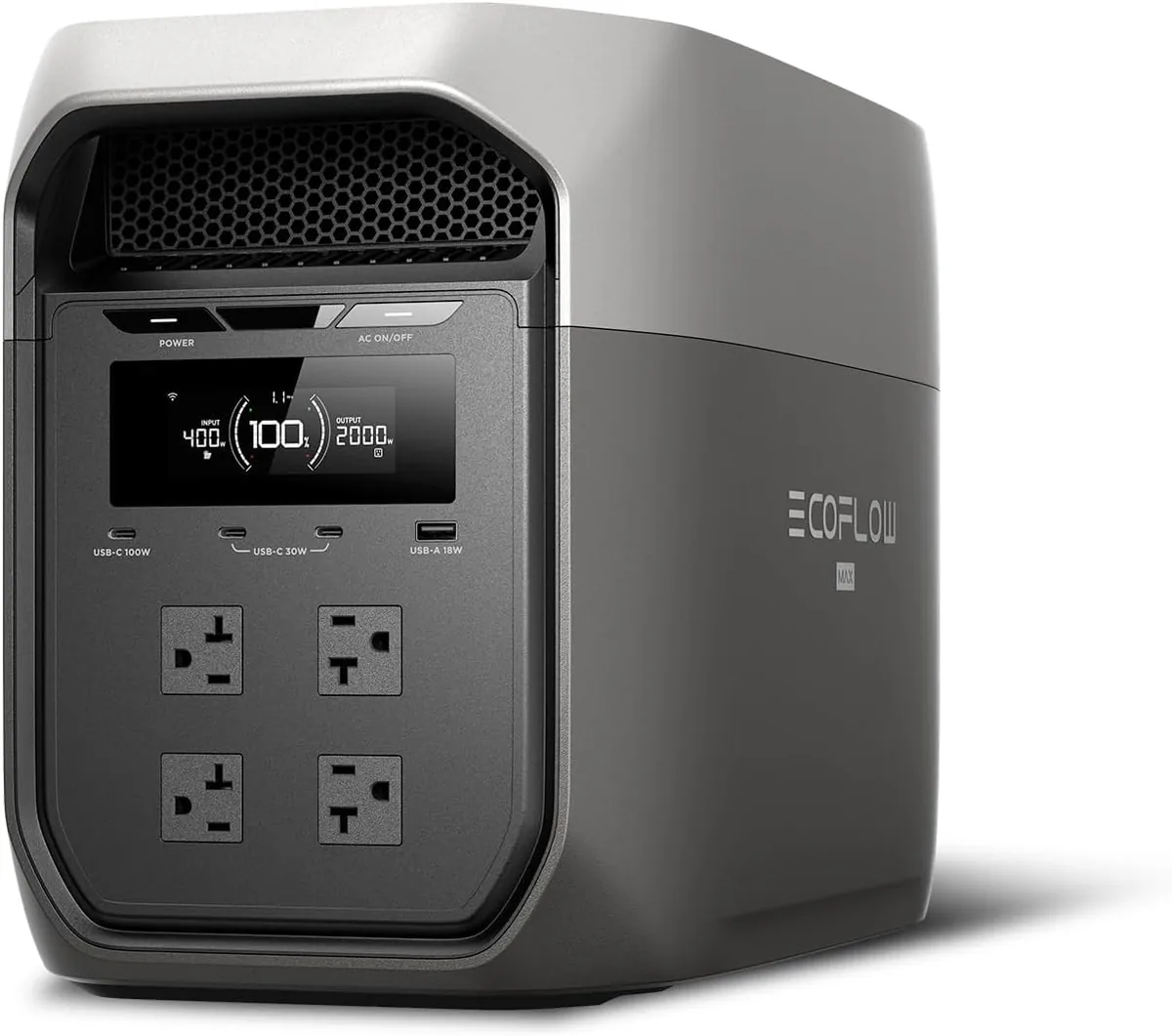
The DELTA 3 Max is a battery with an inverter, so it burns nothing, makes no exhaust and, according to EcoFlow, runs at 25 dB or less from 1 meter at a 600 W load. EcoFlow publishes no figure for higher loads, so the rating covers a moderate draw, not 2,400 W. It holds 2,048 Wh and suits lights, a router, a laptop and a fridge in a short outage.
WHY I CHOSE THIS ✓
I included it because it makes no exhaust and needs no fuel. For lights and a router through a night, a battery I recharge beats a can I refill. It is not a fuel generator.
EcoFlow DELTA 3 Max 2048Wh Power Station Specs
Key Features:
- Four AC outlets: Four 120 V outlets share the 2,400 W total, with 20 A at most on each, and one USB-C port gives up to 100 W while two more USB-C ports share 30 W.
- Fast wall recharge: EcoFlow rates 1,800 W of input and 0 to 80% in 68 minutes in optimal conditions.
- Switchover under 10 ms: Pass-through mode sits between the wall and a router or desk, capped at 13 A.
- App control: The EcoFlow app works over Wi-Fi and Bluetooth, and it holds the AC timeout setting.
- Solar input: A single XT60i port takes 11 V to 60 V and up to 500 W, with panel voltage kept under 60 V.
The freezer was the surprise. Its compressor cycles, so the draw sat far below its label and the station outlasted a straight division of watt-hours. It worked only after I set the AC timeout to never in the app, because the idle cutoff switches the outlet off between cycles, as the manual warns for refrigerators.
For a rough sum I allow 85 percent of the 2,048 Wh for inverter loss, about 1,740 Wh, so a steady 100 W load runs about 17 hours and a 1,000 W load about 1.7 hours. At 44.8 lb with no wheels in the box, it was awkward to carry across the gravel yard. I use both side handles, because the manual says never to lift it by one.

Plug the biggest load in first: the four outlets share 2,400 W, and an overload warning blinks when the sum passes it.
It is IP20, not weatherproof. Keep it dry, protect it with a waterproof bag in rain or near water, and never use it for life-sustaining equipment, as the manual says.
It will not charge below freezing, though it discharges down to 14 F. One frosty morning the station in the shed took no charge until it warmed, so now I bring it into the house the day before. For storage the manual asks for a charge cycle every 3 months, and a unit left unused for more than 6 months voids the warranty.
A laptop, a router, lights and a fridge under 2,400 W fit. Skip it if you need 240 V, a 30 A RV inlet, a well pump or central air, or if the outage may last days, because the run ends when the battery does. My EcoFlow and BLUETTI comparison puts the DELTA 3 Max against the BLUETTI Elite 200 V2.
FINAL VERDICT
Choose the DELTA 3 Max when a quiet night matters more than a long run and the loads stay under 2,400 watts. It gives up fuel and 240 V. Think of it as a battery you recharge, never as a tank you refill.
It is the quiet battery unit for lights and a router.
How to Choose the Best Quiet Generator
Seven checks sort a quiet generator, and the first is what the decibel figure actually says. I run them in this order, because a noise number without its conditions cannot be compared and the rest of the choice depends on it.
Read Every Decibel Figure With Its Distance and Load
A decibel figure means something only with its distance and its load. Makers print four kinds of statement, and only the first can be set beside another figure of the same kind.
| What the maker prints | Example form | What you can do with it |
|---|---|---|
| Load and distance | 58 dBA at 25% load from 22 ft | Compare with figures at the same load and distance |
| Distance only | 64 dB(A) at 23 ft | Wait to compare until the load is confirmed |
| Load only | 48 dB(A) at 1/4 load | Read it as that machine’s own range |
| Neither | As low as 52 dBA | Treat it as a size-class label, not a measurement |
A number with a distance beats a lower number without one, because you cannot tell what the lower number was measured against. I rank no unit as quieter than another from figures in different rows. The best quiet portable generator for your yard is the one whose rating you can read. My roundup of the best portable generator covers a wider range of jobs.
Noise is also a nuisance in its own right. In a pilot study of one university building, noise from portable generators averaged 60.26 dB indoors and 58.15 dB outdoors, above WHO guideline limits, and occupants reported ear pain and tiredness (1). It is a small study with self-reported symptoms, so I read it as a reminder that a unit near the house is a daily annoyance.
Why Quarter-Load Figures Flatter an Inverter
An inverter drops engine speed when the load falls, so a quarter-load figure shows the machine at its best. One maker prints 48 dB(A) at quarter load and 57 dB(A) at rated load for the same unit, a gap of 9 dB. A quarter-load figure describes light-load operation only, so compare it solely with figures at a matching load and distance, and remember that the load you run decides what you hear.
- Eco mode or Eco Throttle lowers engine speed at light load, and the manuals say to turn it off when a pump or several large loads start together.
- Conventional generators run the engine at one fixed speed, while an inverter varies it with the load. Open frame describes the housing, not the engine control, so ask the maker which one a model uses.
- Battery units have no engine, but a fan rises with the load, and the one battery figure on this page is for 600 W only.
Pro Tip
Ask for the figure at the load you will run, the fridge and a few lights or the whole workshop, and buy on that number.
Inverter, Open Frame or Battery Unit
The best quiet inverter generator for most yards is one that spends most of its time below half load, which is why inverters fill six of the seven places here. I leave open-frame machines off the list because their makers print figures such as 74 dBA with no distance, and I do not call that quiet. My ranking of the best inverter generator looks at clean power as well as noise.
| Type | Noise behavior | What it costs you |
|---|---|---|
| Inverter | Engine speed follows the load | Lower top output and a higher price per watt |
| Open frame | Fixed engine speed in a conventional design; some open-frame inverters vary it | Often louder and heavier, with more watts and 240 V |
| Battery unit | No engine, a fan at high load | A fixed store of energy, so a heavy load empties it fast |
Running Watts, Weight and the Job You Need Done
Add the running watts of everything that must run together, then add only the extra start-up watts of the largest motor. Read the nameplate of your own pump or freezer, because a table is only a guide. Start the biggest motor first and add small loads one at a time, the order several manuals give.
- Running watts are what a unit holds for hours, and starting watts are a peak that lasts a few seconds.
- A 120 V unit cannot run a 240 V pump, so check the pump before you check the generator.
- Eco mode has a load limit in each manual, so keep the sum under it when you want the quiet.
The weights on this page run from 39 lb to 104.7 lb, and one maker does not say whether its figure is dry. I move a generator with my own back, so I read the weight before the watts. The best small quiet generator is the one a single person can set down at a safe spot. My WEN 56235i review covers the 39 lb unit on this list.
Gasoline, Propane or a Battery
Propane stores for years without gumming a carburetor, and gasoline goes stale. Dual fuel units give up some watts on propane, so size the job for the lower number. I compare gasoline-and-propane options for backup power in my dual fuel generator picks.
| Unit class | Gasoline | Propane |
|---|---|---|
| Mid-size dual fuel inverter | 3,500 | 3,150 |
| Smaller dual fuel inverter | 3,000 | 2,700 |
Propane gives about 90 percent of the gasoline figure in both rows. A battery unit burns nothing, so a closed room is no carbon monoxide risk from it, but its run ends when its energy is gone. Fuel handling differs by model, so read the manual of the machine you buy.
Outlets, Voltage and the House Connection
Read the plug on your appliance before you read the generator. For the best quiet generator for RV use, look for a 30 A TT-30R socket, which three units here carry. My RV generator picks match each outlet and weight to the rig.
- 20 A duplex outlets run ordinary household plugs and tools.
- A 30 A RV socket takes an RV cord, and a 30 A twist-lock needs a matching plug.
- A house connection runs only through a transfer switch or an interlock fitted by a licensed electrician.
OSHA says never to attach a generator directly to a building’s wiring without a transfer switch, because power fed back can energize lines and kill utility workers. I run a grounded, outdoor-rated cord from the generator to each appliance and lay it where nobody trips on it. The best quiet generator for home use still needs that electrician for any house connection. I compare options for keeping household loads running during an outage in my top home backup generators.
Hearing Protection Beside a Running Unit
NIOSH recommends a limit of 85 dBA averaged over an eight-hour workday, and it recommends halving the exposure time for every 3 dBA increase (2). That is a workplace limit, not a rule for a yard, but it shows why a few decibels matter when you stand beside the unit. I put earmuffs on when I work next to a running generator for more than a few minutes, whatever its rating says.
Where to Put a Quiet Generator on Your Land
A quiet engine tempts you to set the unit closer, and that is the mistake that kills. Placement is a safety rule first and a noise rule second.
Carbon Monoxide Sets the Distance
The CPSC says to run a portable generator outside only, at least 20 feet from the house, with the exhaust pointed away, and the CDC says to keep it 20 feet from doors, windows and vents. After a major ice storm in Maine, gasoline generators were the CO source in 30 incidents, and the strongest risk factor for poisoning was a generator in a basement or an attached structure such as a garage (3). After four hurricanes struck Florida in 2004, misplaced portable gasoline generators caused nearly all of the CO exposures in a CDC analysis (4).
Alarms matter as much as distance. After a 2002 ice storm in North Carolina, 96.2 percent of the severe poisonings occurred in homes with no reported working CO alarm (5). NIST tests in an attached garage recorded peak house CO from under 10 ppm to over 10,000 ppm across seven door and ventilation setups, with the highest levels from a stock generator, the garage bay door closed and the house door open (6). I stand mine on the gravel pad with the exhaust pointed away from the sheds and the house, and I keep battery CO alarms on every floor.
Never Indoors
Never run a fuel generator in a garage, basement, shed, carport or on a porch, even with the doors and windows open. A CO shutoff is a backup and never a reason to move the unit closer.
Refuelling, Rain and Storage
- Refuel only with the engine stopped and cool, outdoors, and keep fuel in approved containers away from the unit and out of the house.
- Keep it dry, use a cover or canopy only as the manual allows with the exhaust open, and never touch it with wet hands or while standing in water.
- Storage differs by model: drain the carburetor as the manual says, and run a unit that sits for a short time each month when the manual asks for it.
A battery unit asks for different care. Lithium iron phosphate cells wear faster at high temperature, and a model of one cell type showed more cycling wear at a high state of charge (7). I store a station cool and follow the manual’s charge schedule between jobs.
My Overall Verdict
I ranked these seven on how clearly each maker states its noise, then on watts, weight and the manual’s safety rules. The top three suit three different households.
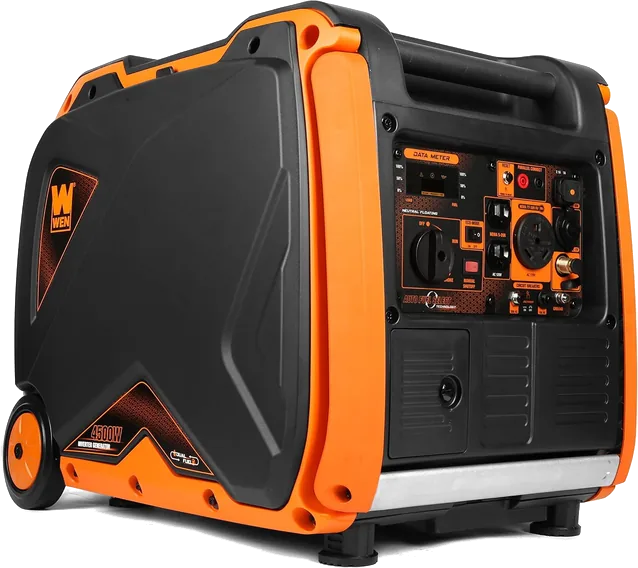
1. WEN DF450i 4,500-Watt Dual Fuel Inverter Generator Best Overall
For a camp, an RV or a few home loads, when you want a noise rating with its load and distance and can handle 100 lb.

2. Honda EU2200i 2,200-Watt Inverter Generator Best Premium
For a short list of small loads, when a built-in CO shutoff and a unit one person carries matter more than watts.

3. WEN 56235i 2,350-Watt Inverter Generator Best Value
For one fridge, lights and a router on a tight budget, when you accept a 2-year warranty and no CO shutoff.
Check the distance and the load behind every decibel number, then add up the running watts you need, run the unit outdoors and leave any house connection to an electrician. For a buyer who wants a rating he can read, the WEN DF450i is the best quiet generator on this page.
Why WEN DF450i 4,500-Watt Dual Fuel Inverter Generator Might Be the Best Choice
I put the WEN DF450i 4,500-Watt Dual Fuel Inverter Generator first because its noise rating tells me what it means: 58 dBA at 25% load from 22 feet, according to WEN. No other fuel unit here prints both a load and a distance, and that is the only honest basis for a ranking on noise.
The trade is weight and a pull cord. At 100 lb it rolls on its wheels but needs two people at a step, and WEN describes no CO shutoff, so I place it 20 feet from the house. Two other units print lower figures with no distance, so that comparison stays open. I cover this dual-fuel inverter for RV trips and camping in my review of the WEN DF450i.
What puts it first:
✓ Rating: 58 dBA at 25% load from 22 ft, according to WEN.
✓ Fuel: propane first and gasoline as backup, at 3,150 and 3,500 running watts.
✓ Outlets: a 30 A RV socket and two 20 A household outlets.
✓ Eco-Mode: engine speed follows the load for less fuel and less noise.
✓ Parallel port: WEN sells a kit that joins a second unit.
Frequently Asked Questions
What decibel is quiet for a generator?
The decibel figure that counts as quiet for a generator depends on its load and its distance, because a bare number means nothing alone. The inverters on this page range from 48 dB(A) at quarter load to 64 dB(A) at 23 feet, and those two figures cannot be set side by side.
What is the best quiet generator to buy?
The best quiet generator to buy on this page is the WEN DF450i, because its 58 dBA rating names both a 25% load and a distance of 22 feet. A short load list suits the Honda EU2200i for its built-in CO shutoff, and a tighter budget suits the WEN 56235i.
Which is the best quiet generator for camping?
The best quiet generator for camping is a light inverter, and here that means the WEN 56235i at 39 lb or the Honda EU2200i at 47.4 lb dry. Each prints its noise at quarter load with no distance, so use it as that unit’s own range and stand the unit 20 feet from the tent.
Which generator is the most fuel-efficient?
Fuel efficiency at light load is better on an inverter with an eco mode, because engine speed falls with the load and the engine burns less at light draw. Compare fuel burned for the same watts, not tank run time, since 25 percent and half load on different units are different wattages.
Where can I find quiet generators for sale?
Quiet generators are sold through makers’ dealers, home centers and online stores, and the same model can differ in price and warranty by seller. Check the seller, the return terms and who honors the warranty before you order, because a unit of 50 to 100 lb is hard to send back.
References
- Olamijulo JO. Noise from portable electric power generators in an institutional setting: a neglected risk factor. Int J Environ Monit Anal. 2016;4(4):115. doi:10.11648/j.ijema.20160404.11
- National Institute for Occupational Safety and Health. Noise-Induced Hearing Loss. Noise and Hearing Loss. Centers for Disease Control and Prevention; 2024.
- Daley WR, Smith A, Paz-Argandona E, Malilay J, McGeehin M. An outbreak of carbon monoxide poisoning after a major ice storm in Maine. J Emerg Med. 2000;18(1):87-93. doi:10.1016/S0736-4679(99)00184-5
- Centers for Disease Control and Prevention. Carbon monoxide poisoning from hurricane-associated use of portable generators – Florida, 2004. JAMA. 2005;294(12):1482. doi:10.1001/jama.294.12.1482
- Centers for Disease Control and Prevention. Use of carbon monoxide alarms to prevent poisonings during a power outage – North Carolina, December 2002. JAMA. 2004;291(14):1691. doi:10.1001/jama.291.14.1691
- Emmerich SJ, Persily AK, Wang L. Modeling and Measuring the Effects of Portable Gasoline Powered Generator Exhaust on Indoor Carbon Monoxide Level. NIST Technical Note 1781. National Institute of Standards and Technology; 2013. doi:10.6028/NIST.TN.1781
- Schimpe M, von Kuepach ME, Naumann M, et al. Comprehensive modeling of temperature-dependent degradation mechanisms in lithium iron phosphate batteries. J Electrochem Soc. 2018;165(2):A181-A193. doi:10.1149/2.1181714jes
Safety Note: Generator exhaust contains carbon monoxide, which can kill in minutes. Run a fuel generator outdoors only, never in a home, garage, basement, shed or other enclosed or partly enclosed space, even with doors or windows open. The CPSC says to place it at least 20 feet from your home and other buildings, with the exhaust pointed away from doors, windows and vents. Install battery-operated or battery-backup carbon monoxide alarms on every level of the home and outside sleeping areas. Never plug a generator into a wall outlet: connect it to a house only through a transfer switch or interlock installed by a licensed electrician. Refuel only with the engine off and cool, and read the manufacturer’s manual, including for a portable power station.