
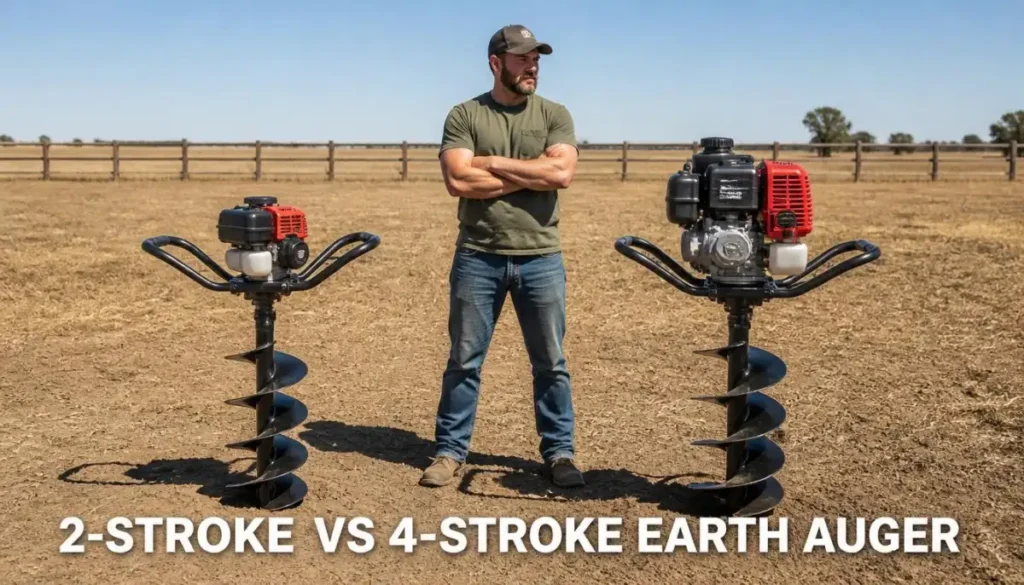
The 2-stroke vs 4-stroke earth auger choice comes down to the fuel can and the oil stick: a 2-stroke engine burns 2-cycle oil mixed into its gasoline, and a 4-stroke engine runs on plain gasoline and keeps its own oil inside. The engine type changes the chores around the machine, not the hazards at the bit. I run a 3.7-acre orchard and a family farm, so fuel cans, oil and winter storage are part of my year. Below I compare fuel, oil, break-in, weight, upkeep and storage, then the safety steps that stay the same.
2-Stroke vs 4-Stroke Earth Auger: The Short Answer
Pick the engine by the habit you will keep. A 2-stroke engine asks for correctly pre-mixed fuel every time you fill the tank, and a 4-stroke engine asks for an oil check before every use and an oil change on a schedule. I recommend you decide on that habit first and on engine size second, because neither engine type is safer at the bit and Champion’s two manuals print no digging speed for either one. My roundup of earth augers for real digging puts gas, corded and battery models side by side.
| Item | 2-stroke (Champion 200940, 52 cc) | 4-stroke (Champion 201092, 53.5 cc) |
|---|---|---|
| Fuel | Unleaded, 87 octane minimum, 10% ethanol or less | Unleaded, 87 octane minimum, 10% ethanol or less |
| Oil | 2-cycle oil mixed into the fuel at 50:1 | 5W-30 in the engine, 0.3 US quart supplied |
| Before the first start | Fill with the 50:1 mix | Add the oil: the unit ships without any |
| New engine | Smoke from a new engine is normal | Smoke is normal; 5-hour break-in, then change the oil |
| Routine check | Mix only as much fuel as you can use in 30 days | Check the oil level at every use |
| Service interval | Spark plug gap every 50 hours or each season; new plug each year | Same, plus an oil change every 50 hours or each season |
This is one maker’s pair of models with the same bit size, so read it as an example of what each engine type asks, and take the exact figures from the manual of the auger you own.
How Each Engine Works in an Earth Auger
Both engines turn the bit of a gas powered earth auger, and both are small air-cooled engines started with a recoil cord. According to LSU AgCenter engineer Dr. Dick Parish, a 2-stroke engine completes all five functions of its cycle in two strokes of the piston and is lubricated by oil mixed into the gasoline, not by a reservoir in the crankcase. A 4-stroke engine needs four strokes for the same five functions and keeps its oil in the crankcase, apart from the fuel. I explain how the engine drives the bit in my guide “how does an earth auger work”.
The 2-Stroke: Oil in the Fuel
Parish says 2-stroke engines have a higher power-to-weight ratio than most 4-stroke engines and rev up to higher speeds. The price is that much of the oil is not burned and leaves with the exhaust, which adds smoke, and spark plug fouling is more common because of the oil in the fuel. In a bench test of one portable 2-stroke gasoline engine, carbon-based matter made up 85% of the fine particles in the exhaust, and switching the 2-stroke oil brand cut total PAH concentrations by 46.4% and 59.7% compared with one reference oil (1). That was a single engine on a test bench, not an auger. Separately, Champion’s 2-stroke manual requires 2-cycle oil and forbids automotive oil and marine outboard oil. The same oil and smoke trade-off shows up on small yard tools, and my guide to 2-stroke and 4-stroke string trimmers lays out the engine differences that matter there.
The 4-Stroke: A Separate Oil Sump
A 4 stroke earth auger keeps its oil in the crankcase, the way a lawn mower does. According to Champion, its 53.5 cc 4-stroke model ships from the factory without oil, takes 5W-30, comes with 0.3 US quart in the box and must not be overfilled. Champion’s manual is the 4-stroke example in this article, so read each figure as that maker’s rule for that model and not as a law of the engine type.
Key Takeaway
Engine type changes the work you do before and after digging: mixing and dating fuel on a 2-stroke, checking and changing oil on a 4-stroke. It does not change the bit, the torque reaction or any safety step below.
Fuel and Oil: Pre-Mix Versus a Separate Oil Sump
Fuel is where the two engines differ most in daily life, and a mistake here costs you the engine or the warranty. Both Champion manuals require unleaded gasoline with a minimum octane rating of 87 and no more than 10% ethanol by volume.
Gas Auger Shutdown Box
Shutdown before you clear or free the bit, change or attach the bit, free a stuck bit, adjust, check or add oil or fuel, clean, load, move, store or leave the auger. Never reach toward the bit while it turns, and never clear it or free it with the machine running. Gas auger: release the throttle, trigger or control, turn the engine off, wait until the bit and every moving part have stopped completely, then disconnect the spark plug wire (a spark plug cap on some makes) and secure it away from the plug. Let the engine and muffler cool before you touch the bit or anything near the exhaust. Only then free a stuck bit or clear wrapped material, using only the method your manual specifies (gloves do not make grabbing sharp wire or cutting edges safe), and check the bit and guards for damage. Do not handle unidentified wire, cables or pipes. Do not use reverse or run the engine or motor to back the bit out unless your manual expressly authorizes it for this task, with both hands on the designated handles and everyone clear of the bit; complete the full shutdown again before any further hands-on work. Add every step your manual gives, in its order, and refit every guard and shield before you restart.
Mixing Fuel for a 2-Stroke
Every 2 stroke earth auger prints its own mix ratio, so use the number in your manual and no other. Champion, Echo and Powermate give 50:1, and another maker prints 40:1. According to Champion, 50:1 means 1 gallon of gasoline to 2.6 ounces of 2-cycle oil, mixed in a clean, approved gasoline container, shaken gently, and never in quantities larger than you can use in 30 days. Champion also says to use premium 2-cycle oil or an equivalent synthetic, never automotive oil or marine outboard oil, and not to crank the engine before it holds the correct mix.
| Gasoline | 2-cycle oil |
|---|---|
| 0.5 gallon | 1.3 ounces |
| 1 gallon | 2.6 ounces |
| 2 gallons | 5.2 ounces |
Champion tells you to fill the tank only to 80% of its 0.3 gallon capacity. That is about 0.24 gallon, so one gallon of mix fills the tank about four times. I label every pre-mix can with the ratio and the date, because a 30-day limit only works if the date is on the can. I treat that limit as a hard rule. I also keep that can apart from the plain gasoline can in the shed, so the two never get swapped.
Oil and Break-In for a 4-Stroke
The 4-stroke asks for a different routine. Before you check or add oil, complete the full gas shutdown in the shutdown box above. According to Champion, you check the oil level at every use with the machine resting firmly on level ground, and the first 5 hours of run time are the break-in period. During break-in Champion recommends blended non-synthetic oil, no bogging or lugging of the engine and no long runs at constant rpm, and after the 5 hours you change the oil. Synthetic oil is allowed after break-in, and Champion says it does not lengthen the oil change interval.
Champion’s schedule for the 4-stroke says to change the oil every 50 hours or every season, whichever comes first. A light user may never reach 50 hours, so the every-season limit applies first. The end of the season is a good time for it, when the machine goes into storage anyway.
Gasoline Quality for Both Engines
Champion forbids E15 and E85 in both models and says more than 10% ethanol will damage the engine and void the warranty. A US Department of Energy test of 28 small engines found that ethanol blends made open-loop engines run leaner, and exhaust temperatures were 20 to 70 degrees C higher on a 20% blend than on plain gasoline (2). Those were not augers, and for the residential Class IV engines in the test the durability effect stayed unclear because they failed on every fuel, but the result points the same way as the makers’ 10% cap.
In a small simulated yard-work study with 2-stroke and 4-stroke equipment, benzene during 2 to 3 minutes of fueling measured 20 to 110 parts per billion, against about 1.2 parts per billion over 15 minutes of trimming, which was higher than the trimming figure, and every value stayed well below US occupational limits (3). With so few people sampled, I treat it as a reason to fuel outdoors and keep the cap on between pours, not as a scare.
Before refueling, complete the full gas shutdown in the shutdown box above. Refuel outdoors on the ground, not in a truck or trailer, with the engine cooled. Follow your exact manual’s precautions for ignition sources, filling the tank and dealing with spilled fuel. Mix fuel and oil only as the exact manual says.
The cool-down time is the one place Champion’s 4-stroke manual disagrees with itself: its safety list says to wait a minimum of two minutes after stopping the engine, and its operation section says to wait 15 minutes. I follow the 15 minutes.
Starting and Running Habits
Starting is the same recoil-cord job on both engines, and the difference is what you do before the first pull. According to Champion, rapid retraction of the recoil cord pulls the hand and arm toward the engine faster than you can let go, and its manuals say to pull the cord slowly until resistance is felt and then pull rapidly to avoid kickback. Champion’s 4-stroke manual adds short pulls, no letting the rope snap back and no more than 6 pulls; follow the starting steps in your own manual.
What You Check Before the First Pull
Before you check or add oil or fuel, complete the full gas shutdown in the shutdown box above. Then run through this list.
- 2-stroke: the can holds the mix your manual names and is inside your manual’s fuel-age limit (30 days in Champion’s 2-stroke manual), and the tank is filled outdoors to your manual’s fill level (80% of capacity in Champion’s manuals).
- 4-stroke: the oil is at the mark on level ground, the cap is tight, and the tank is filled outdoors to your manual’s fill level.
- Both: the gasoline cap, air filter, spark plug, fuel lines and exhaust are in place, and spilled fuel has evaporated before you start.
Read the oil level on level ground before every start, not once per season, because Champion’s 4-stroke manual asks for a check at every use. Champion also says not to move or tip the auger while it runs.
Running It Outdoors, Always
Never start or run a gas auger indoors or in a garage or shed, even with the doors open. Start and run it outdoors: the exhaust contains deadly carbon monoxide, which has no color, taste or smell. Champion’s manuals carry the same carbon monoxide warning, and it applies to a 2-stroke and a 4-stroke alike.
Weight, Smoke and Noise
Weight, smoke and noise are the three things buyers expect the engine type to settle, and only part of that holds up. Parish’s general point is that a 2-stroke engine is lighter for its power. For augers, the two Champion manuals print a weight each without saying what is included, so I do not set them side by side. Compare two augers only when their labels state the same basis: with or without the bit, with or without fuel.
Smoke is normal from a new engine in both Champion manuals. Noise has no printed figure in either manual, but both tell you to wear sound protection, and a review of agricultural and forestry workers found that those exposed to both hand-arm vibration and noise had greater hearing loss than workers who were not (4). The workers were mostly on chainsaws, not augers, so I use the finding for one practical point: a gas engine that also vibrates in your hands needs ear protection from the first pull, not after the first complaint. I wear plugs and earmuffs together on any gas tool.
Upkeep and Storage
Upkeep is where a 2-stroke and a 4-stroke end up closest, because both Champion manuals share one service schedule and the 4-stroke simply adds the oil. Storage is where the fuel rules matter most. My guide to 2-stroke and 4-stroke lawn edgers covers the same fuel, oil and upkeep split on that tool.
Service Schedule
Before you do any of this work, complete the full gas shutdown in the shutdown box above.
- Before every use: wipe up fuel leaks and spillage and clean the fuel tank; on the 4-stroke, check the oil level.
- Every 25 hours: clean the cylinder fins and the intake cooling vent, and inspect and clean the air filter.
- Every 50 hours or each season: clean and reset the spark plug gap to 0.6 to 0.8 mm (0.024 to 0.031 inch), replace the plug if needed and clean the air filter; on the 4-stroke, change the oil.
- Each year: replace the spark plug.
Parish adds that spark plug fouling is more common on 2-stroke engines because of the oil in the fuel, so a 2-stroke may need its plug changed more often than the schedule says. A harder start than last month is a reason to look at the plug.
Storing the Auger
Champion’s rule depends on how long the machine sits. For one month or less, add fuel stabilizer to the fuel container, not to the tank, and run the engine at least 3 minutes. For longer than a month, drain the tank into an approved gasoline container and run the engine until it stops. After any of that running, complete the full gas shutdown in the shutdown box above again before you touch the tank, the plug or the bit. Champion adds that ethanol blends absorb water and can separate, leaving water or a watery goo in the tank and carburetor.
Store the auger away from sparks, open flames, pilot lights, furnaces and water heaters, and away from fertilizer and other corrosive material, even with an empty tank, because fuel vapors can still ignite. Keep fuel and the auger well away from fertilizer and sprays in your shed. Before you lift, load, carry or move the auger, complete the full shutdown in the shutdown box. Load and unload only as your manual describes, never carry the auger by its cord, and refuel a gas unit on the ground, not in the truck bed. Champion also tells you to move or transport the unit only with the fuel valve in the OFF position and the tank empty, and the spark plug wire disconnected.
Safety Steps That Do Not Change With the Engine
Neither engine type changes what a spinning bit can do, and I recommend you read these steps before you buy, not after the first hole. Where your exact manual is stricter, follow the manual.
Protective Gear and Exhaust
Wear safety glasses with side shields or goggles meeting your manual’s specification, including ANSI Z87.1 where required, and add a face shield where required. Wear hearing protection with gas engines and wherever your manual requires it. Wear long pants and sturdy, closed footwear with secure traction, plus any additional protection your manual specifies. Tie back long hair, remove jewelry and secure drawstrings; do not wear loose clothing or loose gloves. Use the gloves specified for the task and keep hair, clothing, gloves, hands and feet away from moving parts.
A gas engine makes carbon monoxide. Never start or run a gas auger indoors or in a garage or shed, even with the doors open. A case series of fatal carbon monoxide poisonings tied to small engines found them in poorly ventilated spaces (5), and a model of a small gasoline engine running in an enclosed room showed carbon monoxide passing the immediately dangerous level within minutes (6). Use that for the direction, not as a rule for your shed. Allow the muffler and engine to cool before touching them, and keep at least 5 feet of clearance from combustible material, as Champion’s 4-stroke manual asks.
Before You Dig
Before you start, walk the spot and remove rocks, sticks, wire, hose, stakes and anything else the bit could catch or throw. Identify irrigation lines, drip lines, cables and sprinkler heads before you start, and take loose garden hoses out of the work area. Do not handle or move unidentified cables, pipes or utility lines: keep the auger away from them and contact the utility if their location is uncertain.
Contact 811 before digging and include every planned hole in the locate request. Wait the required state notice period and confirm responses from every notified utility, including markings or a clear/no-conflict response for the work area. Resolve missing or conflicting responses before digging. Follow state ticket-validity and tolerance-zone rules, preserve markings, and keep augers outside the required clearance area.
Near marks, use careful hand digging or another locating method permitted by state rules and the utility; obey any stricter auger-manual prohibition. Arrange separate locating for private services that 811 does not cover (irrigation lines, cables). Do not dig where a service’s location remains uncertain, and do not switch to a larger machine to get around it. No augering depth above a buried service is safe. According to PHMSA, all states run one-call centers and the notice period before digging is set by state law.
If the Bit Binds or Sticks
If the bit hits a root, a rock or a buried object, it can bind and the machine can twist or kick. Keep firm, balanced footing and hold the designated handles with both hands. Keep hands and feet away from the bit; never grasp or brace the bit or shaft. Release the throttle or trigger immediately if the bit binds or control is threatened, then complete the full shutdown in the shutdown box and inspect for damage before restarting. Use reverse only where your manual authorizes it for your model.
If the bit sticks in the hole or material wraps around it, do not force it and do not reach for the bit. Stop and complete the full shutdown in the shutdown box before touching or inspecting it. Use only the freeing or clearing method specified in your exact manual. Powered reverse is permitted only when your manual expressly authorizes it for that task, with both hands on the designated handles and everyone clear of the bit. If your manual gives no procedure, obtain manufacturer or qualified service guidance.
Keep children, pets and other people out of the work area and at least the distance your exact manual specifies. Stop if anyone enters that area. No distance makes a work area safe on its own: keep watching it. Champion’s 4-stroke manual states that only one person should operate the earth auger, and you should use the number of people your exact manual specifies.
Do Not Dig Hard Ground
Do not dig in frozen or rock-hard ground or in ground full of roots and stones: the bit can bind and the machine can twist or kick. Digging with an auger is heavy, jarring work that twists your arms and back, so take breaks and stop when you are tired or your attention slips.
Which Engine Fits Which Owner
My pick is the engine whose routine you will actually follow, because a missed oil check or a stale can of fuel does more harm than the difference between the engines on paper. The choice of power type, gas against battery or cord, is a separate question that the battery against gas comparison covers. If you lean electric, my guide to corded and cordless earth augers sorts out which power source fits your yard.
Choose a 2-Stroke If
- You will mix fuel in a clean approved container, date it and use it inside your manual’s fuel-age limit (30 days in Champion’s 2-stroke manual).
- You prefer an engine with no oil level to check and no oil change, and you accept more exhaust smoke and plug attention.
- Your manual’s ratio is on the can lid and you will not guess it.
Choose a 4-Stroke If
- You want plain gasoline at the pump and no mixing step.
- You will check the oil on level ground at every use and change it after break-in and then on schedule.
- You will fill the oil correctly before the first start, as your manual requires (Champion’s 4-stroke model ships without oil).
Skip a 2-stroke if you cannot keep fresh fuel and a labeled can, and skip a 4-stroke if you will not check the oil. I do not buy an auger on engine size alone, and I do not pick between these two on a cc number. If you have settled on gas, my roundup of five gas earth augers compares them for fence and garden post holes.
What to Remember Before You Fill the Tank
Three things carry the comparison: the manual’s ratio or oil grade, the 30-day limit on mixed fuel or the oil check at every use, and the full shutdown before any fuel, oil or bit work. My tip is to write the ratio on the can lid and the oil grade on the shed wall, so neither is a guess on a cold morning. Then read the shutdown box again before you start, and look at my guide to battery against gas earth augers if the power type is still open. The 2-stroke vs 4-stroke earth auger choice is a choice between a fuel mix you control and an oil level you check.
Frequently Asked Questions
Is 2-stroke or 4-stroke better for beginners?
Neither engine is easier by design, because each asks for a different habit. A 2-stroke needs the correct fuel mix every time and a 4-stroke needs an oil check before every use. Both need the same safety steps and the full shutdown before fuel, oil or bit work.
Is 2 stroke or 4 stroke faster?
The Champion manuals for the two models compared here print no digging speed or hole time for either engine type. The engine’s cc is its printed size, not a speed rating, and the bit speed depends on the whole machine. The difference you can count is the work around the dig: mixing fuel on one, checking oil on the other.
Do 2 stroke earth augers need mixed fuel?
A 2 stroke earth auger needs gasoline mixed with 2-cycle oil at the ratio its own manual prints. According to Champion, its 52 cc 2-stroke model needs 50:1, which is 1 gallon of gasoline to 2.6 ounces of 2-cycle oil, mixed in a clean approved container and used within 30 days. Complete the full shutdown in the shutdown box above before you add fuel.
Does a 4 stroke earth auger need oil changes?
A 4 stroke earth auger needs its engine oil checked at every use and changed on a schedule, after the full shutdown in the shutdown box above. According to Champion, its 53.5 cc 4-stroke model needs an oil change after the first 5 hours of break-in and then every 50 hours or every season. Follow the oil grade and interval in your own manual.
Is a 2 stroke earth auger lighter than a 4 stroke earth auger?
Small 2-stroke engines are generally lighter for their power, according to LSU AgCenter engineer Dr. Dick Parish. For augers, the two Champion manuals print weights without saying what is included, so that pair cannot settle the question. Compare two augers only when their labels state the same basis, such as with or without the bit and fuel.
References
- Tsai JH, Chen YR, Chen SJ, et al. Characteristics of emissions from a portable two-stroke gasoline engine. Aerosol Air Qual Res. 2020;20(3):630-642.
- Knoll K, West B, Clark W, et al. Effects of Intermediate Ethanol Blends on Legacy Vehicles and Small Non-Road Engines, Report 1 – Updated. NREL/TP-540-43543; ORNL/TM-2008/117. National Renewable Energy Laboratory; 2009.
- Avens HJ, Maskrey JR, Insley AL, Unice KM, Reid RCD, Sahmel J. Characterization of airborne BTEX exposures during use of lawnmowers and trimmers. Arch Environ Occup Health. 2019;74(4):197-205.
- Thaper R, Sesek R, Garnett R, Acosta-Sojo Y, Purdy GT. The combined impact of hand-arm vibration and noise exposure on hearing sensitivity of agricultural/forestry workers: a systematic literature review. Int J Environ Res Public Health. 2023;20(5):4276.
- Hyson BE, Friedman BM, Spear B, Bishop-Freeman SC. Lethal carbon monoxide generated from small internal combustion engines. J Anal Toxicol. 2024;48(8):625-629.
- Earnest GS, Mickelsen RL, McCammon JB, O’Brien DM. Carbon monoxide poisonings from small, gasoline-powered, internal combustion engines: just what is a “well-ventilated area”? Am Ind Hyg Assoc J. 1997;58(11):787-791.
Safety Note: Only an adult who has read the manual and understands the controls should use an earth auger or post hole digger, never a child or anyone tired or impaired. Use the number of people your manual specifies, and keep everyone else out of the work area. The rotating bit can catch hair, clothing and gloves, and it can bind on a root, a rock or a buried object: the machine can then twist or kick in your hands. Stand with firm, balanced footing and hold the designated handles with both hands. Keep hands and feet away from the bit; never grasp or brace the bit or shaft. Never wrap the power cord around your hand, arm or body. If utility contact or a gas leak is suspected, stop work immediately. Do not touch, inspect, free or move the auger or exposed service, and do not attempt the normal hands-on shutdown or disconnect electrical connections in the suspected leak area. Leave the area, keep others away and contact the utility from a safe location; call 911 for a suspected gas leak or immediate danger. Otherwise, release the throttle or trigger immediately if the bit binds or control is threatened, then follow the shutdown procedure. On a two-person unit, both operators must understand the controls and agree on start and stop signals before starting; stop whenever either operator calls stop. Use reverse only where your manual expressly authorizes it. Never touch or clear the bit while it turns. Before you clear or free the bit, change or attach the bit, adjust, check or add oil or fuel, clean, load, move, store or leave the auger, complete the shutdown for its power type. Corded electric: release the switch or trigger, wait until the bit has stopped completely, then unplug it from the outlet by the plug, not the cord; before transport or storage, also let the motor cool. Battery: release the switch or trigger, wait until the bit has stopped completely, then remove the battery, and the switch key where the model has one. Gas: release the throttle, trigger or control, turn the engine off, wait until the bit and every moving part have stopped completely, then disconnect the spark plug wire and secure it away from the plug, and let the engine and muffler cool before touching the bit, engine, muffler or anything near the exhaust. For a drill-driven bit or any attachment system, follow the shutdown instructions in both the bit or attachment manual and the power-head or drill manual. If the bit sticks or material wraps around it, stop and complete the full shutdown before touching or inspecting it. Use only the freeing or clearing method specified in the exact manual; gloves do not make grabbing sharp wire or cutting edges safe. Do not handle unidentified wire, cables or pipes. Powered reverse is permitted only when the exact manual expressly authorizes it for that task, with both hands on the designated handles and everyone clear of the bit. Complete the full shutdown again before any subsequent hands-on work. Wear safety glasses with side shields or goggles meeting the manual’s specification, including ANSI Z87.1 where required; add a face shield where required. Wear hearing protection with gas engines and wherever the manual requires it. Wear long pants and sturdy, closed footwear with secure traction, plus any additional footwear protection the manual specifies. Tie back long hair, remove jewelry and secure drawstrings; do not wear loose clothing or loose gloves. Use the gloves specified for the task and keep them, clothing, hair, hands and feet away from moving parts. Contact 811 before digging and include every planned hole in the locate request. Wait the required state notice period and confirm that every notified utility has responded with markings or a clear/no-conflict response for the work area. Resolve missing or conflicting responses before digging. Preserve the marks and follow your state’s ticket-validity and tolerance-zone rules. Keep the auger out of the required clearance area; near marks, use careful hand digging or another locating method permitted by state rules and the utility. Follow any stricter prohibition in the auger’s manual. Marks do not show a safe drilling depth. Arrange to locate private irrigation lines, cables and other services that 811 may not cover. If a line’s location remains uncertain, do not dig there. Do not handle or move unidentified cables, pipes or utility lines. Before you start, remove rocks, sticks, wire and loose hoses, and identify irrigation lines, drip lines and sprinkler heads. Keep children, pets and other people out of the work area and at least the distance your exact manual specifies. Stop if anyone enters that area. If your manual gives no number, keep everyone well clear of the work area as it directs. No single distance is safe for every auger. On a slope or uneven ground, slow down, keep firm footing and follow only your manual’s rule. Do not dig in frozen or rock-hard ground. Before refuelling, complete the full gas shutdown described above. Refuel outdoors on the ground, not in a truck or trailer, with the engine cooled. Keep fuel away from smoking, flames, sparks and other ignition sources. Use an approved fuel container, avoid overfilling, secure the cap and follow the manual’s spill-cleanup and restart-location instructions; do not start with a fuel leak. Use the specified fuel and oil arrangement for that engine. Never start or run a gas auger indoors, in a garage or shed, or in an enclosed or poorly ventilated area, even with doors open. Operate outdoors where exhaust cannot accumulate or enter occupied spaces through doors, windows or air intakes. Exhaust contains deadly carbon monoxide. For a corded auger, inspect the cord and extension cord before use and do not use damaged cords or plugs. Use an outdoor extension cord meeting the exact manual’s gauge, length, plug and grounding requirements, and follow its GFCI instructions. Keep connections dry and the cord clear of the bit, heat, oil and sharp edges. Never carry the auger by its cord or wrap the cord around your body. Do not use it in rain or wet conditions prohibited by the manual. Use only manufacturer-approved batteries and chargers for the exact model. Complete the battery shutdown before removing or changing a battery, and keep the switch off and fingers off the trigger when installing one. Do not use damaged or modified batteries or chargers. Keep loose battery terminals away from metal objects, and follow the battery and charger manuals for moisture exposure, charging temperature, cooling and storage. Load and unload only as your manual describes, and store the auger dry and out of children’s reach. Take breaks and stop when you are tired.