
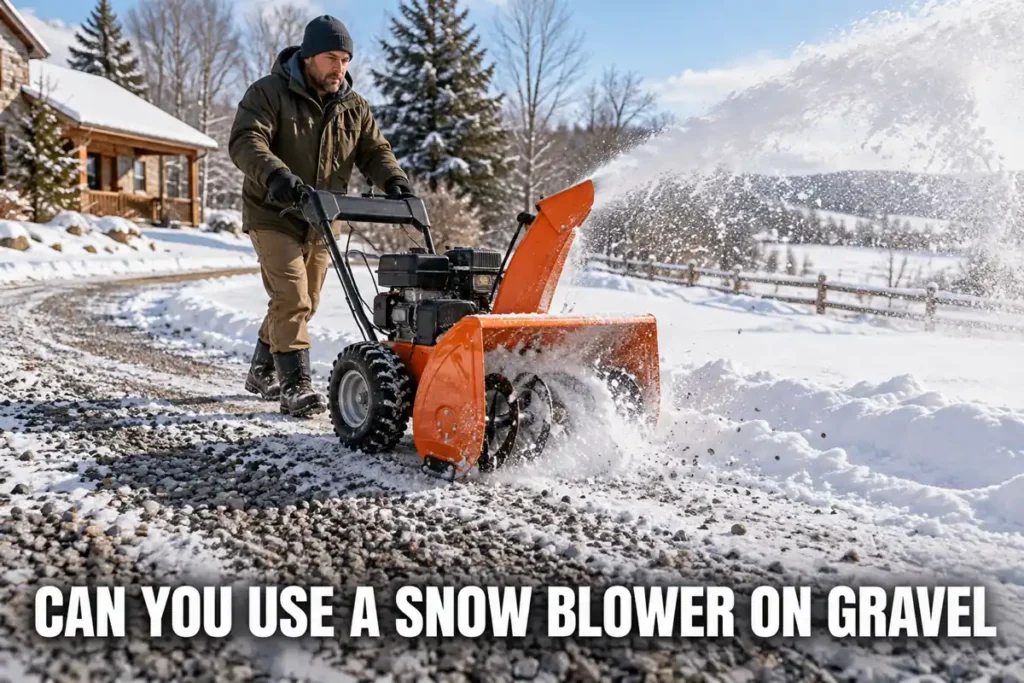
A two-stage snow blower can work on gravel when its skid shoes are set low enough to lift the scraper above the stones. A single-stage snow blower should stay off gravel, and the maker manuals say so.
My farm yard is crushed stone, so I have a stake in the answer. Below you get each maker’s rule, the skid shoe settings with real numbers, a routine for the drive and the safety steps for stones and clogs.
Can You Use a Snow Blower on Gravel? The Short Answer by Machine Type
A two-stage snow blower is the machine that works on gravel, when its manual allows it and its skid shoes are set for it. A single-stage auger touches the ground to clean it, so it lifts stones into the housing and throws them. A two-stage auger rides above the ground on its skid shoes. EGO, Toro, Ariens and Cub Cadet tell you how to set their two-stage machines for gravel, and the single-stage manuals from EGO, DeWalt and Milwaukee tell you to stay off it.
| Machine type | On gravel? | What the makers say |
|---|---|---|
| Single-stage | No | EGO, DeWalt and Milwaukee ban gravel for their single-stage models. Toro says its single-stage machines are not for unpaved surfaces. |
| Crossover single-stage | No | Toro says its SnowMaster crossover is not meant for gravel. |
| Two-stage | Yes, when the manual allows it and the skid shoes are set for gravel | EGO, Toro, Ariens and Cub Cadet give a way to set the machine. |
| Three-stage | Yes, per Cub Cadet | Cub Cadet says its 3X handles slushy, wet or icy conditions on smooth and gravel driveways. |
| Power shovel | Check your manual | EGO’s SNS1200 and SSA1200 manuals allow gravel only when the tool is adjusted for it. The Greenworks 80V shovel manual bans it. |
Key Takeaway
No setting makes gravel safe. Lowering the skid shoes raises the scraper and housing, which cuts the chance that a stone is picked up, and a stone that gets in is still thrown.
Single-Stage Snow Blower on Gravel and Why the Manuals Say No
The auger of a single-stage machine is a spinning screw with a rubber paddle, and it turns against the ground to leave a clean surface. On pavement that is the design. On gravel the paddle lifts stones into the housing, and the chute throws them out. According to Toro, single-stage machines “should not be used on unpaved surfaces” because they clean down to the pavement.
The EGO manuals for the SNT2100, SNT2110, SNT2120AP and SNT2130 say “Do not use on graveled surface.” and allow no exception. The DeWalt DCSNP2142 and Milwaukee M18 FUEL 3036-20 manuals carry the same ban. I explain where the single-stage fits in my guide that answers what is a single-stage snow blower.
I learned this on our own gravel yard. A single-stage machine I ran onto the stones picked them up, so I stopped, finished the concrete pad with the machine and shoveled the gravel part by hand. That test showed me why the manuals ban it.
Why Adjustable Skid Shoes Do Not Change the Rule
Of the four EGO single-stage manuals, only the SNT2130 (sold in the SNT2134 kit) describes adjustable skid shoes, and its manual says to adjust them on uneven or gravel surfaces so the machine can maneuver on the snow. I cover that kit in my EGO SNT2134 kit review.
The same manual still says “Do not use on graveled surface.” Skid shoes for single stage snow blower models help the machine ride over uneven ground, and the ban stays in place.
What Each Maker Manual Says About Gravel
The single-stage manuals carry a flat ban, and the two-stage manuals carry a rule with a setting attached.
| Maker and model | Type | Rule on gravel | Setting |
|---|---|---|---|
| EGO SNT2100, SNT2110, SNT2120AP, SNT2130 | 56V single-stage | “Do not use on graveled surface.” | No exception |
| DeWalt DCSNP2142 | 60V single-stage | “Do not use on graveled surface.” | Disengage the auger when crossing gravel |
| Milwaukee M18 FUEL 3036-20 | Battery single-stage | “Do not use on a gravel surface.” | No exception |
| Greenworks 2600402 thrower and 2600602 shovel | 80V | “Do not use on graveled surfaces.” | No exception |
| EGO SNT2400, SNT2410, SNT2800 | 56V two-stage | Not on gravel “unless the snow blower is adjusted for such a surface” | Loosen the nuts, move the skid shoe, retighten. No gap figure |
| Toro Power Max e26 | 60V two-stage | “Stop the machine when crossing gravel surfaces.” | Scraper 1/8 in (3 mm) above a level surface; for gravel, skids “further down” |
| Ariens Deluxe series | Gas two-stage | Adjust the housing height to clear gravel or crushed rock | Two 1/8 in (3 mm) spacers for smooth ground, two 7/8 in (22 mm) for gravel |
| Cub Cadet 2X and 3X | Gas two-stage and three-stage | On gravel, keep the skid shoes in the position for maximum clearance | Skid shoes about 1/8 in below the shave plate at the factory |
Ariens is the only maker in the table that prints a smooth-ground number and a gravel number side by side. None of these manuals promises that a stone will never be thrown.
Snow Blower Skid Shoes for Gravel and How to Set Them
Skid shoes are the metal or plastic pads on each side of the housing, and they decide how high the scraper bar and the auger housing ride above the ground. Lowering the shoes lifts the housing, so the scraper clears the stones instead of cutting through them.
Take the Ariens spacers as a worked example. Moving from 1/8 in to 7/8 in adds 3/4 in (19 mm) of clearance under the scraper. The price of that clearance is snow, because on level ground a scraper leaves a layer about as thick as its gap.
| Snowfall | Left at 1/8 in | Left at 7/8 in |
|---|---|---|
| 1 in | about 13 percent | about 88 percent |
| 3 in | about 4 percent | about 29 percent |
| 6 in | about 2 percent | about 15 percent |
Gravel is not level. Between stones the gap grows, and over a high stone it shrinks, so 7/8 in is a starting gap and the test pass decides. On a 1 in dusting the machine has almost nothing to take, and that is when I leave it in the shed.
How to Adjust Snow Blower Skid Shoes
The steps below follow the Ariens gravel procedure for a two-stage machine. Other makers give their own steps, and your manual comes first. If you are choosing a machine for stone, my two-stage snow blower picks name five gas and battery models.
- Park on a level, hard surface such as a concrete pad. Stop the engine and take out the key on a gas machine, or take out the start key where there is one and every battery pack on a battery machine. If your manual says so, disconnect the spark plug lead. Wait the time your manual gives, until every moving part has stopped.
- Support the scraper bar at the height the manual gives. For gravel, Ariens has you place two 7/8 in (22 mm) spacers under the two ends of the scraper bar.
- Loosen the fasteners that hold each skid shoe, lower both shoes to the surface or to the maker’s gravel position, and tighten them. Set both sides the same so the scraper bar stays parallel to the ground.
- If your manual gives a gap, measure it under the scraper bar on the flat surface. I do this with a tape on the concrete pad before the first storm.
- Make a short test pass on the gravel at walking speed, with nobody near the chute. If stones come out, stop, wait for a complete stop, isolate the power as in step 1, then check for damage and repair it before you restart. Lower the shoes further within your manual’s limit, and if stones still come out at the most clearance it allows, keep the machine off that gravel.
Using a Snow Blower on a Gravel Driveway, Step by Step
A gravel routine keeps the same order every storm: clear loose objects, set the shoes, make a test pass, then clear in thin, slow passes with the chute aimed away from windows and cars. I explain pass patterns and wind direction in my guide on how to use a snow blower.
- Walk the area first and take out sticks, wires, toys and any large stones lying on the surface.
- Set the skid shoes for gravel and make the test pass described above.
- Let snow cover the gap. A snowfall thinner than the scraper gap gives the machine nothing to take, so I let the first snow of the season settle into a base layer before I run the machine.
- Walk slowly. I keep my pace on gravel slower than on the concrete pad, so I can stop the moment a stone strikes the housing. After a strike I shut down, take out the key or packs and check the machine before I go on.
- Disengage the auger when you cross a gravel strip from pavement, as DeWalt says, or stop the machine, as Toro says.
Where to Aim the Chute and Pile the Snow
Aim the chute away from house windows, parked cars, people and pets. EGO says to keep bystanders and pets at least 100 ft away, and Toro warns that thrown material can ricochet off a wall. On gravel the chute direction also decides where any stone lands.
Throwing into the Košava, our strong southeast wind, sent the snow back at me once, so I changed the chute direction and the line of my pass. I pile the snow on the open grass strip beside the gravel and never against the trunk of a young tree. Frozen ground and skid shoe settings for lawns get a full page in my look at a snow blower on grass.
What You Give Up When You Clear Gravel
Using a snow blower on a gravel driveway trades a clean surface for safety from stones. You give up snow depth, parts and some battery runtime, and no setting removes the chance that a stone gets thrown.
- A layer of snow stays. The scraper gap decides how much, as the Ariens example shows. A thin layer left on the stones can pack down and freeze on a cold night.
- Parts wear faster. Snow blower skid shoes wear down on stone, and Toro says to check the skids and the scraper every year. The shoes on my gas two-stage wore faster on our gravel yard, and I set them lower there so the machine stopped picking up stones. My guide to how long snow blowers last lists the wear parts to check first.
- A hard strike can break a snow blower shear pin. According to EGO, the shear pins in its two-stage machines absorb the stall when the auger strikes an obstacle.
- Battery runtime drops in a thick layer. An electric snow blower on a gravel driveway follows the same shoe rules as a gas one, and EGO says to use two packs and a slower pace in deep, very wet or icy snow.
Gravel Safety for Thrown Stones and Clogged Chutes
Gravel adds two hazards to snow clearing: stones that can leave the chute, and clogs that tempt a hand into it. Each has a fixed answer.
Thrown Stones and Your Eyes
EGO says to wear eye protection with side shields that comply with ANSI Z87.1, because thrown objects can damage eyes severely. A US emergency room study of lawnmower eye injuries from 2004 to 2023 found that about three quarters came from thrown objects, mostly grass, dirt and rocks, and only 2 percent of those cases had eye protection documented (1). It covers lawnmowers, not snow blowers, and supports one point: a machine that throws loose material can put it at eye level.
Wear hearing protection with a gas machine from the first minute. A gas machine starts and runs outdoors only, never in a garage, even with the door open.
Clearing a Clogged Chute Without a Hand
Clearing Order
Release the controls. On a gas machine, stop the engine, take out the key and, where your manual says so, disconnect the spark plug lead. On a battery machine, take out the start key where there is one and every battery pack. On a corded machine, unplug the cord. Wait the full time your manual gives, until every moving part has stopped (EGO gives 10 seconds). Then clear the chute with the clean-out tool, or with a stick when your kit has none, and never with a hand.
A stone can jam a chute as well as wet snow, and a hand in the chute is the main danger of any snow blower. A US emergency room study of 2009 to 2017 found that 22 percent of hand injuries from clearing a clogged snow blower were amputations (2), and a study of 2003 to 2018 found that a hand placed in the chute caused 44.5 percent of snow blower emergency room visits (3). I explain how wet snow, pace, wear and ice contribute when a snow blower keeps clogging.
At one Connecticut hospital, 82 percent of 22 hand injuries happened with the machine still running (4). National data for 2001 to 2016 put snow blower injuries at about 5,800 a year, with the finger the most injured body part (5).
My gas two-stage jammed once on a frozen lump from the plow ridge at the farm gate. I released the controls, stopped the engine, took out the key, waited for the auger to stop and cleared the lump with the clean-out tool.
When a Snow Blower Is the Wrong Tool for Your Gravel
A snow blower earns its place on gravel only when its manual allows it and its skid shoes are set for it. A layer of snow stays under it, and a clog is cleared with a tool and never a hand. Thin snow, a very short drive or soft edges where grass creeps in call for a shovel instead, and you can browse our other snow removal tools for those jobs.
My tip: I measure the gap with a tape on the concrete pad before the first storm, so the shoes are set before the weather decides. Read the gravel line in your manual, set the skid shoes to it and make a slow test pass before a snow blower meets your gravel drive in a storm. For a gravel drive, I compare five two-stage models in my snow blower for gravel driveways guide.
Frequently Asked Questions
Can you use a single-stage snow blower on gravel?
A single-stage snow blower should not be used on gravel, because its auger touches the ground and throws the stones it lifts. The EGO, DeWalt and Milwaukee manuals for their single-stage models ban gravel, and Toro says its single-stage machines should not be used on unpaved surfaces. A two-stage machine with its skid shoes set for gravel is the safer choice.
What’s the best way to remove snow from a gravel driveway?
The best way to remove snow from a gravel driveway is a two-stage snow blower with its skid shoes set for gravel, run at walking speed in thin layers. A shovel suits light snow and short drives.
What’s the best snow blower to use on a gravel driveway?
The best snow blower to use on a gravel driveway is a two-stage machine whose manual allows gravel and explains how to lower the skid shoes. Keep single-stage models for pavement, and ask for a gap figure only when your model’s manual gives one.
What is the best tool to remove snow from a gravel driveway?
The best tool to remove snow from a gravel driveway depends on the depth of the snow. Use a two-stage snow blower for deep or packed snow, and a shovel for a thin layer or a short stretch.
How to use a snow blower on a gravel driveway?
To use a snow blower on a gravel driveway, pick a two-stage machine, set its skid shoes to the maker’s gravel position and make a slow test pass first. Clear in thin layers at walking speed, disengage the auger when you cross gravel from pavement, and aim the chute away from windows, cars and people.
References
- Stange NR, Jennissen CA. Lawnmower-Related Eye Injuries in the U.S., 2004 to 2023. Am J Ophthalmol. 2025;277:7-16.
- Hammig B, Jones C. Hand injuries associated with reaching into a snow blower to clear clogged snow. Am J Emerg Med. 2020;38(4):785-788.
- Loder RT, Solanki D. Events Due to Snowblower Use Seen in US Emergency Departments From 2003 Through 2018. Cureus. 2020;12(12):e11836.
- Master D, Piorkowski J, Zani S, Babigian A. Snowblower Injuries to the Hand. Ann Plast Surg. 2008;61(6):613-617.
- Rubinstein AJ, Thomson JE, Siracuse BL, DeCotiis MR, Ahmed IH, Vosbikian MM. The Incidence of Snow Blower-Related Injuries to the Hand in the United States. Ann Plast Surg. 2019;82(4):393-398.
Safety Note: Snow blowers throw snow, ice and hidden objects with force. Never reach into a clogged chute or auger. Shut the machine off first: stop the engine on a gas model, unplug a corded model, or remove the safety key and every battery pack from a battery model. Wait at least as long as your manual says, often 10 seconds, and until every moving part has stopped, then remove the key and disconnect the spark plug wire where your manual says so, and clear the clog with the clearing tool. Keep people and pets out of the discharge path, run gas models outdoors only, and read the manufacturer’s manual.