
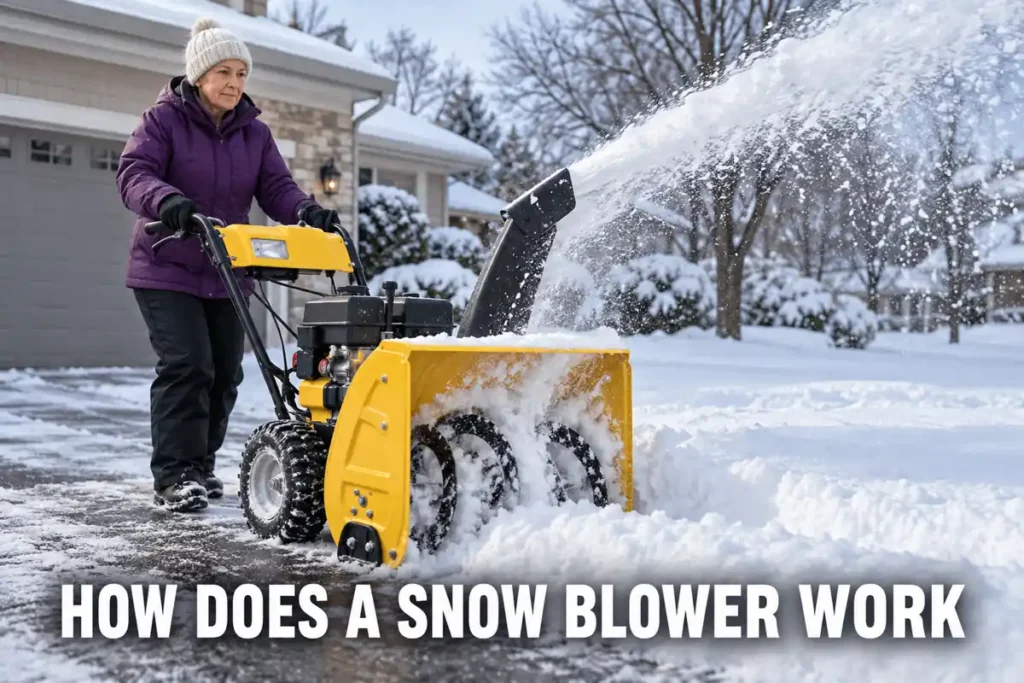
A snow blower works in three steps: a spinning auger pulls the snow in, a throwing stage flings it out, and a chute aims it. An engine or an electric motor turns the auger, and on two-stage machines a drive carries it forward.
I verified seed drill calibration on weighing trays, so I judge any machine by what goes in per minute, and a snow blower is no exception. This guide follows the snow from intake to chute: parts, feed rate, throw, power and safety.
How Does a Snow Blower Work? The Short Answer
Snow moves through a snow blower in one line, from the auger to the chute. The engine or motor, the drive, the scraper bar and the controls power that line, carry it over the ground or stop it.
- The engine or motor turns the auger.
- The auger pulls snow in from both sides toward the center of the housing.
- A throwing stage takes over: the auger paddles on a single-stage machine, or an impeller, a fast fan behind the auger, on a two-stage machine.
- The snow leaves through the chute, and the deflector on top sets the angle.
- You walk the machine forward at a pace that matches the snow coming in.
The types differ at step three, where a different part does the throwing. The stage count is the number of separate parts that work the snow.
| Type | What throws the snow | Touches the ground |
|---|---|---|
| Single-stage | The auger paddles | Yes |
| Two-stage | A separate impeller behind the auger | No, it rides on skid shoes |
| Three-stage | A separate impeller, fed by an accelerator | No |
Cub Cadet uses the term ‘three-stage’ for the three-stage snow blower design. According to Cub Cadet, the accelerator on its 30-inch 3X spins 10 times faster than the augers to break up heavy, wet snow.
Parts of a Snow Blower and What Each One Does
Ten parts do the work on most snow blowers, and each has one job and one way of wearing out. In my guide to how long a snow blower lasts, I explain how wear parts and storage affect the life of the machine.
| Part | What it does | What wears or breaks |
|---|---|---|
| Auger | Pulls snow in from both sides toward the center | Rubber paddles on a single-stage wear down |
| Impeller | A fan behind the auger on two-stage and three-stage machines | Packs with snow when the feed outruns it |
| Housing | Holds the pile and guides it onward | Wet snow freezes to it |
| Chute and deflector | Aims the snow left or right, and the deflector sets the angle | Clogs in wet snow |
| Scraper bar | A steel strip along the bottom that scrapes the surface | Wears down and catches on raised edges |
| Skid shoes | Pads that set the gap above the ground | Wear; Toro says to check them yearly |
| Shear pins | Lock the auger to its shaft and snap on purpose | Snap on a rock or an ice chunk |
| Engine or motor, and battery | A gas engine, or brushless motors on packs | Gas: oil, plug, filter. Battery: less power in the cold |
| Drive | Wheels, tracks or auger paddles | Belts and a friction wheel on Cub Cadet machines |
| Controls | An auger lever, a drive lever, a key or bail | Release both levers to stop the auger and the drive |
Makers use different names for the same parts. Cub Cadet calls the scraper bar a shave plate, and Ariens calls shear pins shear bolts, so the snow blower parts names in your manual may differ from the table.
The scraper bar is the part I notice first on my own ground. It caught on the raised edge of the concrete pad in front of the machinery shed, because a bar set to ride close to the surface meets every raised edge head on. Since then I cross that edge slowly.
How the Auger Takes In Snow
The auger is a screw conveyor for snow. Its spiral blades turn and pull snow from both sides toward the center of the housing, where it leaves through the chute or meets the impeller. On the farm a screw conveyor jams the same way when it is fed faster than it can clear.
Makers list housing intake heights of about 11.5 to 13 inches for single-stage machines and 18 to 23 for two-stage and three-stage ones, and deeper snow goes in layers. I give the depth limits by machine type in my answer to how much snow can a snow blower handle.
A Worked Example of Feed Rate
Feed rate depends on the width of the pass, the depth of the snow and your walking speed. Take a 24-inch pass through 8 inches of snow at a slow 1.5 miles per hour, typical assumptions and not readings from one machine.
- Volume in: 2 ft wide x 8 in (two-thirds of a foot) deep x 132 ft of walking per minute is about 176 cubic feet of snow a minute.
- Ordinary snow: at the common 10:1 ratio, meaning 10 inches of snow melt to 1 inch of water, snow weighs about 6.2 pounds per cubic foot (1). The machine takes in about 1,100 pounds a minute.
- Dense fresh snow: the heaviest daily snowfall in a four-year record from mountain sites in Colorado and Wyoming weighed about 16 pounds per cubic foot (2). The same pass then takes in about 2,800 pounds a minute, about 2.6 times as much.
Toro lists 2,000 pounds a minute for one 26-inch two-stage model, less than the dense case above. Snow ratios run from about 3:1 to as much as 100:1 (1), so the same depth can be easy one day and a clog the next. Halving your walking speed halves the load. I compare five models for deep, packed drifts in my guide to snow blowers for heavy snow.
When I walked too fast in wet snow near freezing, the chute packed solid. I let go of both levers, took out the start key and every pack, waited the ten seconds the manual gives and cleared the chute with the clean-out tool, never with a hand. I discuss wet snow, pace, wear and ice in my answer to why does my snow blower keep clogging.
How the Impeller and Chute Throw Snow
On two-stage machines, throwing is a separate job for a faster part. A single-stage snow blower uses the auger paddles that gather the snow to fling it up the chute. According to Toro, a two-stage machine hands over to a high-speed impeller, a centrifugal fan whose blades push the snow outward and up.
What Up to 45 Feet Says About Exit Speed
Makers print throw distances as “up to” figures, from 35 to 60 feet. The longest throw for a given speed leaves at 45 degrees, so an idealized 45-foot throw needs about 38 feet per second, 26 miles per hour (the square root of 32.2 x 45). That assumes equal launch and landing heights and no air resistance, so 26 is a rough guide, not a measured exit speed. If your machine starts throwing noticeably shorter distances in the same conditions, I explain what to check in my guide to a snow blower not throwing far.
Distance grows with the square of the speed, so doubling the throw takes about 1.4 times the exit speed.
Chute, Deflector and Wind
The chute turns about 200 degrees on EGO’s two-stage models, and the deflector on top tilts the stream higher or lower. Your manual shows how your model sets it.
Wind and wet snow shorten the throw. Throwing into the wind sends the snow back at you. The Košava, our cold southeast wind, taught me that on the farm road: a gust sent the snow back over me even with eye protection on, so I turned the chute and changed the line of my pass to throw across the wind. Pass patterns and wind rules are part of how I use a snow blower each winter, and my walkthrough covers them.
How Gas and Battery Power Reach the Auger
Gas and battery machines turn the same augers by different routes. How far a charge goes is covered on a page about how long a battery snow blower runs in cold and heavy snow.
| Feature | Gas | Battery |
|---|---|---|
| Power source | Four-stroke engine (Ariens, Cub Cadet), with oil in the crankcase and plain gasoline in the tank | Brushless motors on lithium-ion packs; many machines use two packs |
| Starting | Recoil pull or push-button electric start; a 120V model runs the starter from a household outlet | Key or button, with no pull cord, choke or primer |
| In the cold | Old fuel is the trouble: Cub Cadet says gasoline over 30 days old without stabilizer can gum the carburetor | A cold pack gives less energy and power |
| Under overload | A shear pin snaps on a hard hit | EGO says the unit shuts off if the battery passes 158°F |
Cub Cadet’s two-stage and three-stage machines use an auger belt and a separate drive belt for the wheels. On the battery side, EGO lists independent brushless motors for self-propel and for the auger system on its SNT2405.
Lab tests on lithium-ion cells show substantially reduced energy and power at low temperatures (3), though cells on a test bench are not tool packs. EGO recommends operating its snow tools between -4°F and 50°F, says the machine may not start when the battery is at -4°F or lower, and asks you to warm the pack indoors for 10 minutes or more. I keep the spare pack indoors and swap it in when the first one goes cold. Charge times for each maker are in my answer to how long does it take to charge a snow blower battery.
How the Machine Moves, Steers and Rides on the Ground
Many single-stage machines are pushed, or pulled along by the auger paddles. Two-stage snow blowers usually drive their wheels or tracks. The drive is a separate system from the auger, with its own lever.
Drive, Steering and Controls
Cub Cadet’s manual lists a drive belt and a friction wheel, a rubber-edged wheel that transmits the engine’s power to the drive. Steering is a control that frees one wheel in a turn: on Cub Cadet machines you squeeze the trigger on the side you want to turn toward, and Ariens’ Auto-Turn frees the wheel without a trigger.
Two levers sit on the handles, one for the auger and one for the drive, and releasing both levers stops the machine. On Cub Cadet and EGO models with linked controls, a held drive lever keeps the auger running for the chute control. A self-propelled drive does not free both hands: on those Cub Cadet machines, one stays on the right-hand drive lever. On a gas machine a key or bail cuts the engine.
Scraper Bar, Skid Shoes and Gravel
The scraper bar and skid shoes set the height of the housing. Toro sets its scraper 3 mm, about 1/8 inch, above a level surface, and Cub Cadet asks for at least that gap. For hard-packed snow Cub Cadet raises the shoes, which lowers the bar, and for gravel it keeps them in the lowered, maximum-clearance position, which lifts the bar over the stones. I set out what the maker manuals say in my answer to can you use a snow blower on gravel.
A single-stage auger touches the ground, so it picks up gravel and throws it, and Toro says single-stage machines should not be used on unpaved surfaces. A two-stage auger rides above the ground but can still throw a stone, and the price of a high bar is a thin layer of packed snow left on the stones.
On the gravel yard I ran a two-stage machine with the shoes at maximum clearance. A few stones still flew and the shoes wore faster there, so a machine that keeps picking up stones gets its clearance rechecked, and I keep people, windows and the car out of the throw path. I compare five two-stage models for stone drives in my guide to snow blowers for gravel driveways.
The Safety Parts and Why They Exist
Every safety part answers one hazard: a spinning auger or impeller that cuts, and a chute that throws. The shear pin protects the gearbox, the levers protect your hands, and the clean-out tool replaces your hand in the chute.
Shear Pins and Hold-to-Run Levers
A shear pin locks the auger to its shaft and snaps on purpose when the auger hits a rock or a frozen lump. EGO says the pins protect the gearbox and motor. Which machines carry snow blower shear pins, and which do not, is set out on a separate page.
Cub Cadet and Ariens both say to fit only their own pins or bolts, because a hardware store bolt does not break at the right load, and Toro’s Power Max e26 uses hardened gears and no shear pins. The hold-to-run levers work the other way: the machine runs only while a lever is held.
The Chute Is Where People Get Hurt
According to Cub Cadet, hand contact with the rotating impeller or auger inside the discharge chute is the most common cause of injury associated with snow blowers. US emergency department records show the same pattern: about 91,000 visits linked to snow blowers from 2003 to 2018, and 44.5% of the injury mechanisms were a hand put into the chute (4). In a separate national sample, about 22% of the hand injuries from clearing a clogged snow blower were amputations (5).
Clearing a Clog
Release both levers. Stop the engine and take out the key on a gas machine, unplug a corded one, or on a battery machine take out the start key where it has one and every battery pack. Wait 10 seconds, the time EGO and Cub Cadet give, until every moving part has stopped, then use the clean-out tool. Never use a hand, and never clear a chute with the machine running.
Exhaust, Thrown Objects and Noise
A gas snow blower starts and runs outdoors only, because its exhaust carries carbon monoxide, and an open garage door does not change that.
The machine throws stones, ice and anything buried in the snow. Clear toys, boards, wires and hoses first, wear eye protection and keep people and pets away, 100 feet according to EGO’s manual. A gas machine is loud, so I put hearing protection on before I pull the cord or press the starter, and I wear it for the whole job.
Wet Snow, Ice and Deep Snow Change How It Works
The same machine behaves differently in different snow, because the load changes. Wet snow weighs more per cubic foot, packs in the housing and slows the throw. Maker manuals differ, and I compare them in my answer to can a snow blower handle wet snow.
A study of snowfall records found that ratios above 25:1, the fluffiest snow, turned up less than 5% of the time when the low-level air averaged above about 27°F (6). Snow work is sporadic on my farm, but when snow comes it often falls near freezing, so heavy, wet snow is the case I plan for.
No snow blower clears solid ice. The Greenworks manual says not to use the scraper to remove compact snow and ice, and a frozen lump is what snaps a shear pin. I break a hard crust with a shovel first.
The ridge a plow leaves at the gate is the hardest case. How deep one pass can go depends on the model and the manual: EGO warns against a single pack in snow deeper than 3 inches on its single-stage machines and 8 on its two-stage ones, or in very wet or icy snow. I take the ridge top first and the base after, in thin layers. After the job I run the machine outside for a few minutes so the melted snow flings off, because EGO, Ryobi, Cub Cadet and Ariens warn that wet snow can freeze the auger to the housing. For a machine built for this slush, see my picks of snow blowers for wet snow.
What to Check Before the First Snow
One walk around the parts of a snow blower before the first forecast covers everything that wears or breaks. At the end of the season I follow my steps to winterize a gas snow blower.
- Scraper bar and skid shoes: worn evenly, and set for your surface.
- Shear pins: none broken, with spares of the maker’s own part on hand.
- Belts and cables: no cracks, and tension and control operation checked against your manual, on models that have them.
- Battery packs: charged, and kept warm indoors.
- Fuel: fresh, with stabilizer, on a gas machine.
- Clean-out tool: within reach, findable with gloves on.
I also decide the pile site before the first pass: the gravel edge and the open grass strip, never the tree strips or the base of a trunk. Choose where the snow blower will throw the pile before you start, and allow for the wind. If you are still choosing a machine, my list of the best snow blowers for 2026 covers gas, battery and corded picks.
Frequently Asked Questions
How does the auger work on a snowblower?
The auger on a snow blower works as a spinning screw that pulls snow in from both sides toward the center of the housing. On a single-stage machine it also throws the snow up the chute, and on a two-stage machine it hands the snow to the impeller.
How does a snow blower engine work?
A snow blower engine works as a four-stroke gasoline engine on Ariens and Cub Cadet machines, with oil in the crankcase and plain gasoline in the tank, while older two-stroke machines need mixed fuel, so check your manual. It turns the auger and, on a two-stage machine, the impeller.
How does electric start work on a snowblower?
Electric start works by letting a small electric starter motor turn the engine over in place of the pull cord. On a 120V model such as the Ariens Deluxe, a cord from a household outlet powers the starter and you press a button.
How does power steering work on a snowblower?
Power steering on a snow blower works by freeing one wheel or track in a turn, so you do not drag the machine around. On Cub Cadet machines you squeeze the trigger on the side you want to turn toward.
How does a snowblower transmission work?
A snow blower transmission works by carrying the engine’s power to the wheels or tracks. In Cub Cadet’s manual that path is a drive belt and a friction wheel, and self-propelled battery machines such as EGO’s SNT2405 drive the wheels with their own motor instead.
References
- Roebber PJ, Bruening SL, Schultz DM, Cortinas JV Jr. Improving Snowfall Forecasting by Diagnosing Snow Density. Weather Forecast. 2003;18(2):264-287.
- Judson A, Doesken N. Density of Freshly Fallen Snow in the Central Rocky Mountains. Bull Am Meteorol Soc. 2000;81(7):1577-1587.
- Ji Y, Zhang Y, Wang C-Y. Li-Ion Cell Operation at Low Temperatures. J Electrochem Soc. 2013;160(4):A636-A649.
- Loder RT, Solanki D. Events Due to Snowblower Use Seen in US Emergency Departments From 2003 Through 2018. Cureus. 2020;12(12):e11836.
- Hammig B, Jones C. Hand injuries associated with reaching into a snow blower to clear clogged snow. Am J Emerg Med. 2020;38(4):785-788.
- Ware EC, Schultz DM, Brooks HE, Roebber PJ, Bruening SL. Improving Snowfall Forecasting by Accounting for the Climatological Variability of Snow Density. Weather Forecast. 2006;21(1):94-103.
Safety Note: Snow blowers throw snow, ice and hidden objects with force. Never reach into a clogged chute or auger. Shut the machine off first: stop the engine on a gas model, unplug a corded model, or remove the safety key and every battery pack from a battery model. Wait at least as long as your manual says, often 10 seconds, and until every moving part has stopped, then remove the key and disconnect the spark plug wire where your manual says so, and clear the clog with the clearing tool. Keep people and pets out of the discharge path, run gas models outdoors only, and read the manufacturer’s manual.