
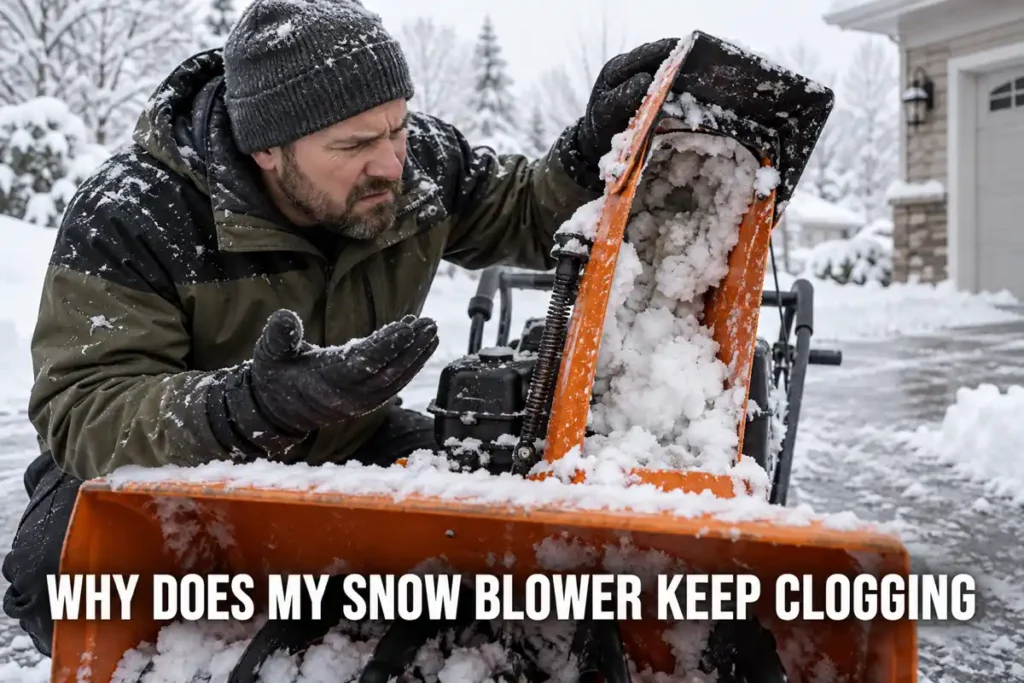
A snow blower keeps clogging when it takes in snow faster than it can throw it. Wet snow, a pace or swath that is too big, a motor or belt that is not at full speed, worn scraper and paddles, and ice in the chute are the usual causes, and each has a fix in the owner’s manual.
I judge every snow tool on the wet day near freezing, because that is the day a chute packs. The table below matches each symptom to its cause, each cause gets its fix, and one short section covers clearing a clog safely.
Why Does My Snow Blower Keep Clogging? Start With the Snow and Your Pace
Check the snow and your pace first, before you open a toolbox. Snow reaches the housing faster than the auger and the impeller (the fan behind the auger on a two-stage machine) can lift it up the chute. Once the chute packs, the auger keeps feeding the housing until the machine stalls or its overload protection trips. My explainer on how a snow blower works shows how the auger and impeller move snow through the housing.
Find the row that matches what you see, then read that section.
| What you see | Likely cause | First fix |
|---|---|---|
| Clogs in wet or heavy snow, fine in powder | Snow too heavy for the pace and swath | Narrow the swath, slow down, use a lower gear or a second battery pack |
| Motor note drops and the auger slows (EGO battery models) | Overload | Slow down or narrow the swath; the speed returns on its own |
| Clogs in modest snow and the throw is short | Low power: auger speed, belt, tired or cold pack, throttle | Raise the auger speed, charge or warm the pack, set the gas throttle to fast, replace a worn belt |
| Leaves a layer of snow behind or throws less | Worn scraper bar or paddles, skid shoes set too low | Replace the worn part and adjust the shoes |
| Clogs at the start of a session or after the machine sat | Ice or frozen snow inside | Shut the machine down and remove the key or every pack, wait for all parts to stop, clear with the tool, thaw a frozen impeller in a warm place |
| Fast orange flashing on the power light (EGO) | Augers clogged and not turning | Release the controls, remove the battery packs, wait 10 seconds, then clear snow and ice with the clean-out tool |
| Motor runs and the auger does not turn | Possibly an obstruction, a broken shear pin or a belt | Shut down and check for an obstruction first, then the pin or belt as the manual says |
A motor that runs while the auger stands still may be a different fault. Shut the machine down and check for an obstruction first. If the auger still does not turn once it is clear, look at the shear pin or the drive belt.
Wet and Heavy Snow Packs Harder Than Powder
Snow blower clogging peaks in wet snow, because the same depth of snow can weigh far more and it packs and sticks to the metal it touches. Where I farm, snow often arrives near freezing, and snow near freezing is often wet and heavy.
How Much Heavier Wet Snow Can Be
Depth tells you little about load. The snow ratio is the depth of fresh snow that melts down to one unit of water, and measured ratios run from about 3:1 to 100:1. The common 10:1 rule equals a density of about 100 kilograms per cubic meter (1). In a four-year Rocky Mountain dataset, fresh snow ran from 10 to 257 kilograms per cubic meter, and most daily falls sat between 50 and 100 (2). I explain how machine type affects the answer when discussing snow blowers handling wet snow.
Warm air gives denser snow. In a US statistical study, low-level air near or above about 27 F rarely produced the fluffiest snow, with ratios above 25:1 (3). That study used the average temperature of the layer of air above the ground, so a porch thermometer is only a rough guide.
A worked example shows what that means for the chute. Take a 21 inch swath through 6 inches of snow over 100 feet. That is about 88 cubic feet of snow. At 100 kilograms per cubic meter it weighs about 550 pounds, and at 250 kilograms per cubic meter, within the range above, it weighs about 1,370 pounds. My page on the snow blower size you need matches swath width to your drive and your snow.
That is a calculation, so read it as a rough guide. The same depth and swath put about 2.5 times the weight through the chute, and halving your pace halves the load per minute.
What the Makers Say About Wet Snow
Toro lists extremely heavy or wet snow as a cause of poor discharge in its 39926 manual and tells you not to overload the machine. According to EGO, one battery pack should not clear more than 3 inches of snow on the single-stage SNT2130, or more than 8 inches on the two-stage SNT2800 and SNT2410, and not in very wet or icy snow. The reason is the pack’s heat shutoff at 158 F (70 C), and EGO’s answer is two packs, a slower pace and a narrower swath. My page on how much snow blowers handle lists depth limits by machine type.
A Pace or Swath That Is Too Big
Pace and swath width set how much snow enters the housing every second, and the manuals ask you to cut both when the machine labors. According to EGO, you should not try to remove too much snow at a time: slow down or decrease the width of the swath. Under overload the auger motor slows by itself and the motor note drops, and when you ease off, the speed comes back.
I listen for that drop more than I watch the chute. The worst clog I remember came when I walked into wet snow at my dry-snow pace. The chute packed before I noticed, and since then I slow down at the first change in the sound.
Toro gives the same advice for its self-propelled machine: if it slows under load or the wheels slip, shift to a lower gear, let it work at its own pace and overlap each swath.
You will meet advice to walk faster to keep a chute from packing. The makers say the opposite for an overloaded machine, and Toro lists a pace too fast for the snow as a cause of poor discharge. A steady pace that holds the motor at its normal sound is the target. For the full routine, see my page on using a snow blower, which covers pace and swath width in more detail.
Intake Height Sets the Depth of Each Bite
Every machine has a ceiling on how deep a bite it can take. The EGO single-stage has a 13 inch intake, and the EGO two-stage machines run 20 to 21 inches. A single-stage snow blower can clog when you feed it snow deeper than its intake, and the EGO SNT2130 on one battery pack has its own 3 inch limit.
Deeper snow goes in layers, top first. At the gate I meet the ridge that a plow leaves across the entrance, packed and sometimes icy, and I take it in layers, top first and then the base, so no pass is deeper than the intake.
Pace Rule
Keep the motor at its normal sound. When the note drops, narrow the swath or slow down before the chute packs, and take snow deeper than the intake height in layers.
Low Power, Engine Speed, Battery and Belts
A machine that turns its auger and impeller below full speed throws less snow, and a machine that throws less clogs sooner in my experience. Makers list low power as a cause of poor throw, a connection I explain in my guide to a blower not throwing snow far. When a snow blower keeps clogging up in modest snow, check its power before you blame the snow.
Throttle and Drive Belts
On gas machines, Ariens lists a throttle lever in the wrong position and a slipping, worn or damaged auger drive belt as causes when its machine throws snow poorly. The fix is the throttle at fast, and a new belt or an adjusted auger control cable. In the manual of the battery-powered Toro 39926 a loose, off-pulley, worn or broken auger and impeller belt sits in the same troubleshooting row, with the advice to install, adjust or replace it and to have a dealer service it.
Battery Machines and the Pack
EGO’s troubleshooting row for a single-stage machine that throws less snow lists auger speed set too low, and the fix is to raise it. The auger speed control also sets the throw distance. Toro’s battery machine lists a low battery charge and blocked air vents when it does not reach full power, so charge the pack and clean the vents. My page on snow blower battery charge time explains how long a pack takes to fill.
Cold takes power too. In lab tests, lithium-ion cells at -20 C had higher internal resistance and gave less capacity and less power (4). Those were lab cells, not tool packs, so I read it as a direction. EGO’s operating range starts at -4 F.
I keep the spare pack indoors and swap it in when the first one goes cold. The pack from the house gives the machine its normal note. My page on battery snow blower run time shows what to expect from a pack.
Worn Scraper Bar, Paddles and Skid Shoes
Worn parts change how snow enters the housing and how much leaves it. The manuals list them under “leaves a layer of snow” and “throws less snow”, not under clogging. I treat a layer of snow left behind as the first warning, because a machine that leaves snow behind will take more of it on the next pass. In my guide titled “how long does a snow blower last”, I explain how wear parts affect the life of the machine.
- EGO single-stage: worn rubber paddles and a worn scraper bar both call for replacement.
- EGO two-stage: skid shoes set too low put the scraper bar too far from the ground, and worn augers throw less.
- Ariens: a worn scraper blade is adjusted, then replaced when it is damaged or already adjusted down as far as it goes. The skid shoes follow the blade.
- Toro: check the skids and scraper once a year; the scraper sits 1/8 inch above a level surface.
Surface changes the setting. On its two-stage models, Ariens uses a 1/8 inch spacer on hard, smooth pavement and 7/8 inch on uneven or gravel surfaces, and the Toro 39926 moves the skids down for gravel. Lower shoes lift the scraper above the stones, but they do not override a manual that rules out gravel, and stones can still be thrown. My page on running a snow blower on gravel covers the full setup.
I lowered the skid shoes on the gravel yard so the scraper rode above the stones, and the shoes wore faster there. A bent or worn impeller blade, or a belt that slips, is a dealer check. I leave the impeller to the shop.
Ice and Frozen Snow Inside the Chute
Snow blower chute clogging at the start of a session often traces back to the end of the last one. Wet snow left in the housing can freeze, and a frozen auger or impeller turns the next start into a clog. Ariens lists an impeller frozen in place, and it says to move the unit to a warm place to thaw. A gas machine only thaws with the engine off, and it starts and runs outdoors.
EGO and Ariens both give the prevention step. After the last pass, run the machine outdoors for a few minutes to throw off loose and melting snow so the auger and impeller do not freeze. Then shut the machine down in the clearing order below before you touch the chute: stop the engine, remove the key and every battery pack, and wait until all parts have stopped. EGO adds that you should then turn the chute from left to right, move the deflector up and down to free ice, and clean snow and ice off the base of the chute. My page on winterizing a gas snow blower covers the end-of-season steps.
EGO also says never to operate the unit with frozen parts or to force a frozen control. Where its steel auger is frozen, remove the battery packs first, then use the chute cleaning tool supplied with the machine.
A frozen lump from the plow ridge once jammed the auger of my gas two-stage. I shut it off, took out the key, waited until every part had stopped and cleared it with a stick.
Fixes That Stop Repeat Clogs
To prevent snow blower clogging, work down this list in order, since the first steps cost nothing.
- Narrow the swath and slow down until the motor sounds steady (EGO, Toro).
- On a self-propelled machine, shift to a lower gear and overlap the passes (Toro).
- Clear snow soon after it falls, and take snow deeper than the intake height in layers (Toro).
- On an EGO battery machine, use two charged, warm packs; on other makes, use the pack setup your manual requires. My list of battery snow blowers worth buying compares kits by pack setup.
- On a gas machine, set the throttle to fast and check the drive belt (Ariens).
- Check the scraper bar, paddles and skid shoes before the season and after rough ground.
- After the last pass, run the machine outdoors for a few minutes, shut it down as described below, then clear the chute base and the deflector and store it dry (EGO, Ariens).
Where the first throw lands matters on a farm. After I clear a packed chute I restart the machine with the chute aimed at open ground, never at the plum row, in case the first throw comes out in lumps. My page on starting a snow blower covers the cold-start routine.
Two habits keep a snow blower clogging up on the same job.
- Ignoring a worn scraper bar or paddles: the machine leaves a layer of snow behind.
- Leaving wet snow in the housing after the last pass: it can freeze before the next start.
Clearing a Clog Without Putting a Hand In
Clearing a clog is a short job, and the order matters more than the speed. Release the controls, then stop the engine and take out the key on a gas machine, unplug the cord on a corded one, or remove the key and every battery pack on a cordless one. Wait until every moving part has stopped, which is 10 seconds in the EGO manual.
Then use the clean-out tool from the kit, or a stick if the kit has none, and put the tool back. Never use a hand.
Hands are how people get hurt. In US emergency department data for 2009 to 2017, about 22 percent of hand injuries from clearing a clogged snow blower were amputations (5). Across 2003 to 2018, a hand placed into the chute made up 44.5 percent of the injury mechanisms in snow blower visits (6). In a small series of 22 hand injuries at one hospital, 82 percent happened with the machine still running, after about 20 minutes of use on average in snow close to freezing (7).
When Repeat Clogs Mean a Service Visit
When the swath is narrow, the pace is steady, the throttle or packs are right, the scraper and paddles are sound and the chute is free of ice, the fault sits inside the machine. A slipping or worn belt, a bent impeller blade or a fault light that stays on after you have followed the manual’s troubleshooting all need a dealer. I run the checks in this article on a dry day in autumn, so a clog in January gets a quick answer instead of a guess. A snow blower that keeps clogging after all of these checks needs a dealer, not a different pace. If wet snow is your main problem, my picks of snow blowers for wet snow cover machines suited to it.
Frequently Asked Questions
Why does my snowblower stall when I engage the auger?
A snowblower stalls when you engage the auger because something holds the auger below speed, usually packed or frozen snow around it or too much snow per pass. Release the controls, stop the machine, take out the key or the battery packs, wait until every part has stopped and clear the housing with a tool. If the auger still will not turn once it is clear, the shear pin or belt needs a dealer.
How to keep snow blower from clogging?
To keep a snow blower from clogging, narrow the swath and slow down until the motor sounds steady. Take snow deeper than the intake height in layers, and clear wet snow soon after it falls. On a self-propelled machine use a lower gear, and on a battery machine use the number of charged packs your manual requires.
How to stop snow blower from clogging?
To stop a snow blower from clogging, check the equipment before the first storm. Set the gas throttle to fast, look at the belt, and check the scraper bar, paddles and skid shoes against the manual. A part that is weak or worn throws less snow, so adjust, service or replace it as its manual specifies before the season.
How to prevent snow blower chute from clogging?
To prevent a snow blower chute from clogging with ice, run the machine outdoors for a few minutes after the last pass so loose and melting snow leaves the housing. Then shut the machine down, remove the key and every battery pack, wait until all parts have stopped, and clear snow and ice from the base of the chute with the clean-out tool. Store the machine dry so nothing freezes in the housing.
How to get your snow blower ready for winter?
To get your snow blower ready for winter, check the parts that decide whether it clogs: the scraper bar, paddles, skid shoes, drive belt, throttle and battery packs. Charge the packs, keep spares indoors and make sure the clean-out tool is with the machine.
References
- Roebber PJ, Bruening SL, Schultz DM, Cortinas JV Jr. Improving Snowfall Forecasting by Diagnosing Snow Density. Weather Forecast. 2003;18(2):264-287.
- Judson A, Doesken N. Density of Freshly Fallen Snow in the Central Rocky Mountains. Bull Am Meteorol Soc. 2000;81(7):1577-1587.
- Ware EC, Schultz DM, Brooks HE, Roebber PJ, Bruening SL. Improving Snowfall Forecasting by Accounting for the Climatological Variability of Snow Density. Weather Forecast. 2006;21(1):94-103.
- Hossain Ahmed S, Kang X, Bade Shrestha SO. Effects of Temperature on Internal Resistances of Lithium-Ion Batteries. J Energy Resour Technol. 2015;137(3):031901.
- Hammig B, Jones C. Hand injuries associated with reaching into a snow blower to clear clogged snow. Am J Emerg Med. 2020;38(4):785-788.
- Loder RT, Solanki D. Events Due to Snowblower Use Seen in US Emergency Departments From 2003 Through 2018. Cureus. 2020;12(12):e11836.
- Master D, Piorkowski J, Zani S, Babigian A. Snowblower Injuries to the Hand. Ann Plast Surg. 2008;61(6):613-617.
Safety Note: Snow blowers throw snow, ice and hidden objects with force. Never reach into a clogged chute or auger. Shut the machine off first: stop the engine on a gas model, unplug a corded model, or remove the safety key and every battery pack from a battery model. Wait at least as long as your manual says, often 10 seconds, and until every moving part has stopped, then remove the key and disconnect the spark plug wire where your manual says so, and clear the clog with the clearing tool. Keep people and pets out of the discharge path, run gas models outdoors only, and read the manufacturer’s manual.