
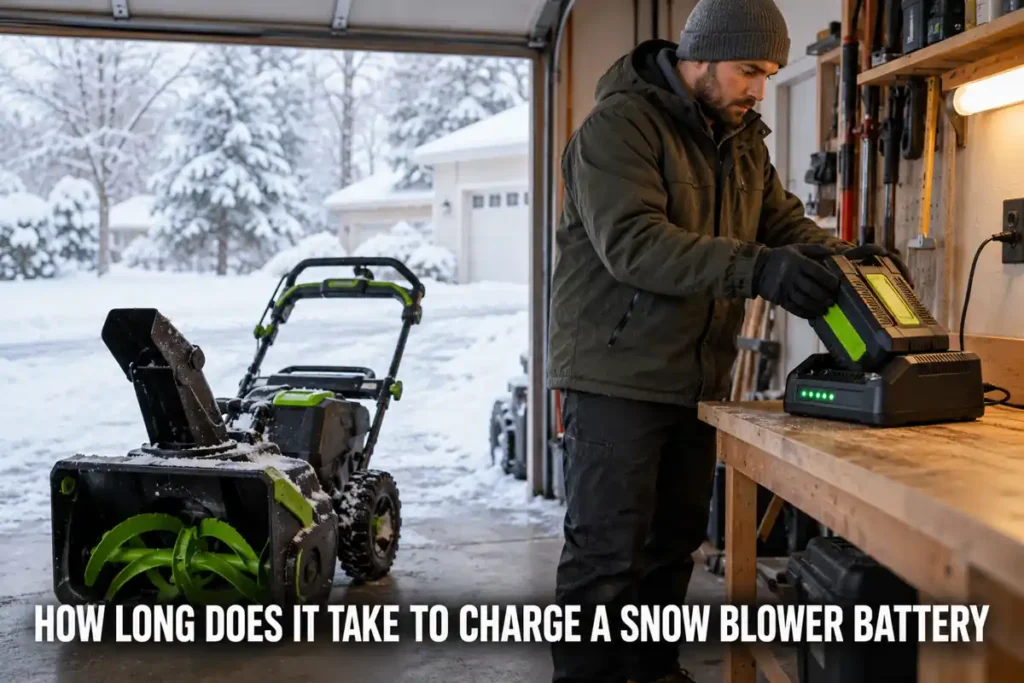
A snow blower battery takes about 1 to 5 hours to charge from empty, and the charger sets that time as much as the pack does. According to EGO, its dual-port charger fills two 12.0 Ah packs together in 180 minutes, while Toro lists 250 to 300 minutes for one 10 Ah pack. I plan winter work on the farm the way I plan a spray day, working backward from the refill. Below are the times by maker, the sum behind them, the 41 F rule for cold packs and a way to plan a storm around the charger.
How Long Does It Take to Charge a Snow Blower Battery? The Short Answer
Plan on about 1 to 5 hours for the kits makers list, and under an hour for the small packs. Three things set the number: the pack’s amp-hours (Ah, the size of the tank), the charger’s amps (how fast it fills the tank) and the pack’s temperature when it goes on the charger. Voltage does not set the time.
A kit ships two or four packs, so what matters is how many packs the charger fills at once. A simultaneous dual-port charger, such as EGO’s CH2800D, fills a pair of equal packs in the time of one, while a single-port or sequential charger fills them one after the other. Check which kind your kit has.
| Pack size | Charger | Time listed |
|---|---|---|
| Small packs, 2.0 to 2.5 Ah (Greenworks 80V, Toro shovel) | Rapid charger | 30 to 60 minutes |
| Two 6 Ah (Ryobi 40V) | Dual-port rapid | Less than 60 minutes for both |
| One 7.5 Ah (Toro 60V Max) | Toro charger | 180 minutes |
| Two 12.0 Ah (EGO 56V) | Dual-port | 180 minutes for both |
| One 10 Ah (Toro 60V Max) | Toro charger | 250 to 300 minutes |
Every maker calls its times approximate, and a pack that is cold or hot when it arrives adds to them.
Charge Times by Maker and Model
Makers count charge times from an empty pack. The tables below keep each maker’s own figures. The line I check first on any snow kit is the charger, because it tells me whether the packs can follow each other through a long storm.
EGO Pairs on the Dual-Port Charger
According to EGO, its dual-port charger, the CH2800D, is the charger in most of its snow blower kits and fills both ports at the same time. From empty it charges two 5.0 Ah packs in 80 minutes and two 7.5 Ah packs in 120 minutes.
| Pack each | Two packs together |
|---|---|
| 2.5 Ah | 40 |
| 5.0 Ah | 80 |
| 7.5 Ah | 120 |
| 10.0 Ah | 160 |
| 12.0 Ah | 180 |
A pair takes the time of one pack. The kit with two 12.0 Ah packs, the SNT2807, finishes in 180 minutes, and a kit with two 7.5 Ah packs in 120. My review of the EGO SNT2807 kit covers that 28-inch model in use.
Toro 60V Max Packs
For a Toro snow blower battery, Toro lists 60 minutes for the 2.5 Ah pack of its Power Shovel, 180 minutes for the 7.5 Ah pack and 250 to 300 minutes for the 10 Ah pack. The Power Max e26 ships with two 7.5 Ah packs and two chargers, so both packs can charge at once.
| Machine | Pack | Charge time listed |
|---|---|---|
| Power Shovel 12 in | One 2.5 Ah | 60 |
| Power Clear e21 | One 7.5 Ah | 180 |
| Power Max e26 | Two 7.5 Ah, two chargers | About 180 for both |
| Power Max e24 and SnowMaster 24 in | One 10 Ah | 250 to 300 |
Plan on the longer figure for the 10 Ah pack.
Ryobi 40V Packs in Under an Hour
For a Ryobi snow blower battery, Ryobi lists less than 60 minutes to recharge two 6 Ah packs at the same time on the OP409 dual-port rapid charger that comes with the RY40870 kit. The kit has four packs, so the full set takes two rounds, under about 2 hours.
Greenworks 80V Rapid and Standard Chargers
A Greenworks snow blower battery in the 80V line charges in up to 30 minutes for the 2.0 Ah pack on the 80V Rapid Charger, according to Greenworks. On its 2 A standard charger the times run from 60 minutes for a 2.0 Ah pack to 240 for an 8.0 Ah pack.
DeWalt and Milwaukee Minutes
DeWalt prints no charge time for its snow blower kit, and Milwaukee prints none for its two-pack M18 FUEL kit. Milwaukee’s charger manual gives about 25 to 130 minutes for a fully discharged pack, depending on the pack, and Milwaukee says its dual-bay charger charges 2 packs simultaneously.
Why the Snow Blower Battery Charger Sets the Time
Charge time is roughly amp-hours divided by charger amps, times 60 minutes. A big tank on a slow pump takes the longest, which is why the charger in the box matters as much as the pack.
A Worked Example With Real Numbers
Take the EGO kit with two 12.0 Ah packs. EGO prints a maximum of 4 A for the charger, and its 180 minutes matches the sum: 12.0 divided by 4.0, times 60, is 180 minutes. Both packs finish together because the two ports run at the same time. I run that sum on paper before I trust any claim on a kit’s box.
The same two packs on a single-port charger finish one after the other, so the times add. By the sum of EGO’s one-pack times, a Turbo charger needs about 150 minutes for the pair and a Standard charger about 460.
| Charger | How the packs charge | Minutes for the pair |
|---|---|---|
| Dual-port (CH2800D), maker’s figure | Together | 180 |
| Turbo (CH7000) | One after the other | About 150 |
| Rapid (CH5500) | One after the other | About 180 |
| 320W (CH3200) | One after the other | About 320 |
| Standard (CH2100) | One after the other | About 460 |
A Standard charger would keep a pair of big packs on the bench for nearly eight hours, which is the trap in a kit that pairs large packs with a slow charger. Two 5.0 Ah packs take 80 minutes either way, on the dual-port charger or one after the other on a Rapid charger at 40 minutes each, while a Standard charger takes far longer. I compare five options for jobs from porch steps to long driveways in my list of the best cordless snow blowers.
What Comes in the Box
A cordless snow blower with battery and charger in one box saves a second purchase. A bare tool comes with neither, so the packs and the charger are an extra cost. Read the kit list for the number of packs and the charger type before anything else. If your drive is short and you’d rather skip charging, my roundup of compact snow blowers for driveways includes corded options.
Charge a pack only on the charger its maker names for it. If the same EGO or Ryobi 40V packs also run a leaf blower, the leaf blower battery charge times give the full grid of pack and charger pairs.
Charging Temperature Limits for Snow Blower Batteries
Most makers recommend charging only between about 41 and 104 F, and a pack outside that window waits. The window for charging is far narrower than the window for use. EGO rates its snow blower for use from -4 F and Toro rates its pack for use down to -22 F, yet both recommend charging from 41 F, so an electric snow blower battery can run the machine and still wait on the charger afterward. EGO’s charger also judges the temperature of the pack itself, and holds the charge while the pack is too cold or above about 135 F.
| Maker | Charging window | What the charger does outside it |
|---|---|---|
| EGO 56V | 41 to 104 F | Red light; charging starts on its own when the pack is back in range |
| Toro 60V Max | 41 to 104 F | Red light; charging time increases outside the range |
| Greenworks 80V | 39 to 104 F | Solid red light |
| DeWalt | Not below 40 F, not above 104 F | Charging pauses until the pack reaches a suitable temperature; a cold pack may charge slower |
| Milwaukee | No numbers printed | Fast flashing red; charging starts when the pack is in range; hot or cold packs may take longer |
I treat a pack that feels cold to my hand as outside the window, whatever the thermometer in the shed says.
Why Makers Draw the Line at 41 F
The cold limit has a physical reason. When a lithium-ion cell is charged cold, metallic lithium can deposit on the anode, a process called lithium plating, and researchers consider it one of the main causes of capacity fade in cold and fast charging (1). A review of fast charging treats low-temperature charging as a problem of its own and names warming the battery in cold weather as critical (2). A study of large lab cells adds that cycling below 0 C can shorten a cell’s life, because the anode becomes vulnerable to that plating (3).
Cold also costs you on the discharge side: a review of cold-weather research found that low temperature cuts the energy a lithium-ion battery can deliver and raises its internal impedance (4). These are lab results on cells, not tests of snow blower packs. Heat is the other side of the window: EGO’s charger waits while the pack is above about 135 F.
What to Do With a Cold Pack After a Storm
Bring the pack inside and let it reach room temperature before it goes on the charger. No maker publishes how many minutes that takes, so I go by the pack itself.
- Take the pack out of the machine and carry it inside, not to the garage floor or the shed.
- Set it on a hard, dry surface away from any heater until it reaches room temperature.
- Put it on the maker’s charger indoors. Check your charger’s own light pattern for a temperature delay, because the meanings differ by brand, and expect charging to start by itself once the pack is in range.
The Unheated Shed Trap
The usual mistake is charging where the snow blower lives. A pack kept at the machine reads the temperature of the shed, and a charger in an unheated shed in winter may refuse to start. On my farm a shed in a normal January sits near or below the 41 F floor, so the packs live in the house and only the machine stays in the shed. EGO’s snow manual says to charge indoors, and Greenworks’ manual says not to store or charge the battery outside.
Keep a Spare Pack Indoors
When a pack cuts out in hard cold, I swap in the spare that has been sitting in the house, and the cold one goes to the kitchen to warm up. That way I get another clearing session from the spare, and the charger gets a pack at room temperature. Clearing after that depends on the first set finishing its warm-up and recharge, and on a complete compatible set where the machine takes a pair. Once the packs are ready, I explain pass patterns and safe clearing in my guide on how to use a snow blower.
Charging Safety
Charge packs indoors on a hard, dry surface with the charger’s vents clear, and use only the charger the maker names for the pack. Do not charge a cracked, swollen or damaged pack, and keep chargers away from rain, snow and standing water.
Rapid Chargers and Charger Lights
A rapid charger shortens the wait, and the price is more heat in the pack. The saving is large on big packs. According to EGO, a 10.0 Ah pack takes 60 minutes on its Turbo charger, 75 on its Rapid charger and 190 on its Standard charger.
Fast charging adds heat, and a modeling study checked against measurements on five fast-charge scenarios predicted shorter cycle life as the accumulated heat rose (5). A review adds that high charging currents are known to cause faster capacity and power fade (2). Both are lab results on cells, so they show the direction and not the cost in seasons. My rule is a rapid charger when the next storm is close and a standard one overnight, when speed does not matter.
What Charger Lights Mean
The patterns differ between brands, so read the light for your own charger.
- EGO dual-port charger: flashing green is charging, solid green is full, solid red is a pack too hot or too cold, and flashing red is a defective pack or charger.
- Toro charger: blinking green is charging, solid green is charged, red is out of temperature range, and blinking red is a charging fault.
- Milwaukee dual-bay charger: continuous red is charging, slow flashing green is near full, continuous green is done, and fast flashing red is too hot or too cold.
Leaving a Pack on the Charger
A pack left on its maker’s charger after the full light does not overcharge, because the charger ends the charge. The makers differ on how long they are happy for it to stay.
- EGO: the pack charges fully and does not overcharge. After a month or more on the charger it performs self-maintenance and drops to 30 percent of capacity.
- Toro: the pack can stay on the charger for short periods between uses, and should come off for longer ones.
- Milwaukee: a charger left connected keeps the pack fully charged.
- DeWalt: store a fully charged pack out of the charger, and not completely depleted.
On my farm a pack comes off the charger once the light is green, unless I expect to use it within a day or two. The off-season charge level is a separate question, and the makers disagree on it: Toro asks for a pack that is neither full nor empty, and DeWalt asks for a full one. Research on lithium-ion cells recommends avoiding a high charge for long storage (6). For the storage charge level, follow your pack maker’s storage guidance. The off-season steps are in my guide on how to store your snow blower.
How to Plan a Storm Around Your Charger
Charge time matters only against clearing time. Makers list how long a full charge runs the machine in their own test conditions, and the ratio of the two shows how much charger time a storm costs. I count a storm in charger hours before I count it in clearing hours.
| Machine | Charge time listed | Run time listed, up to | Charging minutes per run minute |
|---|---|---|---|
| Toro Power Max e26, two 7.5 Ah packs, two chargers | 180 | 70 minutes | 2.6 |
| Toro Power Clear e21, one 7.5 Ah pack | 180 | 45 minutes | 4.0 |
| Toro Power Max e24 and SnowMaster, one 10 Ah pack | 250 to 300 | 60 minutes | 4.2 to 5.0 |
| Ryobi RY40870, four 6 Ah packs, one dual-port charger | Under about 120 | 45 minutes | Under 2.7 |
EGO lists no run minutes for its snow blowers, so with an EGO kit compare its charge time with how long your own driveway takes. A machine that runs up to an hour needs two to five hours of charging, so the plan is to charge the night before and again after the clearing, not to top up between passes. The snow removal equipment section lists the machines these packs run.
Two Storms Close Together
Say a pair of EGO 12.0 Ah packs runs to empty in the first storm. The dual-port charger refills both in 180 minutes, so a second front a day later finds them full. A Toro 10 Ah pack needs 250 to 300 minutes, so a storm that restarts a few hours after the clearing finds it unfinished.
A spare pair turns the charger from a wait into a rotation. When I look at a forecast with a second front behind the first, I check whether the first set will be full in time.
Charge Both Packs the Night Before
Before a forecast storm, check that the chargers are indoors, that the spare pack is in the house and that the pack set you plan to use has a full charge window before the first pass. What a full charge buys you is set out in my notes on how long a battery snow blower runs.
My routine is to charge both packs the night before a forecast storm and keep the spare in the house. With two 7.5 Ah packs on EGO’s dual-port charger that is 120 minutes, done long before bed, and with two Toro 7.5 Ah packs on their two chargers it is about 180. Know how long a snow blower battery needs on its charger, and you can plan the storm around it. My list of the best battery snow blowers sorts the picks by pack size and runtime.
Frequently Asked Questions
How long does it take to charge a Toro 60V battery?
A Toro 60V battery takes 180 minutes for the 7.5 Ah pack and 250 to 300 minutes for the 10 Ah pack, according to Toro. The 2.5 Ah pack of the Power Shovel takes 60 minutes. Toro says charging time increases when the pack is outside 41 to 104 F.
How long does it take to charge a Ryobi 40V battery?
A Ryobi 40V battery takes less than 60 minutes when two 6 Ah packs recharge together on the OP409 dual-port rapid charger, according to Ryobi. The RY40870 kit has four packs, so the full set takes two rounds. A cold pack waits on the charger until it warms.
How long does it take to charge a Greenworks 80V battery?
A Greenworks 80V battery takes up to 30 minutes for the 2.0 Ah pack on the 80V Rapid Charger, according to Greenworks. On the 2 A standard charger the times run from 60 minutes for a 2.0 Ah pack to 240 minutes for an 8.0 Ah pack. Greenworks gives a charging window of 39 to 104 F.
Can you charge a frozen battery?
You should not charge a frozen snow blower battery, because the makers’ chargers wait until the pack is back in range. EGO and Toro give a window of 41 to 104 F, and DeWalt says not below 40 F. Bring the pack indoors and let it reach room temperature first.
Can you leave a lithium battery on the charger?
A lithium battery can stay on its maker’s charger for a short time between uses, and the makers differ on how long. EGO says the pack will not overcharge but drops to 30 percent after a month, Toro says short periods only, and Milwaukee’s charger keeps the pack topped up. Take the pack off for longer breaks.
References
- Koleti UR, Rajan A, Tan C, Moharana S, Dinh TQ, Marco J. A Study on the Influence of Lithium Plating on Battery Degradation. Energies. 2020;13(13):3458.
- Tomaszewska A, Chu Z, Feng X, et al. Lithium-ion battery fast charging: A review. eTransportation. 2019;1:100011.
- Jaguemont J, Boulon L, Venet P, Dube Y, Sari A. Lithium-Ion Battery Aging Experiments at Subzero Temperatures and Model Development for Capacity Fade Estimation. IEEE Trans Veh Technol. 2016;65(6):4328-4343.
- Jaguemont J, Boulon L, Dubé Y. A comprehensive review of lithium-ion batteries used in hybrid and electric vehicles at cold temperatures. Appl Energy. 2016;164:99-114.
- Koo B, Yi J, Lee D, Shin CB, Park S. Modeling the Effect of Fast Charge Scenario on the Cycle Life of a Lithium-Ion Battery. J. Electrochem. Soc. 2018;165(16):A3674-A3683.
- Keil P, Schuster SF, Wilhelm J, et al. Calendar Aging of Lithium-Ion Batteries. J Electrochem Soc. 2016;163(9):A1872-A1880.
Safety Note: Snow blowers throw snow, ice and hidden objects with force. Never reach into a clogged chute or auger. Shut the machine off first: stop the engine on a gas model, unplug a corded model, or remove the safety key and every battery pack from a battery model. Wait at least as long as your manual says, often 10 seconds, and until every moving part has stopped, then remove the key and disconnect the spark plug wire where your manual says so, and clear the clog with the clearing tool. Keep people and pets out of the discharge path, run gas models outdoors only, and read the manufacturer’s manual.